Graphs vertex-partitionable into strong cliques
Ademir Hujdurović
a,b, Martin Milanič
a,b,*, Bernard Ries
caUniversity of Primorska, IAM, Muzejski trg 2, SI-6000 Koper, Slovenia bUniversity of Primorska, FAMNIT, Glagoljaška 8, SI-6000 Koper, Slovenia
cUniversity of Fribourg, Department of Informatics, Bd de Pérolles 90, CH-1700 Fribourg, Switzerland
a b s t r a c t
A clique in a graph is strong if it intersects all maximal independent sets. A graph is localizable if it has a partition of the vertex set into strong cliques. Localizable graphs were introduced by Yamashita and Kameda in 1999 and form a rich class of well-covered graphs that coincides with the class of well-covered graphs within the class of perfect graphs. In this paper, we give several equivalent formulations of the property of localizability and develop polynomially testable characterizations of localizable graphs within three non-perfect graph classes: triangle-free graphs, C4-free graphs, and line graphs. Furthermore,
we use localizable graphs to construct an infinite family of counterexamples to a conjecture due to Zaare-Nahandi about k-partite well-covered graphs having all maximal cliques of size k.
1. Introduction 1.1. Background
A clique (resp., independent set) in a graph is a set of pairwise adjacent (resp., pairwise non-adjacent) vertices. A clique (resp., independent set) in a graph is said to be maximal if it is not contained in any larger clique (resp., independent set), and strong if it intersects every maximal independent set (resp., every maximal clique). In other words, a strong clique is a transversal of the family of all maximal independent sets of the graph (in fact, an exact transversal, since a clique can intersect an independent set in at most one vertex). The notions of strong cliques and strong independent sets in graphs have given rise to several interesting graph classes studied in the literature, including strongly perfect graphs [3,4], very strongly perfect graphs [10,33,45], general partition graphs [38,44], and CIS graphs [6,19] (see also [7]). It is co-NP-complete to test whether a given clique in a graph is strong [65] and NP-hard to test whether a given graph contains a strong clique [34]. On the other hand, the complexity of recognizing: (i) strongly perfect, (ii) general partition, and (iii) CIS graphs is, to the best of our knowledge, open. In terms of strong cliques, these problems are equivalent to testing if: (i) every induced subgraph of a given graph has a strong clique, (ii) every edge of a given graph is contained in a strong clique, and (iii) every maximal clique in a given graph is strong.
In this paper we study two interrelated graph classes, the class of well-covered graphs and the class of localizable graphs. A graph is well-covered if all its maximal independent sets have the same size and localizable if it has a partition of the vertex set into strong cliques. Well-covered graphs were introduced by Plummer in 1970 [50] and have been studied extensively in the literature, for various reasons. A most obvious reason is that the maximum independent set problem, which is generally NP-complete, can be solved in polynomial time in the class of well-covered graphs by a greedy algorithm.
*
Corresponding author at: University of Primorska, FAMNIT, Glagoljaška 8, SI-6000 Koper, Slovenia.E-mail addresses:[email protected](A. Hujdurović),[email protected](M. Milanič),[email protected](B. Ries).
Published in "Discrete Mathematics 341 (2018) 1392-1405"
which should be cited to refer to this work.
Furthermore, well-covered graphs have applications in distributed systems [63], are related to the so-called Generalized Kayles game [22,24], and play an important role in commutative algebra, where they are typically referred to as unmixed graphs, see, e.g., [32,47,61]. The well-coveredness property of a graph G is equivalent to the property that the simplicial complex of the independent sets of G is pure and generalizes the algebraically defined concept of a Cohen–Macaulay graph (see, e.g., [13]). For further background on well-covered graphs, we refer to the surveys by Plummer [51] and Hartnell [30]. It is not difficult to see that every localizable graph is well-covered. However, unlike well-covered graphs, localizable graphs have not been much studied in the literature. They were introduced in 1999 by Yamashita and Kameda [63] and appeared, at least implicitly, in other works, for example in 1983 in the work of Finbow and Hartnell [24, Proposition 1] and more recently, in 2015, the work of Zaare-Nahandi [64, Theorem 2.1]. In particular, Finbow and Hartnell proved in [24] that every well-covered graph of girth at least 8 has a perfect matching formed by pendant edges. Since every pendant edge is a strong clique, this implies that every well-covered graph of girth at least 8 is localizable. Unaware of this result, Yamashita and Kameda observed in [63] that all well-covered trees are localizable, pointed out that the converse inclusion fails in general, and asked for a characterization of localizable graphs.
1.2. Aims and motivation
In this work we initiate a systematic study of localizable graphs. Our motivations for this study are threefold.
First, the class of localizable graphs is defined via the notion of strong cliques in graphs, which, as outlined above, gives rise to many interesting and challenging graph classes. It is also worth pointing out that strong cliques can arise as images, under suitable transformations, of other well-studied objects in graphs; for example, transforming a regular triangle-free graph to the complement of its line graph maps any perfect matching into a strong clique (see [5,46] for applications of this observation). All these facts lead us to believe that the class of localizable graphs is worthy of study on its own and that investigating it is likely to lead to interesting new results and questions on connections between various graph notions, inclusions between graph classes, and complexity considerations. Indeed, some of the characterizations obtained in this paper unify and generalize several known results from the literature. Furthermore, localizable graphs will be a useful tool in our construction of counterexamples to a conjecture due to Zaare-Nahandi [64] about k-partite well-covered graphs having all maximal cliques of size k.
Second, a better understanding of the class of localizable graphs may lead to further insights on the class of well-covered graphs. Since every localizable graph is well-covered, any construction leading to localizable graphs will immediately result in a family of well-covered graphs. Moreover, as we will see in Section2, the two classes coincide within the class of perfect graphs, and, more generally, within the class of semi-perfect graphs, defined as graphs in which the clique cover number and the independence number coincide [64]. This relation may lead to new perspectives and insights into classes of well-covered perfect and semi-perfect graphs.
Finally, the study of localizable graphs directly addresses the question about characterizations of localizable graphs raised by Yamashita and Kameda. As we will show in Section2, it is generally NP-hard to determine if a given graph is localizable. This motivates the question of identifying graph classes where the property of localizability can be tested efficiently. Several examples of such graph classes will be presented in this paper.
1.3. Overview of results
Our results can be roughly divided into three main parts, which we now summarize.
1. Equivalent formulations. We give several equivalent formulations of localizability, which allow us to derive several characterizations of localizable graphs within the class of semi-perfect graphs.
2. Counterexamples to a conjecture due to Zaare-Nahandi. We use localizable graphs to construct an infinite family of counterexamples to a conjecture due to Zaare-Nahandi about k-partite well-covered graphs having all maximal cliques of size k.
Conjecture 1 (Zaare-Nahandi [64]). Let G be a k-partite well-covered graph in which all maximal cliques are of size k. Then G is semi-perfect.
A graph is co-well-covered if its complement is well-covered. We will show thatConjecture 1can be equivalently posed in terms of localizable graphs, as follows.
Conjecture 2. Let G be a localizable co-well-covered graph. Then G is localizable.
We disprove these two equivalent conjectures by constructing an infinite family of counterexamples to the weaker statement saying that every localizable co-well-covered graph has a strong independent set. We also give a related hardness result showing that it is NP-hard to determine whether the complement of a given localizable co-well-covered graph is localizable. The proof is based on a reduction from the 3-colorability problem in triangle-free graphs and shows a way how to transform, in a simple way, any triangle-free graph of chromatic number at least four to a counterexample toConjecture 1. 3. Characterizations. We characterize localizable graphs within the classes of triangle-free graphs and C4-free graphs.
characterization of well-covered triangle-free or C4-free graphs is known. (Well-covered graphs of girth at least five were
characterized by Finbow et al. [23] and well-covered graphs without a subgraph isomorphic to C4were studied by Brown
et al. [9].) The characterizations of localizable triangle-free and C4-free graphs generalize, respectively, a characterization due
to Dean and Zito about well-covered triangle-free semi-perfect graphs [18] and characterizations due to Prisner et al. [52] and Dean and Zito [18] about well-covered chordal, resp. C4-free semi-perfect graphs.
We develop a characterization of localizable graphs within the class of line graphs. This characterization is more involved than the characterizations of localizable triangle-free and C4-free graphs and also leads to a polynomial-time recognition
algorithm. Note that the line graph of a graph G is well-covered if and only if G is equimatchable, that is, if all maximal matchings of G are of the same size (see, e.g., [41,42]). Our characterization of localizable line graphs is derived independently of the characterizations of equimatchable graphs and implies, in particular, that the equimatchable bipartite graphs are the only triangle-free graphs whose line graphs are localizable.
2. Equivalent formulations of localizability
In this section, we give several equivalent formulations of the property of localizability. First we recall some definitions and fix some notation. We consider only finite, simple and undirected graphs. Given a graph G
=
(V,
E), its complement G is the graph with vertex set V in which two distinct vertices are adjacent if and only if they are non-adjacent in G. By Kn, Pn, and Cnwe denote the n-vertex complete graph, path, and cycle, respectively, and by Km,nthe complete bipartite graph with parts of sizes m and n. The degree of a vertexv
in a graph G is denoted by dG(v
), its neighborhood by NG(v
) (or simply by N(v
) if the graph is clear from the context), and its closed neighborhood by NG[
v]
(or simply by N[
v]
). For a set of vertices X⊆
V (G), we denote by NG(X ) (or N(X )) the set of all vertices in V (G)\
X having a neighbor in X . A triangle in a graph is a clique of size 3; a graph is triangle-free if it has no triangles. Similarly, a graph is C4-free if it has no induced subgraph isomorphic to a C4. Wewill often identify a triangle with the set of its edges; whether we consider a triangle as a set of vertices or as a set of edges will always be clear from the context. For graph theoretic notions not defined here, we refer the reader to [62].
Given a graph G, we denote by
α
(G) its independence number, that is, the maximum size of an independent set in G, by i(G) its independent domination number, that is, the minimum size of an independent dominating set in G (equivalently: the minimum size of a maximal independent set in G), byω
(G) its clique number, that is, the maximum size of a clique in G, byχ
(G) its chromatic number, that is, the minimum number of independent sets that partition its vertex set, and byθ
(G) its clique cover number, that is, the minimum number of cliques that partition its vertex set. Every graph G hasα
(G)=
ω
(G),θ
(G)=
χ
(G),χ
(G)≥
ω
(G), andθ
(G)≥
α
(G). It follows that every graph G satisfies the following chain of inequalities:i(G)
≤
α
(G)≤
θ
(G).
(1)Clearly, a graph G is well-covered if and only if i(G)
=
α
(G).For a positive integer k, we say that a graph G is k-localizable if it admits a partition of its vertex set into exactly k strong cliques. Recall that a graph G is said to be semi-perfect if
θ
(G)=
α
(G), that is, if there exists a collection ofα
(G) cliques partitioning its vertex set. We will refer to such a collection as anα
-clique cover of G. Thus, G is semi-perfect if and only if it has anα
-clique cover, and G isα
(G)-localizable if and only if it has anα
-clique cover in which every clique is strong.Now we have everything ready to prove the following equivalent formulations of localizability. Theorem 2.1. For every graph G, the following statements are equivalent.
(a) G is localizable.
(b) G is
α
(G)-localizable (equivalently, G has anα
-clique cover in which every clique is strong). (c) G has anα
-clique cover and every clique in everyα
-clique cover of G is strong.(d) G is well-covered and semi-perfect. (e) i(G)
=
θ
(G).Proof. (a)
⇒
(b): Suppose that G is localizable, and let C1, . . . ,
Ckbe a collection of strong cliques of G partitioning its vertex set. Let S be a maximal independent set of G. Then S intersects each Ciin a vertex, which implies that|
S| =
∑
ki=1
|
Ci∩
S| =
k. Since S was arbitrary, G is well-covered, withα
(G)=
k. In particular, G isα
(G)-localizable. Thus, (a) implies (b).(b)
⇒
(d): Suppose that G isα
(G)-localizable. Thenθ
(G)≤
α
(G). Since the opposite inequality holds for every graph, we conclude thatθ
(G)=
α
(G), that is, G is semi-perfect. Moreover, since V (G) has a partition intoα
(G) strong cliques, every maximal independent set in G is of sizeα
(G). Thus, G is also well-covered and the implication (b)⇒
(d) follows.(d)
⇒
(c): Suppose that G is well-covered and semi-perfect. Since G is semi-perfect, it has anα
-clique cover. Now consider an arbitraryα
-clique cover C1, . . . ,
Cα(G) of G. We will show that each clique Ci is strong. Suppose this is not the case. Without loss of generality, assume that C1is not strong. Then, there exists a maximal independent set S of G disjoint fromC1. Consequently,
|
S| =
∑
α(G)i=2
|
S∩
Ci| ≤
α
(G)−
1, contrary to the fact that G is well-covered. This proves that every Ciis strong and establishes the implication (d)⇒
(c).(c)
⇒
(a): Trivial.(d)
⇔
(e): Recall that G is well-covered if and only if i(G)=
α
(G). Therefore, condition (d) is equivalent to i(G)=
α
(G)=
θ
(G), which, by(1), is equivalent to condition (e).Given two sets of vertices A
,
B in a graph G, we say that A dominates B if, for every vertexv
in B, eitherv
is in A orv
has a neighbor in A.Theorem 2.1generalizes the following result of Zaare-Nahandi about semi-perfect graphs.Theorem 2.2 (Theorem 2.1 in [64]). Let G
=
(V,
E) be a semi-perfect graph with anα
-clique cover Q1, . . . ,
Qα(G). Then G iswell-covered if and only if, for each i
∈ {
1, . . . , α
(G)}
, the following holds: if A⊆
V\
Qidominates Qi, then A is not an independent set.To see why Theorem 2.1impliesTheorem 2.2, note first that since every semi-perfect graph has an
α
-clique cover,Theorem 2.1specialized to the case of semi-perfect graphs can be stated as follows. Theorem 2.3. For every semi-perfect graph G, the following statements are equivalent.
(a) G is localizable.
(b) G is
α
(G)-localizable (equivalently, G has anα
-clique cover in which every clique is strong). (c) Every clique in everyα
-clique cover of G is strong.(d) G is well-covered. (e) i(G)
=
θ
(G).Next, observe that a clique C is strong if and only if it is not dominated by an independent set I
⊆
V\
C . Indeed, if C is not strong, then any maximal independent set disjoint from C dominates C . If some independent set I⊆
V\
C dominates C , then any maximal independent set I′containing I is disjoint from C . Indeed, since I dominates C , no vertex of C can be added to I without violating the condition that the set is independent. It follows that C is not strong whenever some independent set I⊆
V\
C dominates C .Theorem 2.2can be therefore equivalently stated as follows:Theorem 2.4. Let G
=
(V,
E) be a semi-perfect graph with anα
-clique cover Q1, . . . ,
Qα(G). Then G is well-covered if and only ifall cliques Qiare strong.
We conclude thatTheorem 2.4follows from the equivalencies between statements (b), (c), and (d) inTheorem 2.3. We will useTheorem 2.1several times in the paper. The following consequence will also be of use.
Corollary 2.5. A semi-perfect graph is well-covered if and only if it is localizable.
A graph G is perfect if
χ
(H)=
ω
(H) holds for every induced subgraph H of G. Since the complementary graph G is perfect whenever G is perfect [43], every perfect graph G is also semi-perfect. In particular, a perfect graph is well-covered if and only if it is localizable. A graph is weakly chordal if neither G nor its complement contains an induced cycle of length at least 5. Sankaranarayana and Stewart [56] and Chvátal and Slater [16] proved that the problem of recognizing well-covered graphs is co-NP-complete, even for weakly chordal graphs. Hayward [31] proved that weakly chordal graphs are perfect, and consequently, they are also semi-perfect. Based on this fact,Corollary 2.5implies that a weakly chordal graph is well-covered if and only if it is localizable. In particular, the problem of determining whether a given weakly chordal graph is localizable is co-NP-complete.3. Counterexamples to a conjecture by Zaare-Nahandi
In [64], Zaare-Nahandi posed the following conjecture. Recall that a graph G is said to be semi-perfect if
θ
(G)=
α
(G). Conjecture 1 (Restated). Let G be a k-partite well-covered graph in which all maximal cliques are of size k. Then G is semi-perfect.The conjecture can be equivalently stated in terms of localizable graphs as follows. Conjecture 2 (Restated). Let G be a localizable co-well-covered graph. Then G is localizable. Proposition 3.1. Conjectures 1and2are equivalent.
Proof. First we prove thatConjecture 1impliesConjecture 2. Assume the validity ofConjecture 1. Let G be a localizable co-well-covered graph. ByTheorem 2.1, this is equivalent to: G and G are well-covered and
θ
(G)=
α
(G). Let k=
α
(G). Thenχ
(G)=
k, hence G is a k-partite well-covered graph in which all maximal cliques are of size k. ByConjecture 1, G is semi-perfect, that is,θ
(G)=
α
(G). Therefore, since G is well-covered, G is localizable byTheorem 2.1. Thus,Conjecture 2holds.
Conversely,Conjecture 2impliesConjecture 1. Assume the validity ofConjecture 2. Let G be a k-partite well-covered graph in which all maximal cliques are of size k. Then
χ
(G)=
ω
(G)=
k and all the maximal independent sets of G are of size k. These conditions imply thatθ
(G)=
α
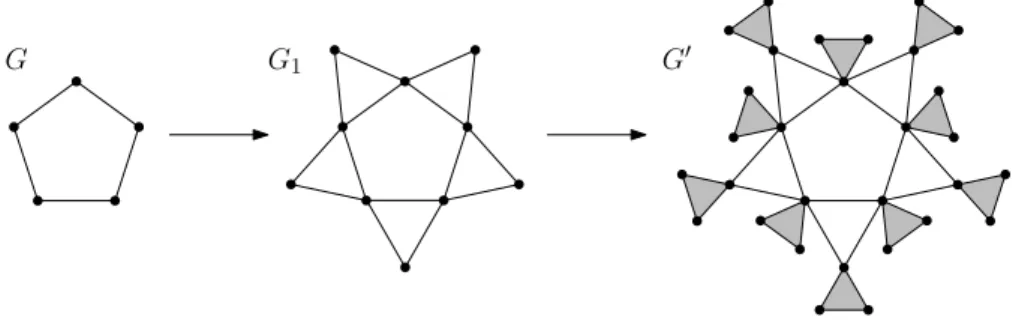
(G) and both G and G are well-covered. ByTheorem 2.1, this is equivalent to: G is a localizable co-well-covered graph.Conjecture 2implies that G is localizable, and byTheorem 2.1, G is semi-perfect. Thus,Fig. 1. An example of the transformation G→G′
. The simplicial cliques of G′
(which partition V (G′
)) are shaded gray.
In what follows, we disproveConjecture 1in two different ways. First, we give an infinite family of counterexamples showing that even the following conjecture, which would be a consequence ofConjectures 1and2, fails.
Conjecture 3. Let G be a localizable co-well-covered graph. Then G has a strong clique.
In the proof of the following theorem, we will use the notion of simplicial cliques. A clique C in a graph G is said to be simplicial if there exists a vertex
v ∈
V (G) such that C=
N[
v]
, the closed neighborhood ofv
. Observe that every simplicial clique is strong.Theorem 3.2. Conjecture 3is false. Consequently,Conjectures 1and2are false.
Proof. Let C be an odd cycle of length at least 5, and let G be the corona of C , that is, the graph obtained from C by adding to it
|
V (C )|
new vertices, each adjacent to a different vertex of cycle (and there are no other edges in G). Each of the|
V (C )|
sets N[
v]
, wherev ∈
V (G)\
V (C ), is a simplicial (hence strong) clique in G. These cliques are pairwise disjoint and their union is V (G). Therefore, G is localizable. Since every maximal clique of G has size 2, we infer that G is co-well-covered. We claim that G does not have any strong clique, which is equivalent to stating that G does not have any strong independent set. This is true since any strong independent set in G would have to contain a vertex from each of the edges of C (as these edges are all maximal cliques in G); however, as C is not bipartite, no independent set of C hits all edges of C . □Second, we give a ‘computational complexity’ disproof ofConjecture 1, by showing that not only there are localizable co-well-covered graphs whose complement is not localizable, but that it is NP-hard to determine if the complement of a given localizable co-well-covered graph is localizable.
Theorem 3.3. Given a localizable co-well-covered graph G, it is NP-hard to determine if G is localizable.
Proof. We make a reduction from the 3-Colorability problem in triangle-free graphs, which is NP-hard [37]. Given a triangle-free graph G, we will construct from G a localizable co-well-covered graph G′such that G is 3-colorable if and only if G′is localizable.
The graph G′
is obtained from G in two steps. First, every edge of G is extended into a triangle with a unique new vertex; let G1be the resulting graph. Second, to every vertex
v
of G1two new vertices are added, sayv
′andv
′′, which are adjacentto each other and to
v
. Then, G′is the so obtained graph. An example of the reduction is shown inFig. 1.
Since there is a set of
|
V (G1)|
simplicial cliques partitioning V (G′), the graph G′is localizable. Since G is triangle-free, everymaximal clique of G′
is of size 3, therefore G′
is co-well-covered. To complete the proof, we show that G is 3-colorable if and only if the complement of G′is localizable. Suppose that G is 3-colorable, and let c be a 3-coloring of G. Extend c to a 3-coloring c′
of G′
. The color classes of c′
define a partition of V (G′
) into three independent sets, equivalently, a partition of the vertex set of the complement of G′
into three cliques, say C1
,
C2,
C3. Since all maximal cliques of G′are of size 3, every color classcontains a vertex of each maximal clique of G, which means that each Ciis a strong clique in the complement of G′. Therefore the complement of G′
is localizable. Conversely, since
α
(G′)=
ω
(G′)
=
3, if the complement of G′is localizable, then it has a partition of its vertex into 3 strong cliques, and therefore G′
is 3-colorable. But then so is G, as an induced subgraph of G′
. □
It follows from the proof ofTheorem 3.3that if G is any triangle-free graph of chromatic number at least 4, then the graph G′
obtained from G as in the above proof (cf.Fig. 1) is a localizable co-well-covered graph with a non-localizable complement. There are many known constructions of triangle-free graphs of high chromatic number, see, e.g., [1,48,66].
We would also like to point out that in [64] Zaare-Nahandi claimed that the problem of determining if a given semi-perfect graph is well-covered is a polynomially solvable task. However, a polynomial-time recognition algorithm for testing if a given semi-perfect graph is well-covered would imply P = NP. This follows from the fact that the recognition problem of well-covered weakly chordal graphs is co-NP-complete and that every weakly chordal graph is semi-perfect.1
4. Characterizations
The fact the problem of recognizing localizable graphs is NP-hard motivates the question of identifying graph classes where the property of localizability can be tested efficiently. In this section, we characterize localizable graphs within the classes of triangle-free graphs, C4-free graphs, and line graphs. Our characterizations imply polynomial-time recognition
algorithms of localizable graphs within each of these classes. 4.1. Overview
First, we summarize known results from the literature leading immediately to characterizations of localizable graphs in various graph classes, some of which lead to polynomial-time recognition algorithms. For the definitions of graph classes mentioned below and further background, we refer to [8,25].
ByCorollary 2.5, a semi-perfect graph is localizable if and only if it is well covered. Therefore, any result characterizing well-covered graphs within a class of semi-perfect graphs immediately implies the same characterization of localizable graphs within the class. This yields characterizations of localizable graphs within the classes of bipartite graphs [54], or, more generally, of triangle-free semi-perfect graphs [18]. Moreover, the class of localizable graphs can be recognized in polynomial time in any class of semi-perfect graphs for which the well-coveredness property can be tested in polynomial time. Examples of classes of perfect graphs for which the well-coveredness (and thus localizability) property can be tested in polynomial time include perfect graphs of bounded degree [12] and claw-free perfect graphs [59,60]. Chordal well-covered (equivalently: chordal localizable) graphs were characterized by Prisner et al. [52], as follows. Prisner et al. showed that a chordal graph is well-covered if and only if each vertex is in a unique simplicial clique. (Recall that a clique is simplicial if it consists of a vertex and all its neighbors.) They also proved that the same condition characterizes well-covered graphs among simplicial ones, that is, among graphs in which every vertex is in a simplicial clique. Since each simplicial clique is strong, this property implies localizability, and therefore localizable simplicial graphs can also be recognized in polynomial time. The characterization of well-covered chordal graphs due to Prisner et al. was further generalized by Dean and Zito, who showed in [18, Theorem 4.2] that a C4-free semi-perfect graph G is well-covered if and only if every minimum clique
coverCof G is a partition of the vertex set and every clique ofCcontains a simplicial vertex. It is not difficult to see that this condition is equivalent to the condition that each vertex is in a unique simplicial clique.
ByTheorem 2.1, a graph is localizable if and only if its independent domination and clique cover numbers coincide. Therefore, the class of localizable graphs can be recognized in polynomial time in any class of graphs for which these two parameters are polynomially computable. Examples of such graph classes include the class of circular-arc graphs [14,36], graphs of bounded clique-width [17,49,53], and, using the fact that the clique cover number is polynomially computable in the class of perfect graphs [27], any class of perfect graphs for which the independent domination problem is polynomially solvable, for instance distance-hereditary graphs [15] (which are of clique-width at most 3 [26]) and cocomparability graphs [39]. Note also that well-coveredness (equivalently: localizability) of cocomparability graphs is equivalent to a known (and polynomially verifiable) property of a derived partially ordered set. For a graph G, let us denote byPGthe set of all partial orders (posets) with ground set V (G) in which two distinct elements are incomparable if and only if they are adjacent in G.
1Let us explain what we believe was the error in the arguments from [64] leading the author to conclude that the problem of determining if a given
semi-perfect graph is well-covered is a polynomially solvable task. The author assumes that a semi-perfect graph G is given together with anα-clique cover
Q1, . . . ,Qkwhere k=α(G), denotes by N(Qi) the set of vertices that are either in Qior have a neighbor in Qiand writes:
‘‘. . .Therefore, checking well-coveredness of the graph G is equivalent to checking that, for each i, 1≤i≤k, the set of vertices of Qiis part of a minimal
vertex cover of G. But, this is a simple task: it is enough to check that the set of vertices of Qiis a minimal vertex cover of the subgraph of G induced by N(Qi),
which can be done in polynomial time.’’
Recall that a vertex cover in a graph G is a set S of vertices such that every edge of G has at least one endpoint in S and that a set S⊆V (G) is a (minimal)
vertex cover if and only if V (G)\S is a (maximal) independent set. Thus, a clique Qiis contained in a minimal vertex cover S if and only if Qiis disjoint
from some maximal independent set, which is equivalent to the statement that Qiis not strong. Therefore, the first sentence in the above text is correct,
in the sense that G is not well-covered if and only if some Qiis part of a minimal vertex cover of G (cf.Theorem 2.4). It is also true that the condition
that Qiis a minimal vertex cover of the subgraph of G induced by N(Qi) can be tested in polynomial time. However, this condition is not equivalent to
the condition that Qiis part of a minimal vertex cover of G. This latter condition is equivalent to testing if Qiis disjoint from some maximal independent
set, which, in general, is an NP-complete problem [65], and remains NP-complete for weakly chordal and thus for semi-perfect graphs. This can be seen
by analyzing the NP-hardness proofs of recognizing well-covered graphs due to Sankaranarayana and Stewart [56] and Chvátal and Slater [16]. It is also
not difficult to construct a concrete counterexample to the claimed equivalence between the condition that Qiis a minimal vertex cover of the subgraph
of G induced by N(Qi) and the condition that Qiis part of a minimal vertex cover of G. For example, let G be the graph with vertex set{a,b,c,d,e,f}and
edge set{ab,ac,bc,bd,cd,de,ef}, and consider anα-clique cover Q1,Q2,Q3of G where Q1= {a,b,c}, Q2 = {d,e}, and Q3= {f}. Then, Q2is part of a
minimal vertex cover of G, for example, of{a,b,d,e}, but Q2is not a minimal vertex cover (in fact, not even a vertex cover) of the subgraph of G induced
A graph G is cocomparability if and only ifPG
̸= ∅
. A cocomparability graph G is well-covered if and only if some poset inPG is graded (that is, all its maximal chains are of the same size), if and only if all posets inPGare graded.Finally, let us note that the classification of well-covered cubic graphs due to Campbell et al. [11] implies a classification of localizable cubic graphs. The class of localizable cubic graphs consists of an infinite family of planar cubic graphs along with three small graphs (K4, K3,3, and the complement of C6).
We summarize the above observations in the following theorem.
Theorem 4.1. The problem of recognizing localizable graphs is polynomially solvable within each of the following graph classes: cubic graphs, C4-free semi-perfect graphs, cocomparability graphs, perfect graphs of bounded degree, claw-free perfect graphs,
simplicial graphs, and graphs of bounded clique-width.
The results obtained in the rest of this section allow to update the above list by replacing the class of C4-free semi-perfect
graphs with the larger class of C4-free graphs and adding to the list the classes of triangle-free graphs and line graphs.
4.2. Triangle-free graphs and C4-free graphs
Let G be a triangle-free graph without isolated vertices. Since G is triangle-free and without isolated vertices, G is localizable if and only if G has a partition of its vertex set into strong cliques of size two.
Proposition 4.2. For a triangle-free graph G without isolated vertices, the following properties are equivalent: 1. G is localizable.
2. G has a perfect matching every edge of which is a strong clique.
3. G has a perfect matching, and every edge of every perfect matching in G is a strong clique. Proof. Since G is triangle-free and without isolated vertices, every strong clique is of size two.
Implications 3
⇒
2⇒
1 hold for all graphs. The first one is trivial and the second one follows directly from the definition of localizability. Suppose now that G is localizable. ByTheorem 2.1, G has anα
-clique cover and every clique in everyα
-clique cover of G is strong. LetC= {
C1, . . . ,
Cα(G)}
be anα
-clique cover of G. Since every clique Ciis strong, every Ciis of size two, that is,Cis a perfect matching in G; moreover,α
(G)= |
C| = |
V (G)|
/
2. Conversely, if M is a perfect matching in G, then M is anα
-clique cover of G, therefore, since every clique in everyα
-clique cover is strong, every edge of M is a strong clique. □Proposition 4.2andCorollary 2.5imply the characterization of well-covered graphs within the class of triangle-free semi-perfect graphs by Dean and Zito [18, Theorem 4.3]. From the algorithmic point of view,Proposition 4.2implies that there is a polynomial-time algorithm to test if a given triangle-free graph is localizable: After the removal of isolated vertices, one can use Edmonds’ algorithm [20] to test if the graph has a perfect matching, and if a perfect matching is found, each of its edges is tested for being a strong clique. It is not difficult to see that an edge
{
u, v}
in a triangle-free graph G is a strong clique if and only if every vertex of N(u) is adjacent to every vertex of N(v
).Remark 4.3. The two equivalent properties characterizing localizability in the class of triangle-free graphs without isolated vertices appeared in the literature in various contexts. For example, as shown independently by Staples in 1975 [58, Theorem 1.11] and by Favaron in 1982 [21], the two properties exactly characterize the class of very well-covered graphs. (A graph G is said to be very well-covered if it has no isolated vertices and every maximal independent set is of size
|
V (G)|
/
2). Clearly, if a graph G has a perfect matching every edge of which is a strong clique, then V (G) can be partitioned into strong cliques, and thus G is localizable. It follows that every very well-covered graph is localizable. Condition 2 was also studied in the context of commutative algebra by Benedetti and Varbaro [2].We now turn to a characterization of C4-free localizable graphs. First, we characterize strong cliques in a C4-free graph. Lemma 4.4. A clique in a C4-free graph is strong if and only if it is simplicial.
Proof. Recall that every simplicial clique is strong. For the converse direction, let C be a strong clique in a C4-free graph G.
Suppose for a contradiction that C is not simplicial. Then, every vertex of C has a neighbor in V (G)
\
C , that is, N(C ) dominates C . Let I be any minimal set of vertices in N(C ) that dominates C . We claim that I is an independent set in G. Suppose that there exists a pair x,
y of adjacent vertices in I. The C4-freeness of G implies that the neighborhoods of x and y in C are comparable,that is, N(x)
∩
C⊆
N(y)∩
C or N(y)∩
C⊆
N(x)∩
C . But then, assuming (w.l.o.g.) N(x)∩
C⊆
N(y)∩
C , we could remove x from I to obtain a subset of N(C ) that dominates C properly contained in I, contradicting the minimality of I. This shows that I is independent, as claimed. Extending I to an arbitrary maximal independent set of G yields a maximal independent set disjoint from C , contradicting the fact that C is a strong clique. The obtained contradiction completes the proof that C is simplicial. □Theorem 4.5. A C4-free graph G is localizable if and only if each vertex of G is in a unique simplicial clique.
Proof. ByLemma 4.4, G is localizable if and only if its vertex set can be partitioned into simplicial cliques. This condition is clearly satisfied if each vertex is in a unique simplicial clique.
Suppose now that V (G) partitions into simplicial cliques C1
, . . . ,
Ck. It suffices to show that for everyv ∈
Ci, clique Ci is the only simplicial clique containingv
. This is clear ifv
is a simplicial vertex (in this case Ciis the only maximal clique containingv
). Suppose now thatv
is not a simplicial vertex and that C′is a simplicial clique containing
v
such that C′̸=
Ci. Letv
′∈
C′
be a vertex such that N
[
v
′] =
C′. Consider the simplicial clique Cjsuch that
v
′∈
Cj. We have j̸=
i, since otherwise we would have Ci⊆
N[
v
′] =
C′, contrary to the fact that Ciand C′are distinct maximal cliques. Since Cjis a maximal clique, vertexv
has a non-neighbor in Cj, sayv
′′. But now, verticesv
andv
′′form a pair of non-adjacent neighbors ofv
′, contrary to the fact that the neighborhood ofv
′is a clique. This shows that Ciis the only simplicial clique containing
v
and completes the proof. □Since the set of simplicial cliques in a graph can be computed in polynomial time,Theorem 4.5implies the existence of a polynomial-time algorithm to determine if a given C4-free graph is localizable. Moreover, since within the class of
semi-perfect graphs, localizable graphs coincide with well-covered ones,Theorem 4.5generalizes the characterizations of well-covered graphs within the classes of chordal and of C4-free semi-perfect graphs due to Prisner et al. [52] and Dean and
Zito [18], respectively.
To put the results ofProposition 4.2andTheorem 4.5in perspective, recall that no characterizations of well-covered triangle-free or C4-free graphs are known.
4.3. Line graphs
Consider a graph H
=
(VH,
EH) and let L(H) be the graph constructed as follows: we associate a vertex with each edge in EHand two vertices are adjacent if and only if the corresponding edges in H share an endpoint. A graph G is said to be a line graph if G=
L(H) for some graph H. In this section we characterize localizable line graphs. The characterization implies the existence of a polynomial-time algorithm to determine whether a given line graph is localizable.Recall that the line graph of a graph H is well-covered if and only if H is equimatchable, that is, if all maximal matchings of G are of the same size. The question of characterizing equimatchable graphs was posed by Grünbaum in 1974 [28]; in the same year, equimatchable graphs were studied and characterized by Lewin [42] and shown to be polynomially recognizable by Lesk et al. [41]. Since every localizable graph is well-covered, every graph the line graph of which is localizable is equimatchable. Moreover, since the line graphs of bipartite graphs are perfect (see, e.g., [57]) and hence semi-perfect,
Corollary 2.5implies that the line graph of a bipartite graph H is localizable if and only if it is well-covered; equivalently, if H is equimatchable. Lesk et al. [41] characterized equimatchable bipartite graphs as follows.
Theorem 4.6 (Lesk et al. [41]). A connected bipartite graph H with a bipartition of its vertex set into two independent sets V (H)
=
U∪
W with|
U| ≤ |
W|
is equimatchable if and only if for all u∈
U , there exists a non-empty set X⊆
N(u) such that|
N(X )| ≤ |
X|
.Given a graph H, we say that a vertex
v ∈
V (H) is strong if every maximal matching of H coversv
. The above characterization has the following consequence.Lemma 4.7. A connected bipartite graph H is equimatchable if and only if it has a bipartition of its vertex set into two independent sets V (H)
=
U∪
W such that all vertices of U are strong.Proof. First, we show that a vertex u
∈
V (H) in a bipartite graph H is strong if and only if there exists a non-empty set X⊆
N(u) such that|
N(X )| ≤ |
X|
. This is equivalent to showing that u is not strong if and only if|
N(X )|
> |
X|
for all non-empty sets X⊆
N(u), which is further equivalent to the condition that|
NH−u(X )| ≥ |
X|
for all non-empty sets X⊆
NH(u). By Hall’s Theorem [29], this is equivalent to the existence of a matching M in the graph H−
u such that every vertex of NH(u) is incident with an edge in M. This is in turn equivalent to the condition that H contains a maximal matching not covering u, that is, that u is not strong in H, as claimed.Let H be a connected bipartite graph. Suppose first that H is equimatchable and fix a bipartition of its vertex set into two independent sets V (H)
=
U∪
W with|
U| ≤ |
W|
.Theorem 4.6implies that for all u∈
U, there exists a non-empty set X⊆
N(u) such that|
N(X )| ≤ |
X|
. By the above equivalence, all vertices in U are strong. Conversely, suppose that H is a connected bipartite graph with a bipartition of its vertex set into two independent sets V (H)=
U∪
W such that all vertices of U are strong. By the above equivalence, for all u∈
U, there exists a non-empty set X⊆
N(u) such that|
N(X )| ≤ |
X|
. Let M be a maximal matching of H. By assumption on U, every vertex of U is incident with an edge of M. This implies that|
U| = |
M| ≤ |
W|
. Thus, byTheorem 4.6, H is equimatchable. □As pointed out above, the line graph of every equimatchable bipartite graph is localizable. In what follows, we will show that graphs the line graphs of which is localizable do not differ too much from equimatchable bipartite graphs. To describe the result, we need a couple of definitions.
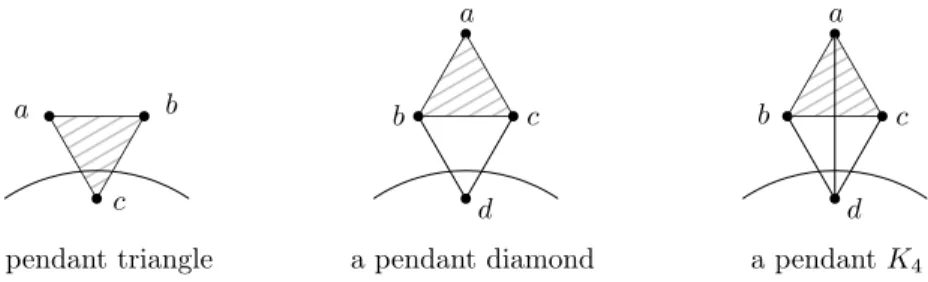
Fig. 2. The three types of pendant subgraphs. The shaded triangles represent a pendant triangle, a triangle contained in a pendant diamond, and a triangle
contained in a pendant K4, respectively.
Definition 4.8. The diamond is the graph with vertices a
,
b,
c,
d and edges ab,
ac,
bc,
bd,
cd; the vertices a and d are its tips. Let T be a triangle in a graph H and let a,
b,
c be the vertices of T . We say that T is:•
a pendant triangle of H if dH(a)=
dH(b)=
2<
dH(c),•
contained in a pendant diamond if H has a subgraph with vertices a,
b,
c,
d inducing a diamond with tips a and d such that dH(a)=
2 and dH(b)=
dH(c)=
3≤
dH(d), and•
contained in a pendant K4if H has a subgraph with vertices a,
b,
c,
d inducing a K4such that dH(a)=
dH(b)=
dH(c)=
3<
dH(d).Any diamonds and K4s as above will be referred to as pendant diamonds and pendant K4s (of H), respectively. Pendant
triangles, pendant diamonds, and pendant K4s of H will be referred to briefly as its pendant subgraphs; seeFig. 2. Note that
if a graph H has a pendant subgraph, then H is not isomorphic to any graph in the set {K3, K4, diamond}. Moreover, every
pendant subgraph of H has a unique root, that is, a vertex connecting it to the rest of the graph. We denote by R△(H), R (H), and R (H) the sets of roots of all pendant triangles, pendant diamonds, and pendant K4s of H, respectively. The pendant
reduction of H is the graph obtained from H by deleting from H all non-root vertices of its pendant subgraphs. The characterization of localizable line graphs is given by the following theorem.
Theorem 4.9. Let H be a connected graph and let G
=
L(H). Then, G is localizable if and only if one of the following holds: 1. H is not isomorphic to any graph in the set { K3, K4, diamond} and its pendant reduction F is a connected bipartite graphwith a bipartition of its vertex set into two independent sets U and W such that (a) R (H)
∪
R (H)⊆
U,(b) R△(H)
⊆
W , and(c) each vertex u
∈
U\
R (H) is strong in the graph F−
(NF(u)∩
R△(H)). 2. H is isomorphic to either K3or K4.Before provingTheorem 4.9, let us note two of its consequences.
Corollary 4.10. Let H be a connected triangle-free graph and let G
=
L(H). Then, G is localizable if and only if H is an equimatchable bipartite graph.Proof. If H is triangle-free, then its pendant reduction equals H and R (H)
=
R (H)=
R△(H)= ∅
. Thus, the statement of the corollary is an immediate consequence ofTheorem 4.9andLemma 4.7. □Corollary 4.11. There exists a polynomial-time algorithm for the problem of determining if a given line graph is localizable. Proof. Let G be a line graph. Since a graph H such that G
=
L(H) can be computed in linear time [40,55], we may assume that we know H. Moreover, since G is localizable if and only if each component of G is localizable, we may assume that G (and therefore H) is connected. We may also assume that H is not isomorphic to any graph in the set {K3, K4, diamond}.We applyTheorem 4.9. We compute the pendant subgraphs of H, the sets R△(H), R (H), and R (H) of their roots, and the pendant reduction F of H. If F is not connected and bipartite, then since H is not isomorphic to K3or K4, byTheorem 4.9it
follows that G is not localizable. Hence we may assume that F is a connected bipartite graph, with parts U and W . Under these assumptions, to verify whether L(H) is localizable we only need to verify whether there exists a part of the bipartition of F , say U, satisfying the following conditions:
(a) R (H)
∪
R (H)⊆
U. (b) R△(H)∩
U= ∅
, andAll the above computations as well as the verification of conditions (a) and (b) can be carried out in linear time. It only remains to justify that conditions (c) can be tested in polynomial time. Note that a vertex u
∈
U\
R (H) is not strong in the graph F′=
F−
(NF(u)∩
R△(H)) if and only if F ′has a matching M such that every neighbor of u is incident with an edge of M. The existence of such a matching can be determined by a maximum matching computation in the (bipartite) subgraph of F′induced by the vertices of distance 1 or 2 from u. Thus, condition (c) can be verified in polynomial time by carrying out O(
|
U|
) bipartite matching computations, which is well-known to be polynomially solvable (see, e.g., [35]). □In the rest of this section, we proveTheorem 4.9. This will be done through a sequence of lemmas. Our first lemma gives a translation of the property that G
=
L(H) is localizable to the graph H. Recall that a vertexv ∈
V (H) is said to be strong if every maximal matching of H coversv
. We say that a triangle T in a graph H is strong if every maximal matching of H contains an edge of T . A decomposition of a graph H is a setFof subgraphs of H such that each edge of H appears in exactly one subgraph fromF(we also say thatFdecomposes H).Lemma 4.12. Let G
=
L(H). Then, G is localizable if and only if H contains an independent set S of strong vertices and a setT of strong triangles decomposing H−
S.Proof. Consider a graph H and suppose that its line graph, G
=
L(H), is localizable. Thus, the vertices of G can be partitioned into k=
α
(G) strong cliques C1, . . . ,
Ck. Note that every strong clique is maximal. Each maximal clique of G corresponds to either a triangle in H or to a star of H, that is, to a set of edges of the form E(v
)= {
e∈
E(H):
v
is an endpoint of e}
for somev ∈
V (H) (in which case we say that E(v
) is the star centered atv
). Suppose that the cliques C1, . . . ,
Ck′correspond to triangles T1, . . . ,
Tk′in H, and the cliques Ck′+1, . . . ,
Ckcorrespond to stars Sk′+1, . . . ,
Skof H, respectively. Since C1, . . . ,
Ck is a partition of V (G), and G=
L(H), it follows that the triangles T1, . . . ,
Tk′and stars Sk′+1, . . . ,
Skform a partition of the edge set of H. Let i and j be two distinct elements of{
k′+
1
, . . . ,
k}
and letv
i, v
jbe the centers of Siand Sj, respectively,that is, Si
=
E(v
i) and Sj=
E(v
j). Since Siand Sjare disjoint, it follows thatv
iandv
jare non-adjacent. It follows that the centers of the stars Sk′+1, . . . ,
Skform an independent set of H, say S. Since for each i∈ {
1, . . . ,
k′}
and j∈ {
k′+
1, . . . ,
k}
, triangle Tiis disjoint from star Sj=
E(v
j), the definition of E(v
j) implies thatv
jis not a vertex of Ti. This shows that for each i∈ {
1, . . . ,
k′}
, triangle Tiis a subgraph of H
−
S. Since{
T1, . . . ,
Tk′,
Sk′+1, . . . ,
Sk}
is a partition of the edge set of H, each edge of H−
S belongs to a unique triangle Ti. It follows that the triangles T1, . . . ,
Tk′are subgraphs of H−
S decomposing H−
S. Since every maximal independent set of G intersects every strong clique C1, . . . ,
Ck, we deduce that every maximal matching in H intersects every triangle Tiand every star Sjfor i=
1, . . . ,
k′and j=
k′+
1, . . . ,
k, that is, each triangle Tiis strong and each vertex in S is strong.Conversely, suppose that H contains an independent set S of strong vertices and a setT of strong triangles decomposing H
−
S. Every triangle inT corresponds to a clique in G=
L(H) and every star with center s∈
S also corresponds to a clique in G. This clearly gives us a partition of the vertex set of G into cliques C1, . . . ,
Ck. Furthermore, since every maximal matching in H covers S and contains an edge from each triangle inT, it follows that every maximal independent set of G intersects every maximal clique C1, . . . ,
Ck, and thus each of these cliques is strong. We conclude that G is localizable. □Given a graph H such that L(H) is localizable, a pair (S
,
T) such that S is an independent set of strong vertices in H andTis a set of strong triangles decomposing H
−
S will be referred to as a line-localizability certifier of H.The next lemma characterizes strong triangles of a graph H. A bull is a graph with vertices a
,
b,
c,
d,
e and edges ab,
bc,
cd,
be,
ce. A triangle T in a graph H is said to be contained in a bull if there exists a subgraph of H isomorphic to a bull that contains T as a subgraph.Lemma 4.13. For every triangle T in a connected graph H of order at least 4, the following conditions are equivalent: 1. T is strong in H.
2. T is not contained in any bull.
3. T is either a pendant triangle, or is contained in a pendant diamond or in a pendant K4.
Proof. Let T be a triangle in H. Clearly, T is not strong if and only if there exists a matching M in H not containing any edge of T and covering at least two vertices of T . A minimal matching with such properties consists of two edges, each of which is incident with a vertex of T , and hence forms a bull together with T . Therefore, T is not strong if and only if T is contained in a bull.
If T is either a pendant triangle, or is contained in a pendant diamond or in a pendant K4, then T is not contained in any
bull. Conversely, suppose that T is not contained in any bull, and let U be the set of vertices in T with a neighbor outside T . Since H is connected and of order at least 4 it follows that
|
U| ≥
1. If|
U| =
1 then T is a pendant triangle. If|
U| =
2 then, since T is not contained in any bull, there is a unique vertex outside T with a neighbor in T , and hence T is contained in a pendant diamond. Similarly, if|
U| =
3 then T is contained in a pendant K4. This establishes the equivalence of the last twoThe next lemma shows that with the exception of two small cases, the strong triangles in H are pairwise edge-disjoint. Lemma 4.14. Let H be a connected graph that is not isomorphic to either K4or to the diamond. Then, any two strong triangles in
H are edge-disjoint.
Proof. Let H be a connected graph with a pair T
= {
a,
b,
c}
and T′= {
a,
b,
d}
of strong triangles sharing an edge (namely, ab). ByLemma 4.13, each of T and T′is either a pendant triangle, or is contained in a pendant diamond or in a pendant K4. Sinceeach of T and T′has at most one vertex of degree 2, none of them can be a pendant triangle. Suppose first that one of them, say T , is contained in a pendant diamond. Then the vertex set of this diamond is exactly
{
a,
b,
c,
d}
, and the only remaining possibility for T′is that it is also contained in a pendant diamond. Since H is connected, we infer that H is isomorphic to a diamond in this case. If T is contained in a pendant K4, then, similarly, the vertex set of this K4is exactly
{
a,
b,
c,
d}
, and theonly remaining possibility for T′
is that it is also contained in a pendant K4, hence H
∼
=
K4in this case. □Let H be a connected graph that is not isomorphic to any graph in the set {K3, K4, diamond}. Recall that the pendant
reduction of H is the graph obtained from H by deleting from H all non-root vertices of its pendant subgraphs. The next lemma establishes some necessary conditions for L(H) to be localizable.
Lemma 4.15. Let H be a connected graph not isomorphic to any graph in the set { K3, K4, diamond} such that L(H) is localizable
and let (S
,
T) be a line-localizability certifier of H. Then: 1. T is the set of all strong triangles of H.2. R△(H)
∩
S= ∅
. 3. R (H)∪
R (H)⊆
S.4. The pendant reduction F of H is a connected bipartite graph with a bipartition of its vertex set
{
S,
V (F )\
S}
.Proof. Let H, S, andT be as in the statement of the lemma. LetT△denote the set of pendant triangles of H, and letT and
T denote the sets of triangles of H contained in a pendant diamond or in a pendant K4, respectively. ByLemma 4.13, each
strong triangle of H belongs to one (and then to exactly one) of the setsT△,T , andT . Moreover, byLemma 4.14, any two triangles inT△
∪
T∪
T are pairwise edge-disjoint.ByLemma 4.13, in order to show statement 1, we need to show thatT
=
T△∪
T∪
T . Since every triangle inT is strong, we haveT⊆
T△∪
T∪
T . We prove the converse inclusionT△∪
T∪
T⊆
T in three steps. Along the way we will also prove statements 2 and 3 above.First, let T
= {
a,
b,
c} ∈
T△be a pendant triangle with root c. Note that none of the vertices a and b is strong. Therefore,{
a,
b} ∩
S= ∅
and consequently there is a strong triangle T′∈
T such that{
a,
b} ⊆
T′. Since T is the only triangle of H containing the edge ab, we infer that T′
=
T and hence T∈
T. This shows thatT△⊆
T. Moreover, since T∈
T, we have T∩
S= ∅
and consequently c̸∈
S. This shows statement 2, that is, that no root of a pendant triangle is in S.Second, let T
= {
a,
b,
c} ∈
T be a triangle contained in a pendant diamond with root d such that dH(a)=
2, dH(b)=
dH(c)=
3. Since vertex a is not strong, we have a̸∈
S. Since S is independent, one of b and c, say b, does not belong to S. It follows that the edge ab is contained in some triangle T′∈
T. Again, since T is the only triangle containing the edge ab, we infer that T′=
T and hence T∈
T. This shows thatT⊆
T. ByLemma 4.14, the strong triangles of H are pairwise edge-disjoint, therefore the triangle{
b,
c,
d}
is not strong. It follows that d∈
S since otherwise the edge bd would be an edge of H−
S not covered by any triangle inT.Now, let T
= {
a,
b,
c} ∈
T be a triangle contained in a pendant K4 with root d and dH(a)=
dH(b)=
dH(c)=
3. Suppose for a contradiction that T̸∈
T. Since S is independent, it contains at most one vertex of T . We may thus assume that{
a,
b} ∩
S= ∅
. Let T′be the triangle inTcovering the edge ab. Since T
̸∈
T, we infer that T′̸=
T and therefore T′
= {
a,
b,
d}
. Since the strong triangles of H are pairwise edge-disjoint and T is a strong triangle sharing the edge ab with T′, we infer that T′
is not strong, contrary to the fact that T′
∈
T. This shows thatT
⊆
T. Similarly as above, using the fact that the strong triangles of H are pairwise edge-disjoint, we infer that in order to cover the edge ad, we must have d∈
S. The above two paragraphs show statement 3, that is, that the root of every pendant diamond or K4is in S.Finally, we show statement 4. Let F be the pendant reduction of H. Since H is connected and F differs from H only by non-root vertices of its pendant subgraphs, we infer that F is connected. SinceT is the set of all strong triangles of H and T
∩
S= ∅
for all T∈
T, it follows that S⊆
V (F ); in particular, S is an independent set of F . It thus suffices to show that the set V (F )\
S is independent. We have V (F )=
Z∪
R△(H), where Z is the set of vertices of H not contained in any strong triangle. Suppose for a contradiction that there is an edge uv ∈
E(H) connecting two vertices of V (F )\
S. Then uv
is an edge of the graph H−
S. If{
u, v} ∩
Z̸= ∅
, then uv
would be an edge of H−
S not contained in any triangle inT, contrary to the assumption onT. Thus, we have{
u, v} ⊆
R△, therefore u andv
are adjacent roots of two pendant triangles. Since uv
is an edge of H−
S, it is contained in some triangle T∈
T, which is clearly impossible due to the characterization of strong triangles given byLemma 4.13. This contradiction proves statement 4. □Now we have everything ready to prove the announced characterization of localizable line graphs, which we restate here for convenience.
Theorem 4.9 (Restated). Let H be a connected graph and let G
=
L(H). Then, G is localizable if and only if one the following holds: 1. H is not isomorphic to any graph in the set { K3, K4, diamond} and its pendant reduction F is a connected bipartite graphwith a bipartition of its vertex set into two independent sets U and W such that (a) R (H)
∪
R (H)⊆
U ,(b) R△(H)
⊆
W , and(c) each vertex u
∈
U\
R (H) is strong in the graph F−
(NF(u)∩
R△(H)). 2. H is isomorphic to either K3or K4.Proof. Suppose first that G
=
L(H) is localizable, and let (S,
T) be a line-localizability certifier of H. Suppose that H is not isomorphic to any of K3or K4. Since the line graph of the diamond is not localizable, H is also not isomorphic to thediamond. Let F be the pendant reduction of H. By construction, we have R△(H)
∪
R (H)∪
R (H)⊆
V (F ). ByLemma 4.15, F is a connected bipartite graph with a bipartition of its vertex set{
S,
V (F )\
S}
. The same lemma implies that R (H)∪
R (H)⊆
S and R△(H)⊆
V (F )\
S. Thus, letting W′
=
NF(u)∩
R△(H) and F ′=
F−
W′, we only need to show that each vertex u∈
S\
R (H) is strong in graph F′, and the desired conclusion will follow by taking U
=
S and W=
V (F )\
S. Suppose for a contradiction that there exists a vertex u∈
S\
R (H) that is not strong in graph F′. Then there exists a maximal matching M′
of F′
such that u is not incident with any edge of M′
. Since u
∈
S, vertex u is strong in H, that is, every maximal matching of H covers u. However, we will now show that M′is contained in a maximal matching of H not covering u. Since u
∈
S and R△(H)⊆
V (F )\
S, vertex u is not the root of any pendant triangle of H. Moreover, since u̸∈
R (H), it is also not the root of any pendant K4. LetDbe the (possibly empty) set of pendant diamonds in H having u as the root. For eachpendant diamond D
∈
D, let eDbe the edge of D completing a triangle with u. For each vertexw ∈
W′, letTw= {
T1, . . . ,
Tk}
be the set of pendant triangles of H with rootw
, let Ti= {
w,
ai,
bi}
, and let Mw= {
w
a1} ∪ {
aibi:
2≤
i≤
k}
. Note that Mwis a matching in H. Let M=
M′∪ {
eD:
D∈
D} ∪
⋃
w∈W ′ Mw.
Then, M is a matching in H covering all neighbors of u. Therefore, M′
is contained in a maximal matching of H not covering u, contradicting the fact that u is strong in H. This completes the proof of the forward direction.
For the converse direction, suppose that one of conditions 1 and 2 in the statement of the theorem holds. If H is isomorphic to one of K3and K4, then its line graph is localizable. Suppose now that condition 1 holds, that is, H is not isomorphic to any
graph in the set {K3, K4, diamond} and its pendant reduction F is a connected bipartite graph with a bipartition of its vertex
set into two independent sets U and W such that conditions (a)–(c) hold. LetT be the set of all strong triangles of H. We will show that the pair (U
,
T) is a line-localizability certifier of H, which will imply that G is localizable byLemma 4.12. In other words, we need to show that U is an independent set of strong vertices in H and thatTis a set of strong triangles decomposing H−
U. ByLemma 4.13,T equals the set containing all pendant triangles, all triangles contained in a pendant diamond, and all triangles contained in a pendant K4. Note that byLemma 4.14, any two strong triangles in H are edge-disjoint. Therefore,the fact that F is bipartite and properties (a) and (b) imply thatTdecomposes H
−
U. Clearly, U is an independent set in H. It therefore remains to show that every vertex u∈
U is strong in H. Suppose for a contradiction that some u∈
U is not strong in H. Then, there exists a maximal matching M of H not covering u. We consider two cases. Suppose first that u∈
U\
R (H). By property (c), vertex u is strong in the graph F′=
F
−
(NF(u)∩
R△(H)). It follows that matching M′=
M∩
E(F′) covers all vertices in NF(u)\
R△(H), which are exactly the neighbors of u in F′. Extending M′to a maximal matching of F′not covering u shows that u is not strong in F′, a contradiction. Suppose now that u
∈
R (H). Let D be a pendant K4of H with vertex set{
a,
b,
c,
u}
and with root u. Since u is not covered by M, matching M covers at most two of the vertices in{
a,
b,
c}
. Adding to M the edge connecting u with an uncovered vertex in{
a,
b,
c}
results in a matching of H properly containing M, which contradicts the maximality of M. This completes the proof. □5. Concluding remarks
In this paper we have initiated a study of localizable graphs, a rich subclass of well-covered graphs. The two properties coincide in the class of perfect graphs, and more generally in any class of graphs in which the clique cover number equals the independence number. We gave efficiently testable characterizations of localizable graphs within the classes of triangle-free graphs, C4-free graphs, and line graphs. Based on properties of localizable graphs, we disproved a conjecture due to
Zaare-Nahandi about k-partite well-covered graphs having all maximal cliques of size k.
Our work leaves open many questions related to localizable graphs. For example, is it polynomial to check whether a given planar graph is localizable? (The corresponding question for well-covered graphs was asked in 1994 by Dean and Zito [18] and seems to be open.) Testing localizability is polynomial for triangle-free graphs. What is the complexity of the problem for K4-free graphs (and, more generally, for graphs of bounded clique number)? Is it polynomial to check whether
a given comparability graph is localizable? (Equivalently, given a partially ordered set, is it polynomial to test whether all its maximal antichains are of the same size?) It follows fromTheorem 3.3that it is NP-hard to recognize graphs such that both G and its complement are localizable. What is the complexity of recognizing well-covered co-well-covered graphs?