Open Archive Toulouse Archive Ouverte (OATAO)
OATAO is an open access repository that collects the work of Toulouse researchers and makes it freely available over the web where possible.
This is an author-deposited version published in: http://oatao.univ-toulouse.fr/
Eprints ID: 2111
To cite this document: BOUVET C. GOURINAT Y. MEZEIX L. MORLIER J. SHAHDIN A. Static and dynamic testing of glass fiber entangled sandwich beams: a comparison with honeycomb and foam sandwich beams. In: 15th International Conference on Composite Structures (ICCS15),15-17 June 2009, Porto, Portugal, p.1-2.
Any correspondence concerning this service should be sent to the repository administrator: [email protected]
15th International Conference on Composite Structures ICCS 15 A. J. M. Ferreira (Editor) FEUP, Porto, 2009
STATIC AND DYNAMIC TESTING OF GLASS FIBER ENTANGLED
SANDWICH BEAMS: A COMPARISON WITH HONEYCOMB AND
FOAM SANDWICH BEAMS
A. Shahdin*, L.Mezeix†, C. Bouvet§ , J. Morlier*, Y.Gourinat* *
Université de Toulouse, ISAE, 10, Av Edouard Belin, 31055 Toulouse, France. e-mail: [email protected]
†
Université de Toulouse, ENSIACET-CIRIMAT, 118 route de Narbonne, 31077 Toulouse, France,
§
Université de Toulouse, UPS/LGMT, Bat 3PN, 31062 Toulouse Cedex,
Key words: Entangled sandwich materials, Mechanical Testing, Vibration Testing, Damping Summary. The aim of this study is the fabrication and mechanical testing of entangled
sandwich beam specimens and the comparison of their results with standard sandwich specimens with honeycomb and foam as core materials. The entangled sandwich specimens have glass fiber as core and glass woven fabric as skin materials. The tested glass fiber entangled sandwich beams possess low compressive and shear modulus as compared to honeycomb and foam sandwich beams of the same specifications. The vibration tests show that the entangled sandwich beams possess higher damping ratios and low vibratory levels as compared to honeycomb and foam sandwich beams, making them suitable for vibro-acoustic applications where structural strength is of secondary importance.
1 EXPERIMENTAL PROCEDURE
Three types of sandwich beam specimens are fabricated and tested in this article with entangled glass fibers, honeycomb and foam as core materials. The skins for all the sandwich beams used are made of glass woven fabric 20823. The fabrication process of honeycomb and foam sandwich beams is very classical, however that of entangled sandwich beams is a complex process and the one used in this article is explained in detail in reference [1]. Entangled sandwich beams are fabricated having glass fiber length of 10 mm using an aluminum mold. A glass fiber density of 200 kg/m3 is chosen for the entangled sandwich core. The glass fibers are cut with the help of a fiber cutting machine. The fibers are then separated by a blow of compressed air. The mixture of resin and hardener is then sprayed on the separated glass fibers by a spray paint gun. The fibers vaporized by the resin are then placed in the mold between the two skins of impregnated glass woven fabric.
The first part of the experimental work consists of testing the three types of sandwich beams with entangled glass fibers, honeycomb and foam as core materials under compression and 3-point bending in order to calculate their compressive and shear moduli. Results of the compression and bending tests are shown in Figure 1. The compressive and shear moduli are
A.Shahdin, L.Mezeix, C.Bouvet, J.Morlier, Y.Gourinat
2
calculated from the linear-elastic part of the curves shown in zoomed view in Figure 1.
Figure 1: (a) Compession tests (b) 3-point bending tests on entangled (10 mm and 15 mm fiber core length), foam and honeycomb sandwich specimens.
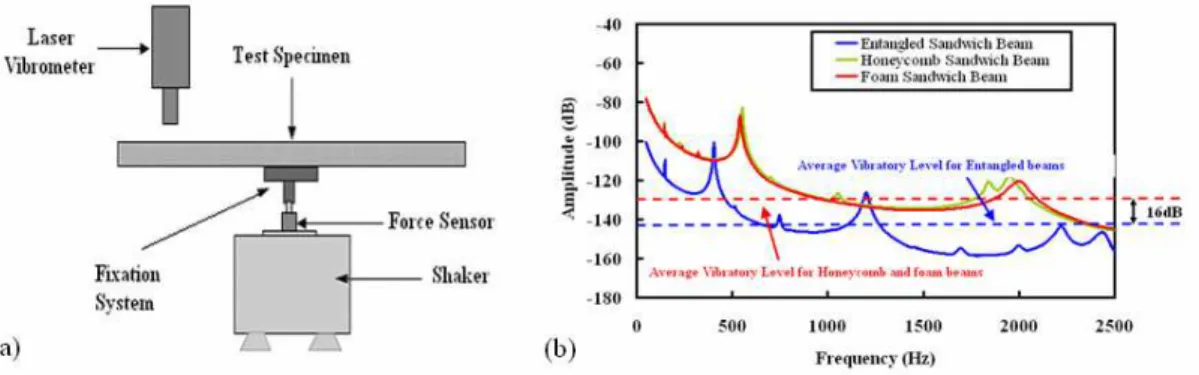
It is clear from the static test results that the standard sandwich specimens with honeycomb and foam as core materials possess better compressive and shear strengths as compared to the entangled sandwich specimens. Vibration tests are based on Oberst method (free-free beam excited at its centre), as shown in Figure 2a.
Figure 2: (a) Experimental Set-up (b) Comparison of the sum of FRFs with indication of vibratory level Despite their lower static strengths, vibration tests verify the presence of high damping in the entangled sandwich specimens making them suitable for specific applications like the inner paneling of a helicopter cabin. Furthermore, the vibration tests showed that entangled sandwich specimens possess on the average 60 % higher damping ratios and 16 dB lower vibratory levels than the honeycomb and foam sandwich specimens (Figure 2b).
REFERENCE
[1] L. Mezeix, C. Bouvet, D. Poquillon. Experimental data and modelling of entangled fibers and entangled cross-linked fibers during compression Accepted January 2009 in journal of material science.