Optimization of p-cycle protection schemes in optical networks
par
Caroline Thennecy de Medeiros Rocha
Département d’informatique et de recherche opérationnelle Faculté des arts et des sciences
Thèse présentée à la Faculté des études supérieures et postdoctorales en vue de l’obtention du grade de Philosophiæ Doctor (Ph.D.)
en informatique
Août, 2009
c
Faculté des études supérieures et postdoctorales
Cette thèse intitulée:
Optimization of p-cycle protection schemes in optical networks
présentée par:
Caroline Thennecy de Medeiros Rocha
a été évaluée par un jury composé des personnes suivantes: Jacques Ferland, président-rapporteur
Brigitte Jaumard, directeur de recherche Michel Gendreau, membre du jury Arie Koster, examinateur externe
Claude Carignan, représentant du doyen de la FESP
La survie des réseaux est un domaine d’étude technique très intéressant ainsi qu’une pré-occupation critique dans la conception des réseaux. Compte tenu du fait que de plus en plus de données sont transportées à travers des réseaux de communication, une simple panne peut interrompre des millions d’utilisateurs et engendrer des millions de dollars de pertes de revenu. Les techniques de protection des réseaux consistent à fournir une ca-pacité supplémentaire dans un réseau et à réacheminer les flux automatiquement autour de la panne en utilisant cette disponibilité de capacité.
Cette thèse porte sur la conception de réseaux optiques intégrant des techniques de survie qui utilisent des schémas de protection basés sur les p-cycles. Plus précisément, les p-cycles de protection par chemin sont exploités dans le contexte de pannes sur les liens. Notre étude se concentre sur la mise en place de structures de protection par p-cycles, et ce, en supposant que les chemins d’opération pour l’ensemble des requêtes sont définis a priori. La majorité des travaux existants utilisent des heuristiques ou des méthodes de résolution ayant de la difficulté à résoudre des instances de grande taille. L’objectif de cette thèse est double. D’une part, nous proposons des modèles et des mé-thodes de résolution capables d’aborder des problèmes de plus grande taille que ceux déjà présentés dans la littérature. D’autre part, grâce aux nouveaux algorithmes, nous sommes en mesure de produire des solutions optimales ou quasi-optimales. Pour ce faire, nous nous appuyons sur la technique de génération de colonnes, celle-ci étant adéquate pour résoudre des problèmes de programmation linéaire de grande taille. Dans ce projet, la génération de colonnes est utilisée comme une façon intelligente d’énumérer implici-tement des cycles prometteurs.
Nous proposons d’abord des formulations pour le problème maître et le problème auxiliaire ainsi qu’un premier algorithme de génération de colonnes pour la concep-tion de réseaux protegées par des p-cycles de la protecconcep-tion par chemin. L’algorithme obtient de meilleures solutions, dans un temps raisonnable, que celles obtenues par les méthodes existantes. Par la suite, une formulation plus compacte est proposée pour le problème auxiliaire. De plus, nous présentons une nouvelle méthode de décomposition
hiérarchique qui apporte une grande amélioration de l’efficacité globale de l’algorithme. En ce qui concerne les solutions en nombres entiers, nous proposons deux méthodes heurisiques qui arrivent à trouver des bonnes solutions.
Nous nous attardons aussi à une comparaison systématique entre les p-cycles et les schémas classiques de protection partagée. Nous effectuons donc une comparaison pré-cise en utilisant des formulations unifiées et basées sur la génération de colonnes pour obtenir des résultats de bonne qualité. Par la suite, nous évaluons empiriquement les versions orientée et non-orientée des p-cycles pour la protection par lien ainsi que pour la protection par chemin, dans des scénarios de trafic asymétrique. Nous montrons quel est le coût de protection additionnel engendré lorsque des systèmes bidirectionnels sont employés dans de tels scénarios.
Finalement, nous étudions une formulation de génération de colonnes pour la concep-tion de réseaux avec des p-cycles en présence d’exigences de disponibilité et nous obte-nons des premières bornes inférieures pour ce problème.
Mots clés : Conception de réseaux, Télécommunications, Protection partagée, Génération de colonnes
Network survivability is a very interesting area of technical study and a critical con-cern in network design. As more and more data are carried over communication net-works, a single outage can disrupt millions of users and result in millions of dollars of lost revenue. Survivability techniques involve providing some redundant capacity within the network and automatically rerouting traffic around the failure using this redundant capacity.
This thesis concerns the design of survivable optical networks using p-cycle based schemes, more particularly, path-protecting p-cycles, in link failure scenarios. Our study focuses on the placement of p-cycle protection structures assuming that the working routes for the set of connection requests are defined a priori. Most existing work carried out on p-cycles concerns heuristic algorithms or methods suffering from critical lack of scalability. Thus, the objective of this thesis is twofold: on the one hand, to propose scalable models and solution methods enabling to approach larger problem instances and on the other hand, to produce optimal or near optimal solutions with mathematically proven optimality gaps. For this, we rely on the column generation technique which is suitable to solve large scale linear programming problems. Here, column generation is used as an intelligent way of implicitly enumerating promising cycles to be part of p-cycle designs.
At first, we propose mathematical formulations for the master and the pricing prob-lems as well as the first column generation algorithm for the design of survivable net-works based on path-protecting p-cycles. The resulting algorithm obtains better solu-tions within reasonable running time in comparison with existing methods. Then, a much more compact formulation of the pricing problem is obtained. In addition, we also propose a new hierarchical decomposition method which greatly improves the efficiency of the whole algorithm and allows us to solve larger problem instances. As for integer solutions, two heuristic approaches are proposed to obtain good solutions.
Next, we dedicate our attention to a systematic comparison of p-cycles and classical shared protection schemes. We perform an accurate comparison by using a unified
col-umn generation framework to find provably good results. Afterwards, our study concerns an empirical evaluation of directed and undirected link- and path-protecting p-cycles un-der asymmetric traffic scenarios. We show how much additional protection cost results from employing bidirectional systems in such scenarios.
Finally, we investigate a column generation formulation for the design of p-cycle net-works under availability requirements and obtain the first lower bounds for the problem. Keywords: Network design, Telecommunications, Shared protection, Column generation.
RÉSUMÉ . . . iii
ABSTRACT . . . v
CONTENTS . . . vii
LIST OF TABLES . . . xi
LIST OF FIGURES . . . xii
DEDICATION . . . xv
ACKNOWLEDGMENTS . . . xvi
CHAPTER 1: INTRODUCTION . . . 1
1.1 Motivation and objective . . . 3
1.2 Thesis organization . . . 4
1.3 Articles produced during the thesis . . . 5
CHAPTER 2: FUNDAMENTALS OF NETWORK SURVIVABILITY . 7 2.1 Basic concepts . . . 7
2.1.1 Terminology . . . 7
2.1.2 Optical networks . . . 8
2.1.3 Protection versus restoration . . . 10
2.1.4 Dedicated versus shared protection . . . 10
2.2 Survivability techniques . . . 11
2.2.1 Electronic layer schemes . . . 12
2.2.2 Optical layer schemes . . . 14
2.3 p-Cycle techniques . . . 20
2.3.2 Flow p-cycles . . . 21
2.3.3 FIPP p-cycles . . . 22
CHAPTER 3: LITERATURE REVIEW . . . 27
3.1 Link-protecting p-cycles . . . 27
3.1.1 Works based on cycle enumeration . . . 27
3.1.2 Alternative solution approaches . . . 33
3.2 FIPP p-cycles . . . 35
3.3 Availability and p-cycles . . . 39
3.4 Further literature . . . 40
CHAPTER 4: A COLUMN GENERATION APPROACH FOR DESIGN OF NETWORKS USING PATH-PROTECTING P -CYCLES . . . 43
4.1 Chapter presentation . . . 43
4.2 Introduction . . . 44
4.3 Background and literature . . . 45
4.3.1 Non-disjoint working route sets . . . 48
4.4 FIPP mathematical models . . . 49
4.4.1 Generalities . . . 49
4.4.2 Motivation and basic theory for column generation . . . 49
4.4.3 Notation . . . 50
4.5 The FIPP-SCP Iterative Heuristic (IH) method . . . 50
4.6 The FIPP-SCP DRS model . . . 52
4.7 A column generation model . . . 54
4.7.1 Master problem . . . 54
4.7.2 Pricing Problem . . . 55
4.7.3 Solving the CG Model . . . 58
4.8 Computational Results . . . 60
CHAPTER 5: A UNIFIED FRAMEWORK FOR SHARED PROTECTION
SCHEMES IN OPTICAL MESH NETWORKS . . . 66
5.1 Chapter presentation . . . 66
5.2 Introduction . . . 66
5.3 Mathematical models for network protection . . . 69
5.3.1 Link protection . . . 69
5.3.2 Path protection . . . 74
5.3.3 Implementation details . . . 78
5.4 Computational results . . . 79
5.5 Conclusions . . . 82
CHAPTER 6: ASYMMETRY ISSUES IN P -CYCLE AND FIPP P -CYCLE PROTECTION SCHEMES . . . 83
6.1 Chapter presentation . . . 83
6.2 Introduction . . . 83
6.3 Problem definition and assumptions . . . 86
6.4 p-Cycles . . . 88
6.5 FIPP p-cycles . . . 92
6.6 Computational experiments . . . 96
6.7 Conclusion . . . 99
6.8 Appendix . . . 100
CHAPTER 7: A HIERARCHICAL DECOMPOSITION METHOD FOR EFFICIENT COMPUTATION OF PATHPROTECTING P -CYCLES . . . 103
7.1 Chapter presentation . . . 103
7.2 Introduction . . . 103
7.2.1 FIPP p-cycle concept . . . 104
7.2.2 Related work . . . 106
7.2.3 Contribution . . . 107
7.3.1 Assumptions and definitions . . . 108
7.3.2 An ILP formulation . . . 110
7.4 Generating columns . . . 111
7.5 Column generation algorithm . . . 117
7.6 Solving the integer problem . . . 119
7.6.1 Rounding-based algorithm . . . 119
7.6.2 Round-robin algorithm . . . 121
7.7 Computational results . . . 122
7.7.1 Column generation algorithm . . . 122
7.7.2 Lower bound quality . . . 125
7.7.3 Integer solution . . . 127
7.8 Conclusion . . . 129
CHAPTER 8: LOWER BOUNDS FOR THE DESIGN OF P -CYCLE NET-WORKS WITH AVAILABILITY REQUIREMENTS . . 132
8.1 Chapter presentation . . . 132
8.2 Introduction . . . 132
8.3 Availability analysis of p-cycle based networks . . . 134
8.3.1 An illustrative example . . . 137
8.3.2 Problem definition . . . 138
8.4 A mathematical formulation for APNDP . . . 139
8.5 The pricing problem . . . 140
8.5.1 Pricing problem 1 . . . 141
8.5.2 Pricing problem 2 . . . 145
8.6 Results and discussion . . . 147
CHAPTER 9: CONCLUSION . . . 150
4.I Results obtained by the FIPP-CG Algorithm . . . 64
4.II FIPP-SCP DRS Results . . . 65
4.III FIPP-SCP IH Results . . . 65
5.I Real-world networks . . . 80
5.II Results for link protection . . . 80
5.III Results for path protection . . . 81
6.I Characteristics of the data sets . . . 97
6.II Results obtained for p-cycles . . . 98
6.III Results obtained for FIPP p-cycles . . . 98
7.I Characteristics of the problem instances . . . 123
7.II Performance of the column generation algorithm without pricing decom-position . . . 124
7.III Performance of the column generation algorithm with pricing decompo-sition . . . 125
7.IV Average time required for solving an instance of CPP and CCP . . . 126
7.V Optimal solutions obtained by the column generation algorithm . . . 127
7.VI Results obtained by the proposed heuristic methods . . . 131
8.I Partition of links into sets for the example in Figure 8.1. . . 138
8.II Obtained lower bounds. . . 148
2.1 A unidirectional path-switched ring. Source: [95]. . . 14
2.2 A four-fiber bidirectional line-switched ring. Source: [95]. . . 15
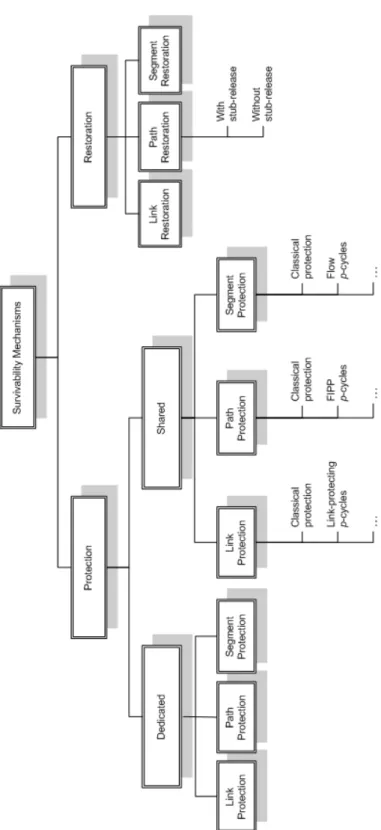
2.3 Classification of survivability mechanisms for optical mesh networks. . 17
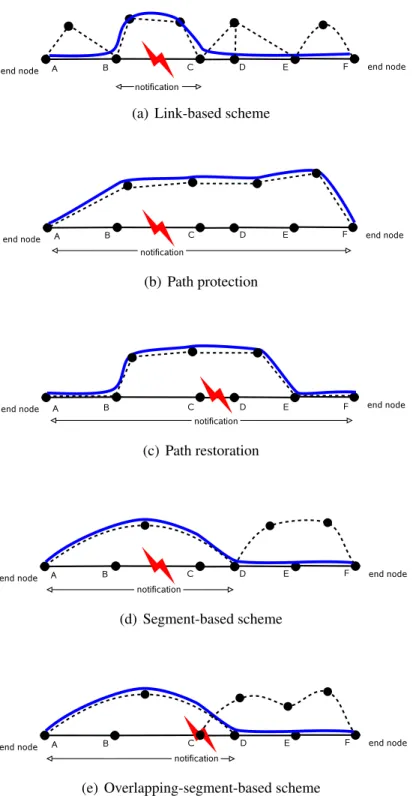
2.4 Mesh survivability mechanisms. Working and protection links are repre-sented by solid and dashed lines respectively. Thick solid lines represent the route taken by the affected traffic after restoration. . . 18
2.5 A link-protecting p-cycle. . . 21
2.6 Flow-protecting p-cycle. Source: [118]. . . 22
2.7 A FIPP p-cycle shared by a set of pairwise disjoint working paths. . . . 23
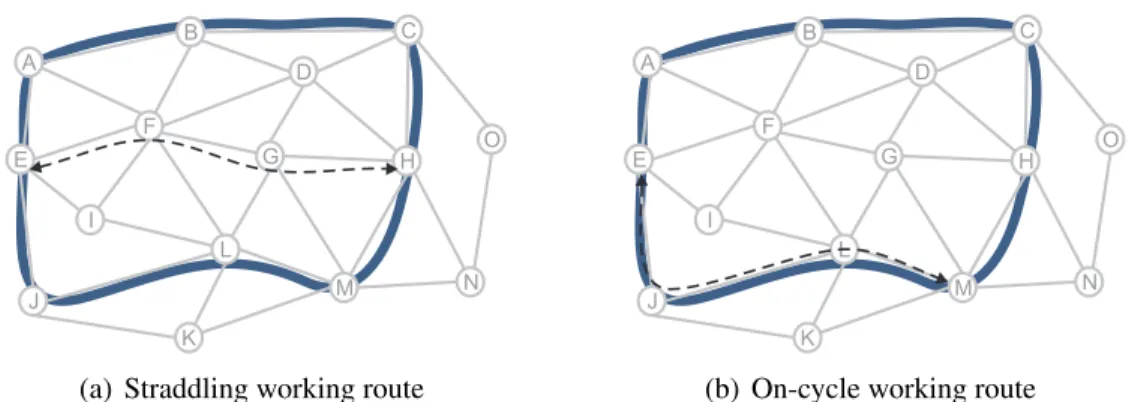
2.8 Different relationships between working routes and FIPP p-cycles. . . . 25
2.9 Partially on-cycle working routes. . . 26
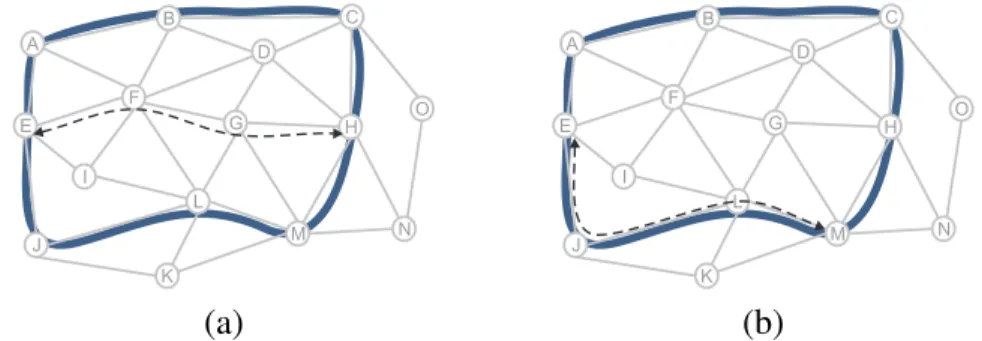
4.1 Different relationships between working routes and FIPP p-cycles: (a) fully straddling; (b) fully on-cycle. . . 46
4.2 Examples of partially on-cycle routes. . . 47
4.3 Protection of non-disjoint working paths by FIPP p-cycles. . . 48
5.1 Examples of the four protection schemes. . . 71
5.2 Results for 15-node network family. . . 82
6.1 Example of a link-protecting p-cycle. . . 84
6.2 Example of a path-protecting p-cycle. . . 85
6.3 Example of an on-cycle link failure in a directed p-cycle. . . 88
6.4 Accuracy of the symmetric model forCOST239. . . 99
7.1 A FIPP p-cycle example. . . 105
7.2 Two concurrent working paths (2-3-6 and 6-3-5) sharing a FIPP p-cycle. 107 7.3 A CPP instance (on the left) and its corresponding graph of request clashes (on the right). . . 116
7.5 Different lower bounds obtained for a 15-node network family. . . 128 7.6 Running times for a 15-node network family. . . 128 8.1 An example of protection domains. . . 138
4.5.1 FIPP_SCP_IH Algorithm . . . 51 7.6.1 Rounding-based algorithm . . . 120 7.6.2 Round-robin algorithm . . . 121
First and foremost, I offer my gratitude to my supervisor, Professor Brigitte Jaumard, who supported me throughout my thesis with her encouragement and knowledge. This work would not have been possible without her effort, patience and avalaibiliy during these four years, specially in the final stages. I also would like to thank all members of the thesis committee for their prompt evaluation and comments.
All my research work was financially supported by the Brazilian National Council for Scientific and Technological Development (CNPq) and I am extremely grateful to every single Brazilian citizen for her/his precious contribution.
The Department of Computer Science and Operations Research (DIRO) and the Interuniversity Research Centre on Enterprise Networks, Logistics and Transportation (CIRRELT) at Université de Montréal provided the support and equipment I needed to produce and complete my thesis. I thank the technical and administrative staff members for being abundantly helpful and having assisted me in numerous ways.
I also would like to thank my Quebecker and “almost" Quebecker friends, specially Marie-Ève, Julie, Simon, Nadia, Benoit, Catherine, Claudio, and Gerardo, for sharing with me their culture and showing me many different worlds. They brought me light and warmth when winter was not so friendly. In addition, I thank my office colleagues for the pleasant environment they have provided me with.
Meeting my Brazilian friends, Alysson, Gisela, Patricia, and Rafael, was undoubtably one of the best things that happened to me in these last years. I will forever be grateful to them for enjoying with me many memorable moments and for being so supportive and thoughtful in the difficult ones.
I thank my dear parents, Lourenço and Fátima, and my sisters and brother, Lourena, Segundo, and Aline, on whose unconditional encouragement and love I relied throughout my entire time at the Academy.
I could not end without thanking my husband, Daniel, who tirelessly supported and loved me, even when I was being unloveable. Without him I could not have made it this far.
INTRODUCTION
Providing resilience against failures is an important requirement for many high speed networks. As these networks carry more and more data, a single outage can disrupt mil-lions of users and result in milmil-lions of dollars of lost revenue. Thus, network survivability becomes a critical concern in network design and in its real-time operation [38].
A connection traverses several nodes in the network between its source and its desti-nation, and there are several elements along its path that can fail. In most cases, failures occur due to natural disasters, such as power outages, fires, or earthquakes, human errors, such as accidental cable cuts, or wrong operation of a switch, and failure of active com-ponents inside network equipment, such as transmitters, receivers or controllers [125].
Network failures commonly arise in the form of link failures and node failures. Link failures are mostly caused by fiber cable cut, which is the most likely failure event. For instance, U.S. carriers reported 136 such failures to the Federal Communications Commission (FCC) in 1997 [95]. Fiber cuts often result from accidental or malicious excavation, or inline component disfunction such as the failure of an optical amplifier. A node failure, although likely less frequent than a link failure, can cause widespread disruption when it occurs. For instance, a node failure can completely isolate a region from communicating with others, as the flooding of several central offices caused by hurricane Floyd in 1999 [95]. More recently, several critical optical fibers were cut causing severe interruption of telecommunication services in all Eastern Asia due to Taiwan earthquake of December 26, 2006 [97].
According to [132], the fiber cut rate in Telcordia network is 4.39 cuts/year/1000 miles of fiber. Also, FCC published that 3 and 13 cuts for miles of fiber were experienced in metro and long haul networks respectively in 2002 [38]. These statistics show that the frequency of cable cut events can be up to thousands of times higher than node failures, therefore it is acknowledged that providing protection against these failure scenarios is a realistic goal.
Another common assumption is that of single link failures. Indeed, a comprehensive survey on cable cut events reported that the average cable repair time is 5.2 hours and all of 160 of the cable failures experienced were single-failure events [21]. This strengthens the claim that the probability that a second link failure arises during another failure repair is very unlikely.
Protection techniques involve providing some redundant capacity within the network and automatically rerouting traffic around the failure using this redundant capacity. We will focus on a recent development in transport network survivability: The p-cycle tech-nique [39, 46]. p-Cycles are cyclic protection structures which offer very fast protection switching with guaranteed transmission integrity of protection paths. p-Cycle designs also achieve high spare capacity efficiency and support independent routing of traffic, without constraints implied by the placement of protection structures. Another oper-ational advantage of p-cycles is that protection can be implemented on simple nodal equipment [65] and it does not require expensive optical switches. Among the interest-ing features of p-cycle configuration, we can cite:
– It can be logically managed on a per channel basis; – It can be adapted to implement multi-priority protection; – It can be adapted to changing traffic patterns;
– It can also be adapted for maximized survivability in multiple failure scenarios; – It supports path length or optical reach restrictions.
Overall, p-cycles offer intriguing and promising alternatives to conventional optical network architectures. Hence, there is considerable motivation to further explore and refine this domain of networking technology and theory. Originally designed for link protection, several extensions of the p-cycle concept have been proposed by researchers. Among them, we remark the failure independent path protecting (FIPP) p-cycles which provide end-to-end path protection. Thus, FIPP p-cycles approach mesh-like efficiency in capacity utilization while retaining ring-like speed (see Chapter 2).
1.1 Motivation and objective
This thesis concerns the design of survivable optical networks using p-cycle schemes, more particularly, FIPP p-cycles, in link failure scenarios. Our study focuses on the placement of p-cycles assuming that the working routes for the set of connection requests are defined a priori. This problem is known as the non-joint optimization problem. In contrast, when the protection and working networks are determined simultaneously, we have the joint optimization problem. The main advantage of joint over non-joint opti-mization is that it leads to more resource-efficient designs. However, it corresponds to a much more complex design problem and the solution of medium size problem instances is not reachable. In addition, non-joint optimization is a realistic assumption since place-ment of protection capacity is considered as a strategic decision whereas working routing is an operational decision [108].
Since most existing work done on p-cycles concerns heuristic algorithms or methods suffering from critical lack of scalability (see Chapter 3), the objective of this thesis is twofold: on the one hand, to propose scalable solution methods enabling to approach larger problem instances, and on the other hand, to produce optimal or near optimal solutions with mathematically proven optimality gaps. For this, we rely on a powerful tool for solving large scale linear programming problems: Column generation [36, 37]. A column generation approach works with a reasonably small subset of the columns in the linear problem, originating the restricted master problem. This is solved iteratively, augmenting the number of columns until optimality of the original problem is proved with the available columns. Entering columns are found by solving an auxiliary prob-lem, usually called pricing probprob-lem, which tries to identify variables with negative (or positive) reduced cost.
In this thesis, column generation is used as an intelligent way of enumerating promis-ing cycles to be part of p-cycle designs. We also propose mathematical formulations for the master and pricing problems within the column generation algorithms. Good formu-lations are crucial to achieve an overall effective solution approach.
1.2 Thesis organization
The study carried out in this thesis originated several articles submitted to publication in scientific journals or international conferences with peer refereeing. Some of these ar-ticles have already been published or accepted for publication. This thesis consists of four main chapters, each one presenting an article selected among all those produced, and an additional chapter concerning a preliminary study on availability in p-cycle net-works. The articles not included here present preliminary results, which were improved in the selected articles. Because these chapters must be presented exactly as the articles published or submitted to publication, there may be some redundancy throughout the thesis, which is organized as follows.
Chapter 2 provides background information on optical network survivability, which covers concepts and terms relevant to network survivability and introductions of var-ious survivability techniques. The concepts and terms include network failure types, the difference between protection and restoration, etc. The survivability techniques are categorized into electronic and optical layer schemes and involve the popular point-to-point systems and self-healing rings as well as more advanced mesh survivable networks, which include classical link and path protection, and p-cycle schemes.
Chapter 3 presents a review of the existing solution methods found in the litera-ture concerning p-cycle techniques, with a special emphasis on path-protecting p-cycles, which are the main topic of this thesis. Firstly, we divide the methods for link-protecting p-cycles into two categories according to the solution approach applied to optimize the design of p-cycle networks: those based on explicit enumeration or pre-selection of can-didate cycles, and those applying alternative solution strategies. Then, the literature on FIPP p-cycle is covered.
In Chapter 4, we study the first column generation algorithm for the design of sur-vivable networks based on FIPP p-cycles. Mathematical formulations for the master and pricing problems are proposed. The resulting algorithm obtains better solutions within reasonable running time in comparison with existing methods.
protection schemes. Although these protection schemes have been compared in the lit-erature, we perform an accurate comparison by using a unified column generation based approach to find provably good results.
Chapter 6 concerns an empirical evaluation of directed and undirected link- and path-protecting p-cycles under asymmetric traffic scenarios. We show how much additional protection cost results from employing bidirectional systems in such scenarios. Here again, column generation is used to obtain solutions with very small optimality gaps. The formulation presented in Chapter 5 is improved and a new formulation is proposed for directed FIPP p-cycles.
In Chapter 7, some different assumptions on the problem are considered and a much more compact formulation of the pricing problem is obtained. In addition, we also pro-pose a new decomposition of the problem which greatly improves the efficiency of the whole algorithm and allows us to solve larger problem instances. As for integer solu-tions, two heuristic approaches are proposed.
A preliminary study on a column generation algorithm for the design of surviv-able networks using link-protecting p-cycles under availability constraints is presented in Chapter 8. Therein, we report the first lower bounds obtained for the problem and compare them with integer solutions existing in the literature.
Finally, Chapter 9 concludes the thesis and suggests future research directions.
1.3 Articles produced during the thesis
In the following, we present the chronological list of the articles published or sub-mitted to publication in journals and international conferences with peer review during the thesis. Those included here as chapters are indicated by an star (?).
1. ? B. Jaumard, C. Rocha, D. Baloukov and W.D. Grover. A column generation approach for design of networks using path-protecting p-cycles. In Proceedings of the International Workshop on the Design of Reliable Communication Networks (DRCN), October 2007.
path Protection. In Proceedings of the 17th International Conference on Computer Communications and Networks (ICCCN), August 2008.
3. C. Rocha, B. Jaumard, and P.-E. Bougué. Directed vs. undirected p-cycles and FIPP p-cycles. In Proceedings of the International Network Optimization Confer-ence (INOC), April 2009.
4. ? C. Rocha and B. Jaumard. A column generation approach for shared protec-tion schemes in WDM mesh networks. Pesquisa Operacional, 2009 (accepted for publication).
5. ? C. Rocha, B. Jaumard, P.-E. Bougué. Asymmetry issues in p-cycle and FIPP p-cycle protection schemes, 2009 (submitted for publication in Networks).
6. ? C. Rocha and B. Jaumard. A hierarchical decomposition method for efficient computation of path-protecting p-cycles, 2009 (to be submitted for publication in Telecommunication Systems).
7. M. Kiaei, A. Ranjbar, C. Rocha, B. Jaumard and C. Assi. Improved Availability Models for p-Cycle-Based Network Design. In Proceedings of the International Workshop on the Design of Reliable Communication Networks (DRCN), October 2009 (to appear).
FUNDAMENTALS OF NETWORK SURVIVABILITY
As previously discussed in Chapter 1, network failures such as fiber cuts and equip-ment fault can be catastrophic and survivability mechanisms are of paramount impor-tance. This chapter provides a brief description of fundamental concepts in network survivability in the context of undirected networks (the directed case is fairly similar). First, we will introduce basic concepts and terms used in the domain. Then, a discussion of various survivability techniques, including p-cycle schemes, will be presented.
2.1 Basic concepts 2.1.1 Terminology
Some important terms in transport networks and survivability are summarized as follows. Although the terms found in the literature are not necessarily uniform, we follow what we consider to be the most common terminology.
Span: Physical entity that is a collection of all channels between two adjacent nodes. Typically, a span is a set of cables co-routed in the same ducts. Each cable may have multiple fibers, and each fiber may carry many multiplexed signals.
Channel: Wavelength on a fiber link. Path: Route in the physical network.
Lightpath: All-optical path between a pair of nodes which may go through multiple fiber links, i.e., a path that optically bypasses intermediate nodes. Occasionally, we will also refer to it as a segment.
Request: Demand of traffic with a given bandwidth between two end nodes. Connection: Capacity occupied by a request over a path.
Optical hop: Lightpath traversed by a connection request. The number of optical hops on a path can be computed from the number of signal regenerations across that
path. For example, if a signal is submitted to two regenerations, then its path traverses three optical hops.
Working path: Path used in the “pre-failed“ state, i.e., carry traffic under normal oper-ation conditions. Also called primary path.
Protection path: Alternate path to carry traffic in the ”failed“ state. Also called backup path.
Restoration time: Time elapsed between the moment at which a failure occurs and the moment at which traffic is restored.
Working capacity: Capacity used by the working paths on a link.
Protection capacity: Capacity used by the protection paths on a link. The term spare capacity is used to designate all capacity, other than working capacity, available on a link and it is more often used in the context of networks without capacity constraints.
Redundancy: Ratio of the total spare capacity to the total working capacity. It is often used to compare the performances of different survivability techniques.
Optical connection: Switching action performed by a device called optical cross-connect (OXC) in order to setup a lightpath.
OC-n: Transmission rate (OC means Optical Carrier). OC-n corresponds to a n× 51,84 Mb/s signal, e.g., OC-48 ' 2.5 Gb/s and OC-192 ' 10 Gb/s.
Availability: Probability of finding the system in the operating state at any arbitrary time in the future.
2.1.2 Optical networks
Currently, there are basically two generations of optical networks. In the first gen-eration, all the switching and other intelligent network functions were performed by electronics while optics were essentially used for network capacity and transmission. However, we are moving towards a second generation of optical networks, where some
of the routing, switching, and intelligence is performed in the optical layer. Several ad-vantages come from this change as it becomes more difficult for electronics to process the increasing amount of data. Moreover, the electronics at a node only need to handle the data addressed to that node while all the remaining data is routed through in the opti-cal domain, significantly reducing the need for electronic equipment. These networks are based on WDM transmission and are called wavelength-routed networks, where WDM stands for wavelength-division multiplexing.
WDM networks are a type of high-speed transport networks, in which wavelength-division multiplexing is applied to simultaneously transmit multiple distinct wavelengths in a single fiber. Depending on the spacing between two neighboring wavelengths, we can have dense WDM (DWDM) or coarse WDM (CWDM). Recently, the International Telecommunication Union (ITU) has standardized a 20nm channel spacing grid for use with CWDM, while DWDM systems use 100 GHz (0.8nm), 50 GHz (0.4nm) or even 25 GHz channel spacing [55]. The new ITU specification opens for 18 CWDM channels on a special type of fiber [56], while a grid of 81 wavelengths is defined for DWDM systems.
WDM systems use different wavelengths for different channels. Each channel may transport homogeneous or heterogeneous traffic, such as SONET/SDH (synchronous op-tical network/synchronous digital hierarchy) over one wavelength, ATM (Asynchronous Transfer Mode) over another, and yet another may be used for TDM voice, video or IP (Internet Protocol). WDMs also makes it possible to transfer data at different bit rates. Thus, it offers the advent that one channel may carry traffic at OC-48, OC-192 or up to OC-768 rate while another channel may carry traffic at a different rate transmission; all on the same fiber. The technology applied to a WDM network node must support some functionalities, among which wavelength routing (or switching) and multiplex-ing/demultiplexing are the most important ones.
The optical layer provides lightpaths for use by its client layers, such as SONET, IP, or ATM layers. Lightpaths are all-optical connections from a source node to a destination node over a wavelength, with optical bypasses on each intermediate link. At intermediate nodes, the lightpaths are routed and switched from one link to another and, in some cases,
lightpaths may be converted from one wavelength to another as well along their route if we have all-optical wavelength conversion capabilities within the network. Different lightpaths in a wavelength routing network can use the same wavelength as long as they do not share any common links.
2.1.3 Protection versus restoration
A survivable network can basically use a protection or a restoration scheme. Pro-tection refers to a preplanned system where a proPro-tection path is precomputed for each potential failure during network design or at the time of connection establishment. In the event of a failure, the disrupted connections are recovered by using the reserved network resources for failure recovery, which can be dedicated for specific failure scenarios or shared among different ones. In contrast, restoration schemes take action in real time which means that the backup route is computed after the failure occurrence using the available network resources, based on the failure and the state of the network.
Generally, restoration schemes are more efficient in utilizing network capacity be-cause no resources are allocated before any failure occurs. They do not allocate spare capacity in advance, but protection schemes have faster restoration time as there is no dynamic search for spare network resources and they can always guarantee recovery from failure, which is not the case in restoration as the network may not have sufficient spare resources at the time of a failure event.
2.1.4 Dedicated versus shared protection
Protection schemes can be further classified into dedicated or shared protection. In dedicated protection, each working connection is assigned its own dedicated spare ca-pacity in the network over which it can be rerouted in case of a failure. A typical example of dedicated protection is 1+1 protection, in which the optical signals are transmitted si-multaneously on two dedicated channels between end nodes. In shared protection, the reserved network resources can be shared among multiple working connections under the assumption that they do not fail simultaneously.
It is clear that dedicated protection is very fast in service recovery since both working and protection paths are fully set up in advance. Besides, it can handle multiple failures as there is no resource sharing among connections. However, shared protection is more efficient in resource utilization because it reduces the amount of bandwidth needed in the network for protection. Another advantage of shared protection is that the protection bandwidth can carry low-priority traffic under normal conditions. When the bandwidth is needed to protect a connection in the event of a failure, this low-priority traffic is preempted for restoration of a higher priority request.
2.2 Survivability techniques
Survivability schemes are extensively used to maintain or restore an acceptable level of performance during network failures by applying various restoration techniques. For instance, in WDM networks, the failure of a network element, such as fiber link, cross-connect, etc., can cause the failure of several lightpaths, thereby leading to large data and revenue losses [38]. Three important criteria are usually considered when evaluating a survivability mechanism: capacity efficiency, operational complexity, and restoration time. These aspects may greatly vary depending on the network layer in which surviv-ability is applied.
Survivability can be provided within different network layers, such as IP, ATM, SONET, and the optical layer. Despite the existence of widespread survivability mech-anisms in the client layers, it is very attractive to provide fault recovery in the optical layer according to the following main reasons [81, 95]:
– The optical layer can provide survivability functions that the higher layers, such as IP and ATM, do not provide.
– Optical layer protection can yield significant cost savings in comparison to client layer protection, as shown in [95].
– An additional level of resilience can be provided with optical layer survivability (for example, against multiple failures).
layers.
– In general, it is preferable to recover a failure in the layer in which it occurs. – Possibility of reducing the restoration times below those obtained with SONET/
SDH [84].
Despite the mentioned advantages, optical layer protection also have its own limi-tations. For example, client equipment faults need to be solved by the client layer and traffic at a granularity finer than one lightpath cannot yet be handled in the optical layer. In this thesis, we will focus on optical layer techniques and only briefly discuss techniques within the electronic layer, such as SONET/SDH. A more detailed review of survivability techniques for optical networks can be found in [38, 95, 120, 136].
2.2.1 Electronic layer schemes
In this section, we briefly discuss the two most commonly used survivability tech-niques in the electronic layer: Point-to-Point Systems and Self-Healing Rings. These techniques are inherently protection schemes featuring the following relevant character-istics:
(i) Prior to any failure, the protection paths are pre-determined and pre-configured. (ii) Moreover, only the nodes adjacent to the failure performing switching action,
which offers the great advantages of fast restoration and simple operations. However, these techniques suffer from low spare capacity efficiency. Indeed, they re-quire over 100% spare capacity redundancy. A more detailed review of these techniques can be found in [136], [95], and [38].
2.2.1.1 Point-to-point systems
Point-to-point systems use automatic protection switching (APS) to switch failed traffic to protection facilities. It consists of two fundamental types of protection mech-anisms: 1+1 and 1:1 protection. The former is the simplest and fastest protection tech-nique because there is no signaling between nodes. The traffic is transmitted simultane-ously on both working and dedicated backup fibers (or channels) and the receiver selects
the signal with better quality. In 1:1 protection, there are also two channels from source to destination but the traffic is only transmitted on the working fiber. Upon a failure event, the backup fiber is used to carry the affected traffic. Note that the presence of co-routed working and protection fibers in these schemes is unsuitable for protection against cable cuts. For this reason, diverse routing has been imposed to APS systems in order to obtain path diversity between working and backup fibers. Please refer to [4] for an extensive discussion on routing and diversity algorithms for such systems.
As signaling is required between the source and destination, 1:1 protection yields a longer restoration time in comparison to 1+1 protection. However, it offers two main advantages over 1+1 protection. First, the backup fiber can be used to transmit lower priority traffic under normal operation. Another advantage is that 1:1 protection can be extended to 1:N (or M:N) protection in order to achieve better capacity efficiency, by allowing multiple working fibers to share a single (or multiple) common backup fiber. Even in shared versions of point-to-point APS, the backup fibers are dedicated to the working fibers they protect, which is becoming prohibitively expensive due to the frequent changes and augmentation of Internet traffic.
2.2.1.2 Self-healing rings
Self-Healing Rings are very popular carrier structures used in SONET/SDH net-works since they incorporate protection mechanisms which automatically detect failures and switch the failed traffic. Unidirectional Path-Switched Ring (UPSR) and Bidirec-tional Line-Switched Ring (BLSR) [38, 136] are the two most popular ring-based tech-niques.
Under UPSRs, a ring carries working traffic in only one direction while another ring is dedicated to protection, as shown in Figure 2.1. Indeed, the traffic is sent simultane-ously on both working and protection fibers but in opposite directions. As in 1+1 APS systems, the destination node selects the best signal.
Instead of switching over end nodes as in UPSRs, BLSRs perform local switching at the nodes adjacent to the failure. They can be of two types: a 4-fiber or 2-fiber structure. In a BLSR/4, two fibers carry working traffic in both directions along the ring
Figure 2.1: A unidirectional path-switched ring. Source: [95].
and another two fibers are used for protection, as shown in Figure 2.2. Upon a failure, the traffic is partially carried through the working fiber and the ring performs a loopback function [29] to switch the traffic to the protection fiber around the failed link. In a BLSR/2, half of the capacity of each fiber is used by the working traffic and the other half is dedicated to protection.
Ring networks are usually simple to manage and have very short restoration time because they rely on pre-configured protection structures, which is of great interest in many applications. Nevertheless, they yield excessive redundancy of spare capacity and are expensive to upgrade. Another drawback is that both working and protection traffic are constrained to be over a ring structure which may be prohibitive in large scale mesh networks. A detailed discussion of ring-based protection schemes can be found in [95, 136], and a recent survey of mathematical programming models for ring-network designs can be obtained in [13, 121].
2.2.2 Optical layer schemes
The WDM-based equivalent architectures to SONET/SDH rings are Optical Path Protection Rings (OPPR) [86] and Optical Shared Protection Rings (OSPR) [78]. OPPR
Figure 2.2: A four-fiber bidirectional line-switched ring. Source: [95].
is similar to UPSR, except that it operates at the optical layer, and OSPR is analogous to BLSR/4 with some changes.
Given the well-known disadvantages of ring networks, we will turn our attention to survivability mechanisms for optical mesh networks, whose classification is summarized in Figure 2.3. Mesh survivable networks refer to networks over a mesh-like physical topology where survivability techniques can find arbitrary backup paths. Depending on their characteristics and structures, these survivability schemes can provide protection against node and/or link failures. Furthermore, they can be divided into link-based, path-based, and segment-based techniques.
Link-based schemes
Originally devised for ring networks, link-oriented protection has migrated to mesh networks. Link-based techniques act locally in the vicinity of the failed link to switch the traffic to protection paths between the end nodes of the failed link. Therefore, only these nodes need to be notified of the failure.
These schemes can be implemented in two ways: Link protection and link restora-tion. In link protection, for each link of a working path, a protection route and the
assigned capacity are pre-determined and stored at the end nodes of the link. Because multiple backup paths may share the spare capacity reserved on each link, the backup paths are set up only after the failure occurs so that restoration is achieved. If a dedicated strategy is used instead, all the backup paths are ready to be used at any time. In link restoration, not only the backup paths are configured and set up, but also all the protec-tion routes and spare capacity are determined and allocated by the network in real time whenever a failure occurs.
Figure 2.4(a) illustrates how protection is provided within this scheme. For example, if a failure on link B-C occurs, the traffic going through this link is rerouted over a backup route and then continue its way over the subsequent working links. Each working link (solid lines) has its own protection path (dashed lines). From this example, we can also see that it corresponds to a shared protection scheme as links C-D and D-E have a link in common in their protection routes.
These schemes provide very fast restoration due to fault localization but, on the down side, they are less efficient in utilizing network capacity in comparison to path-oriented approaches because they act locally. Link-based survivability mechanisms include the classical Shared Link Protection (SLP), Dedicated Link Protection (DLP), and Link Restoration (LR) as well as link-protecting p-cycles, which are discussed in Section 2.3. Path-based schemes
Path-based schemes consist in protecting each connection individually by providing an end-to-end backup path. The techniques in this category include Path Restoration (PR) [54], Shared Path Protection (SPP), also known as Shared Backup Path Protection (SBPP) [62], and path-protecting p-cycles (see Section 2.3). Such techniques differ in the way backup paths can be routed, as discussed below.
When a link fails, PR does not impose any restriction regarding the backup path for a given working path, except that it cannot use the failed link. This means that different protection paths can be used to restore the traffic through a given working path (e.g., a different protection path for each traversed link) and they are not restricted to be link or node-disjoint from the working path as in Figure 2.4(c). In this restoration scheme, the
(a) Link-based scheme
(b) Path protection
(c) Path restoration
(d) Segment-based scheme
(e) Overlapping-segment-based scheme
Figure 2.4: Mesh survivability mechanisms. Working and protection links are repre-sented by solid and dashed lines respectively. Thick solid lines represent the route taken by the affected traffic after restoration.
end nodes of each connection affected by a failure dynamically determine the protection route and spare capacity needed for restoration. PR can be further divided in two sub-cases: Restoration with and without stub release [54]. Here, “stub” is referred to as the surviving parts of an affected working path. For example, in Figure 2.4(c), parts A-B-C and D-E-F are the stubs of the defective working path. Path restoration without stub release does not release the capacity on the unharmed parts while, in the stub-release version, the capacity on the two stubs are released and can be used for protection. PR with stub-release is assumed to achieve the best spare capacity redundancy among all survivability techniques at the price of a more complex protection scheme with longer restoration time.
SPP allows only one protection path to restore the traffic on a given working path, regardless of the failure location. Besides, SPP requires the backup path to be disjointly routed from its working path, as shown in Figure 2.4(b). The backup path can be link or node-disjoint from its corresponding working path depending on the type of protection to be provided. In case of a link failure, a notification signal is sent to the end nodes of each connection traversing the failed link in order for them to switch the traffic over the working path to the backup path. Although less capacity efficient than path restora-tion, SPP yields a faster restoration time because it is a failure-independent survivability scheme.
The recently proposed Demand-wise Shared Protection (DSP) mechanism [68] com-bines advantages of both dedicated and shared path protection. DSP is based on diver-sification routing scheme [22] which consists in routing the traffic volume of a demand (request) though several different working paths. In DSP, the spare capacity is shared by the working paths of a same demand, but not among different demands.
Segment-based schemes
Segment-based schemes are based on a concept generalized from the two previous schemes. These schemes consist in dividing each working path into a sequence of path segments, which can overlap or not, and protecting them separately. As it is a generalized concept, segment can be used to model a complete path itself or a single link. When a
failure occurs, only the affected segment performs protection switching and the other unaffected segments are oblivious to the failure. In the classical segment protection, the working segments are concatenated but not overlapping, as illustrated in Figure 2.4(d). As in link-based schemes, segment-based schemes are not able to protect end nodes of the segments. However, they have the advantages of faster restoration and more spare capacity efficiency compared to path-based schemes, despite the complexity in network planning and operation.
Protection using overlapping working segments was introduced in [93] and further developed in [51, 52, 129]. An enhanced variant with overlapping protection segments was introduced in [7]. The most important advantage of this scheme over the classical segment protection is that it provides recovery against node failure, as shown in Fig-ure 2.4(e), although they consume more spare capacity.
Path-Segment Restoration (PSR) [50] [116], Shared Segment Protection (SSP) [116], Short-Leap Shared Protection (SLSP) [52] and flow p-cycles (see Section 2.3) are all segment-based schemes.
2.3 p-Cycle techniques
2.3.1 Link-protecting p-cycles
p-Cycles are fully preconnected cyclic protection structures with preplanned spare capacity. They were introduced in 1998 by Grover and Stamatelakis [39]. When a link fails, only the two end-nodes of the link perform protection switching, therefore no switching actions are required at any intermediate node of the cycle. Unlike rings, p-cycles protect against straddling link (chord) failures as well as failures on links over the ring itself. Besides, under p-cycles, the working paths are routed independently, i.e., they are not restricted to follow a cyclic structure. These characteristics make p-cycle based networks much more capacity efficient than ring-based networks, while providing "ring-like" speed switching [46].
Figure 2.5 illustrates the operation of basic link-protecting p-cycles. A same single p-cycle, with one channel of spare capacity, is shown by the thick solid line in both
Figure 2.5(a) and (b). In Figure 2.5(a), a link on the cycle fails (dotted line) and the surviving part of the cycle is used to provide a protection path (arrowed solid line), just like rings. In Figure 2.5(b), a straddling link is protected by the same p-cycle. Each unit of spare capacity on a p-cycle can protect two units of working capacity on a failed straddling link because two protection paths are provided in this case. In the example, halves F-E-J-L and F-G-H-M can be used to protect two units of working traffic on link F-L. J F E G H M K I L
(a) On-cycle link failure
J F E G H M K I L
(b) Straddling link failure
Figure 2.5: A link-protecting p-cycle.
So far, basic link-protecting p-cycles have been described. However, the p-cycle concept has been extended to more elaborate techniques, such as segment-protecting and path-protecting p-cycles, which are presented in the next two sections. Other extensions have recently been proposed [38, 40] but will not be discussed in this thesis.
2.3.2 Flow p-cycles
Segment-protecting p-cycles, shortly called flow p-cycles, were introduced by Grover and Shen in [45, 118]. They are an extension of the p-cycle concept to cover straddling flows. A flow (or segment) is any single contiguous segment of a working path. The concept of flow p-cycles is illustrated in Figure 2.6, where we consider three working paths (4-3-5-9, 4-2-7-6-9, and 1-0-7-6-10) and one cycle. In case of failure of links 2-7 and 6-7, the traffic cannot be protected by the cycle if it is a link-protecting p-cycle. But, under a flow p-cycle, the contiguous flow or segment 2-7-6 can be protected by two alternate routes, 6-8-0-2 and 6-5-3-2. Moreover, in case of failure of intermediate node
7, the flows between node pairs 1-10 and 4-9 can be protected by the flow p-cycle, but the flows must be unchanged in its composition between the nodes where it intersects the cycle.
Figure 2.6: Flow-protecting p-cycle. Source: [118].
There are several types of intersections between a working path and a candidate flow p-cycle, possibly involving more than two intersection nodes. These intersections may be arbitrarily complex, possibly leading to a complex flow p-cycle design. Depending on each possible span failure, each p-cycle must know which failed segments are under its protection. This is achieved by maintaining preplanned information at each node for each flow p-cycle traversing it. In other words, failure detection is required at each node for proper activation of the flow-protecting p-cycles.
2.3.3 FIPP p-cycles
Basic link-protecting p-cycles were further extended with the goal of providing end-to-end path protection without requiring any failure specificity issues, originating the Failure Independent Path-Protecting (FIPP) p-Cycles. Under FIPP p-cycles, the cyclical protection structures can be shared by a set of working paths for protection as long as the working paths in this set are mutually disjoint or, if they are not, their protection paths must be mutually disjoint. If these criteria are met, there will be no contention for spare capacity after a failure. Furthermore, the end nodes of the working paths must also be
crossed by the cycle assigned to protect them. According to the properties of p-cycles, a straddling working route may have up to two protection routes, because no link on the cycle is affected in case of a failure.
Without loss of generality, the concept of FIPP p-cycles will be explained by impos-ing mutually disjoint routes in the set of paths protected by the same FIPP p-cycle. Let us consider the example illustrated in Figure 2.7. This example shows how this set of mutually disjoint paths can share the spare capacity of a single FIPP p-cycle, without addressing failure location. Only one route will require protection under a single failure scenario because of the disjointness property of the set. Some of the routes in the ex-ample fully straddle the FIPP p-cycle, such as B-D-H, E-I-L and A-F-G-H. These routes can have two working paths protected per unit of spare capacity on the cycle. In addition, there are some routes lying fully over the cycle (A-B-C and L-M-H) and others partially over the cycle (E-J-K-M and C-H-M-N).
A B J D F E G H N O M K I C L
Figure 2.7: A FIPP p-cycle shared by a set of pairwise disjoint working paths.
FIPP p-cycles and SPP are similar in the sense that working routes allowed to share spare capacity on backup routes must be pairwise disjoint, however, there are significant differences between them. First, the routes protected by the same p-cycle share a fully pre-connected protection structure instead of protection channels. Also, SPP does not al-low partial or full overlap of a working path with its own backup path, like with partially or fully on cycle routes in FIPP p-cycles as shown in Figure 2.7.
The main properties of FIPP p-cycles, presented in [64], are enumerated as follows: 1) Only cross-connections at the end nodes are needed in real time to compose the
protection paths which result in fast restoration.
2) The protection paths are fully pre-cross-connected, providing certainty about func-tioning in case of a failure.
3) Protection switching is end-node controlled, entirely failure-independent, and can recover either link or node failure along the path. Only a single switching action is pre-programmed at each end-node.
4) Straddling routes can have two working paths protected by each unit-capacity p-cycle.
5) Node-failure protection is achievable if working routes are node (and conse-quently link) disjoint. Node-disjointness can be relaxed to link-disjointness if only link failure is required.
6) Protection paths are known in advance before failure, thus, their length can be easily limited by restricting the size of eligible cycles.
The logical operations of FIPP p-cycles are explained as follows by considering the different protection relationships of a given FIPP p-cycle to working paths.
Straddling routes have no link in common with the p-cycle, as shown in Figure 2.8(a), where the working route and the cycle is represented by dashed and solid connected lines, respectively. In this case, two distinct protection paths are available on the cycle, and thus up to two working paths on this route can be protected in case of a failure. In case of a failure, only the end-nodes of the route perform switching actions and any criterion can be adopted to assign working paths to unique protection paths. The pre-assigned direction is stored at the end-nodes where the switching action takes place as soon as a working path failure is detected. Note that the predefined switching action does not depend on the type or the location of the failure.
The pure on-cycle relationship arises when all links of the working route are crossed by the cycle, as shown in Figure 2.8(b). This is the direct extension of the on-cycle concept from link-protecting p-cycles. The protection path for such a relationship is unambiguously determined as the complementary part defined by the links of the cycle that are not shared by the working route.
ex-A B J D F E G H N O M K I C L
(a) Straddling working route
A B J D F E G H N O M K I C L
(b) On-cycle working route
Figure 2.8: Different relationships between working routes and FIPP p-cycles.
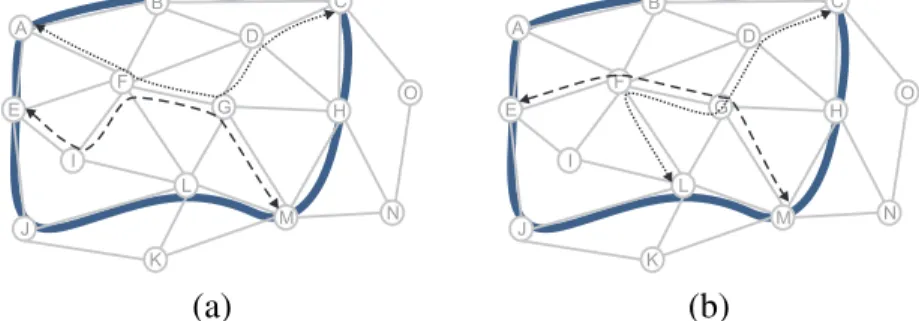
tension to path protection and is not faced by basic p-cycles. This relationship occurs when at least one but not all links in the working route are shared by the cycle. There are two different types of this relationship according to its required operation. In the first one, the working path and the protection path provided by the cycle are disjoint. Two examples are illustrated in Figures 2.9(a), where the dotted arrowed lines represent the available protection path. Operationally, this is the same as the pure on-cycle relation-ship where the assigned protection path is enabled regardless of where the failure affects the working path.
The second type of partially on-cycle relationship occurs when, for a given working route, we cannot find a protection path on the p-cycle such that it does not share at least one span with its respective working route, as illustrated in Figure 2.9(b). In this case, two protection paths must be considered for protection and the switching logic is performed as follows. In the example, let us assume that path `1 (A-E-J-L-M) between
nodes A and M is set as the default pre-assigned protection path for working path A-B-F-L-M. If segments x (A-B) or y (B-F-L) are affected by a failure, protection path `1
will survive and the behavior is the same as before. However, a failure on segment z (L-M) implies that the protection path defined by the default direction also fails and the affected working path must now be protected by path `2(A-B-C-H-M). Fortunately, this
can be realized locally at the end nodes simply by determining which side of the cycle was affected by the failure along with the working path. Thus, in case of coincidence
A B J D F E G H N O M K I C L A B J D F E G H N O M K I C L
(a) Disjoint working and protection paths.
A B J D F E G H N O M K I C L x y z l 1 l2
(b) Non-disjoint working and protection paths
Figure 2.9: Partially on-cycle working routes.
of failure states on both working path and its pre-assigned protecting path, the surviving protection path is selected for recovery.
LITERATURE REVIEW
This chapter presents a literature review on p-cycle techniques, more particularly on path-protecting p-cycles which are the main topic of this thesis. Section 3.1 overviews basic link-protecting p-cycles, while Section 3.2 covers the current literature on FIPP p-cycles. In Section 3.3, we review the literature on the design of p-cycle networks with availability requirements. Finally, Section 3.4 summarizes some further works dealing with different design issues on p-cycles.
For a survey on the p-cycle concept and its extensions as well as existing solution methods for related problems, we refer the reader to [38, 47]. Additionally, various ref-erences in the literature [38, 81, 95, 119] can provide a general overview and discussion on the survivability mechanisms discussed in the previous chapter.
3.1 Link-protecting p-cycles
This section broadly divides the works on link-protecting p-cycles into two subsec-tions according to the solution approach applied to optimize the design of p-cycle net-works. Most of these works propose to enumerate or pre-select candidate cycles before applying integer linear programming (ILP) or any other solution approach. Firstly, a review of these works is presented, and then we discuss the existing alternative solution strategies.
3.1.1 Works based on cycle enumeration
The first paper on p-cycles was published by Grover and Stamatelakis in 1998 [39]. The authors present an ILP formulation for the design of fully restorable networks based on p-cycles. First of all, the set of connection demands are routed using the shortest path or any other routing scheme and the set of all simple distinct cycles up to some limiting size is generated from the network topology. Then an ILP model for minimizing the total
protection capacity is solved. Designs obtained for five networks show that no or little additional capacity is needed in relation to a network with classical link protection. The main drawback of this approach is that it requires enumeration of all possible p-cycles. Because the number of cycles grows exponentially with the network size, only networks of moderate size can be solved to optimality.
To overcome this problem, researchers have proposed different strategies for pre-selecting a reduced number of “promising” p-cycles, thereby reducing the number of candidate cycles in the formulation [31, 42, 71, 118, 138]. Grover and Doucette [42] compare results of non-joint optimization and joint optimization, though the model for joint optimization is not provided. Two pre-selection metrics based on insights about efficient cycles are used: topological score (TS) and a priori efficiency (AE). The TS of a given cycle p is given by the total amount of protection provided by the cycle, i.e., the sum of the number of protection paths that the cycle can provide for each link in the network:
T S(p) =X
`∈Lxp`,
where L denotes the link set, and xp` is the number of protection paths that cycle p can
provide for link ` (xp` = 1 if ` is an on-cycle link, and xp`= 2 if ` is a straddling link).
The AE metric is the ratio between the TS and the cost of the cycle:
AE(p) = P `∈Lxp` P `∈pc` ,
where c` is the cost of a unit of capacity on link `. These metrics select cycles based
purely on the topology of the network and do not take into consideration the traffic distribution. As a result, cycles offering little or no protection to the aimed traffic may be selected while cycles offering more significant protection may not. This shortcoming is alleviated in [118] where a new selection strategy based on the amount of protection offered by the cycles to the applied traffic is presented. Although both methods reduce the number of candidate p-cycles, they still require enumeration of all cycles in the network. Moreover, there is no optimality guarantee and no valid LP bounds to evaluate the quality of the obtained solutions.
Zhang and Yang [138] propose a simple algorithm, which they call Straddling Link Algorithm (SLA), for enumerating a small subset of cycles in the network. Here, no efficiency metric is used. Instead, the algorithm is based on the idea that one can see a cycle as a combination of two node-disjoint paths between the end nodes of a straddling link. Thus, they use Dijkstra’s algorithm for finding disjoint shortest paths between end nodes of potential straddling links in order to compose candidate p-cycles. However, the cycles generated by SLA are generally inefficient because they usually have only one straddling span.
In [26], Doucette et al. propose a heuristic algorithm for the non-joint p-cycle optimization problem. The algorithm, called Capacitated Iterative Design Algorithm (CIDA), first compute a set of candidate cycles and then iteratively chooses one p-cycle from the set to reduce the current unprotected working capacities until all work-ing capacities are protected. The selection of p-cycles is based on a new metric which depends not only on the number of on-cycle and straddling links, but also on the unpro-tected working capacity on these links, unlike a priori efficiency. This metric is called actual efficiency and is defined as
Ew(p) = P `∈Lw`xp` P `∈pc` ,
where w` is the current unprotected working capacity on link `. At each iteration, the
actual efficiency of unused cycles needs to be recalculated as the unprotected working capacities change. The set of candidate p-cycles is generated by using SLA [138]. Then various operations (such as Expand and Grow) are performed in order to improve the initial set of cycles. The authors show that the resulting set of p-cycles have higher aver-age a priori efficiency than those generated by SLA. Consequently, a better performance is obtained when this set of p-cycles is used by CIDA or an ILP method, at the cost of a larger amount of candidate cycles. Moreover, they compare the solution quality of their algorithm to designs obtained with a “pure” ILP method which takes the set of eligible cycles as input, obtaining gaps against optimality that raise up to 20%.
The idea consists in generating a combination of high efficiency cycles and short cycles so that both densely distributed and sparsely distributed working capacities can be ef-ficiently protected by the candidate cycles. Unlike the previous works, the number of generated p-cycles is not fixed but controlled by the algorithm by adjusting an input parameter. The first step of the algorithm is based on Johnson’s cycle enumeration al-gorithm [59], which is based on depth first search in the graph. Weights are assigned to the links in order to guide the search. Then, the algorithm computes two short cycles for each link in the network by using a shortest path algorithm, one containing the link as an on-cycle link and the other with the link as a straddling link. The set of candi-date cycles are used as input to CIDA algorithm [26] and the ILP formulation given in [38, 39]. Compared to optimal solutions, the obtained results show optimality gaps as large as 21.9%.
In a recent work by Eshoul and Mouftah [31], a new metric for preselecting high merit cycles, called Route Sensitive Efficiency (RSE), is introduced. The metric ranks each cycle according to the number of links of the working paths it can protect. The paper also proposes methods to approach the joint and non-joint optimization of the survivable routing and wavelength assignment (RWA) problem under static traffic us-ing link-protectus-ing p-cycles. The RWA problem, also know as lightpath establishment, consists in selecting a route for each demand connection and assigning a suitable wave-length. In the non-joint approach, the minimum backup capacity for placing p-cycles to protect against any single link failure is set up first, regardless of the amount and the distribution of the traffic. Then the RWA problem is solved by considering a subset of candidate routes for each source and destination pair and using an ILP formulation. In the joint version, the problem is formulated as in [38, 127] for both assumptions of full wavelength conversion and no wavelength conversion. Here again, a subset of candidate routes as well as candidate cycles are provided as input for the ILP model.
Other authors have also dealt with the wavelength conversion issue [82, 83, 104, 110]. Schupke et al. [104] developed ILP models for p-cycle configurations in WDM networks with and without wavelength conversion and applied then to a pan-European network. The non-joint optimization problem is considered and the authors use two
cost metrics for determining the shortest paths for the demands. The set of candidate p-cycles is generated from the spare capacity using a breadth first search algorithm start-ing from each link. Moreover, the cycles are length-restricted and unidirectional, which means that straddling links can be protected in only one p-cycle direction. However, the authors avoid generating all possible cycles since the set of candidate cycles still in-creases exponentially with the network size and traffic distribution. In [110], the authors continue the work done in [104] and investigate the configuration of p-cycles in WDM networks with limited wavelength conversion. A relevant finding is that the total number of converters required for the network as a whole can be greatly reduced by only a small increase in protection capacity.
Mauz [82] revisits the joint p-cycle design problem for WDM networks with full wavelength conversion using an ILP, and proposed a heuristic for the problem with no wavelength conversion. As in [104], the designs are based on unidirectional p-cycles. The proposed heuristic uses the solution found for the problem with full wavelength con-version to derive a solution for the case with no concon-version. The algorithm is based on the first-fit method to assign wavelengths [48] and the TS metric to choose the cycles to be included in the design. As a result, the author shows that networks without conversion require 40-60% more capacity than networks with full conversion. In [83], Mauz inves-tigates the capacity of p-cycles using an ILP formulation for the joint design problem. A case study results in redundancy values of 60-130% for three European networks with degree 4.3-2.4 [80].
Besides the mentioned works proposing heuristic algorithms, we can also select from the literature the works of [73, 89, 123, 142]. In the technical report [123], Stamatelakis and Grover indicate that p-cycles are efficient from the structural point-of-view. They use a public-domain genetic algorithm package [19] to find arbitrary pre-configured pro-tection patterns to optimize the network propro-tection capacity. The patterns are generated according to a fitness measure favoring patterns that provide the greatest number of use-ful paths at each stage of the pre-configuration design process. In the results, many final patterns resemble pre-configured cycles, then called p-cycles.
![Figure 2.1: A unidirectional path-switched ring. Source: [95].](https://thumb-eu.123doks.com/thumbv2/123doknet/11603280.300002/30.918.316.665.152.450/figure-a-unidirectional-path-switched-ring-source.webp)
![Figure 2.2: A four-fiber bidirectional line-switched ring. Source: [95].](https://thumb-eu.123doks.com/thumbv2/123doknet/11603280.300002/31.918.318.670.152.451/figure-fiber-bidirectional-line-switched-ring-source.webp)