HAL Id: hal-01204768
https://hal.archives-ouvertes.fr/hal-01204768
Submitted on 24 Sep 2015
HAL is a multi-disciplinary open access
archive for the deposit and dissemination of
sci-entific research documents, whether they are
pub-lished or not. The documents may come from
teaching and research institutions in France or
abroad, or from public or private research centers.
L’archive ouverte pluridisciplinaire HAL, est
destinée au dépôt et à la diffusion de documents
scientifiques de niveau recherche, publiés ou non,
émanant des établissements d’enseignement et de
recherche français ou étrangers, des laboratoires
publics ou privés.
Mode dependent vector quantization with a
rate-distortion optimized codebook for residue coding in
video compression
Bihong Huang, Felix Henry, Christine Guillemot, Philippe Salembier
To cite this version:
Bihong Huang, Felix Henry, Christine Guillemot, Philippe Salembier. Mode dependent vector
quan-tization with a rate-distortion optimized codebook for residue coding in video compression. IEEE
Intl. Conf. on Acoustics and Signal Processing (IEEE-ICASSP), Apr 2015, Brisbane, Australia.
�hal-01204768�
MODE DEPENDENT VECTOR QUANTIZATION WITH A RATE-DISTORTION OPTIMIZED
CODEBOOK FOR RESIDUE CODING IN VIDEO COMPRESSION
Bihong Huang
1,2, Felix Henry
1, Christine Guillemot
2, Philippe Salembier
31
Orange Labs
4 Rue du Clos Courtel, 35512 Cesson Sevigne, France
2
INRIA
Campus de Beaulieu, 35042 Rennes Cedex, France
3
Universitat Politecnica de Catalunya
Jordi Girona 1-3, 08034 Barcelona, Spain
ABSTRACT
The High Efficiency Video Coding standard (HEVC) supports a total of 35 intra prediction modes which aim at reducing spatial redundancy by exploiting pixel correlation within a lo-cal neighborhood. In this paper, we show that spatial corre-lation remains after intra prediction, leading to high energy prediction residues. We propose a novel scheme for encoding the prediction residues using a Mode Dependent Vector Quan-tization (MDVQ) which aims at reducing the redundancy in residual signals. The MDVQ codebook is optimized in a rate-distortion (RD) sense. Experimental results show that the codebook can be independent of the quantization param-eter (QP) with no loss in terms of coding efficiency. A bi-trate reduction of 1.1% on average compared to HEVC can be achieved, while further tests indicate that codebook adap-tivity could substantially improve the performance.
Index Terms— HEVC, vector quantization, residue cod-ing, intra prediction
1. INTRODUCTION
The High Efficiency Video Coding (HEVC) standard [1] de-veloped by the Joint Collaborative Team on Video Coding has been ratified as an international Video Coding Standard in 2013. HEVC contains several elements improving the coding efficiency of intra prediction over the H.264/AVC standard. A wider range of coding block size is supported using a flex-ible quad-tree block partitioning structure, which allows the splitting of an image into Coding Units (CU) with sizes from 8 × 8 to 64 × 64. By introducing a larger number of pre-diction modes, the intra prepre-diction in HEVC can more accu-rately model smooth regions as well as directional structures. Inside a CU, one or four Prediction Units (PU) are defined, each of which specifies a region with an individual intra pre-diction mode. Up to 35 intra prepre-diction modes are available for a PU. A CU is further split into a quad-tree of Transform
Units (TU), on which transform, scalar quantization and en-tropy coding of residual signals are performed. The conven-tional intra prediction in HEVC is efficient at reducing the local spatial correlation in the pixel signals. However, the ac-curacy of intra prediction is limited in regions with complex textures or structures, so the residues in these regions have larger magnitudes.
In this paper, we focus on the remaining redundancy in the residual prediction domain. We propose a novel approach to encode the intra prediction residues based on a Mode De-pendent Vector Quantization (MDVQ). A codebook is learned from training sequences and is optimized in a rate-distortion sense. It is shown that the codebook does not need to be adapted for each Quantization Parameter (QP), which is ad-vantageous for the simplicity of the design. Furthermore, the method provides interesting bitrate savings, especially for low resolution sequences that are usually more difficult to com-press.
The remainder of this paper is organized as follows. We introduce in the first part of Section 2 the method of residue coding using MDVQ in HEVC. In Section 2.2 we present the MDVQ codebook training procedure based on Rate Dis-tortion Optimization (RDO). The QP-independent codebook construction is described in Section 2.3 and the new coding mode signalling is represented in Section 2.4. Experimental results are shown in Section 3. We finally conclude this paper and discuss the perspectives for future research in Section 4.
2. RESIDUE CODING USING MODE DEPENDENT VECTOR QUANTIZATION IN HEVC
The intra coding process of HEVC and H.264 constructs the intra predictor by extrapolating reference samples from pre-viously reconstructed image blocks. In a block of samples predicted with planar mode or DC mode, the residual signals have a relatively homogeneous structure, whereas those de-rived from angular prediction modes tend to have directional
structures. This residue characteristic has been previously in-vestigated to improve coding efficiency. In [2], a directional transform and an adaptive coefficient scanning are used for coding the intra prediction residual. In our approach, a vector quantization codebook is learned with the aim of modelling the directional characteristics of the intra prediction residual signals.
Vector quantization [3] is an efficient data compression technique which exploits correlation in a vector of samples. Theoretically, better performance can always be obtained from coding vectors of source samples as a unit rather than individually. However, as the coding efficiency increases with the growth of the vector dimension, so does the size of required codebook and the complexity of searching for a best matching codeword. Since the codebook size is enormous for vectors of higher dimension, vector quantization is gener-ally considered to be too complex to implement for practical use. We will demonstrate in the rest of this paper that, with our approach, good performance can be achieved for high dimensional vectors by using relatively small codebooks. 2.1. MDVQ-based residue coding
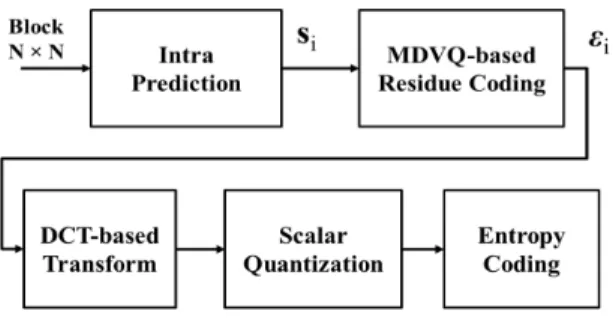
The proposed scheme of residue coding using vector quanti-zation is shown in Fig. 1.
Fig. 1. The proposed approach of residue coding using mode dependent vector quantization
Firstly, an N × N image block is intra predicted by mode i ∈ M (the set of available modes) and the corresponding original residual signal siof the same dimension is computed.
In the conventional HEVC coding chain, this is directly fol-lowed by transform coding, scalar quantization and entropy coding. Let us denote by s0i the reconstructed residual sig-nal at the encoder, and by R(si) the number of bits required
to code the quantified transform coefficients. The best intra prediction mode i∗is the one minimizing the Lagrangian cost function [4] [5]:
i∗= arg min
i∈MD(si, s 0
i) + λ · R(si) (1)
where λ denotes the so-called Lagrange multiplier.
In our proposed scheme, a step of MDVQ-based residue coding is performed after the intra prediction. The N × N image block should be transformed into a 1 × k dimensional vector (k = N × N ) in order to be quantized by MDVQ using a pre-generated codebook. We will explain later in Section 2.2 how to generate this codebook. The index of the match-ing codeword will be then sent to the receiver and the final quantization error (the difference between the residual signal and the matching codeword) will be processed by a series of operations: DCT-based transform, scalar quantization and en-tropy coding.
Formally, let us denote by Ci the VQ codebook for intra
prediction mode i, and by v ∈ Ci a codeword in this
code-book. Let E (si, v) be the quantization error of the input
resid-ual vector siquantized by vector v and E
0
(si, v) be the
recon-structed quantization error. The distortion measured on the prediction residue coded with MDVQ can be then expressed as: D(si, v) = ||si− v − E 0 (si, v)||2 = ||E (si, v) − E 0 (si, v)||2 (2) Let R(si, v) represent the number of bits required for
sig-naling the vector v in the codebook, plus the bits needed to code the quantization error. The best matching vector in a RD optimization sense for a prediction residue block is found by the following minimization:
v∗= arg min
v∈Ci
D(si, v) + λ · R(si, v) (3)
MDVQ-based residue coding will be used for a given residue block if the rate-distortion trade-off given by this mode satisfies:
D(si, v∗) + λ · R(si, v∗) < D(si, s0i) + λ · R(si) (4)
In other words, the MDVQ-based residue coding is performed only if the rate-distortion cost of coding an image block is reduced compared with the conventional HEVC coding. 2.2. RD optimized codebook construction
In the proposed method, the MDVQ codebooks are learned using training video sequences. The training set of residue vectors are obtained by extracting from the training video se-quences the actual set of residual vectors that satisfie Eq. (4). As a consequence, the training set is not “polluted” by the residual vectors that would not be coded by MDVQ. In more details, an iterative approach is used in our codebook con-struction procedure as follows.
Iteration 0:
- Step A: The training video sequences are encoded with the conventional HEVC scheme (residue coding by MDVQ is not applied). Original residues siare gathered to form the
- Step B: The codebooks are constructed with k-means algorithm.
Iteration 1:
- Step A: The training video sequences are encoded with residue coding by MDVQ, using the codebooks generated at the previous iteration. Original residues are extracted from TU blocks where residue coding by MDVQ is selected by RDO to build the training set for the next iteration. It should be noted that the MDVQ will only be selected for blocks where the condition described by Eq.(4) is fulfilled.
- Step B: The codebooks are constructed with k-means algorithm.
Then the steps in Iteration 1 can be repeated several times. The process stops after a predefined number of iterations.
2.3. QP independent codebook construction
When a video sequence is coded with different Quantization Parameters (QP) in HEVC, the coding modes such as intra prediction mode or block partitioning can change. For in-stance, at higher QPs, less bits are used to describe the pre-dictor, leading to a lower quality prediction, and an increase of the average energy of the residue. In order to take this into account, in our early experiments, four groups of MDVQ codebooks for QP values of 22, 27, 32 and 37 were learned separately. However, we have observed that the codebooks learned for different QP values were actually very similar. As a consequence, a generic MDVQ codebook has been learned by including in the training set of residue vectors obtained with the different QP values. The tests have confirmed that the same coding performance could be achieved using the QP independent codebook compared to the groups of code-books learned separately for the different QP values. There-fore, a generalized QP-independent MDVQ codebook can be used. This property is very useful since it helps reducing stor-age requirements, and simplifies the design of the codec: it is not necessary to scale the vectors to match a certain rate-distortion compromise.
2.4. New coding mode signalling
In our experiments, MDVQ based residue coding is allowed only for 4 × 4 and 8 × 8 TU blocks. In reality, 4 × 4 TU blocks are much more frequently represented in 8 × 8 CUs than in 16 × 16 CU blocks, so we limit the residue coding by MDVQ on 4 × 4 TU blocks which reside inside a 8 × 8 CU block. For an 8 × 8 CU block which is split into four 4 × 4 TU blocks, we use three syntax elements and a tree structure for the signalization of residue coding by MDVQ. The syn-tax element res vq cu f lag indicates whether at least one of the four TU blocks inside the CU 8x8 block uses MDVQ. This flag is coded using one bit and an associated context-adaptive binary arithmetic coding (CABAC) context. When res vq cu f lag is set to 1 , for each 4 × 4 TU block a syntax
element res vq tu f lag indicates whether MDVQ is used. This syntax element is also coded using one bit and an as-sociated CABAC context. When MDVQ is used on a TU, a fixed-length syntax element res vq idx is transmitted, repre-senting the index of the codeword in the codebook associated with the intra prediction mode and TU size. As the distri-bution of 8 × 8 TU blocks in different sizes of CU block is relatively uniform, only two syntax elements res vq tu f lag and res vq idx are signalling the use of MDVQ on 8 × 8 TU blocks. Except for the CU flag parsing step for 4 × 4 TU blocks, the reconstruction steps are shared between TU 4 × 4 blocks and TU 8 × 8 blocks.
3. EXPERIMENTAL RESULTS
The proposed approach has been used for residue coding of blocks when the TU block size is 4 × 4 and 8 × 8. For each of them, 35 codebooks corresponding to the 35 intra predic-tion modes have been derived using the codebook construc-tion procedure described in secconstruc-tion 2.2. Each codebook con-tains 256 codevectors, which represents a good compromise between storage, complexity and performance. However our tests indicate that further performance gains can be obtained with larger codebooks. The proposed method has been im-plemented in the reference software HM8.0 [6] of HEVC. The encoder is configured according to the JCT-VC common test conditions with the “all intra” profile. Sequences of six test classes with different resolutions specified in HEVC [7] were encoded. The experiments are performed under the mid-bitrate range of quantization parameters: 22, 27, 32 and 37. The BD-Rate values are measured with the method in [8]. The performance is evaluated by comparing our method against HM8.0, where negative values indicate a bitrate saving. 3.1. Training with test sequences
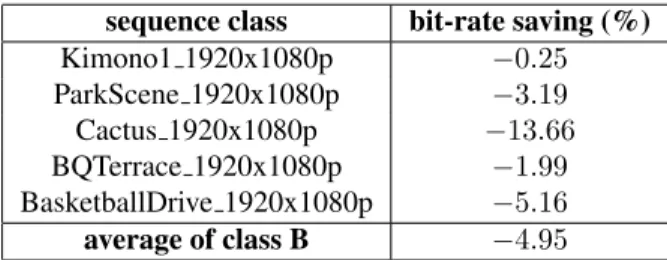
In order to evaluate the potential of the learning method in the ideal case where the codebook is well suited to the input se-quence, we have first learned the codebook using training vec-tors from the same sequence. Table 1 shows the performance of our method on class B sequences using this approach. In this ideal - but not realistic - case, one can observe that MDVQ can provide average bitrate savings of 4.9% on class B.
sequence class bit-rate saving (%) Kimono1 1920x1080p −0.25 ParkScene 1920x1080p −3.19 Cactus 1920x1080p −13.66 BQTerrace 1920x1080p −1.99 BasketballDrive 1920x1080p −5.16 average of class B −4.95
Table 1: Bitrate savings using sequence-dependent code-books
3.2. Training with external sequences
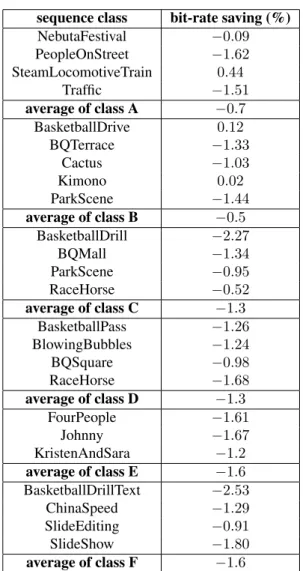
Table 2 shows the performance when the MDVQ codebooks are trained on sequences that are different from those used to measure the performance. This is the realistic use case. One can observe an average bitrate saving of 1.1%. Interestingly, a larger gain is observed for low-resolution sequences which are usually more difficult to compress, this being attributed to the larger proportion of 4 × 4 and 8 × 8 TU blocks. The method also performs well on videoconference (class E) and screen content (class F) sequences. The higher performance shown in section 3.1 indicates that gains may be obtained with a realistic adaptive codebook approach.
sequence class bit-rate saving (%) NebutaFestival −0.09 PeopleOnStreet −1.62 SteamLocomotiveTrain 0.44 Traffic −1.51 average of class A −0.7 BasketballDrive 0.12 BQTerrace −1.33 Cactus −1.03 Kimono 0.02 ParkScene −1.44 average of class B −0.5 BasketballDrill −2.27 BQMall −1.34 ParkScene −0.95 RaceHorse −0.52 average of class C −1.3 BasketballPass −1.26 BlowingBubbles −1.24 BQSquare −0.98 RaceHorse −1.68 average of class D −1.3 FourPeople −1.61 Johnny −1.67 KristenAndSara −1.2 average of class E −1.6 BasketballDrillText −2.53 ChinaSpeed −1.29 SlideEditing −0.91 SlideShow −1.80 average of class F −1.6
Table 2: Bitrate savings using sequence-independent code-books
We show in Fig. 2 for the sequence RaceHorse of class D, the blocks on which the MDVQ-based residue coding is performed.
Fig. 2. Blocks on which MDVQ-based residue coding is per-formed
3.3. Complexity aspects
The proposed approach requires that codebooks are stored in the encoder and decoder. In general, vector quantization tends to impose a much larger complexity burden on the en-coder (because of the search for the best codebook vector) than it does on the decoder (where a simple table look-up is needed). Therefore, it can be viewed as a tool that the encoder can optionally choose to use to further improve the compression, at the expense of some complexity, while the decoder can always easily support it. Furthermore, it is up to the encoder implementer to choose among the wide set of fast vector quantization methods (including tree-structured VQ) or other encoder-side optimization. For instance, to reduce the complexity, the use of MDVQ can be limited to the most frequent intra prediction modes.
4. CONCLUSION
We have presented a new approach for coding the intra predic-tion residues in an HEVC based encoder. This novel method can also be seen as a second-order prediction which aims to further remove remaining correlation in first-order intra pre-diction residues. The method is based on vector quantiza-tion with a codebook tailored for each intra predicquantiza-tion mode. Each codebook is hence learned considering a set of resid-ual signals obtained when using a specific intra prediction mode. This training set of residual signals is further limited to the blocks for which the VQ will bring improved RD perfor-mance when compared to the reference HEVC encoding. Fi-nally, these codebooks are QP independent, limiting the coder and decoder storage requirements.
5. REFERENCES
[1] W.J. Han G.J. Sullivan, J.R. Ohm and T. Wiegand, “Overview of the high efficiency video coding HEVC
standard,” in Transaction on Circuits and Systems for Video Technology. IEEE, December 2012, vol. 22, pp. 1646–1668.
[2] Y. Ye and M. Karczewicz, “Improved h.264 intra coding based on bi-directional intra prediction, directional trans-form, and adaptive coefficient scanning,” in IEEE Conf. Image Process, October 2008, pp. 2116–2119.
[3] A. Gersho and R. M. Gray, “Vector quantization and sig-nal compression,” in Kluwer Academic Press. Springer, 1992, pp. 649–654.
[4] S.-W. Wu and A. Gersho, “Enhanced video compression with standardized bitstream syntax,” in Proc. IEEE Int. Conf. Acoust., Syst., Signal Process. IEEE, April 1993, pp. 103–106.
[5] T. Wiegand, M. Lightstone, D. Mukherjee, T. G. Camp-bell, and S. K. Mitra, “Rate-distortion optimized mode selection for very low bit rate video coding and the emerging h.263 standard,” in Transaction on Circuits and Systems for Video Technology. IEEE, April 1996, vol. 6, pp. 182–190.
[6] “Hevc test model (online),” http://hevc.hhi. fraunhofer.de/svn/svn_HEVCSoftware. [7] F. Bossen, “Common test conditions and software
ref-erence configurations,” in Joint Collaborative Team on Video Coding (JCT-VC) of ITU-T VCEG and ISO/IEC MPEG, February 2008.
[8] G. Bjøntegaard, “Calculation of average psnr differ-ences between rd-curves,” in ITU-T SG16 Q.6 Document. VCEG-M33, April 2008.