Science Arts & Métiers (SAM)
is an open access repository that collects the work of Arts et Métiers Institute of
Technology researchers and makes it freely available over the web where possible.
This is an author-deposited version published in: https://sam.ensam.eu Handle ID: .http://hdl.handle.net/10985/17331
To cite this version :
Giorgio DE PASQUALE, Marco MONTEMURRO, Anita CATAPANO, Giulia BERTOLINO, Luca REVELLI - Cellular structures from additive processes: design, homogenization and experimental validation - Procedia Structural Integrity - Vol. 8, p.75-82 - 2018
Any correspondence concerning this service should be sent to the repository Administrator : [email protected]
ScienceDirect
Available online at Available online at www.sciencedirect.comwww.sciencedirect.com
ScienceDirect
Structural Integrity Procedia 00 (2016) 000–000www.elsevier.com/locate/procedia
2452-3216 © 2016 The Authors. Published by Elsevier B.V.
Peer-review under responsibility of the Scientific Committee of PCF 2016.
XV Portuguese Conference on Fracture, PCF 2016, 10-12 February 2016, Paço de Arcos, Portugal
Thermo-mechanical modeling of a high pressure turbine blade of an
airplane gas turbine engine
P. Brandão
a, V. Infante
b, A.M. Deus
c*
aDepartment of Mechanical Engineering, Instituto Superior Técnico, Universidade de Lisboa, Av. Rovisco Pais, 1, 1049-001 Lisboa,
Portugal
bIDMEC, Department of Mechanical Engineering, Instituto Superior Técnico, Universidade de Lisboa, Av. Rovisco Pais, 1, 1049-001 Lisboa,
Portugal
cCeFEMA, Department of Mechanical Engineering, Instituto Superior Técnico, Universidade de Lisboa, Av. Rovisco Pais, 1, 1049-001 Lisboa,
Portugal
Abstract
During their operation, modern aircraft engine components are subjected to increasingly demanding operating conditions, especially the high pressure turbine (HPT) blades. Such conditions cause these parts to undergo different types of time-dependent degradation, one of which is creep. A model using the finite element method (FEM) was developed, in order to be able to predict the creep behaviour of HPT blades. Flight data records (FDR) for a specific aircraft, provided by a commercial aviation company, were used to obtain thermal and mechanical data for three different flight cycles. In order to create the 3D model needed for the FEM analysis, a HPT blade scrap was scanned, and its chemical composition and material properties were obtained. The data that was gathered was fed into the FEM model and different simulations were run, first with a simplified 3D rectangular block shape, in order to better establish the model, and then with the real 3D mesh obtained from the blade scrap. The overall expected behaviour in terms of displacement was observed, in particular at the trailing edge of the blade. Therefore such a model can be useful in the goal of predicting turbine blade life, given a set of FDR data.
© 2016 The Authors. Published by Elsevier B.V.
Peer-review under responsibility of the Scientific Committee of PCF 2016.
Keywords: High Pressure Turbine Blade; Creep; Finite Element Method; 3D Model; Simulation.
* Corresponding author. Tel.: +351 218419991.
E-mail address: [email protected]
Procedia Structural Integrity 8 (2018) 75–82
2452-3216 Copyright 2018 The Authors. Published by Elsevier B.V.
Peer-review under responsibility of the Scientific Committee of AIAS 2017 International Conference on Stress Analysis 10.1016/j.prostr.2017.12.009
10.1016/j.prostr.2017.12.009 2452-3216
Copyright © 2018 The Authors. Published by Elsevier B.V.
Peer-review under responsibility of the Scientific Committee of AIAS 2017 International Conference on Stress Analysis
ScienceDirect
Structural Integrity Procedia 00 (2017) 000–000www.elsevier.com/locate/procedia
2452-3216 © 2017 The Authors. Published by Elsevier B.V.
Peer-review under responsibility of the Scientific Committee of AIAS 2017 International Conference on Stress Analysis.
AIAS 2017 International Conference on Stress Analysis, AIAS 2017, 6-9 September 2017, Pisa,
Italy
Cellular structures from additive processes: design, homogenization
and experimental validation
Giorgio De Pasquale
a,*, Marco Montemurro
b, Anita Catapano
c,
Giulia Bertolino
a, Luca Revelli
aaPolitecnico di Torino, Dept. of Mechanics and Aerospace, Torino 10129, Italy bArts et Métiers ParisTech, I2M CNRS UMR 5295, Talence 33405, France cBordeaux INP, Université de Bordeaux, I2M CNRS UMR 5295, Talence 33405, France
Abstract
The importance of lightweight structures in many fields of engineering is well known since long time. The innovations in technological processes based on material addiction allow pushing the design towards challenging geometries and associated structural properties. Engineered materials like lattice structures can be theoretically used to modify the local material properties and strength with minimization of the mass of components; in practice, several issues are still to be solved in stabilization of additive processes and achieving repeatable structures able to pass qualification procedures. At this purpose, dedicated experimental and design methods like those reported in this paper are needed.
© 2017 The Authors. Published by Elsevier B.V.
Peer-review under responsibility of the Scientific Committee of AIAS 2017 International Conference on Stress Analysis.
Keywords: lattice structures; homogenisation; additive layer manufacturing; characterization; finite element method
1. Introduction
In biomechanics, current solutions for bone, dental and orthopedic implants are based on components made of metal alloys such as titanium alloys. These materials provide excellent resistance to corrosion in a biological reactive environment, biocompatibility, fatigue resistance, and high strength-to-weight ratios compared to other solutions.
* Corresponding author. Tel.: +39.011.0906912; fax: +39.011.0906999.
E-mail address: [email protected]
ScienceDirect
Structural Integrity Procedia 00 (2017) 000–000www.elsevier.com/locate/procedia
2452-3216 © 2017 The Authors. Published by Elsevier B.V.
Peer-review under responsibility of the Scientific Committee of AIAS 2017 International Conference on Stress Analysis.
AIAS 2017 International Conference on Stress Analysis, AIAS 2017, 6-9 September 2017, Pisa,
Italy
Cellular structures from additive processes: design, homogenization
and experimental validation
Giorgio De Pasquale
a,*, Marco Montemurro
b, Anita Catapano
c,
Giulia Bertolino
a, Luca Revelli
aaPolitecnico di Torino, Dept. of Mechanics and Aerospace, Torino 10129, Italy bArts et Métiers ParisTech, I2M CNRS UMR 5295, Talence 33405, France cBordeaux INP, Université de Bordeaux, I2M CNRS UMR 5295, Talence 33405, France
Abstract
The importance of lightweight structures in many fields of engineering is well known since long time. The innovations in technological processes based on material addiction allow pushing the design towards challenging geometries and associated structural properties. Engineered materials like lattice structures can be theoretically used to modify the local material properties and strength with minimization of the mass of components; in practice, several issues are still to be solved in stabilization of additive processes and achieving repeatable structures able to pass qualification procedures. At this purpose, dedicated experimental and design methods like those reported in this paper are needed.
© 2017 The Authors. Published by Elsevier B.V.
Peer-review under responsibility of the Scientific Committee of AIAS 2017 International Conference on Stress Analysis.
Keywords: lattice structures; homogenisation; additive layer manufacturing; characterization; finite element method
1. Introduction
In biomechanics, current solutions for bone, dental and orthopedic implants are based on components made of metal alloys such as titanium alloys. These materials provide excellent resistance to corrosion in a biological reactive environment, biocompatibility, fatigue resistance, and high strength-to-weight ratios compared to other solutions.
* Corresponding author. Tel.: +39.011.0906912; fax: +39.011.0906999.
76 Giorgio De Pasquale et al. / Procedia Structural Integrity 8 (2018) 75–82
2 Author name / Structural Integrity Procedia 00 (2017) 000–000
However, clinical experience and simulation results about the failure of this kind of implants shows relevant interface issues; in fact, the contact region between bone and prosthesis is affected by high local gradients of stress, due to the different structural response of the prosthesis and bone tissue. Due to this phenomenon the bone is induced to re-absorption and consequently the prosthesis is subject to collapse.
Lattice structures constitute an excellent solution for this type of applications: if properly designed they can ensure simultaneously the required porosity and mechanical strength of the bone tissue. In fact, they belong to a special class of lightweight structures that can withstand relatively high loads and possessing, at the same time, a regular customizable porosity that can accommodate bone cells and ensure the primary stability of the implant (Gibson and Ashby, 1981).
The lattice is composed of a modular unit which, periodically repeated in space, composes the volume of the component. One of the main properties of these structures is the possibility to modify the material relative density by changing the lattice geometry, with the same parent material. Thanks to this preliminary hypothesis, it is possible to scale the mechanical properties of the solid material to those of the entire elementary unit (Dallago and Luchin, 2016; De Pasquale 2107), often referred as representative volume element (RVE). By means of a general homogenization procedure it is possible to replace, at the macroscopic scale (i.e. that of the part), the true geometrical structure of the RVE by a homogeneous anisotropic continuum with equivalent elastic properties. These properties can be computed by means of different (and very general) homogenization schemes: the volume-average stresses method (Catapano and Montemurro 2014), the strain energy-based method (Montemurro et al. 2016).
Several approaches are available in literature for the optimum design of lattice structures. Some methods are based on topology optimization (Nguyen et al. 2012), other approaches include the use of analytical models for evaluating the basic mechanism of the fundamental unit and extend it to the whole component (Deshpande et al. 2001). Further methods are based on numerical models relying on the RVE behavior to describe the mechanical response of the whole lattice (Catapano and Montemurro, 2014; Montemurro et al. 2016; Webb et al. 1994). In (Catapano and Montemurro 2014; Montemurro et al. 2016) the homogenized behavior of the constitutive RVE is integrated in the framework of a multiscale optimization approach which aims at being general and considering all the design variables intervening at different scales. This multiscale optimization procedure, also called multiscale two-level (MS2L) approach, has been firstly introduced in (Montemurro et al. 2012) where it was applied to the least-weight design of a composite wing-box section. The MS2L approach is a very general technique to optimize complex structures at each relevant scale, so it is well suited for lattice structures. The MS2L methodology does not make use of simplifying hypotheses, it properly takes into account all design variables involved at each scale (micro-meso-macro) and it is based on the one hand upon the polar formalism (Montemurro 2015) to rigorously and smartly describe the behavior of anisotropic parts and on the other hand on the utilization of a special genetic algorithm (GA) (Montemurro et al. 2012; Montemurro et al. 2015) able to deal with optimization problems involving a variable number of design variables.
This work gives a brief overview of the application of the volume average stress-based homogenization method utilized in the framework of the MS2L methodology for the optimum design of lattice structures (by taking inspiration from previous research works (Catapano and Montemurro 2014; Montemurro et al. 2016)). The results obtained through this homogenization scheme are compared with those provided by simplified analytical methods (De Pasquale 2017). An experimental validation, through published results, of the proposed numerical homogenization approach is also presented. The main benefit of the proposed homogenization method is the prediction of the equivalent elastic properties of the lattice without using any preliminary simplified hypothesis. Moreover, this technique has no restrictions in terms of the RVE topology and materials: RVE of complex geometry composed of several constitutive phases can be easily integrated within the procedure and their equivalent elastic properties can be always computed without modifying the proposed homogenization scheme. Of course, the homogenization provides the connection between the microscopic scale, i.e. that of the RVE, and the macroscopic one represented by the overall lattice structure.
2. Samples fabrication
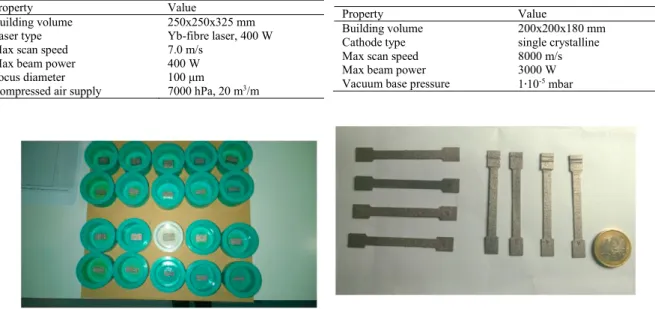
Samples are fabricated with SLM and EBM processes in Ti6Al4V alloy (De Pasquale et al. 2017). For the SLM process, the EOS M290 machine with 400W Yb-fibre laser is used (Tab. 1) and an Arcam Q10 (Tab. 2) machine is
used for EBM process. About the other instrumentation, the ATM Brillant 250 wet abrasive cut-off machine is used to cut the samples for internal inspections. The ultrasonic cleaner Sonica 3300 EP (9.5l tank capacity, 300W power heating, 70° max operative temperature) is used to remove contaminants from samples. After metal solidification, samples are thermally treated for stress relaxation with the vacuum furnace TAV (300x240x150 mm capacity, 1400 °C max temperature). Samples are cut to allow internal inspection with the optical microscope Zeiss Axio Observer, after resin encapsulation (Fig. 1a). The servo hydraulic testing machine Instron 8801 is used for mechanical tests on samples.
Table 1. Technical data of SLM machine (EOS M290). Table 2. Technical data of EBM machine (Archam Q10).
Property Value
Building volume 250x250x325 mm Laser type Yb-fibre laser, 400 W Max scan speed 7.0 m/s
Max beam power 400 W Focus diameter 100 μm
Compressed air supply 7000 hPa, 20 m3/m
Property Value
Building volume 200x200x180 mm Cathode type single crystalline Max scan speed 8000 m/s Max beam power 3000 W Vacuum base pressure 1∙10-5 mbar
Fig. 1. a) SLM samples encapsulated in resin prior optical inspection (left); b) samples for material characterization (right) (De Pasquale et al. 2017).
2.1. Samples for material characterization
The behavior of the base material constituting the lattice structure must be characterized before performing the numerical campaign by means of the proposed predictive models. Therefore dog-bone samples are preliminary fabricated (Fig. 1b) by respecting process parameters later used for lattice specimens. Two sample sets are fabricated, by using SLM and EBM processes respectively. For each set, two growth orientations are considered (horizontal and vertical) to evaluate the eventual anisotropy on both elastic and strength properties induced by the process.
Fig. 2. Samples used for experimental characterization of elastic properties of cubic-cells lattices (De Pasquale et al. 2017).
78 Giorgio De Pasquale et al. / Procedia Structural Integrity 8 (2018) 75–82
4 Author name / Structural Integrity Procedia 00 (2017) 000–000
2.2. Lattice samples
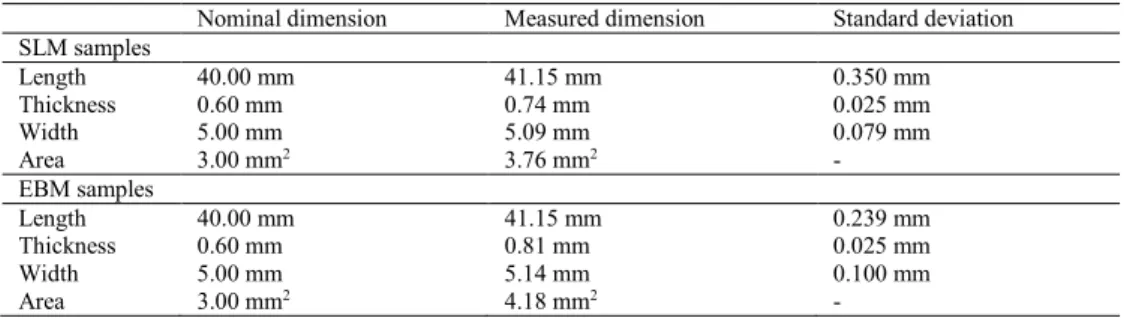
Preliminary EBM and SLM processes calibration based on design of experiments (DOE) is performed to define the best process parameters for fabricating lattice samples. Final dimensions of lattice samples are reported in Tab. 3 and sample shape is reported in Fig. 2.
Table 3. Lattice dimensions (De Pasquale et al. 2017).
Nominal dimension Measured dimension Standard deviation SLM samples Length 40.00 mm 41.15 mm 0.350 mm Thickness 0.60 mm 0.74 mm 0.025 mm Width 5.00 mm 5.09 mm 0.079 mm Area 3.00 mm2 3.76 mm2 - EBM samples Length 40.00 mm 41.15 mm 0.239 mm Thickness 0.60 mm 0.81 mm 0.025 mm Width 5.00 mm 5.14 mm 0.100 mm Area 3.00 mm2 4.18 mm2 -
3. Numerical homogenization of the lattice RVE
Lattice structures can be considered as composite materials where the two constitutive phases are bulk material, e.g. Ti6Al4V alloy, and vacuum. Therefore, at the microscopic scale the RVE of a lattice structure can be interpreted, from a mechanical viewpoint, as a heterogeneous medium, while at the macroscopic scale it can be modelled as an equivalent homogeneous anisotropic continuum (Catapano and Montemurro 2014; Montemurro et al. 2016, De Pasquale et al. 2017),. A proper analysis of these structures requires the investigation of the relevant phenomena involved at both scales.
In particular, for design purposes, it is quite cumbersome (and somewhat useless) to model all the geometrical details of the RVE at the macroscopic scale. If one represented the true geometry of the RVE at the scale of the component the resulting finite element (FE) model would be constituted by a huge number of elements, thus requiring a considerable computational effort in order to produce exploitable results.
When dealing with the analysis and design of cellular and/or lattice structures, the best practice is to make use of an homogenization procedure in order to replace, at the macroscopic scale, the true (and complex) geometry of the RVE by an equivalent homogeneous medium whose mechanical response is described by a set of “effective” (or equivalent) material properties. These properties can be computed through different homogenization schemes: volume average stress-based method, strain energy method, etc. Furthermore, although the bulk material constituting the lattice is isotropic, its macroscopic behavior (i.e. after homogenization) can be (in the most general case) completely anisotropic because its effective elastic properties depends upon the geometrical parameters of the RVE at the lower scale, thus being affected by the RVE orientation too. In the following the volume average stress-based homogenization scheme is briefly introduced.
3.1. Volume average stress-based homogenization method
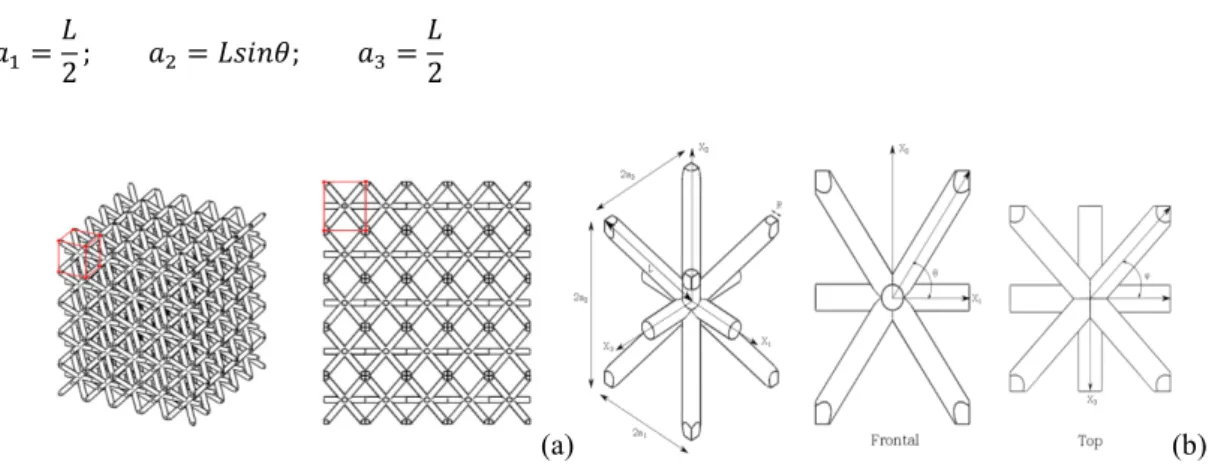
The lattice structure considered here is composed of octahedral elemental units in titanium alloy (Ti6Al4V). The lattice shows a periodic microstructure that fills the volume of the component. The homogenization technique is implemented to determine the mechanical behavior of the equivalent homogeneous anisotropic medium at the macroscopic scale. Fig. 3a shows the lattice structure, while the geometry of the RVE and its size are shown in Fig. 3b.
The overall size of the RVE depends upon two characteristic geometric parameters, i.e. the length of struts (L) and the angular orientation of struts (θ).
Fig. 3. a) Octet-truss RVE, b) RVE geometry and dimensions.
The main concept at the basis of this homogenization scheme is the equivalence between the strain energy of the lattice RVE and that of the equivalent homogeneous material replacing it. Because of this assumption, it is possible to estimate the components of the stiffness matrix [C] of the equivalent homogeneous material at the upper scale. Furthermore, taking into account the periodical nature of the lattice a set of prescribed periodic boundary conditions (PBCs) must be imposed to the RVE. At each time, these PBCs are applied in order to obtain only one component of the strain field different from zero: this strain field represents on the one hand the “exact solution” for the homogeneous medium and on the other hand the average strain field for the RVE of the lattice structure.
The constitutive law for the equivalent homogenous material (at the macroscopic scale) can be defined as (Voigt’s notation):
In Eq. (2.2)
{
𝜎𝜎̅} and
{𝜀𝜀̅} are the stresses and strains of the equivalent homogeneous continuum, respectively. The stiffness matrix components are determined, column by column, by solving six linear static analyses. In each static analysis the PBCs are imposed in such a way that only one component of the average strain field of the RVE is non null and equal to the imposed (arbitrary) strain.The six linear static analyses are implemented in ANSYS® environment and the PBCs are imposed automatically between couples of opposite nodes (belonging to opposite faces of the RVE, respectively). The set of PBCs for each analysis has been parametrized and coded within a dedicated macro (implemented according to the ANSYS parametric design language). Finally, the stiffness matrix components [C] are estimated (Eq. 2.4):
In Eq. (2.4) i corresponds to the actual static case (𝑖𝑖 = 1, … ,6).
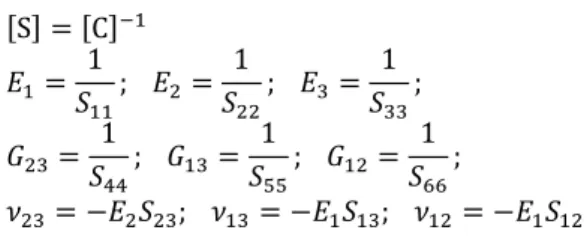
The elastic properties of the material can be derived from the material's compliance matrix [S] as follows (here below the example of an orthotropic material is shown):
𝑎𝑎1=𝐿𝐿2; 𝑎𝑎2= 𝐿𝐿𝐿𝐿𝑖𝑖𝐿𝐿𝐿𝐿; 𝑎𝑎3=𝐿𝐿2 (2.1) 𝜀𝜀𝑖𝑖𝑖𝑖 ̅̅̅ =𝑉𝑉 ∫𝜀𝜀1 𝑖𝑖𝑖𝑖𝑑𝑑𝑉𝑉 = 𝜀𝜀𝑖𝑖𝑖𝑖0, 𝑤𝑤𝑖𝑖𝑤𝑤ℎ 𝑖𝑖, 𝑗𝑗 = 1, … , 3 𝑉𝑉 . (2.2) {𝜎𝜎̅} = [C]{𝜀𝜀̅} . (2.3) Cαi= 𝜎𝜎̅̅̅ =𝛼𝛼 𝑉𝑉1∫𝜎𝜎𝛼𝛼𝑖𝑖(𝑥𝑥1, 𝑥𝑥2, 𝑥𝑥3)𝑑𝑑𝑉𝑉 𝑤𝑤𝑖𝑖𝑤𝑤ℎ 𝛼𝛼 = 1, … , 6 𝑉𝑉 (2.4) (a) (b)
80 Giorgio De Pasquale et al. / Procedia Structural Integrity 8 (2018) 75–82
6 Author name / Structural Integrity Procedia 00 (2017) 000–000
3.2. Finite element model of the RVE
The octahedral elementary volume is modeled by means of 20-nodes solid elements (SOLID186), having 3 degrees of freedom per node (Fig. 4). A FE model made of brick elements is needed to provide a realistic representation of the RVE geometry and to accurately estimate the 3D stress field within the cell, thus the resulting effective properties at the macroscopic scale. The FE model is generated through an ad-hoc automated script in which both geometry and mesh have been properly related to the relevant parameters of the RVE.
Fig 4. 3D FE model of the RVE.
A convergence study in terms of the average element size (for both the transverse section of the beams composing the RVE and the beam span) has been conducted in order to verify the influence of this parameter on the effective elastic properties of the RVE. The mesh size parameters for each region of the RVE (i.e. beam section and beam span) are listed in Table 4.
Table 4. Element size for the sensitivity analysis. Mesh type Average element size
in beam section Average element size along beam span 𝐿𝐿 (𝑚𝑚𝑚𝑚) 𝐷𝐷 (𝑚𝑚𝑚𝑚)
1 𝑅𝑅/𝑛𝑛 𝑅𝑅/𝑛𝑛 2 0.45
2 𝑅𝑅/𝑛𝑛 𝐿𝐿/6 2 0.45
3 𝑅𝑅/𝑛𝑛 𝐿𝐿/8 2 0.45
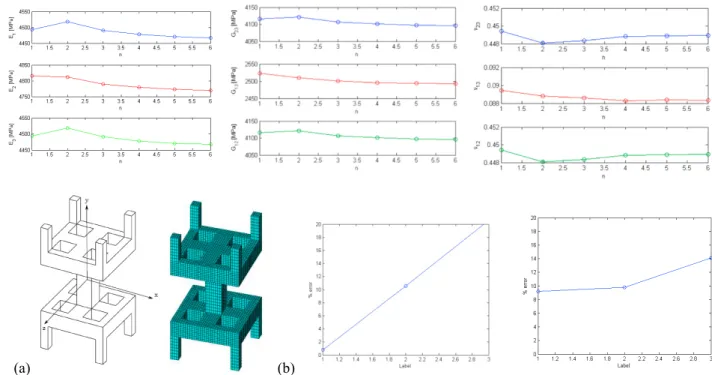
In Table 4, parameter n represents the number of division varying from one to six. Fig. 5 illustrates the trend of the Young's moduli, the shear moduli and Poisson’s ratios of the equivalent homogeneous material when varying the number of divisions. These results show that the technique is basically insensitive to the mesh size.
[S] = [C]−1 𝐸𝐸1=𝑆𝑆1 11; 𝐸𝐸2= 1 𝑆𝑆22; 𝐸𝐸3= 1 𝑆𝑆33; 𝐺𝐺23=𝑆𝑆1 44; 𝐺𝐺13= 1 𝑆𝑆55; 𝐺𝐺12= 1 𝑆𝑆66; 𝜈𝜈23= −𝐸𝐸2𝑆𝑆23; 𝜈𝜈13 = −𝐸𝐸1𝑆𝑆13; 𝜈𝜈12= −𝐸𝐸1𝑆𝑆12 (2.5)
Fig. 5. Elastic properties of the equivalent homogeneous material vs the number of divisions
Figure 6. a) FE model of the RVE utilized in the homogenization analysis, b) percent error between numerical and experimental value of the Young’s modulus along y axis.
4. Experimental validation
The validation of the results provided by the homogenization procedure is carried out through a comparison with experiments. At this purpose, the results obtained on cubic cell lattices in (De Pasquale et al. 2017) are used as experimental references. The elastic constants are calculated by homogenization on the same cubic cell.
The force-displacement curve is measured for each sample and the macroscopic stiffness is obtained. The homogenization method is applied to the RVE represented in Fig. 6a and referred to the samples utilized in the tests.
In Fig. 6b the first plot refers to the SLM specimens while the second one to the EBM sample. Of course, the cell size and the number of RVEs within the 3D array affect the accuracy of results: the free edge effects are minimized in the case of the first SLM sample that is composed of 20x20x23 RVEs and characterized by a relative error lower than 1%.
5. Conclusions
The numerical homogenization procedure proposed in this work is characterized by several features that make it an effective and general method for the multi-scale design of complex lattice structures.
On the one hand, the proposed approach is not submitted to restrictions and preliminary hypotheses that extremely shrink the design domain: any parameter characterizing the structure can constitute a design variable. This allows the designer to look for true global optimum solutions (hard to be obtained otherwise) when the proposed homogenization scheme is integrated in the framework of a multiscale design/optimization process.
On the other hand the proposed numerical homogenization method is very general and allows for evaluating the macroscopic elastic properties of lattice structures, regardless to their nature and topology.
Finally, the effectiveness of the homogenization method applied to lattice structures has been proven through an accurate experimental campaign.
82 Giorgio De Pasquale et al. / Procedia Structural Integrity 8 (2018) 75–82
8 Author name / Structural Integrity Procedia 00 (2017) 000–000
References
Barbero, E.J., 2008. Finite element analysis of composite materials, CRC Press.
Catapano, A., Montemurro, M., 2014. A multi-scale approach for the optimum design of sandwich plates with honeycomb core. Part I: homogenisation of core properties. Composite Structures 118, 664-676.
Catapano, A., Montemurro, M., 2014. A multi-scale approach for the optimum design of sandwich plates with honeycomb core. Part II: the optimization strategy. Composite Structures 118, 677-690.
Dallago, M., Luchin, V., 2016. Stiffness of 2D cellular square cell structures, 45° National Congress AIAS.
De Pasquale, G., Luceri, F., Riccio, M., 2017. Experimental characterization of EBM and SLM cubic lattice structures for lightweight applications. Sub. To Experimental Mechanics.
De Pasquale, G. Analytic homogenization of cubic lattices in the elastic field for AM applications. Sub. to Int. J. of Solids and Structures. Deshpande, V.S., Fleck, N.A., Ashby, M.F., 2001. Effective properties of the octet-truss lattice material. Journal of the Mechanics and Physics of Solids 49, 1747-1769.
Gibson, L.J., Ashby, M.F., 1981. The mechanics of three-dimensional cellular materials, Royal Society Publishing. Jones, R.M., 1999. Mechanics of composite materials, Taylor and Francis Ed.
Montemurro, M., Catapano, A., Doroszewski, D., 2016. A multi-scale approach for the simultaneous shape and material optimisation of sandwich panels with cellular core. Composites Part B: Engineering 91, 458-472.
Montemurro, M., Vincenti, A., Vannucci, P., 2012. A Two-Level Procedure for the Global Optimum Design of Composite Modular Structures-Application to the Design of an Aircraft Wing. Part 1: theoretical formulation. Journal of Optimization Theory and Structures-Applications 155, 1-23. Montemurro, M., Vincenti, A., Vannucci, P., 2012. A Two-Level Procedure for the Global Optimum Design of Composite Modular Structures-Application to the Design of an Aircraft Wing. Part 2: numerical aspects and examples. Journal of Optimization Theory and Structures-Applications 155, 24-53.
Montemurro, M., 2015. An extension of the polar method to the First-order Shear Deformation Theory of laminates. Composite Structures 127, 328-339.
Montemurro, M., 2015. Corrigendum to" An extension of the polar method to the First-order Shear Deformation Theory of laminates"[Compos. Struct. 127 (2015) 328-339]. Composite Structures 131, 1143-1144.
Montemurro, M., Vincenti, A., Vannucci, P., 2015. The automatic dynamic penalisation method (ADP) for handling constraints with genetic algorithms. Computer Methods in Applied Mechanics and Engineering 256, 70-87.
Nguyen, J., Park, S.I., Rosen, D.W., Folgare, L., Williams, J., 2012. Conformal Lattice Structure Design and Fabrication. Solid Freeform Fabrication Proceedings Symposium.
Webb, D.C., Kormi, K., Al-Hassani, S.T., 1994. Use of FEM. in performance assessment of perforated plates subject to general loading conditions. International Journal of Mechanical Sciences, 64, 137-152.