Hybrid process, electrocoagulation-biofiltration for landfill leachate
treatment
Oumar Dia
a, Patrick Drogui
a,⇑, Gerardo Buelna
b, Rino Dubé
b aInstitut national de la recherche scientifique (INRS-Eau Terre et Environnement), Université du Quebec, 490 rue de la Couronne, Quebec, QC G1K 9A9, Canada b
Centre de Recherche Industrielle du Québec (CRIQ), 333 rue Franquet, Québec, QC G1P 4C7, Canada
a r t i c l e i n f o
Article history: Received 3 August 2017 Revised 25 December 2017 Accepted 9 February 2018 Available online xxxx Keywords: Landfill leachate Electrocoagulation Biofiltration Humic acids Fulvic acids Aluminum anodea b s t r a c t
Landfill leachates are known for their high and complex composition of organic, inorganic and microbial pollutants. As a result, it is quite challenging to treat these effluents by using only one treatment process. A combining approach is generally required to treat efficiently these wastewaters and comply with the discharge standards. In this present study, electrocoagulation (EC) and biofiltration (BF) processes were sequentially used to treat landfill leachate. EC process has been able to remove 37 ± 2% of the initial total COD. A fractionation of organic compounds showed that EC was particularly efficient to remove insoluble COD and humic acids. In addition, other pollutants such as turbidity, true color, Zn and phosphorus were significantly reduced by EC with 82 ± 2.7%, 60 ± 13%, 95 ± 2.6% and 82 ± 5.5% of removal respectively. The subsequent treatment by BF process led to completely removal of ammonia pollution (>99% of NH4
removal) and a partial removal of dissolved organic compounds (42 ± 7% of COD removal). The hybrid process EC/BF could form the basis of a process capable of removing organic and inorganic pollutants from many refractory wastewaters (mature landfill leachates, industrial and municipal wastewaters).
Ó 2018 Elsevier Ltd. All rights reserved.
1. Introduction
Landfill leachate is generated after the percolation of water (rainfall, melting snow) and solid wastes moisture through a land-fill. During this percolation, different types of organic, inorganic and microbial pollutants are extracted out of the biosolids and car-ried by the leachate (Wiszniowski et al., 2006). Hence, this later should be captured and treated properly to avoid groundwater and surrounding surface water contamination. Among other fac-tors, the age of the landfill and the nature of the buried biosolids have the most significant impact on landfill leachate characteris-tics (Renou et al., 2008). In the case of sanitary landfill, the leachate can be classified into 3 groups based on the age of the landfill, ‘‘young”, ‘‘intermediary” and ‘‘mature” landfill leachates (Renou et al., 2008). The ‘‘young” leachates are generally from landfill which have <5 years old and are known for their high concentra-tion of biodegradable organic compounds (Renou et al., 2008). By contrast, ‘‘mature” leachates are usually from old landfill with
>10 years old. These leachates are characterized by moderate con-centrations of organic matter with a high proportion of refractory compounds mainly composed of humic substances (Mandal et al., 2017).
Biological processes (BP) are traditionally used for the treat-ment of landfill leachate. The use of BP is mainly justified by their simplicity, a low treatment cost, and a good performance for the removal of biodegradable organic materials and nitrogen (Kurniawan et al., 2006). However, these technologies face some limits when it is come to deal with ‘‘mature” leachates with a high proportion of bio-refractory compounds (Xiao et al., 2013). To overcome this issue, BP can be coupled with other non-biological systems to increase the purification efficiency (Mandal et al., 2017). Among these combinations, electrocoagulation (EC) process could be an interesting approach to support a biological system in a treatment system. The principle of EC consists to generate coag-ulant agents such as Al3+or Fe2+by applying a current intensity
between a cathode and a sacrificial anode. These coagulants can then interact with the colloids by disturbing their stability and leading to the formation of flocs capable to settle down. The main advantages of EC are a low sludge production in comparison to the chemical coagulation, a low or no chemical reagents requirement, short treatment time, and an easy automation (Drogui et al., 2007). Depending on the treatment needs, the BP can be used as a pre-treatment or postpre-treatment step. In our previous study, we did
https://doi.org/10.1016/j.wasman.2018.02.016
0956-053X/Ó 2018 Elsevier Ltd. All rights reserved.
Abbreviations: BF, biofiltration; BFM, biofiltration media; BP, biological process; EC, electrocoagulation; ECLL, electro-coagulated landfill leachate; FA, fulvic acids; HA, humic acids; Hyl, hydrophilic compounds; j, current density.
⇑ Corresponding author.
E-mail addresses: [email protected] (O. Dia), [email protected]
(P. Drogui),[email protected](G. Buelna),[email protected](R. Dubé).
Contents lists available atScienceDirect
Waste Management
j o u r n a l h o m e p a g e : w w w . e l s e v i e r . c o m / l o c a t e / w a s m a n
investigate the possibility to treat landfill leachate by using biofil-tration (BF) as a pretreatment process followed by EC as a sec-ondary treatment (Oumar et al., 2016). This configuration showed a very good performance in terms of COD, nitrogen, phos-phorus, turbidity, and color removals. However, the main problem-atic related to this configuration was the electrochemical reduction of nitrate to ammonia during the EC. In fact, nitrate ions produced from the nitrification of ammonia during the BF were transformed back to ammonia during the subsequent EC treatment and raising the ammonia concentration in the treated effluent. This phe-nomenon of ammonia electro-production can be alleviated by using a cathode with low hydrogen overpotential such as platinum or titanium platinized (Dia et al., 2017; Dima et al., 2005). How-ever, these materials are costly and their use in EC process might be questionable. Another way to avoid this phenomenon is to reverse the configuration by putting the EC as a pretreatment pro-cess before the biological system. Nevertheless, there are also some uncertainties regarding this configuration such as very low phos-phorus concentration after the EC and the impact of the residual metallic coagulants on the biological treatment.
The main objective of this research was to investigate the tech-nological uncertainties related to the successive use of EC and BF for mature landfill leachate treatment. To do so, the performance of each process had been evaluated in terms of COD, NH4,
phospho-rus and metals removal. A particular attention was paid to the organic matter by making its fractionation in order to know which organic fractions were preferentially removed by each process.
2. Material and methods
2.1. The raw landfill leachate
The landfill leachate used in this study was sampled from a municipal landfill located in the province of Québec, Canada. This landfill is operated since 2000 and receives about 25,000 tons of biosolids per year. The buried biosolids are mainly comprised of household wastes. Around 80 L of leachate was sampled from an unaerated storage tank where the raw landfill leachate was stocked before any treatment. The sampling operation was carried out during a sunny October 2015 day. The leachate was then sealed in polypropylene buckets and kept at 4°C before utilization.Table 1
shows the average initial concentrations of the raw landfill lea-chate and the guidelines from Quebec province for lealea-chate dis-charge in the environment (MDDELCC, 2009).
2.2. EC setup
The EC experiments were carried out in batch mode using a cylindrical reactor with a capacity of 1.5 L (Fig. 1). The electrodes were arranged in a concentric manner by using a cylindrical hollow as a cathode and a full cylindrical rod as an anode. The anode was
made of pure aluminum metal while the cathode was in stainless steel. The inner diameter and the length of the cathode were respectively 5 and 72 cm, representing an area of 1130 cm2. With regard to the anode, this later had a diameter and a length of 1.9 and 79.8 cm respectively; corresponding to an anodic surface of 476 cm2. The distance between the electrodes was 1.55 cm. The
raw landfill leachate was introduced from the top of the reactor by a conical opening and then recirculated in a closed loop by a mean of centrifugal pump. After the treatment, the leachate was withdrawn out of the reactor via a drain valve located at the bot-tom of the system. This drain valve was also used to sample the leachate when the system was running. The EC cell was operated under galvanostatic mode by using a DC power supplier, Xantrex XFR40-70 (Aca Tmetrix, Mississauga, ON, Canada) to apply the desired current intensity. The EC cell was cleaned by recirculating tap water in the reactor after each experiment. A more rigorous cleaning with 5% sulfuric acid was conducted after each set of five experiments. The anodic rod was mechanically polished with sand-paper before each experiment. At the end of the experiment, the effluent was naturally settled down for at least one hour before to sample the supernatant. The samples were analyzed at the same day or kept at 4°C for later analysis.
2.3. Biofiltration unit
The biological treatment was performed using an aerated BF column garnished with a mixture of peat and wood chips. The PVC column was 7.6 cm in diameter and 70 cm height. The compo-sition of the biofilter media was (from the top to the bottom), 3.12 cm (wood chips), 9.37 cm (80% of wood chips + 20% of peat), 9.37 cm (wood chips), 28.12 cm (80% of wood chips + 20% of peat). Note that the given percentages are expressed as volumetric percent-ages. The biofilter was operated in countercurrent mode, the land-fill leachate was introduced at the top of the column while the air was injected from the bottom. A peristaltic pump was used to feed the biofilter with the electro-coagulated landfill leachate (ECLL). Given the low values of BOD, ammonia was chosen as the critical parameter during the biological treatment. Hence, the feeding flow rate was set at a specific value, depending to the inlet ammonia concentration, in order to respect a nitrogen load of 0.055 kg of N-NH4m 2d 1. The biofilter was aerated with a compressed air
at a flow rate of 0.4 L min 1corresponding to a superficial velocity
of 5.33 m h 1. The biomass acclimation was carried out using the
raw landfill leachate as inoculum. The BF unit was operated at room temperature at around 22 ± 2°C and its clogging was con-trolled by measuring the inlet and outlet flow rate every four days.
2.4. Experimental design
After the physio-chemical characterization of the raw landfill leachate, this later was subjected to EC treatment. The objective
Table 1
Raw landfill leachate characteristics and Québec province discharge standards.
Parameters Units Raw landfill leachate Québec regulation na
Total COD mg L 1 1619 ± 49 – 3 BOD5 mg L 1 460 65 1 BOD/COD – 0.29 – 1 Conductivity mS cm1 5.29 – 1 pH – 7.83 ± 0.17 6–9.5 4 Alkalinity mg CaCO3L1 4301 ± 1067 – 3 Turbidity NTU 178.75 ± 54 – 4 N-NH4 mg L 1 653 ± 38 10 4 P-t mg L 1 4.89 ± 0.39 – 4 Zn mg L 1 1.46 ± 0.06 0.07 4 Fe mg L 1 24.74 ± 8.7 – 4 a Number of analysis.
was to determine the best conditions in terms of current density and treatment time. Thus, the influence of different current densi-ties (3, 5, 8, 10 and 15 mA/cm2
) and treatment time (5, 10, 15, 20 and 30 min) was tested on the COD removal. After finding the best EC operating conditions for raw landfill leachate treatment, dupli-cate experiments were conducted using these conditions. In addi-tion to COD, others pollutants such as TOC, nitrogen, phosphorus, alkalinity, color and metals were analyzed as well. Thereafter, at the end of 40 days of acclimation with the raw landfill leachate, the biofiltration unit was then fed with the electro-coagulated landfill leachate. The aerated biofilter was operated continuously during 120 days with an average flow rate of 365 ± 0.4 mL d 1. In
order to assess to performance of the biofiltration treatment, sam-ples were taken twice a week from the outlet of the biofilter col-umn. Different types of pollutants such as COD, TOC, NH4, NO3,
phosphorus, color, turbidity, alkalinity and metals were carried out on these samples. The removal percentages and the initial and final concentrations given in this manuscript are average val-ues obtained during the operating period with the associated stan-dard deviations.
2.5. Analytical methods
All the reagents used were analytical grade with at least 97% purity. The Chemical Oxygen Demand (COD) was measured using the colorimetric method (closed reflux) (APHA, 1998). Ammonia (NH4+) and nitrate (NO3) were respectively measured by the
salicy-late and atrazine methods approved by USEPA (USEPA, 1979a, 1979b). BOD5samples were frozen and sent to an accredited
exter-nal laboratory (AGAT laboratoires, Québec, Canada) and the aexter-naly-
analy-sis was performed using an electrometric method (APHA, 2012). The pH was measured with a pH meter (Accumet Excel XL25, Fisher Scientific Co) connected to a Cole-Palmer double junction electrode (Ag/AgCl reference). The conductivity was determined using a Mettler Toledo conductivity meter (S230 SevenCompactTM Conductivity,) connected to a Mettler Toledo InlabÒ731-2m con-ductivity electrode. A 2100 N HACH turbidity meter was used to measure the turbidity. The total alkalinity was determined by a colorimetric titration using a 0.02 N sulfuric acid and methyl-orange as titrating agent and color indicator respectively. The true color of the samples was analyzed according to the platinum-cobalt method (APHA, 2005). To avoid any interference with the suspended particles, samples were centrifuged at 15,000g during 15 min before color measurement. Metallic ions, including phos-phorus, were measured using a mass spectrophotometry technique (ICP Optical Emission Spectrometer, VARIAN 725-ES). Before the metals analysis, samples were digested at 95°C for two hours in a mixture of nitric acid (10% v/v) and hydrogen peroxide (15% v/ v). Total Organic Carbon (TOC) was estimated using a Shimadzu TOC 5000A analyzer (Shimadzu Scientific Instruments Inc).
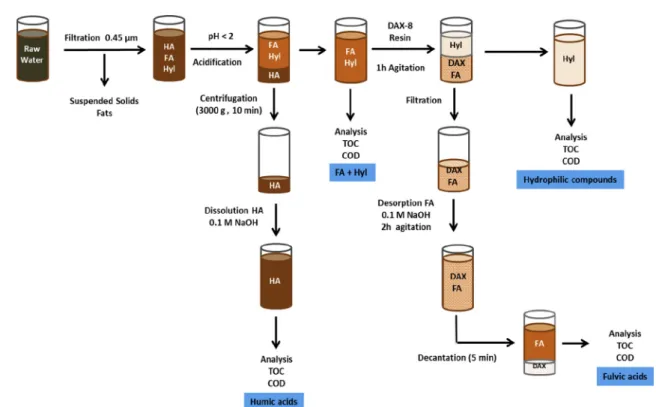
The organic matter (OM) was fractionated based on the method described byVan Zomeren and Comans (2007).Fig. 2shows the different step of the OM fractionation. The OM was separated into three groups, humic acids (HA), fulvic acids (FA) and hydrophilic compounds (Hyl). The HA fraction was extracted by centrifugation after precipitation under pH < 2. The supernatant (FA and Hyl) was then mixed with a non-ionic and slightly polar resin (SupeliteTM DAX-8, Sigma-Aldrich Co) in order to adsorb the FA onto the resin surface while the Hyl fraction remained in the supernatant. After separating the resin from the slurry, the FA was desorbed using a Fig. 1. Electrocoagulation set-up.
0.1 N sodium hydroxide solution. The experiments were conducted in duplicate and COD as well as TOC analysis were performed on each organic fraction.
3. Results and discussion
3.1. Electrocoagulation of raw landfill leachate
3.1.1. Influence of current density and treatment time
Current intensity and treatment time are the most important parameters of EC process. These parameters define the amount of
coagulant (Al3+) introduced in the reactor. In order to determine
the best conditions for COD removal in terms of current density and treatment time, different values of these parameters were applied on the raw landfill leachate. The obtained results are pre-sented inFig. 3. From this figure, it can be seen that, for the low current densities (3–5 mA cm 2), the COD elimination increased
when the current density and the treatment time increased. How-ever, no significant COD removal was recorded when the current density was increased in the range of 5–15 mA cm 2. Nonetheless, a current density of 8 mA cm 2and a treatment time of 20 min had
been chosen as the best conditions for COD removal. This choice was justified by the lowest residual COD concentration recorded. Fig. 2. Different steps organic matter fractionation.
850 950 1050 1150 1250 1350 1450 1550 0 5 10 15 20 25 30
COD (mg/L)
Time (min)
3mA/cm2 5 mA/cm2 8 mA/cm2 10 mA/cm2 15 mA/cm2Fig. 3. Influence of current densities and treatment time on COD removal.
The concentration of COD continued to decrease slowly after 20 min of treatment. A treatment time of 20 min was selected in order to minimize the energy consumption. Under these conditions, 37 ± 2% of COD was removed. The corresponding amount of electrical charge and theoretical dissolved aluminum were 3040 A.s L 1
and 0.28 g of Al L 1, respectively. It is worth noting that the most
important part of the total COD removal (82%) was achieved within the first 15 min of the experiment. This kinetic behavior could be explained by the presence of some organic fractions that were preferentially removed by the EC process than others. A fractiona-tion of the organic matter was conducted before and after EC in order to assess the efficiency of EC process on each organic fraction.
3.1.2. Dissolved organic matter fractionation
In order to investigate the efficiency of the EC process for differ-ent organic fractions, the landfill leachate was fractioned into three groups based on their polarity properties (HA, FA and Hyl). The fractionation was carried out before and after EC treatment. TOC and COD measurements were carried out for different fractions. The results for TOC and COD are presented inFigs. 4 and 5 respec-tively. The total dissolved TOC of raw landfill leachate was com-prised of 5.3% of HA, 36.0 ± 0.9% of Hyl and, 45.4 ± 0.6% of FA (Fig. 4). After EC treatment, only 15.1% of TOC was removed. Even though the HA fraction represented a small percentage of TOC (5%), it was effectively removed by EC (71.3 ± 0.8% of HA). However, Hyl and FA compounds were not effectively removed. Only 4.4 ± 1.1% of Hyl and 11.9 ± 1.9% FA were respectively removed. This discrep-ancy in removing HA, FA and Hyl compounds was reported by some authors while using EC or chemical coagulation for the treat-ment of effluents containing high concentration of humic materials
(Hall and Packham, 1965; Labanowski et al., 2010; Wu et al., 2011). The relatively high removal rate of humic acids could be explained by the fact that this organic fraction presents high molecular weights (10–100 KDa) (Stevenson, 1994) and negative surface charges that can react and co-precipitate with positive charges of metallic hydroxides formed during coagulation process. On the other hand, Hyl and FA compounds having lower molecular weights (<500 Da for Hyl and 1–10 KDa for HA) showed less inter-actions with the metallic hydroxides and tend to remain in solution.
The COD analysis of the three organic fractions is shown in
Fig. 5. The raw landfill leachate COD was comprised of 12.1 ± 1.5 % of HA, 27.3% of Hyl and 41.8 ± 1.1% of FA. These proportions were slightly different with those obtained with TOC measurements. For example, the HA fraction had increased by 6%, whereas Hyl fraction decreased by 7.7% in comparison with TOC percentages. This could be explained by the difference of molecular structure between these two organic fractions. In fact, HA molecular structure con-tains a limited amount of oxygen and many aromatic rings (Huo et al., 2008). Hence, more chemical oxidants were required to oxi-dize these molecules and this led to the increase of COD. By con-trast, the Hyl fraction, comprised of small molecular weight compounds, is easier to oxidize. According to Fig. 5, the overall removal of dissolved COD was 23.5%. This was mainly attributed to HA removal (83.6 ± 9.6% of HA removed), a small fraction of FA (7.8 ± 4.6% of HA removed) and probably, the hydrophobic com-pounds which were not take account in this study.
It is worth underlining that the removal of dissolved COD (23.5%) was quite lower than the total COD removal (37 ± 2%) (Fig. 3). This difference can be attributed to the insoluble COD which was efficiently removed during EC treatment. This insoluble organic matter was mainly comprised of humin which is the humic substances fraction insoluble in water at any pH. Overall, it can be concluded that the HA fraction and the insoluble organic matter were preferentially removed during EC treatment of raw landfill leachate. Other organic fractions such as FA and Hyl compounds were poorly removed.
3.1.3. Performances of EC for other pollutants
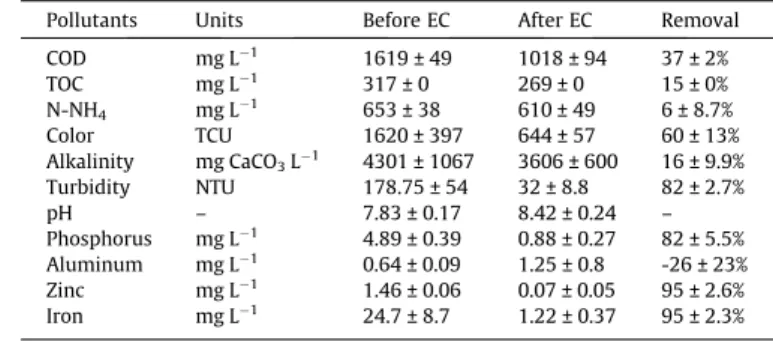
Table 2summarizes the performances of EC for other pollutants removals (turbidity, color, phosphorus, nitrogen, alkalinity and metals) under the best operating conditions (j = 8 mA cm 2and t
= 20 min). It is important to mention that the values given in this table were the average values obtained from the analysis of electro-coagulated landfill leachate (ECLL). It can be seen that the NH4removal was not significant. This was expected because it is
well known that EC has low efficiency for ammonia removal. Other studies have also reported low ammonia removal using EC process to treat landfill leachate (Bouhezila et al., 2011; Ilhan et al., 2008; Poveda et al., 2016). Turbidity, color, and metals were effectively 0 50 100 150 200 250 300 350 Total HA Hyl FA T O C (m g C L -1) Raw leachate after EC
Fig. 4. TOC of different organic fractions before and after EC, Conditions, Anode = Al, j = 8 mA cm2 and t = 20 min. 0 200 400 600 800 1000 1200 Total HA Hyl FA COD (mg L -1) Raw leachate after EC
Fig. 5. COD of different organic fractions before and after EC, Conditions, Anode = Al, j = 8 mA cm2
and t = 20 min.
Table 2
Performances of EC for the treatment of raw landfill leachate. Conditions, Anode = Al, j = 8 mA cm 2
and t = 20 min.
Pollutants Units Before EC After EC Removal
COD mg L1 1619 ± 49 1018 ± 94 37 ± 2% TOC mg L1 317 ± 0 269 ± 0 15 ± 0% N-NH4 mg L1 653 ± 38 610 ± 49 6 ± 8.7% Color TCU 1620 ± 397 644 ± 57 60 ± 13% Alkalinity mg CaCO3L 1 4301 ± 1067 3606 ± 600 16 ± 9.9% Turbidity NTU 178.75 ± 54 32 ± 8.8 82 ± 2.7% pH – 7.83 ± 0.17 8.42 ± 0.24 – Phosphorus mg L1 4.89 ± 0.39 0.88 ± 0.27 82 ± 5.5% Aluminum mg L1 0.64 ± 0.09 1.25 ± 0.8 -26 ± 23% Zinc mg L1 1.46 ± 0.06 0.07 ± 0.05 95 ± 2.6% Iron mg L1 24.7 ± 8.7 1.22 ± 0.37 95 ± 2.3%
removed after EC treatment. 60 ± 13% of true color was removed and this was probably due humic acids removal. In fact, humic acids have a high coloring capacity in spite of its low portion in raw landfill leachates. Among other metals, zinc and iron were effi-ciently removed (95 ± 2.6% of Zn removed and 95 ± 2.3% of Fe removed). The good removal of metals by EC process could be attributed to precipitation, co-precipitation and cathodic elec-trodeposition (Drogui et al., 2007). However, aluminum ions con-centration increased after the treatment because of the use of aluminum as sacrificial anode. Finally, the total phosphorus con-centration was reduced by 82 ± 5.5%. This can be explained by the fact that phosphorus precipitated out with Al3+and the
parti-cles complexes of Al3(PO4)2were removed from solution during
solid/liquid separation. In fact, the particles complexes of Fe3(PO4)2
remained in metallic sludge residues during settling of electro-coagulated landfill leachate (Smoczyn´ski et al., 2014).
3.2. Biofiltration
After an acclimation period of 40 days, the biofiltration unit was fed with electro-coagulated landfill leachate (ECLL) obtained previ-ously. In order to respect the nitrogen load (0.055 kg N-NH4.m 2.
d 1), the BF unit was operated, during 120 days, with an inlet
aver-age flow rate of 365 mL d 1.
3.2.1. Organic matter removal
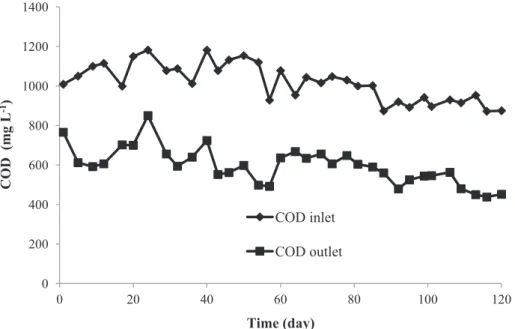
The performances of the biological treatment in terms of COD removal are shown inFig. 6. An average COD removal of 42 ± 7% was recorded. By comparison, BOD5 was totally removed after
the biological treatment (data no shown). The relatively low COD removal can be explained by the presence of refractory organic matter in the ECLL. In fact, the FA and Hyl compounds contained in ECLL represented respectively 47 ± 0.4% and 40 ± 0.5% of TOC. After the treatment, 30.4 ± 1.3% and 49 ± 3.3% of TOCFAand TOCHyl
were respectively removed (Fig. 7). This means that the Hyl frac-tion having smaller molecular weight than FA fracfrac-tion was prefer-entially removed during BF treatment. Similar observations were reported by Liu et al. (2015)using a Sequencing Batch Reactor (SBR) to treat landfill leachate pretreated by Fenton process.Huo et al. (2009)also observed a good removal rate of Hyl fraction,
whereas humic substances (HA and FA) were not significantly removed after biological treatment of landfill leachate. However, in this study, an increase of HA fraction was recorded after biofil-tration treatment. This increase was likely caused by the leaching of HA from the filtration media that was comprised of a mixture of peat and wood chips.
3.2.2. Ammonia removal
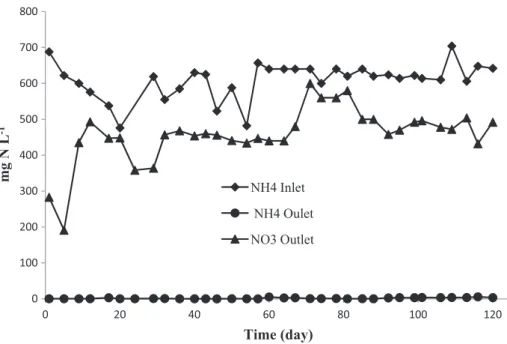
As mentioned earlier, the removal of ammonia was very low during the electrochemical treatment. So, the main challenge of the biological treatment was to treat efficiently the ammonia pol-lution. The BF column was fed with an inlet average flow rate of 365 mL d 1 in order to respect the nitrogen load (0.05 kg N-NH
4
m 2d 1). The variations of nitrogen forms during the biological treatment are shown inFig. 8. It can be seen that the ammonia was almost completely removed after BF treatment. The average of residual ammonia concentration recorded at the outlet was 1.8 4 ± 1.7 mg N L 1that was far below the standard value set by the
province of Québec (10 mg N-NH4L 1) (MDDELCC, 2009). The
residual nitrate concentrations in the BF effluent were also
mea-0
200
400
600
800
1000
1200
1400
0
20
40
60
80
100
120
COD (mg
L
-1)
Time (day)
COD inlet
COD outlet
Fig. 6. COD concentrations before and after biofiltration of the electro-coagulated landfill leachate. Conditions, Hydraulic load = 0.08 m3 .m 2 .d 1 , temperature = 22°C, air flowrate = 0.4 L min1 . 0 50 100 150 200 250 300 Total HA Hyl FA TOC (mg C L -1) Before BF After BF
Fig. 7. Fractionation of the dissolved organic matter before and after biofiltration of the electro-coagulated landfill leachate. Conditions, Hydraulic load = 0.08 m3.m 2. d1, temperature = 22°C, air flowrate = 0.4 L min 1.
sured. A percentage of 78 ± 14% of ammonia was transformed into nitrate. It is worth noting that the nitrate concentration in the affluent was negligible. These results showed that nitrification was the main mechanism for ammonia removal in the biofilter. However, other biological and physico-chemical phenomena such as NH3 stripping, assimilation, denitrification, and adsorption
might also occur in biofilter column (Garzón-Zúñiga et al., 2005). The nitrification process was very efficient in spite of low phos-phorus concentration and the significant amount of residual alu-minum ions obtained after the EC treatment. Given the sensitivity of the nitrifying bacteria, there were some concerns about the inhibition of the nitrification process caused by these critical pollutants. With respect to phosphorus, the suitable dose required for the microorganisms is a controversial subject. The tra-ditional ratio C/N/P, 100/5/1 is generally accepted for a suitable biological treatment. However, several authors reported good nitrogen removal rates in spite of a phosphorus deficiency in the affluent (Aubry, 2008; Nordeidet et al., 1994; Philips et al., 2003; Vanhooren, 2002).Vanhooren (2002)explained the low phospho-rus requirement by a possible recycling of phosphophospho-rus inside the biofilm from the biomass decay. Regarding the effect of the resid-ual aluminum, no negative impact on the nitrifying bacteria had been found. This was not consistent with some studies that argued that residual aluminum ions from chemical coagulation had nega-tive impact on the biological treatment (Iversen et al., 2009; Lees et al., 2001; Snyman et al., 1996). In fact, metals ions can form bond and inactive complexes with some bacteria enzymes and induce an inhibition of their biological functions (Lees et al., 2001). Likewise, it had been reported that microorganisms are more sensitive to metal toxicity when these metals are in the form of free ion (Tyagi and Couillard, 1988). By contrast, the toxicity of metals decreases when they are chelated by some organic ligands such as humic substances (Koukal et al., 2003). This can explain the insignificant impact of metal on nitrification process since the landfill leachate used in this study contained significant amount of humic substances known for their excellent chelating capacity.
3.2.3. Performance of BF for other pollutants
Table 3 summarizes the performance of the biological treat-ment for the other pollutants. The very low BOD concentration at
the outlet indicates that all the biodegradable organic matter was removed. High alkalinity removal (92 ± 6%) was related to the use of the inorganic carbon by the autotroph nitrifying bacteria during the nitrification process. The true color had increased by 34% after the treatment; this was probably linked to the leaching of humic acids from wood peat-based media. Despite an increase of residual aluminum after the EC, this metal was effectively removed from BF effluent (>65% of Al was removed).
Iron was slightly removed from the BF influent with a removal rate of 14%. However, against all odds, the average concentration of phosphorus and zinc recorded at the outlet of BF process were higher than those measured at the inlet of BF process. The total phosphorus concentration had slightly increased by 17%, while the residual zinc concentration increased was six times higher than that measured at the inlet of BF process. The increase of Zn was alarming because this metal is used by the Québec province regu-lation as indicator of metals pollution. In order to understand the reason of such increase in Zn concentration, further investigation had been performed focusing on the biofiltration media (BFM) components. Zn from the mixture of peat and wood chips were then extracted by acid leaching and analyzed. It had been found that the Zn concentration in the BFM was higher after utilization
0 100 200 300 400 500 600 700 800 0 20 40 60 80 100 120
mg N L
-1Time (day)
NH4 Inlet
NH4 Oulet
NO3 Outlet
Fig. 8. Nitrogen species concentrations before and after biofiltration of the electro-coagulated landfill leachate. Conditions, Ammonia load = 0.055 kg of N-NH4.m 2.d1, temperature = 22°C, air flowrate = 0.4 L min1
.
Table 3
Performances of the biofiltration treatment, Ammonia load = 0.055 kg of N-NH4.m2. d 1
, Hydraulic load = 0.08 m3 .m2
.d1
, temperature = 22°C, air flowrate = 5 L min1 . Pollutants Units BF Inlet BF Outlet Removal
COD mg L1 1018 ± 94 595 ± 93 42 ± 7% BOD5 mg L1 150 < 5 >97% TOC mg L1 269 165 37% N-NH4 mg L1 610 ± 49 1.84 ± 1.7 >99% N-NO3 mg L1 < 1 462± – Color TCU 644 ± 57 851 ± 127 34 ± 26% Alkalinity mg CaCO3L1 3606 ± 600 289 ± 71 92 ± 6% Turbidity NTU 32 ± 8.8 8.1 ± 5.3 74 ± 15% pH – 8.42 ± 0.24 8.26 ± 0.31 – Phosphorus mg L1 0.88 ± 0.27 1.03 ± 0.28 34 ± 87% Aluminum mg L1 1.25 ± 0.8 0.39 ± 0.2 66 ± 27% Zinc mg L1 0.07 ± 0.05 0.44 ± 0.09 796 ± 425% Iron mg L1 1.22 ± 0.37 0.87 ± 0.3 14 ± 63%
than before use (0.23 g Zn/kg of BFM before utilization Vs 1.06 g Zn/kg of BFM after utilization). These results were not consistent with the hypothesis of Zn release during biofiltration process. However, Zn accumulation in the BFM might occur during the acclimation period (40 days) when the biofilter was fed with the raw landfill leachate that contained an average Zn concentration of 1.4 ± 0.6 mg L 1. Thereafter, when the ECLL (containing low Zn
concentration, 0.07 mg L 1) was treated by the BF unit, the
accu-mulated Zn was then released causing higher Zn concentration at the outlet. The release of Zn might be also explained by the phe-nomenon of cations exchange during the filtration. According to
Tipping (1998), the complexes formed by Zn2+with the humic
sub-stances are less stable than those formed by Al3+or Fe3+. The com-plexes stability constants (Log KMA) of Zn2+, Al3+ and, Fe3+with
fulvic acids are 1.6, 2.5 and, 2.4 respectively. In addition,
Kerndorff and Schnitzer (1980)investigated the competitive sorp-tion of 11 metals on humic acids and found that the adsorpsorp-tion of Zn2+ was lower than adsorption of Al3+ or Fe3+. As a result, the
adsorbed zinc might be substituted by the aluminum and iron ions having stronger affinity with peat mainly comprised of humic sub-stances. This can also explain why Fe and Al were better removed than Zn in spite of their relatively high concentrations in ECLL. In order to avoid the increase of Zn concentration in the BF outlet, instead of using raw landfill leachate, we recommend the use of electro-coagulated landfill leachate or other types of effluent with low or Zn-free content as inoculum to promote the growth of bio-mass in biofiltration unit.
4. Conclusion
The feasibility of treating landfill leachate by using successively EC and BF processes had been investigated. The pretreatment by EC process allowed removing 37 ± 2% of the total COD. The fractiona-tion of the organic matter (before and after EC treatment) indicated that the fraction of COD removed from raw landfill leachate was mainly attributed to the removal of insoluble COD and HA. How-ever, the removal of other dissolved organic compounds such as FA and Hyl compounds was relatively low. Furthermore, other pol-lutants such as turbidity, true color, zinc, and phosphorus were successfully removed (removal of 82 ± 2.7%, 60 ± 13%, 95 ± 2.6% and 82 ± 5.5%, respectively). The subsequent biological treatment allowed removing the ammonia pollution as well as a partial frac-tion of the dissolved organic matter. Over 99% of the initial NH4
had been removed and nitrate was the main nitrogen by-product formed from the nitrification process. Surprisingly, the phosphorus deficiency and the residual aluminum ions in the electro-coagulated landfill leachate had no negative impact on the nitrifi-cation. This can be explained by the recycling of phosphorus from the biomass decay and the Al ions complexation by humic sub-stances which alleviate their toxicity effect on the microorganisms. The average COD and BOD removals after the biofiltration were 42 ± 7% and 97% respectively. According to these results, it can be con-cluded that the EC/BF hybrid process is a promising technology for landfill leachate. The complementarity of these two technologies allows an efficient removal of various range of pollutants found in landfill leachate effluent. However, more research efforts are needed in terms of EC reactor design in order to facilitate its inte-gration in a continuous treatment system and limit the electrodes fouling caused by the raw landfill leachate. This hybrid process is also economically viable. The operating cost of the process had been estimated at around 1.23 US$ m 3which is below the
operat-ing cost of most alternative processes used for landfill leachate treatment. This cost takes account the aeration of the biofilter, the renewal of anode material and bio-filter media, the energy con-sumption and the EC sludge treatment.
Acknowledgement
This research project was conducted in collaboration with the research institutes INRS – Canada (Institut National de la Recherche Scientifique) and CRIQ (Centre de Recherche Industrielle du Québec) and the companies E2Metrix and Gesterra. It also received the financial support of Mitacs – Canada (IT03162).
References
APHA, 1998. Standard Methods for the Examination of Water and Wastewater. American Public Health Association (APHA), Washington, DC, U.S.A..
APHA, 2005. Standard Methods for the Examination of Water and Wastewater. American Public Health Association (APHA), Washington, DC, U.S.A..
APHA, 2012. Standard Methods for the Examination of Water and Wastewater. American Public Health Association (APHA), Washington, DC, U.S.A..
Aubry, G., 2008. Étude du comportement de l’azote dans un biofiltre à lit ruisselant traitant du lisier de porc, Département Génie civil. Département Génie civil, Faculté des sciences et de génie. Université Laval, Québec, Canada.
Bouhezila, F., Hariti, M., Lounici, H., Mameri, N., 2011. Treatment of the OUED SMAR town landfill leachate by an electrochemical reactor. Desalination 280, 347– 353.
Dia, O., Drogui, P., Buelna, G., Dubé, R., 2017. Strategical approach to prevent ammonia formation during electrocoagulation of landfill leachate obtained from a biofiltration process. Sep. Purif. Technol. 189, 253–259.
Dima, G.E., Beltramo, G.L., Koper, M.T.M., 2005. Nitrate reduction on single-crystal platinum electrodes. Electrochim. Acta 50, 4318–4326.
Drogui, P., Blais, J.-F., Mercier, G., 2007. Review of electrochemical technologies for environmental applications. Recent Pat. Eng. 1, 257–272.
Garzón-Zúñiga, M., Lessard, P., Aubry, G., Buelna, G., 2005. Nitrogen elimination mechanisms in an organic media aerated biofilter treating pig manure. Environ. Technol. 26, 361–372.
Hall, E.S., Packham, R.F., 1965. Coagulation of organic color with hydrolyzing coagulants. J. Am. Water Works. Ass. 57, 1149–1166.
Huo, S., Xi, B., Yu, H., He, L., Fan, S., Liu, H., 2008. Characteristics of dissolved organic matter (DOM) in leachate with different landfill ages. J. Environ. Sci. 20, 492– 498.
Huo, S.L., Xi, B.D., Yu, H.C., Liu, H.L., 2009. Dissolved organic matter in leachate from different treatment processes. Water Environ. J. 23, 15–22.
Ilhan, F., Kurt, U., Apaydin, O., Gonullu, M.T., 2008. Treatment of leachate by electrocoagulation using aluminum and iron electrodes. J. Hazard. Mater. 154, 381–389.
Iversen, V., Koseoglu, H., Yigit, N.O., Drews, A., Kitis, M., Lesjean, B., Kraume, M., 2009. Impacts of membrane flux enhancers on activated sludge respiration and nutrient removal in MBRs. Water Res. 43, 822–830.
Kerndorff, H., Schnitzer, M., 1980. Sorption of metals on humic acid. Geochim. Cosmochim. Acta 44, 1701–1708.
Koukal, B., Gueguen, C., Pardos, M., Dominik, J., 2003. Influence of humic substances on the toxic effects of cadmium and zinc to the green alga Pseudokirchneriella subcapitata. Chemosphere 53, 953–961.
Kurniawan, T.A., Lo, W.H., Chan, G.Y., 2006. Physico-chemical treatments for removal of recalcitrant contaminants from landfill leachate. J. Hazard. Mater. 129, 80–100.
Labanowski, J., Pallier, V., Feuillade-Cathalifaud, G., 2010. Study of organic matter during coagulation and electrocoagulation processes, application to a stabilized landfill leachate. J. Hazard. Mater. 179, 166–172.
Lees, E.J., Noble, B., Hewitt, R., Parsons, S.A., 2001. The impact of residual coagulant on the respiration rate and sludge characteristics of an activated microbial biomass. Process Saf. Environ. Prot. 79, 283–290.
Liu, Z., Wu, W., Shi, P., Guo, J., Cheng, J., 2015. Characterization of dissolved organic matter in landfill leachate during the combined treatment process of air stripping, Fenton, SBR and coagulation. Waste Manage. 41, 111–118.
Mandal, P., Dubey, B.K., Gupta, A.K., 2017. Review on landfill leachate treatment by electrochemical oxidation, drawbacks, challenges and future scope. Waste Manage. 69, 250–273.
MDDELCC, 2009. Règlement sur l’enfouissement et l’incinération des matières résiduelles (REIMR). <http://www.legisquebec.gouv.qc.ca/fr/ShowDoc/cr/Q-2% 20r.%2019> (accessed 24.11.16).
Nordeidet, B., Rusten, B., Ødegaard, H., 1994. Phosphorus requirements for tertiary nitrification in a biofilm. Water Sci. Technol. 29, 77–82.
Oumar, D., Patrick, D., Gerardo, B., Rino, D., Ihsen, B.S., 2016. Coupling biofiltration process and electrocoagulation using magnesium-based anode for the treatment of landfill leachate. J. Environ. Manage. 181, 477–483.
Philips, S., Rabaey, K., Verstraete, W., 2003. Impact of iron salts on activated sludge and interaction with nitrite or nitrate. Bioresource Technol. 88, 229–239.
Poveda, M., Yuan, Q., Oleszkiewicz, J., 2016. The effectiveness of pretreatment methods on COD and ammonia removal from landfill leachate. Int. J. Environ. Sci. Dev. 7, 257.
Renou, S., Givaudan, J.G., Poulain, S., Dirassouyan, F., Moulin, P., 2008. Landfill leachate treatment, review and opportunity. J. Hazard. Mater. 150, 468–493.
Smoczyn´ski, L., Mun´ska, K.T., Kosobucka, M., Piero_zyn´ski, B., 2014. Phosphorus and COD removal from chemically and electrochemically coagulated wastewater. Environ. Protect. Eng. 40.
Snyman, H.G., Rëssle, W., Thompson, A., 1996. The effect of contaminating aluminum sulphate in wastewater sludge production and microbial activity. In: Biennial Conference and Exhibition of the Water Institute of Southern Africa, 4–7 May, Cape Town, pp. 1–8.
Stevenson, F.J., 1994. Humus Chemistry, Genesis, Composition, Reactions. John Wiley & Sons.
Tipping, E., 1998. Humic ion-binding model VI, an improved description of the interactions of protons and metal ions with humic substances. Aquatic Geochem. 4, 3–47.
Tyagi, R., Couillard, D., 1988. Toxic effects of inhibitors in biological wastewater treatment processes. Can. J. Chem. Eng. 66, 97–106.
USEPA, 1979a. Methods for chemical analysis of water and wastes. Method 350.1.
USEPA, 1979b. Methods for chemical analysis of water and wastes. Method 353.1.
Van Zomeren, A., Comans, R.N., 2007. Measurement of humic and fulvic acid concentrations and dissolution properties by a rapid batch procedure. Environ. Sci. Technol. 41, 6755–6761.
Vanhooren, H., 2002. Modelling for optimisation of biofilm wastewater treatment processes, a complexity compromise (Ph.D. Thesis). Universiteit Gent, Belgium.
Wiszniowski, J., Robert, D., Surmacz-Gorska, J., Miksch, K., Weber, J., 2006. Landfill leachate treatment methods, a review. Environ. Chem. Lett. 4, 51–61.
Wu, Y., Zhou, S., Ye, X., Chen, D., Zheng, K., Qin, F., 2011. Transformation of pollutants in landfill leachate treated by a combined sequence batch reactor, coagulation, Fenton oxidation and biological aerated filter technology. Process Saf. Environ. Prot. 89, 112–120.
Xiao, S., Peng, J., Song, Y., Zhang, D., Liu, R., Zeng, P., 2013. Degradation of biologically treated landfill leachate by using electrochemical process combined with UV irradiation. Sep. Purif. Technol. 117, 24–29.