HAL Id: dumas-00910955
https://dumas.ccsd.cnrs.fr/dumas-00910955
Submitted on 28 Nov 2013HAL is a multi-disciplinary open access
archive for the deposit and dissemination of sci-entific research documents, whether they are pub-lished or not. The documents may come from teaching and research institutions in France or abroad, or from public or private research centers.
L’archive ouverte pluridisciplinaire HAL, est destinée au dépôt et à la diffusion de documents scientifiques de niveau recherche, publiés ou non, émanant des établissements d’enseignement et de recherche français ou étrangers, des laboratoires publics ou privés.
Electrorétinogramme multifocal et atteinte
anatomofonctionelle dans la maladie de Birdshot
Joséphine Altayrac-Bethenod
To cite this version:
Joséphine Altayrac-Bethenod. Electrorétinogramme multifocal et atteinte anatomofonctionelle dans la maladie de Birdshot. Human health and pathology. 2013. �dumas-00910955�
AVERTISSEMENT
Ce document est le fruit d'un long travail approuvé par le
jury de soutenance et mis à disposition de l'ensemble de la
communauté universitaire élargie.
Il n’a pas été réévalué depuis la date de soutenance.
Il est soumis à la propriété intellectuelle de l'auteur. Ceci
implique une obligation de citation et de référencement
lors de l’utilisation de ce document.
D’autre part, toute contrefaçon, plagiat, reproduction illicite
encourt une poursuite pénale.
Contact au SICD1 de Grenoble :
[email protected]
LIENS
LIENS
Code de la Propriété Intellectuelle. articles L 122. 4
Code de la Propriété Intellectuelle. articles L 335.2- L 335.10
http://www.cfcopies.com/V2/leg/leg_droi.php
UNIVERSITE JOSEPH FOURIER FACULTE DE MEDECINE DE GRENOBLE
Année : 2013
ERG MULTIFOCAL ET ATTEINTE ANATOMOFONCTIONELLE DANS LA MALADIE DE BIRDSHOT
THESE
PRESENTEE POUR L’OBTENTION DU DOCTORAT EN MEDECINE DIPLÔME D’ETAT
Joséphine ALTAYRAC-BETHENOD
Née le 2 avril 1984 A Avignon, France
THESE SOUTENUE PUBLIQUEMENT A LA FACULTE DE MEDECINE DE GRENOBLE
Le jeudi 3 octobre 2013
DEVANT LE JURY COMPOSE DE
Président du jury : Monsieur le Professeur Jean-Paul ROMANET Directeur de thèse : Monsieur le Professeur Christophe CHIQUET Membres : Madame le Professeur Laurence BOUILLET Madame le Docteur Sylvie BERTHEMY-PELLET
Professeurs des Universités-Praticiens hospitaliers 2013-2014
Occupation Actuelle Discipline Universitaire ALBALADEJO Pierre
Anesthésiologie-réanimation ARVIEUX-BARTHELEMY Catherine
Chirurgie générale BACONNIER Pierre
Biostat, informatique médicale et technologies de communication BAGUET Jean-Philippe
Cardiologie
BALOSSO Jacques
Radiothérapie BARRET Luc
Médecine légale et droit de la santé BAUDAIN Philippe
Radiologie et imagerie médicale BEANI Jean-Claude
Dermato-vénérologie BENHAMOU Pierre Yves
Endocrinologie, diabète et maladies métaboliques BERGER François
Biologie cellulaire BETTEGA Georges
Chirurgie maxillo-faciale et stomatologie BONAZ Bruno
Gastro-entérologie, hépatologie, addictologie
BOSSON Jean-Luc
Biostat, informatique médicale et technologies de communication BOUGEROL Thierry Psychiatrie d'adultes BOUILLET Laurence Médecine interne BRAMBILLA CHRISTIAN Pneumologie BRAMBILLA Elisabeth
Anatomie et cytologie pathologiques BRICAULT Ivan
Radiologie et imagerie médicale BRICHON Pierre-Yves
Chirurgie thoracique et cardio-vasculaire CAHN Jean-Yves
Hématologie CARPENTIER Françoise
Thérapeutique, médecine d'urgence
CARPENTIER Patrick
Chirurgie vasculaire, médecine vasculaire CESBRON Jean-Yves
CHABARDES Stephan Neurochirurgie CHABRE Olivier
Endocrinologie, diabète et maladies métaboliques
CHAFFANJON PhilippeDepuis Anatomie CHAVANON Olivier
Chirurgie thoracique et cardio-vasculaire CHIQUET Christophe
Ophtalmologie CHIROSSEL Jean-Paul
Anatomie CINQUIN Philippe
Biostat, informatique médicale et technologies de communication COHEN Olivier
Biostat, informatique médicale et technologies de communication COUTURIER Pascal
Gériatrie et biologie du vieillissement CRACOWSKI Jean-Luc
Pharmacologie fondamentale, pharmacologie clinique DE GAUDEMARIS Régis
Médecine et santé au travail DEBILLON Thierry
Pédiatrie DEMATTEIS Maurice
Addictologie DEMONGEOT Jacques
Biostat, informatique médicale et technologies de communication DESCOTES Jean-Luc
Urologie ESTEVE François
Biophysique et médecine nucléaire FAGRET Daniel
Biophysique et médecine nucléaire FAUCHERON Jean-Luc
Chirurgie générale FERRETTI Gilbert
Radiologie et imagerie médicale FEUERSTEIN Claude
Physiologie FONTAINE Eric
Nutrition FRANCOIS Patrice
Epidémiologie, économie de la santé et prévention GARBAN Frédéric
Hématologie, transfusion GAUDIN Philippe
Rhumatologie GAVAZZI Gaetan
GAY Emmanuel
Neurochirurgie GODFRAIND Catherine
Anatomie et cytologie pathologiques GRIFFET Jacques
Chirurgie infantile
HALIMI Serge Nutrition
HENNEBICQ Sylviane
Biologie et médecine du développement et de la reproduction HOFFMANN Pascale Gynécologie-obstétrique HOMMEL Marc Neurologie JOUK Pierre-Simon Génétique JUVIN Robert Rhumatologie KAHANE Philippe Physiologie KRACK Paul Neurologie KRAINIK Alexandre
Radiologie et imagerie médicale LABARERE José
Epidémiologie, économie de la santé et prévention LANTUEJOUL Sylvie
Anatomie et cytologie pathologiques LECCIA Marie-Thérèse
Dermato-vénérologie LEROUX Dominique
Génétique LEROY Vincent
Gastro-entérologie, hépatologie, addictologie LETOUBLON Christian Chirurgie générale LEVY Patrick Physiologie MACHECOURT Jacques Cardiologie MAGNE Jean-Luc Chirurgie vasculaire MAITRE Anne
Médecine et santé au travail MAURIN Max
Bactériologie-virologie MERLOZ Philippe
MORAND Patrice
Bactériologie-virologie MOREAU-GAUDRY Alexandre
Biostat, informatique médicale et technologies de communication MORO Elena
Neurologie
MORO-SIBILOT Denis Pneumologie
MOUSSEAU Mireille
Cancérologie MOUTET François
Chirurgie plastique, reconstructrice & esthétique, brulologie PALOMBI Olivier Anatomie PARK Sophie Hématologie PASSAGIA Jean-Guy Neurochirurgie PAYEN DE LA GARANDERIE
Jean-François Anesthésiologie-réanimation PELLOUX Hervé Parasitologie et mycologie PEPIN Jean-Louis Physiologie PERENNOU Dominique
Médecine physique et de réadaptation PERNOD Gilles Médecine vasculaire PIOLAT Christian Chirurgie infantile PISON Christophe Pneumologie PLANTAZ Dominique Pédiatrie POLACK Benoît Hématologie POLOSAN Mircea Psychiatrie d'adultes PONS Jean-Claude Gynécologie-obstétrique RAMBEAUD Jean-Jacques Urologie REYT Emile Oto-rhyno-laryngologie RIGHINI Christian Oto-rhyno-laryngologie ROMANET Jean. Paul
SARAGAGLIA Dominique
Chirurgie orthopédique et traumatologie SCHMERBER Sébastien
Oto-rhyno-laryngologie SCHWEBEL Carole
Réanimation, médecine d'urgence SCOLAN Virginie
Médecine légale et droit de la santé
SERGENT Fabrice Gynécologie-obstétrique
SESSA Carmine
Chirurgie vasculaire STAHL Jean-Paul
Maladies infectieuses, maladies tropicales
STANKE Françoise Pharmacologie fondamentale TAMISIER Renaud
Physiologie
TIMSIT Jean-François Réanimation
TONETTI Jérôme Chirurgie orthopédique et traumatologie
TOUSSAINT Bertrand
Biochimie et biologie moléculaire
VANZETTO Gérald Cardiologie
VUILLEZ Jean-Philippe
Biophysique et médecine nucléaire WEIL Georges
Epidémiologie, économie de la santé et prévention ZAOUI Philippe
Néphrologie ZARSKI Jean-Pierre
Maîtres de Conférence des Universités-Praticiens Hospitaliers 2013-2014
Occupation Actuelle Discipline universitaire
APTEL Florent Ophtalmologie
BOISSET Sandrine
Bactériologie, virologie BONNETERRE Vincent
Médecine et santé au travail BOTTARI Serge Biologie cellulaire BOUTONNAT Jean Cytologie et histologie BOUZAT Pierre Anesthésiologie-réanimation BRENIER-PINCHART M.Pierre Parasitologie et mycologie BRIOT Raphaël
Thérapeutique, médecine d'urgence CALLANAN-WILSON Mary
Hématologie, transfusion DECAENS Thomas
DERANSART Colin Physiologie
DETANTE Olivier Neurologie DIETERICH Klaus Génétique DUMESTRE-PERARD Chantal Immunologie EYSSERIC Hélène
Médecine légale et droit de la santé FAURE Julien
Biochimie et biologie moléculaire GILLOIS Pierre
Biostat, informatique médicale et technologies de communication GRAND Sylvie Radiologie et imagerie édicale
GUZUN Rita
Nutrition LAPORTE François
Biochimie et biologie moléculaire LARDY Bernard
Biochimie et biologie moléculaire LARRAT Sylvie
LAUNOIS-ROLLINAT Sandrine
Physiologie LONG Jean-Alexandre
Urologie
MAIGNAN Maxime Médecine d'urgence
MALLARET Marie-Reine
Epidémiologie, économie de la santé et prévention MARLU Raphaël
Hématologie MAUBON Danièle
Parasitologie et mycologie MC LEER (FLORIN) Anne
Cytologie et histologie MOUCHET Patrick
Physiologie PACLET Marie-Hélène
Biochimie et biologie moléculaire PAYSANT François
Médecine légale et droit de la santé PELLETIER Laurent
Biologie cellulaire RAY Pierre
Génétique
RIALLE VincentDepuis Biostat, informatique médicale et technologies de communication ROUSTIT Matthieu
Pharmacologie clinique ROUX-BUISSON Nathalie
Biochimie et génétique moléculaire SATRE Véronique
Génétique SEIGNEURIN Arnaud
Epidémiologie, économie de la santé et prévention STASIA Marie-Josée
REMERCIEMENTS
Que tous ceux qui m’ont accompagné durant cet internat et dans la réalisation de ma thèse soient remerciés :
A mes Maîtres :
Monsieur le Professeur J.P. Romanet : une énergie sans limites au service de
l’ophtalmologie. Merci de m’avoir accueilli à Grenoble, et merci de m’avoir laissé la possibilité de repartir…
Monsieur le Professeur C. Chiquet : une mémoire sans failles, en particulier lorsqu’il
s’agit de nos travaux…il n’y a pas d’heure pour la recherche ! Merci pour votre engagerment à faire avancer nos études.
Aux membres de mon Jury ce jour :
Madame le Professeur Laurence Bouillet : pour avoir accepté de juger mon travail et
pour votre collaboration à notre activité de centre référent en uvéite.
Madame le Docteur Sylvie Berthemy-Pellet : merci pour tes lumières en
électrophysiologie et pour ton amitié.
Aux acteurs discrets de cette thèse sans qui je n’aurais pu avancer :
Monsieur Jean-Louis Quesada : un grand merci pour votre très grande patience, à la
hauteur de vos compétences en statistiques.
Mesdames Laetitia Baney, Maïté Baraldi et Sandrine Maffre qui patiemment ont
Madame Nathalie Barbier : pour m’avoir sorti, ressorti, et reresorti ces lourds
dossiers Birdshot dès que j’en avais besoin.
A ma famille :
A Johannes : «Patience et longueur de temps font plus que force ni que rage.»
A mes parents dont je suis très heureuse de me rapprocher prochainement pour
prendre le temps … de prendre le temps ! Merci pour votre soutien.
A Luzia : Courage ma jolie … et penses au Sud !
A mes grands parents : pour leur constante bienveillance.
A mes beaux parents : merci pour vos conseils et vos encouragements, nous voilà
confrères !
A tous ceux à qui je dois ma formation de médecin :
En Ophtalmo : Monsieur Olivier Savy, Monsieur Adel Chibani, Monsieur Florent
Aptel, Madame Karine Palombi, Madame Ruxandra Hera, Monsieur Jean-Yves
Millet, Messieurs Pierre Pegourié et Dominique Satger, Elisabeth Renard, Viviane
Vinh, Diane Bernheim, Aurélie Combey, Tiffany Lacharme, Ralitsa Hubanova,
Magali Albrieux-Jeanne, Matthieu Tonini, Hafide Khayi, Monsieur P. Moyenin et
Monsieur X. Picot.
En CMF : Monsieur le Professeur Georges Bettega, Monsieur Jacques Lebeau,
Madame Beatrice Morand, Antoine Grosdidier, Cynthia Hamou, Brice Carlot
En neuroradiologie : Monsieur le Professeur Alexandre Krainik, Monsieur le
Professeur Jean-Francois Lebas, Monsieur Jean-Ashok Vasdev
A toute l’équipe Marseillaise du CHU Nord pour m’avoir si gentiment accueilli l’été dernier, pour toutes vos compétences et vos enseignements notamment en ophtalmopédiatrie : Madame le Professeur Danièle Denis, Madame Corinne Benso,
Madame Isabelle rendu, Emilie Zanin, Rim Sekfali, Sébastien Nadeau. Un grand
merci à Aurore pour toute sa bienveillance.
A mes co-internes, la chance d’avoir créé de solides amitiés… Par pudeur, je ne donnerai pas plus de détails, mais les preuves d’amitié ne manquent pas… Y’a plus qu’à descendre à Marseille maintenant.
Aux équipes infirmières de Grenoble, et de Chambéry pour leur particulière gentillesse.
Aux secrétariats de Grenoble et de Chambéry, chapeautés par nos deux mamans à tous : Madame Catherine Tarantini et Madame Bernadette Rassat.
A mes futurs Chefs du Pays d’Aix :
Monsieur Laurent Coupier et Monsieur Grégoire Alessi : un immense merci pour la
confiance que vous m’accordez. Je tâcherai de faire de mon mieux.
Merci à Madame Cécile Delafontaine, Madame Béatrice Fegy et Madame Monique
Multifocal electroretinogram in birdshot chorioretinopathy
J. ALTAYRAC-BETHENOD, S. BERTHEMY-PELLET, F. APTEL, M. GALLICE, M. TONINI, H. KHAYI, J.P. ROMANET, C. CHIQUET
Clinique Universitaire d’Ophtalmologie, CHU de Grenoble, BP 217, 38043 Grenoble
J LABARERE, Unité d’évaluation médicale, CHU de Grenoble
JL QUESADA, Centre d’investigation clinique, INSERM CIC03, CHU de Grenoble
KEY-WORDS: birdshot chorioretinopathy, uveitis, multifocal electroretinogramm Running title: mfERG and Birdshot chorioretinopathy
Acknowledgments: L. Baney, M. Baraldi, S. Maffre and A. Costa for technical
assistance with mfERG, ARFO (association for research and teaching in ophthalmology) for grants.
ABSTRACT
Purpose: to characterize multifocal ERG parameters in patients with birdshot
disease (BSCR)
Methods: The mfERG was prospectively evaluated in 28 patients using Vision Monitor, Métrovision™, France (2006-2011). One eye was randomized for the statistical analysis. The correlations between mfERG parameters and visual acuity, visual field, color vision, fluorescein and indocyanine green angiography, and optical
coherence tomography were studied.
Twenty seven healthy subjects were matched to BSCR patients for age, axial length
and lens status.
Results: The mean age of the patients was 56.7 ±9.7 years, and 46.4% of the patients were male. BSCR eyes differed significantly from healthy eyes by a decrease in mean RMS (- 24.7%), amplitude of P1 (-17.3%), N2 (-27.5%), and P1/N1 ratio (-26.3%) and an increase in implicit time of N1 (8.7%), P1 (5.4%). An effect of the degree of eccentricity (5 zones, figure 1) was found for RMS (p<0.001), amplitude of P1 (p<0.001) and N2 (p<0.001), and implicit times of P1 (p<0.001). RMS, P1N1 ratio, amplitudes of P1 and N2; implicit times of P1 and N1 were significantly correlated with VA, mean defect, foveal threshold, and colour vision score.
When the central zone (5°: ring 1+2) was considered , RMS, amplitudes of P1, N1 and N2, and not implicit time, were significantly associated with VA, and foveal threshold ; RMS, amplitudes of N1 and P1 were significantly correlated with the FA and ICG score.
Conclusion: Amplitudes and implicit times of mfERG parameters are impaired in BSCR patients and are well correlated with other anatomical and functional tests. The contribution of mfERG for the therapeutic management of patients remains to be determined.
INTRODUCTION:
Birdshot chorioretinopathy (BSCR) is a rare form of posterior uveitis, representing 0.6%-1.5% of patients consulting in reference centers for uveitis, and 6%-7% of cases of posterior uveitis,1 more commonly in the third to the sixth decades.2 Whereas diagnostic criteria may help the clinician to recognize this disease,3 its clinical evolution is still poorly understood and variable among patients.1 Long term complications which may explain the visual deterioration include macular edema, choroidal neovascularization and progressive chorioretinal atrophy. The care of patients with BSCR is challenging because of its relentless chronic nature.2,4,5
The measurement of visual acuity (VA) alone is insufficient to monitor the disease 6,7 and functional monitoring of patients can be facilitated through the exploration of colour vision8 and/or visual field.9 Recent studies showed that full field electroretinogramm (ERG) can also be of value to evaluate the disease progression.
7,10-13
The multifocal electroretinogram (mfERG) is a non invasive method for objectively measuring retinal function within localized patches especially the central retina, i.e. 40 to 50° around the central foveal ar ea.14 Whereas it reflects the activity of cones under light-adapted conditions, and provides a track for each small area of the retina divided (61 areas in general to the posterior pole), this functional test could be useful for the diagnosis of retinal dysfunction and then the downward course of the disease, especially outside the macula. The mfERG is primarily used in the clinic to localize damage spatially, so that variations in the topographic array of signals are more important than absolute signal size.15 The second advantage is that the mfERG provides spatial information not readily available in the full-field ERG in diseases of
the outer retina and help diferentiate diseases that affect the outer retina from those that affect the ganglion cell or optic nerve.15 Finally, the mfERG is useful to follow the effects of clinical intervention, such as in uveitis,16,17 retinal detachment, macular diabetic edema, and macular hole surgery.18 Only one study addressed the contribution of mfERG in 7 patients with BSCR with a special attention to eyes with macula atrophy.19
The aim of this prospective study was to describe the baseline parameters of mfERG in a longitudinal cohort of 28 patients with BSCR, as compared to a population of age-matched healthy subjects and to correlate them with the functional (VA, colour vision, visual field) and anatomical (fluorescein and indocyanine green angiography, optical coherence tomography) data.
MATERIALS AND METHODS:
The patients with BSCR disease were included consecutively from 2006 to 2011 as part of a longitudinal cohort in a tertiary center. The data analyzed in this report correspond to the first examination of the patient in our center. This study followed the Declaration of Helsinki guidelines for research involving human subjects and was approved by the local Institutional Review Board (#5891). All patients met criteria for diagnosis of BSCR,3 were older than 18 years, had no medical contraindications for performing angiography, and gave oral and written consent for conducting all ophthalmological exams. Each patient had a standardized prospectively defined examination including demographic information, medical history, and ophthalmological examination. Functional testing included measurement of VA
(Monoyer chart, converted to LogMAR),20 a 30-2 Swedish Interactive Threshold Algorithm standard program on the Humphrey Field Analyser (Carl Zeiss Meditec Inc.™, Dublin, CA), and a Lanthony desaturated Panel D-15 test for colour vision under standardized conditions of ambient illumination, with calculation of the total score of error.21,22 All patients had a reliable visual field test, defined as a false positive error of less than 15%, a false negative error of less than 15% and a fixation loss less than 20%. Quality of life (QoL) was estimated from the French translation if the NEI Visual function Questionnaire (VFQ-25).23
Anatomical testing were based on a fluorescein and indocyanine green angiography (Heidelberg™, Germany) and an optical coherence tomography (OCT, Stratus®, 2005 Carl Zeiss Meditec Inc™) assessing macular thickness at the fovea, the foveal volume, the presence or absence of epi-macular membrane. Macular edema was defined as a central subfield thickness of more than 250 µm or a center point thickness if necessary (to correct errors in defining outer and inner retinal boundaries). Macular atrophy was defined by a macular thickness less than or equal to 130 µm using the Stratus OCT.24 Angiographic data were quantitatively evaluated using a score established by the Angiography for Uveitis scoring Working Group (ASUWOG).25 Vitreous inflammatory reactions were quantified as described by Nussemblatt and associates.26 Cataract was quantified using the LOCSIII graduation.27 Retinal vasculitis was defined as fluorescein staining of any retinal vessels proximal to the third bifurcation.6
A mfERG (Vision Monitor, Métrovision™, France) was performed according to the ISCEV protocol 15 using a 61-hexagon strategy and scaled hexagons. Stimulations were generated on a cathode ray tube monitor with a 120 Hz frame rate. The luminance of white hexagons was 400 cd/m2 and that of black hexagons less
than 4 cd/m2. Dark frames were inserted after the white frames to achieve a stimulus frequency of 18 Hz. The surround luminance was set to 30 cd/m2. The stimulus was calibrated following ISCEV guidelines.28
After pupil dilation using phenylephrine 5 % (Faure™, France) and tropicamide (Thea™, France), patient positioning, good fixation, best optical correction for near vision, and constant moderate room light for at least 15 min were ensured for each patient. Care was taken to eliminate any reflections from lens surfaces and to keep any bright light sources out of the patient’s direct view. The first-order kernel mfERG responses were analyzed. Individual mfERG responses for the hexagons were grouped into five concentric rings centered on the fovea for analysis (< 2, 2-5, 5-10, 10-15 and >15°). Mathematically the first-order ker nel is obtained by adding all the records that follow the presentation of a white hexagon (luminance of 400 cd/m2) and substracting all the records that follow a black hexagon. We refer to response density (nV/deg2) as amplitude. The following data were collected: the RMS ( root-mean-square values), implicit time (IT) and amplitude (AMP) of N1, P1, and N2 waves, and the N1/P1 ratio. The N1 response was measured from the starting baseline to the base of the N1 trough; the P1 response amplitude was measured from the N1 trough to the P1 peak. Implicit time was measured from the start of the trace to the trough or peak.
A cohort of 100 healthy subjects was previously recorded in order to define normal values of our mfERG. For the purpose of this study, 27 healthy subjects were matched to BSCR patients for age, axial length and lens status.
Statistical analysis:
One eye was randomized for each patient. Normality of parameters was determined by the Shapiro-Wilks test. When the normal distribution was demonstrated, the quantitative parameters were described by their mean and standard deviation (SD). Otherwise, they were described by the median and 25th and 75th percentiles. The qualitative parameters are expressed in numbers and percentages. The comparison of quantitative parameters between groups was performed by Student's t test or a non-parametric test (Mann-Whitney or Kruskal-Wallis test) according the normality and homogeneity of variance. Two-way ANOVA with interaction term randomisation group * zone was used to compare mfERG parameters by concentric rings (5 zones). In order to avoid alpha risk inflation, due to multiple comparisons, and to have an acceptable type 1 error rate, the Bonferroni method for adjusting p-values was used. The correlation between quality parameters was studied using a test of Pearson or Spearman if necessary. Statistical analysis was performed using the SPSS program (Statistical Package for the Social Sciences 17.0 program for Windows. Chicago. IL. USA). The p <0.05 level was considered to define the significance of the statistical tests.
RESULTS:
This cohort included 28 patients who had a baseline examination between 2006 and 2011. The mean age of the series was 56.7 ±9.7 years, and 46.4% of the patients were male. At baseline, patients were under systemic steroid treatment in 53.6% of the cases, cyclosporine in 7%, intravenous immunoglobulin in 7%, and/or had subtenon injection of triamcinolone in 10.7%. Absence of treatment was noted in 42.8% of the cases.
Eye Selection for data analysis.
After randomization of eyes, one eye (group 1) was selected for further analysis. No significant difference for anatomical and functional parameters was found between the random selected group of eyes (group 1) and the group 2 (table 1).
Baseline characteristics of eyes of patients with Birdshot chorioretinopathy.
Ocular data of eyes with BSCR (group 1) are shown in table 1. Visual acuity was greater or equal to 20/40 in 78% of the eyes and vision colour was abnormal in 55% of the cases. Angiographic data showed posterior vasculitis in 50% of the eyes, epiretinal membranes in 35%. The macula was considered atrophic in 3% of the eyes and thickened in 43%.
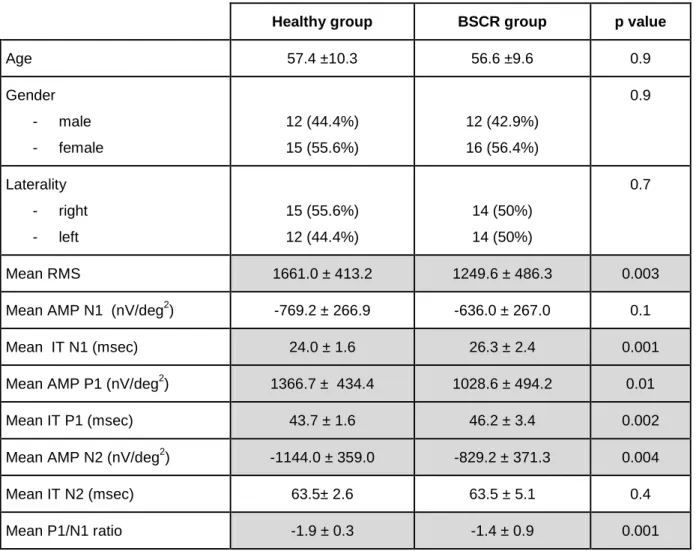
mfERG recordings (table 2) showed that BSCR eyes differed significantly from healthy eyes by a decrease in mean RMS (- 24.7%), amplitude of P1 (-17.3%), N2 (-27.5%), and P1/N1 ratio (-26.3%) and an increase in implicit time of N1 (8.7%) and P1 (5.4%). An effect of the degree of eccentricity (5 zones, figure 1) was found for RMS (p<0.001), amplitude of P1 (p<0.001) and N2 (p<0.001), and implicit times of P1 (p<0.001).
Correlations between mfERG parameters and functional data in eyes with BSCR (table 3).
Correlations between previously abnormal identified mfERG parameters and functional testing are summarized in table 3. In brief, RMS, P1N1 ratio, amplitudes of P1, N1 and N2; implicit times of P1 and N1 were significantly correlated with VA, MD, foveal threshold, and colour vision score.
The composite score of QoL was 69.2±13.5. QoL subscale scores are reported in table 5 and were considered abnormal for general health, general vision, near vision, limitation of activities, and depression.
The composite score was not associated with mfERG parameters but significantly correlated to foveal threshold (r=0.42, p=0.03) and VA (r=-0.46 p=0.02).
When the central zone (5°: ring 1 +2) was considere d, RMS, amplitudes of P1, N1 and N2, and not implicit time, were significantly associated with VA, and foveal threshold (Table 3B). Only RMS and amplitude of P1 were significantly associated with the colour vision score.
Correlations between mfERG parameters and anatomical data in eyes with BSCR (table 4).
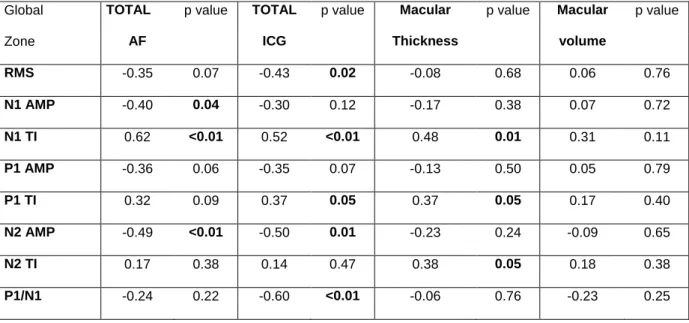
Correlations between previously abnormal identified mfERG parameters and anatomical examinations are summarized in table 4. FA score was significantly correlated to amplitudes of N1 and N2, and implicit time of N1. There was a trend for the correlation with RMS, amplitude or implicit time of P1. ICG score was significantly associated with RMS, amplitude of N2, N1 and implicit time of P1. There was a trend for the correlation with amplitude of P1. In the central zone (5°, ring 1+2), RMS, amplitudes of N1 and P1 were significantly correlated with the FA and ICG score
(Table 4B). We found no relationship between mfERG parameters of these two central rings and macular thickness.
Implicit times of N1, P1 and N2 were positively correlated with foveal thickness. No significant difference was found for mfERG parameters according to the presence of absence of vasculitis.
Table 1: Comparisons of random eyes at the initial visit (supplementary material). Group 1 was considered for further analysis. Results are expressed as mean ± standard deviation or median [25th, 75th percentiles]. P values were obtained using Chi2 test, Student test, or Mann-Whitney test.
*The total maximum score of fluorescein angiography is 40 and that of ICGA is 20. Absence of Group 1 (n=28) Group 2 (n=28) P value
Visual acuity (Logmar) 0.1 [0 ; 0.3] 0.1 [0 ; 0.25] 0.84
20/15 – 20/40 20/50 – 20-160 20/200 - LP 22/28 (78.6%) 4/28 (14.3%) 2/28 (7.1%) 22/28 (78.6%) 4/28 (14.3%) 2/28 (7.1%) 0.99 Foveal threshold (dB) 32.5 [30 ; 35] 33 [30.5 ; 35] 0.59 Mean defect (dB) -5.03 [-9.6 ; -3.2] -5.2 [-8.9 ; -3.3] 0.98 Colour vision
• total score error
• normal • abnormal 230 [108 ; 356] 15/27 (55.6%) 12/27 (44.4%) 222 [80 ; 338] 9/27 (33.3%) 18/27 (66.7%) 0.61 0.40
Score of fluorescein angiography* 3 [1.5 ; 5.5] 3 [1 ; 5.5] 0.95
Retinal vascular staining and/or
leakage at 5-10 mins 14/28 (50%) 13/28 (46.4%) 0.79
Score of indocyanine green
angiography* 5.1 ± 2.5 5.2 ± 2.2 0.89 Foveal thickness (µm) 243.5 [198 ; 282.5] 204 [177 ; 262] 0.17 Macular thickness • atrophy (< 130 µm) • normal (130-250 µm) • edema (> 250 µm) 1 (3.6%) 15 (53.6%) 12 (42.9%) 1 (3.6%) 17 (60.7%) 10 (35.7%) 0.889 Macular Volume 6.89 [6.32 ; 7.74] 6.79 [6.07 ; 8.37] 0.63 Epiretinal membrane 10 (35.7%) 8 (28.6%) 0.57
Table 2: Electrophysiological data of 28 eyes with birdshot disease and comparison with 27 healthy eyes.IT = Implicit time, AMP = Amplitude
Healthy group BSCR group p value
Age 57.4 ±10.3 56.6 ±9.6 0.9 Gender - male - female 12 (44.4%) 15 (55.6%) 12 (42.9%) 16 (56.4%) 0.9 Laterality - right - left 15 (55.6%) 12 (44.4%) 14 (50%) 14 (50%) 0.7 Mean RMS 1661.0 ± 413.2 1249.6 ± 486.3 0.003
Mean AMP N1 (nV/deg2) -769.2 ± 266.9 -636.0 ± 267.0 0.1
Mean IT N1 (msec) 24.0 ± 1.6 26.3 ± 2.4 0.001
Mean AMP P1 (nV/deg2) 1366.7 ± 434.4 1028.6 ± 494.2 0.01
Mean IT P1 (msec) 43.7 ± 1.6 46.2 ± 3.4 0.002
Mean AMP N2 (nV/deg2) -1144.0 ± 359.0 -829.2 ± 371.3 0.004
Mean IT N2 (msec) 63.5± 2.6 63.5 ± 5.1 0.4
Figure 1: Electrophysiological data according the degree of excentricity of 28 eyes with birdshot disease and 27 healthy eyes.
*p-adjust <0.05 **p-adjust < 0.01 * ** * ** ** ** ** ** ** ** ** *
Table 3: Correlations between functional ocular data at baseline and mfERG parameters.IT = Implicit time, AMP = Amplitude
3A: for all rings
Global Zone VA p value Foveal p value
Colour Vision p value threshold Score RMS -0.45 0.02 0,39 0.04 -0.48 0.02 N1 AMP (nV/deg2) -0.44 0.02 0,48 0.01 -0.50 0.02 N1 TI (msec) 0.55 <0.01 -0,81 <0.01 0.56 0.01 P1 AMP (nV/deg2) -0.48 0.01 0,47 0.01 -0.56 <0.01 P1 TI (msec) 0.42 0.02 -0,60 <0.01 0.56 <0.01 N2 AMP (nV/deg2) -0.59 <0.01 0,57 <0.01 0.64 <0.01 N2 TI (msec) 0.33 0.09 -0,55 <0.01 0.55 <0.01 P1/N1 -0.39 0.04 0,36 0.06 -0.42 0.05
3B: for the central zone (ring 1 and 2)
Mean ring 1 VA p value Foveal p value
Colour
Vision p value
+ ring 2 threshold Score
RMS -0.60 <0.01 0.56 <0.01 -0.44 0.02 N1 AMP (nV/deg2) -0.44 0.02 0.44 0.02 -0.21 0.28 N1 TI (msec) 0.33 0.09 -0.41 0.03 0.28 0.16 P1 AMP (nV/deg2) -0.57 <0.01 0.60 <0.01 -0.38 0.05 P1 TI (msec) 0.10 0.60 -0.23 0.24 0.15 0.46 N2 AMP (nV/deg2) -0.52 0.01 0.48 0.01 -0.25 0.22 N2 TI (msec) 0.26 0.21 -0.40 0.04 0.48 0.01 P1/N1 -0.08 0.69 0.10 0.60 -0.33 0.09
Table 4: Correlations between anatomical parameters and mfERG.
IT = Implicit time, AMP = Amplitude
4A: global mfERG (5 rings)
Global TOTAL p value TOTAL p value Macular p value Macular p value
Zone AF ICG Thickness volume
RMS -0.35 0.07 -0.43 0.02 -0.08 0.68 0.06 0.76 N1 AMP -0.40 0.04 -0.30 0.12 -0.17 0.38 0.07 0.72 N1 TI 0.62 <0.01 0.52 <0.01 0.48 0.01 0.31 0.11 P1 AMP -0.36 0.06 -0.35 0.07 -0.13 0.50 0.05 0.79 P1 TI 0.32 0.09 0.37 0.05 0.37 0.05 0.17 0.40 N2 AMP -0.49 <0.01 -0.50 0.01 -0.23 0.24 -0.09 0.65 N2 TI 0.17 0.38 0.14 0.47 0.38 0.05 0.18 0.38 P1/N1 -0.24 0.22 -0.60 <0.01 -0.06 0.76 -0.23 0.25
4B: mfERG for ring 1+2
Mean ring 1 TOTAL p value TOTAL p value Macular p value Macular p value
+ ring 2 AF ICG Thickness volume
RMS -0,55 <0.01 -0.58 <0.01 -0.23 0.24 -0.17 0.39 N1 AMP -0.50 0.01 -0.53 <0.01 -0.25 0.18 0.02 0.93 N1 TI 0.43 0.02 0.29 0.13 0.26 0.17 0.11 0.57 P1 AMP -0.55 <0.01 -0.59 <0.01 -0.29 0.14 -0.17 0.37 P1 TI -0.06 0.76 0.06 0.78 0.30 0.12 0.06 0.76 N2 AMP -0.37 0.06 -0.32 0.11 -0.35 0.08 -0.25 0.22 N2 TI 0.07 0.73 0.08 0.70 0.28 0.17 0.07 0.75 P1/N1 -0.10 0.60 -0.10 0.62 0.07 0.73 -0.16 0.41
Table 5: Quality of Life of 28 patients with BSCR.
Normal scores have values of 100.
VFQ-25 Subscale Mean Median
[IQ range] General Health 69.6 ± 17.4 70 [50 - 80] General Vision 60.9 ± 20 60 [50 - 80] Near Vision 55.2 ± 32.4 50 [25 - 80] Verifying invoices 75.2 ± 26.5 77.5 [50 - 100] To make-up 74.3 ± 29.8 75 [50 - 100]
Recognize people, Distance vision 69.8 ± 31.9 75 [50 - 100]
Play sports 78.9 ± 24.7 80 [50 - 100]
Watching TV 78 ± 18.8 75 [75 - 100]
Social functioning 96.5 ± 11.1 100 [100 - 100]
Need help from other people 70.4 ± 24.6 62.5 [50 - 100]
Limitation of activities 64.6 ± 22.7 50 [50 - 75]
Depression 61.7 ± 29.5 75 [25 - 75]
DISCUSSION:
This prospective study allowed to characterize abnormal parameters of mfERG in a cohort of Birdshot chorioretinopathy. We found that BSCR is associated with reduced amplitudes and increased implicit times of the main waves of mfERG (N1, P1). These abnormalities were well correlated with functional (visual field, visual acuity and colour vision) and anatomical (angiography and OCT) tests.
Demographics of our series is similar to that described in the literature, with a slightly female predominance, and a mean age of 50 years.1,29 Since there can exist an asymmetry between both eyes in 24% of the cases (difference of more than 2 Snellen lines between eyes),1,6 it may be difficult to define the better or the worse eye, anatomically and functionally and that both eyes may not be independent (for axial length, inflammation, genetic background and response to treatment), we randomized the study eye. In our series we showed that both eyes were similar according to the inflammation status and disease severity. The second methodological important point was that the control population was matched to the BSCR series according factors affecting mfERG responses, such as age, lens status, and axial length.18,30
The mfERG offers an objective electrophysiological evaluation of visual function and provides spatial information not readily available in the full-field ERG in diseases of the outer retina.15 Furthermore, the multifocal technique may provide interesting insights into the mechanisms of BSCR since the N1 wave represents the hyperpolarization of cones, and the P1 wave represents the depolarization of bipolar cells.15 We found that BSCR was characterized by abnormalities of P1 waves, with reduced amplitude and increased IT. These results suggest a lesion at the site of cone receptor and ON-bipolar cells.15 On the other hand, increased IT of P1 suggests
of the mfERG is known to be a very sensitive measure of the health of the outer retina,15 and data in BSCR patients showed a significant but moderate increase in implicit times of N1 and P1. Damages to bipolar cells, and of inner nuclear layer, can also have a profound effect on the mfERG.14 These electrophysiological data strongly suggest an important damage of the outer retina in BSCR patients. Histological analysis of eyes with BSCR are rare and showed a foci of lymphocytes in the choroid
31,32
and around some retinal vessels.31 Further analysis should be performed using SD-OCT in regions with decreased amplitude and increased IT.
The spatial resolution of mfERG allowed us to note that the degree of eccentricity (5 rings) was found different for RMS, amplitudes of P1 and N2, and implicit time of P1. These differences accounted essentially between ring 1 (fovea) and the other rings, suggesting that the macula is more sensitive to the extrafoveal retina to inflammation.
One other interesting point is the correlation between focal macular ERG and anatomical data. We found that ERG parameters were correlated with FA and ICG score, and retinal thickness. These results suggest that in the 50° of the posterior pole, inflammatory lesions of BSCR at the choroid and/or retinal site have a negative impact on the visual function as evaluated using mfERG. Macular edema is probably the most common cause of decreased VA and occurs in up to 50% of reported patients.1,6 Our data shown a positive correlation between retinal thickness and implicit times, and not amplitudes, which is consistent with that found in patients with diabetic macular edema.33 The absence of correlation with amplitudes have also been reported in patients with neovascular AMD treated by photodynamic therapy.34 Delays in implicit times have been also described in patients with retinal venous occlusion with macular ischemia,35,36 in diabetic macular edema,37 enlarged foveal
avascular zone in diabetic patients,38 vitelliform macular dystrophy 39 and Stargardt disease.40 In diabetic retinopathy, the changes in implicit times were found to be more diffuse compared with amplitude changes and extended to areas without clinically manifesting macular edema.41,42 mfERG shows also more widespread retinal dysfunction compared with subjective visual field testing in MEWDS 18 or VA in VKH disease.17 The smaller variability in mfERG implicit times among healthy eyes compared to the greater variability of amplitudes33,43 was also found in our BSCR population (table 2). Therefore, the contribution of implicit times in comparison to those of amplitudes for the follow-up of these patients need to be further studied.
The relationship between retinal morphology and ERG parameters may be complex since anatomical examinations provide very different information, from inflammation within retinal vessels or choroid, papilledema, to macular edema or atrophy. Quantitative (thickness) and qualitative (structural change of the outer and inner retina) data are now accessible to SD-OCT and may be differently associated with ERG parameters. One recent mfERG study reported that macular atrophy in long-standing (> 10 years) BSCR patients19 was characterized by a reduced foveal density.
We found that mfERG parameters were well correlated with other functional tests such as visual field (measuring MD, foveal threshold), VA and colour vision test. These results suggest that functional degradation. Visual acuity may be stable over years with VA 20/60 or better, over time in 73% of the patients with BSCR44 and a slow decline in VA since 2 or more lines of Snellen are lost in 19.6% of eyes over a median follow-up period of 3.5 years.1 In other diseases, such as epiretinal membrane,45 vitelliform macular dystrophy,46 P1 implicit time was correlated with VA. However, VA only reflects the function of less than 1° of visual angle, and is probably
better associated with ring 1 and 2 of mfERG. We also found that mfERG parameters were correlated with other central tests such as colour vision and foveal threshold of the visual field. These latter tests are part of the functional testing in BSCR patients, with 8.7% complaining of poor colour vision1 and 61% having deficiencies.8 Visual field abnormalities may be variable, including peripheral constriction, generalized diminished sensitivity, enlarged blind spot, and central or paracentral scotoma.1,26 Ours results showed that both foveal threshold and MD of the 30-2 sita-standard visual field were correlated with reduced amplitudes and increased implicit times of mfERG.
In the literature, abnormal ERGs are reported in 89% of the patients 1 and may not be correlated to visual acuity.7 Previous authors suggest that a negative ERG pattern (decrease in b-wave compared to a-wave amplitude) seen in the early stage of the disease may indicate an abnormal function of Muller and bipolar cells. Rod dysfunction (rod isolated b-wave) may also occur before cone dysfunction (photopic b-wave).1 Retinal vasculitis has also been noted to correlate with electro-oculogram.44 With time the rod and cone b-wave amplitudes and oscillatory potential decreased. The late stages are commonly associated with progressive decrease in a a-wave and b-wave amplitudes which suggested impairment of the inner retina.4,44,47,48
BSCR has a high impact on vision related QoL,51especially for general and near vision, limitation of activities, and depression. Our composite scores are similar to that previously described.49,51 One previous study showed that a median
composite score was 75.9 on 127 patients,49 and related to VA but not age or
score. One reason may be that our ocular data concerned only one eye and
explained insufficiently the relationship between visual impairment and reduced QoL. Previously a weak correlation was found between composite scores and VA.51
Further analysis is needed to study the relationship between mfERG parameters and subscale scores.
Limitations of this study are the limited number of patients, the fact that mfERG data were not collected in absence of treatment, and the use of Time domain Stratus OCT during the baseline examination of patients.
In conclusion, this prospective study showed for the first time that amplitudes and implicit times of mfERG parameters are impaired in BSCR patients and are well correlated with other anatomical and functional tests. One perspective of this work is the longitudinal analysis of electrophysiological parameters in addition to other ancillary tests in order to identify disease progression, as suggested by standard ERG,50 visual field and FA and ICG angiography. Periodic testings are necessary to guide the immunosuppressive treatment given to these patients and to evaluate the efficacy of these treatments. One other perspective will be the study of correlations between mfERG parameters and retinal ultrastructure defined in SD-OCT.
REFERENCES
1. Shah KH, Levinson RD, Yu F, et al. Birdshot chorioretinopathy. Surv
Ophthalmol. Nov-Dec 2005;50(6):519-541.
2. Ryan SJ, Maumenee AE. Birdshot retinochoroidopathy. Am J Ophthalmol. Jan 1980;89(1):31-45.
3. Levinson RD, Brezin A, Rothova A, Accorinti M, Holland GN. Research criteria for the diagnosis of birdshot chorioretinopathy: results of an international consensus conference. Am J Ophthalmol. Jan 2006;141(1):185-187.
4. Kaplan HJ, Aaberg TM. Birdshot retinochoroidopathy. Am J Ophthalmol. Dec 1980;90(6):773-782.
5. de Courten C, Herbort CP. Potential role of computerized visual field testing for the appraisal and follow-up of birdshot chorioretinopathy. Arch Ophthalmol. Oct 1998;116(10):1389-1391.
6. Monnet D, Brezin AP, Holland GN, et al. Longitudinal cohort study of patients with birdshot chorioretinopathy. I. Baseline clinical characteristics. Am J
Ophthalmol. Jan 2006;141(1):135-142.
7. Oh KT, Christmas NJ, Folk JC. Birdshot retinochoroiditis: long term follow-up of a chronically progressive disease. Am J Ophthalmol. May 2002;133(5):622-629.
8. Holland GN, Shah KH, Monnet D, et al. Longitudinal cohort study of patients with birdshot chorioretinopathy II: color vision at baseline. Am J Ophthalmol. Dec 2006;142(6):1013-1018.
9. Thorne JE, Jabs DA, Kedhar SR, Peters GB, Dunn JP. Loss of visual field among patients with birdshot chorioretinopathy. Am J Ophthalmol. Jan 2008;145(1):23-28.
10. Zacks DN, Samson CM, Loewenstein J, Foster CS. Electroretinograms as an indicator of disease activity in birdshot retinochoroidopathy. Graefes Arch Clin
Exp Ophthalmol. Aug 2002;240(8):601-607.
11. Sobrin L, Lam BL, Liu M, Feuer WJ, Davis JL. Electroretinographic monitoring in birdshot chorioretinopathy. Am J Ophthalmol. Jul 2005;140(1):52-64.
12. Holder GE, Robson AG, Pavesio C, Graham EM. Electrophysiological characterisation and monitoring in the management of birdshot chorioretinopathy. Br J Ophthalmol. Jun 2005;89(6):709-718.
13. Comander J, Loewenstein J, Sobrin L. Diagnostic testing and disease monitoring in birdshot chorioretinopathy. Semin Ophthalmol. Jul-Sep 2011;26(4-5):329-336.
14. Hood DC. Assessing retinal function with the multifocal technique. Prog Retin
Eye Res. Sep 2000;19(5):607-646.
15. Hood DC, Bach M, Brigell M, et al. ISCEV standard for clinical multifocal electroretinography (mfERG) (2011 edition). Doc Ophthalmol. Feb 2012;124(1):1-13.
16. Li D, Kishi S. Restored photoreceptor outer segment damage in multiple evanescent white dot syndrome. Ophthalmology. Apr 2009;116(4):762-770. 17. Yang P, Fang W, Wang L, Wen F, Wu W, Kijlstra A. Study of macular function
by multifocal electroretinography in patients with Vogt-Koyanagi-Harada syndrome. Am J Ophthalmol. Nov 2008;146(5):767-771.
18. Lai TY, Chan WM, Lai RY, Ngai JW, Li H, Lam DS. The clinical applications of multifocal electroretinography: a systematic review. Surv Ophthalmol. Jan-Feb 2007;52(1):61-96.
19. Birch DG, Williams PD, Callanan D, Wang R, Locke KG, Hood DC. Macular atrophy in birdshot retinochoroidopathy: an optical coherence tomography and multifocal electroretinography analysis. Retina. Jun 2010;30(6):930-937.
20. Holladay JT. Proper method for calculating average visual acuity. J Refract
Surg. Jul-Aug 1997;13(4):388-391.
21. Török. 2006; http://www.torok.info/colorvision5/d15.htm.
22. Lanthony P. [Evaluation of the desaturated Panel D-15. I. Method of quantification and normal scores]. J Fr Ophtalmol. 1986;9(12):843-847.
23. Mangione CM, Lee PP, Gutierrez PR, Spritzer K, Berry S, Hays RD. Development of the 25-item National Eye Institute Visual Function Questionnaire. Arch Ophthalmol. Jul 2001;119(7):1050-1058.
24. Forooghian F, Yeh S, Faia LJ, Nussenblatt RB. Uveitic foveal atrophy: clinical features and associations. Arch Ophthalmol. Feb 2009;127(2):179-186.
25. Tugal-Tutkun I, Herbort CP, Khairallah M. Scoring of dual fluorescein and ICG inflammatory angiographic signs for the grading of posterior segment inflammation (dual fluorescein and ICG angiographic scoring system for uveitis). Int Ophthalmol. Oct 2010;30(5):539-552.
26. Davis JL, Madow B, Cornett J, et al. Scale for photographic grading of vitreous haze in uveitis. Am J Ophthalmol. Nov 2010;150(5):637-641 e631.
27. Chylack LT, Jr., Wolfe JK, Singer DM, et al. The Lens Opacities Classification System III. The Longitudinal Study of Cataract Study Group. Arch Ophthalmol. Jun 1993;111(6):831-836.
28. Brigell M, Bach M, Barber C, Moskowitz A, Robson J. Guidelines for calibration of stimulus and recording parameters used in clinical electrophysiology of vision. Doc Ophthalmol. Sep 2003;107(2):185-193.
29. Gasch AT, Smith JA, Whitcup SM. Birdshot retinochoroidopathy. Br J
Ophthalmol. Feb 1999;83(2):241-249.
30. Seiple W, Vajaranant TS, Szlyk JP, et al. Multifocal electroretinography as a function of age: the importance of normative values for older adults. Invest
Ophthalmol Vis Sci. Apr 2003;44(4):1783-1792.
31. Gaudio PA, Kaye DB, Crawford JB. Histopathology of birdshot retinochoroidopathy. Br J Ophthalmol. Dec 2002;86(12):1439-1441.
32. Pulido JS, Canal I, Salomao D, Kravitz D, Bradley E, Vile R. Histological findings of birdshot chorioretinopathy in an eye with ciliochoroidal melanoma.
Eye (Lond). Jun 2012;26(6):862-865.
33. Fortune B, Schneck ME, Adams AJ. Multifocal electroretinogram delays reveal local retinal dysfunction in early diabetic retinopathy. Invest Ophthalmol Vis
Sci. Oct 1999;40(11):2638-2651.
34. Ishikawa K, Nagai T, Yamada Y, Negi A, Nakamura M. Optimal conditions for multifocal VEP recording for normal Japanese population established by receiver operating characteristic analysis. Doc Ophthalmol. Feb 2011;122(1):29-37.
35. Hvarfner C, Andreasson S, Larsson J. Multifocal electroretinography and fluorescein angiography in retinal vein occlusion. Retina. Mar 2006;26(3):292-296.
36. Dolan FM, Parks S, Keating D, Dutton GN. Wide field multifocal and standard full field electroretinographic features of hemi retinal vein occlusion. Doc
37. Leozappa M, Micelli Ferrari T, Grossi T, et al. Prognostic prediction ability of postoperative multifocal ERG after vitrectomy for diabetic macular edema. Eur
J Ophthalmol. Jul-Aug 2008;18(4):609-613.
38. Tyrberg M, Ponjavic V, Lovestam-Adrian M. Multifocal electroretinogram (mfERG) in patients with diabetes mellitus and an enlarged foveal avascular zone (FAZ). Doc Ophthalmol. Nov 2008;117(3):185-189.
39. Wittstrom E, Ekvall S, Schatz P, Bondeson ML, Ponjavic V, Andreasson S. Morphological and functional changes in multifocal vitelliform retinopathy and biallelic mutations in BEST1. Ophthalmic Genet. Jun 2011;32(2):83-96.
40. Eksandh L, Ekstrom U, Abrahamson M, Bauer B, Andreasson S. Different clinical expressions in two families with Stargardt's macular dystrophy (STGD1). Acta Ophthalmol Scand. Oct 2001;79(5):524-530.
41. Greenstein VC, Holopigian K, Hood DC, Seiple W, Carr RE. The nature and extent of retinal dysfunction associated with diabetic macular edema. Invest
Ophthalmol Vis Sci. Oct 2000;41(11):3643-3654.
42. Yamamoto S, Yamamoto T, Hayashi M, Takeuchi S. Morphological and functional analyses of diabetic macular edema by optical coherence tomography and multifocal electroretinograms. Graefes Arch Clin Exp
Ophthalmol. Feb 2001;239(2):96-101.
43. Bearse MA, Jr., Adams AJ, Han Y, et al. A multifocal electroretinogram model predicting the development of diabetic retinopathy. Prog Retin Eye Res. Sep 2006;25(5):425-448.
44. Priem HA, De Rouck A, De Laey JJ, Bird AC. Electrophysiologic studies in birdshot chorioretinopathy. Am J Ophthalmol. Oct 15 1988;106(4):430-436.
45. Kim JH, Kim YM, Chung EJ, Lee SY, Koh HJ. Structural and functional predictors of visual outcome of epiretinal membrane surgery. Am J
Ophthalmol. Jan 2012;153(1):103-110 e101.
46. Schatz P, Bitner H, Sander B, et al. Evaluation of macular structure and function by OCT and electrophysiology in patients with vitelliform macular dystrophy due to mutations in BEST1. Invest Ophthalmol Vis Sci. Sep 2010;51(9):4754-4765.
47. Hirose T, Katsumi O, Pruett RC, Sakaue H, Mehta M. Retinal function in birdshot retinochoroidopathy. Acta Ophthalmol (Copenh). Jun 1991;69(3):327-337.
48. Rothova A, Van Schooneveld MJ. The end stage of birdshot retinochoroidopathy. Br J Ophthalmol. Nov 1995;79(11):1058-1059.
49. Kuiper JJ, Missotten T, Baarsma SG, Rothova A. Vision-related quality of life in patients with birdshot chorioretinopathy. Acta Ophthalmol. Jun 2013;91(4):e329-331.
50. Le Hoang P, Girard B, Deray G, et al. Cyclosporine in the treatment of birdshot retinochoroidopathy. Transplant Proc. Jun 1988;20(3 Suppl 4):128-130.
51. Levinson RD, Monnet D, Yu F, Holland GN, Gutierrez P, Brezin AP.
Longitudinal cohort study of patients with birdshot chorioretinopathy. V. Quality of life at baseline. Am J Ophthalmol. Feb 2009;147(2):346-350 e342.