HAL Id: hal-00656457
https://hal.inria.fr/hal-00656457v3
Submitted on 29 Feb 2012
HAL is a multi-disciplinary open access
archive for the deposit and dissemination of
sci-entific research documents, whether they are
pub-lished or not. The documents may come from
teaching and research institutions in France or
abroad, or from public or private research centers.
L’archive ouverte pluridisciplinaire HAL, est
destinée au dépôt et à la diffusion de documents
scientifiques de niveau recherche, publiés ou non,
émanant des établissements d’enseignement et de
recherche français ou étrangers, des laboratoires
publics ou privés.
A class of communication-avoiding algorithms for
solving general dense linear systems on CPU/GPU
parallel machines
Marc Baboulin, Simplice Donfack, Jack Dongarra, Laura Grigori, Adrien
Rémy, Stanimire Tomov
To cite this version:
Marc Baboulin, Simplice Donfack, Jack Dongarra, Laura Grigori, Adrien Rémy, et al.. A class of
communication-avoiding algorithms for solving general dense linear systems on CPU/GPU parallel
machines. [Research Report] RR-7854, INRIA. 2012. �hal-00656457v3�
a p p o r t
d e r e c h e r c h e
ISSN 0249-6399 ISRN INRIA/RR--7854--FR+ENGDomaine Informatique/Analyse numérique
A class of communication-avoiding algorithms for
solving general dense linear systems on CPU/GPU
parallel machines
Marc Baboulin — Simplice Donfack — Jack Dongarra — Laura Grigori — Adrien Rémy
— Stanimire Tomov
N° 7854
Centre de recherche INRIA Saclay – Île-de-France Parc Orsay Université
4, rue Jacques Monod, 91893 ORSAY Cedex
Téléphone : +33 1 72 92 59 00
CPU/GPU parallel machines
Marc Baboulin
∗, Simplice Donfack
†, Jack Dongarra
‡, Laura
Grigori
§, Adrien Rémy
¶, Stanimire Tomov
kDomaine :
Équipe-Projet Grand-Large
Rapport de recherche n° 7854 — January 2012 — 17 pages
Abstract: We study several solvers for the solution of general linear systems where the main objective is to reduce the communication overhead due to piv-oting. We first describe two existing algorithms for the LU factorization on hybrid CPU/GPU architectures. The first one is based on partial pivoting and the second uses a random preconditioning of the original matrix to avoid piv-oting. Then we introduce a solver where the panel factorization is performed using a communication-avoiding pivoting heuristic while the update of the trail-ing submatrix is performed by the GPU. We provide performance comparisons for these solvers on current hybrid multicore-GPU parallel machines.
Key-words: hybrid multicore/GPU computing, dense linear algebra libraries, linear system solvers, communication-avoiding algorithms, LU factorization.
∗Inria and Université Paris-Sud, France ([email protected]). †Inria and Université Paris-Sud, France ([email protected]).
‡ University of Tennessee and Oak Ridge National Laboratory, USA, and University of Manchester, United Kingdom ([email protected]).
§Inria and Université Paris-Sud, France ([email protected]). ¶Inria and Université Paris-Sud, France ([email protected]).
Une classe d’algorithmes à communication
minimale pour résoudre les systèmes linéaires
denses sur machines parallèles multicœurs-GPU
Résumé : Nous étudions plusieurs solveurs de systèmes linéaires avec comme objectif de réduire le surcoût de communication lié au pivotage. Nous décrivons d’abord deux algorithmes existants pour la factorisation LU sur architectures hybrides CPU/GPU. Le premier est basé sur le pivotage partiel et le second utilise un préconditionnement aléatoire de la matrice originale pour éviter de pivoter. Puis nous présentons un solveur où la factorisation du panel est effectuée en utilisant une heuristique de pivotage à communication minimale alors que la mise à jour du reste de la matrice est réalisée par le GPU. Nous proposons des comparaisons de performance pour ces solveurs sur des machines hybrides multicœurs-GPU actuelles.
Mots-clés : calcul hybride multicœurs-GPU, bibliothèques d’algèbre linéaire dense, solveurs de systèmes linéaires, algorithmes à communication optimale, factorisation LU.
1
Introduction
There have been several main changes in the development of dense linear algebra libraries over the years. These changes have always been triggered by major hardware developments. For example, LINPACK [12] in the 70’s targeted the vector machines at the time for which cache reuse was not essential, and as a result LINPACK had relied on just Level 1 BLAS. In the 80’s LINPACK had to be rewritten, leading to LAPACK [1], that would rely on Level 3 BLAS for cache based machines. In the 90’s it was extended to ScaLAPACK [4] for parallel platforms, relying on the PBLAS [8] message passing. Now with the increase in parallelism and heterogeneity as well as the ever increasing data-communication costs, the previous libraries had to be redesigned once again. An example is the MAGMA1library - a collection of this next generation linear
algebra libraries [20, 23, 24].
MAGMA, similarly to LAPACK, is being build as a community effort, in-corporating the newest developments in hybrid algorithms and scheduling, and aiming at minimizing synchronizations and communication in these algorithms. The goal of these efforts is to redesign the dense linear algebra algorithms in LAPACK to fully exploit the power of current heterogeneous systems of multi-/manycore CPUs and accelerators, and deliver the fastest possible time to an accurate solution. Indeed, the algorithms included so far in MAGMA 1.1 man-age to overcome bottlenecks associated with just multicore or GPUs, to signif-icantly outperform corresponding packages for any of these components taken separately. MAGMA’s one-sided factorizations for example (and linear solvers) on a single Fermi GPU (and a basic CPU host) can outperform state-of-the-art CPU libraries on high-end multi-socket, multicore nodes (e.g., using up to 48 modern cores). In parallel to the success stories in the development of hybrid algorithms, there have been a number of new developments related to minimiz-ing the communication in one-sided factorizations (e.g. [2]). Such improvements have become essential due to the increasing gap between communication and computation costs.
For the linear system solvers on current multicore or GPU architectures, a bottleneck in terms of communication cost and parallelism comes from the pivoting, a technique used to prevent divisions by too-small numbers in the Gaussian Elimination (GE) process. The commonly used method of Gaussian Elimination with partial pivoting (GEPP) is implemented in current linear al-gebra libraries for solving square linear systems Ax = b resulting in very stable algorithms. These systems are in general solved using the well-known LU fac-torization that decomposes the input matrix A into the product L × U, where L is a lower triangular matrix and U is an upper triangular matrix. Current libraries like LAPACK implement GE using a block algorithm, which factors the input matrix by iterating over its blocks of columns (panels). At each it-eration, the LU factorization of the current panel is computed, and then the trailing submatrix is updated. In the LAPACK implementation, pivoting is used during the factorization of each column of a panel, and leads to swapping rows. Pivoting not only requires communication (or synchronization in a shared memory environment), but it also limits the exploitation of asynchronicity be-tween block operations. This is because the update of the trailing submatrix
4
can be performed only when the panel factorization is completed. We can find in [3] an evaluation of the communication overhead due to partial pivoting using MAGMA on a given CPU/GPU architecture. This cost can represent on some hybrid architectures up to 40% of the global factorization time, depending on the matrix size. The communication cost of GEPP is asymptotically larger than the lower bounds on communication [14]. Other classical pivoting strategies can be used, as rook pivoting or complete pivoting (see [17] for a comprehensive re-view), but they always require between O(n2)and O(n3)comparisons to search
for the pivot. In this paper we consider two alternative strategies to these pivoting techniques, that can be efficiently applied to hybrid CPU/GPU com-puting. These approaches have the property of reducing communication in the LU factorization while providing a satisfying accuracy.
The first alternative is tournament pivoting, introduced in the last years in the context of CALU, a communication-avoiding LU factorization algorithm [15]. It is shown in [14] that tournament pivoting is as stable as partial pivoting in practice and that CALU minimizes communication. With this strategy, the panel factorization, referred to as TSLU (Tall Skinny LU), can be efficiently parallelized as follows. The panel is partitioned into Pr blocks. From each
block, a set of local pivots is selected in parallel using GEPP. A tournament is used on the Prlocal sets to select a set of global pivots. These global pivots are
moved to the diagonal positions, and then the LU factorization with no pivoting of the entire panel is performed. The tournament is implemented as a reduction operation, with GEPP being the operator used at each step of the reduction.
The second alternative is proposed in [3] where the communication overhead due to pivoting is completely removed by considering a randomization technique referred to as Partial Random Butterfly Transformation (PRBT). This method revisits the approach initially proposed in [21] where the original matrix A is transformed into a matrix that would be sufficiently “random" so that, with a probability close to 1, pivoting is not needed. It consists of a multiplicative preconditioning UTAV where the matrices U and V are chosen among a
partic-ular class of random matrices called recursive butterfly matrices. Then Gaussian Elimination with No Pivoting (GENP) is performed on the randomized matrix UTAV. It has been shown in [3] that a small number of recursions (2 in practice)
is sufficient to obtain a satisfying backward error. Moreover, by exploiting the particular structure of the recursive butterflies, this technique of randomization is attractive in terms of Gflop/s (O(n2)operations) and data storage.
We show in this paper that the usage of these techniques in the context of hy-brid CPU/GPU architectures allows us to take advantage of each computational unit. The paper is organized as follows. First we describe in Section 2 two ex-isting algorithms for LU factorization on hybrid CPU/GPU machines. The first one is implemented in the parallel library MAGMA and is based on partial piv-oting. The second algorithm uses randomization to avoid pivoting and performs GENP on the randomized matrix. Then in Section 3 we introduce tournament pivoting, a strategy based on CALU that we adapt specifically for CPU/GPU architectures. In this new implementation, the panel is factored on the CPU using a modified CALU factorization while the update of the trailing submatrix is performed on the GPU. The resulting solver will be called H-CALU in the reminder of this paper. Finally we propose in Section 4 performance and accu-racy results where we compare H-CALU with LU solvers using partial pivoting (MAGMA) and PRBT. Concluding remarks are given in Section 5.
2
Two existing hybrid algorithms for LU
factor-ization
2.1
LU factorization based on partial pivoting
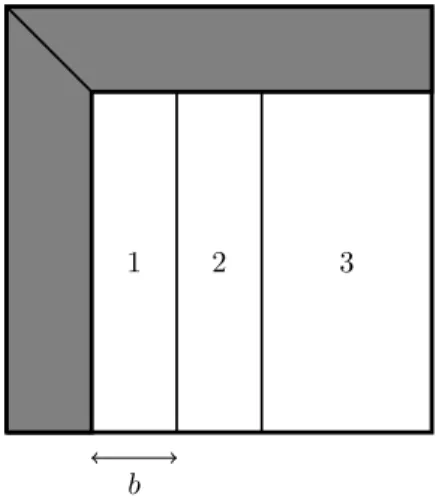
Let us illustrate how the hybrid multicore + GPU approach can be applied to the LU factorization by describing the algorithm as it is implemented in the MAGMA library. The method is based on splitting the computation as shown in Figure 1 that represents a matrix factored via a right-looking block LU factorization [10, p. 85], where the dark part has been already factored. The initial matrix has been downloaded to the GPU and we describe here a current iteration:
1. The current panel (1) containing b columns is downloaded to the CPU. 2. (1) is factored by the CPU and the result is sent back to the GPU. 3. The GPU updates (2) that corresponds to the next panel (first b columns
of the trailing submatrix).
4. The updated panel (2) is sent to the CPU and asynchronously factored on the CPU while the GPU updates the rest of the matrix (3).
The technique consisting of factoring (2) while still updating (3) is often referred to as look-ahead [19]. In the current implementation of MAGMA, the panel factorization is performed using GEPP but this algorithm is general enough to be applicable to many forms of LU factorizations, where the distinction can be made based on the form of pivoting that they employ. In Section 3.2 we will use a different pivoting strategy that turns out to be very efficient for factoring the panel due to its particular “tall and skinny” structure. Depending on the problem size n and on the hardware used, MAGMA proposes a default value for the parameter b (width of the panel). Note that the design of the hybrid LU in MAGMA avoids communicating by having only panels transferred between CPU and GPU (O(n ∗ b) data vs O(n ∗ n ∗ b) computation in the updates), enabling also the total overlap of the panel computation by the updates for n large enough.
2.2
PRBT solver
Using the PRBT solver, we solve the general linear system Ax = b by the following steps:
1. Compute the randomized matrix Ar = UTAV, with U and V recursive
butterflies.
2. Factorize Ar with GENP.
3. Solve Ary = UTb.
4. Solution is x = V y.
In this section, we present an implementation of a PRBT solver for hybrid CPU/GPU architectures. The randomization by recursive butterflies uses 2
6
1 2 3
b
Figure 1: Block splitting in hybrid LU factorization
recursions and the resulting computational cost for randomization is 4n2 flops
(see [3] for more details on the computational kernels that exploit the particular structure of the recursive butterflies). The PRBT solver for hybrid CPU/GPU architectures performs the following tasks:
• Random generation and packed storage of U and V on the CPU, while sending A to the device memory.
• The packed representation of U and V are sent from the host memory to the device memory.
• Randomization is performed on the GPU, updating A in-place (no addi-tional memory needed) on the device memory.
• The randomized matrix is factorized with GENP on the GPU, the panel factorization being performed on the CPU host.
• We compute UTbon the GPU, A
ry = UTbis solved on the GPU, followed
by the solution x = V y.
• The solution is sent to the host memory.
When using the PRBT solver, the bulk of the computation corresponds to the GENP factorization (the randomization represents less than 2% of the global computational time). Since in this approach we know in advance that we are not going to pivot, GENP that follows randomization is implemented as a very efficient fully BLAS 3 algorithm. Then we expect that the Gflop/s performance of the PRBT solver will provide us with an upper bound for other LU solvers on hybrid CPU/GPU architectures. Note that when the initial matrix is ran-domized, we systematically add iterative refinement in the working precision for better stability, as indicated in [17, p. 232].
3
Hybrid communication-avoiding LU
factoriza-tion
3.1
Communication-avoiding LU
The poor evolution of latency and memory bandwidth that we observed over recent years for parallel architectures is a major bottleneck for algorithms that require communication like GEPP. New approaches have been recently proposed to minimize the amount of communication due to pivoting. Among them are the communication-avoiding algorithms introduced for distributed-memory ma-chines [15] and for multicore architectures [9]. These algorithms are effective in the sense that they reduce significantly the communication while being stable in practice. CALU is an algorithm that partitions the input matrix into block of columns (panels), iteratively factors the panel and updates the trailing subma-trix. The factorization of the panel is one of the most important task in the LU fatorization since it is part of the critical path in the diagram of tasks and its effective execution influences the performance of the algorithm. In CALU, the panel factorization is performed by the TSLU algorithm which factors a block column of size b with the following steps:
1. Partition the block column in Prthreads where Pris the number of threads
participating in the panel factorization. Let Ai, the block assigned to each
thread.
2. Each thread applies GEPP to its block and we have ΠiAi= LiUi. We
de-note by Ci= (ΠiAi)(1 : b, 1 : b)the block containing the potential pivots,
where Πi is the permutation matrix resulting from the LU factorization
of Ai.
3. For each step of the reduction tree (see [9] for more details on the most adapted reduction tree):
If j is the thread number exchanging data with thread i and C0
i= [Ci; Cj],
then we compute ΠiCi0 = LiUi and (ΠiCi0)(1 : b, 1 : b) is the new pivot
candidate.
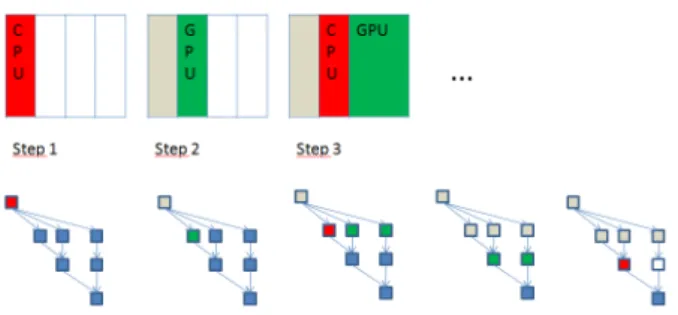
4. Apply the latest permutation computed in 3) to the original panel in order to compute the block column of L and to compute the block row of U. Once the panel is factored using TSLU then we update the trailing subma-trix. Following the approach presented in [6, 7], the CALU algorithm can be represented as a Directed Acyclic Graph (DAG) where nodes are elementary tasks that operate on one or several b × b blocks and where edges represent the dependencies among them. A dependency occurs when a task must access data that is the output of another task, either to further update or just read that data. In Figure 2 we represent an example of LU factorization with CALU as a sequence of DAGs using 2 threads. The panel is partioned into 3 column blocks. Red tasks represent the factorization of the panel via TSLU, the green tasks represent the update of the trailing submatrix, and the blue tasks are those that are not executed so far.
8
Figure 2: Example of asynchronous LU factorization using multithreaded CALU (2 threads, 3 column blocks).
3.2
Hybrid version of CALU (H-CALU)
As explained in Section 2.1, the LU algorithm implemented in MAGMA factors each block of columns iteratively. Each step is essentially decomposed into two distinct phases: the factorization of the panel by the CPU followed by the update of the trailing submatrix by the GPU. The algorithm’s design minimizes the CPU-GPU communications. In the following we describe an algorithm that further improves the algorithm in MAGMA by minimizing the communication associated with the panel factorizations.
At each step, a panel of size B is factored on the CPU by applying CALU to a rectangular matrix and the update of the trailing submatrix is performed by the GPU. CALU factors the panel by splitting the initial block of columns into smaller rectangular blocks containing b columns that are factored iteratively using TSLU. Thus, the factorization of the panel is considered as a variant of the algorithm at the first level where we factor a rectangular matrix using only the CPU. The use of this second level of blocking is important for performance on hybrid CPU/GPU architectures because the CPU and GPU processors have different sizes of cache memory. The block size B is chosen in order to optimize the performance of the matrix-matrix product on the GPU and to ensure a good grain for increasing parallelism. Then the block size b is tuned in order to opti-mize the utilization of the multicore cache. This decomposition of the algorithm into small tasks allows us to operate on block of data that fit into the cache. It results in an asynchronous and dynamic execution of the panel factorization on the CPU, yielding to good performance on multicore machines [9]. This asynchronous execution keeps busy most of the CPU threads. When b = B, CALU behaves simply as TSLU. If B is large enough (which will be the case for our hybrid implementation), the panel is factored using CALU rather than TSLU because CALU can be executed asynchronously [9]. Our approach also uses the well known technique referred to as look-ahead [19] but adapted here so that the CPU and the GPU can work together while minimizing the number of memory transfers. In this approach, we start factoring the next panel as soon as possible.
Figure 3 depicts an example of the factorization of a matrix. We consider that the matrix is initially stored on the GPU. Red tasks represent the factor-ization of the panel using multithreaded CALU and the green tasks represent the update of the trailing submatrix in the GPU. At each step of the factoriza-tion, the block corresponding to the panel is transfered to the CPU and factored using CALU. Once the panel is factored, it is sent back to the GPU in order to
update the trailing submatrix. The GPU updates in priority the column block corresponding to the next panel. Note that, similarly to [23], the data transfer between CPU and GPU is overlapped by computation.
Figure 3: Hybrid CALU factorization (4 panels).
4
Numerical experiments
In this section we present performance results for the H-CALU algorithm described in Section 3.2. These numerical experiments were carried out using a hybrid CPU/GPU system where:
• The GPU device is an NVIDIA Fermi Tesla S2050 with 448 CUDA cores running at 1.15 GHz and 2687 MB memory.
• The multicore host is a 48 cores system (4 sockets × 12 cores) AMD Opteron 6172 (2.1 GHz).
For experiments involving only the multicore host (panel factorization), com-parisons are made against the MKL [18] multithreaded library. For experiments involving both CPU and GPU (factorization of the whole matrix), comparisons are made against version 1.1 of the MAGMA library. All computations are performed on random matrices and in double precision arithmetic.
4.1
Panel factorization
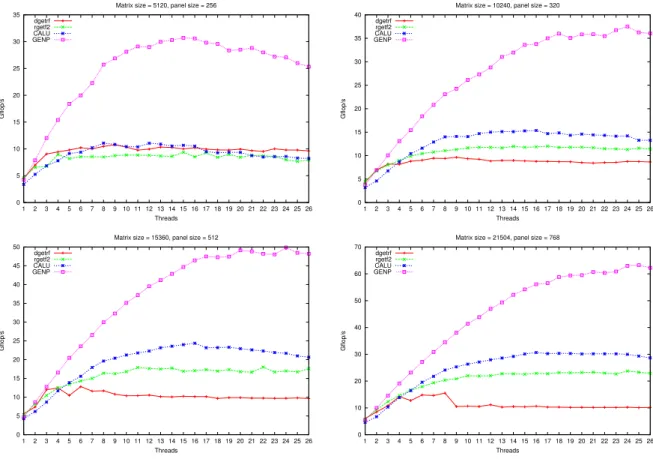
As described in Section 3.2, the panel factorization is performed by the CPU while the update of the trailing submatrix is executed on the GPU. Let us eval-uate specifically the performance for the panel factorization phase in an LU factorization. This performance is measured by summing the total number of flops executed in factoring successively each panel throughout the factorization and dividing it by the time spent during these steps. This performance (ex-pressed in Gflop/s) is plotted in Figure 4 for the factorization of four square matrices, each associated with a given panel size (parameter B defined in Sec-tion 3.2, corresponding to the number of columns for the panel). For factoring the panel, we consider different numbers of threads (one CPU core being used for each thread) varying from 1 to 26. Note that using more than 26 threads does not provide us with better performance, due to the too-large amount of
10
communication involved in the panel factorization. The panel size B considered in Figure 4 for each matrix size corresponds to a value empirically tuned in order to provide the best global factorization time for each matrix when using a hybrid implementation.
In these experiments, we compare the performance of the panel factorization for the following routines:
• CALU factorization routine modified for the H-CALU solver and linked with the sequential version of MKL for the required BLAS and LAPACK routines.
• MKL implementation of the LAPACK routine dgetrf, used in the MAGMA implementation of LU for factoring the panel.
• A recursive routine for GEPP rgetf2 (linked with MKL multithreaded BLAS) described in [16] and known to give good performance on “tall and skinny” matrices.
• PRBT where the panel is factored using the GENP routine dgetrf_nopiv (no pivoting).
The routines compared in this section have been selected on the fact that they can be used as kernels for our hybrid CPU/GPU implementation. If we use only multicore machines without GPU, then other solvers can be considered (see e.g. recursive tile version in [11]). The performance of PRBT, based on a GENP routine can be considered here as a “peak” performance for the panel factorization. In this respect, we observe that, in percentage of this peak per-formance and depending on the matrix size n, CALU achieves between 36 % (n = 5120) and 48 % (n = 21504), dgetrf achieves between 35 % (n = 5120) and 23 % (n = 21504), and rgetf2 achieves between 31 % (n = 5120) and 38 % (n = 21504). We also observe that CALU is even faster for larger ratios rows/columns. Moreover, CALU and PRBT have better scalability properties. This can be explain by the fact that CALU minimizes communication thanks to its pivoting strategy and PRBT does not pivot at all. The plateau observed for each curve after a certain number of threads corresponds to cases where the amount of communication becomes too large and cannot be overlapped by com-putation. For n = 5120, CALU, dgetrf and rgetf2 give similar performance. However, when the matrix size increases and then the panel becomes more “tall and skinny”, CALU outperforms the two other solvers and achieves a reasonable fraction of the PRBT rate. This good behavior of CALU for factoring the panel was already mentioned in [9]. In particular this better scalability of CALU en-ables us to use more CPU threads in factoring the panel and then to improve the overall performance of a hybrid LU solver.
4.2
Performance of hybrid LU implementations
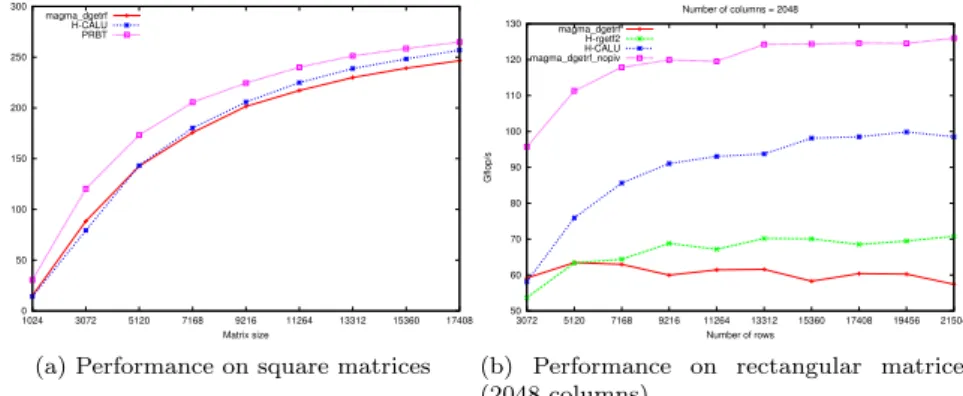
In this section we study the performance of LU factorization routines that utilize resources from multicore (16 threads) and one GPU. We compare in Figure 5a the following routines, applied to square matrices of various sizes:
• The MAGMA routine magma_dgetrf, where the panel is factored using the MKL routine dgetrf.
0 5 10 15 20 25 30 35 1 2 3 4 5 6 7 8 9 10 11 12 13 14 15 16 17 18 19 20 21 22 23 24 25 26 Gflop/s Threads Matrix size = 5120, panel size = 256 dgetrf rgetf2 CALU GENP 0 5 10 15 20 25 30 35 40 1 2 3 4 5 6 7 8 910 11 12 13 14 15 16 17 18 19 20 21 22 23 24 25 26 Gflop/s Threads Matrix size = 10240, panel size = 320 dgetrf rgetf2 CALU GENP 0 5 10 15 20 25 30 35 40 45 50 1 2 3 4 5 6 7 8 9 10 11 12 13 14 15 16 17 18 19 20 21 22 23 24 25 26 Gflop/s Threads Matrix size = 15360, panel size = 512 dgetrf rgetf2 CALU GENP 0 10 20 30 40 50 60 70 1 2 3 4 5 6 7 8 910 11 12 13 14 15 16 17 18 19 20 21 22 23 24 25 26 Gflop/s Threads Matrix size = 21504, panel size = 768 dgetrf
rgetf2 CALU GENP
12
• H-CALU, where the panel is factored using the CALU routine mentioned in Section 4.1.
• The PRBT solver (randomization + GENP).
0 50 100 150 200 250 300 1024 3072 5120 7168 9216 11264 13312 15360 17408 Gflop/s Matrix size magma_dgetrf H-CALU PRBT
(a) Performance on square matrices
50 60 70 80 90 100 110 120 130 3072 5120 7168 9216 11264 13312 15360 17408 19456 21504 Gflop/s Number of rows Number of columns = 2048 magma_dgetrf H-rgetf2 H-CALU magma_dgetrf_nopiv
(b) Performance on rectangular matrices (2048 columns)
Figure 5: Performance on AMD + Tesla 2050, 16 threads
As expected, PRBT outperforms the other routines because it does not pivot and the randomization time is negligible. We can also observe that in the range 1024-5120, H-CALU gives similar performance as MAGMA but it is slightly faster for matrix sizes larger than 5120. This trend can be explained by the fact that, for matrix sizes smaller than 5120, the panels are not enough “tall and skinny” to take advantage of the CALU algorithm. We notice that the difference of performance observed for the panel in Section 4.1 has a moderate impact on the whole factorization since the update phase performed on the GPU represents the bulk of the computation. In particular we do not mention in these results the experiments performed with a MAGMA routine modified so that the panel is factored by the routine rgetf2 mentioned in Section 4.1 because we obtained performance results similar to that of magma_dgetrf. Note that asymptotically, the performance of the three routines should be close because communication becomes negligible compared to the O(n3)computations for large dimensions.
In Figure 5b we compare the performance of hybrid LU factorization rou-tines for rectangular matrices of size m × n with m > n, using 16 threads. Such an LU factorization exists when A(1 : k; 1 : k) is nonsingular for k = 1 : n (see [13, p. 102]). In our experiments n = 2048 and m varies from 3072 to 21504. Comparisons are made against the MAGMA routines magma_dgetrf and magma_dgetrf_nopiv (instead of PRBT since the latter has no implemen-tation for rectangular matrices). We also compare with the MAGMA routine magma_dgetrf modified by factoring the panel using the recursive GEPP ker-nel (this routine is named H-rgetf2 in our graph). On this type of matri-ces, H-CALU outperforms magma_dgetrf and H-rgetf2.Hybrid factorization on rectangular matrices could be for instance useful in a future hybrid factor-ization with multiple GPUs where the (rectangular) panel could be factored using CPU and a GPU.
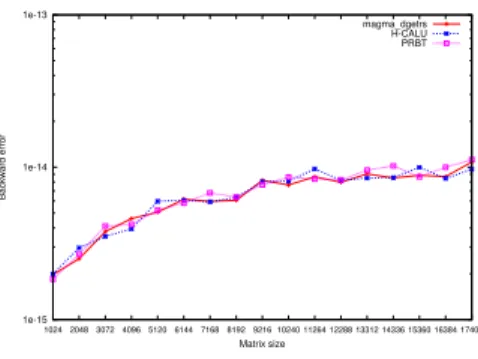
1e-15 1e-14 1e-13 1024 2048 3072 4096 5120 6144 7168 8192 9216 10240 11264 12288 13312 14336 15360 16384 17408 Backward error Matrix size magma_dgetrs H-CALU PRBT
Figure 6: Comparison of componentwise backward error
4.3
Tests on accuracy
First we study the backward error obtained for the linear system solution computed with the solvers LU MAGMA (based on the factorization routine magma_dgetrf), H-CALU and PRBT, using the random matrices considered in the previous experiments. The quantity plotted in Figure 6 corresponds to the componentwise backward error given in [1, p. 78] and expressed by
ω = max
i
|Ax − b|i
(|A| · |x| + |b|)i
,
where x is the computed solution. We observe that the backward errors are very similar for the three hybrid solvers.
Now we present additional experiments using LAPACK test cases given in [5]. Table 1 lists the 11 matrices used in our experiments (size 512, all in double precision). In this table, ε denotes the machine precision and κ is the infinity-norm condition number of the matrix. We report in Table 2 the com-ponentwise backward error obtained for the three hybrid solvers LU MAGMA, H-CALU and PRBT. Iterative refinement (in the working precision) is added if necessary using the LAPACK routine dgerfs on the multicore host. The iter-ative refinement is based on the stopping criterion given in [22] (ω ≤ (n + 1)ε), with a maximum of 5 iterations. Matrices 5 to 7 are singular and have at least one row and column equal to zero. These are used in [5] to test the error return codes. Nevertheless, for these matrices the random transformation of A allows the LU factorization to continue while the pivoting is not capable of removing the zero pivots. For the ill-conditioned matrix 9, the backward error is slightly less accurate than the other solvers. Matrix 10 is scaled to near underflow and the three solvers give similar results but less acurate than other matrices. For all the other matrices, the three solvers give the same accuracy. Tests on accuracy for specific matrix collections can be found in [3] and [14] respectively for PRBT and CALU.
5
Conclusion
In this paper we presented different LU factorization routines using a multicore machine accelerated with one GPU. The difference beween these approaches
14
Table 1: Test matrices
1 Diagonal 7 Last n/2 columns zero 2 Upper triangular 8 Random, κ = p0.1/ε 3 Lower triangular 9 Random, κ = 0.1/ε 4 Random, κ = 2 10 Scaled near underflow 5 First column zero 11 Scaled near overflow 6 Last column zero
Table 2: Componentwise Backward Error Matrix MAGMA LU H-CALU PRBT
Type (magma_dgetrf)
1 0.0 0.0 1.42e-16 2 1.32e-16 1.32e-16 4.02e-16 3 1.85e-16 1.85e-16 2.46e-16 4 2.16e-16 2.76e-16 2.93e-16
5 - -
-6 - -
-7 - -
-8 2.10e-16 3.76e-16 2.64e-16 9 2.70e-16 6.37e-16 1.16e-13 10 7.60e-14 7.40e-14 4.01e-14 11 2.27e-16 2.11e-16 2.41e-16
comes from the pivoting strategy chosen for factoring the panel. We proposed a new hybrid communication-avoiding solver H-CALU where the panel is factored on the CPU while the update is performed by the GPU. In our experiments, this solver turns out to be faster than the classical GEPP implementation in MAGMA for square matrices larger than 5120 and in all cases for rectangular matrices. H-CALU is scalable, allowing us to use larger panels and thus to limit the amount of transfer between the CPU and the GPU memory. We point out that further optimizations are possible with e.g. additional tuning and scheduling but our experiments give a general trend for the performance of algorithms as dictated by the amount of communication that they perform. However, the solver based on randomization always outperforms other solvers since we do not pivot at all and the computational cost for randomizing is small.
References
[1] E. Anderson, Z. Bai, C. Bischof, S. Blackford, J. Demmel, J. Don-garra, J. Du Croz, A. Greenbaum, S. Hammarling, A. McKenney, and D. Sorensen. LAPACK Users’ Guide. SIAM, 1999. Third edition.
[2] M. Anderson, G. Ballard, J. Demmel, and K. Keutzer. Communication-Avoiding QR decomposition for GPUs. 2011. LAPACK Working Note 240, proceedings of IPDPS’11.
[3] M. Baboulin, J. Dongarra, J. Herrmann, and S. Tomov. Accelerating linear system solutions using randomization techniques. 2011. LAPACK Working Note 246.
[4] L. Blackford, J. Choi, A. Cleary, E. D’Azevedo, J. Demmel, I. Dhillon, J. Dongarra, S. Hammarling, G. Henry, A. Petitet, K. Stanley, D. Walker, and R. Whaley. ScaLAPACK Users’ Guide. SIAM, 1997.
[5] S. Blackford and J. Dongarra. Installation Guide for LAPACK. 1999. LAPACK Working Note 41, revised version 3.0.
[6] A. Buttari, J. Dongarra, J. Kurzak, J. Langou, P. Luszczek, and S. Tomov. The impact of multicore on math software. 2006. In Proceedings of PARA 2006, Workshop on state-of-the art in scientific computing.
[7] A. Buttari, J. Langou, J. Kurzak, and J. Dongarra. Parallel tiled QR factorization for multicore architectures. Concurr. Comput. : Pract. Exper., 20:1573–1590, 2007.
[8] J. Choi, J. Dongarra, L. Ostrouchov, A. Petitet, D. Walker, and R. Whaley. A proposal for a set of parallel basic linear algebra subprograms. Technical report, 1995. LAPACK Working Note 100.
[9] S. Donfack, L. Grigori, and A. K. Gupta. Adapting communication-avoiding LU and QR factorizations to multicore architectures. In Parallel & Distributed Processing (IPDPS), 2010 IEEE International Symposium on, pages 1–10. IEEE, 2010.
[10] J. Dongarra, I. Duff, D. Sorensen, and H. van der Vorst. Numerical Linear Algebra for High-Performance Computers. SIAM, 1998.
[11] J. Dongarra, M. Faverge, H. Ltaief, and P. Luszcsek. Achieving numer-ical accuracy and high performance using recursive tile LU factorization. LAPACK Working Note 259.
[12] J. J. Dongarra, C. B. Moler, J. R. Bunch, and G. W. Stewart. LINPACK Users’ Guide. SIAM, 1979.
[13] G. H. Golub and C. F. van Loan. Matrix Computations. The Johns Hopkins University Press, 1996. Third edition.
[14] L. Grigori, J. Demmel, and H. Xiang. CALU: a communication optimal LU factorization algorithm. SIAM J. Matrix Anal. and Appl., 32:1317–1350, 2011.
[15] L. Grigori, J.W. Demmel, and H. Xiang. Communication avoiding Gaus-sian elimination. In Proceedings of the 2008 ACM/IEEE conference on Supercomputing, page 29. IEEE Press, 2008.
[16] F. G. Gustavson. Recursion leads to automatic variable blocking for dense linear-algebra algorithms. IBM Journal of Research and Development, 41(6):737–755, 1997.
[17] N. J. Higham. Accuracy and Stability of Numerical Algorithms. SIAM, 2002. Second edition.
16
[18] Intel. Math Kernel Library (MKL). http://www.intel.com/software/ products/mkl/.
[19] J. Kurzak and J. Dongarra. Implementing linear algebra routines on multi-core processors with pipelining and a look ahead. 2006. LAPACK Working Note 178.
[20] R. Nath, S. Tomov, and J. Dongarra. An improved MAGMA GEMM for Fermi GPUs. International Journal of High Performance Computing Applications, 24(4):511–515, 2010.
[21] D. S. Parker. Random butterfly transformations with applications in com-putational linear algebra. Technical Report CSD-950023, Computer Science Department, UCLA, 1995.
[22] R. D. Skeel. Iterative refinement implies numerical stability for Gaussian elimination. Math. Comput., 35:817–832, 1980.
[23] S. Tomov, J. Dongarra, and M. Baboulin. Towards dense linear alge-bra for hybrid GPU accelerated manycore systems. Parallel Computing, 36(5&6):232–240, 2010.
[24] S. Tomov, R. Nath, and J. Dongarra. Accelerating the reduction to upper Hessenberg, tridiagonal, and bidiagonal forms through hybrid GPU-based computing. Parallel Computing, 36(12):645–654, 2010.
Contents
1 Introduction 3
2 Two existing hybrid algorithms for LU factorization 5 2.1 LU factorization based on partial pivoting . . . 5 2.2 PRBT solver . . . 5 3 Hybrid communication-avoiding LU factorization 7 3.1 Communication-avoiding LU . . . 7 3.2 Hybrid version of CALU (H-CALU) . . . 8 4 Numerical experiments 9 4.1 Panel factorization . . . 9 4.2 Performance of hybrid LU implementations . . . 10 4.3 Tests on accuracy . . . 13
Centre de recherche INRIA Saclay – Île-de-France Parc Orsay Université - ZAC des Vignes 4, rue Jacques Monod - 91893 Orsay Cedex (France)
Centre de recherche INRIA Bordeaux – Sud Ouest : Domaine Universitaire - 351, cours de la Libération - 33405 Talence Cedex Centre de recherche INRIA Grenoble – Rhône-Alpes : 655, avenue de l’Europe - 38334 Montbonnot Saint-Ismier Centre de recherche INRIA Lille – Nord Europe : Parc Scientifique de la Haute Borne - 40, avenue Halley - 59650 Villeneuve d’Ascq
Centre de recherche INRIA Nancy – Grand Est : LORIA, Technopôle de Nancy-Brabois - Campus scientifique 615, rue du Jardin Botanique - BP 101 - 54602 Villers-lès-Nancy Cedex
Centre de recherche INRIA Paris – Rocquencourt : Domaine de Voluceau - Rocquencourt - BP 105 - 78153 Le Chesnay Cedex Centre de recherche INRIA Rennes – Bretagne Atlantique : IRISA, Campus universitaire de Beaulieu - 35042 Rennes Cedex Centre de recherche INRIA Sophia Antipolis – Méditerranée : 2004, route des Lucioles - BP 93 - 06902 Sophia Antipolis Cedex
Éditeur
INRIA - Domaine de Voluceau - Rocquencourt, BP 105 - 78153 Le Chesnay Cedex (France)
http://www.inria.fr ISSN 0249-6399