HAL Id: hal-01435012
https://hal-univ-rennes1.archives-ouvertes.fr/hal-01435012
Submitted on 6 Mar 2017HAL is a multi-disciplinary open access archive for the deposit and dissemination of sci-entific research documents, whether they are pub-lished or not. The documents may come from teaching and research institutions in France or abroad, or from public or private research centers.
L’archive ouverte pluridisciplinaire HAL, est destinée au dépôt et à la diffusion de documents scientifiques de niveau recherche, publiés ou non, émanant des établissements d’enseignement et de recherche français ou étrangers, des laboratoires publics ou privés.
New Insight into Daptomycin Bioavailability and
Localization in Staphylococcus aureus Biofilms by
Dynamic Fluorescence Imaging
Rym Boudjemaa, Romain Briandet, Matthieu Revest, Cédric Jacqueline,
Jocelyne Caillon, Marie-Pierre Fontaine-Aupart, Karine Steenkeste
To cite this version:
Rym Boudjemaa, Romain Briandet, Matthieu Revest, Cédric Jacqueline, Jocelyne Caillon, et al.. New Insight into Daptomycin Bioavailability and Localization in Staphylococcus aureus Biofilms by Dynamic Fluorescence Imaging. Antimicrobial Agents and Chemotherapy, American Society for Mi-crobiology, 2016, 60 (8), pp.4983-4990. �10.1128/AAC.00735-16�. �hal-01435012�
Page 1 of 30
New insight into daptomycin bioavailability and localization in S. aureus biofilms by dynamic
1
fluorescence imaging.
2 3 4
Rym Boudjemaa,a# Romain Briandet,b Matthieu Revest,c,d Cédric Jacqueline,d Jocelyne Caillon,d
5
Marie-Pierre Fontaine-Aupart,a and Karine Steenkestea 6
7
Institut des Sciences Moléculaires d’Orsay (ISMO), CNRS, Univ. Paris-Sud, Université Paris-Saclay, 8
F-91405 Orsay, Francea;Micalis Institute, INRA, AgroParisTech, Université Paris-Saclay, 78350 Jouy-9
en-Josas, Franceb;CHU Rennes, Rennes, Francec;Université de Nantes, Faculté de Médecine, UPRES
10
EA 3826, Nantes, Franced
11 12
Running head: daptomycin diffusion-reaction in S. aureus biofilms
13 14
#Address correspondence to Rym Boudjemaa, [email protected]
15 16
Page 2 of 30
ABSTRACT
17
Staphylococcus aureus (S. aureus) is one of the most frequent pathogens responsible for
biofilm-18
associated infections (BAI) and the choice of antibiotics to treat these infections remains a challenge 19
for the medical community. In particular, daptomycin has been reported to fail against implant-20
associated S. aureus infections in clinical practice while its association with rifampicin remains a good 21
candidate for BAI treatment. To improve our understanding of such resistance/tolerance toward 22
daptomycin, we took advantage of the dynamic fluorescence imaging tools (time-lapse imaging and 23
FRAP) to locally and accurately assess the antibiotic diffusion-reaction in methicillin-susceptible and 24
methicillin-resistant S. aureus biofilms. To provide a realistic representation of daptomycin action, we 25
optimized an in vitro model built on the basis of our recently published in vivo mouse model of 26
prosthetic vascular graft infections. We demonstrated that at therapeutic concentrations, daptomycin 27
was inefficient to eradicate biofilms while the matrix was not a shield to the antibiotic diffusion and to 28
its interaction with its bacterial target. In the presence of rifampicin, daptomycin was still present in the 29
vicinity of the bacterial cells allowing the prevention of the emergence of rifampicin-resistant mutants. 30
Conclusions derived from this study strongly suggest that S. aureus biofilms resistance/tolerance 31
towards daptomycin may be more likely related to a physiological change involving structural 32
modifications of the membrane, which is a strain-dependent process. 33
Page 3 of 30
INTRODUCTION
35
Staphylococcus aureus (S. aureus) is a Gram-positive bacteria shown to be the most frequent
36
cause of biofilm-associated infections (BAI) (1) and one of the major cause of morbidity and mortality 37
in hospitals and communities (2). Unlike planktonic cells, biofilms exhibit specific phenotypic traits 38
allowing them to resist host defenses and antibiotic treatments (3), which frequently leads to chronic 39
infections such as endocarditis, sinusitis, and osteomyelitis but also to implant-associated infections 40
(4). 41
Among the most recent clinically-used antibiotics, daptomycin is a cyclic lipopeptide approved 42
for the treatment of serious staphylococcal infections such as bacteremia and implant-related infections 43
(5). Daptomycin is a calcium-dependent antibiotic, acting by insertion into the Gram-positive 44
cytoplasmic membranes where it forms oligomeric pores, causing potassium ion leakage and 45
subsequent membrane depolarization, leading ultimately to cell death (6). As is the case for many 46
antibiotics, daptomycin has been shown to exhibit a significant bactericidal activity against planktonic 47
cells (7–9). However, the eradication of adherent bacteria is rarely achieved despite the large number of 48
in vitro and animal studies in which daptomycin activity was evaluated (10–16). Besides the results of
49
the literature that appear controversial (17), direct comparison between studies is not directly possible 50
since biofilm growth and treatment protocols used greatly differ. 51
To get a realistic representation of daptomycin action against S. aureus biofilms, we developed 52
an in vitro model built on the basis of our recently published in vivo study on S. aureus prosthetic 53
vascular graft infections using the same strains (18). The interest of this approach was the possibility to 54
use fluorescence imaging techniques that cannot be employed in vivo (confocal laser scanning 55
microscopy, time-lapse and fluorescence recovery after photobleaching) to examine the penetration, 56
diffusion, bioavailability and localization of the fluorescently-labelled antibiotic inside the biofilms. To 57
validate this approach, we monitored for 72 h the activity of daptomycin against biofilms formed by 58
Page 4 of 30 methicillin-susceptible and methicillin-resistant clinical and collection strains. In addition, we enriched 59
the culture medium with proteins and calcium to mimic the in vivo physiological conditions of our 60
mouse model (18). The same experiments were performed in the presence of rifampicin, an antibiotic 61
that can be combined with daptomycin for recalcitrant S. aureus BAI. 62
63
MATERIALS AND METHODS
64
Bacterial strains
65
Four S. aureus strains were tested in the present study: two of them were collection strains (methicillin-66
susceptible S. aureus (MSSA) ATCC 27217 and methicillin-resistant S. aureus (MRSA) ATCC 33591) 67
and two others were isolated from patients with S. aureus bloodstream infections (MSSA 176 and 68
MRSA BCB8). All the strains were kept at -80°C in Tryptic Soy Broth (TSB; Biomérieux, France) 69
containing 20% (vol/vol) glycerol. The frozen cells were subcultured twice in TSB (one 8-hour culture 70
followed by an overnight culture) to constitute the stock cultures from which aliquots were kept at -71
20°C. Bacterial growth and experiments were both conducted at 37°C. 72
Antimicrobial agents and medium
73
Daptomycin and rifampicin were both purchased from Sigma (France). The fluorescently-labelled 74
antibiotic BODIPY-FL®-daptomycin was a kind gift from Cubist Pharmaceuticals (MA, USA) and 75
BODIPY-FL® was purchased from Invitrogen (France). According to the manufacturer’s instructions, 76
the stock solutions were prepared by diluting daptomycin and BODIPY®-FL-daptomycin in 77
dimethylsulfoxide (1 mg/mL), and rifampicin in sterile water (2 mg/mL), further kept at -20°C. Before 78
use, the solutions were diluted in TSB enriched with proteins (BSA, Bovine Serum Albumin, 36 g/L; 79
Sigma, France) and calcium (CaCl2, 2H2O, 50 mg/L; Sigma, France) to mimic in vivo physiological
80
levels. It has been checked that, in these conditions, the final concentration of dimethylsulfoxide was 81
Page 5 of 30 non-cytotoxic for the bacteria. Clinically-meaningful concentrations were used in this study: 20 µg/mL 82
for both daptomycin and rifampicin. When combined, the antibiotics were mixed together before 83
application above the biofilm surface. 84
Susceptibility testing
85
The MICs of daptomycin and rifampicin were determined by the broth microdilution method in cation-86
adjusted Mueller-Hinton broth (CAMHB), according to the European Committee on Antimicrobial 87
Susceptibility Testing (EUCAST). Media were supplemented with 50 mg/L Ca2+ for daptomycin.
88
Characterization of molecular interactions between daptomycin and rifampicin by absorption
89
and fluorescence spectroscopies
90
Absorption spectra of antibiotics alone and in combination were measured with a Varian’s Cary® 300 91
spectrophotometer (Agilent Technologies, France). The corresponding fluorescence emission spectra 92
were recorded using a Fluorolog-3 (Jobin Yvon, Inc., France) fluorescence spectrophotometer mounted 93
with front-face detection geometry by exciting daptomycin at 360 nm. The measurements were made in 94
quintuplicate on each sample. 95
In vitro biofilm preparation and antibiotics activities 96
Biofilms were studied in a polystyrene microtiter plate-based assay since it has been shown that this 97
material has physicochemical properties close to that of biomaterial surfaces such as polyethylene 98
terephthalate that is used in vascular grafts (19, 20). For the preparation of S. aureus biofilms, 250-µL 99
portions of an overnight subculture adjusted to an optical density of 0.02 at 600 nm (corresponding to 100
~108 CFU/mL) were added to 96-well microplates (µClear; Greiner Bio-One, France). After a 1.5-h 101
adhesion period at 37°C, the wells were rinsed with sterile physiological water (150 mM NaCl) in order 102
to eliminate non-adherent cells, refilled with sterile TSB enriched with proteins and calcium (TSBpc) 103
and then incubated for 24 h at 37°C to allow biofilm growth. 104
Page 6 of 30 To assess antibiotics activities, the 24 h-biofilms were rinsed with a 150 mM NaCl aqueous solution 105
before adding the antibiotics solutions diluted in TSBpc as described previously. Viable culturable 106
bacteria were then counted at regular interval times: 0 h (when antibiotics are added), 24, 48 and 72 h 107
after antibiotics injection. For each time, bacterial cultures were centrifuged 10 min at 7000g in order to 108
eliminate the excess of antibiotic. The bacterial pellet was dispersed in NaCl 150 mM sterile saline 109
solution, centrifuged again and dispersed in the same conditions. Successive decimal dilutions were 110
then realized. For each dilution, six drops (10 µL) were deposited on Tryptic Soy Agar (TSA) plates 111
(Biomérieux, France) and incubated at 37°C during 24 h. CFUs were counted and averaged for each 112
dilution at each time. The detection limit of viable culturable cells was 100 CFU/mL. 113
Percentage of rifampicin-resistant mutants in biofilms
114
To measure percentages of rifampicin-resistant mutants, the antibiotics solutions (rifampicin combined 115
or not with daptomycin) were added to 24 h-biofilms. CFUs were counted on TSA plates containing or 116
not rifampicin (20 µg/mL) at 24 and 48 h after antibiotics injections. The percentages were obtained by 117
calculating the ratio between the number of CFUs grown on rifampicin-containing TSA plates and the 118
number of CFUs grown on rifampicin-free TSA plates. 119
Statistical analysis
120
The mean log10 CFU/mL and biovolumes for each therapy were compared with each other using
121
ANOVA variance analyses. They were performed using the Statgraphics software (Manugistics, 122
Rockville, USA). Significance was defined as a P-value associated with a Fisher test value lower than 123
0.05. 124
Confocal Laser Scanning Microscopy (CLSM)
125
Visualization of antibiotics activities against biofilms using Live/Dead® staining
126
24 h-biofilms prepared as described previously were observed 24, 48 and 72 h after antibiotics addition 127
using a Leica TCS SP5 confocal laser scanning microscope (Leica Microsystems, France) implemented 128
Page 7 of 30 at the Centre de Photonique Biomédicale (CPBM, Orsay, France). Prior to each observation, bacteria 129
were stained with 2.5 µM Syto9® (Life Technologies, France), a green cell-permeant nucleic acid dye, 130
and 30 µM propidium iodide (PI) (Life Technologies, France), a red nucleic acid dye that can penetrate 131
cells with compromised membranes (dead cells) only. Syto9® and PI were sequentially excited at 488 132
nm and 543 nm respectively and their fluorescence emissions were collected between 500 and 600 nm 133
for Syto9® and between 640 and 750 nm for PI. Images were acquired using a 63x oil immersion 134
objective with a 1.4 numerical aperture. The size of the confocal images was 512 x 512 pixels (82 x 82 135
µm²), recorded with a z-step of 1 µm. For each biofilm, four typical regions were analyzed. Images 136
were reconstructed in 3D using ICY® Software. 137
Quantification of biovolumes and maximum thickness
138
Maximum thickness (µm) was measured directly from xyz stacks. Biovolumes (µm3) were calculated
139
by binarizing images with a java script executed by ICY as described previously (21). The biovolume 140
was then defined as the overall volume of cells in the observation field. The percentage of dead cells 141
corresponds to the ratio between biovolumes of PI-stained bacteria and Syto9®-stained bacteria. 142
Antibiotics penetration and localization inside biofilms
143
To study the penetration of BODIPY®-FL-daptomycin and its combination with rifampicin within 144
24 h-biofilms, we employed time-lapse microscopy, as described before (22), using the same Leica 145
TCS SP5 confocal microscope. Briefly, the fluorescence intensity evolution over time was observed in 146
a defined focal plane (5 µm above the substratum surface). As soon as the TSBpc-diluted solutions of 147
BODIPY-FL®-daptomycin combined or not with rifampicin were added above the biofilm, 148
fluorescence intensity images were acquired every second during 15 min. Simultaneously, transmission 149
images were acquired to ensure that no structural alteration of the biofilm occurred during this process. 150
Page 8 of 30 The labelled antibiotic was excited with a continuous argon laser line at 488 nm through a 63x oil 151
immersion objective and the emitted fluorescence was recorded within 500 and 600 nm. 152
The corresponding diffusive penetration coefficients (Dp) through the biofilms were determined
153
according to the relationship previously described by Stewart (23): 154
Dp = 1.03 x L²/t90 (Eq. 1)
155
where L is the biofilm thickness and t90 is the time required to attain 90% of the equilibrium staining
156
intensity at the deeper layers of the biofilm. 157
To observe the localization of the fluorescently-labelled daptomycin within biofilms, bacteria were 158
counterstained with the FM4-64 dye (Life Technologies, France): this dye was also excited at 488 nm 159
but its fluorescence emission was collected within the range 640-750 nm. The images (512 x 512 160
pixels) of both fluorophores were simultaneously recorded with a z-step of 1 µm. 161
Antibiotic diffusion and bioavailability inside biofilms using FRAP experiments
162
Image-based Fluorescence Recovery after Photobleaching (FRAP) measurements was used to assess 163
local diffusion and bioavailability of the fluorescently-labelled daptomycin. Briefly, FRAP is based on 164
a brief excitation of fluorescent molecules by a very intense light source in a user-defined region to 165
irreversibly photobleach their fluorescence. Fluorescence recovery is then probed over time at a low 166
light power in the same photobleached region (22, 24). All time-resolved measurements were obtained 167
using the same confocal microscope. The time course of fluorescence intensity recovery was analyzed 168
with mathematical models, giving access to the quantitative mobility of the fluorescent molecules and 169
allowing to determine the diffusion coefficients. For all FRAP experiments, the fluorescence intensity 170
image size was fixed to 512 x 128 pixels with an 80-nm pixel size and recorded using a 12-bit 171
resolution. The line scan rate was fixed to 1400 Hz, corresponding to a total time between frames of ~ 172
265 ms. As determined previously, the full widths at half maximum in xy and z (along the optical axis) 173
Page 9 of 30 of the bleached profile were 0.8 µm and 14 µm, respectively, allowing to neglect diffusion along the 174
axial/vertical axis and thus to consider only two-dimensional diffusion. Each FRAP experiment started 175
with the acquisition of 50 images at 7% of laser maximum intensity (7 µW) followed by a 200-ms 176
single bleached spot at 100% laser intensity. A series of 450 single section images was then collected 177
with the laser power attenuated to its initial value (7% of the bleach intensity). The first image was 178
recorded 365 ms after the beginning of bleaching. 179 180 RESULTS 181 Susceptibility testing 182
The MICs obtained for daptomycin and rifampicin against the four S. aureus strains are presented in 183
Table 1. All isolates in planktonic conditions were susceptible to daptomycin and rifampicin. 184
Breakpoint values of drugs according to the European Committee on Antimicrobial Susceptibility 185
Testing (EUCAST) 2016 are: 2 mg/L for vancomycin; 1 mg/L for daptomycin; for rifampicin S ≤ 0.06 186
and R > 0.5 mg/L. 187
Spectroscopic characterization of the interaction between rifampicin and daptomycin
188
Neither the photonic absorption properties nor the fluorescence emission spectrum of daptomycin were 189
significantly influenced by the addition of rifampicin (Fig. 1), revealing the absence of cross-reaction 190
between the two antibiotics. 191
BODIPY-FL®-daptomycin penetration, diffusion, bioavailability and localization inside S.
192
aureus biofilms 193
Time-lapse imaging: time-lapse experiments were performed to visualize in situ the penetration of the 194
fluorescently-labelled daptomycin and its combination with rifampicin throughout the deepest layers of 195
S. aureus biofilms. By setting the focal plane 5 µm above the substratum surface, we demonstrated that
Page 10 of 30 BODIPY-FL®-daptomycin penetrated the biofilms (~30 µm thickness) within few minutes: 197
fluorescence intensity was measured a few seconds after antibiotic addition and increased rapidly to 198
reach 90% of the maximal intensity in 9 min (Fig. S1 and Movie S4). The penetration coefficients 199
obtained from Eq. 1 ranged from 2.5 ± 0.7 µm²/s for S. aureus 27217, 176 and 33591 to 4.9 µm²/s ± 0.7 200
µm²/s for S. aureus BCB8. These values are both of the same order by comparison with BODIPY-FL® 201
alone for which the penetration coefficient is superior to 140 µm²/s (22). The coefficients were not 202
statistically different in comparison with those of daptomycin in the presence of rifampicin. 203
FRAP imaging: FRAP was used to measure the local diffusion of BODIPY-FL®-daptomycin and its 204
interaction with bacteria within biofilms. According to the FRAP principle (22, 24, 25), if the 205
fluorescently-labelled daptomycin molecules are allowed to move freely in the sample, a total 206
fluorescence recovery is observed, meaning that the fluorescence is redistributed in the defined region. 207
Conversely, if the fluorescence recovery is not total after the photobleaching, it means that a fraction of 208
molecules is not diffusing freely and thus interacts with its local environment. The other fraction 209
diffuses and is thus bioavailable. 210
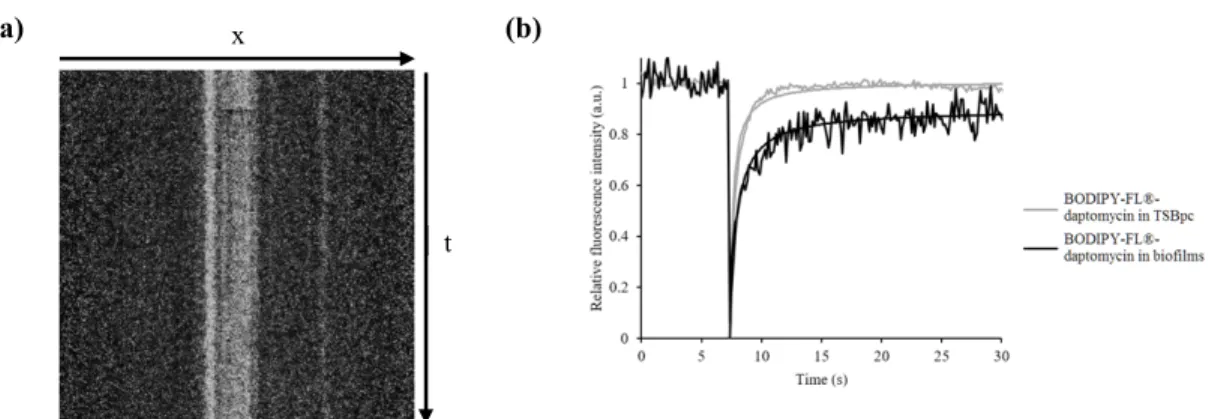
First, we checked that no bacterial movement occurred during image acquisition by representing 211
kymograms, two-dimensional graphs of fluorescence intensity measured along a line (here a straight 212
line drawn on the full width of the images) for each image of the FRAP series (Fig. 2a). A typical 213
FRAP curve of BODIPY-FL®-daptomycin in S. aureus biofilms is presented in Fig. 2b. Whatever the 214
bacterial strains or the treatments used (daptomycin alone and in combination with rifampicin), we 215
demonstrated here that the fluorescence recovery was not total after photobleaching: only 20% of 216
BODIPY-FL-®-daptomycin molecules interacted with the environment, meaning that a large excess of 217
molecules (80%) were diffusing freely in the defined-regions and thus bioavailable (mean local 218
diffusion coefficient, 7.1 +/- 0.6 µm²/s). 219
Page 11 of 30 Localization of the fluorescently-labelled daptomycin combined or not with rifampicin depending on 220
the surrounding environment: As daptomycin is known to be highly bound to serum proteins (90-221
93%) (26), we addressed the question of whether there could be a different localization of the 222
fluorescently-labelled daptomycin in a protein-enriched medium. As shown in Fig. 3, fluorescence 223
intensity images were significantly different depending on the surrounding medium: regardless of the 224
strain tested, the antibiotic appeared to be colocalized with the FM4-64 dye at the bacterial site when 225
the surrounding medium was a NaCl aqueous solution supplemented in calcium while the antibiotic 226
localization appeared to be mainly extracellular when the medium was enriched with proteins (TSBpc). 227
The addition of rifampicin did not affect daptomycin localization in the biofilm. 228
Combining 3D-fluorescence imaging and time-kill studies to assess S. aureus biofilms inactivation
229
in the presence of daptomycin alone and in association with rifampicin
230
We used confocal microscopy to describe the three-dimensional structures of biofilms and the temporal 231
distribution of both live and dead cells throughout the biofilm thickness. 232
Fluorescence intensity images showed that the biofilms formed by the four strains yielded similar 233
compact structures (Fig. 4a and Fig. S2 controls). Their thicknesses were neither significantly variable 234
from one strain to another (25-29 µm, P > 0.05), nor between 24 h and 72 h. This is a reasonable result 235
given that the culture medium (TSBpc) was renewed before the first observation but not over time: thus 236
biofilm development mainly occurred during the first 24 h. 237
When treated with daptomycin, biofilms exhibited more free-of-cells areas compared with controls 238
(Fig. 4a and Fig. S2). This can be related to significant decreases in biofilms thicknesses (19-21 µm in 239
the presence of daptomycin, P < 0.05) by comparison with the control biofilms. Moreover, in the 240
presence of daptomycin, no statistically significant change in the proportion of cell death over time was 241
quantified (10-30 %, P > 0.05) (Fig. 4b). However, the MRSA clinical isolate (BCB8) was more 242
Page 12 of 30 susceptible to daptomycin: ~ 60 % of cell death was quantified at 24 h, a value that decreased beyond 243
(40% at 72 h, P < 0.05) due to cell regrowth (see below). 244
By comparison with the monotherapy treatment, the biofilms structures and thicknesses were not 245
affected when they were treated with daptomycin in combination with rifampicin. However, in these 246
conditions, a significantly higher proportion of cell death was observed, achieving 85% at 72 h (P < 247
0.01) (Fig. 4b). For the two MSSA strains (27217, 176) and the MRSA collection strain (33591), the 248
antibiotics association activity gradually increased over time (Fig. 4) while the maximum activity 249
against the MRSA clinical strain (BCB8) was reached within 24 h. 250
Another observation of interest (Fig. 4a) is that upon daptomycin exposure, dead cells were observed 251
over the whole biofilm depth, including the basal layer of cells in contact with the substratum, 252
providing further evidence of the antibiotic penetration throughout the deepest layers of the biofilms. 253
This result is even more observable for the BCB8 strain because of the greater proportion of dead cells 254
involved by the action of daptomycin. This process was also observed when daptomycin was used in 255
association with rifampicin. 256
These data from fluorescence imaging were supported by CFU counts of suspended biofilms (Fig. 5). 257
The results confirm that daptomycin alone was ineffective against biofilms formed by the two MSSA 258
strains (27217, 176) and the MRSA collection strain (33591). For the MRSA clinical isolate (BCB8), 259
only ~1-2-log reduction in bacterial counts was measured at 24 h before regrowth was observed to 260
reach the same values as for the MSSA biofilms. 261
In accordance with fluorescence imaging data, the activity of the antibiotics combination was much 262
greater than the monotherapy. The sensitivity of the microbiological method allowed determining that 263
the cell population decreased by ~ 4 log after 72 h of treatment (P < 0.05). The emergence of 264
Page 13 of 30 rifampicin-resistant mutants was verified. As presented in Fig. 6, daptomycin dramatically prevented 265
the emergence of rifampicin-resistant mutants when used in combination. 266
267
DISCUSSION
268
The choice of antibiotics to treat S. aureus BAI remains a challenge for the medical community. 269
In this context, the ambivalence of the published results on daptomycin activity is a relevant example. 270
Despite increasing data about daptomycin as an option to treat implant-associated S. aureus infections, 271
as many failures (18, 27) as successes (7–9, 12) have been reported both in clinical practice and in 272
laboratory models. This highlights that S. aureus BAI resistance/tolerance mechanisms to 273
antimicrobials deserve more attention. 274
The biofilm-associated exopolymeric matrix may be considered to act as a shield to the 275
antimicrobial diffusion-reaction (28–32) by delaying its penetration and/or reducing its bioavailability. 276
To verify this hypothesis non-invasively, we took advantage of dynamic fluorescence imaging 277
methods: confocal microscopy, time-lapse imaging and FRAP. For our biofilm model and whatever the 278
bacterial strain, no failure of daptomycin penetrability or bioavailability was observed. The opposite 279
finding described by Siala et al. (31) may be related to the conditions of fluorescence acquisition that 280
were not well-adapted to BODIPY-FL® fluorescence. In this study, time-lapse fluorescence imaging 281
experiments demonstrated that daptomycin rapidly reached the biofilms deepest layers whilesection 282
views of fluorescence intensity images presented in Fig. 3 ascertain the presence of the fluorescently-283
labelled antibiotic through the whole biofilm structure. Furthermore, FRAP results ascertained that only 284
~20% of the antibiotic molecules were immobilized. Thus, the majority of the antibiotic molecules 285
were in free movement and could be bioavailable through the biomass (~80% of non-immobilized 286
molecules). 287
Page 14 of 30 We further addressed the question of whether or not daptomycin reached its bacterial target. 288
Fluorescence intensity images provided interesting information, showing that the fluorescently-labelled 289
antibiotic was distributed majorly in the extracellular matrix rather than in the bacterial cell membranes 290
(Fig. 3). This is in agreement with the well-known property of daptomycin to have a very high degree 291
of protein-binding, especially with serum albumin (90-93%) (26, 33) which is naturally present in 292
physiological conditions. Nevertheless, the fluorescence recovery curves obtained by FRAP 293
experiments in free medium and in the biofilms strongly suggested the reversibility of daptomycin 294
protein-binding (33, 34): the equilibrium between the bound and unbound states may conserve the 295
apparent mobility of the antibiotic. Additional experiments were performed in a protein-free medium (a 296
saline solution supplemented with calcium ions). In this case, bacterial cell membranes appeared as hot 297
spots on fluorescence images, consistently with the described antibiotic interaction with its target (6). 298
Surprisingly, whether the medium was protein-free or not, daptomycin exhibited the same lack of 299
effectiveness, as revealed by time-kill studies performed by fluorescent live-dead staining and 300
conventional plating on agar (data not shown in the absence of proteins). Thus, the interaction with the 301
matrix components cannot explain biofilm tolerance to the antibiotic. 302
The particular physiology of embedded bacteria should be thus considered and more 303
specifically cells with a low metabolic activity. Previous studies using a BrdU immunofluorescent 304
labelling technique demonstrated that the large majority of staphylococci cells in a biofilm were 305
actually in a low-metabolic state (35, 36). Additionally, in the present study, the comparison of cell 306
viability results obtained by CFU counts and fluorescence imaging highlighted a significant proportion 307
of viable cells detected by Live-Dead® staining but not by CFU measurements. This subpopulation 308
may be considered as viable but non-culturable (VBNC), a subpopulation known to have a slow 309
metabolism (37–39). Moreover, it has been demonstrated that daptomycin is poorly effective against 310
bacteria in stationary stage (7, 27). One can thus reasonably suggest that for bacteria with low-311
Page 15 of 30 metabolic activity, the cell membrane dysregulation induced by daptomycin may be slower and/or 312
more difficult to attain due to structural modifications of the cell membrane. This assumption is 313
supported by the reported data revealing that daptomycin displays a concentration-dependent 314
bactericidal activity against dormant cells (7, 9, 12). In the present study, we tested a double 315
concentration of daptomycin (40 µg/mL) on the different S. aureus biofilms, almost leading to 316
bactericidal effects after 24 h of drug exposure (Fig. S3) and showing no cell-regrowth over time. 317
However, biofilm clearance was not reached. This achievement was reported to occur in a daptomycin 318
concentration equal to or greater than 100 µg/mL but may not be relevant in clinical practice (7, 9, 12). 319
One particularity in this study concerns the BCB8 clinical isolate, which discriminated itself by 320
a twice higher penetration coefficient by comparison with the other strains tested and a greater 321
susceptibility as revealed by the observation of a larger proportion of dead cells over the whole biofilm 322
thickness, including the basal layer in contact with the substratum. These results are in line with those 323
obtained in vivo (18), which demonstrated a strain-dependent activity of daptomycin against S. aureus 324
biofilms. In view of the antibiotic mechanism of action which is supposed to target the plasma 325
membrane, the observed variable response depending on the bacterial strain may be due to a change in 326
membrane composition or conformation from a strain to another. 327
Facing the lack of daptomycin efficiency in treating recalcitrant S. aureus BAI, the addition of 328
rifampicin has raised great interest (10–13, 15, 40–42). Through this study, we demonstrated that the 329
combined therapy was indeed highly efficient against S. aureus biofilms, but did not allow total 330
bacterial clearance. Both antibiotics have been shown not to cross-react with each other, as evidenced 331
by steady-state fluorescence spectroscopy. Moreover, the penetration, diffusion and localization of the 332
fluorescently-labelled daptomycin were not affected by the presence of rifampicin. We also proved 333
here that rifampicin-resistant mutants emerged when biofilms were treated with rifampicin alone, but 334
not when treated with the antibiotic combination. Altogether, presented data confirm that daptomycin 335
Page 16 of 30 prevents the emergence of rifampicin resistant mutants, allowing the bactericidal activity of rifampicin 336
to quickly occur in time, regardless of the cell physiological state. 337
In conclusion, consistently with the previous in vivo study aiming at evaluating the antibiotic 338
efficacy in S. aureus prosthetic vascular graft infections (18), we demonstrated in the present in vitro 339
model a strain-dependent lack of daptomycin activity toward biofilms. Dynamic fluorescence 340
microscopy allowed discarding a lack of antibiotic availability and interaction with bacteria. Given the 341
mode of action of daptomycin, these observations suggest a membrane-dependent factor of tolerance in 342
such biofilms. Therefore, to provide a better understanding of daptomycin reduced activity against 343
biofilms, a further step should concern the analysis of the membranes composition. 344
345
FUNDING INFORMATION
346
This work was supported by a grant from the Ministère de l’Education Nationale, de l’Enseignement 347
Supérieur et de la Recherche, Université Paris-Sud, for Rym Boudjemaa’s PhD thesis (grant n° 2014-348 172). 349 350 ACKNOWLEDGEMENTS 351
The authors want to thank the Centre de Photonique Biomédicale (CPBM) of the Centre Laser de 352
l’Université Paris-Sud (CLUPS/LUMAT FR2764, Orsay, France) for the confocal microscope and L2 353
microbiology facilities, Rachel Méallet-Renault for the spectrofluorimeter facilities at the Ecole 354
Normale Supérieure (ENS Cachan) and Jared Silverman (Cubist Pharmaceuticals) for providing 355
BODIPY-FL®-labelled daptomycin. 356
REFERENCES
Page 17 of 30 1. Sun F, Qu F, Ling Y, Mao P, Xia P, Chen H, Zhou D. 2013. Biofilm-associated infections: 358
antibiotic resistance and novel therapeutic strategies. Future Microbiol 8:877–886. 359
2. Costerton JW, Stewart PS, Greenberg EP. 1999. Bacterial Biofilms: A Common Cause of 360
Persistent Infections. Science 284:1318–1322. 361
3. Lebeaux D, Ghigo J-M, Beloin C. 2014. Tolérance des biofilms aux antibiotiques : comprendre 362
pour mieux traiter. J Anti-Infect 16:112–121. 363
4. Costerton JW, Irvin RT, Cheng K-J, Sutherland IW. 1981. The Role of Bacterial Surface 364
Structures in Pathogenesis. Crit Rev Microbiol 8:303–338. 365
5. Steenbergen JN, Alder J, Thorne GM, Tally FP. 2005. Daptomycin: a lipopeptide antibiotic for 366
the treatment of serious Gram-positive infections. J Antimicrob Chemother 55:283–288. 367
6. Straus SK, Hancock REW. 2006. Mode of action of the new antibiotic for Gram-positive 368
pathogens daptomycin: Comparison with cationic antimicrobial peptides and lipopeptides. 369
Biochim Biophys Acta BBA - Biomembr 1758:1215–1223. 370
7. Mascio CTM, Alder JD, Silverman JA. 2007. Bactericidal Action of Daptomycin against 371
Stationary-Phase and Nondividing Staphylococcus aureus Cells. Antimicrob Agents Chemother 372
51:4255–4260.
373
8. Cotroneo N, Harris R, Perlmutter N, Beveridge T, Silverman JA. 2008. Daptomycin exerts 374
bactericidal activity without lysis of Staphylococcus aureus. Antimicrob Agents Chemother 375
52:2223–2225.
Page 18 of 30 9. Silverman JA, Perlmutter NG, Shapiro HM. 2003. Correlation of Daptomycin Bactericidal 377
Activity and Membrane Depolarization in Staphylococcus aureus. Antimicrob Agents Chemother 378
47:2538–2544.
379
10. Khasawneh FA, Ashcraft DS, Pankey GA. 2008. In vitro testing of daptomycin plus rifampin 380
against methicillin-resistant Staphylococcus aureus resistant to rifampin. Saudi Med J 29:1726– 381
1729. 382
11. LaPlante KL, Woodmansee S. 2009. Activities of Daptomycin and Vancomycin Alone and in 383
Combination with Rifampin and Gentamicin against Biofilm-Forming Methicillin-Resistant 384
Staphylococcus aureus Isolates in an Experimental Model of Endocarditis. Antimicrob Agents 385
Chemother 53:3880–3886. 386
12. Parra-Ruiz J, Vidaillac C, Rose WE, Rybak MJ. 2010. Activities of High-Dose Daptomycin, 387
Vancomycin, and Moxifloxacin Alone or in Combination with Clarithromycin or Rifampin in a 388
Novel In Vitro Model of Staphylococcus aureus Biofilm. Antimicrob Agents Chemother 389
54:4329–4334.
390
13. Olson ME, Slater SR, Rupp ME, Fey PD. 2010. Rifampicin enhances activity of daptomycin 391
and vancomycin against both a polysaccharide intercellular adhesin (PIA)dependent and -392
independent Staphylococcus epidermidis biofilm. J Antimicrob Chemother 65:2164–2171. 393
14. Nadrah K, Strle F. 2011. Antibiotic Combinations with Daptomycin for Treatment of 394
Staphylococcus aureus Infections. Chemother Res Pract 2011:e619321.
395
15. Cirioni O, Mocchegiani F, Ghiselli R, Silvestri C, Gabrielli E, Marchionni E, Orlando F, 396
Nicolini D, Risaliti A, Giacometti A. 2010. Daptomycin and Rifampin Alone and in
397
Combination Prevent Vascular Graft Biofilm Formation and Emergence of Antibiotic Resistance 398
Page 19 of 30 in a Subcutaneous Rat Pouch Model of Staphylococcal Infection. Eur J Vasc Endovasc Surg 399
40:817–822.
400
16. Salem AH, Elkhatib WF, Noreddin AM. 2011. Pharmacodynamic assessment of vancomycin– 401
rifampicin combination against methicillin resistant Staphylococcus aureus biofilm: a parametric 402
response surface analysis. J Pharm Pharmacol 63:73–79. 403
17. John A-K, Schmaler M, Khanna N, Landmann R. 2011. Reversible Daptomycin Tolerance of 404
Adherent Staphylococci in an Implant Infection Model. Antimicrob Agents Chemother 55:3510– 405
3516. 406
18. Revest M, Jacqueline C, Boudjemaa R, Caillon J, Le Mabecque V, Breteche A, Steenkeste K, 407
Tattevin P, Potel G, Michelet C, Fontaine-Aupart MP, Boutoille D. 2016. New in vitro and in
408
vivo models to evaluate antibiotic efficacy in Staphylococcus aureus prosthetic vascular graft 409
infection. J Antimicrob Chemother, in press. 410
19. Wang IW, Anderson JM, Jacobs MR, Marchant RE. 1995. Adhesion of Staphylococcus 411
epidermidis to biomedical polymers: contributions of surface thermodynamics and hemodynamic 412
shear conditions. J Biomed Mater Res 29:485–493. 413
20. Mafu AA, Plumety C, Deschênes L, Goulet J. 2010. Adhesion of Pathogenic Bacteria to Food 414
Contact Surfaces: Influence of pH of Culture. Int J Microbiol 2011:e972494. 415
21. Sanchez-Vizuete P, Coq DL, Bridier A, Herry J-M, Aymerich S, Briandet R. 2015. 416
Identification of ypqP as a New Bacillus subtilis Biofilm Determinant That Mediates the 417
Protection of Staphylococcus aureus against Antimicrobial Agents in Mixed-Species 418
Communities. Appl Environ Microbiol 81:109–118. 419
Page 20 of 30 22. Daddi Oubekka S, Briandet R, Fontaine-Aupart M-P, Steenkeste K. 2012. Correlative time-420
resolved fluorescence microscopy to assess antibiotic diffusion-reaction in biofilms. Antimicrob 421
Agents Chemother 56:3349–3358. 422
23. Stewart PS. 2003. Diffusion in Biofilms. J Bacteriol 185:1485–1491. 423
24. Daddi Oubekka S, Briandet R, Waharte F, Fontaine-Aupart M-P, Steenkeste K. 2011. Image-424
based fluorescence recovery after photobleaching (FRAP) to dissect vancomycin diffusion-425
reaction processes in Staphylococcus aureus, Proc. SPIE 8087, Clinical and Biomedical 426
Spectroscopy and Imaging II, p. 80871I–80871I–7. 427
25. Bridier A, Tischenko E, Dubois-Brissonnet F, Herry J-M, Thomas V, Daddi-Oubekka S, 428
Waharte F, Steenkeste K, Fontaine-Aupart M-P, Briandet R. 2011. Deciphering biofilm
429
structure and reactivity by multiscale time-resolved fluorescence analysis. Adv Exp Med Biol 430
715:333–349.
431
26. Benvenuto M, Benziger DP, Yankelev S, Vigliani G. 2006. Pharmacokinetics and Tolerability 432
of Daptomycin at Doses up to 12 Milligrams per Kilogram of Body Weight Once Daily in 433
Healthy Volunteers. Antimicrob Agents Chemother 50:3245–3249. 434
27. Humphries RM, Pollett S, Sakoulas G. 2013. A Current Perspective on Daptomycin for the 435
Clinical Microbiologist. Clin Microbiol Rev 26:759–780. 436
28. Pibalpakdee P, Wongratanacheewin S, Taweechaisupapong S, Niumsup PR. 2012. Diffusion 437
and activity of antibiotics against Burkholderia pseudomallei biofilms. Int J Antimicrob Agents 438
39:356–359.
Page 21 of 30 29. Singh R, Ray P, Das A, Sharma M. 2010. Penetration of antibiotics through Staphylococcus 440
aureus and Staphylococcus epidermidis biofilms. J Antimicrob Chemother 65:1955–1958. 441
30. Jefferson KK, Goldmann DA, Pier GB. 2005. Use of Confocal Microscopy To Analyze the 442
Rate of Vancomycin Penetration through Staphylococcus aureus Biofilms. Antimicrob Agents 443
Chemother 49:2467–2473. 444
31. Siala W, Mingeot-Leclercq M-P, Tulkens PM, Hallin M, Denis O, Bambeke FV. 2014. 445
Comparison of the Antibiotic Activities of Daptomycin, Vancomycin, and the Investigational 446
Fluoroquinolone Delafloxacin against Biofilms from Staphylococcus aureus Clinical Isolates. 447
Antimicrob Agents Chemother 58:6385–6397. 448
32. Stewart PS, Davison WM, Steenbergen JN. 2009. Daptomycin Rapidly Penetrates a 449
Staphylococcus epidermidis Biofilm. Antimicrob Agents Chemother 53:3505–3507. 450
33. Zeitlinger MA, Derendorf H, Mouton JW, Cars O, Craig WA, Andes D, Theuretzbacher U. 451
2011. Protein Binding: Do We Ever Learn? Antimicrob Agents Chemother 55:3067–3074. 452
34. Schmidt S, Röck K, Sahre M, Burkhardt O, Brunner M, Lobmeyer MT, Derendorf H. 2008. 453
Effect of Protein Binding on the Pharmacological Activity of Highly Bound Antibiotics. 454
Antimicrob Agents Chemother 52:3994–4000. 455
35. Oubekka SD. 2012. Dynamique réactionnelle d’antibiotiques au sein des biofilms de 456
Staphylococcus aureus : apport de la microscopie de fluorescence multimodale. Ph.D. Thesis, 457
Université Paris Sud - Paris XI, France. 458
36. Rani SA, Pitts B, Beyenal H, Veluchamy RA, Lewandowski Z, Davison WM, Buckingham-459
Meyer K, Stewart PS. 2007. Spatial Patterns of DNA Replication, Protein Synthesis, and
Page 22 of 30 Oxygen Concentration within Bacterial Biofilms Reveal Diverse Physiological States. J Bacteriol 461
189:4223–4233.
462
37. Ayrapetyan M, Williams TC, Oliver JD. 2014. Bridging the gap between viable but non-463
culturable and antibiotic persistent bacteria. Trends Microbiol 23:7–13. 464
38. Li L, Mendis N, Trigui H, Oliver JD, Faucher SP. 2014. The importance of the viable but non-465
culturable state in human bacterial pathogens. Microb Physiol Metab 5:258. 466
39. Pasquaroli S, Citterio B, Cesare AD, Amiri M, Manti A, Vuotto C, Biavasco F. 2014. Role of 467
Daptomycin in the Induction and Persistence of the Viable but Non-Culturable State of 468
Staphylococcus Aureus Biofilms. Pathogens 3:759–768. 469
40. Credito K, Lin G, Appelbaum PC. 2007. Activity of Daptomycin Alone and in Combination 470
with Rifampin and Gentamicin against Staphylococcus aureus Assessed by Time-Kill 471
Methodology. Antimicrob Agents Chemother 51:1504–1507. 472
41. Garrigós C, Murillo O, Euba G, Verdaguer R, Tubau F, Cabellos C, Cabo J, Ariza J. 2010. 473
Efficacy of Usual and High Doses of Daptomycin in Combination with Rifampin versus 474
Alternative Therapies in Experimental Foreign-Body Infection by Methicillin-Resistant 475
Staphylococcus aureus. Antimicrob Agents Chemother 54:5251–5256. 476
42. Stein C, Makarewicz O, Forstner C, Weis S, Hagel S, Löffler B, Pletz MW. 2016. Should 477
daptomycin–rifampin combinations for MSSA/MRSA isolates be avoided because of 478
antagonism? Infection, in press. 479
Page 23 of 30
Antibiotic MSSA ATCC 27217 MSSA 176 MRSA ATCC 33591 MRSA BCB8
Daptomycin 0.25 0.5 0.25 0.125
Rifampicin < 0.06 0.015 0.0075 < 0.06
Table 1: MICs (mg/L) of daptomycin and rifampicin against the four S. aureus strains (± 5%).
481
Page 24 of 30 483
Fig. 1: Absorption (straight lines) and fluorescence spectra (dashed lines) of daptomycin (20 µg/mL)
484
alone and combined to rifampicin (20 µg/mL). Excitation wavelength: 360 nm. Daptomycin alone is 485
represented in black and its combination with rifampicin in grey. 486
Page 25 of 30
(a) (b)
Fig. 2: FRAP acquisitions for BODIPY-FL®-daptomycin inside S. aureus biofilms. (a) Kymogram
488
representation (x,t) of FRAP acquisitions. The line along which the kymogram was done is 38 µm. (b) 489
Typical fluorescence recovery curves representative of six different zones for each condition: 490
BODIPY-FL®-daptomycin inside biofilms (black) and inside TSBpc without biofilm (grey). The 491
kymogram and fluorescence recovery curve presented here are the ones obtained for MSSA 27217 492
biofilms since they were representative of the data obtained for the other strains only in the presence or 493 not of rifampicin. 494 495 t x
Page 26 of 30 BODIPY-FL®-daptomycin FM4-64 Merge With out pr ote ins With p roteins 496
Fig. 3: Fluorescence imaging of BODIPY-FL®-daptomycin (green channel) and FM4-64 (red channel)
497
in S. aureus biofilms. Merged images are also shown. On the top, the surrounding medium is a NaCl 498
(150 mM) aqueous solution supplemented with calcium ions (50 mg/L). On the bottom, the 499
surrounding medium is TSB enriched with proteins (36 g/L) and calcium ions (50 mg/L). Only images 500
of MSSA 27217 biofilms are represented since they were representative of all biofilms visualized for 501
other strains in the presence or not of rifampicin. 502
Page 27 of 30 504
Fig. 4: (a) Visualization of MSSA 27217 and MRSA BCB8 biofilms using 3D reconstruction to
505
observe biofilm thickness. Images were collected without any drug exposure (control) and after 72 h 506
exposure to unlabeled daptomycin (20 µg/mL) alone and in association with rifampicin (20 µg/mL). 507
Dead cells were stained red with propidium iodide and all bacteria were stained green with Syto9®. 508
The acquisition was performed on the whole biofilm thickness with an axial displacement of 1 µm. 509
Images dimension is 82x82µm². The scale bar corresponds to 20 µm and mean thickness values of the 510
biofilms over time (from 24 to 72 h) are written in white on each image.(b) Percentage of dead cells
511
evolution over time calculated from three series of biofilms images treated or not with daptomycin (20 512
µg/mL) alone or in combination with rifampicin (20 µg/mL). Black bars, controls; grey bars, 513
daptomycin alone; open bars, daptomycin-rifampicin combination. Error bars represent the standard 514
deviation. 515
Page 28 of 30 516
Page 29 of 30 log 10 N (CFU/mL) Time (hours) 517
Fig. 5: Time-kill curves of daptomycin (20 µg/mL) activities combined or not with rifampicin (20
518
µg/mL) against MSSA 27217 and MRSA BCB8 biofilms. Filled circles: controls; filled squares: 519
daptomycin; filled triangles: daptomycin + rifampicin. Error bars represent the standard deviation. 520
Page 30 of 30 522
Fig. 6: Number of rifampicin-resistant mutants determined in MSSA 27217 biofilms counted on
523
rifampicin-containing TSA plates. Above each bar is shown the percentage of rifampicin-resistant 524
mutants in S. aureus biofilms among the total bacterial population. Error bars represent the standard 525
deviation. White bars, rifampicin alone (20 µg/mL); black bars, daptomycin-rifampicin combination 526
(20 µg/mL for both antibiotics). 527