HAL Id: tel-03051732
https://tel.archives-ouvertes.fr/tel-03051732
Submitted on 10 Dec 2020HAL is a multi-disciplinary open access archive for the deposit and dissemination of sci-entific research documents, whether they are pub-lished or not. The documents may come from teaching and research institutions in France or abroad, or from public or private research centers.
L’archive ouverte pluridisciplinaire HAL, est destinée au dépôt et à la diffusion de documents scientifiques de niveau recherche, publiés ou non, émanant des établissements d’enseignement et de recherche français ou étrangers, des laboratoires publics ou privés.
Cryptographic mechanisms for device authentication
and attestation in the internet of things
Aïda Abdou Diop
To cite this version:
Aïda Abdou Diop. Cryptographic mechanisms for device authentication and attestation in the internet of things. Cryptography and Security [cs.CR]. Institut Polytechnique de Paris, 2020. English. �NNT : 2020IPPAS023�. �tel-03051732�
Cryptographic Mechanisms for Device
Authentication and Attestation in the
Internet of Things
By
AÏDA ABDOUDIOP
A
BSTRACTT
he new decentralized computing paradigm introduced by Machine-to-Machine (M2M)com-munications and the Internet of Things (IoT) ecosystem requires developing new security mechanisms and frameworks, adapted to this new decentralized architecture. Internet of Things applications are pervasive and present in the vast majority of industries, with the aim of increasing efficiency and safety in industrial processes and consumer-driven applications. The variety of IoT use cases includes applications leveraging low-level devices such as sensor or actu-ators, to applications deploying safety critical devices such as connected vehicles in Intelligent Transportation Systems (ITS). Devices are deployed as nodes in communication networks, and have become in recent years targets for attackers who exploit the resource-constrained nature of the devices in order to compromise the safety, security, and availability of the different applications. Two of the main challenges in this ecosystem are securing the communication between IoT devices, and ensuring that devices in the network have not been compromised or tampered with, thus attesting of the integrity of the entire network. The challenges are exacerbated by the nature of devices, which present stringent constraints, notably in terms of computational capabilities, storage space, and energy resource. In addition, new privacy concerns affecting users in IoT applications have risen, and require implementing privacy-friendly authentication and attestation mechanisms. Authentication mechanisms allow systems to identify themselves on the network, and provide solutions for the first challenge. Remote Attestation is a security mechanism which enables control systems to verify the software state of devices in the network, thus detecting any tampering or remote malware injection attacks.
In this thesis, we aim to contribute to the development of new and privacy-preserving au-thentication and attestation mechanisms, which are particularly adapted for implementation in constrained environments.
In the traditional computing architecture, secure authentication is addressed through the deployment of Public Key Infrastructures (PKI), which create and manage credentials used in the secure communication between different entities. PKIs notably include a trusted management entity called the Certification Authority (CA), in charge of generating credentials for each device and its public key. This centralized architecture introduces privacy concerns, as well as scalability challenges in the context of IoT applications.
In the first part of this thesis, we leverage a cryptographic mechanism deployed in trusted computing, namely Direct Anonymous Attestation (DAA), in order to provide decentralized, and privacy-preserving authentication protocols adapted for constrained environments. Our work contributes to the development of a variant of Direct Anonymous Attestation schemes, called pre-Direct Anonymous Attestation (pre-DAA), which achieves a trade-off between security and efficiency that was not previously achieved in the literature. In particular, our pre-DAA scheme is proven secure in the Random Oracle Model (ROM) under the q-Strong Diffie Hellman (q—SDH) assumption, while performing better than DAA schemes proven secure under an interactive as-sumption. The pre-DAA scheme is subsequently used in the development of two privacy-preserving
authentication protocols. The first application of our pre-DAA scheme consists in the design of a decentralized architecture for secure communication in vehicular ad hoc networks, which removes the need for a centralize Public Key Infrastructure. The second application of our pre-DAA scheme is the design of a mobile-based access control protocol for public transport systems, which addresses the issue of user traceability inherent to current access control control protocols for transport systems. Using our particular protocol, a user is able to anonymously authenticate on the public transport network in 173 ms with some precomputation.
In the second part of this thesis, we address the device integrity verification challenge by designing a remote attestation protocol which enables the secure and efficient attestation of groups (or swarms) of devices. Our attestation protocol verifies the integrity of every device in the network during a single attestation phase, by leveraging the aggregating properties of an aggregate algebraic MAC scheme. Compared to swarm attestation protocols in the literature, our contribution enables the detection of an erroneous attestation report in the aggregated result, thus allowing the identification of compromised devices.
R
ÉSUMÉE
n introduisant de nouvelles exigences de communications décentralisées entre les systèmesd’informations, l’Internet des Objets (IdO) et le Machine-to-Machine (M2M) ont révolutionné l’architecture de sécurité classique des dits systèmes. Dans cette nouvelle configuration, la sécurité et la protection des données à caractère personnel échangées puis stockées par ces sys-tèmes est devenu un enjeu primordial pour le déploiement de ces nouveaux écosyssys-tèmes. Ces objets présentent aussi des contraintes physiques fortes impactant leurs fonctionnalités, notamment en termes de capacité de calcul et de mémoire, d’énergie, et d’exigences de sécurité en fonction du cas d’usage et de l’application concernés. Ces nouveaux modèles de communications requièrent une nouvelle manière de penser la sécurité des systèmes, qui est notamment dû au déploiement physiques des objets dans le monde réel, et à grande échelle. Cet accès physique permet notamment à un attaquant d’observer un objet, et d’en perturber le fonctionnement. Nous nous intéresserons dans cette thèse aux problématiques liées à l’intégrité des communications entre les objets et les systèmes embarqués pour différents cas d’usages dans l’Internet des Objets, ainsi qu’à l’intégrité des micro-logiciels des dits systèmes. En d’autres termes, nous nous intéressons aux mécanismes d’authentification et d’attestation adaptés pour des environnements contraints.
Les solutions cryptographiques permettant d’assurer la confidentialité des communications pour les environnements contraints sont matures et pérennes. Elles ont notamment fait l’objet d’avancées concrètes par le développement de primitives cryptographiques à bas coût. En revanche, il existe des problématiques de sécurité concrètes concernant l’intégrité des communications, ainsi que l’intégrité des systèmes embarqués utilisés dans des environnements contraints.
D’une part, la question de l’intégrité des communications relève des mécanismes d’authentifi-cation des communid’authentifi-cations. Ces dernières sont basées sur des algorithmes de cryptographie à clé publique, et permettent à chaque nœud d’un réseau de communication de s’assurer de l’identité de chaque nœud sur le réseau, et ainsi d’authentifier les messages échangés.
D’un autre côté, la question de l’intégrité des objets eux mêmes, et notamment de leur mi-crologicielle, fait appelle à des mécanismes d’authentification à distance appelés "Attestation à distance" (ou Remote Attestation). Le mécanisme d’attestation à distance a été introduit dans l’informatique de confiance il y’a déjà deux décennies, notamment pour faire face au développe-ment de nouveaux systèmes décentralisés qui viennent en rupture des structures centralisées des fonctions de sécurité. L’avènement de l’Internet des Objets a permis un regain d’intérêt pour ce mécanisme, notamment dans le but de vérifier l’intégrité logicielle des objets, et ainsi détecter des attaques et tentatives d’intrusion.
L’authentification et l’attestation des objets dans l’Internet des Objets requiert une identifica-tion forte et mutuelle entre les objets, ainsi qu’avec les staidentifica-tions de bases. En effet, pour pouvoir authentifier les messages d’un objet précis, qui dans certains cas peut être une commande de contrôle importante, il est nécessaire de s’assurer de l’identité de l’objet. Cette contrainte offre un avantage certains aux attaquants, qui peuvent exploiter cette information pour lancer des attaques ciblées compromettant ainsi la sûreté de ces systèmes, ou pour extraire des données à caractère
personnel sur les utilisateurs finaux dans certains cas d’usages.
Cette thèse se focalise sur le développement de mécanismes d’authentification et d’attestation anonymes et efficaces. Nous introduisons dans une première partie deux protocoles d’authentification se basant sur une nouvelle primitive d’attestation anonyme (pre-Direct Anonymous Attestation (pre-DAA)), pour les cas d’usages des véhicules connectés et d’authentification anonyme pour les pass de transports mobiles. Notre nouvelle primitive de pre-DAA est prouvée sûr dans le modèle de l’oracle aléatoire, sous une variante de l’hypothèse q—SDH . La deuxième partie de cette thèse se concentre ensuite sur le développement d’un mécanisme d’attestation d’essaims d’objets, avec une propriété de détection lorsque l’un des objets fournit une fausse attestation.
R
EMERCIEMENTSJ
e suis reconnaissante envers un grand nombre de personnes qui m’ont permis de mener à biencette thèse. Tout d’abord, je tiens à remercier Maryline et Jean pour leur accompagnement tout au long de cette thèse. Merci de m’avoir donné une grande autonomie dans mon travail de recherche, tout en veillant à ce que je garde les objectifs finaux en tête. Je tiens à remercier Saïd, qui bien qu’ayant dû nous quitter en cours de route, aura été d’un grand soutien, notamment durant les périodes qui ont précédé le début de la thèse. Merci Saïd de m’avoir initié au monde de la normalisation, des acquis que j’emporte avec moi dans mes aventures futures. Les résultats présentés dans ce manuscrit ont été rendu possible grâce à l’encadrement plein d’enthousiasme de Jacques. Je te remercie Jacques pour ta disponibilité, ta patience, et tes encouragements durant ces trois dernières années. Je te suis reconnaissante de m’avoir initié aux multiples et diverses applications pratiques de la sécurité prouvée, et salue ta capacité à initier et accompagner une doctorante encore novice dans ce domaine.
Je remercie sincèrement Daniel Augot et Samia Bouzefrane, d’avoir tout d’abord accepté de faire partie de mon jury à mi-parcours, et aussi d’avoir accepté de rapporter ce mémoire, en me four-nissant des remarques pertinentes qui m’auront permis de l’amélioer. I sincerely thank Liqun Chen and Youssef Laarouchi for accepting to be part of my thesis committee.
Durant ces trois dernières années, j’ai eu le grand plaisir d’effectuer mon travail de recherche au sein de l’équipe Security–Privacy–Innovation dirigée par Jean-François Misarsky. Je tiens à remercier Jean-François et toute l’équipe SPI pour leur gentillesse, leur bonne humeur, les pauses-café toujours pleines de sourires (et de gâteaux). Cette équipe, je l’ai tout d’abord intégré lors de mon stage sous l’encadrement de Sébastien et Marie, que je remercie de m’avoir non seulement fait découvrir le monde de la recherche, mais aussi pour l’aventure Cybercrypt à laquelle j’ai pris beaucoup de plaisir à participer. Les différents doctorants, post-doctorants, alternants, et stagiaires de l’équipe SPI contribuent à établir une atmosphère que j’ai grandement apprécié durant mon temps chez Orange. Plus particulièrement, je tiens à remercier les doctorants et post-doctorants avec qui j’ai partagé un bout de chemin, en commançant par ceux que j’ai rejoint en cours de route, Donald, Loïc, Quentin, Solenn, et Yacine; puis mes camarades de tranchées avec qui j’ai démarré cette thèse, et le soutien de qui m’aura été précieux pendant ces trois dernières années, Adel "les bons plans", Guigui, et Takoua; et ceux qui nous ont rejoint en cours de route, Maxime, Monir, Olivier (le doctorant au cœur de stagiaire), Paul, et Anaïs. Guillaume je pense qu’on peut enfin se permettre de le dire: "les nerfs sont dé–tendus!".
Je tiens enfin à remercier ma famille, qui a su m’accompagner avec patience et encouragements dans cette entreprise. À mes parents, qui auront malgré eux dû se familiariser avec la cryptogra-phie, pour ensuite tenter d’expliquer ce qui m’aura occupé durant ces trois dernières années à qui voudra bien l’entendre. À Adou pour son soutien toujours plein d’enthousiasme, et à Mamito et Coumbo qui complètent les trois mousquetaires, et qui contribuent toujours de près ou de loin à toutes mes aventures.
Je tiens à dédier ce manuscrit à la mémoire d’Yvan Rafflé, qui aura laissé un grand vide dans les couloirs de l’équipe SPI.
R
ÉSUMÉ EN FRANÇAISComment obtenir des protocoles d’attestation et d’authentification adaptés pour des objets con-traints en terme de capacité de calcul, d’énergie et d’autonomie dans différentes applications de l’Internet des Objets? Comment assurer que de tels protocoles puissent préserver l’anonymat et la protection des données personnelles des utilisateurs, tout en assurant la responsabilité des différentes parties dans l’utilisation des services concernés? Nous allons tenter d’apporter des réponses à ces questions dans cette thèse. La problématique centrale consiste à trouver un com-promis entre sécurité et efficacité, tout en considérant la question de la protection de l’anonymat comme étant une problématique intrinsèque de la sécurité des services dans l’Internet des objets. Ce chapitre introduit la problématique qui a abouti aux différentes contributions de cette thèse. Il présente ensuite les différentes solutions développées pour l’authentification et l’attestation anonymes, adaptées pour l’éventail d’objets dans différents cas d’usages de l’Internet des Objets.
Contexte
L’Internet des Objets (IdO) est un paradigme permettant de connecter des objets, des équipements, des capteurs, ou tout autre système doté d’une capacité de connexion, à des réseaux longues et courtes distance. Ce paradigme permet ainsi aux objets de communiquer entre eux de manière autonome, ainsi que de remonter des données spécifiques, souvent mesurées dans leur environ-nement de déploiement. L’IdO débute dans le monde physique, où des capteurs mesurent et font remonter des données provenant de leur environnement de déploiement telles que la tempéra-ture, le niveau de luminosité, la détection d’un objet, ou d’une personne entre autres, vers une application de traitement des données. Les actuateurs permettent d’agir sur l’environnement, en déclenchant par exemple une fonctionnalité. Ce paradigme a révolutionné plusieurs indus-tries en terme d’applications pratiques, et cette révolution projette le déploiement de près de 29 milliards d’objets connectés d’ici 2022 [ERI]. L’un des enjeux fondamental de son déploiement à grande échelle est la question de la sécurité et de la protection des données personnelles. En effet, nombreuses applications de l’IdO traitent des données permettant par exemple de localiser des personnes et des objets, introduisant ainsi des problématiques de traçabilité. De plus, la sécurité des objets est devenue un enjeu primordial depuis quelques années, notamment dû aux nombreuses attaques perpétuées sur ces objets à faible capacité de calcul. Nous allons présenter dans ce chapitre les problématiques de sécurité et de protection des données personnelles ayant motivé les différentes contributions de cette thèse.
Applications et motivation
Les solutions de l’IdO peuvent être classifiées dans de multiples domaines d’application, tels que la maison connectée (ou maison intelligente), les réseaux électriques intelligents, la ville intelligente, ou les véhicules connectés. Un des domaine les plus prometteurs en terme d’applications pratiques est notamment l’IdO industriel. En effet, l’IdO industriel permet de mettre en place un écosystème permettant de contrôler les automates industriels à distance.
- La maison connectée: les appareils électroniques et systèmes de contrôle des paramètres
tels que la luminosité, la température, et la qualité de l’air de la maison sont reliés à un système central. Le système peut aussi dans certains cas contrôler les différents niveaux d’accès de la maison, nécessitant ainsi l’implémentation de mécanismes assurant la sécurité et l’intégrité du système;
- Le réseau électrique intelligent: les réseaux électriques déployés aujourd’hui font appel
à technologies de l’information et de la communication pour fournir un service efficace, sécurisé, et plus adapté aux contraintes écologiques actuelles. Ils permettent aussi le suivi détaillé de la consommation électrique individuelle et collective, notamment par le biais de relevés plus détaillés sur la consommation des foyers. Ceci conduit à des problématiques de protection des données des utilisateurs;
- Les voitures connectées: les systèmes de transport intelligents sont déployés au moyen
de capteurs présents dans les véhicules, permettant la remontée des données provenant de l’environnement du véhicule, mais aussi la mise en place de réseaux de communications entre les véhicule nommé Vehicular Ad Hoc Network (VANET). Les réseaux VANETs permettent ainsi aux véhicules de transférer de l’information, sur par exemple l’état du trafic en temps réel. Ces nouvelles pratiques ne doivent en revanche pas compromettre l’anonymat du véhicule et de son utilisateur, notamment en permettant de tracer les personnes.
- L’IdO industriel: la gestion des systèmes de contrôle industriels est effectué par le biais
d’automates de contrôle tels SCADA. Ils interviennent par exemple dans les centrales de gaz et d’électricité, ou dans les usines de fabrication de voiture. Garantir la sécurité et l’intégrité de ces automates est un enjeu primordial pour éviter des cyber-attaques avec des conséquences potentiellement désastreuses humainement et matériellement.
Problématique, défis, et enjeux
Besoins et défis
Les objets dans l’IdO varient en terme de capacité de calcul, de mémoire, de source d’énergie, et d’application. Les objets les plus contraints, tels que les capteurs et les actuateurs, peuvent être utilisés comme composant d’objets plus sophistiqués tels les voitures connectées. Ces derniers objets, moins contraints en terme de capacité de calcul, présentent aussi des contraintes propres à l’écosystème de l’IdO comme par exemple des contraintes en terme de bande passante du réseau
CONTEXTE
de communication, d’anonymat des communications. Dans cette thèse, nous allons en général faire référence à un objet défini de la manière suivante: un système embarqué avec des capacités de communication, exécutant une tâche bien définie de manière autonome. Les problématiques de sécurité des objets et des communications entre groupes d’objets, de protection des données personnelles, et de performance des protocoles de sécurité adoptés sont au cœur des travaux de cette thèse. Nous les présentons brièvement ci-dessous:
- Intégrité:
L’intégrité des objets et des communications est primordial dans nombreuses applications de l’IdO, et notamment de l’IdO industriel. En effet, les systèmes de contrôle industriels traitent des données sensibles en terme de sécurité, et ont été la cible de cyber-attaques ces dernières années [FMC10, MD16]. Ces attaques sont perpétrées à distance, et consistent essentiellement à injecter des malware dans des systèmes, les rendant ainsi vulnérables ou tout simplement non fonctionnels. De plus, les données renvoyés par des systèmes compromis peuvent compromettre le fonctionnement de tout le réseau. Assurer l’intégrité des systèmes et des données contribue à assurer la confiance dans les réseaux et les applications de l’IdO, et est donc ainsi devenu un enjeu principal de la sécurité de l’IdO.
- Disponibilité:
En fonction des cas d’usages, les objets dans l’IdO envoient et reçoivent des données en temps réel. Ceci introduit des contraintes de disponibilité des objets, pour notamment assurer l’intégrité des communications dans le réseau. Les solutions pour assurer la disponibilité des objets contribuent à la protection contre les attaques par déni de service (DoS) notamment. - Privacy:
L’adoption de nombreuses règlementations en matière de protection des données person-nelles ces dernières années [EU, PIP16, OPC19] a notamment mis l’accent sur la nécessité d’adopter des processus d’authentification anonymes des objets et des utilisateurs dans différentes applications de l’IdO. En effet, les données récoltées en fonction du cas d’usage peuvent engendrer des problématiques de privacy telle que la traçabilité des personnes par exemple. Des solutions cryptographiques telles que les signatures de groupe ou les schémas d’attestation anonymes permettent d’assurer l’authentification respectueuse de la vie privée. - Responsabilité:
En parallèle de la protection de l’anonymat et des données des usagers, la responsabilité de chaque usager doit être engagée lors de l’utilisation des différents services de l’IdO. En effet, assurer l’anonymat ne doit pas permettre aux usagers de nier la responsabilité des communications qui leurs sont attribuées.
- Performance:
Différentes applications de l’IdO font appel à différents objets aux capacités et fonctionnalités variées. Le consensus étant que tout développement de protocoles de sécurité pour l’IdO doit
tenir compte des contraintes en matière de capacité de calcul, de source d’énergie, et de mé-moire. Lorsque l’on considère les objets comme des systèmes d’un réseau de communication, ces contraintes s’étendent aux capacités du réseau, notamment en terme de bande passante. Dans cette thèse, nous nous intéressons aux problématiques d’authentification, de contrôle d’accès, et d’attestation de l’intégrité des objets, dans le respect de la vie privée. Nous nous in-téressons notamment aux mécanismes cryptographiques d’authentification qui protègent contre la traçabilité tout en assurant la non-répudiation dans différents cas d’usages.
Dans la suite de ce chapitre, nous présentons les défis en terme de sécurité, de protection des données personnelles, ainsi que les solutions cryptographiques qui peuvent être adoptées. Nous introduisons ensuite les différentes contributions de cette thèse.
Défis et enjeux
Les multiples angles d’attaques des objets dans l’IdO en font des cibles idéales pour des attaques à distance. Les objectifs de sécurité identifiés pour les systèmes traditionnels sont valables pour les systèmes embarqués, avec des contraintes encore plus fortes.
Identification et Authentification. L’authentification est un mécanisme permettant de
prouver l’identité d’une partie dans un protocole de communication. En effet, l’identification seule ne suffit pas pour s’assurer de l’intégrité des communications. Les parties doivent pouvoir s’authentifier mutuellement, de manière non ambiguë, assurant la responsabil-ité et la non-répudiation de chaque partie. Les solutions cryptographiques permettant l’authentification des différentes parties dans un protocole de communication sont les sché-mas de signatures. Il s’agit de cryptosystèmes à clé publique, permettant de vérifier et prouver l’identité assignée à un message donné, sur le réseau. La partie signataire n’est pas en mesure de renier sa signature une fois celle-ci générée sur un message. Dans l’IdO, l’authentification est une étape cruciale pour s’assurer non seulement de l’identité des objets remontant des données spécifiques, mais aussi pour s’assurer de l’intégrité des communica-tions une fois cette identification établie. Les schémas de signature à clé publique posent la contrainte forte qu’ils nécessitent parfois des calculs couteux, qui ne sont pas à la portée des objets considérés dans l’IdO.
Attestation. En plus de s’assurer de l’intégrité des communications dans l’IdO, il est
primor-dial de s’assurer de l’intégrité des objets eux-mêmes, notamment pour des applications dans l’IdO industriel, où la compromission des automates pourrait engendrer des conséquences graves. De plus, l’intégrité des communications et des données remontées par un objet repose sur l’hypothèse qu’il n’est pas victime d’une attaque à distance telle une injection de malware. Ceci pourrait en effet compromettre l’intégrité et donc le fonctionnement du réseau tout entier. L’intégrité des objets est mesurée par l’état interne de leur micro-logiciel. Cet état doit être surveillé périodiquement, pour pouvoir ainsi détecter de potentielles attaques. Le mécanisme d’attestation permet à un système donné de fournir la preuve de son état
CONTRIBUTIONS DE CETTE THÈSE
interne. L’attestation à distance est un mécanisme de sécurité introduit par l’informatique de confiance, permettant à des entités de confiance de surveiller l’état des systèmes sous leur contrôle par le biais d’attestations périodiques fournies par les dits systèmes.
Solutions cryptographiques pour l’authentification et l’attestation
La cryptographie a introduit de nombreuses solutions pour l’authentification par le biais de schémas de signature électronique [Sha84a, Sch89, MPSW19, BLS01], et les protocoles d’authentification anonymes qui en découlent tels que les schémas de signatures de groupe [CH91, CS97], les schémas de signatures aveugles [Cha83], les protocoles d’accréditations anonymes [CL01], et les protocoles d’attestations anonymes [BCC04]. Ces solutions permettent de mettre en place des protocoles d’authentification anonymes sûrs, dont la sécurité peut-être prouvée de manière efficace basée sur des hypothèses mathématiques et cryptographiques classiques.
Dans cette thèse, nous nous intéressons particulièrement aux protocoles d’attestations anonymes (DAA), qui sont des protocoles cryptographiques largement déployés, notamment par le biais du protocole de DAA EPID proposé par Intel [BL11a].
Protocoles d’attestation pour l’authentification individuelle: L’attestation anonyme
(ou DAA) permet à un système de prouver l’intégrité de son état interne à une autorité de confiance. Pour cela, le protocole contient deux parties, une première partie où le système s’authentifie et obtient une clé de groupe, et une deuxième partie où il peut émettre des signatures sans que celles-ci ne puissent être tracées. Comme nous allons le démontrer par la suite, les schémas de DAA peuvent donc être utilisés comme protocole d’authentification préservant l’anonymat des différentes parties. La première contribution de cette thèse consiste à développer un schéma d’attestation anonyme efficace, permettant l’authentification sûre dans des environnements contraints.
Protocoles d’attestation de groupe: L’architecture de l’IdO est telle que l’authentification
et la vérification de l’intégrité des objets doivent être considérés au-delà du seul cas indi-viduel. En effet, les objets sont souvent déployés en groupe, permettant ainsi l’exécution d’une ou plusieurs tâches nécessitant la collaboration de plusieurs systèmes. On parle alors d’essaims d’objets. Les protocoles d’attestation de groupe permettent de vérifier l’intégrité de groupe d’objet lors d’une seule exécution du protocole. Ils permettent une gestion efficace et coordonnée de la sécurité des objets. Dans la deuxième partie de cette thèse, nous dévelop-pons un schéma d’attestation de groupe permettant de détecter de manière précise les objets fournissant des attestations erronées.
Contributions de cette thèse
Nous présentons ici les travaux effectués durant cette thèse, portant sur l’attestation et l’authentification anonymes des systèmes pour différents cas d’usages de l’IdO. Les différentes contributions seront présentées en détail dans la suite de ce mémoire.
Contribution C1: Une nouvelle primitive d’attestation anonyme
Les différentes contraintes en termes de capacité de calcul et de performance des objets dans l’IdO nous a conduit à développer une nouvelle primitive d’attestation anonyme adaptée pour des environnements contraints.
Le pré-DAA est une variante efficace des DAA ne nécessitant pas de délégation de calculs. En effet, lors de la génération des signatures de DAA, le module de sécurité délègue certains calculs couteux à l’objet qui le contient comme par exemple un téléphone ou un PC. Ce processus de délégation de calcul induit des préoccupations en terme de sécurité et de traçabilité, notamment en considérant le fait qu’un téléphone ayant été sujet à une attaque de malware pourrait introduire dans chaque signature d’attestation un élément permettant de tracer la signature à l’utilisateur.
Le chapitre 4 introduit un nouveau schéma de pré-DAA efficace, qui peut être exécuté par un module contraint en terme de capacité de calcul et de mémoire, tel une carte à puce. Nous prouvons la sécurité de notre nouveau schéma de pré-DAA dans le modèle de l’oracle aléatoire, en se basant sur une variante de l’hypothèse q-Strong Diffie-Hellman (q—SDH ).
Dans la deuxième partie de ce mémoire, nous utilisons notre schéma de pré-DAA comme brique de base pour la construction de protocoles d’authentification efficaces et anonymes.
Contribution C2: Un protocole pour l’authentification anonyme dans VANET
Le chapitre 5 introduit un protocole d’authentification décentralisé et anonyme pour les communi-cations de voiture à voiture (Vehicle-to-Vehicle (V2X)) dans les réseaux VANET. Notre protocole permet la transmission de messages CAM (Cooperative Awareness Messages), qui contiennent des informations sur le trafic, dans le réseau. L’authentification des voitures ne nécessite pas une autorité de certification centrale, permettant ainsi de résoudre les problématiques d’encombrement de la bande passante. Notre protocole est basé sur notre schéma de pré-DAA présenté au chapitre 4, assurant ainsi une racine de confiance de l’émission des messages à leur réception sur le réseau. L’authentification des messages est ainsi assurée, ainsi que leur intégrité. Les propriétés de sécu-rité du schéma sous-jacent assurent la propriété de non-répudiation. Les travaux de ce chapitre
ont donné lieu à la publication [DDR+19].
Contribution C3: Un protocole de contrôle d’accès sur mobile dans les réseaux de transports
Le chapitre 6 introduit un protocole d’implémentation de pass de transport sur mobile. Notre pro-tocole assure la non-traçabilité des usagers, par le biais d’un propro-tocole anonyme d’authentification sur le réseau. Un usager souscrit à un abonnement au mois ou à l’année, et reçoit une accréditation sous forme de clé de groupe lui permettant de s’authentifier de manière anonyme sur le réseau. Le protocole est basé sur le schéma de pré-DAA introduit au chapitre 4. En effet, les propriétés de notre schéma de pré-DAA assurent les fonctionnalités suivantes:
- Anonymat: l’identité de chaque usager ayant validé un pass à un instant donné ne peut pas
être retrouvée, même par l’opérateur de transport; xii
CONTRIBUTIONS DE CETTE THÈSE
- Non-traçabilité sauf en cas de détection de fraude: différentes signatures générées
par un même pass ne peuvent être liées entre elles, ou à un même utilisateur, sauf en cas de détection de fraude;
- Détection de fraude: la propriété de liaison du schéma de pré-DAA sous-jacent permet de
détecter des tentatives de fraude, notamment l’utilisation consécutive d’un même pass par deux utilisateurs différents.
L’efficacité de notre protocole assure qu’un utilisateur est capable de s’authentifier en moins de 200 ms pour un mobile allumé. De plus, la propriété de non-délégation de calcul au téléphone stipule que la carte à puce intégrée effectue tous les calculs d’authentification de manière autonome, et peut ainsi s’authentifier même lorsque le mobile est éteint, bien qu’avec des performances plus dégradées dans ce cas précis. Les travaux de ce chapitre ont été présentés au symposium Real World Crypto 2020, et font l’objet d’une soumission dans [DDT].
Contribution C4: Un protocole d’attestation de groupe d’objets
Dans la troisième et dernière partie de ce mémoire, nous nous intéressons de plus près à l’intégrité des objets eux-même. En effet, l’utilité première des schémas d’attestation est de prouver l’intégrité des systèmes physiques. Ces schémas ne s’appliquent cependant qu’au cas de l’attestation
indi-viduelle. Asokan et.al. [ABI+15] ont introduit le premier schéma d’attestation d’essaims d’objets,
permettant de vérifier l’intégrité collective d’un groupe d’objets formant un réseau. Les différentes solutions depuis ont été basés sur différents schémas de signature et de MAC agrégés, fournissant ainsi une réponse quand à l’état global du groupe. Cependant, aucun schéma d’attestation d’essaim d’objets ne permettait jusque-là d’identifier l’origine d’une fausse attestation dans le groupe. Dans le chapitre 7, nous introduisons CoRA, un nouveau schéma d’attestation d’essaim d’objets, basé sur
un schéma de MAC algébrique agrégéMACBLS. CoRA permet de détecter l’origine de l’attestation
erronée dans le cas où la vérification de l’intégrité du groupe échoue. Notre solution se base sur les
propriétés algébriques du schémaMACBLSsous-jacent. Les travaux de ce chapitre ont été publié
T
ABLE OFC
ONTENTSRésumé en français vii
Contexte . . . vii
Applications et motivation . . . viii
Problématique, défis, et enjeux . . . viii
Contributions de cette thèse . . . xi
Contribution C1: Une nouvelle primitive d’attestation anonyme . . . xii
Contribution C2: Un protocole pour l’authentification anonyme dans VANET . . . . xii
Contribution C3: Un protocole de contrôle d’accès sur mobile dans les réseaux de transports . . . xii
Contribution C4: Un protocole d’attestation de groupe d’objets . . . xiii
Page 1 Introduction 1 1.1 A New Computing Paradigm . . . 2
1.1.1 Next-generation industries and control systems . . . 2
1.1.2 IoT systems: requirements and key challenges . . . 4
1.2 Security and Privacy Challenges and Cryptographic Solutions . . . 7
1.2.1 Security and Privacy Objectives . . . 7
1.2.2 Security architectures for embedded systems . . . 9
1.2.3 Authentication . . . 10
1.2.4 Remote Attestation . . . 12
1.3 Requirements Considered in this PhD Thesis . . . 13
1.3.1 Efficiency requirements . . . 13
1.3.2 Privacy requirements . . . 13
1.3.3 Security requirements . . . 13
1.4 Contributions and Outline . . . 14
1.4.1 Part I. Background and Preliminaries . . . 14
1.4.2 Part II. Privacy-Preserving Authentication and Access Control . . . 14
TABLE OF CONTENTS
I Background and Preliminaries 17
2 Cryptographic Definitions and Preliminaries 19
2.1 Mathematical Notations . . . 20
2.1.1 Groups, Rings, and Fields . . . 20
2.1.2 Elliptic curve groups . . . 21
2.2 Cryptographic Preliminaries . . . 24
2.2.1 Complexity Tools . . . 24
2.2.2 Basic Functions . . . 25
2.2.3 Hardness Assumptions . . . 27
2.3 Provable security . . . 30
2.3.1 Methods to generate security proofs . . . 30
2.3.2 Security Models . . . 31
2.4 Symmetric-Key Cryptographic Primitives . . . 32
2.4.1 Symmetric key encryption . . . 32
2.4.2 Message Authentication Code . . . 32
2.5 Public-Key Cryptographic Primitives . . . 36
2.5.1 Public key encryption . . . 36
2.5.2 Digital Signature . . . 39
2.5.3 Commitment scheme . . . 45
2.5.4 Zero knowledge proof . . . 46
2.6 Conclusion . . . 48
3 Background on Attestation 49 3.1 Building trust in IoT systems . . . 50
3.1.1 Context . . . 50
3.1.2 Challenges in Industrial Internet of Things . . . 50
3.1.3 Challenges in Vehicular Ad Hoc Networks . . . 51
3.2 Trusted Computing . . . 52
3.2.1 Trusted Execution Environment (TEE) . . . 52
3.3 Remote Attestation . . . 54
3.3.1 Software-based attestation . . . 54
3.3.2 Hybrid attestation . . . 55
3.3.3 Hardware-based attestation . . . 55
3.3.4 Swarm attestation . . . 56
3.4 Privacy in Trusted Computing . . . 57
3.4.1 Direct Anonymous Attestation . . . 57
3.5 Conclusion . . . 59 xvi
TABLE OF CONTENTS
II Privacy-Preserving Authentication and Physical Access Control 61
4 Our pre-Direct Anonymous Attestation Scheme 63
4.1 Two classes of Direct Anonymous Attestation Schemes . . . 64
4.1.1 Interactive vs non-interactive security assumptions . . . 64
4.1.2 The construction of DAA schemes based on LRSW and q—SDH . . . 66
4.2 Pre-DAA Definition and Security Model . . . 66
4.2.1 Definition . . . 66
4.2.2 Security properties . . . 67
4.3 Presentation of Our Scheme . . . 70
4.3.1 Setup . . . 71 4.3.2 Keygen. . . 71 4.3.3 Join-Issue . . . 71 4.3.4 Sign. . . 71 4.3.5 Verify . . . 72 4.3.6 IdentifyS . . . 72 4.3.7 IdentifyT . . . 72 4.3.8 Link . . . 72 4.4 Security Proof . . . 72 4.4.1 Anonymity . . . 72 4.4.2 Traceability . . . 74 4.4.3 Non-frameability . . . 75 4.5 Conclusion . . . 77
5 A Practical and Privacy-Preserving Pseudonym Scheme for V2X Communica-tions 79 5.1 Introduction . . . 80 5.1.1 Use cases . . . 80 5.1.2 Architecture . . . 80 5.2 Vehicle-to-Everything Communication . . . 81 5.2.1 V2X communication frameworks . . . 81
5.2.2 Safety Messaging Protocol. . . 82
5.2.3 Threats and attacks in VANET . . . 82
5.3 Requirements . . . 83
5.3.1 Security and privacy requirements . . . 84
5.3.2 Tamper-proof hardware . . . 85
5.4 Related Work . . . 85
5.4.1 PKI-based solutions . . . 85
5.4.2 Existing solutions . . . 87
5.5 A pre-DAA-based Pseudonym Scheme . . . 88
TABLE OF CONTENTS
5.5.2 Our novel Protocol Construction . . . 89 5.5.3 Efficiency analysis . . . 94 5.6 Security Analysis . . . 94 5.7 Implementation and Evaluation . . . 96 5.8 Conclusion . . . 97
6 A Privacy-Friendly Mobile NFC Transit Pass Service 99
6.1 Mobile NFC for Transport . . . 100 6.1.1 Introduction . . . 100 6.1.2 Technology and Architecture . . . 101 6.1.3 Requirements . . . 102 6.2 Related Work and Motivation . . . 103 6.2.1 The Calypso Standard . . . 104
6.2.2 Solutions based on Public-Key Cryptography . . . 105
6.2.3 Motivation . . . 106 6.3 Pass-As-You-Go: Protocol Description . . . 107 6.3.1 Overview . . . 107 6.3.2 Setup . . . 108 6.3.3 Registration . . . 108 6.3.4 Validation . . . 109 6.3.5 Revocation . . . 112 6.4 Security Analysis . . . 113 6.5 Implementation and Evaluation . . . 114 6.5.1 Implementation specifications . . . 114 6.5.2 Performances . . . 115 6.5.3 Evaluation . . . 116 6.6 Conclusion . . . 116
III Collective Device Attestation 117
7 A Swarm Attestation Protocol with Sequential Detection 119
7.1 Introduction . . . 120 7.2 System Model and Assumptions . . . 121 7.2.1 System model . . . 121 7.2.2 Threat and attack model . . . 121
7.2.3 Security model and assumptions . . . 122
7.2.4 Efficient In-Network Aggregation . . . 124 7.3 Aggregate AlgebraicMACBLS . . . 124
7.3.1 MACBLSconstruction. . . 124 7.3.2 AggregateMACBLSconstruction. . . 125 7.3.3 Security proofs ofMACBLS . . . 125
TABLE OF CONTENTS
7.3.4 Security proof of aggregateMACBLS . . . 126
7.4 CoRA Protocol . . . 127 7.4.1 Protocol construction . . . 127 7.4.2 Detection Phase . . . 130 7.5 Security Analysis . . . 131 7.6 Complexity and Efficiency Analysis . . . 131 7.6.1 CoRA against state of the art constructions . . . 132
7.6.2 Testbed implementation and performance analysis . . . 132
7.7 Conclusion . . . 133
8 Conclusions and Perspectives 135
Bibliography 141
List of Tables 157
A
CRONYMSCA Certification Authority.
CAM Cooperative Awareness Messages. CDH Computational Diffie-Hellman. CPS Cyber Physical Systems.
DAA Direct Anonymous Attestation. DDH Decisional Diffie-Hellman. DL Discrete Logarithm.
DoS Denial-of-Service.
ECC Elliptic Curve Cryptography.
HSM Hardware security module.
ICS Industrial Control System. IdO Internet des Objets.
IIoT Industrial Internet of Things. IoT Internet of Things.
ITS Intelligent Transportation System.
LRSW Lysyanskaya Rivest Sahai Wolf.
MAC Message Authentication Code.
NFC Near Field Communication.
NIZKPK Non-Interactive Zero-Knowledge Proof of Knowledge.
ACRONYMS
PKI Public Key Infrastructure. PLC Programmable Logic Controller. PUF Physically Unclonable Function.
q—SDH sq-Strong Diffie-Hellman.
RA Remote Attestation. RoT Root of Trust.
SA Swarm Attestation.
SGX Software Guard Extension. SoK Signature of Knowledge.
TCG Trusted Computing Group. TEE Trusted Execution Environment. TPM Trusted Platform Module.
UICC Universal Integrated Circuit Card.
V2X Vehicle-to-Everything.
VANET Vehicular Ad Hoc Networks.
ZKPK Zero-Knowledge Proof of Knowledge.
N
OTATIONx ∈ X The element x is in the set X
x←−$ X x is chosen uniformly at random from the set X
{0,1}∗ Set of all binary strings of arbitrary finite length
{0,1}k Set of all binary strings of length k
Zp Set of positive integers less than p − 1
{xi}li=1 The set of elements (x1, x2,..., xl)
x ← y xis assigned the value y
G Cyclic group of prime order
1G Multiplicative identity element of group G
0G Additive identity element of group G
kGi kexponentiations in the group Gi
kGij k j−multi-exponentiations in the group Gi
λ Security parameter
1λ Security parameter in binary notation
p p Public parameters
P r[A] Probability of event A
IDU Identifier of user U
I Issuer
S E Secure element (SIM card)
V Verifier
A Adversary
NOTATION
AO(x) Adversary A takes as input x and has access to oracle O
B Reduction
C Challenger
C
H A P T E R1
I
NTRODUCTIONT
he Internet of Things introduced a new computing paradigm which placesresource-constrained devices at the heart of the computing framework. Its applications range from industrial to consumer-driven, including commercial and services, providing us with new and efficient ways of controlling our environment. This new ecosystem requires a new anal-ysis of the security of the systems, as well as the privacy of users and their data. As with the traditional computing ecosystem, building secure IoT systems should not hinder the efficiency of the corresponding applications and the privacy of end users. The widespread deployment of IoT applications, specifically consumer-driven applications, is hindered by the privacy-related concerns of existing security solutions. The aim of this thesis is to overcome these challenges by developing new privacy-preserving authentication protocols that are optimally efficient for embedded systems, as well as ensuring the integrity of said systems with a new device attestation construction. In this chapter, we provide the motivations behind developing privacy-preserving authentication and attestation protocols in order to build secure IoT systems.
Contents
1.1 A New Computing Paradigm . . . 2 1.1.1 Next-generation industries and control systems . . . 2 1.1.2 IoT systems: requirements and key challenges . . . 4 1.2 Security and Privacy Challenges and Cryptographic Solutions . . . 7 1.2.1 Security and Privacy Objectives . . . 7 1.2.2 Security architectures for embedded systems . . . 9 1.2.3 Authentication . . . 10 1.2.4 Remote Attestation . . . 12 1.3 Requirements Considered in this PhD Thesis . . . 13 1.3.1 Efficiency requirements . . . 13
CHAPTER 1. INTRODUCTION
1.3.2 Privacy requirements . . . 13 1.3.3 Security requirements . . . 13 1.4 Contributions and Outline . . . 14 1.4.1 Part I. Background and Preliminaries . . . 14 1.4.2 Part II. Privacy-Preserving Authentication and Access Control . . . 14 1.4.3 Part III. Collective Device Attestation . . . 15
1.1 A New Computing Paradigm
1.1.1 Next-generation industries and control systems
The Internet of Things (IoT) describes an ecosystem in which a collection of embedded and mobile devices, that can sometimes scale up to thousands of devices, form a wireless network with communication, detection, and actuation capabilities. Devices are equipped with a unique identifier (UID), and are capable of sending and receiving data autonomously across the Internet without any human intervention. IoT applications are growing fast and are increasingly permeating every aspect of our lives, as the number of connected objects is expected to reach 29 billion by 2022 [ERI]. The underlying control systems provide a link between the physical world and the digital world, and their application domains are as vast as there are industries. IoT applications can be classified by solution domain, namely Smart Home, Smart Grid, Smart City, and Automotive. A more recent field has emerged for the management of Industrial Control Systems (ICS) for utility providers, notably controlling processes and systems such as gas centrifuges. It is known as the Industrial Internet of Things (IIoT).
1.1.1.1 Smart Home
On the consumer-specific end of IoT applications, home automation systems control all aspects of home life including lighting, temperature, air quality, appliances, secure access control. Robust security mechanisms must be implemented in order to prevent outside attackers from compromis-ing the control systems [JBC16, KSH16], as well as to protect user privacy from unlawful data collection and location monitoring [CWC13]. Specific Smart Home applications include:
- Access Control implements a security system that defines a fine-grained access control policy for the home, by level of permission;
- Remote Appliance Monitoring enables the remote control (turn on/off, status check) of devices via a connected user interface. It also integrates with the Smart Grid via a user interface for smart meter control;
- Leakage Detection will implement an intelligent gas, smoke, or water leak detection system controlled by the central control system.
1.1. A NEW COMPUTING PARADIGM
1.1.1.2 Smart Grid
The deployment of new intelligent electrical grids has led to more efficient energy production, transportation, and distribution for utility services. It also grants users a more hands on control over their energy consumption data. Smart Grid Applications include:
- Smart Energy Production Management implements a system for exchanging data between energy production sites and the transportation and distribution sites. This allows the dif-ferent actors to streamline the new production systems, notably those participating in the energy production from renewable sources;
- Smart Metering grants end users fine-grained access to their consumption data. Indeed, by way of new and connected meters, consumer data can be monitored at all times, providing more accurate consumption data, which in turns results in a more efficient billing system for utility providers;
- Electric Vehicle Charging (EVC) allows users to locate the nearest charging station in their vicinity. EVCs enable more efficient energy management by tailoring users’ charging need to the nearest power supply.
1.1.1.3 Smart City
The development of Smart Cities with the monitoring of urban infrastructures and traffic, has revolutionized services and their impact in urban areas. Smart City applications include:
- Smart Street Lighting enables the automated control of street lighting with respect to the environmental data forwarded by sensors;
- Environmental Control implements air quality control, as well as pollution level monitoring in cities by way of sensors;
- Traffic Control applications aim to collect and process transportation data collected from vehicles and roadside units, in order to reduce travel time. The transportation data may notably be used to provide parking applications indicating the closest parking spaces to users, which results in a better management of infrastructures and resources;
- Smart Building applications enable the tracking of user and environmental data in order to for example tailor electricity supply to the demand (e.g. thermostats with motion sensors). It also include access control systems in order to ensure the security and privacy of people and data.
1.1.1.4 Intelligent Transportation Systems
The automotive industry has undoubtedly benefited the most from the Internet of Things, from production lines being impacted by intelligent control systems, to the deployment of networks of connected vehicles increasing safety and efficiency on the road. Automotive applications include:
CHAPTER 1. INTRODUCTION
- Connected Vehicles increase safety on the road by implementing a communication network between vehicles equipped and roadside units. They are equipped with Internet access and cellular radio, and are able to send real-time Cooperative Awareness Messages (CAM) including road hazard notifications, crash notifications, and congested areas. This novel communication system is also known as Vehicle-to-Everything (V2X) communication; - Pay-As-You-Drive (PAYD) is a usage-based insurance service which determines a user’s
vehicle insurance plan based on the type of vehicle, as well as driving style based on speed and driving data collected in real-time;
- Smart Ticketing applications allow commuters to purchase and store and use transport tickets and subscribe to transit passes using the NFC capabilities of their mobile phones. Smart ticketing provides a flexible and secure ticketing system, with advantages for both the transport operator and the user. Indeed, the transport operator collects validation data, which allows him to perform data analysis on validation data at different stations in order to optimize the public transport system. It is for example possible to more accurately anticipate peak hours at different stations. It also provide users with a fast, accurate, secure, and paperless validation process;
- Electrical Toll (eToll) enables vehicles equipped with a radio transponder to pay their toll fairs without waiting at tollbooths. This eliminates delays and congestion at tollbooths; - Fleet Management helps minimizing the risks inherent to applications with a significant
vehicle investment. It improves efficiency and productivity by leveraging traffic data and vehicle location. For example, asset tracking allows cities to provide trash collectors with the most efficient routes hence reducing transportation time and cost;
- Stolen Vehicle Tracking (SVT) is a service which allows users to track their stolen vehicle using IoT networks.
1.1.1.5 Intelligent Industrial Control Systems
Industrial Internet of Things applications encompass all applications mentioned above. In this thesis, we mainly consider the Industrial Internet of Things (IIoT) to include all applications affecting the management of Industrial Control Systems ICS. This includes the automation of production lines in factories, as well as the introduction of intelligent control systems in industrial power plants. Indeed, industrial parks are complex, and employ a vast number of control systems such as Supervisory Control And Data Acquisition (SCADA), to monitor other electrical and embedded systems deployed in the field.
1.1.2 IoT systems: requirements and key challenges
Devices in IoT vary in terms of hardware specifications, applications, networking properties, computational capabilities and memory. They range from constrained sensors and actuators, to
1.1. A NEW COMPUTING PARADIGM
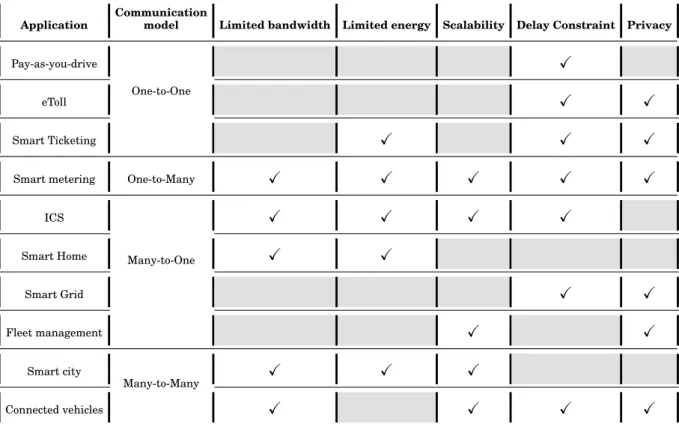
vehicles with built-in sensors and high-end secure trusted hardware. The baseline being that all devices have been assigned an IP address and have the ability to collect and transfer data over a network without any need for human intervention. A connected device is a public application of an embedded system with communication capabilities. Embedded systems are physical and computational systems which are able to autonomously perform a specific task. They are part of a larger ecosystem with specific functional and security requirements. As depicted in Table 1.1, when designing security schemes for IoT applications, we must consider different characteristics of the application by order of priority. We distinguish the following requirements and key challenges in the deployment of devices in IoT applications:
Data and Device Integrity
The integrity of embedded systems is notably of critical importance in IIoT applications [SWW15,
LXL+12]. Indeed, ICSs process security-critical and privacy-sensitive data, which makes them
vulnerable to targeted cyber attacks [FMC10]. These systems are deployed in sometimes inaccessi-ble and uncontrolled environments, further complicating the implementation of efficient security mechanisms to protect them against remote malware attacks. Moreover, the large number of deployed devices requires more scalable methods to verify the integrity of devices and the data they communicate over the network. IoT devices are the target of well known malware attacks due to these constraints. In 2010, a 500-kilobyte computer worm Stuxnet [FMC10] infected the software of SCADA systems and Programmable Logic Controllers used to control industrial processes and gas centrifuges in Iran. The Dyn Distributed Denial-of-Service (DDoS) attack [AvRDN19] was a botnet composed of a collection of infected IoT devices. Critical security challenges in IoT applications primarily result from attackers exploiting the hardware constraints of the devices themselves [Pol10, ZCNC11, MR12, MV14, HABJ].
Availability
The secure access to data in all application domains must be ensured in real-time. For example, in order to prevent any delay in production (which would induce loss of productivity), devices in industrial production must be reachable and in a trustworthy state. Availability ensures that authorized entities always have access to devices and data when needed. This property is particularly important in IIoT applications, as the lack thereof could potentially result in safety issues. Methods to ensure availability include protection against Denial-of-Service (DoS) attacks. Availability is closely linked to data integrity, as interactions must be associated with a specific user, with no ability to forge authentication or to tamper with authenticated data.
Accountability
Users of a system must be accountable for their own actions. This property is especially critical in ITS applications, where it must not be possible for users to deny sending specific messages or having been granted access to services or data for liability issues.
CHAPTER 1. INTRODUCTION
Privacy
The variety of applications imply that IoT devices process varied and large amounts of data. Such data may be sensitive in nature, for example providing information on user location and habits in the case of Home Automation and Intelligent Transportation System applications. Exploiting said data may lead to the invasion of user privacy in consumer-driven applications. The privacy of users and their data must be ensured in the long run. The need for privacy-preserving solutions for device authentication and attestation in IoT is increasing. Such solutions not only allow end users to have control over their data, but they also allow service providers who leverage IoT technologies to provide better services to be compliant with new privacy regulations. Indeed, new laws have been adopted in recent years in order to protect user data privacy. An example of such laws is the European General Data Protection Regulation [EU] adopted in 2016 by the European Commission. These regulations aim to protect user personal data from unauthorized collection and exploita-tion by public and private services alike. They motivated the development of privacy-enhancing cryptographic techniques for user authentication and access control, but also for ensuring data integrity in order to prevent tampering. Considering these new regulations, new protocols designed to secure communications between IoT devices must include "privacy-by-design" mechanisms.
Efficiency
Devices in IoT applications are optimized for a specific task, and as opposed to traditional computing systems, they present a multitude of constraints such as production cost, energy consumption, computational capabilities and limited memory. When deployed as part of a larger IoT application, they also present specific connectivity and communication constraints pertaining to the network bandwidth, as well as the radio technology used in said application.
In this thesis, we will take a closer look at the specific privacy problem of personal location, whether it pertains to the autonomous devices in IoT networks, or the end users who might be affected. In particular, the aim is to develop privacy-preserving cryptographic solutions for device authentication, access control, and attestation, that reveal the minimal amount of personal information required for the secure deployment of each service. In addition, these new mechanisms provide solutions for the efficiency challenges inherent to the IoT ecosystem.
The remaining of this chapter is organized as follows. We introduce the research challenges in designing secure and privacy-preserving cryptographic protocols for IoT devices, and discuss the current cryptographic mechanisms used to build said solutions. We then summarize the contributions of this thesis.
1.2. SECURITY AND PRIVACY CHALLENGES AND CRYPTOGRAPHIC SOLUTIONS
Application Communicationmodel Limited bandwidth Limited energy Scalability Delay Constraint Privacy
Pay-as-you-drive
One-to-One
X
eToll X X
Smart Ticketing X X X
Smart metering One-to-Many X X X X X
ICS Many-to-One X X X X Smart Home X X Smart Grid X X Fleet management X X Smart city Many-to-Many X X X Connected vehicles X X X X
Table 1.1: IoT Applications Characteristics and Requirements
1.2 Security and Privacy Challenges and Cryptographic
Solutions
IoT systems present security challenges due to the variety of attack surfaces, from the device layer to the application layer. In this thesis, we focus on application layer security and privacy. In this section, we first formulate the security and privacy challenges which motivated the contributions in this thesis, as well as the existing cryptographic solutions and security frameworks, prior to formulating the subsequent research goals.
1.2.1 Security and Privacy Objectives
Confidentiality. Cryptographic mechanisms are used to provide data confidentiality, data
in-tegrity, and secure device authentication of mobile and embedded devices in different IoT applica-tions. Devices exchange sensitive data on wireless communication channels, which are vulnerable to eavesdropping attacks. In traditional systems and networks as well as IoT networks and systems,
symmetric keyencryption schemes ensure data confidentiality. A symmetric key encryption scheme
enables two parties to exchange data without any other external party being able to read said message. The encrypted messages are indistinguishable from a random string to external parties, and the encryption process makes use of a common and agreed upon secret session key. Public
keyalgorithms enable the distribution of the secret session key. In public key cryptography, each
CHAPTER 1. INTRODUCTION
the latter is only known to the owner. Implementing cryptographic schemes on embedded devices comes with its own set of challenges. Indeed, cryptographic algorithms require significant computa-tional power, energy, and memory, which are not always met by embedded devices. Cryptographic schemes ensuring data confidentiality, also known as encryption schemes, are mature and robust. Depending on the application, standardized encryption algorithms are used to provide secure communications between IoT devices as well. In fact, in order to incorporate the efficiency, compu-tational capacity and storage space of these new compucompu-tational system, new sets of standards have given way to what is commonly known as Lightweight Cryptography, which includes lightweight
block ciphers [BKL+07, BSS+13, MBSM16], and lightweight public key schemes [HPVP11, PH12].
The ISO/IEC 29192 standard [ISO] specifies three block ciphers suitable for IoT/M2M applications which require lightweight cryptography implementations.
Confidentiality is a low priority challenge in many IoT applications due to the development of lightweight encryption schemes. In fact, ensuring the authenticity of devices as well as the au-thenticity and integrity of the data exchanged between devices in various IoT applications is an
important challenge [RPH06, PBH+08, SWW15]. The remaining of this section will discuss the
importance of authentication and attestation as security services in the IoT ecosystem.
Identification. In the IoT ecosystem, mutual identification between devices is a key security
property. The aim being devices to be able to identify each other and the data being sent on the communication channel, in order to trust those data. For controlling devices, identification allows controllers to identify which devices they control, as well as to accurately forward a certain control command to the concerned device. In access control applications, it is mandatory to identify which device or user is requesting access, in order to grant the proper access credentials. Essentially, the ecosystem is composed of autonomous devices, where trust is derived from complete knowledge of the systems involved.
Authentication. Authentication is a security mechanism which enables devices and users to
prove their identities in the communication process. Indeed, identification alone does not provide complete trust in the system, as the system must prove said identity to be correct. From a security standpoint, authentication can be provided by signature schemes in the public key model. Signature schemes are public key schemes which allow a sending entity to authenticate with a verifying entity, hence ensuring to each party involved in the protocol that messages originate from the expected sender. The signature verification step is public, and can be undertaken by any party. A key property of signature schemes is the fact that the party generating the signature scheme should not be able to repudiate its signature upon its generation. In our case, IoT devices must prove their identity in a secure manner, in order to ensure trust in the data communicated over the network. The authentication proof is verified by a mutually trusted authority, who can be for example a certification authority in the case of public key schemes.
Data/Device Software Integrity Finally, ensuring that messages originating from an
au-thenticated device have not been tampered with is a key security requirement in IoT. In a given application, the integrity of data exchanged between devices must be ensured in order to trust the overall system. In addition to data integrity, the internal software state of devices in an IoT
1.2. SECURITY AND PRIVACY CHALLENGES AND CRYPTOGRAPHIC SOLUTIONS
application must be periodically verified. Devices in a number of IoT use cases are deployed in remote locations which are inconveniently accessible, rendering the process of local attestation (e.g. Secure boot) often impossible. Remote attestation allows control systems to remotely monitor the software state of their devices. It is a security service at the core of the IoT ecosystem, and its analysis constitutes an important part of the work in this thesis. We discuss the concept of remote attestation in Section 1.2.4.
Authorization. In access control applications, once identified and authenticated, devices
can be authorized to access trusted systems or data. A number of IoT applications implement authorization and access control functionalities which leverage embedded devices, including Home Automation, Smart Vehicles, and Mobile Access Control Systems. These systems must identify, authenticate, and grant access to authorized parties, whilst protecting the systems from fraudulent behavior, and from unlawful data collection which can lead to privacy breaches.
Efficiency. Cryptographic protocols designed for embedded systems must minimize the
re-quired hardware size (circuit size, ROM/RAM sizes), the computational cost, and energy consump-tion. They must also provide optimal processing speed (throughput, delay), while minimizing computational and communication overhead. Indeed, these protocols by nature generate overhead, which causes scalability problems in networks and systems incorporating embedded devices. Con-sidering the trade-off between security and efficiency is therefore an important aspect to factor in the design of secure and privacy-preserving protocols.
1.2.2 Security architectures for embedded systems
The variety of IoT applications and the embedded systems deployed in those applications result in a rich body of literature on security mechanisms and architectures for embedded IoT systems. In this thesis, we particularly focus on the following systems:
• Trusted Execution Environments (TEE) at the root of Intel and ARM security architectures. Different security architectures exist for these systems: Trusted Computing based on secure hardware (e.g. Trusted Platform Module (TPM) [TPM19]), Physically Unclonable Function
(PUF) [MS11, MBM+17], and Intel Software Guard Extension (SGX) [MAB+13a, CD16].
• Low-end embedded systems such as smart cards, and more specifically Universal Integrated Circuit Cards (UICC) commonly known as Subscriber Identity Module (SIM) cards [ETS]. Smart cards are embedded in many devices (mobile phones, smart meters), and provide an architecture capable of implementing cryptographic algorithms and security services for devices that are not equipped with high-end hardware modules. In particular, in this thesis we will introduce cryptographic mechanisms that leverage the features of constrained trusted environments such as SIM cards, to provide services such as device attestation, that are built-in more sophisticated systems.
CHAPTER 1. INTRODUCTION
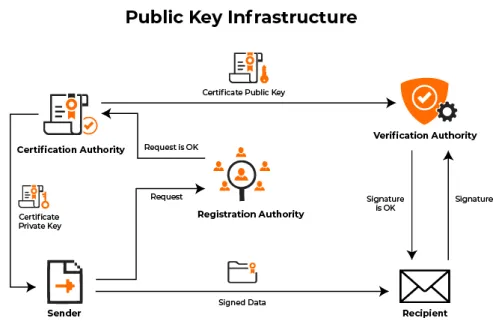
Figure 1.1: Public Key Infrastructure Architecture
1.2.3 Authentication
The first part of this thesis provides secure and privacy-preserving authentication solutions for mobile and embedded devices. In this section, we briefly describe authentication based on cryptographic primitives. We discuss the security and privacy challenges, as well as the efficiency challenges induced by the implementation of cryptographic algorithms on the aforementioned systems.
1.2.3.1 Security architecture
Public Key Infrastructures. Threats affecting IoT systems include impersonation, whereby
attackers take control of a given device, and communicate with other devices using the identifier of an honest user. Cryptography provides us with the tools to enforce mutual authentication, requiring each party to securely prove its identity prior to sending messages over the communication network. A Public Key Infrastructure (PKI) is a set of hardware, software, policies, and procedures required to create, manage, store, and distribute digital certificates and public keys. The PKI is an essential service in authentication schemes and provide the elements for a secure and trusted environment for the Internet of Things, as it establishes the identity of devices and users, as well as a controlled access to systems and services. A PKI operates with a centralized architecture as depicted in Figure 1.1, where public keys are bound to their users using digital certificates. It comprises a Certification Authority (CA), which essentially acts as a trusted third party, in charge of generating the credentials used to identify devices. They bind a given device to its public key in a digital certificate. Certificate management in the IoT world presents a number of challenges.
Challenges. The millions of devices potentially involved in IoT applications lack a
central-ized and scalable system for managing keys and identities. The periodic enrollment of devices 10