HAL Id: hal-03030340
https://hal-imt-atlantique.archives-ouvertes.fr/hal-03030340
Submitted on 30 Nov 2020
HAL is a multi-disciplinary open access archive for the deposit and dissemination of sci-entific research documents, whether they are
pub-L’archive ouverte pluridisciplinaire HAL, est destinée au dépôt et à la diffusion de documents scientifiques de niveau recherche, publiés ou non,
Dissecting bitcoin blockchain: Empirical Analysis of
Bitcoin network (2009-2020)
Pranav Nerurkar, Dhiren Patel, Yann Busnel, Romaric Ludinard, Saru
Kumari, Muhammad Khurram Khan
To cite this version:
Pranav Nerurkar, Dhiren Patel, Yann Busnel, Romaric Ludinard, Saru Kumari, et al.. Dissecting bitcoin blockchain: Empirical Analysis of Bitcoin network (2009-2020). Journal of Network and Computer Applications (JNCA), Elsevier, 2020, �10.1016/j.jnca.2020.102940�. �hal-03030340�
Dissecting bitcoin blockchain: Empirical Analysis of
Bitcoin network (2009-2020)
Pranav Nerurkara,b, Dhiren Patelb, Yann Busnelc, Romaric Ludinardc, Saru Kumarid,∗, Muhammad Khurram Khane
aDept. of Data Science, MPSTME, NMIMS University, Mumbai, India bDept. of CE&IT, VJTI-Mumbai, India
cSRCD department, IMT Atlantique, Rennes, France
dDept. of Mathematics, Ch. Charan Singh University, Meerut, India
eCenter of Excellence in Information Assurance (CoEIA), King Saud University, Saudi
Arabia
Abstract
Bitcoin system (or Bitcoin) is a peer-to-peer and decentralized payment sys-tem that uses cryptocurrency named bitcoins (BTCs) and was released as open-source software in 2009. Unlike fiat currencies, there is no centralized authority or any statutory recognition, backing, or regulation for Bitcoin. All transactions are confirmed for validity by a network of volunteer nodes (miners) and after collective agreement is subsequently recorded into a dis-tributed ledger ”Blockchain”. Bitcoin platform has attracted both social and anti-social elements. On the one hand, it is social as it ensures the exchange of value, maintaining trust in a cooperative, community-driven manner with-out the need for a trusted third party. At the same time, it is anti-social as it creates hurdles for law enforcement to trace suspicious transactions due to anonymity and privacy. To understand how the social and anti-social tendencies in the user base of Bitcoin affect its evolution, there is a need to analyze the Bitcoin system as a network. The current paper aims to explore the local topology and geometry of the Bitcoin network during its first decade of existence. Bitcoin transaction data from 03 Jan 2009 12:45:05 GMT to 08 May 2020 13:21:33 GMT was processed for this purpose to build a Bitcoin user graph. The characteristics, local and global network prop-erties of the user’s graph were analyzed at ten intervals between 2009-2020
with a gap of one year. Small diameter, skewed distribution of transactions, power-law distributed in and out degrees, disconnected graph, and presence of large connected components were the observations from network analysis. Thus, it could be inferred that despite anti-social tendencies, Bitcoin net-work shared similarities with other complex netnet-works. Netnet-work analysis also uncovered twenty types of legal and anti-social entities operating on Bitcoin and provided a path for uncovering these anti-social entities.
Keywords: Bitcoin, Network Science, Graph Algorithms, Exploratory Data Analysis
1. Introduction
1
Originally proposed in 2008 by an unknown individual (or a group of
2
individuals) who used a pseudonym ”Santoshi Nakamoto”, Bitcoin
cryp-3
tocurrency has since then emerged as the most successful cryptocurrency
4
amongst its peers, reaching an adoption level unrealized by older digital
5
currencies [1, 2, 3]. As on 19th March 2020, Bitcoin has a market cap of
6
USD$98,584,789,143 with 18,277,112 bitcoins (BTC’s) in circulation each
7
with a value of USD$5,393.89. Bitcoin differs from its traditional online
8
banking peers by relying on a decentralized consensus scheme for verifying
9
the correctness and authentic nature of currency transfers between users
10
[4, 5, 6]. The decentralized consensus scheme is made possible by an
or-11
ganized collective of nodes in the Bitcoin system known as “miners”. The
12
miners confirm each transaction for authenticity. This increases security in
13
the Bitcoin system and ensures the core philosophy of Bitcoin ”Maintain trust
14
in an untrusted environment” without the need for a trusted third party as a
15
reward miners collect transaction fees for the transactions that they confirm.
16
Illustrating the transaction fundamentals of bitcoin transfers, consider
17
that user i wants to transfer n bitcoins to user j. Then i will need a bitcoin
18
wallet, which holds all his private keys and the wallet address of j (Figure 1).
19
Also, the transaction is valid only if user i signs it using his cryptographic
20
key.
21
Valid transactions are then broadcast over the Bitcoin network, and all
22
miners are informed. Technically, the transaction is not broadcast to all nodes
23
in the Bitcoin network, as a single node can be connected to a maximum 125
24
(incoming connections=8, outgoing connections=117) other nodes. However,
25
Figure 1: Transfer of bitcoins from user i to j and j to k
nodes [1,7]. Miners keep all received transactions in their memory pool and
27
combine these transactions to form a ”candidate block.” Each miner then
28
competes with other miners to add its candidate block to the blockchain.
29
The miner who succeeds gets a reward in BTC’s and broadcasts its newly
30
mined block to other miners. Other miners will independently verify the
31
newly mined block before adding it to their blockchain.
32
Since Bitcoin’s inception in 2009, the initial two years saw slow adoption
33
with hardly 1000 unique addresses and less than 10000 transactions per day
34
[1, 8]. However, as bitcoin became financially significant, there was an
ex-35
ponential growth in transactions from 2012-2016, which also saw the entry
36
of serious users, investors, speculators, and independent mining industries.
37
Before the popularity of bitcoin, the users were mostly crypto-enthusiasts.
38
The change in the profile of Bitcoin’s user base was also evident from the
39
increase in the transaction values, fluctuations in BTC price, and volumes of
40
BTC’s. This phase also saw the emergence of Ponzi schemes, money
launder-41
ing, frauds [9], embezzlements, extortion [10] and tax evasion [11] practices
42
that used the blanket of secrecy afforded by Bitcoin to mislead the audit trail.
43
There emerged a diversity even amongst the miners in terms of geography
44
and size. When Bitcoin was launched, it was feasible for any participant to
45
become a miner, but as the user base increased, mining became competitive
46
and required specialized hardware. Miners prefer large warehouses with
ac-47
cess to cheap electricity [12]. With time, solo miners decreased and gave way
48
to mining pools.
As the scale and complexity of the Bitcoin network increased, research
50
interest too emerged to allow for its better understanding [4,11, 12, 13, 14].
51
However, analysis of network properties of Bitcoin graph is an interesting
52
domain, albeit one that has received comparatively less attention. A reason
53
for this could be the complexity of identifying users in the Bitcoin network.
54
In the Bitcoin network, identifying users by wallet addresses (aka accounts,
55
bitcoin addresses, public keys, or other unique identifiers used
interchange-56
ably to refer to users’ in Bitcoin system) is complicated as these can be
57
generated and discarded multiple times [12]. There is also no upper limit
58
to the identities a single person can create or any limits on the number of
59
transactions or beneficiaries. These factors significantly enhance the hurdles
60
in analyzing the Bitcoin network. To overcome the hurdle caused by
multi-61
ple identities of a single user, heuristic clustering is applied to the Bitcoin
62
network. With heuristic clustering, multiple identities of a single user are
63
grouped into a single identity. This strategy is used in several Bitcoin
net-64
work studies [15, 16, 17, 18] and has the advantage of reducing the number
65
of entities of the Bitcoin network.
66
1.1. Motivation
67
Based on an oft-quoted maxim in network science, ”We will never
under-68
stand complex systems unless we develop a deep understanding of the
net-69
works (graphs) behind them” [19], the current paper proposes to shed light
70
on the network properties of Bitcoin. Bitcoin is a diverse ecosystem
inhab-71
ited by users (wallets) that could be ordinary people interested solely in the
72
exchange of assets or mining nodes competing to ensure that the transactions
73
in their memory pool get added to the blockchain. Though the interactions
74
behind entities in other large systems such as the internet, wireless sensor
75
networks [20,21, 22], social networking websites, citation systems, file
shar-76
ing systems are well studied, However Bitcoin system failed to receive similar
77
attention. Network analysis would also help machine learning based
appli-78
cations of Bitcoin such as illegal transaction detection and forensics improve
79
feature engineering.
80
1.2. Contributions
81
• Conducted a comprehensive study of the large-scale Bitcoin system and
82
interactions occurring in it from 2009 to 2020 by constructing a network
83
from the blockchain files.
• Studied the Bitcoin network at scale based on local and global graph
85
properties (see Section 3.2).
86
• Network analysis to uncover types of legal and illegal entities operating
87
on Bitcoin and provide a path for uncovering these entities to aid digital
88
forensic tools.
89
• Proposed techniques for detection of illegal entities operating in bitcoin
90
network
91
• Used structural information of Bitcoin network to characterize
interac-92
tions and evaluate it at scale
93
• Open sourced the Bitcoin network dataset to motivate independent
94
research
95
• A time series analysis was performed using previous data obtained of
96
the Bitcoin network. The data for training the machine learning models
97
was from years 2009-2020 and the predictions were made for the year
98
2021.
99
So far only I Alqassem et al. [12] and X Lee et al. [13] have provided a
de-100
tailed graph-theoretic assessment of Blockchain cryptocurrencies. However,
101
X Lee et al. focused on Ethereum blockchain, and I Alqassem et al. focused
102
on the time period of 2009-2014 to analyze Bitcoin systems. Although these
103
papers provide a technical foundation for the current work, there is no
over-104
lap. Ethereum is not just a crypto-currency but also a platform that enables
105
distributed applications. Analysis cannot be compared between Ethereum
106
and Bitcoin. Bitcoin has higher volumes, users and market cap so affects
107
more users and should therefore receive more attention. I Alqassem et al.
108
[12] worked on Bitcoin 2009-2014 so the current papers extended their work
109
to 2020. Additionally, observations and conclusions on future outlook of
110
Bitcoin were made using time series analysis. Time series models are
data-111
driven. So observations and conclusions are obtained after experimentation.
112
The data is allowed to speak for itself and used for predicting growth outlook
113
for year 2021.
114
The rest of the paper is organized as follows: Section2 gives the related
115
work done on Bitcoin and other cryptocurrencies. The procedure to convert
116
raw data into a processed form is outlined in Section 3, followed with a
117
description of network analysis tools in Section 3.2 and discussion of results
in Section 4. The paper concludes in Section 5, mentioning future works for 119 subsequent research. 120 2. Related work 121
The related work reviewed can be divided into two categories: First, the
122
work that examined the Bitcoin system itself. Second, work that examined
123
other blockchain-based systems.
124
2.1. Bitcoin studies
125
The journey of Bitcoin, which builds upon nearly two decades of ideas
126
proposed in mailing lists, forum posts, blogs [23], wikis, and source code
127
found in cryptographic circles, is described by F Tschorsch et al. [14].
How-128
ever, the authors focused more on framing a tutorial on Bitcoin that includes
129
an outline of selective existing literature. I Alqassem et al. have provided
130
a longitudinal network-based analysis of Bitcoin systems from 2009-2014.
131
The authors have commented upon the changing nature of bitcoin users over
132
time and also drew attention to various structural properties of the Bitcoin
133
system viz. longest connected component, network diameter, densification
134
power law, degree assortativity, time-evolving community structure and
in-135
equality in the network [12]. The authors agreed that analyzing the Bitcoin
136
system presents challenges due to the anonymity seeking behaviors of the
137
user base. Though the results highlighted key differences between the
Bit-138
coin network and networks of other systems, the continuous developments
139
and fluctuations in the complex cyber-physical Bitcoin systems necessitate
140
another up-to-date review. T Chang et al. analyzed the various heuristics
141
that are proposed in the literature to identify all public keys that belong to
142
the same user. The heuristics create an approximation of the original Bitcoin
143
network by merging multiple user identifiers to a single identifier and
reduc-144
ing number of entities in the network. Previous studies on network analysis
145
of cryptocurrencies [12,13,11] to have used heuristics and hence, it is a tried
146
and tested method for improving network analysis. S Park et al. scanned
147
the live Bitcoin network for 37 consecutive days in 2018 to track the behavior
148
of the miners. The authors commented upon Bitcoin network statistics such
149
as the number of users, the geographic distribution of users, Bitcoin wallet
150
protocols, and messages propagating in the network [1].
2.2. Studies on other blockchain-based systems
152
Y Li et al. used the Ethereum transaction graph (interactions between
153
smart contracts and users) to explore the relationship between the graph
154
structure and crypto-currency price fluctuations [24]. H Sun et al. attempt
155
clustering analysis on Ethereum data to segment malicious users from the
156
rest [25]. S Ferratti et al. has used global network statistical measures such
157
as the order of the network, degree distribution, distance, clustering
coef-158
ficient, and the tendency of exhibiting a ”small world” effect [26]. Based
159
on the observations from these measures, the authors have speculated about
160
the online behavior of Ethereum users, the geographic distribution of miner
161
nodes, and the characteristics of transactions. While S Ferratti et al.
ar-162
gued for the advantages of studying the blockchain structure through a
com-163
plex network perspective, their focus remained on the Ethereum blockchain
164
structure only. X Lee et al. studied the Ethereum blockchain at scale and
165
applied network analysis measures to characterize interactions between users
166
in Ethereum [13]. The authors studied the network characteristics (vertex
167
count, edge count, self-loop count, and edge density), local network
prop-168
erties (degree distribution, correlation of out and indegree, node centrality
169
measures) and global network properties (reciprocity, assortativity, connected
170
component distribution, diameter, path length, adhesion, cohesion). Just like
171
[26], the authors focused on Ethereum blockchain only but have emphasized
172
that a similar line of network analysis could be extended to another web
173
of blockchain networks. The work in the current paper relies on tools and
174
methods given by S Ferratti et al. [26] and X Lee et al. [13] but targets
175
a longitudinal analysis of Bitcoin network. Table 1 gives the methods and
176
results of network-based studies on blockchain and other real-world systems.
Table 1: Results of published network studies
System under review
Network
theory used Observation Twitter [27] Gini index Dominant nodes are
present Facebook [28] Assortativity
coefficient Negative assortativity Social networking websites [29] Diameter and Average path length Small Social networking websites [29] Clustering coefficient High Social networking websites [30,31] Average degree,
Edge density High
World wide web [30,31] Degree distribution In and out degree distribution follow power law
Protein-protein interaction [31] Degree distribution Power law
World wide web [32] Small world effect 19 hops between any two webpages
Facebook [32,33] Strongly connected component (SCC)
99.8% - 100% nodes and edges are covered. Citation networks [32,33] Graph structure Acyclic
Citation network [30] Degree distribution In and out degree distribution follow power law
Film actors [30] Degree distribution Power law Company directors [30] Degree distribution No power law Co-authorship network [34] Degree distribution No power law
Ethereum network [13]
Vertices, arcs,
self-loops, edge density, degree distributions, centrality measures,
reciprocity, assortativity, SCC
In and out degree distribution follow power law.
Density is low, reciprocity is positive, assortativity is negative. SCC has 98-99% nodes and edges.
D Ding et al. [35]
Study topological connectivity and message routability of P2P overlays
Degree and Connectivity Analysis
D Ding et al. [36]
Study topological connectivity and message routability of P2P overlays
Degree and Connectivity Analysis
It can be observed from Table 1 that using a unified set of tools and
178
principles, networks of different fields can be studied. This is because, despite
179
variations, networks grow following certain basic principles [37].
3. Bitcoin blockchain to Graph
181
Bitcoin blockchain dataset in raw form was obtained from full node at
182
VJTI Blockchain lab 1. The dataset was of size 268GB and consisted of
183
blockchain in the form of blk.data files. All blocks and transactions from 03
184
Jan 2009 12:45:05 GMT to 08 May 2020 13:21:33 GMT were present in the
185
dataset. This raw data was then converted to CSV files using the blockchain
186
parser built by the VJTI Blockchain lab 2. The processed dataset, which is
187
in the form of ”.csv” files were made available for download3. Table 2shows
188
the four “.csv” files of the processed dataset.
189
Table 2: Description of processed dataset
Relation Attributes
Output tx hash:START ID wallet address:END ID amount Address wallet address:ID
Inputs wallet address:START ID tx hash:END ID amount Transactions tx hash:ID timestamp
From the Transactions dataset, it is possible to obtain the count of
190
transactions occurring in that year. Each transaction (tx) is identified in
191
blockchain by a unique hash (tx hash: ID) and has a timestamp, which is
192
the UNIX time of the transaction. For the year 2009, transactions start from
193
03 Jan 2009 12:45:05 GMT, and for the year 2020, transaction up to 08 May
194
2020 13:21:33 GMT is considered. Bitcoin entities were identified using an
195
API4 [38]. Table 3 and 4describes the dataset.
196
Table 3: Distribution of transactions in Bitcoin blockchain network (2009-2015)
2009 2010 2011 2012 2013 2014 2015 Transactions 32741 185410 1902443 8459093 19645798 25265702 45689861 Inputs 2810 108965 1902443 5716084 15407017 33300547 54564769 Outputs 32643 143863 2595309 5981241 16278420 34586691 57150816 Max BTC’s in a tx 22500 96999 550000 158336.30 194993.50 217517.63 172841.81 Max inputs in a tx 320 901 529 673 1757 674 1519 Max outputs in a tx 2 98 2002 2792 3075 5352 13107
Input sending highest amount COINBASE COINBASE CoinJoin Mess DeepBit.net DeepBit.net Unknown Unknown Output receiving highest amount Unknown Unknown CoinJoin Mess DeepBit.net DeepBit.net Unknown Unknown Total BTCs sent 1978736 22667790 297984085 925215501 429732306 264107039 548006072
1https://www.vjti-bct.in/
2https://github.com/pranavn91/blockchain
3https://drive.google.com/open?id=1pEpBAUXKgQX0BP8ircQgd9yXiucLY14h 4https://www.walletexplorer.com
Table 4: Distribution of transactions in Bitcoin blockchain network (2016-2020) 2016 2017 2018 2019 2020 Transactions 82634637 104081930 81393458 119729415 39978670 Inputs 90773554 128642149 77568478 128768057 52805351 Outputs 95783964 144361281 104780607 133558733 54179450 Max BTCs in a tx 99489.99 87082.81 109735.6 157457.612 182501 Max inputs in a tx 677 1089 1061 1347 1442 Max outputs in a tx 11515 6626 5027 7266 6990
Input sending highest amount Unknown Unknown Unknown Unknown Unknown
Output receiving highest amount Unknown Unknown Unknown Unknown Unknown
Total BTCs sent 1068404725 896026050.66 290858051.91 515972850.159 128637285.824
By parsing through the Bitcoin blockchain dataset, a transaction graph
197
(representing the exchange of bitcoins between wallet addresses) was built.
198
Each transaction has multiple inputs and outputs, as shown in Figure 2.
199
This transaction graph is refined further by heuristic clustering to obtain the
200
user’s graph (see Figure 3). The heuristic used for clustering is called the
201
regular inputs heuristic, i.e., all input addresses in a transaction belong to
202
the same user [5,15]. The user’s graph (payments made between users) leads
203
to meaningful analysis compared to the transaction graph [15, 16, 17, 18].
204
Additionally, the results from the user’s graph of Bitcoin can be compared
205
with social network analysis of other real-world systems viz. web, social
206
networking websites, citation graphs. A similar comparison is not possible if
207
the transaction graph of Bitcoin is considered.
208
Figure 2: Multi-input multi-output transactions
The heuristic clustering reduces the multi-input multi-output
transac-209
tions to a form more suited for network analysis. Multiple inputs are
clus-210
tered, and a single address is used as a starting point for the transaction.
211
The details of the heuristic clustering strategy are given in [15, 16, 17, 18].
212
Figure 3graphically shows the information of each attribute and relation in
213
the dataset after heuristic clustering is applied.
Figure 3: Illustration of attributes of processed dataset
3.1. Experimental setup
215
The preprocessing code is in Python 3.6, and the code for network analysis
216
is in R. The network analysis functions are from the igraph package of R [39].
217
The experiments are performed on a single core 1 TB Intel(R) Xeon(R) Silver
218
4114 [email protected].
219
3.2. Network measurements of Bitcoin network
220
For this study, Bitcoin user graph is represented as a network G = (V, E),
221
where V refers to the addresses of users’ wallets, while E represents a bitcoin
222
exchanges between these wallets. The timestamp of transaction, tx hash,
223
and amount are attributes of E. As multiple transactions can occur between
224
wallet addresses, G is a directed multi-graph. Using tools described in
Sec-225
tion 3.3, an analysis of the Bitcoin network G is performed for the period
226
2009-2020.
227
3.3. Description of tools for Network analysis
228
1. Vertex count (order of graph) |V | and edge count (size of graph) |E|
229
2. Graph density (GD): Number of edges present graph G amongst all
230
possible edges in G. GD for undirected and directed graphs is given by
231
below equations 1and 2 respectively.
232 233 2|E| |V |(|V | − 1) (1) 234 |E| |V |(|V | − 1) (2) 3. Average degree d d = 1 |V | X u∈V d(u) = 2m n (3)
4. Degree distribution of graph P (k) = nk
n is fraction of nodes in the
235
network with degree k i.e. nk where n is the Graph order.
236
5. Probability distribution
237
(a) Power law: y = k−α (k=constant, α=exponent)
238
(b) Exponential: y = e−λk (λ= mean time between events)
239
(c) Lognormal: y = 1ke−(logk−µ)22σ2 (µ=scale parameter, σ=shape pa-240
rameter)
241
(d) Poisson: e−µx!µx
242
6. Adhesion or edge connectivity E for connected graph G is the
mini-243
mum number of edges λ(G) whose deletion from a graph G disconnects
244
G.
245 246
7. cohesion - a minimum number of vertices needed to remove to make
247
the graph not strongly connected
248
8. Diameter is the length max(u,v)d(u, v) of the ”longest shortest path”
249
(i.e., the longest graph geodesic) between any two graph vertices (u, v)
250
of a graph, where d(u, v) is a graph distance.
251 252
9. Average path length L = PE
1(G) d(u,v)
E(G)
253 254
10. reciprocity ρ as given in Eq. 4 is the measure of the likelihood of
ver-255
tices in a directed network to be mutually linked.
256 257
ρ = P
i6=j(aij−a)(i6=j(aji−a)
sumi6=j(aij−a)2
(4) 11. Assortativity: level of homophily of the graph.
258 259 r = P jkjk(ejk− qjqk) σ2 q (5) where, 260
• qk number of edges leaving the node, other than the one that
261
connects the pair j, k
262
• σq standard deviation of q in Eq. 5
• ejk refers to the joint probability distribution of the remaining
de-264
grees of the two vertices
265 266
12. Number of connected components of a graph G is c(G). A connected
267
component is a set of vertices all of which are connected, and
un-268
connected to the other nodes in the network. The weakly connected
269
components are found by performing breadth-first search. The strongly
270
connected components are implemented by two consecutive depth-first
271
searches.
272
13. Degree Centrality of a vertex vi is defined as deg(vi)/2|E|
273
14. Betweenness centrality CB(v) of v ∈ V is the fraction of times v occurs
274
on any shortest path connecting any other pair of vertices s, t ∈ V .
275
Let σst be the total number of shortest paths connecting vertex s with
276
vertex t. Let σst(v) be the number of these shortest paths containing
277
v. The geodesic centrality of v is:
278 CB(v) = X s6=t6=v σst(v) σst (6) 15. Size of largest strongly connected component Ns - a set of vertices in
279
a directed graph such that any node is reachable from any other node
280
using a path following only directed edges in the forward direction.
281
N = max
F ⊆C |F | (7)
C = {C ⊆ V | ∀u, v ∈ C : ∃w1, w2, . . . ∈ V : u ∼ w1 ∼ w2 ∼ · · · ∼ v}
16. Relative size of the largest connected component (Nrel) equals the size
282
of the largest connected component divided by the size of the network
283
Nrel =
N
n. (8)
17. Number of triangles defined in the following way is independent of the orientation of edges when the graph is directed.
18. Global clustering of a network is the probability that two incident edges are completed by a third edge to form a triangle
c = |{u, v, w ∈ V | u ∼ v ∼ w ∼ u}|
|{u, v, w ∈ V | u ∼ v 6= w ∼ u}| (10) Tools for network measurement can be divided into three groups:
mea-284
sures for characteristics (vertex count, edge count, edge density), measures
285
of local network properties (radius, local clustering coefficient, node degree)
286
and measures for global network properties (degree distribution, adhesion,
287
cohesion, components, centralization, k-cores).
288
4. Experimental study
289
Bitcoin users graph is studied using the tools given in Section 3.3. The
290
entire Bitcoin network is studied at eleven intervals, as seen in the results.
291
The year in the results corresponds to a Bitcoin users graph built from
trans-292
action data considered from 01 Jan 12:00:00 AM GMT to 31 Dec 11:59:59
293
PM GMT of that year. An exception is the year 2020, which is built
us-294
ing transaction data from 01 Jan 2020 12:00:00 AM GMT to 08 May 2020
295
13:21:33 GMT.
296
4.1. Bitcoin Network characteristics
297
Table 5 gives the bitcoin users graph. Two versions of edge density are
298
indicated by (S) for a simple, undirected version of the user’s graph and
299
(D) for the directed user’s graph. Multiple directed edges between two users
300
are collapsed to a single undirected edge to obtain edge density (S). Vertex
301
count in Table 5and 6 gives the total senders and receivers in that calendar
302
year. Bitcoin users have increased till 2017, leading to the price of BTC’s
303
reaching its peak in Dec 2017. The following years have seen a decline in
304
both users and the value of BTCs. In 2009, out of 32741 transactions, 32522
305
were COINBASE transactions. The highest number of BTCs transferred in
306
a single transaction was 22500, and 320 were the highest number of inputs
307
present in a transaction. Limited edges were created as transactions between
308
users were less. The edge density is low in both the directed graph (Edge
309
density (D)) and the undirected graph (Edge density (S)) for the period
310
2009-2020 compared to social networks. The low density is due to the skewed
311
distribution of transactions amongst the users. 99.8% of the total users in
Table 5: Characteristics of Bitcoin blockchain network (2009-2015)
2009 2010 2011 2012 2013 2014 2015 Vertex count 32644 143943 2599119 6001831 16337189 34693993 57381025 Edge count 32808 233872 4642054 19710026 49336100 78077032 145496703 Edge density (S) 6.16e-05 2.25e-05 1.28e-07 3.4e-07 0.94e-07 3.7e-08 2.37e-08 Edge density (D) 3.08e-05 1.12e-05 6.87e-07 5.4e-07 1.85e-07 6.48e-08 4.42e-08
Table 6: Characteristics of Bitcoin blockchain network (2016-2020)
2016 2017 2018 2019 2020
Vertex count 57107986 78724132 53049193 32288199 3160555 Edge count 29365348 625420597 330885984 230911982 24840651 Edge density (S) 5.2e-08 0.49e-07 0.68e-07 1.12e-07 1.18e-06 Edge density (D) 9e-08 1.01e-07 1.17e-07 2.21e-07 2.49e-06
Till the year 2010, Bitcoin was used by crypto-enthusiasts and year 2011
314
saw the entry of the first mixing service and mining pools. Both these services
315
involve transactions with one or limited inputs and several outputs.
Conse-316
quentially, the maximum number of outputs in a single transaction increased
317
from 98 in 2010 to 2002 in 2011 and has remained in range of 2000-7000. This
318
leads to observation that ”Number of outputs” can be used to discriminate
319
between different types of users in Bitcoin.
320
4.2. Vertex degree distribution
321
The procedure mentioned by C Gillespie [40] was followed to understand
322
the distribution of in (see Table 7and 8) and out degrees (Table9and10) of
323
users graph. In 2009, for the distribution of in degrees, the minimum value
324
from which the power-law distribution was fitted i.e., (xmin) was 4 and for
325
exponential xmin was 1, log-normal xmin was 1 and poission xmin was 5. For
326
2010, xmin was 31 for power law, 183 for exponential, 29 for log-normal and
327
4351 for poisson. In 2011, xmin was 397 for power law, 279 for exponential,
328
359 for log-normal and 8079 for poisson. In 2012, xmin was 621 for power law,
329
72053 for exponential, 608 for log-normal and 5352 for poisson. In 2013, xmin
330
was 987 for power law, 76728 for exponential, 1151 for log-normal and 4751
331
for poisson. In 2014, xmin was 1615 for power law, 99867 for exponential,
332
1702 for log-normal and 154 for poisson. In 2015, xmin was 2994 for power
333
law, 99891 for exponential, 1950 for log-normal and 359 for poisson.
Table 7: Likelihood ratio tests for comparing in degree distribution (2009-2015) Distributions Parameters 2009 2010 2011 2012 2013 2014 2015 Power law α 1.99 1.54 2.35 1.86 1.88 1.98 2.12 Exponential λ 0.11 0.001 0.011 0.004 0.002 0.002 0.0001 Log-normal µ 1.79 2.59 -26.61 -52.63 -29.818218 -21.38 2.62 α 1.01 2.65 5.06 8.42 6.50 5.55 2.61 Poisson µ 13.83 4992.6 26133.67 43568.6 43778.7 7764.21 8610.67
In 2016, xmin was 2318 for power law, 99549 for exponential, 1510 for
335
log-normal and 5 for poisson. In 2017, xmin was 3118 for power law, 99671
336
for exponential, 99671 for log-normal and 6294 for poisson. In 2018, xminwas
337
1862 for power law, 96500 for exponential, 2179 for log-normal and 11175 for
338
poisson. In 2019, xmin was 2674 for power law, 97258 for exponential, 97258
339
for log-normal and 1 for poisson. In 2020, xminwas 2588 for power law, 95384
340
for exponential, 1939 for log-normal and 1 for poisson. From Table 7 it is
341
observed that power-law and log-normal are better fit to data than
exponen-342
tial or poisson. Moreover, Xmin values indicate that tail of the distribution
343
follows power law. α value indicates inverse relationship between degree and
344
frequency of such nodes. High degree nodes such as mixing services and pools
345
would form LSCC/LWCC making it easy for identifying them on Bitcoin.
346
Table 8: Likelihood ratio tests for comparing in degree distribution (2016-2020)
Distributions Parameters 2016 2017 2018 2019 2020 Power law α 2.1 2.11 1.92 2.4 2.2 Exponential λ 0.001 0.001 0.001 0.001 0.003 Log-normal µ 5.15 -194.65 -17.11 -398.36 -7.01 α 2.06 12.1 5.29 15.85 3.78 Poisson µ 7918 29039.39 63050.8 5095.25 4054.3
In 2009, for the distribution of out degrees, the minimum value from which
347
the power-law distribution was fitted i.e., (xmin) was 4 and for exponential
348
xmin was 3, log-normal xmin was 1 and poission xmin was 12. For 2010, xmin
349
was 14 for power law, 5136 for exponential, 15 for log-normal and 42 for
350
poisson. In 2011, xmin was 520 for power law, 42350 for exponential, 145 for
351
log-normal and 252 for poisson. In 2012, xmin was 667 for power law, 93316
352
for exponential, 562 for log-normal and 2210 for poisson. In 2013, xmin was
353
1073 for power law, 94828 for exponential, 94828 for log-normal and 2244 for
354
poisson. In 2014, xmin was 1540 for power law, 98344 for exponential, 1544
355
for log-normal and 2334 for poisson. In 2015, xmin was 2251 for power law,
Table 9: Likelihood ratio tests for comparing out degree distribution (2009-2015) Distributions Parameters 2009 2010 2011 2012 2013 2014 2015 Power law α 1.33 1.42 1.73 1.74 1.85 1.86 1.87 Exponential λ 0.25 0.06 0.013 0.005 0.002 0.002 0.001 Log-normal µ -7.27 -4.52 -52.81 -7.835970 -137.41132 -18.89 1.25 α 6.10 5.14 8.31 4.77 10.3 5.73 3.14 Poisson µ 10851.33 3754.7 4516.74 27558.8 24466.7 25145.02 14322.95
In 2016, xmin was 2224 for power law, 99977 for exponential, 1722 for
log-358
normal and 2314 for poisson. In 2017, xmin was 5338 for power law, 96639
359
for exponential, 2820 for log-normal and 1 for poisson. In 2018, xmin was
360
4308 for power law, 97340 for exponential, 6600 for log-normal and 10649 for
361
poisson. In 2019, xmin was 9124 for power law, 98154 for exponential, 98154
362
for log-normal and 1 for poisson. In 2020, xmin was 842 for power law, 84442
363
for exponential, 456 for log-normal and 69 for poisson.
364
Table 10: Likelihood ratio tests for comparing out degree distribution (2016-2020)
Distributions Parameters 2016 2017 2018 2019 2020 Power law α 1.77 2.58 2.34 2.7 2.07 Exponential λ 0.001 0.001 0.0006 0.0007 0.0051 Log-normal µ 7.3 7.76 4.8 -338.17 5.56 α 1.8 1.13 2.02 11.65 1.67 Poisson µ 15859.95 5967.4 28175.95 5362.98 2580.6
Figure 4 and 5 show the fitting of four heavy-tailed distributions to
in-365
degree and out-degree distribution of users graph respectively. Four
distribu-366
tions considered are discrete power law (red), exponential (dark blue),
log-367
normal (green), and Poisson (light blue). Distribution is fit as per protocol
368
specified by C Gillespie [40].
1 2 5 10 20 0.1 0.2 0.5 1.0 x y (a) 2009 1 5 10 50 100 5001000 5000 0.01 0.02 0.05 0.10 0.20 0.50 1.00 x y (b) 2010 1 10 100 1000 10000 0.002 0.005 0.010 0.020 0.050 0.100 0.200 0.500 1.000 x y (c) 2011
1e+00 1e+02 1e+04 1e+06
0.001 0.005 0.010 0.050 0.100 0.500 1.000 x y (d) 2012
1e+00 1e+02 1e+04 1e+06
5e−04 1e−03 5e−03 1e−02 5e−02 1e−01 5e−01 1e+00 x y (e) 2013 1 100 10000 5e−04 1e−03 5e−03 1e−02 5e−02 1e−01 5e−01 1e+00 x y (f) 2014
1e+00 1e+02 1e+04 1e+06
5e−04 1e−03 5e−03 1e−02 5e−02 1e−01 5e−01 1e+00 x y (g) 2015
1e+00 1e+02 1e+04 1e+06
5e−04 1e−03 5e−03 1e−02 5e−02 1e−01 5e−01 1e+00 x y (h) 2016
1e+00 1e+02 1e+04 1e+06
5e−04 1e−03 5e−03 1e−02 5e−02 1e−01 5e−01 1e+00 x y (i) 2017
1e+00 1e+02 1e+04 1e+06
5e−04 1e−03 5e−03 1e−02 5e−02 1e−01 5e−01 1e+00 x y 1 100 10000 5e−04 1e−03 5e−03 1e−02 5e−02 1e−01 5e−01 1e+00 x y
1e+00 1e+02 1e+04 1e+06
5e−04 1e−03 5e−03 1e−02 5e−02 1e−01 5e−01 1e+00 x y
1 10 100 1000 10000 0.1 0.2 0.5 1.0 x y (a) 2009 1 100 10000 0.02 0.05 0.10 0.20 0.50 1.00 x y (b) 2010 1 100 10000 0.002 0.005 0.010 0.020 0.050 0.100 0.200 0.500 1.000 x y (c) 2011
1e+00 1e+02 1e+04 1e+06
0.001 0.005 0.010 0.050 0.100 0.500 1.000 x y (d) 2012
1e+00 1e+02 1e+04 1e+06
5e−04 1e−03 5e−03 1e−02 5e−02 1e−01 5e−01 1e+00 x y (e) 2013
1e+00 1e+02 1e+04 1e+06
5e−04 1e−03 5e−03 1e−02 5e−02 1e−01 5e−01 1e+00 x y (f) 2014
1e+00 1e+02 1e+04 1e+06
5e−04 1e−03 5e−03 1e−02 5e−02 1e−01 5e−01 1e+00 x y (g) 2015 1 100 10000 5e−04 1e−03 5e−03 1e−02 5e−02 1e−01 5e−01 1e+00 x y (h) 2016 1 100 10000 1e−04 1e−03 1e−02 1e−01 1e+00 x y (i) 2017
1e+00 1e+02 1e+04 1e+06
5e−04 1e−03 5e−03 1e−02 5e−02 1e−01 5e−01 1e+00 x y (j) 2018
1e+00 1e+02 1e+04 1e+06
5e−04 1e−03 5e−03 1e−02 5e−02 1e−01 5e−01 1e+00 x y (k) 2019 1 100 10000 0.001 0.005 0.010 0.050 0.100 0.500 1.000 x y (l) 2020
As claimed for most complex networks, even bitcoin users graph followed
370
the ”scale-free” property as power-law exponent ranged from 1.54-2.4 for
371
in-degree distribution and from 1.42-2.7 for out-degree distribution. xmin
372
indicated that the tail of the in and out-degree distributions fit the power
373
law. High degree entities such as mixing services, gambling websites and
374
pools will occupy the tail of the degree distribution. Whereas, ordinary users
375
shall be at the other end of the spectrum. Thus, the location of the entity
376
on the degree distribution curve could reveal its nature.
377
4.3. Bitcoin: Global networks properties
378
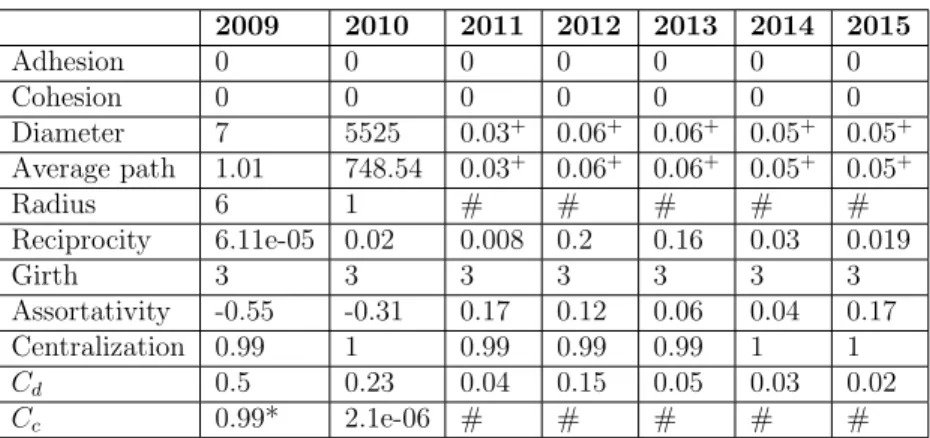
Table11and 12give the global network properties of bitcoin users graph. Measures marked with # could not be computed on the current configuration of the system.
+
indicates approximation used for computation as given by M Jackson et al.
379
[41]. In 2009, as transactions were infrequent, adhesion and cohesion were
380
zero indicating a sparsely connected graph where information transfer was
381
slow due to long diameter. As the majority were COINBASE transactions in
382
2009, the graph had high centralization tendency, low reciprocity, girth, and
383
assortativity. Till 2010, crypto-enthusiasts dominated the transactions, and
384
transactions were less, and diameter increased. In 2011, mixing services and
385
miner pools entered, and the DeepBit.net mining pool had 61897 incoming
386
and 120756 outgoing connections. CoinJoin Mess, a mixing service, had 903
387
incoming and 1800 outgoing connections in 2011. The presence of mining
388
pools and mixing services decreased the diameter and average path length
389
while leading an increase in reciprocity. In 2012, SantoshiDice.com, a
gam-390
bling website, saw 810474 incoming and 1055385 outgoing connections. In
391
2013 too SantoshiDice.com continued to get the highest incoming and
out-392
going connections. In 2014, SantoshiDice.com had the maximum incoming
393
connections (1592352), whereas CoinJoin Mess had the maximum outgoing
394
(2256302). In 2015, another online gambling site LuckyBit.it had the highest
395
incoming connections at 1655881, and CoinJoinMess had the highest
outgo-396
ing connections at 2256344.
Table 11: Global network properties (2009-2015) 2009 2010 2011 2012 2013 2014 2015 Adhesion 0 0 0 0 0 0 0 Cohesion 0 0 0 0 0 0 0 Diameter 7 5525 0.03+ 0.06+ 0.06+ 0.05+ 0.05+ Average path 1.01 748.54 0.03+ 0.06+ 0.06+ 0.05+ 0.05+ Radius 6 1 # # # # # Reciprocity 6.11e-05 0.02 0.008 0.2 0.16 0.03 0.019 Girth 3 3 3 3 3 3 3 Assortativity -0.55 -0.31 0.17 0.12 0.06 0.04 0.17 Centralization 0.99 1 0.99 0.99 0.99 1 1 Cd 0.5 0.23 0.04 0.15 0.05 0.03 0.02 Cc 0.99* 2.1e-06 # # # # #
In 2016, with 300120 outgoing connections, Faucetbox.com (bitcoin
re-398
ward site) was very active. In 2017 highest connections were recorded by
399
Poloniex.com, a crypto exchange with 4473190 incoming and 445628
outgo-400
ing connections. In 2019, Huobi.com-2, a bitcoin exchange platform, had the
401
highest outgoing connections. Due to anonymity, the identity of an entity
402
with the highest incoming and outgoing connections in 2018 was not found.
403
Table 12: Global network properties (2016-2020)
2016 2017 2018 2019 2020 Adhesion 0 0 0 0 0 Cohesion 0 0 0 0 0 Diameter 0.09+ 0.11+ 0.1+ 0.11+ 0.13+ Average path 0.09+ 0.11+ 0.1+ 0.11+ 0.13+ Radius # # # # # Reciprocity 0.016 0.003 0.0016 0.0009 0 Girth 3 3 3 3 3 Assortativity -0.026 -0.005 -0.022 0.28 0.09 Centralization 0.99 0.99 0.99 1 0 Cd 0.044 0.031 0.05 0.02 0.15 Cc # # # # #
Reciprocity is close to 0 indicating that Bitcoin is majorly for payments
404
or investments and not for exchange of BTC’s between account owners.
As-405
sortativity in range −1 − 0 indicates that low degree nodes (ordinary users,
406
enthusiasts, small investors ) are linked to high degree nodes (gambling hubs,
407
exchanges, pools, mixers). Due to the high transactions received by such
en-408
tities the centralization remained close to 1. Based on these observations,
transaction based features would be key in discriminating entities. These
410
features would be - Total transactions in which wallet has participated (Tx),
411
Total incoming transactions to the wallet (Txin), Total outgoing transactions
412
from the wallet (Txout), Average number of incoming transactions received by
413
an address of a wallet (Av), Total number of addresses sending BTC to the
414
wallet (T ) and Ratio of Transaction count and address count (R) gives the
415
average number of times an address of the wallet was reused for a transaction.
416
4.4. Community structure
417
Usually, triangles, transitivity, and clustering coefficient are higher in
418
social networks than non-social networks [13]. These parameters indicate
419
the tendency of entities in the network to form dense communities. In 2009,
420
the Largest Weakly Connected Component (LWCC) was the entire graph,
421
and Largest Strongly Connected Component (LSCC) was minimal. Triangles
422
and clustering coefficients were also negligible. In 2010, WCC was 25, and
423
SCC was 108482. In 2011, WCC was 1400, and SCC were 2029127. In 2012,
424
WCC was 6165, and SCC were 3149100. In 2013, WCC was 15122, and
425
SCC was 9888167. DeepBit.net formed the largest SCC and largest WCC in
426
2011. SantoshiDice.com formed the largest SCC and largest WCC in 2012
427
(see Table 13).
428
Table 13: Community structure (2009-2012)
2009 2010 2011 2012 LSCC Triangles 0 9580 104368 3797352 Nodes 2 (0%) 34709 (24.1%) 567144 (21.8%) 2846171 (47%) Edges 5 (0%) 75367 (32.2%) 1345036 (28.9%) 13908941 (70%) Articulation pt. 0 72 638 1389 C NaN 0.003 0.003 9.1e-05 LWCC Triangles 9 18708 3102649 4267711 Nodes 32644 (100%) 143880 (100%) 2593961 (100%) 5979901 (100%) Edges 32808 (100%) 233829 (100%) 4638181 (100%) 19693726 (100%) Articulation pt. 79 20774 496060 1440988 C 2.4e-05 1.11e-05 0.0005 0.0001 Full network Triangles 9 18709 3102700 4267910 Articulation pt. 79 20784 497641 1447747 C 2.4e-05 1.11e-05 0.0005 0.0001
In 2013, 2014 and 2015 too the largest SCC and WCC were formed by
429
SantoshiDice.com (see Table 14). In 2014, there were a total of 40508 WCC
430
and 24516983 SCC in the network. In 2015, WCC was 253244, and SCC
Table 14: Community structure (2013-2015) 2013 2014 2015 LSCC Triangles 7751768 5140336 21461343 Nodes 6437119 (39.4%) 10157747 (29.6%) 17445491 (30.2%) Edges 32501745 (65.8%) 41139689 (52.3%) 85078065 (58.9%) Articulation pt. 9270 14777 14790 C 0.0002 0.0008 0.0004 LWCC Triangles 7751768 6832830 25928531 Nodes 16282225 (100%) 34556782 (100%) 57084066 (100%) Edges 49292728 (100%) 77961419 (100%) 145254102 (100%) Articulation pt. 4282322 7775376 13682985 C 0.0002 0.0001 0.0002 Full network Triangles 9102472 6834251 25931343 Articulation pt. 4297982 7809891 13771043 C 0.0002 0.0001 0.0002
In 2016, unknown wallets had formed the largest WCC and SCC. In 2017,
433
Bittrex.com, a crypto trading exchange, formed the largest SCC. In 2019, the
434
largest SCC was formed by Bitcoin exchange service Huobi.com-2. In 2016,
435
WCC was 871640, and SCC was 46385054 in the network. In 2017, WCC
436
was 1476165, and SCC were 69375203. In 2018, WCC was 1032588, and
437
SCC were 30074974. In 2019, WCC were 967845 and SCC were 26896674
438
(see Table 15).
439
Table 15: Community structure (2016-2020)
2016 2017 2018 2019 2020 LSCC Triangles 125423937 95674389 62367145 24089648 0 Nodes 10698736 (18.7%) 9306342 (3%) 3242666 (6.1%) 844423 (2.7%) 1 Edges 120658573 (41.1%) 169589795 (15.07%) 62330136 (18.8%) 18010394 (8.2%) 0 Articulation pt. 1259 2206 717 522 0 C 0.0015 0.0009 0.0004 0.004 0 LWCC Triangles 213985326 210765433 214016097 88648952 0 Nodes 53556287 (93.7%) 74366786 (94.4%) 47785524 (90.7%) 26470992 (85.5%) 123583 (0.03%) Edges 287695383 (93.7%) 618579809 (98.9%) 325783461 (98.4%) 212922543 (97.8%) 403262 (0.01%) Articulation pt. 5333181 6854728 4535938 3167225 4785 C 0.0005 0.0003 0.0001 0.0004 0 Full network Triangles 214055511 287646955 214094259 88721557 0 Articulation pt. 6212728 6987676 5488866 4060330 351463 C 0.0005 0.0003 0.0001 0.0004 0
The LSCC increased from 2009-2012 to close to 47% of all nodes of the
440
graph in 2012 and then has declined to 2 − 3% of all nodes by 2019. LWCC
441
has remained in a range of 97 − 98% of the total nodes. LWCC and LSCC
442
were formed mainly because of mixing services, gambling services, and crypto
443
exchanges. The LSCC formed in past years (see Table 16) confirms this.
444
Reuse of addresses for transferring BTCs led to the compromise of anonymity
of bitcoin users. Thus, another feature to discriminate entities is suggested
446
- Ratio of Transaction count and address count (R). This feature gives the
447
average number of times an address of the wallet was reused for a transaction.
448
Table 16: Categories and address forming LSCC
Year Address Category Entity name 2010 1Bw1hpkUrTKRmrwJBGdZTenoFeX63zrq33 Unclassified 0091107f8aaff711 2011 1VayNert3x1KzbpzMGt2qdqrAThiRovi8 Miner DeepBit.net 2012 1VayNert3x1KzbpzMGt2qdqrAThiRovi8 Miner DeepBit.net 2013 1VayNert3x1KzbpzMGt2qdqrAThiRovi8 Miner DeepBit.net 2013 1P49eoo8YgWrdYmMJwo7KYAvyhJYtDfWBg Mixer BitcoinFog 2014 1VayNert3x1KzbpzMGt2qdqrAThiRovi8 Miner DeepBit.net 2014 1P49eoo8YgWrdYmMJwo7KYAvyhJYtDfWBg Mixer BitcoinFog 2015 1VayNert3x1KzbpzMGt2qdqrAThiRovi8 Miner DeepBit.net 2015 1P49eoo8YgWrdYmMJwo7KYAvyhJYtDfWBg mixer BitcoinFog 2016 1NxaBCFQwejSZbQfWcYNwgqML5wWoE3rK4 Gambling LuckyB.it 2016 1changeGhAXKoTEkMntbAe1VHh52jFQhh Gambling BitZillions.com 2016 19DhUuwoywejreRPhW9XWXKZTmSRNwud8x Mixer HelixMixer-old3 2016 184S3jPkbwS7UJbCUYgL7VKeye5aqSKinF Darkmarket AlphaBayMarket 2019 1HckjUpRGcrrRAtFaaCAUaGjsPx9oYmLaZ Exchange Huobi.com-2
4.5. k-core decomposition
449
Table 17and 18give the core decomposition of bitcoin users graph. The
450
k-core of a graph is the maximal subgraph in which every vertex has at
451
least degree k. The core decomposition is a set of all k-cores of a graph.
452
Core decompositions are used to study the resilience or robustness of a
net-453
work [42]. Due to the existence of single entities that captured the majority
454
of all incoming connections, the k-cores had single nodes from 2011-2019.
455
These single nodes were DeepBit.net (2011), SantoshiDice.com (2012-2015),
456
Unknown wallets (2016,2018), Bittrex.com (2017), and Huobi.com-2 (2019).
457
Table 17: Core decomposition (2009-2015)
2009 2010 2011 2012 2013 2014 2015
Cores in LSCC 5 9930 120262 1065542 347630 333420 601493 Cores in LWCC 24 10964 120262 1065542 347630 333420 601493 Cores in full graph 24 10964 120262 1065542 347630 333420 601493
Table 18: Core decomposition (2016-2020)
2016 2017 2018 2019 2020 Cores in LSCC 146836 72718 272896 1154252 0 Cores in LWCC 112356 72718 272896 1154252 704 Cores in full graph 375513 72718 272896 1154252 109080
4.6. Time series analysis of Bitcoin network
458
Figure 6 gives the fluctuations in the characteristics of Bitcoin network
459
from 2009-2020. To predict the future outlook of the network, time series
460
analysis is performed. The objective of the analysis is to predict the outlook
461
of Bitcoin network for year 2021. Four models were selected for the analysis,
462
the settings are listed:
463
• Linear regression
464
• Neural network: Two layers NN (units=64, activation=none)
465
• Convolutional neural network: Two layers (Filter=32, size=1, stride=1,
466
padding=0)
467
• LSTM: Single layer (units=32, activation=none)
468
The four models were trained on a single step, single output time
se-469
ries prediction task on the dataset of Bitcoin network characteristics from
470
2009-2020 viz. data mentioned in Tables 3-10 and 13-18. Results of four
471
models on validation and test set are illustrated in Figure 7. Comparatively,
472
dense models are better suited for the time series prediction although all four
473
models have mean absolute error close to 0.
474
Figure 7: Performance of models on Validation and Test set
Dense model was used to predict the characteristics of the Bitcoin model
475
for the Year 2021 and results of the prediction are given in Table 19.
Trans-476
actions, inputs, outputs and Max BTC’s in a Tx may continue a downward
477
trend seen in Bitcoin networks since 2019. Degree distributions could not be
478
predicted using past data; However, centralization measures, assortativity
479
and reciprocity were in range of previous years. Assortativity shall remain
480
negative and reciprocity low which conforms to standard notions of Bitcoin
481
networks. The LSCC and LWCC in Bitcoin network shall continue to
dom-482
inate reaching 81% and 99% of the total network size respectively. Cores
483
in full graphs will see a decline to 2018 levels. Overall, it can be concluded
484
that data-driven time series analysis observes normalcy will be restored in
Table 19: Prediction of Bitcoin network for Year 2021
Year Transactions Inputs Outputs Max BTCs in a tx
2021 17916462.0 19343784 134251.34 15666966.0
Max inputs in a tx Max outputs in a tx Total BTCs sent Vertex count Edge count
1176.0 2485 9928711 269887 2283282
Edge density (S) Edge density (D) Power law \alpha in Exp lambda in Lognormal \mu in
4.39e-06 3.64e-06 0.034 0.13 0.83
Lognormal alpha in Poisson in Power law \alpha out Exp lambda out Lognormal \mu out
0.46 0.53 1.15 -0.11 0.2
Lognormal alpha out Poisson out Diameter Avg path length Reciprocity
-0.07 -1.01 6.7e-02 4.4e-02 3.8e-02
Assortativity Centralization Cd Triangles (LSCC) Nodes (LSCC)
-0.2 0.99 4.7e-02 8.6e+06 1.5e+05
Edges (LSCC) AP (LSCC) C (LSCC) Triangles (LWCC) Nodes (LWCC)
5.1e+06 5.9e-03 5.2e+04 2.9e+07 1.8e+07
Edges (LWCC) AP (LWCC) C (LWCC) Triangles (Full) Nodes (Full)
6.5e+07 3.7e+06 1.4e-04 1.8e+07 2.4e+06
Edges (Full) Cores (LSCC) Cores (LWCC) Cores (Full)
7.3e+05 2.5e+05 1.65e+05 4e+05
4.7. Summary of Results with Discussion and lessons learnt
487
• The edge density is low in both the directed graph (Edge density (D))
488
and the undirected graph (Edge density (S)) for the period 2009-2020
489
compared to social networks
490
• 99.8% of the total users in 2009 made at the most a single transaction
491
this declined to 73.24% by 2020.
492
• Even bitcoin users graph followed the ”scale-free” property as
power-493
law exponent ranged from 1.54-2.4 for in-degree distribution and from
494
1.42-2.7 for out-degree distribution
495
• LWCC and LSCC were formed mainly because of mixing services,
gam-496
bling services, and crypto exchanges.
497
• k-cores had single nodes from 2011-2019
498
Comparing complex networks with bitcoins users graph, it is seen that it
499
shares certain features with the Ethereum network. Unlike social networks
500
(Twitter, Facebook, Actors, Directors, Co-authorship, citation), it has no
501
giant LSCC but follows properties of ”scale-free” networks.
Table 20: Comparison with other complex networks
Complex network Hubs? Assortativity Small diameter? C Degree
distribution Giant LSCC Edge density
Bitcoin Yes (-) Yes Low Power law No Low
Citation NA (-) NA Low Power law NA Low
WWW Yes (+) Yes Low Power law Yes Low
Social networking Yes (-) Yes High Power law Yes High
Protein-Protein NA (+) NA Low Power law NA Low
Co-authorship NA (+) NA Low No power law NA Low
Ethereum Yes NA Yes Low Power law Yes Low
Film actors NA NA NA NA Power law NA Low
Company directors NA NA NA NA No power law NA Low
With the use of deanonymizing and network analysis, common types of
503
services on Bitcoin network datasets were able to be identified. These are
504
listed as follows:
505
• Exchanges: Allow trading of BTC to fiat currencies
506
• Pools: Individual users combine their processing power for mining
507
blocks
508
• Gambling: Allow placing of bets using BTCs
509
• Wallets: Store BTC private keys and balance
510
• Payment gateways: Allow accepting payment for services in BTCs
511
• Miner: Organizations competing to mine blocks
512
• Darknet markets: Selling and buying goods using BTCs
513
• Mixers: Remove traceability of BTCs from source
514
• Trading sites: Purchase equities using BTCs
515
• P2Plenders: Crowdsourcing BTCs for loans
516
• Faucets: Reward in BTCs to subscribers
517
• Explorer: Educational websites provide API to explore Bitcoin
518
• P2PMarket: Marketplace for second-hand goods where buyers can
con-519
tact sellers, payments in BTCs
• Affiliate marketers: Pay per click in BTC
522
• Video sharing: Payment in BTCs for viewing videos
523
• Money launderers: Convert fiat currencies to BTC
524
• Cyber-security providers: Provide cybersecurity products for BTC
525
• Cyber-criminals: Blacklisted by governments
526
• Ponzi: High yield investment scams
527
To build a system for detection of these entities in Bitcoin network and
528
aid forensic tools, network analysis conducted in the current paper identified
529
discriminating features. Feature list is given in Table 21. These features can
530
be used to build a classifier for detecting or identifying illegal activities or
531
users in Bitcoin.
532
Table 21: List of Features
Feature symbol Feature description
Tx Total transactions in which wallet has participated
B Current BTC present in the wallet Txin Total incoming transactions to the wallet
Txout Total outgoing transactions from the wallet
L Total active life of the wallet Aw Total addresses of the wallet
Av
Average number of incoming transactions received by an address of a wallet
T Total number of addresses sending BTC to the wallet
R Ratio of Transaction count and address count. Gives the average number of times an address of the wallet was reused for a transaction.
5. Conclusion and Future works
533
Since its launch in 2009, Bitcoin has seen a steady increase in its user base
534
and transactions, both volume and value. As it aims to promote the exchange
535
of value without reliance on a trusted third party, it could be speculated
536
that the network form of the Bitcoin system should be decentralized and
537
disconnected without any giant connected component. This would mean a
538
robust structure. However, in reality, there are connected components in
539
the bitcoin users graph. These components have emerged due to gambling
540
websites, mixing services, crypto trading exchanges, and mining pools. These
services have been easier to identify due to the high incoming and outgoing
542
connections they have with other bitcoin users. From 2011, these entities
543
have created giant connected components in bitcoin users graph. A result of
544
their presence was a reduction in diameter, average path length, and radius.
545
Additionally, ”scale-free” property, was observed in bitcoin users graph as
546
preferential attachment occurred.
547
The blanket of anonymity and secrecy provided by Bitcoin has made it
548
difficult to label each and every address with a label. However, network
549
analysis can shed light on this confidentiality and reveal the nature of the
550
bitcoin user. There is no straightforward application of network analysis on
551
bitcoin data as bitcoin users are identified by addresses, and a single user can
552
have multiple addresses. This issue of multiple identities is not seen in other
553
networks. Heuristic clustering, such as combining multi-inputs to a single
554
transaction as a single entity, can reduce this issue to some extent and hence
555
is commonly used in bitcoin network studies.
556
Even with clustering and network analysis without labeled datasets,
lim-557
ited progress can be made in tracing entities on the Bitcoin network. To
558
overcome this drawback, features related to each entity can be extracted
559
from the blockchain to train a supervised learning technique for identifying
560
unknown wallets.
561
Bitcoin scenario has changed drastically in the last 3 months - e.g. Feb
562
20, 2020 BTC @10k USD, March 12, 2020 BTC@4k USD, April 2020
-563
BTC@6k-9k, May 8 - BTC again @10k (reward halving will be happening
564
on 11 May 2020). BTC is detaching itself from linearity of cryptocurrency
565
market (i.e. Since last 3 months, BTC and ETH were going neck to neck
566
in terms of percentage pricing variation). This detachment may be because
567
of the following considerations: Pandemic Work From Home culture created
568
opportunity for people to shift focus on stock markets and cryptocurrency
569
markets. BTC is reemerged as a parking heaven (hedging / protection against
570
inflation) - due to USD influx of 7 Trillion - COVID 19 stimulus printing of
571
money - and other bailouts by governments across the World. India legalized
572
crypto currencies from March 2020 first week (after a ban of about 2 years)
-573
and market started buzzing with large number of new players/small investors.
574
Steady emergence of Internet of Trusted Things - which sees blockchain as a
575
platform to build trust.
Acknowledgment
577
This work was supported in part by the Raman Charpak Fellowship of
578
the Indo-French Centre for the Promotion of Advanced Research Grant no:
579
IFC/4132/RCF 2019/716. The authors thank VJTI Mumbai and IMT
At-580
lantique, France for providing the lab resources. Any opinions, findings, and
581
conclusions or recommendations expressed in this material are those of the
582
authors and do not necessarily reflect the views of the sponsors.
583
[1] S. Park, S. Im, Y. Seol, J. Paek, Nodes in the bitcoin network:
compara-584
tive measurement study and survey, IEEE Access 7 (2019) 57009–57022.
585
[2] Q. Feng, D. He, S. Zeadally, M. K. Khan, N. Kumar, A survey on
pri-586
vacy protection in blockchain system, Journal of Network and Computer
587
Applications 126 (2019) 45 – 58.
588
[3] L. Wang, X. Shen, J. Li, J. Shao, Y. Yang, Cryptographic primitives in
589
blockchains, Journal of Network and Computer Applications 127 (2019)
590
43 – 58.
591
[4] M. Rahouti, K. Xiong, N. Ghani, Bitcoin concepts, threats, and
592
machine-learning security solutions, IEEE Access 6 (2018) 67189–67205.
593
[5] S. Nakamoto, Bitcoin: A peer-to-peer electronic cash system, Tech.
594
Rep., Manubot, 2019.
595
[6] S. Aggarwal, R. Chaudhary, G. S. Aujla, N. Kumar, K.-K. R. Choo,
596
A. Y. Zomaya, Blockchain for smart communities: Applications,
chal-597
lenges and opportunities, Journal of Network and Computer
Applica-598
tions 144 (2019) 13 – 48.
599
[7] A. A. Monrat, O. Schel´en, K. Andersson, A survey of blockchain from
600
the perspectives of applications, challenges, and opportunities, IEEE
601
Access 7 (2019) 117134–117151.
602
[8] A. Ghosh, S. Gupta, A. Dua, N. Kumar, Security of Cryptocurrencies
603
in blockchain technology: State-of-art, challenges and future prospects,
604
Journal of Network and Computer Applications 163 (2020) 102635.
605
[9] R. B¨ohme, N. Christin, B. Edelman, T. Moore, Bitcoin: Economics,
606
technology, and governance, Journal of economic Perspectives 29 (2)
607
(2015) 213–38.
[10] V. G. Reyes-Macedo, M. Salinas-Rosales, G. G. Garcia, A Method for
609
Blockchain Transactions Analysis, IEEE Latin America Transactions
610
17 (07) (2019) 1080–1087.
611
[11] K. Toyoda, P. T. Mathiopoulos, T. Ohtsuki, A Novel Methodology for
612
HYIP Operators Bitcoin Addresses Identification, IEEE Access 7 (2019)
613
74835–74848.
614
[12] I. Alqassem, I. Rahwan, D. Svetinovic, The anti-social system properties:
615
Bitcoin network data analysis, IEEE Transactions on Systems, Man, and
616
Cybernetics: Systems .
617
[13] X. T. Lee, A. Khan, S. S. Gupta, Y. H. Ong, X. Liu, Measurements,
618
analyses, and insights on the entire ethereum blockchain network .
619
[14] F. Tschorsch, B. Scheuermann, Bitcoin and beyond: A technical survey
620
on decentralized digital currencies, IEEE Communications Surveys &
621
Tutorials 18 (3) (2016) 2084–2123.
622
[15] D. D. F. Maesa, A. Marino, L. Ricci, The bow tie structure of the Bitcoin
623
users graph, Applied Network Science 4 (1) (2019) 56.
624
[16] D. D. F. Maesa, A. Marino, L. Ricci, The graph structure of bitcoin, in:
625
International Conference on Complex Networks and their Applications,
626
Springer, 547–558, 2018.
627
[17] D. D. F. Maesa, A. Marino, L. Ricci, Data-driven analysis of Bitcoin
628
properties: exploiting the users graph, International Journal of Data
629
Science and Analytics 6 (1) (2018) 63–80.
630
[18] D. D. F. Maesa, A. Marino, L. Ricci, Uncovering the bitcoin blockchain:
631
an analysis of the full users graph, in: 2016 IEEE International
Confer-632
ence on Data Science and Advanced Analytics (DSAA), IEEE, 537–546,
633
2016.
634
[19] A.-L. Barab´asi, et al., Network science, Cambridge university press,
635
2016.
636
[20] X. Fu, H. Yao, O. Postolache, Y. Yang, Message forwarding for
WSN-637
Assisted Opportunistic Network in disaster scenarios, Journal of
[21] X. Fu, G. Fortino, W. Li, P. Pace, Y. Yang, WSNs-assisted opportunistic
640
network for low-latency message forwarding in sparse settings, Future
641
Generation Computer Systems 91 (2019) 223–237.
642
[22] X. Fu, G. Fortino, P. Pace, G. Aloi, W. Li, Environment-fusion
multi-643
path routing protocol for wireless sensor networks, Information Fusion
644
53 (2020) 4–19.
645
[23] N. Szabo, Bit gold, URL https://unenumerated.blogspot.com/
646
2005/12/bit-gold.html, 1970.
647
[24] Y. Li, U. Islambekov, C. Akcora, E. Smirnova, Y. R. Gel, M.
Kantar-648
cioglu, Dissecting Ethereum Blockchain Analytics: What We Learn
649
from Topology and Geometry of Ethereum Graph, arXiv preprint
650
arXiv:1912.10105 .
651
[25] H. Sun, N. Ruan, H. Liu, Ethereum Analysis via Node Clustering, in:
652
International Conference on Network and System Security, Springer,
653
114–129, 2019.
654
[26] S. Ferretti, G. D’Angelo, On the Ethereum blockchain structure: A
655
complex networks theory perspective, Concurrency and Computation:
656
Practice and Experience (2019) e5493.
657
[27] P. Nerurkar, M. Chandane, S. Bhirud, Empirical analysis of synthetic
658
and real networks, International Journal of Information Technology
659
(2019) 1–13.
660
[28] P. Nerurkar, M. Chandane, S. Bhirud, Understanding structure and
661
behavior of systems: a network perspective, International Journal of
662
Information Technology (2019) 1–15.
663
[29] J. Leskovec, A. Krevl, SNAP Datasets: Stanford Large Network Dataset
664
Collection, http://snap.stanford.edu/data, 2014.
665
[30] M. E. Newman, The structure and function of complex networks, SIAM
666
review 45 (2) (2003) 167–256.
667
[31] M. Golosovsky, Preferential attachment mechanism of complex
net-668
work growth:” rich-gets-richer” or” fit-gets-richer”?, arXiv preprint
669
arXiv:1802.09786 .