Submitted Manuscript
Polyphasic study of Antarctic cyanobacterial strains Journal: Journal of PhycologyManuscript ID: JPY-05-252-ART.R1 Manuscript Type: Regular Article Date Submitted by the
Author: 25-May-2006
Complete List of Authors: Taton, Arnaud; University of Liège, Center for Protein Engineering (CIP); University of Liège, Laboratory of Algology, Mycology and Experimental Systematics Grubisic, Stana Ertz, Damien Hodgson, Dominic A. Piccardi, Raffaella Biondi, Natascia Tredici, Mario Mainini, Mariangela Marinelli, Flavia
Wilmotte, Annick; University of Liège, Center for Protein Engineering (CIP)
Keywords: Cyanobacteria, microbial mats, Antarctic lakes, polyphasic characterization, rRNA operon, bioactive compounds Category: Phylogenetics and Taxonomy
Submitted Manuscript
Polyphasic study of Antarctic cyanobacterial strains1
Arnaud Taton1,2, Stana Grubisic2, Damien Ertz1,3, Dominic A. Hodgson4, Raffaella Piccardi5,
2
Natascia Biondi5, Mario Tredici5, Mariangela Mainini6, Daniele Losi6, Flavia Marinelli6,7 and
3
Annick Wilmotte2*
4
1Laboratoire d’Algologie, de Mycologie et de Systématique Expérimentale, Institut de
5
Botanique B22, Université de Liège, B-4000 Liège, Belgique
6
2Centre d’Ingénierie des Protéines, Institut de Chimie B6, Université de Liège, B-4000
7
Liège, Belgique
8
3Present address: Département Bryophyta – Thalophyta, Jardin Botanique National de
9
Belgique, Domaine de Bouchout B-1860 Meise, Belgique
10
4British Antarctic Survey, Natural Environmental Research Council, High Cross, Madingley
11
Road, Cambridge CB3 0ET, United Kingdom
12
5Dipartimento di Biotecnologie Agrarie, Universita’di Firenze, P. le delle Cascine 24, 50144
13
Firenze, Italy
14
6Vicuron Pharmaceuticals (formerly Biosearch Italia s.p.a.), Via R. Lepetit 34, 21040
15
Gerenzano, Varese, Italy
16
7Dipartimento di Biotecnologia e Scienze Molecolari, Università dell’Insubria, Via J. H.
17
Dunant 3, 21100 Varese, Italy
18
*Corresponding author. Mailing address: Centre d’Ingénierie des Protéines, Institut de
19
Chimie B6, Université de Liège, B-4000 Liège, Belgique. Phone: 32 4 366 38 56. Fax : 32 4
20
366 33 64. E-mail: [email protected]
21
Running title: Antarctic cyanobacterial strains
22
Keywords: Cyanobacteria, microbial mats, Antarctic lakes, polyphasic characterization,
23
rRNA operon, bioactive compounds.
24
of
Deleted: Novel diversity of Antarctic
cyanobacteria
Submitted Manuscript
Abstract1
We isolated 59 strains of cyanobacteria from the benthic microbial mats of 23 Antarctic
2
lakes, from 5 locations in 2 regions, in order to characterize their morphological and
3
genotypic diversity. On the basis of their morphology, the cyanobacteria were assigned to 12
4
species that included 4 Antarctic endemic taxa. Sequences of the ribosomal RNA gene were
5
determined for 56 strains. In general, the strains closely related at the 16S rRNA gene level
6
belonged to the same morphospecies. Nevertheless, divergences were found concerning the
7
diversity in terms of species richness, novelty and geographical distribution. For the 56
8
strains, 21 OTUs (Operational Taxonomic Unit, defined as groups of partial 16S rRNA gene
9
sequences with more than 97.5% similarity) were found, including 9 novel and 3 exclusively
10
Antarctic OTUs. Sequences of Petalonema cf. involvens and Chondrocystis sp. were
11
determined for the first time. The Internally Transcribed Spacer (ITS) between the 16S and
12
the 23S rRNA genes was sequenced for 33 strains and similar groupings were found with the
13
16S rRNA gene and the ITS, even when the strains were derived from different lakes and
14
regions. In addition, 48 strains were screened for antimicrobial and cytotoxic activities, and
15
17 strains were bioactive against the Gram-positive Staphylococcus aureus, or the fungi
16
Aspergillus fumigatus and Cryptococcus neoformans. The bioactivities were not in 17
coincidence with the phylogenetic relationships, but rather specific to certain strains.
18
Introduction 19
Cyanobacteria are a major component of Antarctic ecosystems (Vincent 2000). Classical
20
taxonomic studies have described Antarctic species compositions based on morphological
21
and ecological features (e.g. Broady and Kibblewhite 1991) in several types of habitat,
22
including lacustrine benthic microbial mats, However, morphological features do not
23
necessarily reflect the real genetic and physiological divergences which can be revealed using
24
molecular data (Nadeau et al. 2001). To date, only 22 strain sequences (Casamatta et al.
25
Deleted: biotopes Deleted: Vincent 2000b
Deleted: , Fumanti et al. 1997
Submitted Manuscript
2005, Nadeau et al. 2001, Rudi et al. 1997, Smith et al. 2000, Vincent et al. 2000) and 144
1
16S rRNA gene sequences are available from uncultured Antarctic cyanobacteria (Bowman
2
et al. 2000, Christner et al. 2003, De la Torre et al. 2003, Jungblut et al. 2005, Priscu et al.
3
1998, Smith et al. 2000, Taton et al. 2003). These studies have shown that many sequences
4
from Antarctic cyanobacteria are grouped together in distinct clusters (Nadeau et al. 2001,
5
Priscu et al. 1998, Smith et al. 2000, Taton et al. 2003). In contrast, morphological studies
6
have identified an apparently cosmopolitan distribution (Vincent 2000), principally due to a
7
lack of morphological diacritical traits for certain groups, the use of taxonomic keys written
8
for temperate and tropical floras and a lack of consideration for ecological information
9
(Komárek 1999).
10
The isolation and characterizationof cyanobacterial strains from diverse biotopes remains
11
extremely important for studies of the cyanobacterial diversity, even where culture
12
independent techniques based on the rRNA operon have successfully been used (e.g.Ward et
13
al. 1998). Indeed, they permit to make a link between genotypic and phenotypic features to
14
allow a better understanding of their physiology, autoecology and biotechnological potential.
15
In addition, by using clonal strains instead of environmental clone libraries, artifactssuch as
16
the formation of chimeras and other cloning biases are avoided. Finally, characterizations
17
based on polyphasic studies improve the resolution of cyanobacterial taxonomy (Wilmotte
18
1994) and currently constitute the best-defined baseline for biodiversity and ecological
19
studies. The taxonomy of cyanobacteria is still under revision and too few studies have
20
investigated cyanobacterial morphotypes and genotypes in parallel.
21
The discovery of novel and endemic bacterial, fungal and algal genotypes using a
22
multidisciplinary approach (e.g. Sabbe et al. 2004, Taton et al. 2003, Van Trappen et al.
23
2002) has made mass cultivation and biotechnological exploration of isolated Antarctic
24
strains particularly interesting (Marinelli et al. 2004). Although the search for bioactive
25
Deleted: Vincent 2000b
Deleted: characterisation
Deleted: Garcia-Pichel et al. 2001,
Nübel et al. 2000, Redfield et al. 2002,
Deleted: artefacts
Deleted: Brambilla et al. 2001, Göttlich
et al. 2003,
Submitted Manuscript
products from cyanobacteria, i.e. antitumor, antifungal, antibacterial and antiviral molecules,
1
has intensified during recent decades (e.g. Burja et al. 2001, Namikoshi and Rinehart 1996),
2
until this study, there has not been a pharmaceutical screening of a significant number of
3
Antarctic cyanobacteria.
4
The aims of the present study were: 1 – to obtain a wide variety of strains from different
5
Antarctic lakes by experimenting with isolation methods, growth conditions and novel
6
culture media. 2 – to characterize the isolated strains using a polyphasic approach and assign
7
them to new, endemic or known organisms. 3 – to compare this new diversity with culture
8
and environmental sequences already available for Antarctica and to examine the
9
geographical distribution of genotypes. 4 – to compare the patterns of antimicrobial and
10
cytotoxic activities with the evolutionary relationships.
11
Materials and methods 12
Sampling
13
Twenty-seven benthic microbial mat samples were collected during the Antarctic summers
14
1997-1998 and 1998-1999 from 23 lakes and ponds in the Larsemann Hills (LH), Bølingen
15
Islands (BI), Vestfold Hills (VH), Rauer Islands (RI) and the McMurdo Dry Valleys (DV).
16
The LH and VH, located in the Prydz Bay region, constitute two major ice-free areas in
17
continental East Antarctica of around 50 km2and 400 km2, respectively (Hodgson et al.
18
2001b). The Bølingen Islands form a smaller, though significant ice-free archipelago, 25 km
19
to the west south west of the LH. The RI are a coastal archipelago of ice-free Islands situated
20
in the Southeastern Prydz Bay (Hodgson et al. 2001a). The DV, the largest ice free area in
21
Antarctica, 4800 km2, are located in Southern Victoria Land between the polar plateau and
22
McMurdo Sound (Gordon et al. 2000). These locations and the main abiotic characteristics of
23
the lakes are listed in Appendix 1 (http://www.cip.ulg.ac.be/AppendixesStr.pdf).
24
Field Code Changed Deleted: Gerwick et al. 1994, Deleted: , Patterson et al. 1994
Deleted: Thus, Deleted: t
Deleted: get a first glimpse of
Submitted Manuscript
Isolation of strains
1
Strains were isolated using three different methods: small subsamples of microbial mats
2
were: 1 - spread out on solid media using a dissecting needle under a binocular microscope. 2
3
- homogenized with a Potter tube and 500 Ol of the suspension spread out on solid media. 3 -
4
maintained in liquid culture media and resulting cyanobacterial biofilm spread out on solid
5
media. The media ASNIII/2, GANX, BG11, and ASNIII0/2, GOX, BG110(Rippka et al.
6
1979, Waterbury and Stanier 1981) were used with and without nitrogen. In addition, 6 new
7
media (1NP, 2NP, 3NP and 1, 2, 3 with and without nitrogen, respectively - Appendix 2 -
8
http://www.cip.ulg.ac.be/AppendixesStr.pdf) were created based on water chemical data from
9
the LH and RI lakes (Hodgson et al. 2001a, Sabbe et al. 2004). Incubation temperatures were
10
5, 12 and 22°C. When several strains from the same sample with similar morphologies were
11
isolated in the same conditions, isolation was pursued for only one.
12
Unialgal cultures were obtained by picking material from the edge of discrete colonies that
13
had been growing for about 3 weeks on solid media. Cultures were cleaned of eukaryotic
14
contaminants, by one transfer to solid media containing 50 mg/l of cycloheximide. Clonal
15
isolates were obtained by subculturing one filament or some cells originating from the same
16
colony twice (Rippka et al. 1979).
17
All the strains were then kept in their isolation media as well as in BG11 and BG110for
non-18
heterocystous and heterocystous cyanobacteria, respectively. The strains were named after
19
the lakes from which they originated.
20
Morphological characterization
21
The strains were observed with a Wild MS-20 microscope equipped with a screw
22
micrometer. The diacritical morphological traits used in botanical species descriptions were
23
considered, including cell shape for intercalary and terminal cells, width and length of
24
intercalary cells, presence or absence of constrictions at the cross-wall, of necridic cells, of a
25
Submitted Manuscript
sheath, color of the sheath, number of trichomes per filament, presence or absence of false
1
branching, of heterocysts, and the width and length of heterocysts. For each biometrical
2
character, thirty to fifty measurements were taken of cells and heterocysts, and filaments
3
were sampled at random. Taxonomy was based on Geitler (1932), Komárek and
4
Anagnostidis (1989, 1998, 2005), and Antarctic literature (e.g. Broady and Kibblewhite
5
1991).
6
Molecular characterization
7
The method used for the nucleic acid extraction was described by Taton et al. (2003) but
8
glass beads had a diameter of 0.1 mm (BioSpec, USA) and the shaking was performed by
9
vigorous vortexing for 10 min. The crude DNA preparations were purified using the
Prep-A-10
Gene® DNA Purification Systems (Bio-Rad, U.S.A.), following the manufacturer's
11
instructions. The PCR amplification of cyanobacterial 16S rRNA gene plus ITS using the
12
primer pair 16S27F / 23S30R is described in Taton et al. (2003).
13
Partial 16S rRNA gene sequences with a minimum length corresponding to Escherichia coli
14
positions 405-780 were determined for 56 strains using the sequencing primers 16S378F or
15
16S784R. Complete sequences (E. coli positions 27 to 1542) were determined (on one DNA
16
strand) for at least one representative strain selected at random from each OTU. An OTU was
17
defined as a group of sequences that exhibited more than 97.5% similarity with each others,
18
using the E. coli positions 405 – 780, not taking into account indels and ambiguous bases
19
(Stackebrandt and Göbel 1994, Taton et al. 2003).
20
In addition, complete ITS sequences were determined for 32 Oscillatoriales and 1 Nostocales.
21
Sequencing was carried out with the primers used by Taton et al. (2003) as well as with the
22
sequencing primers 16S1514F(5’ - GTC GTA ACA AGG TAG CCG TAC – 3’) (Wilmotte
23
et al. 2002) and/or Ile23F (5’ - ATT AGC TCA GGT GGT TAG – 3’) (Wilmotte et al. 1993).
24
Sequencing was carried out by Genome Express (Meylan, France) on an ABI PRISM system
25
Formatted Deleted: &
Deleted: , McKnight et al. 1998
Deleted: containing partial 16S rRNA
gene sequences that were more than 97.5 % similar
Deleted: oe
Submitted Manuscript
377 (PE Applied Biosystems, USA) and contig sequences were obtained using the software
1
Sequencher (Gene Codes Corporation, USA). The sequences (E. coli positions: 100-1450 and
2
405-780) were initially analyzed by similarity search using the BLAST software (widely
3
available on Internet) and chimera detection was performed using ‘Check Chimera’ from the
4
Ribosomal Database Project (Maidak et al. 2001). The 16S rRNA gene sequences determined
5
in this study were included in the database of the ARB software package (Ludwig et al. 2004)
6
at [http://www.arb-home.de] and aligned with the cyanobacterial sequences available from
7
GenBank. Phylogenetic trees were constructed using the maximum likelihood of fastDNAml
8
(Olsen et al. 1994) implemented in ARB, the Wagner parsimony of PHYLIP 3.63
9
(Felsenstein 1989) and the neighor-joining (Saitou and Nei 1987) on the Jukes and Cantor
10
distances matrix (Jukes and Cantor 1969) of TREECON 1.3b (Van de Peer and De Wachter
11
1997). Bootstrap analyses involving the construction of 500 resampled trees were performed
12
for the parsimony and neighbor-joining methods. Aligned 16S rRNA gene sequences
13
corresponding to E. coli sequence positions 100-1450 were used, but indels were not taken
14
into account in the distance matrix calculation. The trees comprised the sequences determined
15
in this study together with their two nearest neighbors indicated by BLAST that contained the
16
same positions. If these hits were from uncultured clones, we looked for the sequences of the
17
two closest cultured strains and added them. Furthermore, we included at least one sequence
18
of each of the clusters previously defined by Wilmotte and Herdman (2001).
19
Because we generated more partial than complete sequences, and there are a lot of short
20
sequences in Genbank, we also constructed a neighbor-joining tree, as described above, with
21
all our partial and complete Antarctic strain sequences plus the sequences indicated by
22
BLAST, but using E. coli sequence positions 405-780 for the procedure. This allows us to
23
show the relationships between all our sequences in all OTUs, and complements the tree
24
based on near-complete sequences. The OTUs,as defined above,were used to delineate the
Submitted Manuscript
clusters in the tree. Furthermore, the OTUs were divided in 3 categories: 1 - the new OTUs
1
only composed of our sequences, none exhibiting more than 97.5% similarity with GenBank
2
sequences. 2 - the Antarctic OTUs, in which our sequences were grouped with GenBank
3
Antarctic sequences with a minimal threshold of 97.5% similarity. 3 - the cosmopolitan
4
OTUs in which our sequences were grouped with GenBank sequences that originated from
5
non-Antarctic samples.
6
ITS sequences were aligned on the basis of conserved domains (Iteman et al. 2000) and
7
tRNAs. Among their closest relatives available from GenBank, those for which the alignment
8
with our ITS sequences seemed meaningful were included in the alignments (Appendix 3 -
9
http://www.cip.ulg.ac.be/AppendixesStr.pdf).
10
Screening for antimicrobial and cytotoxic activities
11
Strains were axenically mass-cultivated in the inorganic mediaBG11 and BG110in 500 to
12
1100 ml glass tubes bubbled with air/CO2(98/2, v/v) at 30 µmol photons m-2 s-1 irradiance,
13
provided by daylight fluorescent tubes (Osram Lumilux L 58W). PAR (Photosynthetic
14
Available Radiation) irradiance was measured with a Li-Cor Li185A quantum meter
15
equipped with a Li190SB cosine quantum sensor. Temperature was maintained at 20 ± 2 °C.
16
The cultures were routinely and carefully screened by microscopic observations; they were
17
healthy and dense so that the bacterial contamination would be very small. Furthermore, the
18
cyanobacterial biomass was harvested and washed with stirring on a nylon net of 12 Om
19
mesh by the sucking of a saline solution under vacuum. This would further reduce bacterial
20
contaminants. Biomass was then frozen, thawed and extracted overnight with ethyl acetate
21
(50 ml per 1 g of dry biomass) or with methanol (50 ml per 1 g of dry biomass). After
22
filtration on paper, the solvent was evaporated under vacuum and the dry residue was
23
dissolved in 40 Ol DMSO/H2O (1/9, v/v). In addition, for the same cultures, the thawing 24
water was recovered, filtered, frozen, lyophilized and finally extracted overnight with
25
Formatted
Deleted: http://www.***
Submitted Manuscript
methanol. Media and procedures used for the antimicrobial screening in liquid microtiter
1
assay have been previously described in Gaspari et al. (2005).
2
The following human pathogens were used: Staphylococcus aureus ATCC 6538; Escherichia
3
coli L47; Candida albicans L145, Aspergillus fumigatus ATCC 90112; Cryptococcus 4
neoformans IUM 94698. They originated from the American Type Culture Collection 5
(ATCC) or from the Lepetit Culture Collection (L) c/o Vicuron Pharmaceuticals, Gerenzano,
6
Varese, Italy or from the Instituto di Igiene, Università di Milano, Italy (IUM). Optical
7
density at 620 nm was checked to detect pathogen growth inhibition by cyanobacterial
8
extracts. One point test was used to select the “active” strains, i.e., those inhibiting more than
9
80% of the pathogen growth in comparison with the control growth set as 100 %, when only
10
DMSO/ H2O was added to the pathogen inoculum.The broth micro-dilution method was 11
used to confirm positive broths and to assay their potency (Gaspari et al. 2005). For the
12
cytotoxic assay, HeLa cells were used screening in an in vitro test, previously developed for a
13
rapid identification of extracts active on mammalian cells (Marinelli et al. 2004). Those
14
cyanobacterial extracts able to inhibit of at least the 40% the cellular thymidine uptake, set as
15
100 % in the control condition when only DMSO/ H2O was added to the Hela cells. 16
Nucleotide sequence accession numbers
17
Twenty-nine almost complete, 27 partial 16S rRNA gene and 33 ITS sequences were
18
deposited under the following accession numbers, AY493572 to AY493600, AY493601 to
19
AY493627 and AY493628 to AY493660, respectively.
20
Results 21
Strain isolation
22
In order to reduce the selection of opportunistic cyanobacteria and to promote diversity
23
among the isolated strains, 12 culture media, of which 6 were newly created, and 3
24
incubation temperatures were used for the strain isolation. In total, 59 clonal unialgal strains
25
extracts were obtained by solvent extraction according to procedures described elsewhere in detail (Biondi et al. in prep).
Deleted: growth inhibition
Deleted: Those samples able to inhibit
40% cell thymidine uptake relative to the control were flagged as cytotoxic.
Submitted Manuscript
from 26 samples derived from 23 lakes were isolated. Even though the relative efficiency of
1
the different media cannot be rigorously compared, 76% of the strains were isolated with the
2
media 2, 2NP, 3 or 3NP (Appendixes 2 and 4 - http://www.cip.ulg.ac.be/AppendixesStr.pdf).
3
Furthermore, 34 strains were isolated at 22°C, 23 at 12°C and 2 at 5°C. This reflected the
4
slower growth at lower temperature. The origin of these strains and a short description of the
5
main abiotic parameters of the lakes are summarized in Appendix 1
6
(http://www.cip.ulg.ac.be/AppendixesStr.pdf).
7
Morphology
8
Fifteen strains belonged to the Nostocales, one strain to the Chroococcales and 43 strains to
9
the Oscillatoriales (Figures 1 and 2 – Table 1). Within the Nostocales order, 8 strains
10
belonged to the genus Nostoc, 5 strains to the genus Calothrix, 1 strain to the genus
11
Petalonema and 1 strain to the genus Coleodesmium. The only Chroococcales isolated 12
belonged to the genus Chondrocystis. Ten morphological criteria were used to describe the
13
oscillatorian strains. Of these, trichome width, cell shape, presence or absence of cross wall
14
constrictions, of necrids, of a sheath, of false branching and the number of trichomes per
15
filament allowed to distinguish seven morphospecies (Table 1).
16
A description of the morphospecies and the corresponding number of isolated strains is
17
presented in Table 1. In addition, biometrical and other morphological criteria are given for
18
each strain (Appendix 4 - http://www.cip.ulg.ac.be/AppendixesStr.pdf).
19
The strain ANT.L70.1 did not clearly belong to any of these morphospecies, mainly because
20
of the large variations in cell length observed in culture. Two types of trichomes were
21
observed, one with cells longer than wide and one with cells shorter than wide. Nevertheless,
22
no evidence was found of the coexistence of two distinct strains in the culture. We suspected
23
that the presence of shorter cells could be due to the cultivation conditions. Therefore, this
24
strain was considered as belonging to L. frigida but the cell dimensions were not used in the
25
Deleted: http://www.***
Deleted: http://www.***
Submitted Manuscript
average value of the morphospecies description. Four of our morphospecies were considered
1
as endemic to Antarctica by Komárek (1999) (Table 1).
2
16S rRNA gene analysis
3
For 56 strain sequences, 21 OTUs were defined using a threshold of 97.5% similarity and
4
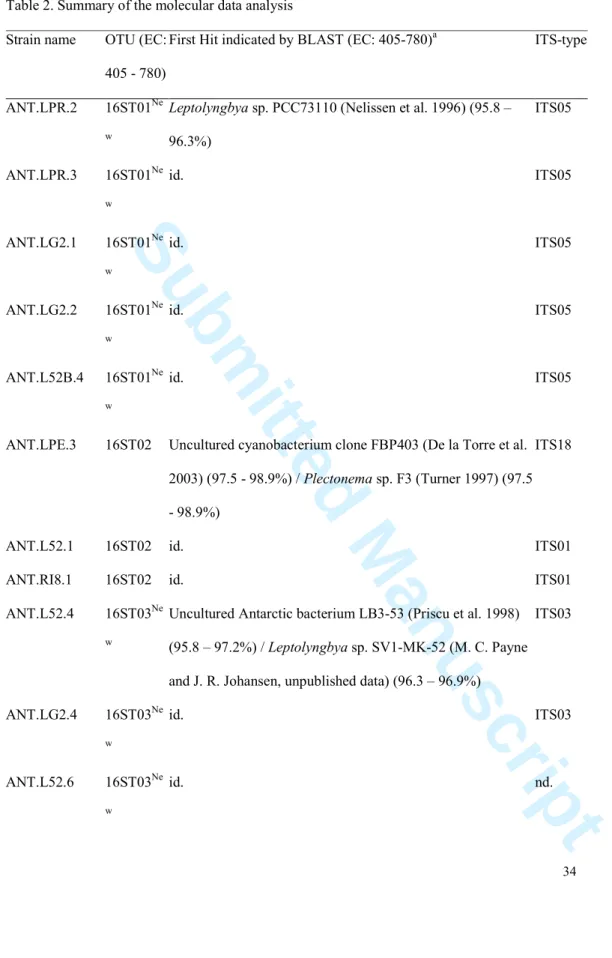
partial 16S rRNA gene (E. coli positions 405 to 780). Fifteen belonged to the Oscillatoriales,
5
5to the Nostocales and 1 to the Chroococcales (Table 2). Complete 16S rRNA gene
6
sequences were obtained for at least 1 strain per OTU, except for Calothrix sp. ANT.L52B.2,
7
the only strain belonging to 16ST17New. The PCR did not work when we tried to obtain PCR
8
products longer than ca. 400 bp. In total, 29 complete sequences were obtained.
9
The new sequences have 89.6 to 100% 16S rRNA gene similarities with their closest
10
relatives, currently deposited in GenBank (Table 2). Nine out of 21 OTUs had at least 2.5 %
11
dissimilarity with the sequences in the databases. Three OTUs were related to sequences
12
found only in Antarctica, and in two cases, they were from clone libraries. The remaining 9
13
OTUs exhibited more than 97.5% similarity with polar and/or non-polar sequences and were
14
considered as cosmopolitan OTUs.
15
The phylogenetic analyses (Figure 3) based on near-complete sequences and using several
16
methods for tree construction, showed that the OTUs constituted monophyletic clades that
17
were usually well supported by the bootstrap values. Therefore, as many sequences in
18
GenBank are partial, but generally contain EC positions 405-780, the analyses of
19
evolutionary relationships were based on the comparisons of partial sequences. The partial 20
sequences recently obtained by Jungblut et al. (2005)were not indicated in the tree, but were 21
included in the analysis. Here, we distinguish 3 groups: new, Antarctic and cosmopolitan
22
OTUs.
23
New OTUs. The sequences belonging to these new OTUs exhibited 2.5 to 10.4% 24
dissimilarity with all sequences available in the databases. The sequence of P. cf. involvens
25
Submitted Manuscript
ANT.LG2.8 was the first sequence determined for this genus and belonged to 16ST20New. 1
The sequence of Calothrix sp. ANT.L52B.2 belonged to 16ST17New. Its closest relative
2
belonged to the genus Calothrix, although with less than 97.5% binary similarity. The
3
sequence of Chondrocystis sp. ANT.L59B.1 belonged to 16ST21New and was loosely
4
associated with other unicellular cyanobacteria. 16ST09New comprised 2 sequences of L. 5
frigida, identical to each other but isolated from different lakes. The sequence of L. frigida 6
ANT.L52.2, belonged to 16ST08New. Three sequences of P. priestleyi belonged to 7
16ST03New. Two of them, isolated from Lake Bruehwiler (VH), were identical to each other
8
and 1.4% dissimilar to the third strain isolated from another lake. 16ST01New comprised 5 9
sequences of Pseudophormidium sp. / Schizothrix sp. Four of them were identical to each
10
other even though they originated from 3 different lakes. The minimum level of similarity
11
within this OTU was 99.4%. Seven sequences of L. frigida belonged to 16ST07New. Six of
12
them fell into two groups of identical sequences, one group with 4 sequences originating
13
from 3 lakes, and one group with two sequences from 2 different lakes. A seventh sequence
14
(L. frigida ANT.L52B.3)shared more than 97.5% similarity with the first group but only 15
96.9% similarity with the second group. However, to avoid adding one new OTU on the basis 16
of a sequence that was only slightly divergent, we includedthis strain in OTU 17
16STO7New.The sequence of P. priestleyi ANT.LACV5.1 belonged to 16ST06New.
18
Antarctic OTUs. Eight identical sequences of L. antarctica belonged to 16ST11Ant and came 19
from 5 different lakes in 3 distinct regions: the LH and VH in Eastern Antarctica and the DV
20
in the Ross Sea region. In addition, these sequences appear related (at least 99.1%) to clones
21
of the DV, Fr397 (Taton et al. 2003),LB3-46 (Priscu et al. 1998) and clones from Fresh and
22
Orange ponds on Bratina Island (Antarctica) (Jungblut et al. 2005). Within 16ST13Ant, the 23
sequence of L. antarctica ANT.BFI.1 (BI) was identical to the sequence of clone Fr132
24
isolated from microbial mats of Lake Fryxell in the Antarctic DV (Taton et al. 2003) and
25
Formatted
Deleted: The minimum level of
similarity between the new sequences within this cluster was 96.9%.
Deleted: ,
Deleted: sequences Deleted: and
Submitted Manuscript
clone sequences from Fresh and Orange ponds on Bratina Island (Jungblut et al. 2005). Two
1
identical sequences of P. priestleyi belonged to 16ST05Ant and were isolated from different 2
lakes in the LH. These sequences exhibited 99.4% similarity with the sequence of clone
LB3-3
53 from the Antarctic DV (Priscu et al. 1998).
4
Cosmopolitan OTUs. Nostoc sequences were grouped in 16ST16. The minimum similarity 5
within this cluster was 96.0% but distinct OTUs within this OTU could not be easily
6
distinguished. Interestingly, the 3 Nostoc strains originating from Lake L52B (LH) possessed
7
16S rRNA sequences that exhibited 1.4 to 3.1% dissimilarity. The Antarctic clone OraP15
8
(Jungblut et al. 2005) also fell in this OTU. C. cf. scottianum ANT.L52B.5, belonging to 9
16ST19 clustered together (97.7% similarity) with Tolypothrix distorta SEV2-5-2-Ca, 10
isolated from arid soil in New Mexico (USA) (Flechtner et al. 2002). Furthermore, it
11
exhibited a maximum of 96.9% similarity with the other sequences of the genus
12
Coleodesmium available in the databases. The Calothrix sp. ANT.LPR.4 sequence belonging 13
to 16ST18 exhibited 98,3% similarity with the sequence of Calothrix sp CCMEE 5085, from
14
hot spring microbial mats in Yellowstone (USA) that is considered as moderately
15
thermotolerant (Dillon and Castenholz 2003). 16ST14 comprised 3 identical sequences of P.
16
murrayi from two lakes of the VH. These sequences were identical to theseof Microcoleus 17
glaciei Johansen & Casamatta UTCC475 (Casamatta et al. 2005), previously assigned to P. 18
murrayi UTCC475 and isolatedfrom a pond on Bratina Island. Furthermore, this OTU
19
comprised clones from Fresh Pond (Jungblut et al. 2005) and the clone CD29 from a soil
20
crust on the Colorado Plateau (USA) (Yeager et al. 2004). The sequence ofP. 21
pseudopriestleyi ANT.LACV5.3 from Ace Lake (VH) and belonging to 16ST15 was 22
identical to clone and strain sequences from mats in ponds on Bratina Island (Nadeau et al.
23
2001 and Jungblut et al. 2005). The strains ANT.LJA.1 and ANT.L61.2 belonged to 16ST10.
24
Both strains were isolated from 2 lakes in the LH and assigned to L. frigida and P. priestleyi,
25
Deleted: Interrestingly
Deleted: The sequence of Deleted: that of Deleted: { Deleted: } Deleted: , Deleted: which Deleted: also
Deleted: Antarctic strain sequence Deleted: ,
Deleted: The latter strain was
reassigned to Microcoleus glaciei Johansen & Casamatta sp. nov. UTCC475 (Casamatta et al. 2005).
Deleted: sequence of Deleted: isolated Deleted: isolated Deleted: other Deleted: isolated Deleted: microbial
Deleted: Nevertheless, this OTU also
included other non-polar organims.
Submitted Manuscript
respectively. Their sequences exhibited levels of similarity ranging from 98.9 to 99.4% with
1
those of clone LB3-64 (Priscu et al. 1998) and of Leptolyngbya sp. SV1-MK-52 from a soil
2
crust in the Silurian Valley (USA) (M. C. Payne and J. R. Johansen, unpublished data).
3
16ST02 comprised the identical sequences of L. cf. fragilis ANT.L52.1 and ANT.RI8.1 that 4
were isolated from 2 lakes of 2 neighboring regions (LH and RI). They exhibited 98.9%
5
similarity with the clone FBP256 from a cryptoendolithic community in DV (De la Torre et
6
al. 2003) and with the sequence of the marine non-polar strain of Plectonema sp. F3 (Turner
7
1997). Furthermore, this OTU also included Pseudophormidium sp. / Schizothrix sp.
8
ANT.LPE.3.. 16ST04 comprised 2 sequences of P. priestleyi strains isolated from Progress 2
9
pond that were 99.4% similar to each other and clustered together with theclones
Fr-10
BGC054 and LB3-1 from DV (Priscu et al. 1998, Taton et al. 2003) with levels of similarity
11
ranging from 98.6 to 100%.. The identical sequences of L. antarctica ANT.LAC.1 and
12
ANT.LACV6.1 belonged to 16ST12 and exhibited 98.6% similarity with the sequence of
13
Oscillatoria sp. ANT.SOS (Nadeau et al. 2001). The clone SalP05 (Jungblut et al. 2005) also
14
fell in this OTU. Interestingly, Ace Lake, and both ponds on Bratina Island are saline.
15
ITS analysis
16
For 32 oscillatorian strains, and C. cf. scottianum ANT.L52B.5, both tRNA Ile and Ala genes
17
were found, except for strains ANT.BFI.1 and ANT.LACV5.3 that did not possess any tRNA
18
genes in the amplified rRNA operon. Eight groups of ITS sequences where the alignment
19
seemed meaningful (Wilmotte 1994) were defined as ITS-types (ITS01 – ITS08) (Table 2).
20
In addition, 10 sequences did not belong to any groups and were the unique representatives of
21
their ITS-types. Alltogether, eighteen ITS-types were defined. Levels of sequence similarities
22
within these ITS-types ranged from 98.8 to 100% (indels taken into account) with the
23
exception of ITS-type ITS03, in which sequences ANT.L52.4 and ANT.LG2.4 only exhibited
24
83.8% similarity. Furthermore, for 3 ITS-types, database sequences could be meaningfully
25
Deleted: isolated
Deleted: in Eastern Antarctica Deleted: sequence Deleted: isolated Deleted: the Antarctic Deleted: , Wilmotte 1991 Deleted: the sequence of
Deleted: However, the latter was only
97.5% similar to the other sequences
Deleted: 99.4% similar to each other Deleted: These sequences Deleted: that
Deleted: these of Deleted: and exhibited Deleted: Furthermore, the new
sequences exhibited more than 97.5% similarity with those of the LPP-group cyanobacterium QSSC8cya, isolated from quartz stones (VH) (Smith et al. 2000) and the non-polar clone TAF-B22 (O'Sullivan et al. 2002) (not shown in the tree)
Deleted: were from samples of Ace
Lake (VH) taken at different years. These sequences
Deleted: ,
Deleted: isolated on Bratina Island Deleted: and more than 97.5%
Submitted Manuscript
included in the alignment but all came from Lake Fryxell in the Antarctic DV (Taton et al.
1
2003). The ITS sequences of clones Fr005, Fr127, Fr297, Fr311, Fr350 and Fr397 obtained
2
from Lake Fryxell could be aligned with the sequences belonging to ITS-type ITS08.
3
However, the 6 clone sequences from Lake Fryxell (DV) were more similar to each other
4
than to the strain sequences from LH lakes. The clone sequences Fr023 and
BGC-5
Fr054 (Taton et al. 2003) were aligned with the sequence of P. priestleyi ANT.LPR.5
6
(ITS09) and the clone sequences of Fr132 and Fr246 (Taton et al. 2003) were aligned with
7
the sequence of L. antarctica ANT.BFI.1 (ITS10). Table 2 lists the different ITS-types in
8
relation to the OTUs based on 16S rRNA data. The strains that possessed the same ITS-types
9
belonged also to same OTUs. However, ITS sequences of 2 and 3 different types were
10
obtained for the strains belonging to 16ST02 and 16ST07New, respectively.
11
Bioactivity
12
A total of 126 samples were prepared from the culture of the 48 cyanobacterial strains and
13
tested against the panel of human pathogens used at Vicuron Pharmaceuticals. Seventeen
14
strains were active, and among them 14produced antibacterial activities and 12 showed
15
inhibition of fungal strains (Table 3 – Appendix 5 reports the results for all the tested strains,
16
http://www.cip.ulg.ac.be/AppendixesStr.pdf). The frequency of antibacterial activity against
17
the Gram-positive S. aureus was 29%. No activities were detected vs. the Gram-negative E.
18
coli and the yeast C. albicans, whereas 4% and 20% of the tested strains inhibited the growth 19
of A. fumigatus and C. neoformans, respectively. Half of the tested isolates were cytotoxic to
20
the mammalian cell line. The bioactivities were compared to the evolutionary relationships of
21
the strains.
22
Among the 19 isolates assigned to the new OTUs, 6 strains of Pseudophormidium sp. /
23
Schizothrix sp. and P. priestleyi belonging to 16ST01New and 16ST03New, respectively,
24
produced antimicrobial activities,coupled for 4 strains with a significant cytotoxicity. None
25
Field Code Changed
Deleted: (Table 3) Deleted: six
Deleted: and belonged to 16ST01New and
Deleted: to
Deleted: 16ST03New. Strains of
Pseudophormidium sp. / Schizothrix sp.
belonging to 16ST01New showed similar antimicrobial profiles against S. aureus and C. neoformans, coupled with a significant cytotoxicity in the in vitro assay, except strain ANT.L52B.4, which was inactive against pathogens and not cytotoxic. Two out of the three P.
priestleyi strains belonging to 16ST03New, inhibited A. fumigatus growth. Though
Deleted: ,
Deleted: both strains were isolated
from the same lake and exhibited identical partial 16S rRNA gene sequences, only one was cytotoxic.
Submitted Manuscript
of the 9 isolates of L. frigida belonging to novel OTUs (16ST07New, 16ST08New and 1
16ST09New) showed any antibacterial activity. However, 4 of them, with identical 16S rRNA
2
gene sequences produced cellular toxins. Among the Antarctic OTUs, 3 out of the 7 strains
3
screened were microbiologically active and specifically inhibited S. aureus growth. These 3
4
strains assigned to L. antarctica, belonged to 16ST11Ant and exhibited identical 16S rRNA 5
gene sequences. One of them was cytotoxic. A similar absence of correlation of the metabolic
6
profiles with the geographical origin and genetic/morphological characteristics was observed
7
within 16ST02, 16ST04, 16ST10, 16ST12, 16ST14. Indeed,diverse patterns of 8
antimicrobial/cytotoxic activities were often observed among the strains of L. cf. fragilis, P.
9
priestleyi, L. antarctica and P.murrayi having identical sequences, isolated from different 10
regions or even from the same lake.The frequency of antimicrobial activities against S.
11
aureus and C. neoformans was particularly high in the Nostoc group (16ST16): 5 out of 6 12
strains were active. Furthermore, 5 strains exhibited a high-level cytotoxicity. In contrast, the
13
screened strains of the genus Calothrix were microbiologically inactive but3 out of 5 were
14
cytotoxic.
15
Discussion 16
Several studies have focusedon the cyanobacterial diversity of microbial mats in Antarctic
17
lakes, mainly based on species morphology. Nevertheless, the number of Antarctic
18
cyanobacterial strains available in culture collections is limited. Furthermore, little is known
19
concerning their phylogenetic affiliations, geographic distribution, their physiology and their
20
bioactive metabolites. To our knowledge, this is the first study, in which a concentrated effort
21
has been carried out to obtain a wide variety of cyanobacterial strains from this biota from
22
different regions, and where a combined microscopic analysis with 16S rRNA gene and ITS
23
analyses, as well as an evaluation of bioactivities has been performed.
24 Formatted Formatted Formatted Deleted: S Deleted: with Deleted: ere Deleted: : Deleted: Deleted: , strains
Deleted: often showed diverse patterns
of antimicrobial/cytotoxic activities.
Deleted: Within 16ST10, P. priestleyi
ANT.L61.2 was active vs. S. aureus whereas L. frigida ANT.LJA.1 did not produce any activity. The two P.
priestleyi strains belonging to 16ST04,
isolated from the same lake were both cytotoxic, but only one of them inhibited
S. aureus growth. The three strains of P. murrayi belonging to 16ST14 had
identical sequences, but only one of them inhibited the S. aureus growth and was cytotoxic. The two strains of L.
antarctica belonging to 16ST12, which
were isolated from the same lake and had identical sequences, were both cytotoxic and microbiologically inactive. One of the two L. cf. fragilis belonging to
16ST02, isolated from different lakes in
different regions but having identical sequences, showed cytotoxicity whereas the other was completely inactive.
Deleted: and Deleted: focussed
Submitted Manuscript
Diversity and geographical distribution
1
The genotypic diversity (21 OTUs) appeared higher than the morphological diversity (12
2
morphospecies). In addition,each OTU might correspond to more than one species following
3
the bacteriological standards, but is likely to be distinct from other OTUs at the specific level
4
(Stackebrandt and Göbel 1994). In 7 cases (16ST01New, 16ST02, 16ST03New, 16ST04,
5
16ST07New, 16ST10 and 16ST16), slightly different sequences (levels of similarity ranging
6
from 97.5% to 99.9%) within the same OTUs were observed and were reminiscent of the
7
microdiversity found in molecular ecology studies using clone libraries (Fuhrman and
8
Campbell 1998). If we consider such microheterogeneities as a real feature of the 16S rRNA
9
gene that could be explained, for example, by the presence of different ecotypes (Fuhrman
10
and Campbell 1998), these divergences would increase the genotypic diversity. This
11
hypothesis is even more probable, given that the PCR and cloning biases that are well known
12
in molecular ecology (Speksnijder et al. 2001), are not relevant here. In contrast, identical
13
strain sequences isolated in different lakes were found for 9 OTUs (16ST01New, 16ST02,
14
16ST05Ant, 16ST07New, 16ST09New, 16ST11Ant, 16ST12, 16ST14 and 16ST16). The
15
cultivation conditions may have selected identical ecotypes, or direct sequencing of the PCR
16
products without cloning may have hidden microheterogeneities between different operons of
17
the same strain. However, the wide range of culture conditions, including the use of novel
18
culture media, designed on the basis of the lake water chemical composition, and the strain
19
selection procedure should have permittedto obtain different ecotypes, if they were present.
20
With the exception of strains belonging to 16ST02 and 16ST07New, similar groupings were
21
found with the ITS and the 16S rRNA gene. The levels of similarity were lower between
ITS-22
types than between 16S types, giving a more clear-cut distinction of the groups. Though the
23
ITS was used successfully in several studies to discriminate cyanobacterial strains at the
24
intra- or interspecific level (e.g. Ernst et al. 2003, Otsuka et al. 1999), this is not the case
25 Deleted: , Deleted: oe Deleted: r Deleted: r Deleted: ,
Deleted: Qiu et al. 2001,
Deleted: permited
Deleted: Baurain et al. 2002, Boyer et
Submitted Manuscript
here, except for 2 ITS sequences of type ITS03. The high levels of similarity within
ITS-1
types in this study seemed to reflect a remarkable conservation of sequences from different
2
lakes/regions. Interestingly, in ITS-type ITS08, the 6 clones sequences from Lake Fryxell are
3
more similar to each other than to the 4 LH strain sequences, giving a hint of a better
4
geographical resolution for the ITS marker than 16S rRNA gene.
5
The divergence between the morphological and molecular results was particularly evident in
6
the Oscillatoriales that concealed a high degree of genotypic diversity (15 OTUs) despite a
7
very simple morphology (7 morphospecies). Moreover, the Antarctic oscillatorian strains
8
belonging to different OTUs fell into paraphyletic lineages. This confirms the polyphily of
9
the Oscillatoriales order (e.g. Ishida et al. 2001, Wilmotte 1994), and implies that
10
psychrotolerance has arisen several times among the Antarctic oscillatorians (Nadeau et al.
11
2001).
12
The strains belonging to the same morphospecies may possess sequences belonging to
13
paraphyletic OTUs. This suggests multiple origins for the same morphospecies and makes the
14
phylogenetic interpretation of morphological criteria difficult.As often suggested (e.g.
15
Wilmotte 1994), this confirmsthat cyanobacterial taxonomy cannot be based solely on
16
morphology.
17
Nevertheless, besides these divergences, a one-way correlation between morphological and
18
molecular results was found. Indeed, most strains closely related at the 16S rRNA gene level
19
belonged to the same morphospecies and most strains that belonged to different
20
morphospecies were different at the 16S rRNA gene level. This was the case for 51 out of the
21
56 sequenced strains. Consequently (although they cannot be used alone), several
22
morphological characters used for the oscillatorian morphospecies description were of
23
taxonomic value such as the cell shape, the cell width, the presence or absence of cross wall
24
constrictions and the number of trichomes per filament. Though this latter character depends
25
Deleted: Nelissen et al. 1996,
Deleted: Furthermore, t
Deleted: quite complex Deleted: I
Submitted Manuscript
on the culture age and the sheath structure, it appeared to be a good diacritical trait if
1
frequently displayed by the culture.
2
In Nostoc strains, the 16S rRNA gene sequences belonged to 16ST16 but exhibited a minimal
3
internal similarity of 96.6% only (E. coli positions: 405-780). The morphological criteria did
4
not permit a clear-cut distinction between the different strains. The sequences of Calothrix sp.
5
belonged to two Calothrix clusters and exhibited 8.4% dissimilarity, what hints to a large
6
genetic diversity of this morphogenus. The two strains differed in the length of the
7
heterocysts. As already mentioned, the 16S rRNA gene sequence of P. cf. involvens
8
ANT.LG2.8 was the first available for this genus. Interestingly, this sequence exhibited 94.6
9
to 96.6% similarity with strain sequences of Scytonema sp. available in the databases. Both
10
genera are morphologically very similar. However, Komárek and Anagnostidis (1989) place
11
the genus Scytonema into the family Scytonemataceae and the genus Petalonema into the
12
family Microchaetaceae. Interestingly, C. cf. scottianum ANT.L52B.5 was grouped in the
13
tree with Tolypothrix distorta SEV2-5-2-Ca (97.7% similarity) and exhibited more than 3.1
14
% dissimilarity with other Coleodesmium sequences in Genbank. The genera Coleodesmium
15
and Tolypothrix have basically the same structure but different branching processes
16
(Komárek and Watanabe 1990)
17
This study contributes to the interesting and debatable topic of microbial biogeography
18
recently reviewed by Martiny et al. (2005). Indeed, 22 strains corresponding to 9 OTUs did
19
not have relatives in the databases, and 11 strains corresponding to 3 OTUs were closely
20
related only (more than 97.5% similarity) to other Antarctic sequences from uncultivated
21
organisms (Priscu et al. 1998, Jungblut et al. 2005, Taton et al. 2003). In contrast, the
22
taxonomic assignments based on morphology showed a majority of known cosmopolitan
23
taxa. Hence, molecular studies show that endemism in Antarctic cyanobacteria is likely to be
24
more common than has been previously estimated on the basis of morphology alone. The 9 25
Deleted: &
Deleted: family Microchaetaceae
Deleted: An important result of t Deleted: raised
Deleted: of this study is that
Deleted: Deleted: Antarctic
Submitted Manuscript
cosmopolitan OTUs (23 strains) were related to non-polar database sequences, of which 2
1
were obtained for the first time from Antarctic biotopes and the remaining 7 OTUs had 2
previously beenfound in Southern Victoria Land and/or Bratina Island, as well asin
3
Dronning Maud Land (only one strain). This supports the idea that cosmopolitan OTUsare
4
well adapted to transport and colonization, and thus were quite successful in their dispersal
5
and occupation of new habitats in different regions of Antarctica.
6
Bioactivities
7
Strains isolated from the same lakes, and belonging to the same OTUs showed different
8
patterns of activity in antimicrobial and cytotoxic assays. This finding confirms that the strain
9
isolation procedures described above, permitted us to obtain different ecotypes with diverse
10
metabolic profiles. As in the case of morphology or cyanotoxin production (Otsuka et al.
11
1999),differences in secondary metabolism do not correspond to genetic differences as
12
indicated by rRNA and ITS analysis. These results suggest that a complementary way to
13
screen cyanobacterial diversity may be to directly look for secondary metabolic operons such
14
as polyketide synthase (PKS) and nonribosomal peptide synthase (NRPS) clusters, that 15
correspond to ca. 1% of all cyanobacterial sequences submitted to GenBank (Burja et al.
16
2003). Nevertheless, we observed a certain clustering of activities, as the oscillatorian and
17
Nostoc strains that exhibited only antibacterial activities belonged to 16ST04 (1 out of 2 18
strains), 16ST10 (1 out of 2 strains), 16ST11Ant (3 out of 6 strains), 16ST14 (1 out of 3
19
strains) and 16ST16 (1 out of 6 strains) whereas the strainsexhibiting only antifungal or both
20
antibacterial and antifungal activities belonged to 16ST01New (4 out of 5 strains), 16ST03New
21
(2 out of 3 strains) and 16ST16 (5 out of 6 strains). Furthermore, all the oscillatorian strains
22
belonging to 16ST02, 16ST05Ant, 16ST06New, 16ST07New, 16ST08New, 16ST09New, 16ST12 as
23
well as Calothrix strains 16ST17New and 16ST18 were microbiologically inactive. In the
24
course of our screening, the majority of the microbiologically active strains inhibited a
Gram-25
Deleted: 9 Deleted: were Deleted: (one of them Deleted: )
Deleted: several OTUs, particularly the
non-polar ones
Deleted: , Deleted: colonisation
Deleted: the secondary metabolism
therefore does not seem to be linked with the rRNA operon.
Submitted Manuscript
positive pathogen, whereas no activities were found against Gram-negative and yeast
1
representatives. This is in agreement with the few data available in the literature about
2
antimicrobial frequencies in cyanobacterialscreening programs (Kreitlow et al. 1999).
3
Promising results from our screenings were the demonstrated activities against filamentous
4
fungi, which are worthy of further investigation. As previously reported (Burja et al. 2001),
5
cyanobacteria constitute a major source of toxins. Indeed, the alkaloid neurotoxins and the
6
cyclic peptide hepatotoxins are responsible for toxic cyanobacterial blooms in waterbodies
7
worldwide. More than half of the Antarctic isolates of this study produced a cytotoxic activity
8
and at a first screening level, it was not possible to differentiate between cytotoxic and
9
antibacterial/antifungal activities, because the crude extracts contained a variety of different
10
compounds. Further work, including HPLC fractionation and mass spectrometry of the active
11
fractions, is in progress on the characterization of these cyanobacterial metabolites.
12
Conclusions 13
Molecular and morphological approaches revealed different diversity patterns in term of
14
species richness but also novelty and geographical distribution (endemism). Divergences
15
were particularly evident for the oscillatorian strains for which a very simple morphology can
16
hide a considerable genotypic diversity. A previously unknown molecular diversity was
17
found, not only for the oscillatorian strains, but also for strains of the genera Petalonema,
18
Calothrix and Chondrocystis. In addition, several new strain sequences have allowed us to 19
assign morphologyto 3 OTUs that previously comprised only uncultivated sequences from
20
Antarctic biotopes (Priscu et al. 1998, Jungblut et al. 2003,Taton et al. 2003). This study also
21
showed that morphologically and genotypically identical strains were isolated from widely
22
separated Antarctic regions. Genotypically identical strains isolated either from the same lake
23
or from different lakes may produce different patterns of bioactivity. Cultivation and
24
Deleted: me
Deleted: , Namikoshi and Rinehart
1996
Deleted: Preliminary analytical studies
were performed with a subset of these strains (hits) that exhibited relatively potent antibacterial and/or antifungal activities. HPLC fractionation and mass spectrometry of active fractions in P.
priestleyi ANT.L52.4 and ANT.L52.6
(16ST03New) showed very similar
chromatographic profiles, where the fraction active against A. fumigatus was separated from the fraction exhibiting cytotoxicity (Luc Jacquet, personal communication). In the same Liquid Chromatography – Mass Spectrometry system, Pseudophormidium sp. /
Schizothrix sp. ANT.LPR.2 (16ST01New), L. antarctica ANT.LG2.3 (16ST11Ant)
and Nostoc sp. L34.1 (16ST16) showed that the fraction active against S. aureus eluted at similar retention times, suggesting that the three strains produced similar novel antibacterial compounds (Luc Jacquet, personal communication). Further work is in progress on the chemical characterization of these cyanobacterial metabolites.
Deleted: ding remarks Deleted: A not yet-discovered Deleted: a morphology Deleted: clusters
Submitted Manuscript
screening of novel and/or endemic species of Antarctic cyanobacteria holds promise for the
1
discovery of new biotechnologically valuable antifungal and antibacterial metabolites.
2
Acknowledgements 3
This study was funded by the European Union Biotechnology Program through the
4
MICROMAT project (BIO4-CT98-0040) and the Federal office for Scientific, Technical and
5
Cultural affairs – Belgium project LAQUAN (EV/02/01). Annick Wilmotte is a research
6
associate of the National Fund for Scientific Research (Belgium). Arnaud Taton had a
7
fellowship from the Funds for Research Formation in Industry and Agriculture (Belgium).
8
We thank Stefano Ventura (CNR-ISE, Italy) for providing two primer sequences. We thank
9
Kathy Welch (Byrd Polar Research Center, USA), Philippa Noon, Wendy Quayle (British
10
Antarctic Survey, UK), Johanna Laybourn-Parry, Gareth Murtagh, Paul Dyer, Tracey
11
Henshaw (University of Nothingham, UK) and Ingmar Janse (University of Groningen, NL)
12
who collected the mat material, and the Long Term Ecosystem Research Program (LTER)
13
and the Australian Antarctic Division (AAD), under whose auspices the material was
14
collected. We also thank Jiri Komárek (University of South Bohemia, Czech Republic) and
15
Lucien Hoffmann (Centre de Recherche Public - Gabriel Lippmann, Luxembourg) for their
16
help in the taxonomic assignation of the cyanobacterial strains.
17
References 18
Bowman, J. P., Rea, S. M., McCammon, S. A. & McMeekin, T. A. 2000. Diversity and
19
community structure within anoxic sediment from marine salinity meromictic lakes and a
20
coastal meromictic marine basin, Vestfold Hills, eastern Antarctica. Environ. Microbiol.
21
2:227-37.
22
Deleted: can lead to
Deleted: Baurain, D., Renquin, L.,
Grubisic, S. & Scheldeman, P. 2002. Remarkable conservation of internally transcribed spacer sequences of
Arthrospira ('Spirulina') (cyanophyceae,
cyanobacteria) strains from four continents and of recent and 30-year-old dried samples from Africa. J. Phycol. 38:384-93.
Submitted Manuscript
Broady, P. A. & Kibblewhite, A. L. 1991. Morphological characterization of Oscillatoriales
1
(Cyanobacteria) from Ross Island and southern Victoria Land, Antarctica. Antarct. Sci.
3:35-2
45.
3
Burja, A. M., Banaigs, B., Abou-Mansour, E., Burgess, J. G. & Wright, P. C. 2001. Marine
4
cyanobacteria - a prolific source of natural products. Tetrahedron 57:9347-77.
5
Burja, A. M., Dhamwichukorn S., Wright P. C. 2003. Cyanobacterial postgenomic research
6
and systems biology. Trends in Biotechnol. 21:504-11.
7
Casamatta, D. A., Johansen, J. R., Vis, M. L. & Broadwater, S. T. 2005. Molecular and
8
morphological characterization of ten polar and near-polar strains within the oscillatoriales
9
(cyanobacteria). J. Phycol. 41:421-38.
10
Christner, B. C., Kvitko, I. I. & Reeve, J. N. 2003. Molecular identification of bacteria and
11
eukarya inhabiting an Antarctic cryoconite hole. Extremophiles 7:177-83.
12
De la Torre, J. R., Goebel, B. M., Friedmann, E. I. & Pace, N. R. 2003. Microbial diversity of
13
cryptoendolithic communities from the McMurdo Dry Valleys, Antarctica. Appl. Environ.
14
Microbiol. 69:3858-67. 15
Dillon, J. G. & Castenholz, R. W. 2003. The synthesis of the UV-screening pigment,
16
scytonemin, and photosynthetic performance in isolates from closely related natural
17
populations of cyanobacteria (Calothrix sp.). Environ. Microbiol. 5:484-91.
18
Ernst, A., Becker, S., Wollenzien, U. I. A. & Postius, C. 2003. Ecosystem-dependent
19
adaptive radiations of picocyanobacteria inferred from 16S rRNA and ITS-1 sequence
20
analysis. Microbiol. 149:217-28.
21
Felsenstein, J. 1989. PHYLIP - Phylogeny Inference Package (Version 3.2). Cladistics 5:164.
22
Formatted
Flechtner, V. R. & Howard, G. L. 2002. Phylogeny and genetic variance in terrestrial Microcoleus (cyanophyceae) species based on sequence analysis of the 16S rRNA gene and associated 16S-23S ITS region. J. Phycol. 38:1222-35.¶ Brambilla, E., Hippe, H., Hagelstein, A., Tindall, B. J. & Stackebrandt, E. 2001. 16S rDNA diversity of cultured and uncultured prokaryotes of a mat sample from Lake Fryxell, McMurdo Dry Valleys, Antarctica. Extremophiles 5:23-33.
Deleted: 
Fumanti, B., Cavacini, P. & Alfinito, S. 1997. Benthic algal mats of some lakes of Inexpressible Island (northern Victoria Land, Antarctica). Polar Biol. 17:25-30.
Submitted Manuscript
Flechtner, V. R., Boyer, S. L. , Jeffrey, S. W. & DeNoble M. L. 2002. Spirirestis rafaelensis
1
gen. et sp. nov. (Cyanophyceae), a new cyanobacterial genus from arid soils. Nova Hedwigia
2
74: 1-24.
3
Fuhrman, J. A. & Campbell, L. 1998. Microbial microdiversity. Nature 393:410-1.
4
Gaspari, F., Paitan, Y., Mainini, M., Losi, D., Ron, E. Z. & Marinelli, F. 2005. Myxobacteria
5
isolated in Israel as potential source of new anti-infectives. J. Appl. Microbiol. 98:429-39.
6
Geitler, L. 1932. Cyanophyceae. In Kolkwitz, R. [Ed.] Rabenhorst's Kryptogamenflora von
7
Deutschland, Osterreich und der Schweiz. Akademische Verlagsgesellschaft, Leipzig, pp. 8
Gordon, D. A., Priscu, J. & Giovannoni, S. 2000. Origin and phylogeny of microbes living in
9
permanent Antarctic lake ice. Microbial. Ecol. 39:197-202.
10
Hodgson, D. A., Vyverman, W. & Sabbe, K. 2001a. Limnology and biology of saline lakes in
11
the Rauer Islands, eastern Antarctica. Antarct. Sci. 13:255-70.
12
Hodgson, D. A., Noon, P. E., Vyverman, W., Bryant, C. L., Gore, D. B., Appleby, P.,
13
Gilmour, M., Verleyen, E., Sabbe, K., Jones, V. J., Ellis-Evans, J. C. & Wood, P. B. 2001b.
14
Were the Larsemann Hills ice free through the Last Glacial Maximum?' Antarct. Sci.
13:440-15
54.
16
Ishida, T., Watanabe, M. M., Sugiyama, J. & Yokota, A. 2001. Evidence for polyphyletic
17
origin of the members of Oscillatoriales and Pleurocapsales as determined by 16S rDNA
18
analysis. FEMS Microbiol. Lett. 201:79-82.
19
Iteman, I., Rippka, R., Tandeau de Marsac, N. & Heussner, S. 2000. Comparison of
20
conserved structural and regulatory domains within divergent 16S rRNA-23S rRNA spacer
21
sequences of cyanobacteria. Microbiol. 146:1275-86.
22
Formatted Formatted
Deleted: r
Deleted: Garcia-Pichel, F.,
López-Cortés, A. & Nübel, U. 2001. Phylogenetic and morphological diversity of cyanobacteria in soil desert crusts from the Colorado Plateau. Appl. Environ.
Microbiol. 67:1902-10.
Deleted: Gerwick, W. H., Roberts, M.
A., Proteau, P. J. & Chen, J.-L. 1994. Screening cultured marine microalgae for anticancer-type activity. J. Appl. Phycol. 6:143-9.
Deleted: Göttlich, E., de Hoog, G. S.,
Genilloud, O., Jones, B. E. & Marinelli, F. 2003. MICROMAT: Culturable fungal diversity in microbial mats of Antarctic lakes. In Huiskes, A. H. L., Gieskes, W. W. C., Rozema, J., Schorno, R. M. L., van der Vies, S. M. & Wolff, W. J. [Eds.]
VIII SCAR International Biology Symposium - Antarctic biology in a global context. Amsterdam, The
Submitted Manuscript
Jukes, T. H. & Cantor, C. R. 1969. Evolution of protein molecules. In Munro, H. N. [Ed.]
1
Mammalian protein metabolism. Academic Press, New York, pp. 21-132. 2
Jungblut, A.D., Hawes, I., Mountfort, D., Hitzfeld, B., Dietrich, D.R., Burns, B.P. & Neilan
3
B.A. (2005) Diversity within cyanobacterial mat communities in variable salinity meltwater
4
ponds of McMurdo Ice Shelf, Antarctica. Env. Microbiol. 7 : 519-29.
5
Komárek, J. 1999. Diversity of cyanoprokaryotes (cyanobacteria) of King George Island,
6
maritime Antarctica - a survey. Arch. Hydrobiol. 94:181-93.
7
Komárek, J. & Anagnostidis, K. 1989. Modern approach to the classification system of
8
cyanophytes 4. Nostocales. Arch. Hydrobiol. 82:247-345.
9
Komárek, J. & Watanabe, M. 1990. Morphology and taxonomy of the genus Coleodesmium
10
(Cyanophyceae/Cyanobacteria). In Watanabe, M. & Malla, S. B. [Eds.] Cryptogams of the
11
Himalayas. National Science Museum, Tsukuba, Japan, pp. 1-22. 12
Komárek, J. & Anagnostidis, K. 1998. Cyanoprokaryota 1. Teil Chroococcales. Gustav
13
Fischer Verlag, Stuttgart.
14
Komárek, J. & Anagnostidis, K. 2005. Cyanoprokaryota 2. Teil Oscillatoriales. Elsevier
15
GmbH, Spektrum Akademischer Verlag, Heidelberg.
16
Kreitlow, S., Mund, S. & Lindequist, U. 1999. Cyanobacteria - a potential source of new
17
biologically active substances. J. Biotechnol. 70:61-3.
18
Ludwig, W., Strunk, O., Westram, R., Richter, L., Meier, H., Yadhukumar, X., Buchner, A.,
19
Lai, T., Steppi, S., Jobb, G., Förster, W., Brettske, I., Gerber, S., Ginhart, A. W., Gross, O.,
20
Grumann, S., Hermann, S., Jost, R., König, A., Liss, T., Lüßmann, R., May, M., Nonhoff, B.,
21
Reichel, B., Strehlow, R., Stamatakis, A., Stuckmann, N., Vilbig, A., Lenke, M., Ludwig, T.,
22
Formatted Formatted