HAL Id: hal-00945267
https://hal.inria.fr/hal-00945267
Submitted on 24 Mar 2014
HAL is a multi-disciplinary open access
archive for the deposit and dissemination of
sci-entific research documents, whether they are
pub-lished or not. The documents may come from
teaching and research institutions in France or
abroad, or from public or private research centers.
L’archive ouverte pluridisciplinaire HAL, est
destinée au dépôt et à la diffusion de documents
scientifiques de niveau recherche, publiés ou non,
émanant des établissements d’enseignement et de
recherche français ou étrangers, des laboratoires
publics ou privés.
projections
Miguel Alonso Arevalo, Roland Badeau, Bertrand David, Gael Richard
To cite this version:
Miguel Alonso Arevalo, Roland Badeau, Bertrand David, Gael Richard. Musical tempo estimation
using noise subspace projections. Proc. of IEEE Workshop on Applications of Signal Processing to
Audio and Acoustics (WASPAA), 2003, New Paltz, New York, United States. pp.95–98. �hal-00945267�
MUSICAL TEMPO ESTIMATION USING NOISE SUBSPACE PROJECTIONS
Miguel Alonso, Roland Badeau, Bertrand David and Ga¨el Richard
ENST, D´epartement de Traitement du Signal et des Images
46, rue Barrault, 75634 Paris cedex 13, France
{
malonso,rbadeau,bedavid,grichard
}
@tsi.enst.fr
ABSTRACT
Tempo estimation plays a fundamental role in music analysis, especially for the automatic processing of large amounts of musical data. In this paper, a novel idea to en-hance the estimation of the tempo in musical pieces is de-scribed, based on an harmonic/noise decomposition. This separation of the signal into a deterministic and a stochastic part is performed by projecting the signal onto its noise sub-space. Besides, the proposed algorithm shares various ele-ments with other tempo estimation methods. On a database composed of 54 excerpts from many musical genres our al-gorithm scored a success rate of 96%.
1. INTRODUCTION
Despite the apparent simplicity of the foot-tapping or beat-tracking skill compared to other musical ones, computer-based tempo estimation has remained a difficult work for processing a wide range of musical genres. The tempo, also known as the beat, is an important rhythmic property of mu-sic. In this paper, an algorithm is described, that determines the period between two musical motifs or beats and finds the rate in beats per minute (BPM) at which they occur. There exist numerous examples of applications: musical analysis, automatic rhythm alignment of multiple musical instruments, audio content analysis for automatic indexing and retrieval, beat driven special effects, musical education, etc. So far, some of the tempo tracking systems found in the literature focus on finding the tempo of strong beat1
sig-nals [1–3]. Some are more general, but are often challenged by orchestral classical music, mainly because of the weak-ness of the attacks and tempo variations [4, 5].
Many tempo estimation algorithms share the same prin-ciple. First, they decompose the input signal into a number of frequency bands by means of a filter bank [1, 4, 5] or by grouping frequency bins in the DFT of the signal [2, 3]. No consensus has been established about an optimal frequency decomposition and according to experimental results pre-sented in [1], many frequency decompositions lead to sat-1According to [1], regardless of their melodic complexity strong beat
signals bear a straightforward, perceptually simple rhythm.
isfactory results. Nevertheless, there is a tendency towards splitting the signal in a logarithmic scale [1, 4, 5]. Next, ex-traction of subband onsets is carried out. As for the previous stage, there are different approaches to solve this problem. In [2, 3] onset detection is performed independently in clus-ters of frequency bins directly from the spectrogram, in the first case using the first-order difference function and in the second case using a tailored-made function. In [1, 4, 5] on-sets are detected by computing the bandwise temporal enve-lope (the signal is rectified, lowpass filtered and decimated) and then calculating the first-order difference function as in [1], or a slight variation of the relative first-order differ-ence function [5] introduced in [6]. Although the envelope extraction is rather similar in most systems, there is a large variety of methods employed to estimate subband periodic-ity. For example, in [1] the author uses a bank of oscilla-tors which resonate at integer multiples of their characteris-tic frequency, [4] uses a fundamental frequency estimation method (called YIN [7]) which is a more robust replacement of the autocorrelation function, [2] uses a four component Gaussian mixture model to express the likelihood of onset locations, others compute in each frequency band an inter onset interval (IOI) histogram to determine the tempo [3] or the tatum2[5].
In this paper, we assume that the tempo of the audio signal is constant over the duration of the analysis window. The proposed system aims at estimating the tempo for a va-riety of musical genres. Its performance was tested using an experimental manually annotated data base comprising ex-cerpts from rock, latin (cuban/salsa), pop music, jazz, clas-sical and traditional songs. The paper is organized as fol-lows: section 2 provides a detailed description of the pro-posed system, except for the noise subspace projection al-gorithm which is described in section 3. Next, in section 4 tests results are provided and compared to other exist-ing methods, issues about the sensitivity and robustness of the presented method are also addressed. Finally, section 5 summarizes the main achievements of the presented algo-rithm and gives some possible directions for future research. 2The term ”tatum” has been derived from temporal atom and is the
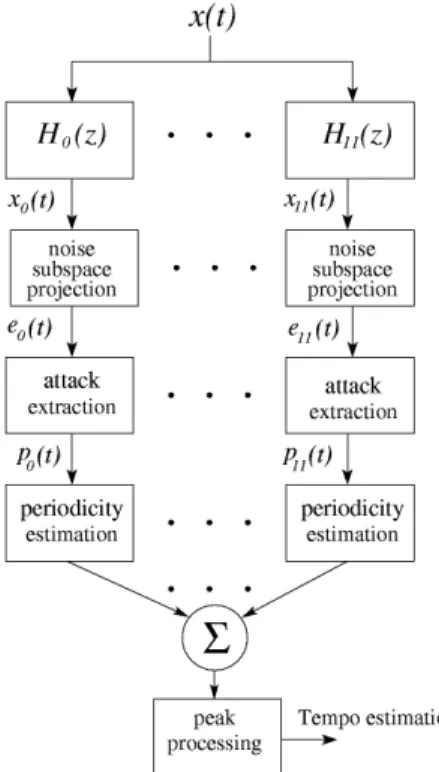
Figure 1: Overview of the system.
2. DESCRIPTION OF THE ALGORITHM
Our tempo estimation algorithm shares a number of features with other systems found in the literature. The main differ-ence is that we estimate the tempo from the residual com-ponent of a harmonic plus noise model, in order to highlight the attacks in the musical signal.
The General overview of the tempo estimation system is
presented in Figure 1. The algorithm works as follows: the input audio signalx(t) is first decomposed into twelve
uni-form non-overlapping subbands using a cosine modulated filterbank where the prototype filter is implemented using a 200th order FIR filter with 80 dB of rejection in the stop band. The use of a highly selective filter is necessary be-cause the noise subspace projection stage is very sensitive to spurious sinusoids in the stop band. The filterbank output signalsxk(t), where k = 0, ..., 11, are then projected onto
the noise subspace (cf. section 3), providing the correspond-ing residualsek(t).
The subband onset detection is the next stage, once the
bandwise noise signalsek(t) have been calculated. A
com-pound system is used, which combines the schemes pro-posed in [6, 8]. Figure 2 depicts the flow diagram of this onset detector. The role of the filterHk(z) is described as
follows. After subtracting the harmonic components from the subband signalxk(t) the energy ratio between the pass
band and the stop band for the noise signalsek(t) has been
severely reduced. Therefore, prior to further processing it is necessary to refilter those signals in order to eliminate noise components outside the desired frequency range. The next three diagram blocks concern the envelope extraction. To compute the subband noise envelope ak(t), the noise
sig-nalek(t) is half-wave rectified and low-pass filtered using
a 100ms decreasing waveform defined as the2nd
half of a 200ms Hanning window. The narrow-band output signal is then decimated by a factor ofM = 16 for the purpose of
reducing the computational burden. To find the onset points inak(t), the first order relative difference function wk(t)
proposed in [6] is used. This function gives the amount of change in the signal in relation to its absolute level. This is equivalent to differentiating the logarithm of the subband noise envelope, as given by Eq. (1).
wk(t) = d
dtln(ak(t)) (1)
The first order relative difference function is a psychoacous-tically relevant measure, since the perceived increase in sig-nal amplitude is in relation to its level, the same amount of increase being more prominent in signals with a low dynam-ical range [6]. Hence, we find onset points by a peak picking operation, which looks for peaks above a given threshold. An adequate threshold value was found experimentally to be near1.5 σwk, whereσwk stands for the standard devia-tion ofwk(t).
Figure 2: Attack extraction flow diagram.
Periodicity estimation. The signalpk(t) at the output of
the onset detection stage is a train pulse. It can be seen as composed of two parts: one corresponding to a quasi-periodic pulse signal, bearing the beat ofx(t), and an
ad-ditive noisy pulse signal. To ease the periodicity estimation of the train pulse, the signalpk(t) is convolved with a 75ms
odd-length Hanning window. This leads to a smooth quasi-periodic signalzk(t). The method we employed to
deter-mine the periodicity of zk(t) was motivated by the work
presented in [8], which is a very efficient model in time-domain pitch analysis, and is based on the summary auto-correlation function (SACF). First, the signalzk(t) is
cen-tered (z˜k(t) = zk(t)−¯zk) and then the autocorrelation
rk(τ ) = X
t ˜
zk(t + τ )˜zk(t) (2)
where0 ≤ t ≤ W − 1, and W stands for the analysis
window length. Finally, the ACFsrk are summed across
bands to form the summary ACF (SACF).
We suppose that the tempo lies between 60 and 200 BPM, without loss of generality since any other value can be mapped into this range. Hence, during the SACF calcu-lation, it is merely necessary to shiftτ within the 300 ms to
1,000 ms time range. To find the periodicity of the sub-band envelope signals zk(τ ), we look for the three most
salient peaks in the SACF. To ensure a more robust and ac-curate tempo extraction, a multiplicity relationship between them is extensively searched via a numerical algorithm. If no multiplicity relation is found among the detected peaks, the time lag of the most prominent one is taken as the beat period.
3. NOISE SUBSPACE PROJECTION
The noise subspace projection stage is processed indepen-dently in each subband. It is based on the Exponentially Damped Sinusoidal (EDS) model [9]:
• The harmonic part of the sound is modeled as a sum
of n sinusoids, which may have an exponential
de-cay. In order to include polyphonic sounds, the fre-quencies of these sinusoids are not constrained to be evenly distributed.
• The noise part is defined as the difference between
the original signal and the harmonic part.
The estimation of multiple sinusoids in noise has been extensively investigated in signal processing literature [10]. Among the various approaches, subspace-based techniques are of major interest because they overcome the resolution limit of the Fourier analysis, they are robust to high noise levels, and they can be used with short analysis windows.
Consecutive snapshot vectors of lengthL are extracted
from the signal. The subspace analysis consists in split-ting theL-dimensional space which contains those vectors
into the signal subspace and the noise subspace. The sig-nal subspace characterizes then sinusoids; its dimension is p = 2n < L. On the opposite, the noise subspace only
contains noise; its dimension isL − p. In practice, L must
be much larger thanp to enhance the robustness of the
algo-rithm.
The most interesting property of these methods for our purposes is that the estimation / subtraction of the sinu-soids is not even required: the noise part can be directly ob-tained by projecting the subband signal onto the noise sub-space. More precisely, an orthonormal basis USk(t)
span-ning the signal subspace in the kth
subband in the time
window[t − L + 1, t] can be computed via a singular or
eigenvalue decomposition of a data or a covariance matrix, or via subspace tracking methods [9]. Then, a noise vec-tor ek(t) = [ek(t − L + 1), ek(t − L + 2), . . . , ek(t)]T
can be obtained by applying the noise subspace projector
IL− USk(t) USk(t)Tto the subband vector xk(t) = [xk(t − L + 1), xk(t − L + 2), . . . , xk(t)]T:
ek(t) = xk(t) − US k(t) U
S
k(t)Txk(t). (3)
The noise part of the whole subband signal can be com-puted by an overlap-add method:
1. the analysis window[t − L + 1, t] is recursively
time-shifted (in practice, we chose an overlap of3L/4),
2. the signal subspace basis USk(t) is tracked by means
of the Sequential iteration EVD algorithm [9], 3. the vector ek(t) is computed according to Eq. (3),
4. finally, the consecutive noise vectors are multiplied by a Hanning window and added to the noise subband signal.
The overall computational cost of the subspace projec-tion process for each analysis block is that of step 2, which is the most computationally demanding. As shown in [9], its complexity isO(Ln(n + log(L))). Note that the
Sequen-tial iteration EVD algorthm can be replaced by a subspace tracker of lower complexity (e.g. that presented in [11]).
4. SIMULATION RESULTS
The proposed tempo estimation system was tested using a data base of 54 excerpts taken from commercial recordings. These musical pieces were chosen in order to cover the fol-lowing characteristics: various tempi, wide range of instru-ments, male/female vocals, with/without percussions. They were also selected to represent a variety of musical gen-res: classical music (23% of the data base); rock, modern or pop music (33%); traditional songs (12%); latin/cuban music (12%) and jazz (20%). From each of the selected recordings, an excerpt of 10 seconds long having a constant tempo was extracted and converted to a monophonic signal sampled at 16 kHz. In addition, the beat in each excerpt was meticulously manually annotated by three skilled musicians whose tempi estimations did not differ by more than 1%.
Due to the somewhat ambiguous beat definition, peo-ple tend to tap at different metrical levels. For instance, if a given track has a tempo ofα BPM, some people might
say that the tempo is2α BPM, or viceversa. For
evalua-tion purposes, the tempo estimaevalua-tion (Te) provided by the
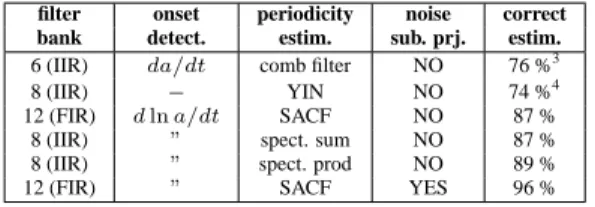
algorithm is labeled as correct if it disagrees less than 5% from the manually annotated tempo (T ), i.e., 0.95 α T < Te< 1.05 α T with α ∈ {12, 1, 2}. Table 1 summarizes the
filter onset periodicity noise correct
bank detect. estim. sub. prj. estim.
6 (IIR) da/dt comb filter NO 76 %3
8 (IIR) − YIN NO 74 %4
12 (FIR) d ln a/dt SACF NO 87 % 8 (IIR) ” spect. sum NO 87 % 8 (IIR) ” spect. prod NO 89 % 12 (FIR) ” SACF YES 96 %
Table 1: Tempo estimation performances.
results obtained using our implementation of Scheirer [1], Paulus [4], three other methods presented in [12] and finally our new method. The spectral sumS(ejωn) and the spectral productΓ(ejωn) of a given signal y(t) are given by Eq. (4) and Eq. (5) respectively, whereY (ejωn) stands for the DFT ofy(t). S(ejωn) = N X l=1 |Y (ejlωn)|2 for ω n < π N (4) Γ(ejωn ) = N Y l=1 |Y (ejlωn )|2 for ωn < π N (5)
Although the database used for testing our method has a rather limited size, simulation results indicate that it out-performs the previously mentioned algorithms. It must be pointed out that all simulations were computed using the same set of parameters. The minimal size of the analysis window (W ) to achieve a success score of 96% is 6 seconds.
Lower window size values reduce the system’s performance for rhythmically complex signals, even though for strong beat pieces it makes no difference. The algorithm failed in 2 out of 54 excerpts, one of them is a classical music excerpt and the tempo found differed by 5.8% from the estimated one. In the second case, transients were properly detected, but the estimated tempo was erroneous because of the tem-poral irregularity of the onsets. During the harmonic/noise decomposition stage, several values for the numbern of
ex-tracted sinusoids per subband were carefully tested andn
was finally set to 5. If too many sinusoidal components
are extracted, the analyzed signal is whitened and it is no longer possible to detect the attacks. If too few sinusoids are used, signal attacks are not enhanced, making onset de-tection more difficult. For the harmonic/noise analysis, the observation window (L) was set to 300 samples, which
ap-proximately corresponds to 19ms.
5. CONCLUSIONS
In this paper we have presented a new tempo estimation al-gorithm based on the harmonic/noise decomposition using
3Our implementation of Scheirer’s method. 4Our implementation of Paulus’ method.
noise subspace projections. Beat detection is carried out in the noise component of the signal via subband decomposi-tion and bandwise periodicity detecdecomposi-tion. The performance of the proposed system was tested using 54 musical excerpts from several musical genres. The rate of success for tempo estimation was 96%. Future work will include an evaluation of this method using a larger database, a window size which adapts to the rhythmic complexity, and an adaptive estima-tion of the number of sinusoids. A real-time implementaestima-tion is being considered.
6. REFERENCES
[1] Scheirer, E. D., ”Tempo and Beat Analysis of Acoustic Music Signals”, JASA, Vol. 103: 588–601, Jan. 1998. [2] Laroche, J., ”Estimating Tempo, Swing, and Beat
Locations in Audio Recordings”, WASPAA’01, New York, USA, Oct. 2001.
[3] Goto, M., Muraoka, Y., ”Real-time Rhythm Track-ing for Drumless Audio Signals”, In Proc. of the IJ-CAI’97, 1997.
[4] Paulus, J., Klapuri, A.,”Measuring The Similarity of Rhythmic Patterns”, ISMIR’02, 3rd Int. Conf. on Mu-sic Information Retrieval, Paris, France, Oct. 2002. [5] Sepp¨anen, J. ”Tatum Grid Analysis of Musical
Sig-nals”, WASPAA’01, New York, USA, Oct. 2001. [6] Klapuri, A., ”Sound Onset Detection by Applying
Psychoacoustic Knowledge”. Proc. ICASSP’99, Ari-zona, USA, Mar. 1999.
[7] Cheveign´e, A. Kawahara, H., ”YIN, a Fundamental Frequency Estimator for Speech and Music”, JASA, Vol. 111: No. 4, Apr. 2002.
[8] Meddis, R., O’Mard, L., ”A Unitary Model of Pitch Perception”, JASA, Vol. 102, Sept. 1997.
[9] Badeau, R., Boyer, R., David, B., ”EDS parametric modeling and tracking of audio signals”, Proc. DAFx-02, Hamburg, Germany, Sept. 2002.
[10] Keiler, F., Marchand, S., ”Survey on extraction of si-nusoids in stationary sounds”, Proc. DAFx-02, Ham-burg, Germany, Sept. 2002.
[11] Badeau, R., Richard, G., David, B., Abed-Meraim, K., ”Approximated power iterations for fast subspace tracking”, Proc. ICASSP’03, Apr. 2003.
[12] Alonso, M., David, B., Richard, G., ”A Study of Tempo Tracking Algorithms from Polyphonic Music Signals”. 4th COST 276 Workshop, France, Mar 2003.