HAL Id: hal-00403154
https://hal.archives-ouvertes.fr/hal-00403154
Submitted on 9 Jul 2009HAL is a multi-disciplinary open access archive for the deposit and dissemination of sci-entific research documents, whether they are
pub-L’archive ouverte pluridisciplinaire HAL, est destinée au dépôt et à la diffusion de documents scientifiques de niveau recherche, publiés ou non,
Exact Calculation of Optimal Filter in Hidden Markov
Switching Long-Memory Chain
Wojciech Pieczynski
To cite this version:
Wojciech Pieczynski. Exact Calculation of Optimal Filter in Hidden Markov Switching Long-Memory Chain. International Conference on Mathematics and Statistics (ICMS 2009), Jun 2008, Athènes, Greece. pp.1-10. �hal-00403154�
Exact Calculation of Optimal Filters in Hidden Markov
Switching Long-Memory Chain
Draft version: June 2009
Wojciech Pieczynski Telecom SudParis, Dept CITI, 8, rue Charles Fourier, 91 000 Evry, France E-mail: [email protected]
http://www-public.it-sudparis.eu/~pieczyn/
Abstract
This paper considers the problem of continuous state estimation in the presence of random switches. There are three random chains X1N =(X1,...,XN),
) ..., , ( 1 1 N N R R
R = , and Y1N =(Y1,...,YN). The random variables X , i Y , and i R i
take their values from R , q R , and m S =
{
1,...,s}
, respectively. Y1N is observed,N
X1 and R1N are hidden, and the problem is to estimate (R1N,X1N) from Y1N. In the classical probabilistic models R1N is Markovian, X1N is linear Markovian conditionally on R1N, and (Y1,...,YN) are independent conditionally on (R1N,X1N). Neither exact filtering nor smoothing is possible with polynomial complexity in time in such models and the different research works mainly concern different approximate algorithms. More recently, another class of models, in which exact filtering and smoothing with polynomial complexity in time are feasible, has been proposed. In the latter models the distribution of the triplet (X1N,R1N,Y1N) is defined by a Markov distribution of (R1N,X1N), and then X1N is assumed to be linear Markovian conditionally on (R1N,Y1N). Subsequently, two extensions of these models have been specified. In the first one, the Markovianity of (R1N,Y1N) is extended to the « partial » Markovianity, in which (R1N,Y1N) is Markovian with respect to R1N, but may not be with respect to Y1N. In the second one, (R1N,Y1N) remains Markovian and X1N is assumed to be linear conditionally on (R1N,Y1N), but is not assumed Markovian. The aim of this paper is to propose a family of models admitting both these extensions simultaneously. In the new models proposed the distribution of Y1N conditional on R1N can be of the « long dependence » kind, and it is the same for the distribution of X1N conditional on (R1N,Y1N). We show that the Kalman-like exact filtering remains feasible with polynomial complexity in time in the new models models.
1. Introduction
Let us consider X1N =(X1,...,XN) and Y1N =(Y1,...,YN) two sequences of random vectors, and let R1N =(R1,...,RN) be a finite-values random chain. Each X takes n
its values from R , while q n
Y takes its values from R . The sequences m XN
1 and
N
R1 are hidden and the sequence Y1N is observed. For each n=1, …, N , we will set x1n =(x1,...,xn),y1n =(y1,...,yn), and r1n =(r1,...,rn). We deal with the problem of filtering, which consists of the computation, for each n=1, …, N , of the conditional expectation E[XnY1n = y1n]. To simplify, we will set
= = ] [ 1n 1n nY y X E [ 1n] n y X
E . As is well known, this conditional expectation is the
optimal estimation of X from n Y1n, when the squared error is concerned. This expectation can be considered – which will be done in this paper - as given by the distribution ( 1n)
n y
r
p , which is the distribution of R conditional on n Yn yn
1
1 = , and
by the conditional expectation [ , 1n 1n]
n n n R r Y y X E = = , denoted by [ , 1n] n nr y X E . We have = ] [Xn y1n E [ , 1] (n 1n) r n n nr y p r y X E n
∑
(1.1)Finally, the problem considered is to compute ( 1) 1 1 + + n n y r p and [ , 1] 1 1 1 + + + n n n r y X E from ( 1n) n y r p and [ , 1n] n nr y X
E . The most classical model to define the
distribution of the triplet T1N =(X1N,R1N,Y1N), in use for about thirty years, is the so-called “conditionally Gaussian state-space linear model” (CGSSLM), which consists of considering that R1N is a Markov chain and, roughly speaking,
) ,
(X1N Y1N is the classical linear system conditionally on R1N. This is summarized in the following: N R1 is a Markov chain; (1.2) n n n n n n n F R X G R W X +1 = ( ) + ( ) ; (1.3) n n n n n n n H R X J R Z Y = ( ) + ( ) , (1.4)
where X1, W1, …, W are independent (conditionally on N R1N) Gaussian vectors in R , q Z1, …, Z are independent (conditionally on N R1N) Gaussian vectors in
m
R , F1(R1), …, FN(RN), G1(R1), …, GN(RN) are matrices of size q×q
depending on switches, and H1(R1), …, HN(RN), J1(R1), …, JN(RN) are matrices of size q×m also depending on switches. Therefore the classical
Kalman filter can be used when R1N =r1N is known; however, it has been well known since the publication of (Tugnait, 1982) that the exact computation of neither E[Xnrn,y1n] nor E[Xnrn,y1N] is feasible with linear - or even polynomial - complexity in time in such models when R1N is not known. The difficulty comes from the fact that conditional probabilities p(yn+1 y1n) are not computable with a reasonable complexity. This is a constant problem in all the classical models and the very reason for this is the fact that in the classical model (1.2)-(1.4) the couple
) ,
(R1N Y1N is not Markovian. Then different approximations have to be used and a rich bibliography on the classical methods concerning the subject can be seen in recent books (Costa et al. 2005, Ristic et al. 2004, Cappe et al. 2005,), among others. Roughly speaking, there are two families of approximating methods: the stochastic ones, based on the Monte Carlo Markov Chains (MCMC) principle (Doucet et al. 2001, Andrieu et al. 2003, Cappe et al. 2005, Giordani et al. 2007), among others, and deterministic ones (Costa et al. 2005, Zoeter et al. 2006), among others. Further recent results concerning different applications of these models and related approximation methods can be seen in recent works (Germani
et al., 2006; Ho & Chen, 2006; Kim et al., 2007; Lee & Dullerud 2007; Zhou and
Shumway 2008; Johnson and Sakoulis 2008; Orguner & Demirekler 2008), among others.
To remedy this impossibility of exact computation, different models have been proposed since 2008. Two of them, proposed in (Abbassi and Pieczynski 2008, Pieczynski 2008), are based on the following two general assumptions: (i) R1N is a Markov – or a semi-Markov chain, the difference being of little importance here ; (ii) X1N and Y1N are independent conditionally on R1N. As (R1N,Y1N) is Markovian in the proposed models, the conditional ditributions ( 1 1n)
n y
y
p + are
computable, which implies that the exact filtering and smoothing are also. Further, prediction is workable (Bardel and Desbouvries 2009). More sophisticated models, in which the hypothesis (ii) is relaxed but the possibility of exact filtering remains were proposed in (Pieczynski 2009a; Pieczynski and Desbouvries 2009). In the latter models, the Markovianity of (R1N,Y1N) is kept, which still allows exact filtering and exact smoothing with complexity linear in time to be performed. Subsequently, based on the recent model proposed in (Lanchantin et al. 2008), two extensions to “partially” Markov models, which can include the “long-memory” ones (Beran and Taqqu 1994; Doukhan et al. 2003), have been introduced. In the first one the Markovianity of (R1N,Y1N) has been relaxed and replaced by the “partial” Markovianity, in which (R1N,Y1N) is Markovian with respect to RN
1 but is not necessarily Markovian with respect to
N
Y1 (Pieczynski et al. 2009). In the second one, the distribution of the state chain
N
X1 conditional on (R1N,Y1N) remains linear but is no longer necessarily Markovian (Pieczynski 2009b).
The aim of the present paper is to consider both the latter extensions simultaneously. Roughly speaking, we propose a general model in which
although neither p(y1N r1N,x1N) nor ( , ) 1 1 1 N N N r y x
p are Markovian, the filtering can
be performed with complexity polynomial in time.
The new model is proposed and discussed in the next section, and the exact computation of smoothing is described in the third one. The fourth section contains some conclusions and perspectives.
2. Conditionally Markov switching linear chain (CMSLC)
Let (X1N,R1N,Y1N) be the triplet of random sequences as specified above. The distribution of the couple (R1N,Y1N) will be assumed to be a “pairwise partially Markov chain” (PPMC) distribution recently introduced in (Lanchantin et al.
2008). The distribution p(r1N,y1N) of a PPMC ( , ) 1 1 N N Y R can be defined by ) , (r1 y1
p and the transitions p(rn+1,yn+1r1n,y1n) verifying
) , , ( ) , , ( 1 1 1 1 1 1 1n n n n n n n n y r y p r y r y r p + + = + + . (2.1)
Such a law is called “partially” Markovian as it can be seen as being Markovian with respect to the variables RN
1 , but being not necessarily Markovian with respect to the variables YN
1 .
Definition 1
A triplet (X1N,R1N,Y1N) will be said to be a “conditionally Markov switching linear chain” (CMSLC) if it verifies
) ,
(R1N Y1N is a PPMC ; (2.2)
for n=1, …, N−1, Xn+1 =Fn+1(Rn+1,Yn+1)X1n+Gn+1(Rn+1,Yn+1)Wn+1 , (2.3) with Fn+1(rn+1,yn+1)=[F1n+1(rn+1,yn+1),F2n+1(rn+1,yn+1),...,Fnn+1(rn+1,yn+1)], where for each i=1, …, n, Fin+1(rn+1,yn+1) is a matrix of size q×q depending on
) ,
(rn+1 yn+1 , Gn+1(rn+1,yn+1) is a matrix of size q×q depending on (rn+1,yn+1), and 1
X , W1, …, WN are independent centred vectors in Rq such that each n
W is independent of (R1N,Y1N).
Let us point out the following aspects of the model (2.2)-(2.3), underlying its differences with the classical ones:
(a) the model (2.2)-(2.3) is said to be “conditionally Markov switching” because the switching process RN
1 is Markovian conditionally on
N
Y1 ; however, it does not need to be Markovian according to its own distribution (without conditioning upon YN
1 ). We may recall that such models are richer and more efficient that the classical hidden Markov chains in which RN
1 is Markovian (Derrode and Pieczynski 2004, Pieczynski 2007);
(b) similarly, the model is said to be “conditionally linear” because XN
1 is linear conditionally on (R1N,Y1N); however, contrary to the classical models, it is not necessarily linear according to its own distribution (without conditioning upon (R1N,Y1N));
(c) the distribution of YN
1 conditional on ( 1 , 1 )
N N R
X is a very complex one,
while it is, in general, very simple in the classical models. However, this additional complexity enriches the model and does not interfere in the computations of interest;
(d) the Gaussianity is not needed, either at the X1N distribution level or at the
N
Y1 one.
We see that in “CMSLC” the word “conditionally” concerns the Markovianity of
N
R1 as well as the linearity of X1N.
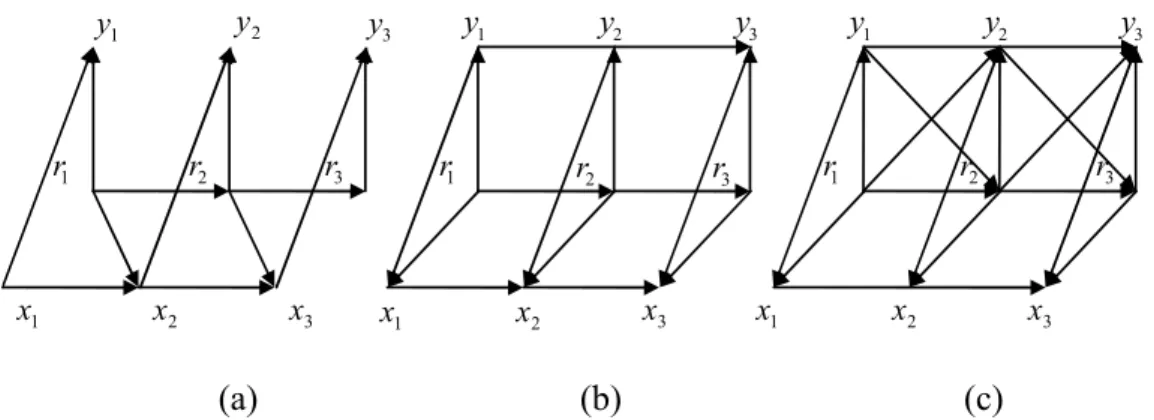
The oriented dependence graphs of the classical models, the long-memory models proposed in (Pieczynski et al., 2009), and the CMSLC proposed in the present paper are presented in Figure 1.
1 r r2 r3 1 r r2 r3 1 x x2 x3 x1 x2 x3 x3 1 r r2 r3 1 x x2 1 y y2 y3 2 y y1 y2 y3 1 y y3 (a) (b) (c) Figure 1: Depen Figure 1: DepenFigure 1: Depen
Figure 1: Dependence oriented graphs of: (a) classical model; (bdence oriented graphs of: (a) classical model; (bdence oriented graphs of: (a) classical model; (b) dence oriented graphs of: (a) classical model; (b) ) recent long) recent longrecent longrecent long----memory model; (c) new c
memory model; (c) new c memory model; (c) new c
memory model; (c) new conditionally Markov switconditionally Markov switconditionally Markov switconditionally Markov switchhhhing linear chaining linear chaining linear chaining linear chain ( ( ( (CMSLCCMSLCCMSLC)))) CMSLC model.
model. model. model.
3. Filtering withCMSLC
In the following, we assume that p(rn+1,yn+1rn,y1n) are given in a closed form. The main property of the CMSLC model is that p(yn+1 y1n) is linked to p(rn y1n) by
∑ ∑
+ + + + = 1 ) , , ( ) ( ) ( 1 1 1 1 1 1 n n r r n n n n n n n n y p r y p r y r y y p , (2.4)which comes from the fact that (R1N,Y1N) is a PPMC. Thus p(y2 y11), …, )
(yn 1y1n
p + are computable with complexity linear in time. This is the key point
because the lack of the computability of p(rn y1n) with complexity linear in times is the very reason for the impossibility of exact filtering in classical models. We can state the following result:
Lemma
Let us consider a CMSLC (X1N,R1N,Y1N). Then we have:
(i) p(rn+1 y1n+1) is given from p(rn y1n) by
) , , ( ) ( ) ( 1 ) ( 1 1 1 1 1 1 1 1 1 n n n n r n n n n n n p r y p r y r y y y p y r p n + + + + + =
∑
; (2.5)(ii) for n=1, …, N −1, and i=1, …, n, the distribution p(xirn+1,y1n+1) is given from the distribution p(xi rn,y1n) by
= + +, ) (xirn 1 y1n1 p ) ( ) ( ) , ( ) , , ( ) ( 1 1 1 1 1 1 1 1 1 1 + + + + +
∑
n n n n n n i n n n n r n n y r p y y p y r x p y r y r p y r p n , (2.7) where ( 1) 1 1 + + n n y rp is computable with (2.5) and ( 1, 1 , 1n)
n n n y r y r p + + are given. Proof
(i) is given by the following classical computation:
= + + ) (rn 1 y1n 1 p
∑
+ + = n r n n n r y r p( 1, 1 1)∑
+ + + rn n n n n n n y y r r p y y p( ) ( , , ) 1 1 1 1 1 1 , which) ( ) , , , ( 1 1 1 1n n n n n n n r y r y p r y r p + + = ( 1, 1 , 1n) n n n y r y r p + + ;
to show (ii), we can write:
= + +, ) (xirn 1 y1n1 p = + + + + ) , ( ) , , ( 1 1 1 1 1 1 n n n n n n i y y r p y y r x p = + + + + + ) ( ) ( ) , , ( 1 1 1 1 1 1 1 1 n n n n n n n i y r p y y p y y r x p =
∑
+ + + + + n r n n n n n n n n i y r p y y p y y r r x p ) ( ) ( ) , , , ( 1 1 1 1 1 1 1 1∑
+ + + + + n r n n n n n n i n n n n i y r p y y p y r x y r p y r x p ) ( ) ( ) , , , ( ) , ( 1 1 1 1 1 1 1 1 1 .Knowing that according to the model we have p(rn+1,yn+1xi,rn,y1n)= ) , , ( 1 1 1n n n n y r y r p + + , it gives = + +, ) (xirn 1 y1n1 p
∑
+ + + + + n r n n n n n n n n n n i n n y r p y y p y r y r p y r x p y r p ) ( ) ( ) , , ( ) , ( ) ( 1 1 1 1 1 1 1 1 1 1 ,which is (2.7) and ends the proof.
Proposition
Let us consider a CMSLC (X1N,R1N,Y1N). Then for n=1, …, N −1, and i=1, …, n, E[Xirn+1,y1n+1] is given from E[Xirn,y1n] by = + + , ] [ 1 1 1 n n ir y X E ) ( ) ( ] , [ ) , , ( ) ( 1 1 1 1 1 1 1 1 1 1 + + + + +
∑
n n n n n n i n n n n r n n y r p y y p y r X E y r y r p y r p n , (2.8)and E[Xn+1rn+1,y1n+1] is given from E[X1rn+1,y1n+1], …, E[Xn rn+1,y1n+1] by
= + + + , ] [Xn 1rn1 y1n 1 E ( 1, 1) [ 1, 1 1] 1 1 + + + + = +
∑
n n i n n n i n i r y E X r y F (2.9) Proof(2.8) is a direct consequence of (2.7). To show (2.9), let us take the expectation of (2.3) conditional on (Rn+1,Yn+1)=(rn+1,yn+1). As the randomn variables G1,
…, GN−1 are centred, we have E[Xn+1rn+1,y1n+1]=
] , [ ) , ( 1 1 1 1 1 1 1 + + + + = +
∑
n n i n n n i n i r y E X r y4. Conclusions and perspectives
We presented a “Conditionally Markov switching linear chain” (CMSLC) model (X1N,R1N,Y1N), in which both hidden switches process R1N and hidden states process X1N can be recovered from the observed process Y1N by a Kalman-like filtering with complexity polynomial in time. None of the distributions p(x1N r1N,y1N), p(y1N r1N,x1N) needs to be Markovian, and can be, in particular, of the “long-memory” kind.
Tackling the parameter problem in such models, using the general “Expectation-Maximization” (EM) principle (McLachlan and Khrishnan 1996) or the general “Iterative Conditional Estimation” (ICE) principle (Derrode and Pieczynski 2004), is undoubtedly among the most important perspectives.
References
Abbassi, N. and Pieczynski, W. (2008). “Exact filtering in semi-Markov jumping system.” Paper presented at the Sixth International Conference of Computational Methods in Sciences and Engineering, September 25-30, Hersonissos, Crete, Greece.
Andrieu, C., Davy, C. M., and Doucet, A. (2003). “Efficient particle filtering for jump Markov systems. Application to time-varying autoregressions.” IEEE
Trans on Signal Processing, 51(7): 1762-1770.
Bardel, N. and Desbouvries, F. (2009). “Exact Bayesian Prediction in non-Gaussian Markov-Switching Model.” Paper presented at the XIIIth International Conference on Applied Stochastic Models and Data Analysis (ASDMDA), Vilnius, Lithuania, June 30-July 3.
Beran J. and Taqqu M. S. (1994). “Statistics for Long-Memory processes.” Monographs on Statistics and Applied Probability, Chapman and Hall, New York.
Cappé, O., Moulines E., and Ryden T. 2005. Inference in hidden Markov
models, Springer.
Costa, O. L. V., Fragoso, M. D., and Marques, R. P. (2005). “Discrete time
Markov jump linear systems.” New York, Springer-Verlag.
Derrode S. and Pieczynski W. (2004). “Signal and Image Segmentation using Pairwise Markov Chains.” IEEE Trans. on Signal Processing, 52(9): 2477-2489.
Doucet, A., Gordon, N. J. and Krishnamurthy, V. (2001). “Particle filters for state estimation of Jump Markov Linear Systems.” IEEE Trans. on Signal
Doukhan P., Oppenheim G., and Taqqu M. S. (2003). “Long-Range
Dependence.” Birkhauser.
Germani, A. Manes, C., and Palumbo, P. (2006). “Filtering for bimodal systems: the case of unknown switching statistics.” IEEE Trans. on Circuits
and Systems, 53(6): 393-404.
Giordani P., Kohn R., and van Dijk, D. (2007). “A unified approach to nonlinearity, structural change, and outliers.” Journal of Econometrics, 137: 112-133.
Ho, T.-J. and Chen, B.-S. (2006). “Novel extended Viterbi-based multiple-model algorithms for state estimation of discrete-time systems with Markov jump parameters.” IEEE Trans. on Signal Processing, 54(2): 393-404.
Johnson, L. D. and Sakoulis, G. (2008). “Maximizing equity market sector predictability in a Bayesian time-varying parameter model.” Computational
Statistics & Data Analysis, 52(6): 3083-3106.
Kim, C.-J., Piger, J. and Starz, R. (2007). “Estimation of Markov regime-switching regression models with endogenous regime-switching.” Journal of
Econometrics, 143: 263-273.
Lanchantin, P., Lapuyade-Lahorgue, J., and Pieczynski, W. (2008). “Unsupervised segmentation of triplet Markov chains hidden with long-memory noise.” Signal Processing, 88(5): 1134-1151.
Lee, J.-W. and Dullerud, G. E. (2007). “A stability and contractiveness analysis of discrete-time Markovian jump linear systems.” Automatica, 43: 168-173. McLachlan, G. J. and Khrishnan, T. (1996). ”The EM algorithm and
extensions”. Wiley series in Probability and Statistics, Wiley Interscience.
Orguner, U. and Demirekler, M. (2008). “Risk-sensitive filtering for jump Markov linear systems.“ Automatica, 44: 109-118.
Pieczynski, W. (2007). “Multisensor triplet Markov chains and theory of evidence.” International Journal of Approximate Reasoning, 45(1): 1-16. Pieczynski, W. (2008). “Exact calculation of optimal filter in semi-Markov switching model.” Paper presented at the Fourth World Conference of the International Association for Statistical Computing (IASC 2008), December 5-8, Yokohama, Japan.
Pieczynski, W., Abbassi, N., and Ben Mabrouk, M. (2009) “Exact filtering and smoothing of Markov switching linear system hidden with Gaussian long-memory Noise.” Paper presented at the XIII International Conference Applied
Stochastic Models and Data Analysis, (ASMDA 2009), June 30- July 3, Vilnius, Lithuania.
Pieczynski, W. (2009a). “Exact filtering in Markov marginal switching hidden models.” Submitted to Comptes Rendus Mathématique.
Pieczynski, W. (2009b). ”Exact smoothing in hidden conditionally Markov switching chains.” Paper presented at the XIII International Conference Applied Stochastic Models and Data Analysis, (ASMDA 2009), June 30- July 3, Vilnius, Lithuania.
Pieczynski, W. and Desbouvries, F. (2009). ”Exact Bayesian smoothing in triplet switching Markov chains.” Paper presented at the conference “Complex data modeling and computationally intensive statistical methods for estimation and prediction” (S. Co 2009), September 14-16, Milan, Italy.
Ristic, B. Arulampalam, S. and Gordon, N. (2004). “Beyond the Kalman Filter
- Particle filters for tracking applications.” Artech House, Boston, USA.
Tugnait, J. K. (1982). “Adaptive estimation and identification for discrete systems with Markov jump parameters.” IEEE Trans. on Automatic Control, AC-25: 1054-1065.
Zhou, T. N. and Shumway, R. (2008). “One-step approximations for detecting regime changes in the state space model with application to the influenza data.”
Computational Statistics & Data Analysis, 52(5): 2277-2291.
Zoeter, O. and Heskes, T. (2006). “Deterministic approximate inference techniques for conditionally Gaussian state space models.” Statistical