HAL Id: inria-00587148
https://hal.inria.fr/inria-00587148
Submitted on 19 Apr 2011
HAL is a multi-disciplinary open access
archive for the deposit and dissemination of
sci-entific research documents, whether they are
pub-lished or not. The documents may come from
teaching and research institutions in France or
abroad, or from public or private research centers.
L’archive ouverte pluridisciplinaire HAL, est
destinée au dépôt et à la diffusion de documents
scientifiques de niveau recherche, publiés ou non,
émanant des établissements d’enseignement et de
recherche français ou étrangers, des laboratoires
publics ou privés.
Fair Uplink Scheduling for rtPS traffic in IEEE 802.16
Broadband Wireless Systems
Zeeshan Ahmed, Salima Hamma
To cite this version:
Zeeshan Ahmed, Salima Hamma. Fair Uplink Scheduling for rtPS traffic in IEEE 802.16 Broadband
Wireless Systems. CFIP 2011 - Colloque Francophone sur l Ingénierie des Protocoles, UTC, May
2011, Sainte Maxime, France. �inria-00587148�
IEEE 802.16 Broadband Wireless Systems
Zeeshan Ahmed
—Salima Hamma
LUNAM Université, Université de Nantes IRCCyN, CNRS UMR 6597, Polytech0Nantes
rue Christian Pauc, BP 50609 - 44306 Nantes Cedex 3, France {zeeshan.ahmed,salima.hamma}@univ-nantes.fr
ABSTRACT. IEEE 802.16 standard provides a revolutionary air interface that enables very high data rates over large distances. It is also one of the leading candidates to become the official standard of next generation of cellular networks. It incorporates a Quality of Service (QoS) framework to ensure satisfactory transmission of different classes of traffic. However, the actual implementation of QoS mechanisms is not defined in the standard and left out for vendors. One of the five different classes of services supported by the standard is real-time polling service (rtPS). Scheduling rtPS traffic is the trickiest because of its bursty nature and tight delay constraints. In this article, we provide an algorithm for fair scheduling of rtPS traffic in uplink direction. The proposed algorithm is simple and efficient and therefore it is suitable for high speed data networks. Simulation results are provided to show that the algorithm is fair and efficient.
RÉSUMÉ. Le standard IEEE 802.16 offre une interface radio révolutionnaire qui permet des débits très élevés sur des grandes distances. Il est également l’un des principaux candidats pour devenir le standard officiel de la prochaine génération de réseaux mobiles. Il intègre un framework de qualité de service (QoS) pour assurer une transmission satisfaisante des différentes classes de trafic. Néanmoins, la mise en œuvre effective des mécanismes de QoS n’est pas définie dans la norme IEEE 802.16 et laissé à la libre appréciation des construteurs. L’une des cinq classes différentes de services pris en charge par le standard est le real-time polling service (rtPS). La planification du trafic rtPS est la plus délicate en raison de sa nature sporadique et des contraintes de délai serré. Dans cet article, nous proposons un algorithme pour la planification équitable de rtPS pour la liaison montante. L’algorithme proposé est simple et efficace et il est donc approprié pour le cas des réseaux à grande vitesse. Les résultats de simulation apportés dans ce papier montrent que l’algorithme répond au problème posé tout en êtant efficace.
KEY WORDS: IEEE 802.16, WiMAX, QoS, rtPS, scheduling
2 CFIP 2011.
1. Introduction
The advancements in the Internet and mobile communication has resulted in a tremendous growth in the number of users who use these services. There is also a continuous trend of increased usage of multimedia services, such as IPTv, video conferencing, VoIP etc. These applications require huge re-sources and put enormous burden on network infrastructure. In fact, current cellular networks would not be able to cope up with the increasing demand within next few years [WiM 08]. Therefore, there is a need of faster and more reliable networks to support the future applications. Furthermore, to maintain an acceptable level of service, a network must also be able treat applications according to their priorities. In this regard IEEE 802.16 [IEE 06] (WiMAX) is an ideal choice. It offers very high data rates over large distances. Moreover, it incorporates a well-defined QoS framework. It supports five classes of services: (i) Unsolicited Grant Service (UGS) (ii) Extended Real-Time Polling Ser-vice (ertPS) (iii) Real-Time Polling SerSer-vice (rtPS) (iv) Non-Real-Time Polling SerSer-vice (nrtPS) (v) Best Effort (BE) Service.
Scheduling is an essential element of any QoS architecture. The complex task of scheduling is performed by three schedulers in WiMAX i.e. Base Station (BS) downlink scheduler, BS uplink scheduler and Subscriber Station (SS) scheduler. The functions of these schedulers are defined, however the details are not defined in the standard and left out for vendors [TAL 08]. The most complex task is performed by the BS uplink scheduler as it does not have complete view of queues that are maintained at SSs. Furthermore, scheduling rtPS traffic is the trickiest because of its bursty nature and tight delay constraints. The article provides an algorithm for the BS uplink scheduler to fairly schedule rtPS traffic.
2. Methodology
Firstly, we present the terminology that is important to understand the rest of the article. (i) rmin
i : minimum reserved traffic rate for connection (MRTR) i (ii) rimax: maximum sustained
traffic rate for connection i (iii) di: delay limit for connection i (number of uplink frames) (iv) bwi:
bandwidth requested by connection i in current frame (v) n : number of rtPS connections admitted (vi) dmax: max(di), where i = 1, 2, ...n (vii) bwT able : an n × dmaxtable (viii) f : current uplink
frame (ix) rf : unused bandwidth in frame f (x) SRi : service ratio for connection i (xi) SR : total
service ratio (xii) ra: total uplink bandwidth available
A new rtPS connection k is admitted by BS only if rmink ≤ ra. It is assumed that a traffic
conditioner is present at the SS that keeps the bandwidth demand always below rmaxk . For each uplink frame the BS allocates bandwidth to connections in increasing order of di, i.e. priority is
given to the connection with the tightest delay constraint. In order to guarantee fairness among rtPS flows Service Ratio is computed for each flow, as shown in Eq. 1. So, a session i is only allow to transmit data if SRi≤ SR. The idea is to guarantee MRTR for each session, while fairly distributing
the available bandwidth among active rtPS flows.
The scheduler keeps an n × dmaxtable, where an entry in jthrow and kthcolumn signifies the
bandwidth allocated to connection j in frame f + k. The table is used by the scheduler to generate UL-MAP. In each round a connection i is only allowed to transmit data if SRi≤ SR. Unlike other
Algorithm 1 The proposed algorithm for i = 1, 2, ...n do if SRi≤ SR and rf ≥ bwithen set bwT able[i][0] = bwi else if rdi≥ bwithen set bwT able[i][di] = bwi end if end for if rf > 0 then reschedule rf from f + 1 to f end if generate UL-MAP
algorithms, a SS needs not to send the sum of backlog as bandwidth request. A SS can simply send the actual new bandwidth demand generated to the BS. This is both simple and efficient. The scheduler tries to allocate bandwidth in the current frame, however if enough space is not available then it allocates the remaining bandwidth in frame f + di.
SRi= f −1
X
t=1
BW allocated to conn i in f rame t
f −1
X
t=1
BW requested by conn i in f rame t
i = 1, 2, ..., n [1]
SR =
f −1
X
t=1
total uplink BW available in f rame t
f −1 X t=1 n X i=1
BW requested by conn i in f rame t
[2]
3. Simulation Results
The performance of the proposed algorithm is evaluated by developing a simulation model. The goal is to accurately determine the bandwidth allocation to each SS. It is assumed that: (1) Packets arrive at start of a frame. (2) There is only rtPS traffic (3) All connections are already admitted. (4) Total uplink bandwidth = 10 Mbps (5) Four rtPS connections with parameter as shown in Table 1. These parameters imply a very heavy load on system as SR ' 50%
4 CFIP 2011.
Connection rmin(kbps) rmax(kbps) Max Delay (frames)
A 4000 9000 2
B 1000 3000 3
C 2000 4000 3
D 3000 5000 4
Table 1. Input traffic parameters
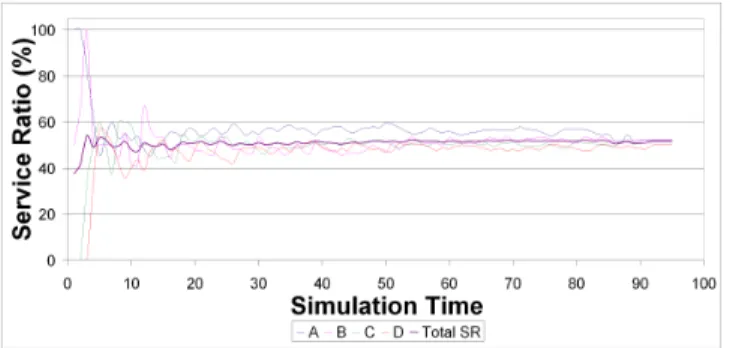
Figure 1 shows the service ratio for each rtPS connection as well as total service ratio SR. It is obvious that service ratios of all rtPS connections adapt and follow SR. Even though the available bandwidth could only provide minimum guaranteed service to each rtPS, the proposed algorithm performed very well and dynamically allocate bandwidth to ensure fairness. In fact, SR is the best a connection can get and all the connections seem to follow SR rather well. Thus it proves that the algorithm is able to fairly allocate maximum possible bandwidth to each admitted rtPS connection.
Figure 1. Service ratio for rtPS connections
4. Conclusion
In this article an algorithm is provided for IEEE 802.16 networks that provides fair uplink scheduling of rtPS traffic. The scheduler is fast, efficient and easy to implement. The simulation results prove that the algorithm is able to fairly allocate maximum possible bandwidth among all admitted rtPS connections.
5. References
[IEE 06] IEEE, “IEEE 802.16-2005, IEEE standard for local and metropolitan area networks - Part 16: Air interface for fixed and mobile broadband wireless access systems amendment for physical and medium access control layers for combined fixed and mobile operation in licensed bands”, February 2006. [TAL 08] TALWALKARR. A., ILYASM., “Analysis of quality of service (QoS) in WiMAX networks”,
De-cember 2008.
[WiM 08] WIMAX FORUM, “Deployment of Mobile WiMAX networks by operators with existing 2G and 3G networks”, March 2008.