
Collaborative Reverse Engineering Design Experiment Using PLM Solutions
Texte intégral
Figure
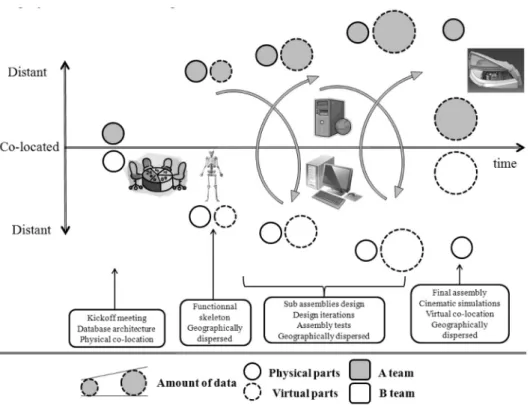
![Fig. 1. Changes in design teams adapted from [1].](https://thumb-eu.123doks.com/thumbv2/123doknet/7279374.207274/3.892.204.690.117.367/fig-changes-in-design-teams-adapted-from.webp)
![Fig. 4.Use percentages for various collaboration tools, comparing Brown’s results [23] with those from our project.](https://thumb-eu.123doks.com/thumbv2/123doknet/7279374.207274/7.892.196.676.121.396/percentages-various-collaboration-tools-comparing-brown-results-project.webp)
![Fig. 5.Collaboration matrix and position of a collaborative distributed design platform, adapted from [25].](https://thumb-eu.123doks.com/thumbv2/123doknet/7279374.207274/8.892.191.701.116.453/collaboration-matrix-position-collaborative-distributed-design-platform-adapted.webp)
Documents relatifs
This initial experiment is now finished, and has enabled us to evaluate the utility of a Web collaborator editing in a real context. We have conducted this experiment to enhance
This is derived mainly from reports by the United States National Commission on the BP Deepwater Horizon Oil Spill and Offshore Drilling (2011) and the United States Coast
Frédéric SEGONDS, Nicolas MARANZANA, Philippe VERON, Améziane AOUSSAT - PLM and design education: a collaborative experiment on a mechanical device - In: Product Lifecycle
In fact, there is also one reference data model, but this one is generic enough to allow any mapping of the different concepts that come from the different
Tables 2, 3, 4 and 5.1 summarize the different approaches used by protocol reverse engineering tools based on network traces. Network inference is mainly based on: 1) sequence
This paper investigates the fundamentals of shape representation, shape processing and mining at a conceptual, geometric and computational level to address
PLM facilitates project monitoring and mature objects sharing PLM supports structuring of new product development process.. PLM relies on content based
Based on an empirical application, the paper describes a methodology for evaluating the impact of PLM tools on design process using BPM techniques. It is a conceptual
