Any correspondence concerning this service should be sent to the repository administrator:
[email protected]
O
pen
A
rchive
T
oulouse
A
rchive
O
uverte (
OATAO
)
OATAO is an open access repository that collects the work of Toulouse researchers
and makes it freely available over the web where possible.
This is an author -deposited version published in:
http://oatao.univ-toulouse.fr/
Eprints ID: 4838
To link to this article: DOI: 10.1049/el.2010.1767
URL:
http://ieeexplore.ieee.org/xpls/abs_all.jsp?arnumber=5585039&tag=1
To cite this version: MARTIN-GONTHIER Philippe, Havard E., Magnan Pierre. Custom
transistor layout design techniques for random telegraph signal noise reduction in CMOS
image sensors. IEEE Electronics Letters, vol. 46, n° 19, pp. 1323 -1324.
Custom transistor layout design techniques
for random telegraph signal noise reduction
in CMOS image sensors
P. Martin-Gonthier, E. Havard and P. Magnan
Interface and near oxide traps in small gate area MOS transistors (gate area ,1 mm2) lead to RTS noise which implies the emergence of noisy pixels in CMOS image sensors. To reduce this noise, two simple and efficient layout techniques of custom transistors have been imagined. These techniques have been successfully implemented in an image sensor test chip fabricated in a 0.35 mm CMOS image sensor process. Experimental results demonstrate a significant reduction of the noisy pixels for the two different techniques.
Introduction: CMOS image sensors are nowadays extensively used in commercial and scientific applications. CMOS standard processes, which are developed for digital and mixed signal applications, are really attractive particularly because of their low power consumption, applicability for on-chip signal processing and large availability. Several ways have been explored to improve image sensor performance to a very high level and performance has been significantly enhanced with the use of CMOS image sensor (CIS) processes[1]. In addition, the use of aggressive technologies and small MOS transistors (gate area ,1 mm2) in the pixel are required in order to maximise the pixel photosensitive area. This leads to an increase of MOS transistor low fre-quency noise impact. The use of correlated double sampling (CDS) cir-cuits and readout mode allows elimination of photodiode reset noise (KTC noise) which is usually the major noise contributor. At the same time, it reveals the random telegraph signal (RTS) noise impact of the in-pixel source follower transistor. This RTS noise becomes an issue for low light sensitivity applications[2].Fig. 1depicts the cumu-lative histogram of the image sensor pixel output noise showing noisy pixels emergence due to in-pixel source follower transistor RTS noise.
4500
distribution tail due to noisy pixels 4000 3500 3000 2500 2000 1500 1000 500 0 1.0 1.5 output noise, V RMS (×10–4) occurence , n u mber of pix els 2.0 2.5 3.0 3.5
Fig. 1 Cumulative histogram of image sensor pixel output noise
RTS noise impact can be reduced by increasing the length and width of the in-pixel source follower transistor[3, 4]. However, this implies an increase of the in-pixel source follower transistor gate capacitance, so also a decrease of the conversion gain value. Thus, this technique leads to a decrease of the image sensor sensitivity. In this Letter, we propose custom transistor layout design techniques in order to minimise the number of noisy pixels by reducing in-pixel source follower transis-tor RTS noise.
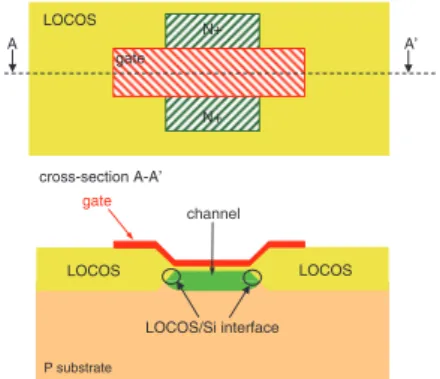
Proposed techniques: Fig. 2 shows the cross-section of a standard NMOS transistor with a local oxidation of silicon (LOCOS) technology. When the transistor is on (weak, moderate and strong inversion), the channel is in contact with the gate oxide but also with the isolation oxide, which is in our case the LOCOS, along the gate length. For shallow trench isolation (STI) technologies, the channel is in contact with STI walls instead of LOCOS. As RTS fluctuations arise from traps located at the silicon and oxide interfaces, a part of these fluctu-ations comes from the silicon and LOCOS interfaces. The principle of our RTS noise reduction techniques is to minimise or eliminate transistor channel areas which are in contact with oxide isolation. The first tech-nique is depicted inFig. 3afor a LOCOS technology. Oxide isolation is recessed from the channel by layout design. Thus, as channel area
in contact with isolation oxide (LOCOS) is eliminated, the probability to have traps at the silicon/oxide interface and in oxide, inducing RTS noise, is reduced. The transistor layout for the second technique is shown inFig. 3b. The goal is to strain current flow in the centre of the channel in order to avoid electron flow near oxide isolation. The gate is enlarged at the silicon and oxide interface. Hence, the channel resistance is lower in the middle of the transistor leading to the fact that current is canalised far away from oxide isolation. This technique minimises the impact of traps located in the silicon and oxide isolation interfaces. gate LOCOS LOCOS channel LOCOS/Si interface gate N+ A’ A cross-section A-A’ P substrate N+ LOCOS
Fig. 2 NMOS transistor cross-section for LOCOS technology
gate LOCOS LOCOS channel P substrate a gate N+ N+ current LOCOS b
Fig. 3 Modified NMOS transistors
a NMOS transistor with recessed oxide technique (type 1)
b NMOS transistor with enlarged gate length near isolation oxide (type 2)
Test image sensor: To verify the performances of the proposed RTS noise reduction techniques, a test image sensor was designed and fabri-cated in a 0.35 mm CIS process (which is a LOCOS technology). Sensor format is 128× 128 pixels with a 13 mm pixel pitch. A three transistors pixel structure is used with a special readout sequence allowing corre-lated double sampling in order to eliminate reset noise. The test sensor is composed of four arrays of 4096 pixels. Three sub-arrays are tested in this Letter. One of these sub-sub-arrays has a standard layout in-pixel source follower transistor and the two others have the proposed modified layout transistors. Gate length is 0.5 mm and gate width is 1.5 mm for the in-pixel source follower transistor. Type 1 and type 2 MOS transistors are defined as the modified transistors depicted
inFigs. 3aandb, respectively.
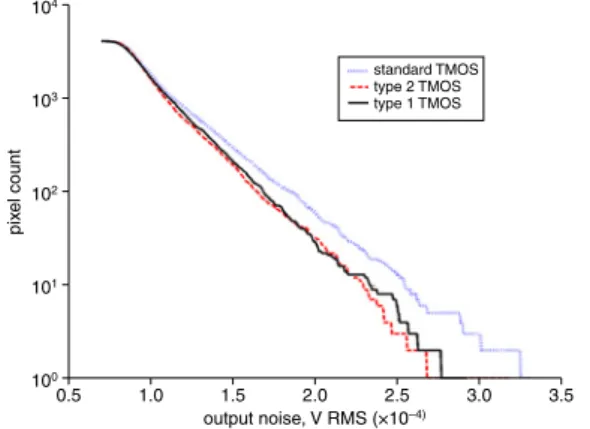
Measurements results: Output noise measurements were performed with an in-pixel source follower transistor current bias of 18 mA. Spatial output noise means for each sub-array, i.e. standard, type 1 and type 2 in-pixel source follower transistors, are 106, 103 and 102 mV RMS. Cumulative histograms, depicted in Fig. 4, represent the pixel output noise distribution of each sub-array. Cumulative histo-grams show noisy pixels which can reach around 330 mV RMS for the standard MOS transistor type and 275 mV RMS for the type 1 and 2 transistors. A significant reduction of noisy pixels is achieved with the modified in-pixel source follower transistors. For example, the number of pixels having an output noise beyond 200 mV RMS is reduced by roughly 30% for the two proposed custom in-pixel source follower transistors.
1.0 0.5 100 101 102 103 104 pix el count 1.5 output noise, V RMS (×10–4) 2.0 2.5 3.0 standard TMOS type 2 TMOS type 1 TMOS 3.5
Fig. 4 Cumulative histogram of pixel output noise distribution for each in-pixel source follower transistor type
Conclusion: Two simple and efficient layout design techniques of custom transistors for random telegraph signal noise reduction in CMOS image sensors are proposed. The in-pixel source follower transis-tors are the major RTS noise contributransis-tors in CMOS image sensors leading to an increase of noisy pixels. In-pixel source follower transis-tors are designed and laid out in order to minimise contact between the transistor channel and isolation oxide. Measurement results performed on a test image sensor fabricated in a 0.35 mm CIS process
confirm that the layout design techniques proposed in this Letter allow a significant reduction of noisy pixels.
#The Institution of Engineering and Technology 2010 29 June 2010
doi: 10.1049/el.2010.1767
One or more of the Figures in this Letter are available in colour online. P. Martin-Gonthier, E. Havard and P. Magnan (DEOS-CIMI Integrated Image Sensor Laboratory, Universite´ de Toulouse, ISAE, 10 avenue E. Belin, Toulouse 31055, France)
E-mail: [email protected] References
1 Furumiya, M., et al.: ‘High sensitivity and no-crosstalk pixel technology for embedded CMOS image sensor’, IEEE Trans. Electron Devices, 2001, 48, (10)
2 Findlater, K.M., Vaillant, J.M., Baxter, D.J., Augier, C., Herault, D., Henderson, R.K., Hurwitz, J.E.D., Grant, L.A., and Volle, J.-M.: ‘Source follower noise limitations in CMOS active pixel sensors’, Detectors and Associated Signal Processing, Proc. SPIE, 2004, 5251, pp. 187 – 195
3 Assaf Lahav, A.F., and Shiwalkar, A.: ‘Optimization of random telegraph noise non uniformity in a CMOS pixel with a pinned-photodiode’. Int. Image Sensor Workshop, Ogunquit, ME, USA, June 2007, pp. 219 – 223 4 Martin-Gonthier, P., and Magnan, P.: ‘RTS noise impact in CMOS image sensors readout circuit’. 16th IEEE Int. Conf. on Electronics, Circuits and Systems, (ICECS2009), Tunisia, December 2009