HAL Id: hal-02521655
https://hal-mines-albi.archives-ouvertes.fr/hal-02521655
Submitted on 27 Mar 2020
HAL is a multi-disciplinary open access
archive for the deposit and dissemination of
sci-entific research documents, whether they are
pub-lished or not. The documents may come from
teaching and research institutions in France or
abroad, or from public or private research centers.
L’archive ouverte pluridisciplinaire HAL, est
destinée au dépôt et à la diffusion de documents
scientifiques de niveau recherche, publiés ou non,
émanant des établissements d’enseignement et de
recherche français ou étrangers, des laboratoires
publics ou privés.
Application of Process Mining Notations
Sina Araghi, Franck Fontanili, Elyes Lamine, Nicolas Salatge, Frederick
Benaben
To cite this version:
Sina Araghi, Franck Fontanili, Elyes Lamine, Nicolas Salatge, Frederick Benaben. Interpretation of
Patients’ Location Data to Support the Application of Process Mining Notations. HEALTHINF 2020
- 13th International Conference on Health Informatics, Feb 2020, La Valette, Malta. pp.472-481,
�10.5220/0008971104720481�. �hal-02521655�
Interpretation of Patients’ Location Data to Support the Application of
Process Mining Notations
Sina Namaki Araghi, Franck Fontanili, Elyes Lamine, Nicolas Salatge and Frederick Benaben
IMT Mines Albi, France
Keywords: Model-driven Engineering, Process Mining, Indoor Localization Systems (ILS), Patient Pathways.
Abstract: The application of indoor localization and process mining emerges as an intriguing tool for the researchers to address the structural issues related to the patient pathways inside healthcare organizations. However, there is a major gap in the literature. This is related to the lack of enough attention to the interpretation of location data. Therefore, as a contribution, this article presents the DIAG meta-model and relevant location data interpretation rules. This model-driven approach has been realized in the context of the R-IOSUITE application and it supports the further analyses by the process mining methods.
1
INTRODUCTION
The so-called ”no-shows” or ”missed appointments“ concept is a costly defect for patients and healthcare organization. According to the article published in (Anisi et al., 2018), the ratio of the missed appoint-ments is about 34 % only in the USA, and each missed appointment costs about 100 $. One of the major causes behind this issue is the structural problems of the healthcare processes.
Recently, the application of Indoor Localiza-tion Systems (ILS) and Process Mining is pro-posed in several research works to address such is-sues and to improve the outcome of patient pathways (Kamel Boulos and Berry, 2012; Martin, 2019; Rojas et al., 2017b; Martinez-Millana et al., 2019).
In line with these applications, this research work highlights a major concern in this area. According to the analysis of the literature provided in this article, most of research works focused on the ”knowledge-extraction” approaches by using location data of the tagged objects. On the other hand, the interpretation of location data or as called here the ”sense-making procedures” are completely ignored.
Therefore, this research work aims to propose a model-driven engineering approach to tackle this is-sue. As a result, the contribution of this article is ori-ented towards the DIAG meta-model which supports the interpretation of the location data that can be performed by two groups of interpretation rules.
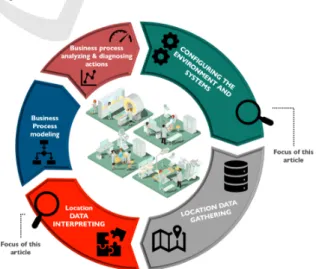
The used methodology in this article is shown in figure 1. This methodology which has been
devel-oped previously in (Namaki Araghi et al., 2018b; Na-maki Araghi et al., 2019) consists of several functions to extract meaningful information by using indoor lo-calization systems in association with process mining. These functions are: configuring the environment and systems, Location data gathering , Location data in-terpreting, Business process modeling, and Business process analyzing and diagnosing. The focus of this paper is mainly on the first and third functions. Within these functions, the contributions of this article pre-pare a solid foundation prior to applying process min-ing notations.
Figure 1: The used approach in this research work.
Consequently, the next section of this article presents the analysis of the literature. The third
sec-472
Araghi, S., Fontanili, F., Lamine, E., Salatge, N. and Benaben, F.
Interpretation of Patients’ Location Data to Support the Application of Process Mining Notations. DOI: 10.5220/0008971104720481
In Proceedings of the 13th International Joint Conference on Biomedical Engineering Systems and Technologies (BIOSTEC 2020), pages 472-481 ISBN: 978-989-758-398-8
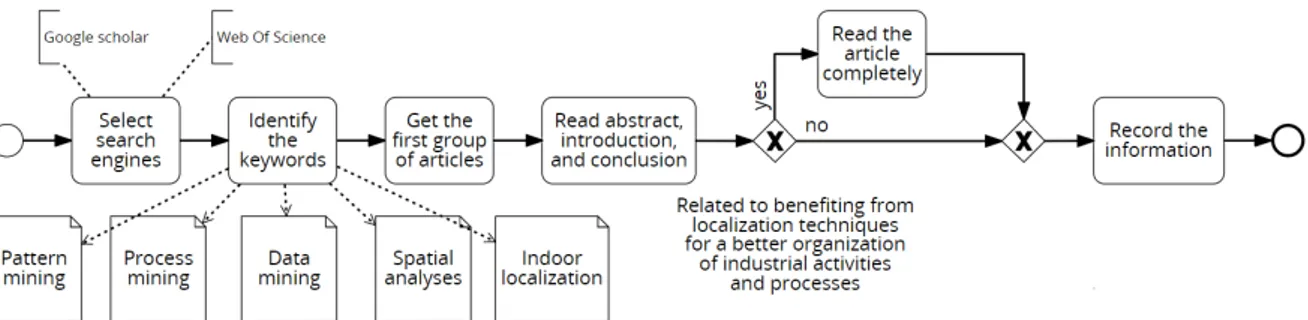
Figure 2: The used approach for analyzing research works related to applying localization techniques for a better organization of processes and activities in different industries.
tion focuses in presenting the DIAG meta-model and the location data interpretation rules. The fourth sec-tion presents a series of experimental results. Finally, the last section concludes the article.
2
BACKGROUND
This section presents a systematic literature and tech-nological review in a five-year (2015- June 2019) pe-riod. The objective for choosing this period was to recognize the recent trends in the field of applying lo-cation data for data and process mining. The main focus here was to analyze the existing works that ad-dressed the trajectory pattern mining regardless of a specific industry. These works were selected due to the nearness of the presented methods to the applied algorithms for discovery of the end-to-end process-like patterns.
Accordingly, Google scholar and Web Of Science were the two search engines used for this purpose. Several keywords were considered such as process mining, location data, indoor location/localization systems. As a result, 42 research works were recorded. We tried to ensure about the proximity of the obtained works to the purposes of this research work. Therefore, by skimming the abstract, conclu-sion and introduction of these works, 31 out of 42 were selected for final literature analysis. Table 1 pro-vides an overview of the cited works. Figure 2 shows the approach for analyzing the literature related to the works that have applied localization techniques.
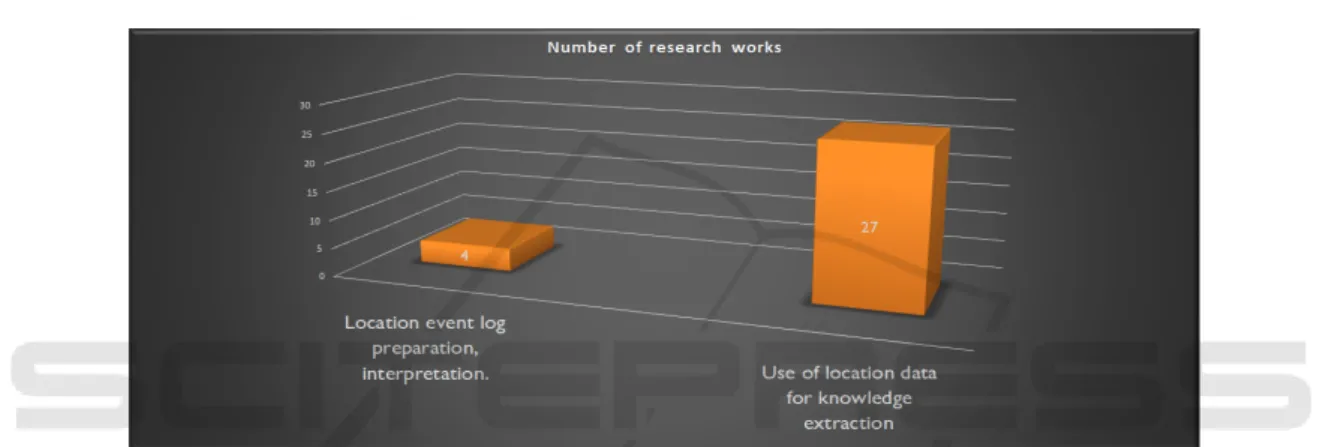
As mentioned previously, the objective was to capture an overall image of the recent trends for us-ing location data in different industries. Notably, two criteria were used; (i) works related to the interpreta-tion of locainterpreta-tion data, and (ii) works which addressed the knowledge-extraction based on location data.
In some cases researchers worked on several of the mentioned criteria. For instance the work in (Senderovich et al., 2016; Wan et al., 2017;
Muza-mmal et al., 2018), it addresses both mining process-like patterns and how to interpret the location data.
According to the presented analysis in figure 3, the recent trend is mainly on the extraction of knowl-edge from location data. On the other hand, despite its importance, the interpretation and preparation of location data were almost completely neglected. The following will present briefly some of the sig-nificant information extracted from these works.
2.1
Preparation and Interpretation of
Location Data
Despite the lack of attention for this notion, several robust works proposed different methods to interpret the location data prior to the knowledge discovery. In (Senderovich et al., 2016) the authors used a so-called interaction mining to transform the real-time location data into standard event logs for enabling process mining activities. The transformation of event streams was according to the defined notion of inter-action. This interaction provides a knowledge layer that links the raw sensor data and process instances.
In (Muzammal et al., 2018), the authors have used the uncertain sensor data and tried to transform these data into probabilistic trajectory data using pre-processing routines. Then, they have used a dynamic agorithmic approach to extract the preferable trajec-tories. Their approach consists of 3 main steps: data cleaning , data compression and finally trajectory mining. The trajectory creation step which generates togetherness pattern, common path pattern and group patterns and cyclic patterns.
The work in (Wan et al., 2017) presents a frame-work for deriving information about people continu-ous activities from their individual GPS data. The au-thors have proposed a framework which includes two major techniques for processing GPS data: (i) a fuzzy classification for differentiating the activity patterns . (ii) a scale- adaptive method for refining the location of activities within outdoor and indoor environments.
Table 1: Cited research works that addressed the knowledge extraction from location data and those which addressed inter-pretation of these data.
Cited research works location event log preparation
and interpretation
(Senderovich et al., 2016; Muzammal et al., 2018; Wan et al., 2017; Namaki Araghi et al., 2018a)
Use of location data for extraction of knowledge
(Hwang and Jang, 2017; Sztyler et al., 2016; Ertek et al., 2017; Mazim-paka and Timpf, 2016), (Rojas et al., 2017a; Zheng, 2015a; Tanuja and Govindarajulu, 2017; Ramos et al., 2017; Garaeva et al., 2017; Bao and Wang, 2017), (Zhenjiang et al., 2017; Aryal and Sujing Wang, 2017; Tanuja and Govindarajulu, 2016; Feng Ling et al., 2016), (Lamr and Skrbek, 2016; Blank et al., 2016; Fernandez-Llatas et al., 2015; Zheng, 2015b), (Liao et al., 2015; Tang et al., 2015; Miclo et al., 2015; Jin et al., 2015; Martinez-Millana et al., 2019), (Dogan et al., 2019; Na-maki Araghi et al., 2019; NaNa-maki Araghi et al., 2018a; NaNa-maki Araghi et al., 2018b; Araghi et al., 2018)
Figure 3: Analysis of the literature of process mining, indoor localization systems, and data mining relevant to the approaches in which the location data were used.
The clustering techniques used in their work helped to classify which activities are occurring. It helped also to detect the outliers and indicated in which positions an activity is being executed.
The next section will highlight how the review of these previous works gave the direction for the pro-posed solutions in this article.
2.2
A Decision based on the Literature
The processing of location data is not only a technical challenge, but it can be seen as a scientific challenge as well. Due to the existing high ambiguity in location data, it is not feasible to extract proper information from event logs. This ambiguity can be caused by the way these data are being registered.
These data are recorded by coordination. They are not representing activities and they only illustrate the positions of tags. Therefore, researchers need to address how one can interpret this type of data. Simply put, the sense-making procedure is miss-ing in the literature. Some researchers insisted on
this important gap, and indicated the need to pro-vide an abstraction of what exists in the location data (Senderovich et al., 2016).
In line with this issue, the next section will focus on presenting the DIAG meta-model and the location data interpretation rules.
3
METHOD
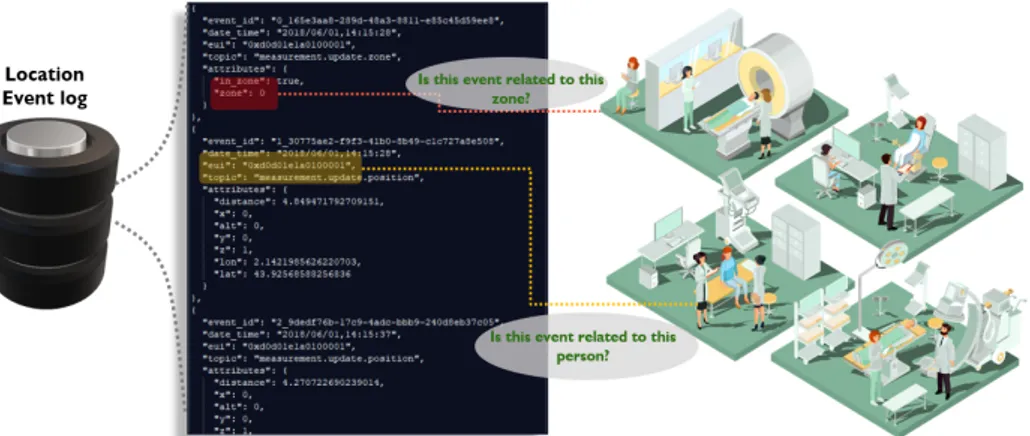
Assume that a location event log similar to the one in figure 4 is given for further analyses. By focusing on such event log, one could observe that the given data is vague. This means it is not clear which recorded information belongs to the patients, which belongs to the healthcare staff, and what is the corresponding ac-tivity. In that, there exist many other blurred informa-tion that should be detected. In fact, there is a con-siderable gap to link the actual concepts in patient— pathways—processes with the registered data in the location event logs. Figure 4 embodies this gap be-HEALTHINF 2020 - 13th International Conference on Health Informatics
Figure 4: Illustrating the need to provide a sense-making procedure for the recorded information in location event logs.
tween raw data and the actual concepts in patient pro-cesses.
3.1
DIAG Meta-model
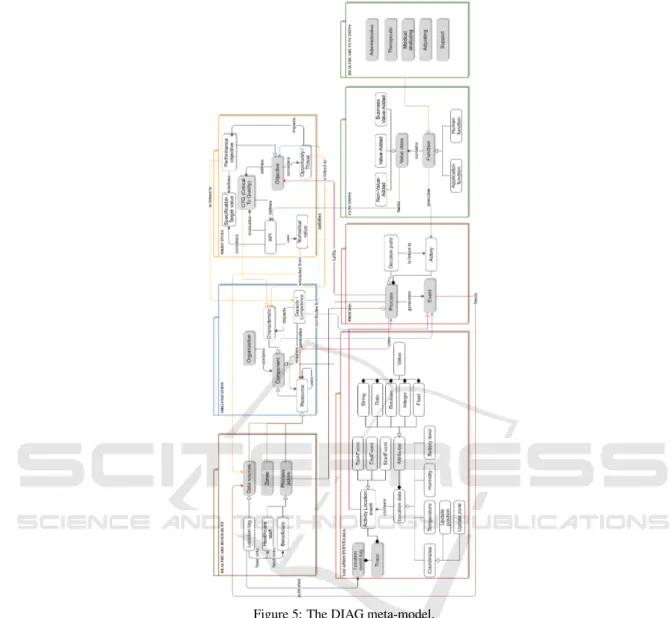
To fill this gap, the DIAG meta-model is presented in figure 5. This meta-model consists of seven different packages. Each package contains several classes that help to create a model of the link between the actual concepts in the environment and the raw data in loca-tion event logs. As shown in figure 5, (i) Healthcare resources package includes the main resources used in patient processes that can be detected and moni-tored by location tags. (ii) The Organization package which represents the main classes that are linked to the healthcare organization. (iii) Location event logs package provides a model of all the information that exist within a location event log and their relationship with other classes. (iv) The Objective package con-sists of necessary classes to perform business process analyses on top of the registered information. (v) The Process package models the concepts that are consid-ered to represent a patient pathways as a business pro-cess model. (vi) The Function package is addressing the different classes that lead to the execution of ac-tivities in processes. (vii) The Healthcare functions package addresses different types of actions that can take place during the run-time of patient pathways. (viii) The Context package helps to provide a base for further business process diagnosing actions.
The DIAG meta-model has been realized and de-veloped thanks to a web-based application known as R IOSUITE. This multidisciplinary framework in-cludes multiple modules (IODA, IOSEMIT, R-IOGA and etc.) to obtain the location event logs and extract the required information. https://research-gi. mines-albi.fr/display/RIOSUITE/R-IOSuite+Home
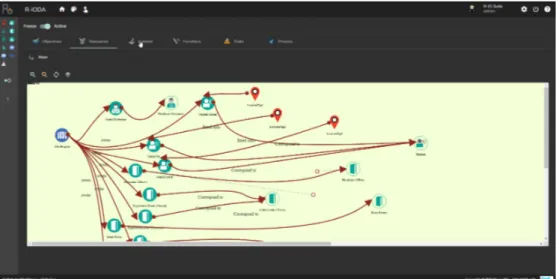
Evidently, the detailed presentation of the pack-ages and their included classes are out of the limit of this paper. However, some examples illustrate the ap-plicability of this meta-model. Figure 6 shows how the user can model engaged healthcare resources in patient pathways by the application. As shown within figure 6, a hospital is addressed by the Organiza-tion package and it can have different Healthcare re-sources such as healthcare staff and other rere-sources like the hospital zones. Modeling these concepts within the application provides a-priori knowledge for interpreting the information within the location event logs.
3.2
Location Data Interpretation Rules
After gathering the primary location event logs, they will be uploaded to each defined ”location tag“ class in the ”resource“ tab of the application (c.f. figure 6). As shown in figure 1, it is necessary to interpret the location event logs in order to be used for the process modeling function.
In line with this objective, two groups of location interpretation rules are defined.
• First group: This set is constructed by three rules. (i) Add start-event, (ii) Add end-event, and (iii) Add task-events. They are in charge of trans-forming the very first visualization of data as ”nodes“ with out any semantics. These graphs will be sent to a graph database management sys-tem. For example, outputs of this step will be se-ries of nodes labeled as ”Activity.Inside.Zone # “. • Second group: After detecting the nodes, the sec-ond group of rules will start retracting the mod-eled a-priori knowledge within the application. These rules are: (i) Add knowledge onto
Figure 5: The DIAG meta-model.
event, (ii) Add knowledge to end-event, and (iii) Add knowledge to task-event. As mentioned this action is possible by the modeled information within the ”resource“ tab of the application. Since the presentation of all the rules is much broader than the limit of this paper, we only present one of the most critical ones which is the Add task-events.
3.2.1 Add Task-event
The presented algorithm in this section (c.f. algorithm 1) describes how to discover the activities from the lo-cation event logs. Assuming human functions are ex-ecuting the process activities within defined zones of the facility, one can infer that an activity (a task) starts when a process actor enters a certain zone and it fin-ishes when the process actor leaves that zone.
Algo-rithm 1 expresses in more detail the rule for detecting such activities.
The algorithm is looking for the events that are re-lated to the zones (measurement.update.zone). How-ever, here the algorithm is seeking zones that are within the general process zones or zones with the id greater than ‘0’ (If the zj.id > 0).
After identifying the zone in z1eventwe look for the next event that share the same zone id (zj.id), and additionally, we ensure that the second event also is related to the same patient (for example: z3.eui == z6.eui). This helps to ensure that the activity has been finished and the algorithm is not considering an in-complete data in the event log. This is an important characteristic to provide a refined set of data sets for avoiding the incompleteness notion in event logs. HEALTHINF 2020 - 13th International Conference on Health Informatics
Algorithm 1:Add-task-event.
1:procedure ADDTASKEVENT . Discovering the Human Task
2: Input < EventLog >= Structure
3: < Name >: string;
4: < Id >: integer;
5: < Tags >: integer;
6: < Topic >: string;
7:
8: Select(EventLog, Topic == “measurement.update.zone”)
9:
10:< zone event >= Structure;
11: < Topic >= string ; 12: < EventID >= integer; 13: . j=1,2,3,...,m 14: < eui >= integer; 15: < DateTime >= string; 16: < InZone >= boolean; 17: < Zone.ID >= integer; . i= 0,1,2,3,...,n
18: for zone event do
19: if (z1= zone event [z1.topic== ‘measurement.update.zone, AND z1.id > 0 ] AND (z2= zone event[z2.topic == ‘measurement.update.zone0
AND z2.id > 0 AND z1.id==z2.id AND z1.eui == z2.eui])) 20: then
21: Select “z1.event id” as ‘HumanTask’ ;
22: Define ’name’ (“z1.event id” as “Activity.Inside.Zone”); 23: Register ’z1.event.propoerties’ as ‘HumanTask.propoerties’; 24: end if
25: if ((z1.id == z2.id) AND( z1.eui==z2.eui )AND (z1.zone.attribute in zone==‘T RU E0) AND (z2.zone.attribute in zone==‘FALSE0) AND
(z1.date time, z2.date time )) 26:
27: OR . In case of existing noises
28:
29:(z2.zone.attribute in zone == ‘T RU E‘) AND z1.zone.attribute in zone==‘FALSE‘) AND (z2.date time, z1.date time))) 30: then
31:Register zj.date time; 32: end if
33: end for
34:end procedure
After extracting the starting point of an activity, the algorithm randomly defines a node and name it as ”Activity.Inside.Zone #” and all the defined proper-ties of the node such as time will be recorded. Note that a process actor may go several times into a zone and goes out during his/her process. In order to avoid misinterpreting the activity sequences, the algorithm uses the date time concept (at line 14 of the algorithm 1). At the final step, duration of the activity is regis-tered thanks to the extracted start and end-event.
Later on, these nodes will be retracted by the ”data interpreter” in order to add more knowledge on them. It is worth noting that, the a-priori knowledge is provided thanks to the implementation of the DIAG meta-model (c.f. 5).
4
RESULT
To evaluate the applicability of this approach, an ex-periment was conducted within a hospital living-lab in south of France. During this study, 30 patients were monitored. To begin with this experiment, the resources and other involved elements with the pa-tient pathways were modeled in the R-IOSUITE ap-plication. This action is similar to what has been shown previously in figure 6. Next, each patient re-ceived a location tag. Consequently, several location event logs were registered by the localization system. These data were uploaded in the application to be in-terpreted.
An example of the interpretation procedure is shown in figure 7. In figure 7 at the left side, a map illustrates the movement of the patient who is wearing the tag 3. On the right side the graph represents how the events are seen. According to this graph each time
Figure 6: An screen-shot of the R.IO-DIAG application which illustrate the modeling of the healthcare resources in the application.
Figure 7: An illustration of the interpretation procedure.
a patient enters a zone the graph will reach the upper threshold, and by touching the lower threshold, it can be inferred that the patient left the zone.
After finishing the interpretation of the location event logs, the application discovers the patient path-ways by using the heuristic miner algorithm. This well-known process discovery algorithm previously has been presented in the work of (Weijters and Ribeiro, 2011; Weijters et al., 2006; De Cnudde et al., 2014).
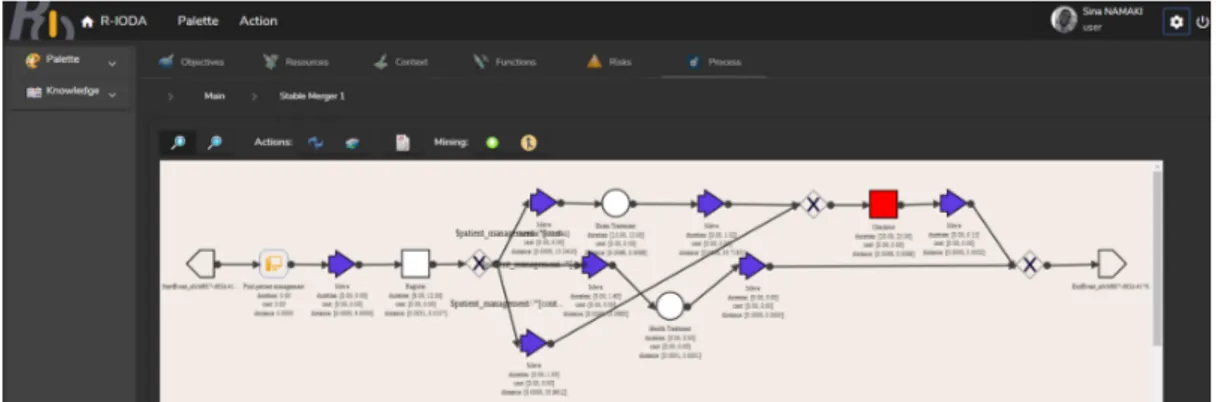
Figure 8 shows the result of the process modeling function. The patient pathways in this research work were modeled by the OPC (Operation Process Chart) modeling language (Namaki Araghi et al., 2018a).
Thanks to the development of the meta-model, the application is able to detect what are the different types of activities that patient are doing within their process. These activity types are defined within the Healthcare function package. This supports the fur-ther process mining analyses; such as, which class of HEALTHINF 2020 - 13th International Conference on Health Informatics
Figure 8: The process model extracted from the location event logs.
activities is leading to deviation in patient pathways. Diagnosing such deviations could unfold the further improvement plans.
5
CONCLUSIONS
The association of localization technologies and pro-cess mining in healthcare is limited by two main cat-egories of different issues. The first category is the social challenges regarding the use of location data of patients or staff. There are multiple aspects that should be addressed such as the ethical issues. The second category is the scientific and technical chal-lenges.
Concerning this category, there exists a major is-sue which is the inadequate attention in the litera-ture to the ”interpretation of location data for cess mining“. As a result, this research work pro-posed the DIAG meta-model which can provide a proper core to interpret the location data and support the sense-making procedure. Such model-driven ap-proaches were encouraged previously for enriching the raw data in data science projects (Benaben et al., 2019).
To best of our knowledge, such a model-driven approach has not been used previously for apply-ing process minapply-ing and indoor localization technolo-gies to monitor patient pathways. Indeed, due to the complexity of the healthcare organizations, this meta-model and the corresponding interpretation rules may not be a global answer for different hospitals. How-ever, it can reach a sufficient maturity level by receiv-ing more practical experiences.
REFERENCES
Anisi, S., Zarei, E., Sabzi, M., Chehrazi, M., et al. (2018). Missed appointments: Factors contributing to patient no-show in outpatient hospital clinics in tehran, iran. Shiraz E-Medical Journal, 19(8).
Araghi, S. N., Fontanili, F., Lamine, E., Tancerel, L., and Benaben, F. (2018). Monitoring and analyzing pa-tients’ pathways by the application of Process Mining, SPC, and I-RTLS. IFAC-PapersOnLine, 51(11):980– 985.
Aryal, A. M. and Sujing Wang (2017). Discovery of pat-terns in spatio-temporal data using clustering tech-niques. In 2017 2nd International Conference on Im-age, Vision and Computing (ICIVC), pages 990–995. Bao, X. and Wang, L. (2017). Discovering Interesting
Co-location Patterns Interactively Using Ontologies. In Bao, Z., Trajcevski, G., Chang, L., and Hua, W., ed-itors, Database Systems for Advanced Applications, pages 75–89, Cham. Springer International Publish-ing.
Benaben, F., Li, J., Koura, I., Montreuil, B., Lauras, M., Mu, W., and Gou, J. (2019). A Tentative Framework for Risk and Opportunity Detection in A Collaborative Environment Based on Data Interpretation.
Blank, P., Maurer, M., Siebenhofer, M., Rogge-Solti, A., and Schonig, S. (2016). Location-Aware Path
Align-ment in Process Mining. In 2016 IEEE 20th
In-ternational Enterprise Distributed Object Computing Workshop (EDOCW), pages 1–8.
De Cnudde, S., Claes, J., and Poels, G. (2014). Improv-ing the Quality of the Heuristics Miner in ProM 6.2. Expert Syst. Appl., 41(17):7678–7690.
Dogan, O., Bayo-Monton, J.-L., Fernandez-Llatas, C., and Oztaysi, B. (2019). Analyzing of Gender Behaviors from Paths Using Process Mining: A Shopping Mall Application. Sensors (Basel, Switzerland), 19(3). Ertek, G., Chi, X., and Zhang, A. N. (2017). A
Frame-work for Mining RFID Data From Schedule-Based Systems. IEEE Transactions on Systems, Man, and Cybernetics: Systems, 47(11):2967–2984.
Feng Ling, Tianyue Sun, Xinning Zhu, Qingqing Chen, Xi-aosheng Tang, and Xin Ke (2016). Mining travel be-haviors of tourists with mobile phone data: A case
study in Hainan. In 2016 2nd IEEE International Con-ference on Computer and Communications (ICCC), pages 1524–1529.
Fernandez-Llatas, C., Lizondo, A., Monton, E., Benedi, J.-M., and Traver, V. (2015). Process mining methodol-ogy for health process tracking using real-time indoor location systems. Sensors, 15(12):29821–29840. Garaeva, A., Makhmutova, F., Anikin, I., and Sattler, K.
(2017). A framework for co-location patterns min-ing in big spatial data. In 2017 XX IEEE Interna-tional Conference on Soft Computing and Measure-ments (SCM), pages 477–480.
Hwang, I. and Jang, Y. J. (2017). Process Mining to Dis-cover Shoppers’ Pathways at a Fashion Retail Store Using a WiFi-Base Indoor Positioning System. IEEE Transactions on Automation Science and Engineer-ing, 14(4):1786–1792.
Jin, P., Du, J., Huang, C., Wan, S., and Yue, L. (2015). De-tecting hotspots from trajectory data in indoor spaces. In International Conference on Database Systems for Advanced Applications, pages 209–225. Springer.
Kamel Boulos, M. N. and Berry, G. (2012). Real-time
locating systems (RTLS) in healthcare: a condensed primer. International Journal of Health Geographics, 11:25.
Lamr, M. and Skrbek, J. (2016). Traffic Data and
Possibilities of Their Utilization for Safer
Traf-fic. Technical Univ Liberec, Faculty Economics.
WOS:000404420200007.
Liao, J., Wang, Z., Wan, L., Cao, Q. C., and Qi, H. (2015). Smart Diary: A Smartphone-Based Framework for Sensing, Inferring, and Logging Users’ Daily Life. IEEE Sensors Journal, 15(5):2761–2773.
Martin, N. (2019). Using Indoor Location System Data to Enhance the Quality of Healthcare Event Logs: Opportunities and Challenges. In Daniel, F., Sheng, Q. Z., and Motahari, H., editors, Business Process Management Workshops, Lecture Notes in Business Information Processing, pages 226–238. Springer In-ternational Publishing.
Martinez-Millana, A., Lizondo, A., Gatta, R., Vera, S., Sal-cedo, V. T., and Fernandez-Llatas, C. (2019). Process Mining Dashboard in Operating Rooms: Analysis of Staff Expectations with Analytic Hierarchy Process. International Journal of Environmental Research and Public Health, 16(2).
Mazimpaka, J. D. and Timpf, S. (2016). Trajectory data mining: A review of methods and applications. Jour-nal of Spatial Information Science, 2016(13):61–99. Miclo, R., Fontanili, F., Marqu`es, G., Bomert, P., and
Lauras, M. (2015). RTLS-based Process Mining: To-wards an automatic process diagnosis in healthcare. In 2015 IEEE International Conference on Automation Science and Engineering (CASE), pages 1397–1402. Muzammal, M., Gohar, M., Rahman, A. U., Qu, Q.,
Ah-mad, A., and Jeon, G. (2018). Trajectory Mining Us-ing Uncertain Sensor Data. IEEE Access, 6:4895– 4903.
Namaki Araghi, S., Fontanili, F., Lamine, E., Salatge, N., Lesbegueries, J., Pouyade, S. R., and Benaben, F. (2019). Evaluating the Process Capability Ratio of
Patients’ Pathways by the Application of Process Min-ing, SPC and RTLS. pages 302–309.
Namaki Araghi, S., Fontanili, F., Lamine, E., Salatge, N., Lesbegueries, J., Pouyade, S. R., Tancerel, L., and
Benaben, F. (2018a). A Conceptual Framework to
Support Discovering of Patients’ Pathways as Oper-ational Process Charts. In 2018 IEEE/ACS 15th Inter-national Conference on Computer Systems and Appli-cations (AICCSA), pages 1–6.
Namaki Araghi, S., Fontanili., F., Lamine., E., Tancerel., L., and Benaben., F. (2018b). Applying process mining and rtls for modeling, and analyzing patients’ path-ways. In Proceedings of the 11th International Joint Conference on Biomedical Engineering Systems and Technologies - Volume 5: HEALTHINF,, pages 540– 547. INSTICC, SciTePress.
Ramos, J., C´esar, A., Neves, J., and Novais, P. (2017). Adapting the User Path Through Trajectory Data Min-ing. In De Paz, J. F., Juli´an, V., Villarrubia, G., Marreiros, G., and Novais, P., editors, Ambient In-telligence– Software and Applications – 8th Inter-national Symposium on Ambient Intelligence (ISAmI 2017), Advances in Intelligent Systems and Comput-ing, pages 195–202. Springer International Publish-ing.
Rojas, E., Fern´andez-Llatas, C., Traver, V., Munoz-Gama, J., Sep´ulveda, M., Herskovic, V., and Capurro, D. (2017a). Palia-er: Bringing question-driven process mining closer to the emergency room. In BPM (De-mos).
Rojas, E., Sep´ulveda, M., Munoz-Gama, J., Capurro, D., Traver, V., and Fernandez-Llatas, C. (2017b). Question-Driven Methodology for Analyzing Emer-gency Room Processes Using Process Mining. Ap-plied Sciences, 7(3):302.
Senderovich, A., Rogge-Solti, A., Gal, A., Mendling, J., and Mandelbaum, A. (2016). The ROAD from Sen-sor Data to Process Instances via Interaction Mining. In Nurcan, S., Soffer, P., Bajec, M., and Eder, J., editors, Advanced Information Systems Engineering, pages 257–273, Cham. Springer International Pub-lishing.
Sztyler, T., Carmona, J., V¨olker, J., and Stuckenschmidt, H. (2016). Self-tracking reloaded: applying process mining to personalized health care from labeled sen-sor data.
Tang, L.-A., Yu, X., Gu, Q., Han, J., Jiang, G., Leung, A., and Porta, T. L. (2015). A Framework of Mining Tra-jectories from Untrustworthy Data in Cyber-Physical System. ACM Trans. Knowl. Discov. Data, 9(3):16:1– 16:35.
Tanuja, V. and Govindarajulu, P. (2016). Application of trajectory data mining techniques in crm using move-ment based community clustering. 16(11):20. Tanuja, V. and Govindarajulu, P. (2017). A novel
frame-work for geo-clustering of user movements based on trajectory data. 17(3):212.
Wan, N., Kan, G. L., and Wilson, G. (2017). Addressing location uncertainties in GPS-based activity monitor-ing: A methodological framework. Transactions in GIS, 21(4):764–781.
Weijters, A., van der Aalst, W. M. P., and De Medeiros,
HEALTHINF 2020 - 13th International Conference on Health Informatics
A. A. (2006). Process mining with the heuristics miner-algorithm. 166:1–34.
Weijters, A. J. M. M. and Ribeiro, J. T. S. (2011). Flexi-ble Heuristics Miner (FHM). In 2011 IEEE Sympo-sium on Computational Intelligence and Data Mining (CIDM), pages 310–317.
Zheng, Y. (2015a). Trajectory Data Mining: An Overview. ACM Trans. Intell. Syst. Technol., 6(3):29:1–29:41. Zheng, Y. (2015b). Trajectory Data Mining: An Overview.
ACM Transaction on Intelligent Systems and Technol-ogy.
Zhenjiang, D., Deng, J., Xiaohui, J., and Yongli, W. (2017). RTMatch: Real-time location prediction based on tra-jectory pattern matching. In Database Systems for Advanced Applications - DASFAA 2017 International Workshops: BDMS, BDQM, SeCoP, and DMMOOC, Proceedings, pages 103–117. Springer Verlag.