HAL Id: hal-01113824
https://hal.archives-ouvertes.fr/hal-01113824
Submitted on 3 Mar 2017
HAL is a multi-disciplinary open access
archive for the deposit and dissemination of
sci-entific research documents, whether they are
pub-lished or not. The documents may come from
teaching and research institutions in France or
abroad, or from public or private research centers.
L’archive ouverte pluridisciplinaire HAL, est
destinée au dépôt et à la diffusion de documents
scientifiques de niveau recherche, publiés ou non,
émanant des établissements d’enseignement et de
recherche français ou étrangers, des laboratoires
publics ou privés.
Electronic sensor for pH measurements in nanoliters
Ismaïl Bouhadda, Olivier de Sagazan, France Le Bihan
To cite this version:
Ismaïl Bouhadda, Olivier de Sagazan, France Le Bihan. Electronic sensor for pH measurements in
nanoliters. Procedia Engineering, Elsevier, 2014, EUROSENSORS 2014, the 28th European
Confer-ence on Solid-State Transducers, 87, pp.915-918. �10.1016/j.proeng.2014.11.304�. �hal-01113824�
Procedia Engineering 87 ( 2014 ) 915 – 918
1877-7058 © 2014 Published by Elsevier Ltd. This is an open access article under the CC BY-NC-ND license (http://creativecommons.org/licenses/by-nc-nd/3.0/).
Peer-review under responsibility of the scientific committee of Eurosensors 2014 doi: 10.1016/j.proeng.2014.11.304
ScienceDirect
EUROSENSORS 2014, the XXVIII edition of the conference series
Electronic sensor for pH measurements in nanoliters
I. Bouhadda, O. De Sagazan, F. Le Bihan
Microelectronics and Microsensor Department, IETR, Rennes University, France
Abstract
An original design is proposed for the fabrication of an electronic sensor. The device consists on a field effect transistor (FET) combined with an integrated microfluidic channel and is devoted to charges detection in liquids. The technological process has been optimized. Fluidic inlet and outlet, performed bybulk micromachining, are located on the back side of the device. Electrical responses of the sensor are shown with different ambiances. Charge detection is validated thanks pH measurements. The sensors present high sensitivity associated to good electrical performances. Stability of the sensor is also presented and compared to nearby technologies.
© 2014 The Authors. Published by Elsevier Ltd.
Peer-review under responsibility of the scientific committee of Eurosensors 2014.
Keywords: pH sensor, microfluidic, Field effect transistor.
1. Introduction
Among the different kinds of sensors developed for chemicals tests in liquids, electronic transducers present the advantages to be simple to use, easily miniaturized and quite sensitive. The main structure developed for chemical sensing, especially for pH measurement is the ISFET (Ion Sensitive Field-Effect Transistor) [1,2], which is now widely commercialized. Different other structures of transistors have also shown many interests for chemical sensing, as Floating Gate FET [3] or Extended Gate FET (EGFET) [4]. For all these devices, the maximum pH sensitivity is limited to the Nerstian response (59.5 mV/pH at room temperature) [5]. SGFETs (Suspended Gate Field Effect Transistor) involving gates suspended at submicron distance have shown good properties in charges detection, especially a high sensitivity to pH [6].
The detection of pH and its variation has many applications in chemistry, in environment or in biochemistry and biology. For each application, requirements can be different. For example, in environment, it should require a high volume of liquid under test and a long life sensor in order to measure the quality of water for example. In
© 2014 Published by Elsevier Ltd. This is an open access article under the CC BY-NC-ND license (http://creativecommons.org/licenses/by-nc-nd/3.0/).
916 I. Bouhadda et al. / Procedia Engineering 87 ( 2014 ) 915 – 918
biochemistry and biology, the required volume can be very small, for example in the case of studies of cell activities, biological reactions …
For this second part, in order to decrease the required volumes, sensors have been combined with microfluidic technologies, most of time using soft technology (chambers and channels designed in PDMS, polydimethylsiloxane).
The motivation of this work is to propose an integrated sensor, based on electronic detection which requires only few nanoliters of liquid. This device is inspired by SGFET technology including a major advantage by the combination of a microfluidic microchannel and an electronic device. Its fabrication needs both bulk and surface micromachining. Previous technologies [7] have been developed with inlet and outlet on the front side. This new technology, with inlet and outlet on the back side, has many advantages. The microfluidic flow, including inlet and outlet is then totally insulated from the electrical pads, thus facilitating the test under liquids and the general handling. Moreover, thanks to the low size of the integrated channel, the required volume under test is very low.
2. Technology
The device, including the transistor structure and the microfluidic channel is presented in figure 1a. The electronic part involves classical microtechnology. The transistor is P-type, with source and drain doped with boron. The channel insulator is a stack of first a silicon dioxide, for the high quality of the channel interface, and second a silicon nitride for the electrical insulation, especially in liquid, as well as sensitive layer. The microfluidic channel technology has been optimized in order to obtain good mechanical and electrical properties, as well as a good insulation of the gate from the liquid under test. This microchannel is processed using a sacrificial layer made of photoresist, patterned and covered with silicon dioxide and aluminum for the gate. Mechanical properties are enhanced by depositing a thick layer of SU8 photoresist.
Several devices are fabricated along the same microfluidic channel as shown figure 1b. Photoresist has been chosen for sacrificial layer in order to reduce the etching time (the distance between inlet and outlet is 1 mm).
Fig. 1. (a) Technology and materials; (b) Geometry of the transistors with integrated microfluidic channel.
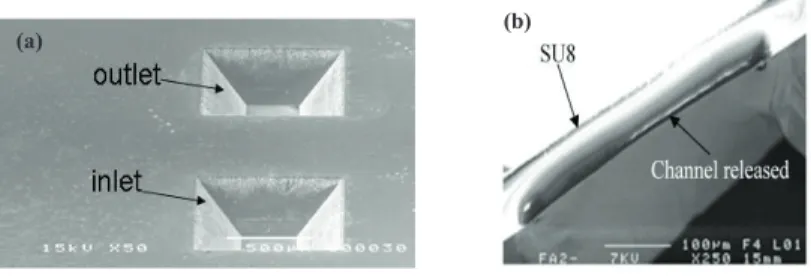
Back side inlet and outlet are fabricated by using wet etching of silicon. The main etching is done at the beginning of the process. Final etch, to open the microfluidic channel, is performed at the end of the process by deep RIE (Reactive Ion Etching). SEM pictures are given in figure 2 and show the back side opening for inlet and outlet (2.a) as well as the released microfluidic channel (2.b).
Fig. 2. SEM pictures (a) of the back side of the wafer; (b) of the microfluidic channel obtained after etching.
(a)
(b)
3. Sensor characteristics
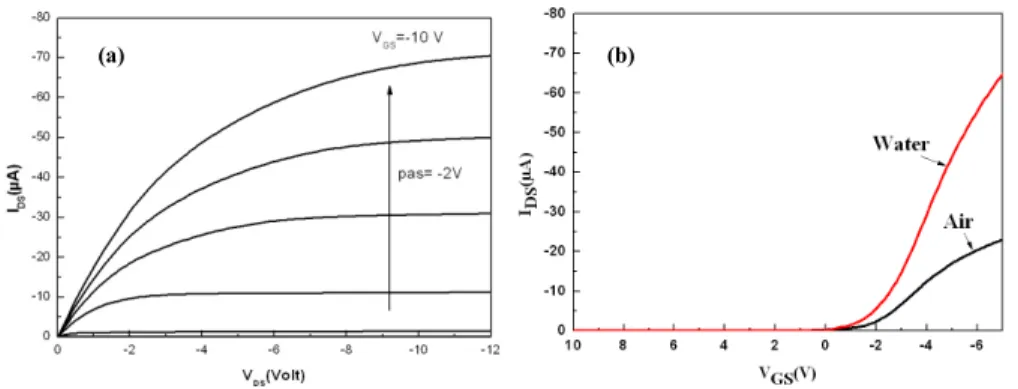
The device characterizations include the output characteristics (drain current versus drain to source voltage), IDS(VDS) for different gate voltages VGS, and transfer characteristics IDS(VGS). These curves allow to show the good
electrical behavior of the devices. These characteristics are presented in figure 3 in air medium, comparison between air and water is also presented in fig. 3b. It appears in this figure, from the difference between the two characteristics, that the sacrificial layer has been successfully removed (air curve) and that microfluidic channel can be filled with water (water curve). Indeed, the capacitance between the gate and the electrical channel has changes (in the case of water), involving a change of the conductance and of the current between source and drain.
Fig. 3. Electrical characteristics (a) output characteristic in air; (b) Comparison of transfer characteristics with air or with water.
The model of classical MOS transistor can then be used to determine the electrical parameters, as the threshold voltage, the transconductance. These values are extracted and presented for the two media (Table 1). The mobility values are in good agreement with theory and thus validate the process. The change in the threshold voltage is linked to a modification of the charge concentration on the sensitive layer.
Table 1. Comparison of electrical parameters for FET in air and in water. Electrical parameters Threshold voltage Vth (V) Transconductance gmax (A/V) Current ratio Ion/Ioff Air -1.9 6*10-6 >103 Water -1.7 1.6*10-5 >106
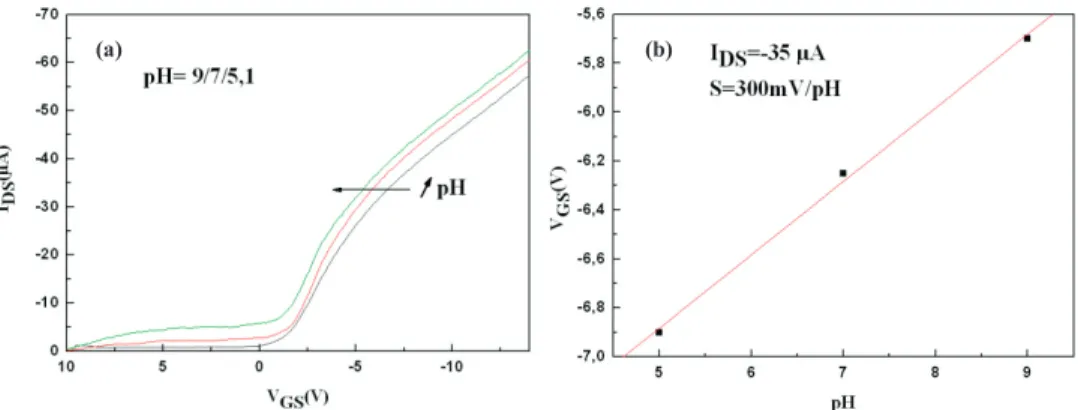
The sensitivity for pH measurement is then measured by plotting the transfer characteristic for liquids according different pH values. The device is then rinsed in pure water between each measurement. The shift of the characteristic is observed versus the increase of pH, corresponding to the increase of negative charges on the solution. The sensitivity is measured with potentiometric detection, i. e. by plotting the voltage variation at fixed drain current, versus pH values. This variation, shown figure 4.b allows calculating the sensitivity to pH, deduced from the slope of the characteristic. This one reaches 300 mV/pH and corresponds to classsical value obtained in the case of suspended field effect transistor. This technology with integrated microfluidic channel doesn’t lead to an increase of the pH sensitivity but has the advantage of been more compact. The required volume is less than 1 nl.
This device presents also a higher electrical stability compared to the SGFET ones. This stability is shown in figure 5, with the threshold voltage shift versus time (potentiometric detection) as shown figure 5, and also by continuous measurement at fixed gate voltage (amperometric detection).
918 I. Bouhadda et al. / Procedia Engineering 87 ( 2014 ) 915 – 918
Fig. 4. pH sensing (a) shift of the transfer characteristic with pH; (b) Voltage shift versus pH showing the pH sensitivity.
Fig. 5. Stability (a) shift of the transfer characteristic with time; (b) Voltage shift versus time.
The shift of the threshold voltage (ΔVTH = 0.6 V) is indeed lower than the one observed with SGFET with the same conditions (ΔVTH = 2V).
4. Conclusion
The devices presented in this paper, which combines an electronic transducer associated with an integrated channel has been processed and as shown good properties of pH detection by using very small volumes of liquids. Its high sensitivity, compared to existing technology, associated with an improvement of the stability have also been demonstrated.
References
[1] P. Bergveld, Development of an ion-sensitive solid-state device for neurophysiological measurements, IEEE Trans. Biome. Eng BME-17, (1970), 70-71.
[2] J. Janata, “20 years of Ion selective Field Effect Transistors”, Analyst 1994, 119, 2275-2278.
[3] Shi Zhaoxia, Zhu Dazhong, “Modeling and discussion of threshold voltage for a multi-floating gate FET pH sensor”, Journal of Semiconductors Vol. 30, No. 11 November 2009
[4] L. L. Chi, J. C. Chou, W. Y. Chung, T. P. Sun, S. K. Hsiung, “Study on extended gate field effect transistor with tin oxide sensing membrane”, Mater ,Chem Phys 2000;63:19–23.
[5] D. E. Yates, S. Levine, T. W. Healy, “ Site-binding model of the electrical double layer at the oxide/water interface”, J Chem Soc Faraday Trans I, 1974, 70: 1808.
[6] T. Mohammed-Brahim, A-C. Salaün, F. Le Bihan, “SGFET as charge sensor: application to chemical and biological species detection”, Sensor& Transducers journal, 900, (2008) 11-26.
[7] I. Bouhadda, O. de sagazan, F. Le Bihan, Suspended Gate Field Effect Transistor with an Integrated Micro-Fluidic Channel Performed by Surface Micromachining for Liquids Sensing, Procedia Engineering 47, 754-757, 2012.
(a) (b)