Direction des bibliothèques
AVIS
Ce document a été numérisé par la Division de la gestion des documents et des archives de l’Université de Montréal.
L’auteur a autorisé l’Université de Montréal à reproduire et diffuser, en totalité ou en partie, par quelque moyen que ce soit et sur quelque support que ce soit, et exclusivement à des fins non lucratives d’enseignement et de recherche, des copies de ce mémoire ou de cette thèse.
L’auteur et les coauteurs le cas échéant conservent la propriété du droit d’auteur et des droits moraux qui protègent ce document. Ni la thèse ou le mémoire, ni des extraits substantiels de ce document, ne doivent être imprimés ou autrement reproduits sans l’autorisation de l’auteur.
Afin de se conformer à la Loi canadienne sur la protection des renseignements personnels, quelques formulaires secondaires, coordonnées ou signatures intégrées au texte ont pu être enlevés de ce document. Bien que cela ait pu affecter la pagination, il n’y a aucun contenu manquant.
NOTICE
This document was digitized by the Records Management & Archives Division of Université de Montréal.
The author of this thesis or dissertation has granted a nonexclusive license allowing Université de Montréal to reproduce and publish the document, in part or in whole, and in any format, solely for noncommercial educational and research purposes.
The author and co-authors if applicable retain copyright ownership and moral rights in this document. Neither the whole thesis or dissertation, nor substantial extracts from it, may be printed or otherwise reproduced without the author’s permission.
In compliance with the Canadian Privacy Act some supporting forms, contact information or signatures may have been removed from the document. While this may affect the document page count, it does not represent any loss of content from the document.
Université de Montréal
Novel Multicast Protocols in Ad-Hoc Networks
Par:
Astier Eric Jean Léopold
Département d'informatique et de recherche opérationnelle Faculté des arts et des sciences
Mémoire présenté à la Faculté des études supérieures en vue de J'obtention du grade de
Maîtrise ès sciences (M.Sc.) en Informatique
Décembre, 2008
Université de Montréal Faculté des études supérieures
Ce mémoire intitulé
Novel Multicast Protocols in Ad-Hoc Networks
présenté par : Astier Eric
a été évalué par un jury composé des personnes suivantes:
Dr. Esma Aimeur, President Dr. Abdelhakim Hafid, Thesis Director
(
Résumé
Un réseau ad-hoc mobile (MANET) est un réseau de nœuds mobiles qUI s'organise en topologie arbitraire grâce aux liaisons sans fils entre les nœuds. Un protocole multicast permet de livrer l'information à un groupe de nœud simultanément. Il utilise les liens du réseau une seule fois afin d'atteindre plusieurs destinations. Les nœuds dans un MANET ont des quantités d'énergie limitées. Cette énergie est consommée soit en transmettant des paquets, soit en les recevant. Un protocole multicast, s'il se veut être extensible, doit équilibrer les paquets de données et de surcharge opérationnelle des paquets de contrôle (overhead). Cet équilibre doit aussi prendre en compte la consommation d'énergie et la topologie dynamique causée par les déplacements des nœuds. Rassembler les nœuds en groupes réduit le nombre de nœuds qui sont impliqués dans le routage et permet de réduire la surcharge opérationnelle.
Différentes techniques de regroupement (clustering) et de protocoles multicast
/
ont été proposés. Les techniques de regroupement ont différents degrés de succès selon les scenarios. Certaines marchent mieux dans des situations à faible mobilité, d'autres dans des réseaux à large population et haute densité. Cependant, elles peuvent causer la mort prématurée de certains nœuds, des partitions dans le réseau et des interruptions de communication dans des situations à faible densité. Les charges de trafic ne sont pas distribuées équitablement dans un manet, des goulots d'étranglements d'énergie peuvent survenir, plus spécifiquement dans les scénarios de faible densité (la forme du réseau et la distribution des nœuds sont plus arbitraire).
Les protocoles multicast dans la littérature ont différentes méthodes pour exécuter les fonctions multicast. Certains de ces protocoles provoquent la saturation du réseau par les paquets de contrôle à cause des coûts élevés de réparation des liens. D'autres protocoles ne s'ajustent pas en fonction de la mobilité des nœuds et inondent inutilement le réseau de paquets.
D'abord, nous avons conçu un algorithme qui tient compte de la mobilité et de l'énergie résiduelle des nœuds voisins quand on sélectionne les nœuds critiques (p.ex.
chef de groupes). Puis, nous avons créé un protocole muIticast qui tient compte de la mobilité et de la topologie du réseau pour réduire la latence et diminuer la surcharge opérationnelle des paquets de données (data packet overhead).
IV
Mots-Clefs: MANET, Nœuds Mobiles, AODV, MAODV, Multicast, Réseau Ad-hoc, NS-2, Techniques de Regroupement Passif (Clustering), RSIDS, MOBIC, ILBH, GRIDS, Prise en Compte de l'Énergie, Mobilité, PUMA, CPUMA, MODA, ROMANT, Centralisation du Noyau.
Abstract
A mobile ad hoc network (MANET) is a network of mobile nodes that organizes itself into an arbitrary topology by the wireless links between nodes without the presence of a wired support infrastructure. A multicast protocol allows for the delivery of information to a group of nodes simultaneously. It uses links of the network only once to reach multiple destinations. Nodes in a MANET have limited amounts of energy which is consumed by transmitting and receiving packets. A scalable multicast protocol must balance data packet delivery and overhead. This balance must contend with the power consumption and dynamic topology of moving nodes. Clustering reduces the number of nodes involved in routing and is used to reduce overhead.
Several clustering techniques and multicast protocols have been proposed. Clustering techniques have varying degrees of success in different scenarios. Sorne only work in low mobility scenarios, since they do not take node mobility into account when clustering. Sorne techniques work weil in large-population-high-density networks but may cause nodes to fail, network partition and communication interruption in low density situations. Traffic loads in MANETs are evenly distributed, energy bottlenecks can happen, especially in low density scenarios (more arbitrary network shape and no de distribution). Multicast protocols in the literature have very different methods for performing multicast functions. Sorne of the protocols cause networks to be overwhelmed by control packets due to the high costs of their link repair operations. Sorne protocols fail to adjust for node mobility and have unnecessary packet broadcasts.
First we designed a c1ustering algorithm that considers both m6bility and remaining energy of neighboring nodes when selecting critical nodes (e.g. cluster heads). Second, we developed a multicast protocol that takes into account mobility and network topology to reduce latency and lower data packet overhead.
Keywords: MANET, Mobile Nodes, AODV, MAODV, Multicast, Ad Hoc Networks, NS-2, Passive Clustering, RSIDS, MOBIC, ILBH, GRIDS, Energy Aware, Mobility, PUMA, CPUMA, MODA, ROMANT, Centering, Core
Vll
Table of Contents
Résumé ... iii
Abstract ... v
Table of Contents ... vi'i Table List ... x
Figure List ... xi
Abbreviation List ... xii
Acknowledgements ... xiv
Chapter 1: Introduction ... 1
1.1 Mobile Ad Hoc Networks· ... l 1.2 Multicast Protocols ... 3 l.J Clustering ... 4 1.4 Motivation ... 4 1.5 Problem Statement ... 5 1.6 Contributions ... : ... 6 1.7 Thesis Organization ... 7
Chapter 2: State of the Art ... , ... 8
2.1. Clustering: Definitions ... 8
Benefits of Clustering ... 10
Costs of Clustering ... 10
2.2. Clustering: Schemes ... Il Mobility Based Metric for Clustering (MOBIC) ... Il Passive Clustering (PC) ... 12
Geographically Repulsive Insomnious Distributed Sensors (GRIDS) ... 12
Interval-Based Load Balancing Heuristics (ILBH) ... 13
2.3. Multicast Routing: Definitions ... 14
2.4. Multicast Routing: Protocols ... 15
Multicast Ad Hoc On-Demand Distance Vector (MAODV) ... 15
Vlll
Protocol for Unified Multicast Announcements (PUMA) ... 17
Multicasting on Directional Antennas (MOnA) ...
18
2.5. Conclusion ... 19
Chapter 3: Energy and Mobility Aware Clustering Technique for Multicast Routing Protocols in Wireless Ad Hoc Networks ... 21
Background ... 21
Abstract ... 22
L Introduction ... 23
II. Related W ork ... 25
III. RSIDS Protocol Description ...
27-IV. Simulation Model and Methodology ... 33
V. Conclusion ... 41
References ... 42
Chapter 4: Centered and Robust Multicast Routing in Mobile Ad Hoc Networks ... 44
Background ... 44
Abstract ... ~ ... 45
1. Introduction ... 45
II. Related Work ...
4'7
III. CPUMA ... 49A. Overview ... 49
B. The Multicast Announcement ... 49
C. Connectivity and Source Lists ... 51
D. Core Election and Centering ... 53
E. Mesh Establishment and Maintenance ... 54
F. Forwarding Multicast Data Packets ... 55
IV. Simulation Model and Methodology ... 57
A. Metrics ... 60
B. Scenarios ... 60
IX
V. Conclusion ... 66
References ...
68
Chapter 5: Conclusion and Future Work ... 69
S.l. Future Wùrk ... 71
x
Table List
Chapter 2Table 1 - Clustering Aigorithms ... 19
Table 2 - Multicast Protocols ... 20
Chapter 3 Table 1 - Pseudo Code ... '" ... '" 29 Table 2 - Node Deaths and Network Death ... 40
Chapter 4 Table 1 - CPUMA Multicast Announcement Format ... 50
Table 2 - CPUMA Header ... '" 51 Table 3 - Connectivity List at Mesh Member 6 ... 53
Table 4 - Source List at Mesh Member 6 ... 53
Table 5 - CPUMA Pseudo-code ... 56
Table 6 - PUMA vs. CPUMA statistics ... 59
Xl
Figure List
Chapter 2
Figure 1 - Unicast and Multicast.. ... 3
Figure 2 -MAODV Route Requests and Route Replies ... 16
Chapter 3 Figure 1 - GRIDS Clustering ... 32
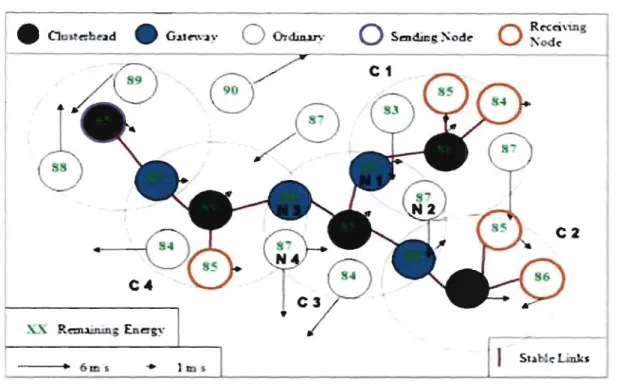
Figure 2 - RSIDS Clustering; ... 33
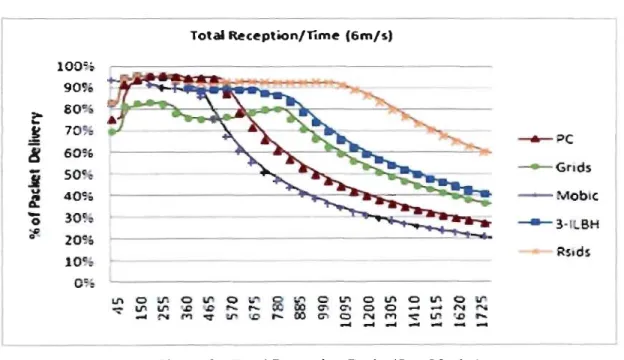
Figure 3 - Total Reception Ratio (5 to 20, 6m) ... 35
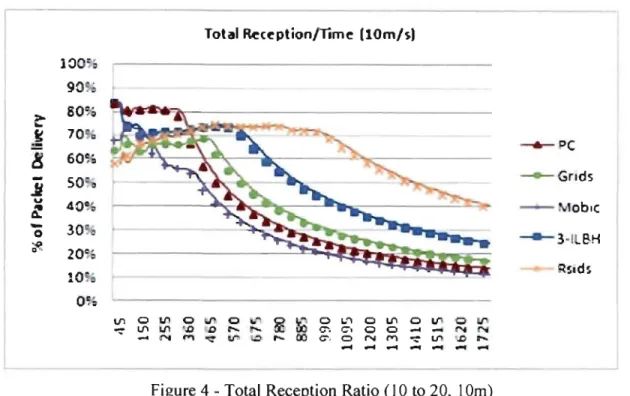
Figure 4 - Total Reception Ratio (10 to 20, lOm) ... 36
Figure 5 - Periodic Packet Reception Ratio (5 to 20, 6m) ... 37
Figure 6 - Periodic Packet Reception Ratio (1
°
to 20, 1 Om) ... ,. 38Figure 7- Remaining Energy (5 to 20, 6m) ... .39
Figure 8 - Remaining Energy (10 to 20, 10m) ... 39
Figure 9 - OverheadlDataRatio (5 to 20, 6m) ... 41
Chapter 4 Figure 1 - Mesh broadcasting Multicast Announcements ... , ... '" ... 52
Figure 2 - PUMA showing Data Packet Overhead ... 58
Figure 3 - CPUMA after Centering the Core ... 59
Figure 4 - Packet Delivery Ratio ... 62
Figure 5 - Control Overhead ... 63
Figure 6 - Data Packet Overhèad ... 64
Figure 7 - Latency ... 65
Abbreviation List
Acronym
AODV CH CHR CPUMA GPS GRIDSGW
ILBH MA MACT MANET MAODV MOBIC MODA NS-2 ON PC PDR PUMA ROMANT RREQ RREP RSIDSTIL
Description
Ad-Hoc On Demand Distance Vector Cluster Head Node
Cluster Head Ready Node
Centered Protocol for Unified Multicasting through Announcements
Global Positioning System
GeographicaUy Repulsive Insomnious Distributed Sensors Gateway Node
Interval-Based Load Balancing Heuristics Multicast Announcement
Multicast Route Activation Packet Mobile Ad-hoc Network
Multicast Ad-Hoc On Demand Distance Vector Mobility Based Metric for Clustering
Multicasting on Directional Antennas Network Simulator 2
Ordinary Node Passivé Clustëting Packet Delivery Ratio
Protocol for Unified Multicasting through Announcements Robust Multicasting in Ad hoc Networks using Trees Route Request
Route Reply
Restful Stability based Insomnious Distributed Sensors TimeTo Live
xiii
To my parents.
To my grand-mother.
To my sister.
Acknowledgements
First of aIl, 1 would like to express my gratitude to my research director Dr. Abdelhakim Hafid who took time out of his busy schedule and personal time to offer advice, read and comment my articles. 1 thank him for being patient and understanding.
Thanks to my family, especially my mother Marie-Thérèse Astier and father Roland Astier for their love, generosity and trust in my abi1ities. Additional1y, 1 would like to thank my sister Hélène Astier and my brother Guillaume Astier for aIl their encouragements.
AdditionaIly, 1 thank Sidney Santos Doria, an alumnus from Federal University of Campina Grande for providing the initial NS-2 code for PUMA. FinaIly, 1 give my gratitude to everyone that supported me especially my friends and the University of Montreal administrative staff.
Chapter 1: Introduction
1.1 Mobile Ad Hoc Networks
Technological advanced in wireless data communication devices has led to their widespread use. Every year priees decline and these devices improve. Newer wireless devices are capable of data rates greater than sorne wired infrastructure and have a range of approximately 70 meters. Turn on the wireless card of any computer near an apartment building and you are bound to find multiple wireless networks. Most of these networks are configured so wireless devices connect to a wireless router which enables communication between nodes. If a device is not within range of the router it will not be part of the network. There is an alternative way to create a wireless network, the ad-hoc network. In an ad-hoc network, wireless devices connect and communicate with each other without the use of a base station or any kind of pre-existing wireless infrastructure.
Mobile ad-hoc networks (MANETs) are infrastructure-less, dynamically reconfigurable wireless networks. In order for a MANET to operate, hosts have to be willing to serve double duty as routers. Nodes participating in a MANET have to forward, packets from the source to the destination. In essence the nodes become the infrastructure. MANETs have the advantages of: 1) being created as needed, 2) fault tolerance, since the loss of any one node may not impact the network if another route can be found and 3) unconstrained connectivity since it is not limited to the range of the wireless router.
Typical applications in a MANET require the nodes to work as a group. Mlich interest is focused on applications sharing a close degree of collaboration between nodes, such as disaster recovery, crowd control, search and rescue, coordinated task scheduling or several battlefield communication schemes where no infrastructure-based topology is available. The main benefit of a MANET is its ease of deployment and support for communication between mobile users from anywhere. Besides data and information sharing in difficuIt terrains, an increasing demand for commercial 'community-centric' applications like multiplayer gaming through handheld
portable--devices is emerging. Other applications, such as sharing information in classrooms, conference rooms, metro-areas and much more are in demand as weIl.
Since nodes forward packets for each other without a wired or wireless infrastructure, a routing protocol is needed to make routing decisions. Deciding the correct route for a packet to take is made more difficult because nodes are free to move around. The route just taken may no longer exist if anode moves out of range of the others along that route. Any node along the route may also simply run out of energy and stop transmitting, or be so overloaded that it no longer has the ability to forward any more packets.
Since sorne of the applications, MANETs are asked to handle, require nodes to work in a group, nodes must be able to route data to a group of other nodes. Anode may send the same data to the group of nodes one at a time, but it would be a terribly inefficient way to do it. This routing scheme is called unicast and basically means a transmission to a single destination. Anode required to transmit data to a group of 5 other nodes would have to send 5 separate transmissions. These wou Id be forwarded up to five times by nodes along the routes to the five destinations. A more efficient way to communicate with a group is to use a multicast routing scheme. In a multicast transmission anode forwards data to a group of nodes simultaneously going over links in the network just once. The data packet transmitted is forwarded only once by any node along the routes to the five destinations. The path splits only when it is necessary in order to reach aIl group members. Figure 1 below illustrates the two routing schemes. Efficiency is important in MANETs because mobile nodes are normally un-tethered to a power source. In scenarios such as search and rescue missions in a dîsaster area or combat duty, nodes must make do with the battery energy available to the device.
Source
5 point-to-point connections
Unicasting same data to 5 nodes
Router Destinations
connection
Multicasting same data to 5 nodes
Figure 2 - Unicast and Multicast
1.2 Multicast Protocols
A multicast protocol is a set of ru les that govem the routing decisions of multicast transmissions. As a general rule, one of the major goals in designing multicast protocols for wireless networks is to reduce unnecessary packet transmissions to nodes outside the multicast group. Many methods have been produced for multicast transmission in MANETs. The four general categories of multicast protocols are Meshed-based, Tree-based, Hybrid and Stateless.
Mesh-based protocols transmit data packets over more than one link, trading redundancy in data transmission for high robustness. Pure flooding is an extreme form of a mesh-based protocol where packets are forwarded by ail nodes. Tree-based protocols create multi hop routes that trade robustness for efficiency and reduce data pack et overhead. This robustnessJefficiency tradeoff is a key issue in mobile ad hoc network multicasting. Hybrid protocols combine meshes and trees in an effort to enhance the positives of each method. Stateless protocols are meant for small multicast
groups only and are not suited for large MANETs. In fact, most ofthese protocols have difficulties scaling when faced with the control and data packet overhead of hundreds ofnodes.
1.3 Clustering
One addition to multicast protocols for improving scalability is cl ustering, or hierarchical architecture, which is essential to achieve basic performance guarantees in large-scale MANETs. Under a cluster structure, nodes are placed into groups by assigning them different roles such as clusterhead (CH), gateway (GW) or ordinary
\
(ON) member. Typically, an entire multi-hop MANET is divided into a number of clusters which are ail independently controlled and dynamically reconfigured as nodes-move. Each node within a cluster performs a different function depending on its role. A CH or group leader normally serves as a local coordinator for its cluster as it performs intra-cluster transmission arrangement, forwards data and may be responsible for route maintenance within its own group and between other clusters. A GW maintains inter-cluster links 80 it can access neighboring clusters and promote information sharing
between them. The other cluster-members within the CH transmission range are usually called ordinary nodes. The cluster architecture improves the scalability by reducing the number of mobile nodes participating in sorne routing algorithm, which in tum significantly reduces the routing-related control overhead. Other advantages are less chances of interference via coordination of data transmissions and more robustness in the eventof node mobility by judiciaJJy selecting stable nodes as CHs and GWs.
1.4 Motivation
Opinions are generaJJy divided on the question of how to set up clusters. It can be asserted that five major objectives influenced published clustering schemes, namely forming a dominating set, having low-maintenance, performing load-balancing, and
being mobility-aware or energy-efficient. Depending on their objective, proposed schemes sometimes make assumptions that may not be applicable in aCtual scenarios or sometimes exploit solely one side of critical tradeoffs like stability and energy-balancing.
Sorne energy-efficient clustering algorithms are more effective in networks with a large population and high density, but fail to consider mobi1ity and are only suitable for low-mobility environments such as sensor networks. In sorne mobility-aware clustering algorithms, critical nodes perform extra work and can easily become single points of failure as they die early because of excessive energy consumption. The death of mobile nodes due to energy depletion may cause network partition and communication interruption.
It is important to balance the ene~gy consumption among the mobile nodes to avoid node failures, especially when the nodes running out of power bear special tasks. The extra energy consumption is caused by data and control packet overhead from both the clustering algorithm and multicast protocol.
There are many proposed wireless multicast routing protocols, but there is no standard. Sorne of the proposed protocols are susceptible to routing loops. Routing loops cause packets to be transmitted continuously in a loop, degrading the network and causing packets to never be delivered. Sorne protocols break down in high mobility MANETs. The rapidly changing network topology can cause sorne protocols to overwhelm the network with control packets as routes are rebuilt. Sorne routing protocols require the use of GPS (Global Positioning System) in order to function, which is not always available.
1.5 Problem Statement
In a MANET nodes have to account for the lack of an infrastructure by routing data packets between themselves. Figuring out how to route data packets from one node to another, or group of other nodes requires the use of control packets. These
control packets are overhead and lower the efficiency of the network. Data packets are transmitted along routes discovered by control packets to get from the source to one or multiple destinations. These routes may not always be optimal causing data packets to be transmitted unnecessarily or redundantly.
Existing muIticast protocols use different techniques to try to reduce the amount of overhead required to successfully route data packets. Clustering techniques allow fewer nodes to participate in the routing function which reduces control packet overhead. CUITent solutions may perform weU with ~pecific applications. However, fin ding an optimal cluster management process and multicast protocol that works well in all situations still remains a buming issue. This led us to study the key attributes essential to provide a scalable and energy-efficient protocol for multicast routing.
1.6 Contributions
In our research, we focused on hierarchical multicasting with the aim of reducing control and data packet overhead. We propose (1) a new clustering technique, called Restful Stability based Insomnious Distributed Sensors (RSIDS) [10], to reduce control overhead; and (2) a new multicast protocol, called Centered and Robust Multicast Routing in Mobile Ad Hoc Networks (CPUMA) [11], to reduce data packet overhead.
RSIDS [10] is a clustering technique that takes both the remaining power of network nodes and the stability of anode within its cluster to account for mobility. RSIDS takes advantage of the benefits of prior algorithms and addresses their shortcomings. Mobility Based Metric for Clustering (MOBIC) [1] uses active clustering, which creates additional control packets and consumes greatet atnOunt of
energy than the Passive Clustering (PC) algorithm [2]. In PC however, CRs and GWs work more and lose power faster than other nodes causing an "early die" problem. Geographically Repulsive Insomnious Distributed Sensors (GRIDS) [3] reduces this problem by using nodes that contain the greatest amount of energy as the critical nodes.
It changes the status of nodes based on energy but does not take into account the
6
stability of the nodes in the cluster. As the CH and GW statu ses of nodes change, forwarding routes have to be recreated resulting in increased control packets. Our algorithm addresses these problems by making use of passive clustering to eliminate additional control packets, opportunistic rest periods for critical nodes to eliminate the "early die" problem, and makes use of the Stability metric to reduce the recreation of forwarding routes.
CPUMA [11] is a mesh-based multicast routing protocol that centers the core of the mesh to be close to the source nodes. It implements a distributed a'gorithm to periodically re-elect the core node. We center the mesh using hop COllOt data gathered from data packets, instead of using GPS or any pre-assignment of cores to groups: Multicast data packet forwarding is directed toward the nearest mesh member to increase robustness. Nodes on the periphery of the mesh do not needlessly rebroadcast data packets received from nodes closer to the core. Our protocol reduces latency, traffic and data packet overhead compared to the PUMA [7] protocol.
This thesis is presented in article format. The first conference paper Energy and Mobility Aware Clustering Technique, was accepted to IEEE WCNC 2009. The second conference paper, Centered and Robust Multicast Routing in Mobile Ad Hoc Networks, is submitted to IEEE Globecom 2009.
1.7 Thesis Organization
The rest of this thesis is organized as follows. Chapter 2 contains an overview of state of the art clustering algorithrns and rnulticast protocols. Chapter 3 presents (in artidé format) the first contribution of this thesis: a novel clustering technique that takes into . account the energy and mobility of the network nodes. Chapter 4 presents (in article format) the second contribution of this thesis: A novel mesh-based multicast protocol that centers the core of the mesh to be close to the source nodes. Finally, Chapter 5 concludes this work and presents future research.
Chapter 2: State of the Art
Without an existing infrastructure, nodes in wireless ad hoc netwotks rely on éâèh other's participation to forward packets and communicate. Routing is enabled by the use of control packets to discover paths from any one node to another or a group of other nodes. Networks come in a11 sizes and densities, and as the number of nodes participating in the routing of packets increases so does the accompanying control packet overhead.
Existing c1ustering algorithms aJ;tempt to solve the problems of multicasting in mobile ad hoc networks utilizing various techniques to limit the number of routing nodes. In this chapter, we review c1ustering; its benefits and costs~ Clustering-techniques using dominating sets and low maintenance c1ustering are assessed. We review a selection of clustering algorithms in the literature that, like our own algorithm, use mobility, energy and resting periods, and intluenced our research.
Second, we review the general categories of proactive and reactive multicast protocols as weIl as tree-based and mesh-based protocols. Achieving the maximum possible efficiency/robustness trade off in multicast routing is an area of ongoing research. We examine sorne of the positives and negatives of existing protocols.
2.1. Clustering: Definitions
Clustering is an important research topic for mobile ad hoc networks because c1ustering makes it possible to guarantee basic levels of system performance, such as throughput and delay, in the presence of both mobility and a large number of mobile terminais. A large variety of approaches for ad hoc c1ustering have been ptesentéd, whereby different approaches typica11y focus on different performance metrics.
Sorne of these approaches to c1ustering in MANETs are: Dominating Nodes Set -based c1ustering aim at finding a (weakly) connected dominating set to reduce the number of nodes participating in route search or routing table maintenance. Low-Maintenance clustering provides a cluster infrastructure for upper layer applications wÎth minimized c1ustering related maintenance cost. Mobility-A ware c1ustering uses
mobile nodes' mobility behavior for cluster construction and maintenance assigning mobile nodes with low relative speed to the same cluster to tighten the connection in such a cluster. Energy-efficient clustering avoids unnecessary energy consumption or balancing energy consumption for mobile nodes in order to pro long the lifetime of mobile terminaIs. Load-balancing clustering distributes the workload of a network more evenly into clusters by limiting the number of mobile nodes in each cluster in a defined range.
Motivation for i~plementing hierarchical routing algorithms is that they tend to be more scalable, due to their intrinsic characteristics. Many approaches have been proposed to leverage the problem of scalability (the multicast service can scale up both vertically in terms of the group size and horizontally in terms of the number of groups). The MAODV algorithm scales in scenarios with h!gh amounts of sender nodes, but does not scale in scenarios of high mobility, high traffic load, high group size, or high number of multicast groups. The ODMRP algorithm scales in scenarios with high mobility and high group size, but does not scale in scenarios that contain high amounts of sender nodes, or high number of multicast groups [8].
In a clustering scheme the mobile nodes are divided into different virtual groups, and they are allocated geographically adjacent into the same cluster according to sorne rules with different behaviors for nodes included in a cluster from those excluded from -the cluster. It has been shown that a flat structure exclusively based on proactive or reactive routing schemes cannot perform weIl in a large dynamic MANET [9]. In other words, a flat structure encounters scalability problems with increased network size~ especially in the face of node mobility at the same time. This is due to their intrinsic characteristics. The communication overhead of link-based proactive routing protocols is 0(n2), where n is the total number of mobile terminaIs in a network. This means that the routing overhead of such an algorithm increases with the square of the number of mobile nodes in a MANET. For a reactive routing scheme, the RREQ (Route Request) flooding over the whole network and the considerable route setup delay become intolerable in the presence ofboth a large number ofnodes and mobility.
Benefits of Clustering
A èluStét Struéturé,
as
an éfféétivé topology éoiittol ihéâiiS, ptovidéS at lèàSt three benefits. A c1uster structure facilitates the spatial reuse of resources to increase the system capacity. With the non-overlapping multi-cluster structure, two c1usters may deploy the same frequency if they are not neighboring c1usters. Also, a c1uster can better coordinate its transmission events with the help of the CH residing in it. This can save much resources used for retransmission resulting from reduced transmission collision. Another benefit is in routin.g, because the set ofCHs and GWs normally form a virtual backbone for inter-c1uster routing, and thus the generation and spreading of routing information can be restricted to this set of nodes. Last, a c1uster structure makes an ad hoc appear smaller and more stable in the view of each mobile terminal. When a mobile node changes its attaching c1uster, only mobile nodes residing in the corresponding c1usters need to update the information. Thus, local changes need not be seen and updated by the entire network, and information processed and stored by each mobile node is greatly reduced.Costs of
Clusteri~gThe cost of c1ustering is a key issue to validate the effectiveness and scalability enhancement of a c1uster structure. By analyzing the cost of a c1ustering scheme-in different aspects quantitatively (any drop in packet reception for example), its usefulness and drawbacks can be c1early specified. Maintaining a c1uster structure in a dynamically changing scenario often requires explicit message exchange between mobilé nodéS. Whéii thé uiidérlyiiig iiétwork topology éhangéS quièkly and involvès many mobile nodes, the clustering related information exchange increases drasticaIly . . Frequent information exchange consumes considerable bandwidth and drain mobile nodes' energy quickly so that upper-layer applications cannot be implemented due to the inadequacy of available resources or the lack of support from related mobile nodes.
Sorne clustering schemes may cause the cluster structure to be completely rebuilt over the whole network when sorne local events take place, e.g. the movement· or "death" of a mobile no de results in lots of CH reelection and re-clustering. This is called the ripple effect of re-clustering. It indicates that the re-election of one CH may affect the structure of many clusters and may significantly affect the performance of upper-layer protocols in a negative way.
2.2. -Clustering: Schemes
Mobility Based Metric for Clustering (MOBIC)
MANETs consist of mobile nodes, and their mobility is the primary factor affecting topology changes and the' need to recreate routes. In order to form stable clusters, it is important to take mobility into account. By clustering mobile nodes that are flocking together, the intra-cluster links can become more tightly connected. Re-routes and re-clustering would be decreased naturally. MOBIC selects mobile nodes .that are close and are staying close to their neighbors to be CHs [1].
The aggregate of the variance ofa mobile node's speed relative to its neighbors is the metric that MOBIC uses. A low value of this metric ifidicates a fiode is less mobile with regards to its neighbors and should therefore be granted CH duties.
MOBIC includes a cluster head contention timer that allows two CHs to pass each other for a short period of time before one of them takes over both clusters. This meChaIiism rrouceS ifiCidental CofitâCt of two CHs CausiIig te-clustèrifig. OfiCe il fiodè has been deemed a CH it remains one unless its duties are taken over by another CH or the node dies. This means that the cluster is only guaranteed to have the node with the lowest mobility metric as the CH during cluster creation. Mobility is ignored after initial cluster creation. It is therefore not suitable for long lasting networks with mobile nodes ofvarying speed.
Passive Clustering (PC)
Passive Clustèting (PC) does not uSe dedicated control packets or signàls for clustering. It uses data traffic forwarding to construct and main tain the cluster architecture. In PC, a mobile node can be in one of the following four states: initial, clusterhead, gateway, and ordinary node. AlI the mobile nodes are with 'initial' state at the beginning. Only mobile nodes with initial state have the potential to be CH. When a potential CH with initial state has something to send, such as a flood search, it declares itself as CH ~y. piggybacking its state in the packet. Neighbors can learn the CH status by monitoring the 'cluster state' in the packet, and then record the CID and the packet receiving time. A mobile node that receives a claim fromjust one CH becomes an ON, and a mobile node that hears more claims ,becomes a GW. Since PC does not send any explicit clustering-related message to maintain the cluster structure, each node is responsible for updating its own cluster status by keeping a timer. For example, when an ON does not receive any packet from its CH for a given period, its status reverts to 'initial' [2].
.PC perfonns weIl in a high mobility network where cluster topology changes frequently. PC is immune from increased control overhead due to frequent changes in network topology. It is howevet dependent on traffic for it to fonction. PC expériences problems maintaining the cluster structure in low traffic networks or networks that experience intennittent periods of high traffic followed by low traffic. In those scenarios the cluster will not be ready to route and forward data.
Geographically
Repulsive
Insomnious
Distributed
Sensors
(GRIDS)
.GRIDS (Geographically Repulsive Insomnious Distributed Sensors) builds upon Passive Clustering by an efficient node status selection algorithm of critical and non-critical nodes without the. periodic maintenance requirement. It adds the status and remaining energy of anode to the sent packet which are then used by receiving nodes to
select no de statuses. Node status is limited to clusterhead, clusterhead ready, gateway, ordinary and initial status. GRIDS inherits many advantages from Passive Clustering: it do es not require any protocol dependent control packet. WeIl distributed insomnious nodes are guaranteed in any density of sensor networks. GRillS is especially useful when there is a data sink which polIs sensor information periodically [3].
GRIDS uses the Number ofCHs and the Number ofGWs to determine the next status of anode when a status change condition is met. If the Amount of CHs is greater the node will change to a GW, otherwise it becomes an ON. In GRillS a CH and clusterhead ready node will trigger a status change upon hearing from a CH with greater energy. An ON and a GW will trigger a status change upon hearing from any neighbor node that changes its count of CH and GW neighbors. Ordinary nodes and GWs will also ch~ge status to initial status if th~y do not hear from a CH in time defined by a Cluster Head Timeout. Initial status and clusterhead ready status are temporary and quickly replaced. Initial status is replaced upon hearing from a neighbor and Cluster Head Ready status is replaced upon sending or hearing from a neighbor. A CH and GW node act similarly in th~t they forward packets and therefore consume more energy than ONs which is the only status that does not forward packets.
Interval-Based Load Balancing Heuristics (ILBH)
ILBH (Interval-based Load Balancing Heuristic) is a heuristic to be used in conjunction with PC (Passive Clustering), which tries and reduce the overall energy consumption so that it extends the lifespan of the network. To avoid the "early die" problem of critical nodes, CHs and GWs should have a preventive mechanism which avoids critical nodes from consuming aIl their limited battery power. The primary function of the mechanism is to force critical nodes which served a certain period to
change to 'ordinary' state and to prevent those nodes from being elected as critical node right away. In addition to the clustering status policing, ILHB switches the nodes from
their active state to another "sleep" state where their energy consumption is minimal [4]. ILHB defines two thresholds a*battery (battery represents the capacity of the node battery) and ~*battery according to the local information of no de batteries (0< a <
~ <1). When anode has not reached the first threshold and after the second threshold (refonnulate) (i.e., energy consumed so far is sm aller than a*battery), it operates nonnall y as in original PC. The proposed heuristic consists of (a) changingthe state of anode to 'sleep' and maintaining this state during [Tl, T2] where Tl is the time the energy consuIl}ption of the node reaches a*battery and T2 is the time the ener-gy consumption reaches ~*battery; and (2) decreasing the node's listening and reception time between the interval [Tl, T2] to reduce energy consumption. These changes- will allow only the nodes that have not reached a*battery (or have reached ~*battery) to become CH or GW nodes executing ori.ginal PC; indeed, a node in 'sle~p' state cannot change its state until its consumption reaches ~*battery.
Intuitively, the_ proposed heuristic will allow 'balanced' distribution of energy consumption; it forces nodes with high energy consumption to 'sleep' and nodes with .low.energy consumption to forward data by becoming CHs or GWs. It is obvious that the proposed heuristic will generate more control traffic (e.g. when used with AODV); when anode reaches the first threshold, it changes to 'sleep' state (e.g. from CH) and extra-traffic is generated to re-cluster the network (e.g., to detennine an alternative path in AODV). Simulations [4] show that even with this overhead the network lifetime is
consider~bly increased when using ILHB.
2.3. Multicast Routing: Definitions
Since not aIl nodes in a MANET can communicate with each other directly it may .be--necessary for a data packet to be forwarded multiple times before it reaches its destination. Routing protocols perfonn the function of selecting which nodes will forwardpackets along to their destination. Multicast routing _ protocols may be proactive or reactive. A proactive protocol wiH try to maintain routes to aH possible
destinations, so when a packet needs to be sent or forwarded, the route is already known. Periodic control packets are broadcasted to announce and maintain routes. Reactive protocols search for routes only as needed. Reactive protocols have intermittent bursts of control packets instead of the steady flow ofproactive protocols.
Most multicast routing protocols are Meshed-based or Tree-based. In a mesh-based protocol nodes in a multicast group form a mesh in conjunction with the nodes between them. Data packets are transmitted by aIl mesh members and can reach their destination via more than one path. Ifone patn is broken, otner patns are still able to deliver the multicast data packet. Control packet overhead is low, but data packet overhead is since mesh-based protocols trade efficiency for increased robustness from redundant packet delivery. Protocols that use the senders to maintain the mesh have the disadvantage ofrequiring multiple control packet floods per multicast group. One or more multicast group memhers can also he selected as the group leader to maintain the mesh avoiding the multiple control packet flood disadvantage.
Tree-based protocols forward data packets along a single route. They offer efficiency and have less data packet overhead than mesh-based protocols. However, tree-based approaches trade this efficiency for the lack of robustness in dynamic environments. Highly mobile nodes wreck havoc on tree structures and require constant maintenance.
2.4. Multicast Routing: Protocols
Multicast Ad Hoc On-Demand Distance Vector (MAODV)
MAODV is a weIl know multicast routing protocol that creates a bi-directional shared tree for each multicast group connecting senders and receivers. Loop freedom is ensured by the use of group sequence numbers. The first node to join a group in each multicast tree is the group leader. Receivers join the tree by broadcasting a route request join packet which is responded to with route reply join packet when a tree
member is found. Nodes along the path to the source node that received RREQs add routing entries when they receive RREPs creating the forwarding path.
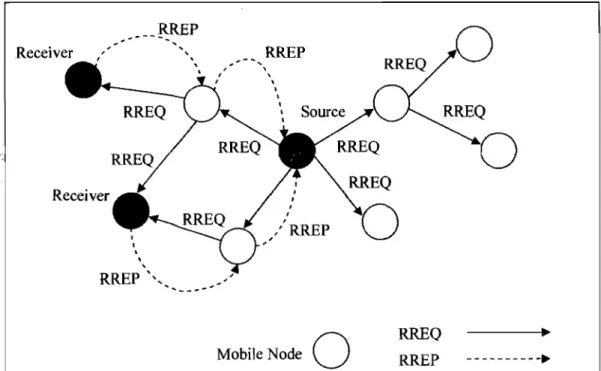
The freshest route with the highest sequence number and least amount of hops to the tree is grafted to the tree by a multicast route activation packet [5]. MACT packets are forwarded activating the braneh until they reaeh a node on the tree. The group leader transmits group hello packets to maintain the tree. If a link breaks, the node furthest from the group leader will try to repair the broken Iink. Links are repaired only when broken, and over a period oftime the tree will not he optimal. The tree becomes vulnerable to more Iink breaks. MAODV experienees high levels of overhead when repairing broken links in a high mobility and high traffie load scenario. The need" to constantly repair the tree causes control packet overhead to overwhelm the network and degrade performance significantly. Figure 2 shows the process for Route Requests and" Route Replies in MAODV.
RREP ...
----
...--
.... , RREP , , , • Mobile Node0
RREQ RREP---.
Figure 2 -MADDV Route Requests and Route Replies
Robust Multicasting in ad hoc networks using trees (ROMANT)
ROMANT is a tree-based protocol that implements a distributed algorithm to elect one of the receivers of a group as the core of the group, and to inform each no de in the network of one or more next hops to the elected core of each group. Every no de has one or multiple paths to the elected core. Every receiver connects to the core along the shortest path and these paths form the tree. Senders send data packets to the group,
along the shortest path between the sender and the core. Once the data packet reaches a tree-member, it is flooded within the tree [6].
ROMANT uses core announcement and join announcement control packets. Core announcements contain the sequence number; address of the group, address of the core, distance to the core and the sending node address. Core announcements originate from the elected core node every three seconds and propagate to every node in the network. loin announcements contain the sender, group address and the parent of the node sending the announcement. loin announcements are transmitted every three seconds by receivers and their parent nodes along the shortest path on the tree toward the core. In this way the protocol rebuilds anoptimal tree every 3 seconds. If a broken link is detected between rebuilds, nodes can use altemate next-hops. Broken links in the branches of the tree result in packets being lost. This is a Iiability of ail tree-based protocols.
Protocol for Unified Multicast Announcements (PUMA)
PUMA is a mesh-based protocol that evolved from ROMANT and simplified control overhead packets to just a single type: the Multicast Announcement (MA). The MA contains a sequence number, the address of the core, the distance to the core, a mesh member flag, and a parent address which is the preferred next hop from anode toward the core. The MA is used to elect cores, join and leave the mesh, update the mesh and allow nodes outside of the mesh find routes toward the core. MAs emanate from the core and are periodically transmitted. Each node that receives the MA, waits
for a short period of time and transmits its own MA. These MAs transmitted throughout the network create connectivity lists that store one or more routes from each node to the core [7].
Cores are elected by a distributed algorithm that selects the highest node id claiming core status. Anode without a route to a multicast group core declares itself as the core and transmits a MA to its neighbors. Once a core is chosen, it remains the core unless the network is partitioned or the core fails. The neighbors propagate the best received MA, considering a high node ID better than a low node ID. Each receiver connects to the core along ail the shortest paths between it and the core forming a mesh with ail the nodes along the shortest paths to the core. The parent address field in the MA allows non-members to forward multicast data packets towards the core.
Multicasting on Directional Antennas (MODA)
MODA is a mesh-based protocol that evolved from PUMA. It makes use of directional antennas to reduce data packet overhead. It does this by using GPS to set the core at the center of the mesh and covering two hops instead of one when forwarding data packets. Each sender tries to forward data packets to anode two hops closer to the core of the mesh. Once the core node receives the data packet it makes multiple transmissions in different directions to reach nodes two hops away from it. Nodes one hop away also receive the transmission but do not need to rebroadcast the data packet lowering data packet overhead [8].
Nodes are expected to know their location and the locations of their neighbors as weil as the locations of the neighbors of their neighbors. However, the algorithm requires nodes to use GPS to know these locations which is not al ways available or may be non-functional inside structures.
2.5. Conclusion
ln this chapter, we reviewed existing clustering algorithms and multicast protocols for MANETs. ln the literature, several clustering algorithms were proposed; they use node mobility or remaining energy as the primary factors in cluster construction and maintenance, but not both. The en erg y aware algorithms used different methods to distribute energy consumption but did not pay much attention to the forwarding route reconstruction required when promoting or demoting critical nodes. Several routing protocols were also proposed that balanced efficiency and robustness but left room for improvement in both areas and did not focus on reducing latency beyond pro-active routing. An attempt to center the mesh was proposed, but it required the use of GPS.
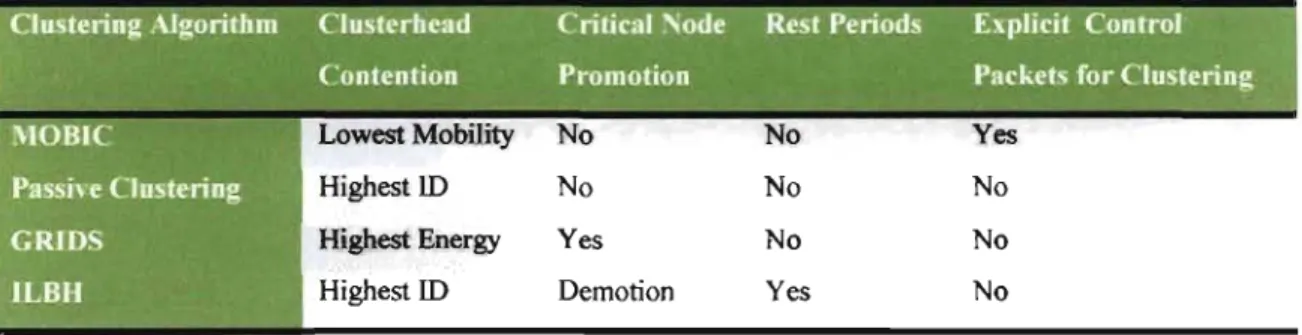
Table 1 is an outline of the properties of the clustering algorithms reviewed. The clustering algorithm (RSIDS) proposed in chapter 3 uses highest energy for clusterhead contention to maintain high energy clusterheads, stability for critical node promotion to reduce the recreation of forwarding routes, rest periods to distribute energy consumption and do es not require explicit control packets for clustering.
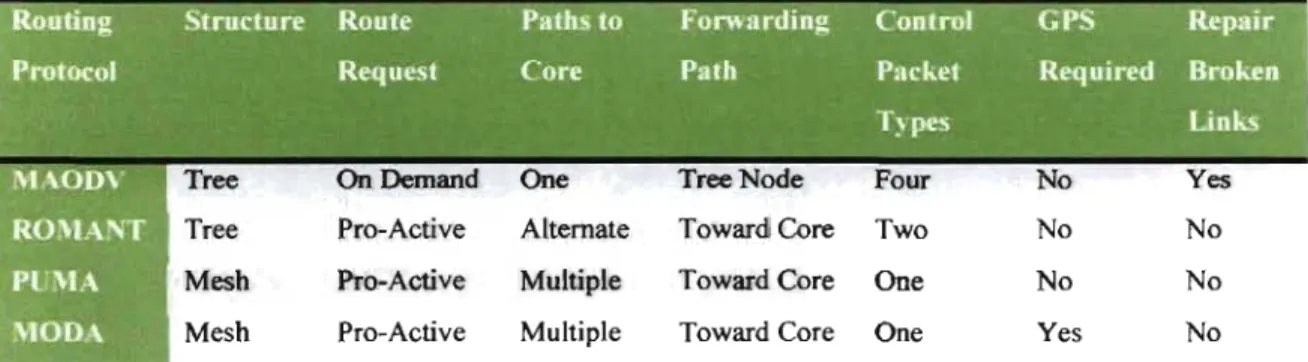
Table 2 is an outline of the properties of the multicast routing protocols reviewed. The multicast routing protocol (CPUMA) proposed in chapter 4 uses a mesh structure for robustness, pro-active routing to lower routing delays, multiple paths to the core to reduce packet loss, forwarding paths that send data packets toward the mesh to reduce latency and improve robustness, a single control packet type to reduce overhead, source node hop counts to center the core without GPS, and has no need to repair broken links.
No Yes Demotion No No Yes Table 1 - Clustering Aigorithms
No No No
Pro-Active Pro-Active Pro-Active Altemate Multiple Multiple
Toward Core Two Toward Core One Toward Core One
Table 2 - Multicast Routing Protocols
No No Yes No No No 20
Chapter 3:
Energy and Mobility Aware Clustering Technique
for Multicast Routing Protocols in Wireless Ad Hoc Networks
Background
Since multicast ad hoc networks lack a physical infrastructure, they rely on nodes to participate in the routing of data packets. To enable routing, control packets are used to discover paths from the sender node to one or more receiving nodes. As networks grow in number of participants, control packet overhead increases significantly. Clustering is a method used to limit the nodes engaged in the network routing function and thus lower overhead. In this chapter, we address the issue of control overhead in MANETs by proposing a new clustering algorithm called Restful Stability based Insomnious Distributed Sensors (RSDIS).
RSIDS uses a combination of stability-based metrics, passive clustering techniques, rest periods and energy balancing techniques to create and maintain the cluster. It creates a stable cluster hierarchy that lowers control overhead and extends network lifetime.
In the simulations we compare the total and periodic packet delivery ratio, overhead, and remaining node energy of RSIDS with existing clustering algorithms. This work is presented here in article form, titled "Energy and Mobility Aware Clustering Technique for Multicast Routing Protocols in Wireless Ad Hoc Networks".
It was accepted to the IEEE Wireless Communications & Networking Conference (WCNC) 2009.
22
Energy and Mobility Aware Clustering Technique for Multicast
Routing Protocols in Wireless Ad Hoc Networks
Abstract
Astier Eric, Abdelhakim Hafid, Abderrahim Benslimane
Network Researeh Laboratory, Université de Montréal CP 6128 suce Centre-Ville Montréal, QC, H3C 3J7, Canada
A number of key issues arise in the implementation of scalable multicast protocols for wireless mobile ad hoc networks (MANETs), namely energy consumption and data delivery over unstable/mobile nodes. To improve scalability of these protocols, clustering has been proposed. Clustering allows reducing the number of mobile nodes participating in multicast routing algorithms, which in tum significantly reduces the routing-related control overhead. In this paper, we propose a clustering algorithm, called RSIDS (Restful Stability based Insomnious Distributed Sensors), which considers both stability and residual energy of neighboring nodes when selecting critical nodes (i.e. cluster heads and gateways). RSIDS uses Passive Clustering (in opposition to active clustering) to form the clustering structure. The critical nodes selection enables the selection ofmost stable nodes with high residual energy as critical nodes; the goal is to minimize re-clustering (and thus re-branching for multicast protocols) that may generate considerable overhead and packet losses and increase the lifespan of the network. We show, via simulations, that RSIDS outperforms existing clustering schemes, in terms of packet delivery ratio and network lifetime, when used with the MAODV (Multicast Ad hoc On demand Distance Vector) routing protocol.
Keywords- MANETs, Multicast Routing Protocols, Mobility, eluster, Network Lifetime, Energy Aware, Stability. MAODV.
1. Introduction
Ad-hoc networks are infrastructure-Iess, dynamically reconfigurable wireless networks that consist of nodes that act as routers and have different power constraints. In such an environment, we are facing the problem of providing a multicast routing protocol capable of handling host mobility and the various power restrictions of the nodes.
During the last few years, several approaches have been proposed to improve multicast communication in mobile environments. Depending on how the routes connect the multicast members with each other, we can basically distinguish four categories of protocols [3]; namely Meshed-based, Tree-based, Hybrid and Stateless multicast approaches. Sorne protocols allow data packets to be transmitted over more than one link by creating a mesh covering aIl group members to increase robustness , with the price of putting more redundancy in data transmission. On the other hand, tree-based approaches offer efficiency aiming at reducing the network load along with the overhead of duplicated packets and their ensuing collisions. Source or shared-tree based methods, however, lack robustness in dynamic environments. It must be acknowledged that this efficiency/robustness tradeotI raiseskey issues in ad hoc multicasting. Hybrid solutions aim to achieve better performance by combining the advantages of both tree and meshed-based approaches. Nevertheless, aIl these flat routing schemes have been shown to have limited scalability, due to their route discovery and maintenance procedures [1, 7]. Stateless multicast approaches focus on small multicast groups only.
To improve scalability ofthese protocols, clustering has been proposed. CJustering allows reducing the number of mobile nodes participating in routing algorithms (including multicast routing), which in tum significantly reduces the routing-related
control overhead. lndeed, only cluster heads and gateways (called critical nodes) forward trafflc, and therefore are part of the forwarding routes which allow nodes to reach each other. We combine clustering with tree-based multicast routing protocols like MAODV [2] by allowing aIl nodes to be at the originating point or receiving end of a multicast tree, but only allowing the critical nodes of the clusters to make up the routing nodes connecting them. Mobility aware clustering algorithms like MOBle [5], form stable clusters using critical nodes with low relative speed to each other in order to minimize the probability of re-clustering. However, these critical nodes perform extra work and can easily become single points of failure as they die early because of excessive energy consumption. This may cause network partition and communication interruption. Hence, it is also important to balance the energy consumption among the mobile nodes. ln energy aware clustering algorithms like GRIDS [8], energy is balanced by alternating the status of critical nodes that perfonn extra work and non-critica) nodes that have more energy left. However, this may cause additional re-clustering which increases overhead.
The usefulness of multicasting for group-oriented applications can be compromised in MANETs if we do not envision the use of a clustering scheme (a hierarchical routing algorithm) considering both nodes' mobility and residual power. To the best of our knowledge, there is no passive clustering scheme, in the open literature, which combines both metrics to overcome MANET limitations. This paper addresses the problem of designing energy and mobility aware clustering algorithm. Our motivation cornes from the fact that an energy-balancing clustering algorithm is promising, when applied to a tree-based multicast routing protocol, only if we take into account the robustness (Le. stability) of the routes. We make use of passive clustering [4] to eliminate clustering overhead (in opposition to active clustering), opportunistic rest periods for critical nodes to eliminate the "early die" problem, and a stability metric to reduce re-clustering and thus re-branching of the multicast tree structure. We
\-evaluate the proposed clustering scheme when used with MAODV [2] to support multicast and compare it with 4 other schemes.
The remainder of the paper is organized as follows. Section 2 presents related work. Section 3 describes details of the proposed clustering scheme. Section 4 demonstrates the effectiveness of the scheme via simulations. Section 5 concludes the paper.
II. Related Work
Mobility is a prominent characteristic ofMANETs and is the main factor affecting topology changes and routes' invalidation. Thus, it is important to take the mobility metric into account in the construction of clusters in order to form a stable cluster structure. Mobility-aware clustering indicates that the cluster structure is computed based on the mobility behavior of network nodes. The basic idea is that by grouping mobile nodes with low relative speeds into the same cluster, the intra-cluster links become more tightly connected and thus the re-clustering rate naturally decreases.
In the cluster formation phase of MOBIC [5], each mobile node sends two consecutive messages to each of its direct neighbors to help that neighbors compute their relative speeds. Then, each mobile node calculates its own aggregate local mobility and broadcasts this information to its neighbors. AIso, since MOBIC has an overlapping cluster structure, a mobile node may broadcast more than one cluster-related message (cluster-cluster-related status) during the cluster formation procedure. The downside is the need for extra explicit message exchanges among mobile nodes for maintaining the cluster structure. When network topology changes frequently, it results in frequent cluster topology updates, and the control overhead for cluster maintenance increases drastically. This maintenance may consume a large portion of the network bandwidth, drain mobile nodes' energy quickly, provoke collisions and congestions, and override its improvement of the network scalability and performance. Hence, it is important to reduce the communication overhead caused by cluster maintenance.
Passive Clustering (PC) [4] is a clustering protocol that does not use dedicated clustering-protocol-specific control packets; it constructs and maintains cluster architecture based on data traffic forwarding. PC is suitable for a dense network with high mobility, where mobile nodes' continuous movement weatl~ affects the cluster
topology. This is because the cluster maintenance of PC is traffic-dependent and immune from increased control overhead caused by frequent changes of c1uster structures. PC does not make use of mobility or energy metrics which leads to critical nodes using more energy shortening the network lifetime; indeed, PC suffers from the "early die problem".
GRIDS (GeographicaHy Repulsive Insomnious Distributed Sensors) [8] builds upon Passive Clustering and extends the lifespan of the network by using an efficient selection mechanism of critical (or not) nodes. GRIDS enables balanced energy consumption among the network nodes. Each node determines being insomnious or not based on its residual energy and the number of neighbouring insomnious nodes and their energy level.
In GRIDS, an energy abundant node can challenge cluster head and usurps the role. GRIDS uses the number of Cluster Head neighbors and the number of gateway neighbors to determine the next status of anode when a status change condition is met. However, the frequent status changes of critical nodes forces forwarding routes (and thus multicast tree structures when used with a multicast protocol) to be recreated.
In [9] the authors propose a heuristic (called ILBH and a derivative 3-ILBH) that can be used with PC in order to balance energy consumption of the network nodes; the goal is to balance energy among nodes and thus to extend the network lifetime. Two thresholds a*battery_capacity and p*batterr_capacity (0<
a
< ~ <1) are defined so that when anode reaches the first threshold, it changes its state to "sleep" until it reaches the second threshold. During this time interval, the node decreases its listening and reception time to balance energy consumption and becomes an Ordinary Node. This compulsory status change will force the reconstruction of clusters and thus of multicast trees.MOBIC uses active clustering, which creates additional control packets and consumes greater amount of energy than PC. However, in PC, Cluster Heads and Gateways work more and lose power faster and therefore die earlier than other nodes causing an "early die" problem. GRIDS eliminates this problem by using nodes with
the most residual, energy as the critical nodes. It changes the status of nodes based on energy but does not take into account the stability of the nodes in the cluster. 3-ILBH helps balancing energy consumption but can also force forwarding routes to be reconstructed when CHs and/or GWs are forced to sleep. In this paper, we propose an algorithm that addresses the problems of existing clustering schemes by making use of passive clustering to eliminate additional control packets, opportunistic rest periods for critical nodes to eliminate the "early die" problem, and a stability metric to reduce the recreation of forwarding routes. When used with MAODV it reduces re-branching the multicast tree structure required to deliver multicast data packets. We also make use of a derived version of 3-ILBH in order to avoid unnatural status changes and preserve established routes and thus multicast trees.
III. RSIDS Protocol Description
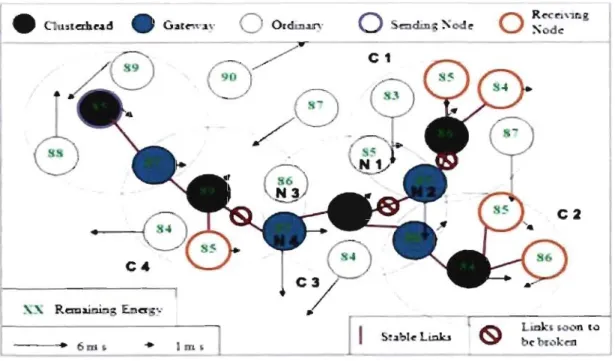
In this Section, we' present the details of the proposed clustering scheme called RSIDS (Restful Stability based Insomnious Distributed Sensors). Anode can be in one of the following 5 states: Initial, Cluster Head (CH), Cluster Head Ready (CHR), GateWays (GW), or Ordinary Node (ON). A CH is anode that is the center ofa cluster of nodes with a radius the length of the farthest node that can still receive packets from it. A GW is anode that can communicate with multiple CHs. ON is anode within the cluster that is not a CH or a GW. An Initial no de is anode that has not heard from any neighboring nodes. A CHR node is anode that has not heard from any CHs and is ready to send a message. These last two states are temporary.
CHs and GWs can both forward packets, while ONs do not. This leads to CHs and GWs using more energy than ONs due to their increase use as forwarding route nodes.
It is important to reduce the amount of energy spent in order to pro long the life of the network nodes and the ability of the network to communicate. To achieve a lower level of energy consumption, we use passive clustering instead of active clustering to create the network clusters. This eliminates the need for additional control packets and
completely eliminates the maintenance phase of active clustering which produces additional hello packets.
A. Stability Metrie
To compute the stability of anode nd, we start by finding out whether a neighbor nb is coming closer or moving away from nd. The distance d to nb can be estimated as
1
=
.J(Tx pr) where RxPr and TxPr correspond to the receiving (by nd) (Rxpr) .J(Rxpr) TxPr
d=
signal strength and transmission signal strength respectively. Friis' free space propagation model uses an inverse-square dependence of the ratio' of received and . transmit power on the physical distance between the transmitter and the receiver. An exact calculation of the distance may not be possible due to the difficulties measuring the transmission signal strength (involves accurate channel modeling). However, the ratio of RxPr from two successive packet transmissions can determine whether nb is moving closer or fartherto nd. The relative mobility of nb relative to nd is defined as
M::
(nd)
=
1010gIO RxPr:~nd
where RxPr:~~nb
is the strength ofthe previous signal RxPrnb~ndreceived and Rx Pr:::nh is the strength of the latest signal received by nd from nb. If
1
the newer RxPr is greater than the older RxPr, then the formula yields a negative value that indicates nd and nb are moving apart. If the newer RxPr is smaller than the older RxPr, then the formula yields a positive value which indicates nd and nb are moving closer to each other.
Stability S is defined as the variance to zero E of the set of relative mobility values
ofall the neighbors ofnd: S