HAL Id: hal-00145391
https://hal.archives-ouvertes.fr/hal-00145391
Submitted on 10 May 2007
HAL is a multi-disciplinary open access
archive for the deposit and dissemination of
sci-entific research documents, whether they are
pub-lished or not. The documents may come from
teaching and research institutions in France or
abroad, or from public or private research centers.
L’archive ouverte pluridisciplinaire HAL, est
destinée au dépôt et à la diffusion de documents
scientifiques de niveau recherche, publiés ou non,
émanant des établissements d’enseignement et de
recherche français ou étrangers, des laboratoires
publics ou privés.
VERNE machine
Daniel Kanaan, Philippe Wenger, Damien Chablat
To cite this version:
Daniel Kanaan, Philippe Wenger, Damien Chablat. Kinematics analysis of the parallel module of the
VERNE machine. The 12th World Congress in Mechanism and Machine Science, Jun 2007, Besançon,
France. pp.1-6. �hal-00145391�
Kinematics analysis of the parallel module of the VERNE machine
D. Kanaan
*Ph. Wenger
†D. Chablat
‡Institut de Recherche en Communications et Cybernétique de Nantes,
UMR CNRS 6597, 1 rue de la Noë, 44321 Nantes, France
Abstract—The paper derives the inverse and forward kinematic equations of a spatial three-degree-of-freedom parallel mechanism, which is the parallel module of a hybrid serial-parallel 5-axis machine tool. This parallel mechanism consists of a moving platform that is connected to a fixed base by three non-identical legs. Each leg is made up of one prismatic and two pair spherical joint, which are connected in a way that the combined effects of the three legs lead to an over-constrained mechanism with complex motion. This motion is defined as a simultaneous combination of rotation and translation.
Keywords: Parallel manipulators, Parallel kinematic machines, inverse kinematics, forward kinematics, complex motion.
I. Introduction
Parallel kinematic machines (PKM) are known for their high structural rigidity, better payload-to-weight ratio, high dynamic performances and high accuracy [1], [2], [3]. Thus, they are prudently considered as attractive alternatives designs for demanding tasks such as high-speed machining [4].
Most of the existing PKM can be classified into two main families. The PKM of the first family have fixed foot and variable–length struts, while the PKM of the second family have fixed length struts with moveable foot points gliding on fixed linear joints [5].
In the first family, we distinguish between PKM with six degrees of freedom generally called Hexapods and PKM with three degrees of freedom called Tripods [6], [7]. Hexapods have a Stewart–Gough parallel kinematic architecture. Many prototypes and commercial hexapod PKM already exist, including the VARIAX (Gidding and Lewis), the TORNADO 2000 (Hexel).
We can also find hybrid architectures like the TRICEPT machine from Neos-robotics [8] which is composed of a two-axis wrist mounted in series to a 3-DOF “tripod” positioning structure.
In the second family, we find the HEXAGLIDE (ETH Zürich) which features six parallel and coplanar linear joints. The HexaM (Toyoda) is another example with three pairs of adjacent linear joints lying on a vertical cone [9]. A hybrid parallel/kinematic PKM with three inclined linear joints and a two-axis wrist is the GEORGE V (IFW
* E-mail: [email protected] † E-mail: [email protected] ‡ E-mail: [email protected]
Uni Hanover).
Many three-axis translational PKMs belong to this second family and use architecture close to the linear Delta robot originally designed by Clavel for pick-and-place operations [10]. The Urane SX (Renault Automation) and the QUICKSTEP (Krause and Mauser) have three non-coplanar horizontal linear joints [11].
Many researches have made contributions to the study of the kinematics of these PKMs. Most of these articles focused on the discussion of both the analytical and numerical methods [12], [13].
The purpose of this paper is to formulate analytic expressions in order to find all possible solutions for the inverse and forward kinematics problem of the VERNE machine. Then we identify these solutions in order to find the solution that satisfies the end-user.
Fig. 1. Overall view of the VERNE machine
The VERNE machine is a 5-axis machine-tool that was designed by Fatronik for IRCCyN [14], [15]. This machine-tool consists of a parallel module and a tilting table as shown in figure 1. The parallel module moves the spindle mostly in translation while the tilting table is used to rotate the workpiece about two orthogonal axes. In the following three sections, we present the VERNE parallel module, its geometric equations and mobility analysis. Symbolic solutions of the inverse kinematics problem are reported in Section V. Section VI is devoted to the resolution of the forward kinematics problem. Finally a conclusion is given in Section VII.
II. Description and mobility of the parallel module
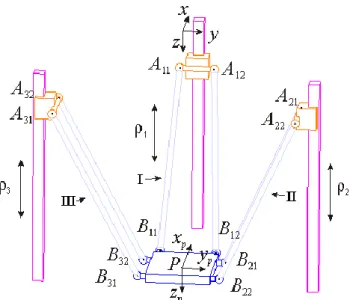
Fig. 2. Schematic representation of the parallel module
Figure 2 shows a scheme of the parallel module of the VERNE machine. The kinematic architecture can be described by a simple scheme shown in figure 3, where joints are represented by rectangles and links between those joints are represented by lines (P and S indicate prismatic and spherical joint, respectively). The moving platform is rectangular. The vertices of this platform are connected to a fixed-base plate through three legs Ι, ΙΙ and ΙΙΙ. Each leg uses pairs of rods linking a prismatic joint to the moving platform through two pair spherical joints. Legs ΙΙ and ΙΙΙ are two identical parallelograms. Leg Ι differs from the other two legs in that A A11 12B B11 12, that is, it is not an articulated parallelograms. The movement of the moving platform is generated by the slide of three actuators along three vertical guideways.
s
s
s
s
s
s
s
s
s
s
s
s
P
P
P
B
as
e
P
latf
o
rm
Fig. 3. Joints and loops graph of VERNE
Using the Grubler formula recalled in Equation (1), it can be proved that the mobility m of the platform is equal to three:
int 1 6 1 t N p t i i m N N f m
(1) where m denotes the mobility of the manipulator, Np is the total number of rigid bodies of the manipulator,11
p
N for 3 piston-rods, one base, one moving platform and 6 rods. Nt is the number of the joints, Nt 15 for 12 spherical joints S, 3 prismatic joints P. fi denotes the number of degrees of freedom (DOF) of the th
i joint, and
mint is the number of internal DOF, which do not influence the motion of manipulator.
Based on equation (1), the mobility of the platform is given by m6 11 15 1
39 6 3.Due to the arrangement of the links and joints, as shown in figure 2, legs ΙΙ and ΙΙΙ prevent the platform from rotating about y and z axes. Leg Ι prevents the platforms from rotating about z-axis but, because A A11 12B B11 12, a slight coupled rotation about x-axis exists.
III. Kinematic equations
In order to analyse the kinematics of our parallel module, two relative coordinates are assigned as shown in figures 2. A static Cartesian frame xyz is fixed at the base of the machine tool, with the z-axis pointing downward along the vertical direction. The mobile Cartesian frame,
P P P
x y z , is attached to the moving platform at point P and remains parallel to xyz.
In any constrained mechanical system, joints connecting bodies restrict their relative motion and impose constraints on the generalized coordinates, geometric constraints are then formulated as algebraic expressions involving generalized coordinates.
Fig. 4. Dimensions of the parallel kinematic structure in the frame supplied by Fatronik
Using the parameters defined in figure 4, the constraint equations of the parallel manipulator are expressed as:
xBijxAij
2 yBijyAij
2 zBijzAij
2Li2 0 (2) where Aij (respectively Bij) is the center of spherical joint number j on the prismatic joint number i (respectively on the moving platform side), i = 1..3, j = 1..2.Leg Ι is represented by two different equations (3) and (4). This is due to the fact that A A11 12B B11 12 (figure 4).
2 2 1 1 1 1 2 2 1 1 1 cos( ) sin( ) 0 P P P x D d y R r z R L (3)
2 2 1 1 1 1 2 2 1 1 1 cos( ) sin( ) 0 P P P x D d y R r z R L (4)Leg ΙΙ is represented by a single equations (5).
2 2 2 2 2 4 2 2 2 2 2 cos( ) sin( ) - 0 P P P x D d y R r z R L (5)The leg ІІІ, which is similar to leg ІІ (figure 4), is also represented by a single equation (6).
2 2 2 2 2 4 2 2 2 3 3 cos( ) sin( ) 0 P P P x D d y R r z R L (6)IV. Coupling between the position and the orientation of the platform
The parallel module of the VERNE machine possesses three actuators and three degrees of freedom. However, there is a coupling between the position and the orientation angle of the platform. The object of this section is to study the coupling constraint imposed by leg I.
By eliminating 1 from equations (3) and (4), we obtain a relation (7) between xP, yP and
independently of zP.
2 2 2 2 2 2 1 1 1 1 1 1 1 2 2 2 2 2 1 1 1 1 1 1 sin( ) 2 cos( ) sin( ) 2 cos( ) 0 P P R x D d r R r R y R L R r R r (7)We notice that for a given , equation (7) represents an ellipse (8). The size of this ellipse is determined by a and
b
,
wherea
isthe length of the semi major axis and b is the length of the semi minor axis.
2 2 1 1 2 2 1 P P x D d y a b (8) where
2 2 2 1 1 1 1 1 2 2 2 2 2 1 1 1 1 1 1 2 2 1 1 1 1 2 cos( ) sin( ) 2 cos( ) 2 cos( ) a L R r R r R L R r R r b r R r R These ellipses define the locus of points reachable with the same orientation .
V. The Inverse kinematics
The inverse kinematics deals with the determination of the joint coordinates as function of the moving platform position. For the inverse kinematics problem of our spatial parallel manipulator, the position coordinates (xP, yP, zP)
are given but the joint coordinates
i (i1..3) of theactuated prismatic and the orientation angle of the moving platform are unknown.
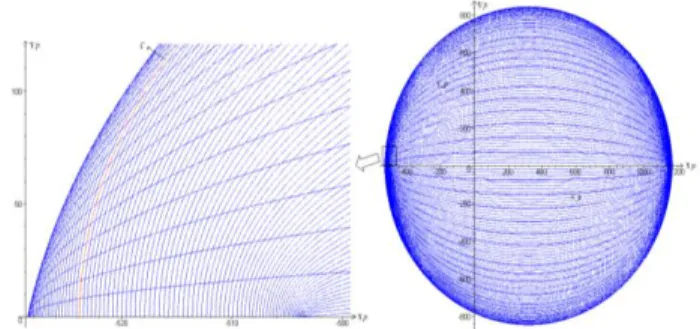
Fig. 5. Curves of iso-values of the orientation from - to
following a constant step of / 90.
To solve the inverse kinematics problem, we first find all the possible orientation angles for prescribed values of the position of the platform (xP, yP, zP). These orientations are determined by solving equation (9), a third degree characteristic polynomial in cos( ) derived from equation (7).
3 2
1cos( ) 2cos( ) 3cos( ) 4
p p p p (9) where
3 3 2 1 1 1 3 1 1 1 1 2 2 2 2 2 2 2 1 1 1 1 1 1 1 2 2 2 2 2 4 1 1 1 1 1 2 2 2 2 1 1 1 1 2 , 2 2 P P P P p R r p R r R r y p R L R r R x D d p R x D d R r y R L R r However this equation also represents ellipses of iso-values of . So if we plot all ellipses together by varying
from - to (figure 5), we notice that every point (defined by xP, yP and zP) is obtained by the intersection of two ellipses and each ellipse represent two opposite orientations so each point can have a maximum of four different orientations. This conclusion is verified by the fact that we can only find four real solutions to the polynomial (Table I).
, , 0 P P P P x y z y
1 and 2
, , 0 P P P P x y z y
0, 1,
TABLE I. the possible orientations for a fixed position of the platform
After finding all the possible orientations, we use the equations derived in section III to calculate the joint coordinates i for each orientation angle . To make this task easier, we introduce two new points A1 and B1 as the middle of A A11 12 and B B11 12, respectively.
2 2 2 1 1 1 2 2 2 1 1 1 2 1 1cos( ) 0 P P P x D d y z L R r R r (10)Then, for prescribed values of the position and orientation of the platform, the required actuator inputs can be directly computed from equations (10), (5) and (6):
2 2 2 1 1 1 1 1 1 1 2 2 1 1 2 cos( ) -P P P L R r R r z s x D d y (11)
2 2 2 2 2 2 2 2 2 2 4 sin( ) cos( ) P P P L x D d z R s y R r (12)
2 2 3 2 2 3 2 3 2 2 4 sin( ) cos( ) P P P L x D d z R s y R r (13)where s1, , s2 s3
1 are the configuration indices defined as the signs of 1 zP, 2 zPR2sin( ) ,3 zP R2sin( )
, respectively.Subtracting equation (3) from equation (4), yields: yP
R cos( )1 r =R sin( )1
1
1zP
(14)
1
1 1
P(14)sgn zp sgn sin( ) sgn R cos( ) r sgn(y ) This means that for prescribed values of the position and orientation of the platform, the joint coordinate 1 possesses one solution, except when
{0, }.
In this case s1 can take on both values +1 and –1. As a result 1 can take on two values when
{0, }.
0,
s1 1 1 1 p cos( ) y 0 with 0 R r 1 zp others s1 1 or -1TABLE II. the solution of the joint coordinate 1 according to the
values of
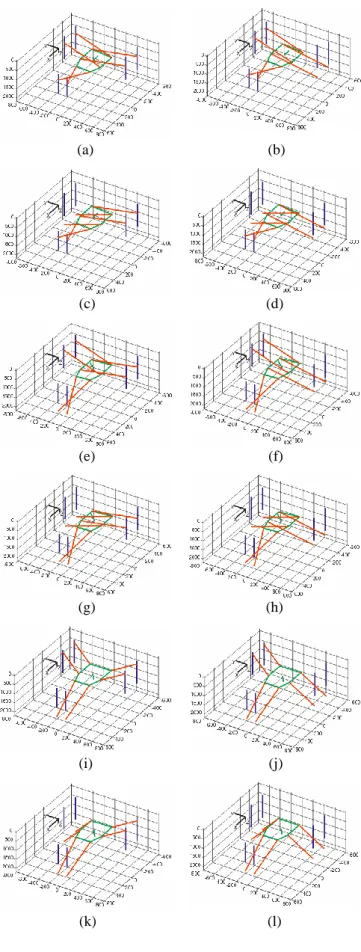
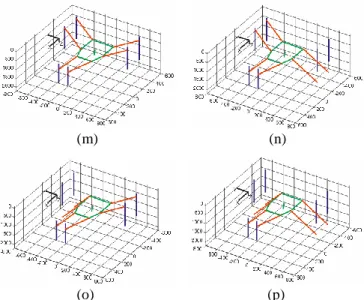
Observing equations (11), (12), (13), Table I and Table II, we conclude that the three legs, with four postures for leg Ι and two postures for leg ΙΙ and ΙΙΙ results in sixteen inverse kinematic solutions (figure 6).
From the sixteen theoretical inverse kinematics solutions shown in figure 6, only one is used by the VERNE machine: the one referred to as (m) in figure 6, which characterized by the fact that each leg must have its slider attachment points upper than the moving platform attachment points, i.e. si 1
(
remember that the z-axis is directed downward). (a) (b) (c) (d) (e) (f) (g) (h) (i) (j) (k) (l)(m) (n)
(o) (p)
Fig. 6. the sixteen solutions to the inverse kinematics problem when
-240 mm, -86 mm and 1000 mm
P P P
x y z
For the remaining 15 solutions one of the sliders leave its joint limits, or the two rods of leg I cross. Most of these solutions are characterized by the fact that at least one of the legs has its slider attachment points lower than the moving platform attachment points. So only
1, , 2 3 1
s s s in equations (11), (12) and (13) must be selected (remember that the z-axis is directed downward). To prevent rod crossing, we also add a condition on the orientation of the moving platform. This condition is
1cos( ) 1.
R r Finally, we check the joint limits of the sliders and the serial singularities [16].
For the VERNE parallel module, applying the above conditions will always yield to a unique solution for practical applications (solution (m) shown in figure 6).
VI. The forward kinematics
The forward kinematics deals with the determination of the moving platform position as function of the joint coordinates. For the forward kinematics of our spatial parallel manipulator, the values of the joint coordinates
( 1..3)
i i
are known and the goal is to find the coordinates xP, yP and zPof the tool centre point PTo solve the forward kinematics, we successively eliminate variables xP, yP and zP from the system ( 1)S
of four equations ((3), (4), (5) and (6)) to lead to an equation function of the joint coordinates
i (i1..3) and function of the orientation angle of the platform. To do so, we first compute yP as function of zP by subtractingequation (3) from equation (4) and we replace this variable in system ( 1)S to obtain a new system ( 2)S of
three equations (15), (16) and (17) derived from equations (3), (5) and (6) respectively. We then compute zP as
function of
i (i1..3) and by subtracting equation (16) from equation (17). We replace this variable in system ( 2)S to obtain a new system ( 3)S of twoequations (18) and (19) derived from equations (15) and (16) respectively. Finally, we compute xP as function of
( 1..3)
i i
and by subtracting equation (18) from equation (19) and we replace this variable in the system( 3)S in order to eliminate xP.
Equations of system ( ) (i=2..3)Si are not reported here
because of space limitation. They are available in [16]. For each step, we determine solutions existence conditions by studying the denominators that appear in the expressions of xP, yP and zP. These conditions are:
R1cos( ) r1 0 (20)
23
R1cos( ) r1
2sin( )
r R4 1r R1 2
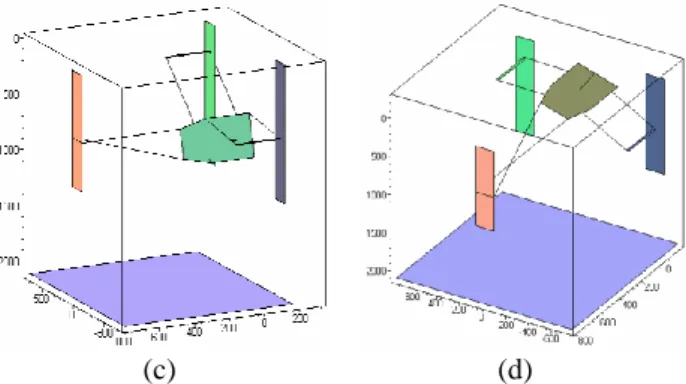
0 (21) Equation (20) obtained from (14) implies that A B1 1 is perpendicular to the slider plane of leg І. In this case equation (8) represents a circle because ab.When 2= 3 in equation (21), we have {0, } . This means that yP0 (obtained from Equations. (5)(6)). To finish the resolution of the system, we perform the tangent-half-angle substitution ttan( / 2) . As a consequence, the forward kinematics of our parallel manipulator results in a eight degree characteristic polynomial in t , whose coefficients are relatively large expressions in 1, 2 and 3. For the VERNE machine, only 4 assembly-modes have been found (figure 7). It was possible to find up to 6 assembly-modes but only for input joint values out of the reachable joint space of the machine.
(c) (d)
Fig. 7. The four assembly-modes of the VERNE parallel module for
1 250 mm,
21000 mm and 3 750 mm
Only one assembly-mode is actually reachable by the machine (solution (a) shown in figure 7) because the other ones lead to either rod crossing, collisions, or joint limit violation. The right assembly mode can be recognized, like for the right working mode, by the fact that each leg must have its slider attachment points upper than the moving platform attachment points, i.e. si 1 (keep in mind that the z-axis is directed downwards).
The proposed method for calculating the various solutions of the forward kinematic problem has been implemented in Maple (Table III).
1 674 mm, 2 685 mm and 3 250 mm Case t (rd
)
xP (mm) yP (mm) zP (mm) (a) -0.22 -199.80 355.92 1242 (b) -0.14 298.35 -297.53 -120.22 (c) 1.81 -393.6 322.82 958.21 (d) 2.70 -115.62 -189.68 -0.26TABLE III. the numerical results of the forward kinematic problem of the example where 1674 mm, 2685 mm and 3 250 mm VII. Conclusion
This paper was devoted to the kinematic analysis of the parallel module of a 5-DOF hybrid machine tool, the VERNE machine. The degrees of freedom, the inverse kinematics and the different assembly modes were derived. The forward kinematics was solved with the substitution method. It was shown that the inverse kinematics has sixteen solutions and the forward kinematics may have six real solutions. Examples were provided to illustrate the results. The forward and inverse kinematics of the full VERNE machine is quite easy to derive [16]. The controller of the actual VERNE machine resorts to an iterative Newton-Raphson resolution of the kinematics models. A comparative study will be conducted by the authors between the analytical and the iterative approaches. It is expected that the analytical method could decrease the Cpu-time and improve the quality of the control.
Acknowledgments
This work has been partially funded by the European projects NEXT, acronyms for “Next Generation of Productions Systems”, Project no° IP 011815.
References
[1] Merlet J.-P. Parallel Robots. Kluwer Academic Publishers, Dordrecht, 20 00 .
[2] Tlusty, Ziegert J.C. and Ridgeway S. Fundamental comparison of the use of serial and parallel kinematics for machine tools,
Annals of the CIRP, 48 (1) 351–356, 1999.
[3] Wenger Ph., Gosselin C. and Maille B. A comparative study of serial and parallel mechanism topologies for machine tools, In
Proceedings ofPKM’99, pages 23–32, Milan, Italy, 1999.
[4] Weck M., and Staimer M. Parallel Kinematic Machine Tools – Current State and Future Potentials. Annals of the CIRP, 51(2) 671-683, 200 2.
[5] Chablat D. and Wenger Ph. Architecture O ptimization of a 3-DO F Parallel Mechanism for Machining Applications, the O rthoglide. IEEE Transactions On Robotics and Automation, Vol. 19/ 3, pages 40 3-410 , June, 20 0 3.
[6] Hervé J. M. and Sparacino F. Structural synthesis of parallel robots generating spatial translation. In Proc. 5th Int. Conf. Advanced
Robotics, volume. 1, pages 808–813, 1991.
[7] Kong X. and Gosselin C. M. Type synthesis of linear translational parallel manipulators. In Advances in Robot Kinematic, J.
Lenarcic and F. Thomas, Eds. Norwell, MA: Kluwer, pages 453–
462, 2002.
[8] Neumann K. E. Robot. U. S. Patent 4 732 525, Mars 22, 1988. [9] Toyama T. and al. Machine tool having parallel structure. U. S.
Patent 5 715 729, February. 10, 1998.
[10] Clavel R.. DELTA, a fast robot with parallel geometry. In Proc.
18th Int. Symp. Robotic Manipulators, pages 91–100, 1988.
[11] Company O., Pierrot F.., Launay F., and Fioroni C. Modeling and preliminary design issues of a 3-axis parallel machine tool. In Proc.
Int. Conf. PKM 2000, Ann Arbor, MI, pages 14–23, 2000.
[12] Liu X.J., Wang J.S., Gao F. and Wang L.P. On the analysis of a new spatial three-degree-of freedom parallel manipulator. IEEE
Trans. Robotics Automation 17 (6) 959–968, December 2001.
[13] Nair R. and Maddocks J.H. On the forward kinematics of parallel manipulators. Int. J. Robotics Res. 13 (2) 171–188, 1994.
[14] Martin Y. S., Giménez M., Rauch M., Hascoët J.-Y. A new 5-axes hybrid architecture machining center. In 5th Chemnitzer
Parallel kinematic Seminar, pages 657-676, Chemnitz, 25-26 April
20 06.
[15] Terrier M., Giménez M. and Hascoёt J.-Y. VERNE – A five axis Parallel Kinematics Milling Machine. In Proceedings of the
Institution of Mechanical Engineers, Part B, Journal of Engineering Manufacture, volume 219, Number 3, pages. 327-336, March, 200 5.
[16] Kanaan D., Wenger Ph. and Chablat D. Kinematic analysis of the VERNE machine. IRCCyN technical report, September 2006.