HAL Id: hal-01271159
https://hal.archives-ouvertes.fr/hal-01271159
Submitted on 9 Feb 2016
HAL is a multi-disciplinary open access
archive for the deposit and dissemination of
sci-entific research documents, whether they are
pub-lished or not. The documents may come from
teaching and research institutions in France or
abroad, or from public or private research centers.
L’archive ouverte pluridisciplinaire HAL, est
destinée au dépôt et à la diffusion de documents
scientifiques de niveau recherche, publiés ou non,
émanant des établissements d’enseignement et de
recherche français ou étrangers, des laboratoires
publics ou privés.
Tackling Bufferbloat in Capacity-limited Networks
Chamil Kulatunga, Nicolas Kuhn, Gorry Fairhurst, David Ros Sanchez
To cite this version:
Chamil Kulatunga, Nicolas Kuhn, Gorry Fairhurst, David Ros Sanchez. Tackling Bufferbloat in
Capacity-limited Networks. EuCNC 2015 : 24th European Conference on Networks and
Communica-tions, Jun 2015, Paris, France. pp.381-385, �10.1109/EuCNC.2015.7194103�. �hal-01271159�
Tackling Bufferbloat in Capacity-limited Networks
Chamil Kulatunga†, Nicolas Kuhn‡, Gorry Fairhurst†, David Ros?
†School of Engineering, University of Aberdeen, Aberdeen, UK. {chamil,gorry}@erg.abdn.ac.uk
‡IMT Télécom Bretagne, IRISA, France. [email protected]
?Simula Research Laboratory, Fornebu, Norway. [email protected]
Abstract—Over-provisioned network buffers, often at the In-ternet edge, induce large queuing delay and high latency; this issue is known as Bufferbloat. In response to this, a set of recently proposed Active Queue Management (AQM) algorithms attempt to reduce standing queues, while maintaining the bot-tleneck utilisation at an acceptable level. This paper assesses the performance of two AQM schemes (CoDel and FQ-CoDel) over capacity-limited networks with large Round-Trip Time (RTT). In such settings, these AQM schemes have difficulty controlling the buffering level, resulting in both momentarily high queuing delay and low bottleneck utilisation, even if the methods are claimed to be insensitive to link rates and round-trip delays. We explore this issue and show that it is possible to adapt the parameterisation of CoDel and FQ-CoDel to offer a higher bottleneck utilisation while maintaining a low queuing delay. We present experiments over an emulated test bed and a satellite network to confirm that our new parameterisation improves the download time of moderate-size files and reduces the latency for capacity-limited and large-RTT networks.
Keywords-Bufferbloat, Rural Broadband, AQM, CoDel.
I. INTRODUCTION
Oversized buffers along Internet paths may lead to large standing queues and high queuing delay, this issue is known as Bufferbloat [1]. Active Queue Management (AQM) proact-ively drop packets before router buffer space is exhausted. This signals incipient congestion to endpoints and avoids persistently large queues. AQM aims at reducing queuing latency and is one piece of the solution to Bufferbloat.
Random Early Detection (RED) [2] is an AQM proposed two decades ago, but has not been widely enabled in Internet routers due to the need to tune its parameters depending on the actual traffic and network conditions. Newly proposed AQM algorithms, such as Controlled Delay (CoDel) [3], Proportional Integral controller Enhanced (PIE) [4] and Flow-Queuing CoDel (FQ-CoDel) [5]), claim to address this difficulty of configuring AQM parameters.
In a rural broadband network, a service is often charac-terised by much less capacity than in other contexts. The greater cable distance to many rural locations is one key factor that can limit offered capacity, but the type of installed access technology and the lower population density can also impact available capacity. In the UK, 21% of rural areas are currently unable to access to a DSL downlink speed of 2 Mbps [6]. Despite introducing a larger RTT (e.g., 500 ms or more) satellite technology may be deployed in such cases to realise a commercially viable broadband service [7].
In [3], the authors say that CoDel “controls delay, while insensitive to round-trip delays, link rates, and traffic loads”.
The claim that CoDel can self-tune its dropping policy sug-gests that no knobs needs to be tuned. However its behaviour has been shown to depend on the congestion level [8] and the RTT of the path [9]. The benefits of introducing AQM mechanisms in capacity-limited and large RTT networks are not yet well understood.
In this paper, we evaluate the potential of deploying AQM in such networks to tackle Bufferbloat. We propose to tune the parameterisation of CoDel and FQ-CoDel to both limit the queuing delay and optimise use of resources for a large-RTT and capacity-limited network. Evaluation in an emulated test bed shows that our parameterisation reduces the transfer time for medium-sized files. This analysis is supported by tests using a broadband satellite access network.
The remainder of this paper is structured as follows. Sec-tion II details the CoDel and FQ-CoDel algorithms. SecSec-tion III illustrates how low-capacity, high-RTT paths are challenging for these self-tuning AQM schemes. Based on ns-2 simula-tions, Section IV develops our updated parameterisation of CoDel. Section IV also evaluates the impact of various base RTTs on the performance of CoDel and FQ-CoDel. Exper-imental results, including from an actual satellite broadband link, are shown in Section V. Section VI concludes the paper.
II. DELAY-BASEDAQMSCHEMES
Delay-based AQM algorithms typically use a target delay, τ , determining the allowable standing queuing delay, and an update interval, λ, determining the frequency at which the dropping policy is updated. PIE has already been shown to need an updated parameterisation for specific scenarios (such as data-centers [10] or cable modems [11]). CoDel has been shown to not always control the queuing delay with a limited impact on the bottleneck utilization [8], [9], and it was uncertain whether CoDel could be tuned for objectives and network conditions other than the ones for which it has been designed: this led to our interest in examining CoDel and not PIE. We also wanted to evaluate the performance of a hybrid scheduling/AQM scheme, which is possible with FQ-CoDel, whereas there is no reference algorithm for FQ-PIE. Therefore, we will focus on CoDel and FQ-CoDel, for which τ = 5 ms and λ = 100 ms have been suggested as default values [3], [5].
A. CoDel
CoDel [3] tracks enqi, the enque time of each packet pi. At
each dequeued packet: δi= deqi−enqi. CoDel has two states,
dropping and non-dropping, and starts on the latter state. We
denote by µ the interval after which CoDel may change its state and drop one packet. The initial value of µ is λ. We
denote by ndrop the number of consecutive drops, initialized
as ndrop = 1. Between t1 = t and t2 = t + µ, if there is a
packet i such that deqi∈ [t1, t2] and δi> τ , then: (1) CoDel
enters the dropping state, (2) the next packet to be dequeued
is dropped, (3) ndrop+=1 and (4) µ is set to µ/√ndrop; else:
(1) CoDel enters the non-dropping state, (2) there is no packet
drop, (3) ndrop is reset to 1 and (4) µ is reset to λ.
B. FQ-CoDel
FQ-CoDel [5] maintains one sub-queue per flow. There is one instance of CoDel per sub-queue. FQ-CoDel features priority-queuing by giving priority to new incoming flows and fair-queuing. When a packet arrives, if there is already another packet belonging to this flow in an existing sub-queue, the incoming packet is added to the latter, else a new sub-queue is instantiated and the incoming packet added to it. FQ-CoDel maintains two lists of sub-queues, new and old. When looking for a packet to dequeue, FQ-CoDel starts by looping over the
new list. If the selected sub-queue has already dequeued a
quantum of bytes (default 1514 B), this sub-queue is put at the end of the old list. If the selected sub-queue in the new list has dequeued less than a quantum of bytes, the sub-queue is selected. If there are no sub-queues in the new list where less than a quantum of bytes has been dequeued, FQ-CoDel loops over the old list in the same manner. Once a sub-queue has been selected, the dropping policy of CoDel is applied to the sub-queue: a packet is dequeued from it if the algorithm of CoDel does not drop this packet.
III. AQMSCHEMES IN CAPACITY-LIMITED NETWORKS
A. Topology and traffic
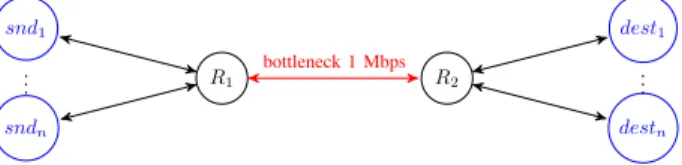
The topology presented in Fig. 1 was used with experiments run with Linux kernel 3.14.4 and a network emulated by netem. Throughout the paper, we consider that there is a sender/receiver pair for each flow (2 flows in this section), all of them sharing the same bottleneck. All flows use TCP NewReno with SACK and an initial window of 3 segments.
.. . R1 R2 ... dest1 destn snd1 sndn bottleneck 1 Mbps
Figure 1: Dumb-bell simulation topology.
The symmetrical bottleneck between R1and R2has 1 Mbps
capacity and a range of RTT values were tested. The bottleneck buffer size is 25 packets of size 1500 B (i.e., a 300 ms worst-case queuing delay). Other links have a 1.25 ms one-way delay and 100 Mbps capacity with a DropTail buffer of 300 packets.
AQM schemes are applied at node R1 but not at R2. In this
section, the default parameterisation of CoDel and FQ-CoDel
is used (τ = 5 ms and λ = 100 ms). 300 s, was replicated ten times and the following plots represent average values and 95% confidence intervals.
B. Issues with low-capacity links
We consider one bulk transfer in parallel with repeated downloads of a 1.7 MB file (inter-file intervals are exponen-tially distributed with mean 9.5 s). In Fig. 2, we plot the throughput of the bulk transfer (averaged every second) and the average File Completion Time (FCT) for the repeated downloads. Queueing delays (not shown) were as high as 300 ms with DropTail, whereas with CoDel and FQ-CoDel they tended to stay below ≈ 30 ms (i.e., at most a couple of packets in the queue).
7 8 9 10 11 12 13 14 50 100 150 200 250 300 350 400 450 500 550 200 250 300 350 400 450 500 550 600 650
Bursty File Comp
letion T
ime (s)
Bulk throughput
(kbps)
Path RTT (ms)
DropTail CoDel FQ-CoDel
Figure 2: Performance with different queue management meth-ods, for various path RTTs (solid lines: FCT for a repeated download; dashed lines: bulk transfer throughput).
These results illustrate the main problem with the con-sidered AQMs when bottleneck capacity is low. AQM does maintain a much lower queuing delay, which should help with achieving a lower FCT. However, the net effect of AQM is a large drop in bulk throughput, for both short and long RTTs, for a relatively modest gain in FCT (≈ 10% at best, for medium-sized files).
Such degradation of throughput can be intuitively explained as follows. With a 1 Mbps link, it takes 12 ms to transmit one 1500-B packet. An AQM algorithm with a 5 ms target delay over a 1 Mbps link is thus attempting to maintain a queue of less than one packet, and an often empty queue translates into lower throughput and low utilisation.
IV. TUNINGCODEL TO CAPACITY-LIMITED NETWORKS
Our goal can be stated as: we seek to find a combination of τ
andλ for both CoDel and FQ-CoDel that, for capacity-limited
networks, both enables a high bottleneck utilisation (around 90% or higher) and limits the queuing delay. We consider both τ and λ because the resulting queuing delay and bottleneck utilisation depend on their interaction: drops are only applied
if the queuing delay grow above τ and only every µndrop in
order to give end-points time to react to a drop.
Figure 2 shows that throughput degradation with FQ-CoDel is less sensitive to the RTT, compared with CoDel; more
generally, the flow-queuing mechanism may result in different dynamics for the individual flows. However, if multiple flows coexist in a single queue (e.g., when flows are aggregated in a VPN), FQ-CoDel would behave similarly as CoDel. Therefore we will consider a parameterisation for CoDel, and verify whether it suits FQ-CoDel too. In this section, we use the ns-2 simulator to easily cover a wide range of values of τ and λ. The validity of our parameterisation is verified with emulations in Section V.
A. Topology and traffic
The topology shown in Fig. 1 was simulated with ns-2. The symmetrical bottleneck has 1 Mbps capacity and a 300 ms RTT; the bottleneck buffer size is set to 25 packets. Other links have a 1.25 ms one-way delay and 100 Mbps capacity with a DropTail queue of 300 packets. On the bottleneck link, CoDel
and FQ-CoDel are used in node R1 but not in node R2.
The following traffic was considered: (1) repeated down-loads of a file of size 1.7 MB, with an inter-file interval expo-nentially distributed with mean 9.5 s; (2) TCP bulk transfer, lasting for the entire length of the simulation; (3) “thin” TCP flows with a constant inter-packet interval of 300 ms and a packet size of 150 B; these may represent gaming traffic. Both (1) and (2) use a packet size of 1500 B. TCP characteristics are the same as in Section III-A. Two traffic mixes were simulated:
lowload (one flow for each of flow types (1), (2) and (3)) and
high load (two flows for each of (1), (2) and (3)). The flows
start randomly within the first second of the simulation. The simulations last 300 s and were run 100 times, each with a different seed.
B. Tuning λ to maximise the goodput
We first want to find a λ so that ≈ 90 % of the link capacity is exploited while limiting the impact on the queuing delay.
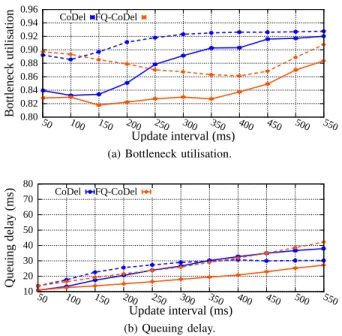
The authors of [12] explain that λ should be set to the largest RTT of the flows sharing the bottleneck. Such setting is said to allow CoDel to keep control of the queuing delay. However, in many deployment cases, the person configuring the router will not be aware of the path RTT. Moreover, in a low-capacity scenario, changing λ alone may not be enough to obtain both a good bottleneck utilisation and control of the delay. When λ increases, CoDel reduces the frequency at which it updates the dropping policy. A larger λ induces less packet drops, resulting in a higher bottleneck utilisation at the expense of higher queuing delay. This can be seen in Fig. 3. With CoDel, increasing λ improves utilisation, with λ = RTT = 300 ms bringing utilisation reasonably close to 90% for both traffic profiles. But, for all the values of λ tested (which include the default one of 100 ms), delays are always > τ .
C. Tuningτ to maximise the goodput
We next turn to finding a value of τ so that at least 90 % of the available capacity is exploited while limiting the impact on the queuing delay. Based on the results in §IV-B, λ is set to 300 ms for both AQMs. Figure 4 presents the same performance metrics of Fig. 3 for various τ . The choice τ =
0.80 0.82 0.84 0.86 0.88 0.90 0.92 0.94 0.96 50 100 150 200 250 300 350 400 450 500 550 B ot tl ene ck ut il isa ti on Update interval (ms) CoDel FQ-CoDel
(a) Bottleneck utilisation.
10 20 30 40 50 60 70 80 50 100 150 200 250 300 350 400 450 500 550 Que ui ng de la y (m s) Update interval (ms) CoDel FQ-CoDel (b) Queuing delay.
Figure 3: Utilisation and delay for various λ, with τ = 5 ms (solid lines: low load; dashed lines: high load).
65 ms yields a reasonable compromise between queuing delay (< 50 ms) and utilisation (slightly above 90%).
0.80 0.82 0.84 0.86 0.88 0.90 0.92 0.94 0.96 5 10 15 20 25 30 35 40 45 50 55 60 65 70 75 80 85 90 95 100 B ot tl ene ck ut il isa ti on Target delay (ms) CoDel FQ-CoDel
(a) Bottleneck utilisation
10 20 30 40 50 60 70 80 5 10 15 20 25 30 35 40 45 50 55 60 65 70 75 80 85 90 95 100 Que ui ng de la y (m s) Target delay (ms) CoDel FQ-CoDel (b) Queuing delay
Figure 4: Utilisation and delay for various τ , with λ = 300 ms (solid lines: low load; dashed lines: high load).
D. Rural and Default parameterisations
We propose to set τ to 65 ms and λ to 300 ms for both CoDel and FQ-CoDel, so that at least 90 % the bottleneck capacity of the constrained network is utilised and the queuing delay limited to a reasonable value, much smaller than the base RTT. While these parameters may be appropriate for other capacity-limited cases, we do not claim they suit every
capacity-limited network. We therefore evaluate if this para-meterisation is robust to a range of RTT values. We refer to the AQM parameter settings optimised to suit the low-bandwidth, high-RTT scenario studied above as Rural parameterisation, in contrast with the Default parameterisation of an AQM. E. RTT sensitivity
As deployments will experience various RTTs, we compare
Ruraland Default parameterisations with a 1 Mbps link across
a range of end-to-end RTTs from 50 ms to 550 ms. The
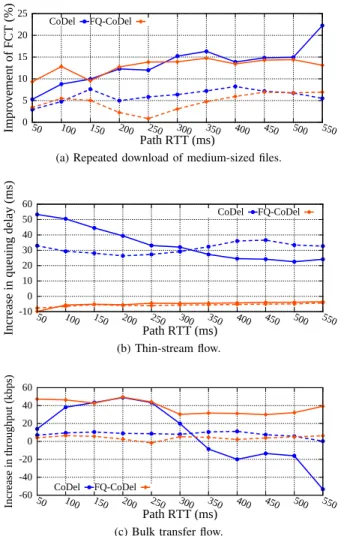
improvement impM for a given metric M is computed as
impM = (MDefault− MRural)/MDefault(for FCT in Fig. 5a) and
the increase incN for a metric N is computed as incN =
NRural− NDefault (for queuing delay in Fig. 5b and the bulk
throughput in Fig. 5c). 0 5 10 15 20 25 50 100 150 200 250 300 350 400 450 500 550 Im prove m ent of F C T (%) Path RTT (ms) CoDel FQ-CoDel
(a) Repeated download of medium-sized files.
-10 0 10 20 30 40 50 60 50 100 150 200 250 300 350 400 450 500 550 Inc re ase in que ui ng de la y (m s) Path RTT (ms) CoDel FQ-CoDel (b) Thin-stream flow. -60 -40 -20 0 20 40 60 50 100 150 200 250 300 350 400 450 500 550 Inc re ase in t hroughput (kbps) Path RTT (ms) CoDel FQ-CoDel
(c) Bulk transfer flow.
Figure 5: Impact of Rural parameterisation for various base RTTs (solid lines: low load; dash lines: high load).
Figure 5a shows that Rural parameterisation improves the FCT for every RTT. In Fig. 5b, we can see that the queuing delay for thin streams is increased with CoDel with Rural
parameterisation, because τRural > τDefault, but this is not the
case with FQ-CoDel, due to its prioritisation scheme. Except when the RTT is higher than 350 ms and CoDel is used, Rural parameterisation increases the bulk throughput.
F. Flows with different RTTs
We next compare the performance of Rural and Default parameterisations by monitoring a repeated-download flow competing with another similar, “background” flow but having a different base RTT. The RTT ratios of the two flows were varied between 0.09 and 11, i.e., RTT ∈ [50, 550] ms.
10-2 10-1 100 101 0.09 0.2 0.33 0.5 0.71 1 1.4 2 3 5 11 FC T ra ti o (m oni tor ed/ ba ckground) RTT ratio (monitored/background) CoDel Default
CoDel Rural FQ-CoDel DefaultFQ-CoDel Rural
Figure 6: FCT with two competing RTTs.
The results presented in Fig. 6 show that both AQMs with
Ruralparameterisation reduce the FCT for the large RTT flow
and reduces the difference of download time for flows that
ex-perience different base RTT: the FCT ratio (F CT BackgroundF CT M onitored )
moves closer to one with Rural parameterisation, for both small and large RTT ratios.
G. Discussion
We do not claim that AQM would provide the best quality of service for various applications when the link capacity or traffic patterns are different; however, we show that (1) adequately tuned AQM schemes can improve the FCTs and the link utilisation , and that (2) CoDel can be tuned to achieve various trade-offs.
V. EXPERIMENTAL EVALUATION A. Performance over a delay-emulated test bed
The experiments described in Section III-B were repeated with Rural parameterisation and the results compared with those presented in that section. Figure 7 presents the improve-ment in terms of FCT and the increase in queuing delay and throughput over Default parameterisation as explained in § IV-E. ICMP ping flows were generated to measure the queuing delay, shown in Fig. 7b. Figure 7a shows that Rural parameterisation improves the FCT for most RTT values. As expected, the higher throughput for the bulk flow, presented in Fig. 7c, results in a higher queuing delay. We notice a difference between the results presented in Figures 5 and 7, which is due to the different traffic characteristics and different source codes of FQ-CoDel in ns-2 and Linux.
B. Performance over a satellite network
Finally, we present results obtained with a operational rural satellite broadband service: the forward satellite link is
between snd1 and R1 in Fig. 1, the bottleneck is restricted
to 1 Mbps and AQM is used at R1; in addition to the queue
-2 0 2 4 6 8 10 12 14 50 100 150 200 250 300 350 400 450 500 550 Im prove m ent of F C T (s) Path RTT (ms) CoDel FQ-CoDel
(a) Repeated download of medium-sized files.
-10 0 10 20 30 40 50 60 70 50 100 150 200 250 300 350 400 450 500 550 Inc re ase in que ui ng de la y (m s) Path RTT (ms) CoDel FQ-CoDel (b) Thin-stream flow. 0 50 100 150 200 250 50 100 150 200 250 300 350 400 450 500 550 Inc re ase in t hroug hput (kbps) Path RTT (ms) (c) Bulk transfer.
Figure 7: Base RTT and Rural and Default parameterisations
use of Stochastic FQ (SFQ). Figure 8 shows that introducing CoDel or FQ-CoDel with Default parameterisation results in (1) a higher FCT than DropTail or SFQ and (2) a lower RTT. With CoDel or FQ-CoDel with Rural parameterisation, the RTT is lower than with the other evaluated schemes, without negative impact on the FCT. With adequately parameterised AQM, as opposed to with DropTail, the latency is reduced by ≈ 60 % (i.e., by 300 ms), which would seriously increase rural broadband users’ experience.
0 5 10 15 20 25 30 35 40 CoDe l De fault CoDe l RuralFQ-CoDe l De fault FQ-C oDe l Rural DropT ail SFQ 500 600 700 800 900 1000 Fi le C om pl et ion T im e (s) Me asure d R T T (m s) FCT Measured RTT
Figure 8: FCT and measured RTT over a satellite network
VI. CONCLUSION
This paper characterised the current default parameterisation of CoDel and FQ-CoDel within a limited-capacity and
large-RTT scenario, which is representative of a rural broadband access network. We show that the default parameters do not offer the desired control of queuing for a single-queue AQM, as claimed in [3]. Consistent with other analysis of PIE, we have proven CoDel can also be tuned to better match the needs of a “non-default” network scenario.
We propose a configuration with a larger target delay and update interval for CoDel: this resulted in reduced download time of medium-sized files, higher bottleneck utilisation and limited queuing delay to an acceptable level, for different traffic profiles. However, this also resulted in queuing delay larger than the target delay. Under a less-controlled queuing delay, the tested flow isolation technique, FQ-CoDel, with our parameterisation, provided low latency and was seen to significantly improve performance for delay-sensitive traffic. FQ-CoDel also features priority queuing which improves the performance of applications transmitting a low amount of data. However, we note that in some cases, flow separation may be difficult (e.g., when encryption is used) and CoDel can then control delay to a reasonable level. With our parameterisation, CoDel and FQ-CoDel would allow a better quality of service for users browsing the web from a rural location since the latency is reduce and the capacitiy exploited close to the one without AQM schemes. As a future work, we will evaluate the benefits of our parameterisation for real-time services.
ACKNOWLEDGMENT
This research was supported by the RCUK DE award to the dot.rural Digital Economy Hub; EP/G066051/1 and by the European Community under its Seventh Framework Programme through the Reducing Internet Transport Latency (RITE) project (ICT-317700).
REFERENCES
[1] J. Gettys, “Bufferbloat: Dark buffers in the Internet,” IEEE Internet Computing, vol. 15, no. 3, pp. 96–96, 2011.
[2] S. Floyd and V. Jacobson, “Random early detection gateways for congestion avoidance,” Networking, IEEE/ACM Transactions on, 1993. [3] K. Nichols and V. Jacobson, “Controlling queue delay,” ACM Queue,
2012.
[4] R. Pan, P. Natarajan, C. Piglione, M. Prabhu, V. Subramanian, F. Baker, and B. VerSteeg, “PIE: A lightweight control scheme to address the Bufferbloat problem,” in IEEE HPSR 2013, 2013, pp. 148–155. [5] T. Hoeiland-Joergensen, P. McKenney, D. Taht, J. Gettys, and E.
Du-mazet, “Flowqueue-codel (work in progress),” 2013, IETF.
[6] SamKnows - Commission for Rural Communities, “Mind the Gap: Digital England – A Rural Perspective,” June 2014.
[7] L. Townsend, A. Sathiaseelan, G. Fairhurst, and C. Wallace, “Enhanced broadband access as a solution to the social and economic problems of the rural digital divide,” Local Economy, 2013.
[8] I. Järvinen and M. Kojo, “Evaluating CoDel, PIE, and HRED AQM Techniques with Load Transients,” LCN, 2014.
[9] J. Schwardmann, D. Wagner, and M. Kühlewind, “Evaluation of ARED, CoDel and PIE,” 20th EUNICE, 2014.
[10] R. Pan, P. Natarajan, C. Piglione, M. S. Prabhu, V. Subramanian, F. Baker, and B. VerSteeg, “PIE: A lightweight control scheme to address the bufferbloat problem. Further Studies– PIE for Data Centers,” in IETF 86 - ICCRG presentation, 2013.
[11] G. White and R. Pan, “A PIE-Based AQM for DOCSIS Cable Modems (work in progress),” 2014, IETF.
[12] K. Nichols, V. Jacobson, A. McGregor, and J. Iyengar, “Controlled delay active queue management (work in progress),” 2014, IETF.