HAL Id: hal-01707679
https://hal.archives-ouvertes.fr/hal-01707679
Submitted on 13 Feb 2018
HAL is a multi-disciplinary open access
archive for the deposit and dissemination of
sci-entific research documents, whether they are
pub-lished or not. The documents may come from
teaching and research institutions in France or
abroad, or from public or private research centers.
L’archive ouverte pluridisciplinaire HAL, est
destinée au dépôt et à la diffusion de documents
scientifiques de niveau recherche, publiés ou non,
émanant des établissements d’enseignement et de
recherche français ou étrangers, des laboratoires
publics ou privés.
A real-time gesture classification using surface EMG to
control a robotics hand
Konstantin Akhmadeev, Elena Rampone, Tianyi Yu, Yannick Aoustin, Éric
Le Carpentier
To cite this version:
Konstantin Akhmadeev, Elena Rampone, Tianyi Yu, Yannick Aoustin, Éric Le Carpentier. A
real-time gesture classification using surface EMG to control a robotics hand. ENOC 2017, Jun 2017,
Budapest, Hungary. �hal-01707679�
ENOC 2017, June 25-30, 2017, Budapest, Hungary
A real-time gesture classification using surface EMG to control a robotics hand
Konstantin Akhmadeev, Elena Rampone, Tianyi Yu, Yannick Aoustin, Éric Le Carpentier
Laboratoire des Sciences du Numérique de Nantes, UMR 6004
[email protected]
CNRS, École Centrale de Nantes, Université de Nantes, France
Summary.This paper addresses the development of a testing algorithm for pattern-recognition-based strategies to control a myoelectric prothesis. This text describes the structure and components of the proposed algorithm, as well as a process of its testing. The latter included an acquisition of an accompanying EMG, for six different gestures (classes) from seven subjects, as well as its processing, feature extraction, training the classifier and further real-time validation with a robotic hand. The results show that the system provides acceptable classification rates.
Introduction
A promising and challenging application of myoelectric control is to govern prosthetics, especially hand prosthetics due to its importance for amputees’ rehabilitation and complexity of the problem. The myoelectric control is usually based on pattern classification, which is a field of artificial intelligence. The most of existing intent derivation algorithms are based on pattern recognition. Three kinds of pattern classification are identified [1]:
• labeling data or called supervised learning,
• separating of data into classes are or called unsupervised learning, • identifying relevant information or called feature selection
To define the gesture recognition algorithm, we choose the third previous pattern classification, feature selection. The surface electromyography (sEMG) signals are used as information carriers that correspond to gesture intention. We consider that the features extracted from the sEMG signals are directly linked to the gesture and the number of gestures (including its positions and velocities) to be identified are finite [2]. Here the set of all possible hand gestures (including its positions and velocities) is separated to form a number discrete subsets, or classes. These subsets are chosen to cover gestures that are considered to be the most important and, at the same time, that they would be distinguishable by a pattern recognition algorithm with a given accuracy. The most frequently accepted classes are cylindrical grasp, hand rotations, wrist flexions, extensions, radial and ulnar deviations ([3]). To apply classification techniques to an EMG signal one should first reduce it’s dimensionality. This is usually achieved by means of feature extraction. Features are vectors that represent temporal or frequency characteristics of the signal. Number of their types considered in literature is large ([4,2]), and some of them are proved to be more effective that others ([4]).
Once features are extracted, they are arranged to form a so-called feature vector. This vector is then serves as an input for a classifier. Classifiers mostly used in related studies are linear discriminant analysis ([5]), neural networks ([6]), support vector machines ([7]) and some others ([8]).
Performance of pattern-recognition-based control algorithms presented in literature is never less that 98% (in terms of correct classification rate) even for large sets of classes. Despite all the advances the application of this approach to human-machine interfaces goes very slowly, especially in commercial products. This situation is caused by different reasons ([9]), one of which is lack of adaptivity of proposed systems to both non-physiological and physiological variability of EMG characteristics. These changes are caused by electrode shifts, skin and muscle state changes, fatigue, sweating etc. Some of these problems are assessed in literature ([10]).
This study aim is to develop a testing system for pattern-recognition-based control strategies and for assessment of the problems caused by lack of adaptivity. Generally, such systems include EMG acquisition and data transmission hardware, a toolbox of feature extraction and signal processing functions, an interface that automates the test, and configurable classifier. To test presented system, entire experimental setup is developed including signal acquisition, training ant testing procedures, subject position, etc. Realization are covered in next sections.
Experimental protocol
This study involved seven normally limbed right-handed subjects: two females and five males all 23 − 28 years old. One of them was familiar with the experimental setup while the others were inexperienced.
During the experiment, each subject sit on a chair wearing the armband on the right forearm. During signal acquisition, subjects were instructed to keep the angle at the elbow joint at approximately 90. Between sessions, the subject could hang the hand down or put the elbow carefully on the table without touching the armband.
The armband was placed on the proximal portion of the forearm. In this way the lateral side of the armband approximately coincided with the middle of the radius bone. The plane passing through centers of all electrodes of the armband was perpendicular to the hand axis and electrodes were aligned with each other. At the beginning of the experiment the position of the armband was contoured by a thin black marker, in order to keep trace of it’s starting position.
ENOC 2017, June 25-30, 2017, Budapest, Hungary
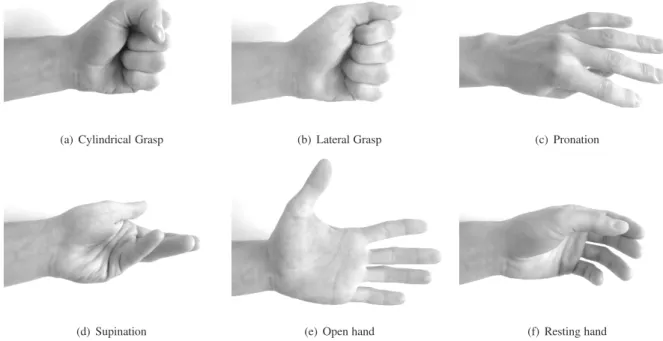
Five hand gestures were chosen for classification in this study: cylindrical grasp, lateral grasp, spread fingers, prona-tion and supinaprona-tion plus resting posiprona-tion, having six moprona-tion classes in total, fig.1. For cylindrical grasp a lightweight cylindrical object was used with diameter of approximately 0.08 m.
(a) Cylindrical Grasp (b) Lateral Grasp (c) Pronation
(d) Supination (e) Open hand (f) Resting hand
Figure 1: Five hand gestures plus resting position used in this study.
EMG sensor
To acquire sEMG signal, we used MYO R armband developed by Thalmic Labs R (fig.2). This device integrates eight
Figure 2: MYO armband by Thalmic Labs R ([13])
sEMG sensors and an inertial measurement unit (IMU). It samples sEMG with 8bit precision at 200Hz and transmits the result to PC wirelessly using Bluetooth Low Energy (BLE) protocol. This device was already used in similar studies, for example [12].
To collect, process and manage the database of received sEMG, an environment was created on a base of Matlab R. It
consists of a graphical user interface and tools for database management, signal processing and experiment planning. To transfer data from official standart MYO armband software Myo Connect R ([13]) to Matlab R, the Myo SDK Matlab
MEX Wrapper ([14]) was used. It is a library that converts original C++ functions of MYO SDK into MEX files callable from Matlab R. During the online validation part, sEMG was processed and classification was done in real-time with
constant delay of about 250 ms.
Robotic hand
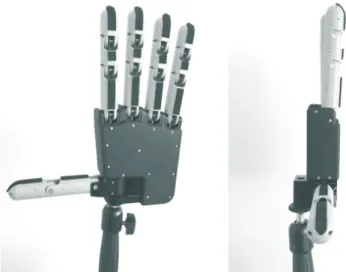
The test-bed of our experiments is a robotic hand fig. (3). It, consists of four fingers and one thumb which together exhibit 15DoFs actuated by six motors [15].
The four fingers are identical and their abduction and adduction degrees of freedom have been omitted for all fingers in order to decrease the complexity of the mechanical design and to limit the hand weight. The total weight of one hand is estimated to be 0.70 kg. The dimensions are based upon average values of a male human hand. Each finger has only one DC electric motor as the actuator, which drives the first joint. A transmission system of pulleys and cables is used to
ENOC 2017, June 25-30, 2017, Budapest, Hungary
Figure 3: Front and side views of the robotic hand to be used in following studies.
transmit the torque to the succeeding joints. The cable wraps around each joint before being firmly anchored in the final phalanx. The thumb has two electric motors. The first controls the movement of the thumb about the palm, and the second controls the flexion and extension of the following two joints. Movement of the motors creates flexion of the rotational joints, the return extension movement is provided by straight springs placed over each joint.
Conclusion and Perspectives
Testing system established is simple and can be easily reproduced by anyone. Results of training procedure and of online validation are acceptable. The main reason of this study was to assess the performance of the developed system, as well as performance of its components, and this task is considered to be done. System developed in this study will serve for testing new classification algorithms, experiment protocols and signal features. It will also be used in benchmarking for analysis of other algorithms of myoelectric control. Another way use such a system is real-time control of a robotic hand. Acknowledgement: This work is supported by University of Nantes, Project M ODERAT O.
References
[1] E. Y. Tov, Advanced lectures on machine learning. Berlin, Heidelberg: Springer Berlin Heidelberg, 2003.
[2] M. Hakonen, H. Piitulainen, and A. Visala, “Current state of digital signal processing in myoelectric interfaces and related applications,” Biomedical Signal Processing and Control, vol. 18, pp. 334–359, Apr. 2015.
[3] K. Xing, P. Yang, J. Huang, Y. Wang, and Q. Zhu, “A real-time EMG pattern recognition method for virtual myoelectric hand control,” Neurocom-puting, vol. 136, pp. 345–355, Jul. 2014.
[4] A. Phinyomark, F. Quaine, S. Charbonnier, C. Serviere, F. Tarpin-Bernard, and Y. Laurillau, “Emg feature evaluation for improving myoelectric pattern recognition robustness,” Expert Systems with Applications, vol. 40, no. 12, pp. 4832–4840, Sep. 2013.
[5] L. J. Hargrove, E. J. Scheme, K. B. Englehart, and B. S. Hudgins, “Multiple binary classifications via linear discriminant analysis for improved controllability of a powered prosthesis,” IEEE Transactions on Neural Systems and Rehabilitation Engineering, vol. 18, no. 1, pp. 49–57, Feb 2010. [6] M. R. Ahsan, M. I. Ibrahimy, and O. O. Khalifa, “Electromygraphy (emg) signal based hand gesture recognition using artificial neural network
(ann),” in Mechatronics (ICOM), 2011 4th Int. Conf. On, May 2011, pp. 1–6.
[7] M. Rossi, S. Benatti, E. Farella, and L. Benini, “Hybrid emg classifier based on hmm and svm for hand gesture recognition in prosthetics,” in 2015 IEEE Int. Conf. on Industrial Technology (ICIT), March 2015, pp. 1700–1705.
[8] Y. Huang, K. B. Englehart, B. Hudgins, and A. D. C. Chan, “A gaussian mixture model based classification scheme for myoelectric control of powered upper limb prostheses,” IEEE Transactions on Biomedical Engineering, vol. 52, no. 11, pp. 1801–1811, Nov 2005.
[9] N. Jiang, S. Dosen, K.-R. Müller, and D. Farina, “Myoelectric control of artificial limbs - is there a need to change focus,” IEEE Signal Process. Mag, vol. 29, no. 5, pp. 152–150, 2012.
[10] K.-H. Park, H.-I. Suk, and S.-W. Lee, “Position-Independent Decoding of Movement Intention for Proportional Myoelectric Interfaces,” IEEE Transactions on Neural Systems and Rehabilitation Engineering, vol. 24, no. 9, pp. 928–939, Sep. 2016.
[11] L. H. Smith, L. J. Hargrove, B. A. Lock, and T. A. Kuiken, “Determining the optimal window length for pattern recognition-based myoelectric control: Balancing the competing effects of classification error and controller delay,” IEEE Transactions on Neural Systems and Rehabilitation Engineering, vol. 19, no. 2, pp. 186–192, April 2011.
[12] J. G. Abreu, J. M. Teixeira, L. S. Figueiredo, and V. Teichrieb, “Evaluating Sign Language Recognition Using the Myo Armband,” in 2016 XVIII Symp. on Virtual and Augmented Reality (SVR). IEEE, Jun. 2016, pp. 64–70.
[13] T. L. Inc., “Myo connect start page,” 2016. [Online]. Available:https://www.myo.com/start
[14] M. Tomaszewski, “Myo sdk matlab mex wrapper,” 2016. [Online]. Available:https://github.com/mark-toma/MyoMex
[15] E. Matheson, Y. Aoustin, E. L. Carpentier, A. Leon, and J. Perrin, “Anthropomorphic underactuated hand with 15 joints,” in New Trends in Medical and Service Robots. Springer Science & Business Media, 2016, pp. 277–295.