an author's http://oatao.univ-toulouse.fr/23309
Nasri, Mondher and Garnier, Christian and Abbassi, Fethi and Labanieh, Ahmad and Dalverny, Olivier and Zghal, Ali Sensitivity analysis of composite forming process parameters using numerical hybrid discrete approach. (2018) In: 8th international Conference on structural Analysis of Advanced Materials, 28 August 2018 - 31 August 2018 (Tarbes, France).
Sensitivity analysis of composite forming process
parameters using numerical hybrid discrete
approach
Mondher Nasri
1, 2, Christian Garnier
1, Fethi Abbassi
3, Ahmed Labanieh
4, Olivier
Dalverny
1and Ali Zghal
2.
1 Laboratoire Génie de Production, ENI de Tarbes, France
2 URMSSDT, ENSI de Tunis, Tunisia
3 Mechanical Engineering Department, College of Engineering, Dhofar University, Sultanate of Oman
4 Laboratoire Génie et Matériaux Textiles (GEMTEX), ENSAIT, Roubaix, France.
Abstract
he aim of this study is to investigate the influence of some important parameters in composite forming using a hybrid discrete hypoelastic computational model developed for simulation of the deformation behaviour of fibres materials. This model is based on elementary cell of shell or membrane type reinforced by nonlinear connectors. Moreover, it can follow the rotation of the fiber during the forming process. The constitutive model has been implemented in a commercial FE code (Abaqus Explicit) via a user material subroutine VUMAT. It has been shown that the forming simulation is affected by the process parameters like the binder force, the coefficient of friction and forming speed on the shear angle distribution.
Keywords: Woven fabric, Forming simulations, sensitivity study, Finite element method
1. Introduction
The shaping processes of composite materials of woven reinforcement are numerous and varied. Among these, LCM processes (Liquid Composite Molding) allow to shape composite parts with woven reinforcements and polymer matrix [1]. This family is dissociated from other processes, the most used are the RTM (Resin Transfer Molding) and the Vacuum Infusion Process [2]. The RTM process has three phases. A first preform step comprises shaping the reinforcement. The shaping of the material can be done in one-step or in several steps up to constitute the complete architecture of the product. Moreover, the preform undergoes a compacting pressure to obtain the desired reinforcement volume ratio. In order to avoid wrinkling during stamping, side clamps can be used by adding a slight tension in the locks. The second step is the injection of resin into the fibrous medium. Finally, after polymerization of the resin (crosslinking or baking), the piece is removed from the mold. The development of LCM processes requires a large number of design variables to improve the performance of these processes, such as mold temperature, inlet pressure, reinforcement deformation, injection point positions. The simulation of the first performing step is necessary to determine the feasibility of the forming process and the fiber orientations in the final composite component. In this context, two different approaches are being used for performing simulation of woven: the geometric and the mechanical approach. The first is based on the kinematic models and considers the yarns to be pinned together at the crossover points of the weave. The second concerns mechanical approaches which are classified into three broad categories: continuous, discrete and semi-discreet. The continuous approach considers the reinforcement as a continuous solid on the macroscopic scale. It takes into account the homogenized global behavior of the reinforcement. The discrete approach represents the reinforcement as an elementary physical cell, which uses structural finite elements like truss, beams, membranes or shell. This approach is modeled at the mesoscopic scale [3]. The semi-discrete approach is an intermediate way between continuous and discrete methods. The approach used in the present work is based on a hybrid discrete approach. The advantage of this approach is to justify some global behavior of fabric from its internal structure. This model has been developed to
simulate the stamping of woven fabric and to predict yarn orientation of deformed shape. Here, to analysis the influence of process parameters on the shear angle distribution.
2.
Hybrid discrete approach
The hybrid discrete hypo-elastic model description of the fabric is built using a mesh of connectors’ elements and shell elements of unit cell of the fabric (figure 1). The behaviour of the shell element is hypo-elastic, and then in which the four vertices are connected by non-linear. The nonlinear connectors control the tensile stiffness in the fabric especially at the being of tensile tests, and naturally capture the anisotropy evolution of the textile media during deformations. The shell element control the in-plane shear stiffness and manages the contact phenomenon. The linear elements do not necessarily to materialize the structure of the single locks, but a rigidity equivalent of a set of locks. The Shell element behaviour is identified using a bias extension test and an inverse optimization method. The stiffness of connector behaviour (Fc=K (uc)), is identified by a polynomial equation fitted using the
uniaxial tensile test.
Figure 1: Hybrid discrete finite element modelling approach: Unit cell of the fabric
3. Parametric sensitivity study: Results and discussion
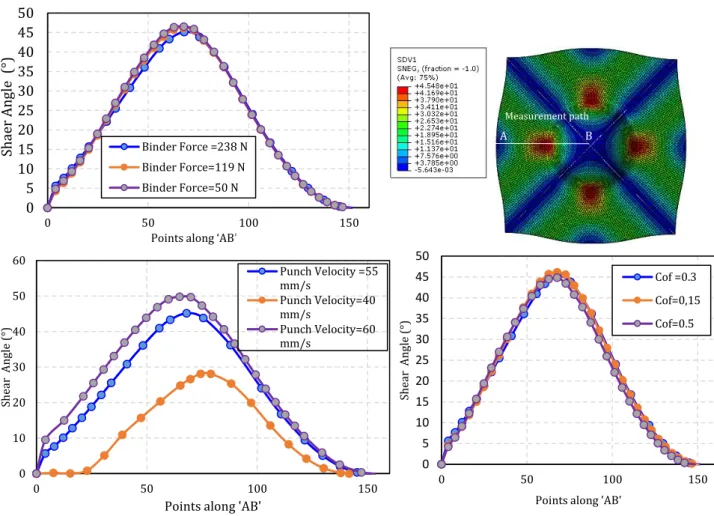
The used stamping set-up is consistent with those presented in [4]. The punch has a hemispherical head with a radius of 50 mm. The die cavities have spherical radius of 6 mm each, and it has a hole diameter of 55.4 mm which allow a gap between punch and die of 2.7 mm. The square composite blank has a dimension of 260 mm × 260 mm and a thickness of 0.62 mm. The binder, die and punch are represented by analytical rigid bodies with respective reference nodes allowing to define boundary and loading conditions. The reinforcement is modeled as four node shell elements S4R (figure 2). Figure 3 shows examples of results for the influence of the variation of the parameters on the distribution of the shear angles. For the Binder force, these variations are more visible in the transition zone. As a result, the maximum shear angle decreases as the blank greenhouse forces increases.
Figure 2: Hemispherical stamping simulation of Hybrid discrete finite element
Connector element Node Shell element Connector element Punch Blank holder Die Fabric Blank holder force Punch force
Figure 3: Evolution, along the edge, of shear angle computed with several forming parameters of model
4. Conclusions
The computational model used in this numerical sensitivity study exploits a hybrid discrete approach for forming of woven composite based on the hypoelastic behaviour of the shell element. This model is implemented in a commercial FE code (ABAQUS/Explicit) via a user material subroutine VUMAT. The effect of the sensitivity of the shear angle to the process parameters (blank holder, punch velocity and the coefficient of friction) has also been, studied. This parametric study gives results in good agreement with the literature [4].
References
[1] Philippe, Boisse. Mise en forme des renforts fibreux de composites. Ed. Techniques Ingénieur, 2004.
[2] Khan, Muhammad Aurangzeb, Mabrouki, Tarek, Gauthier, S., et al.Preforming simulation of the reinforcements
of woven composites: continuous approach within a commercial code. International Journal of Material Forming, vol. 1, n°1, p. 879-882, 2008.
[3] Jauffrès, David, Sherwood, James A., Morris, Corey D., et al. Discrete mesoscopic modeling for the simulation of woven-fabric reinforcement forming. International Journal of Material Forming, vol. 3, n°2, p. 1205-1216, 2010. [4] Peng, Xiongqi et Ding, Fangfang. Validation of a non-orthogonal constitutive model for woven composite fabrics
via hemispherical stamping simulation. Composites Part A: Applied Science and Manufacturing, 2011, vol. 42, n°4,
p. 400-407. 0 5 10 15 20 25 30 35 40 45 50 0 50 100 150 Sha er A ngl e ( °)
Points along ‘AB’
Binder Force =238 N Binder Force=119 N Binder Force=50 N 0 10 20 30 40 50 60 0 50 100 150 She ar A ngl e (° )
Points along 'AB'
Punch Velocity =55 mm/s Punch Velocity=40 mm/s Punch Velocity=60 mm/s 0 5 10 15 20 25 30 35 40 45 50 0 50 100 150 She ar A ngl e (° )
Points along 'AB'
Cof =0.3 Cof=0,15 Cof=0.5
Measurement path