Chapter 6
Theoretical Implications and Applications for Understanding and Changing Concussion-Related Behaviors
Emilie Michalovic, BSc., McGill University, ORCiD: 0000-0003-3097-4941 Jeffrey G. Caron, Ph.D., Université de Montréal ORCiD: 0000-0002-4972-2704
Shane N. Sweet, Ph.D., McGill UniversityORCiD: 0000-0002-6172-3769
July 26, 2018 1 2 3 4 5 6 7 8 9 10 11 13 14 15 16 17 18 19 20 21 22 23 24 25 26
Abstract
Changing health behaviors is a priority for researchers, medical practitioners, and public health officials. Theories provide a framework to help understand and change health behaviors. To date, there has been limited use of theories within sport-related concussion research, however theory-driven research is common in other health-related domains. In this chapter, we discuss theories that have been applied to concussion research so far, such as the theory of planned behavior and social cognitive theory. We also discuss theories that have been used to study other health behaviors, which we believe can be applied to concussion research (i.e., health action process approach, self-determination theory, social ecological model, and the behaviour change wheel). Finally, we present some recommendations that are intended to maximize the use of theory in concussion research. These suggestions are in line with current available evidence and aim to provide concussion researchers with insights about the key ingredients that are necessary to understand and change concussion-related behaviors.
Keywords: theory; behavior change; motivation; adherence 27 28 29 30 31 32 33 34 35 36 37 38 39 40 41 42
Introduction
Changing health behaviors is difficult, as evidenced by the general public’s non-compliance to various health behavior guidelines. For instance, only one third of individuals follow 50% of the recommended nutrition guidelines (de Ridder, Kroese, Evers, Adriaanse, & Gilleaart, 2017), and just 15% of Canadians are currently meeting the physical activity
recommendations (Colley et al., 2011). Concussion-related behaviors are not immune to these challenges. A recent study found that more than 80% of professional players in the Canadian Football League did not seek medical attention after suffering a suspected concussion, despite being aware of the adverse short- and long-term health implications associated with the injury (Delaney, Caron, Correa, & Bloom, 2018). Therefore, understanding concussion-related behaviors is important in making sports safer and reducing the rates of concussions. However, we have learned from other health fields that understanding (and changing) behavior is complex.
Attempts to change health behaviors have mostly been unsuccessful because many focus solely on providing knowledge, which assumes that people will act rationally once they are made aware of the negative implications of continuing to engage in unhealthy behaviors (Kelly & Barker, 2016). A recent special issue in Psychology & Health featured reviews of intervention studies conducted on changing behaviors related to (a) smoking, (b) physical activity, (c) binge drinking, and (d) diet. Overall, these interventions had only a small effect on changing behaviors (Conner & Norman, 2017). The common theme from these reviews was that the researchers could not explain why their interventions were only marginally effective. Unfortunately, current health behavior interventions are typically only inspired by theory and not truly grounded in theory (Conner & Norman, 2017). Researchers have noted that testing interventions that are grounded in theory will be important to move the field of health behavior change forward (Kelly 43 44 45 46 47 48 49 50 51 52 53 54 55 56 57 58 59 60 61 62 63 64 65
& Barker, 2016; Conner & Norman, 2017). Researchers using theory to study concussions can (and should) learn from these reviews. Grounding concussion research and interventions in theory may provide researchers with insight into the key ingredients to understand and change concussion-related behaviors.
Theories that have been Applied to Concussion Research
A theory consists of a set of interrelated constructs or variables that aim to explain the why, when and how of a behavior. A strong theory should also be testable, falsifiable, and refutable (Popper, 1962). Theories provide a common language of the factors that explain a behavior. As such, theories provide a roadmap for understanding a behavior by outlining and hypothesizing the relationship between a set of variables and the behavior (Michie, Atkins, & West, 2014). When applied to the study of concussions, theories can help us understand the variables that predict concussion-related behaviors. Concussion-related behaviors include concussion reporting (e.g., Register-Mihalik et al., 2013), help-seeking (e.g., Kroshus, Garnett, Baugh, & Calzo, 2016), and adherence to physician-administered rehabilitation (e.g., Moor et al., 2015). Once behaviors are understood, they can then be measured in targeted interventions. As a result, grounding interventions in theory allows researchers to test the effects of an intervention on the psychosocial variables (or intervention ingredients) and, in turn, determine if these variables explain the effect of the intervention. This section will review two theories that have been used to study concussions to date. For these two theories, we provide an overview of the theoretical tenets and empirical examples of how they have been used in concussion research. Theory of Planned Behavior
Theoretical tenets. In the theory of planned behavior (TPB; Ajzen, 1991), attitudes (i.e., beliefs about affective or cognitive consequences of a behavior), subjective norms (i.e.,
66 67 68 69 70 71 72 73 74 75 76 77 78 79 80 81 82 83 84 85 86 87 88
perceptions of social pressures to perform a behavior), and perceived behavior control (i.e., perceptions of personal control over a behavior) are determinants of intentions (i.e., willingness to do a behavior). A person’s intention to engage in a behavior is theorized to be the best
predictor of that behavior. Additionally, a person’s perceived behavioral control is directly linked to behavior. See Ajzen (1991) for a visual depiction of TPB.
Empirical examples. TBP has been the most popular theory used in concussion research (e.g., Kroshus, Baugh, Daneshvar, & Viswanath, 2014; Newton, et al., 2014; Register-Mihalik et al., 2013; Rigby, Vela, & Housman, 2013). Concussion researchers have used TPB to investigate athletes’ intentions to report concussions to predict actual concussion-reporting behaviors (Kroshus et al., 2014; Register-Mihalik et al., 2013). Register-Mihalik et al. (2013) used TPB to investigate concussion-reporting intentions and recalled concussion-reporting behaviors1 among a sample of 167 high school athletes. The findings indicated that TPB explained 58% of the variance in athletes’ intentions to report concussions, but intentions to report injuries were not significantly associated with reporting recalled concussion events (i.e., their actual behaviors). Kroshus et al. (2014) also sought to determine whether TPB could predict athletes’ retrospective concussion-reporting behaviors. The sample consisted of 256 male ice hockey athletes 18 to 21 years of age. In this study, all relationships testing TPB were significant. Specifically, TPB variables explained 22% and 10% of the variance of intentions and concussion-reporting
behavior, respectively. In sum, there is support for TPB for understanding athletes’ intentions to report suspected concussions; however, there is mixed evidence regarding whether intentions are associated with reporting behaviors.
Social Cognitive Theory
1 Retrospective account of concussions occurred during their own athletic careers. 89 90 91 92 93 94 95 96 97 98 99 100 101 102 103 104 105 106 107 108 109 110 1
Theoretical tenets. In social cognitive theory (SCT; Bandura, 2004), personal (cognitive, affective, biological), behavioral, and environmental factors are interconnected concepts that explain human actions. The central premise of the theory is that all three are reciprocally related and important for understanding behavior. In 2004, Bandura outlined a SCT model that can be utilized for health behaviors. In this model, health behaviors are influenced by personal factors, namely self-efficacy, outcome expectancies, goals, and sociostructural factors (i.e.,
environment). In this model, self-efficacy beliefs has both a direct relationship with behavior but also an indirect one through outcome expectancies, goals, and the sociostructural factors. See Bandura (2004) for a visual depiction of SCT.
Empirical examples. There is some emerging concussion research that has used SCT or SCT constructs to understand concussion-related behaviors (e.g., Hunt, Harris & Way, 2017; Kroshus, Garnett, Hawrilenko, Baugh, & Calzo, 2015). For example, Kroshus et al. (2015) focused on the interplay between behavioral and environmental factors of SCT. Specifically, they investigated the extent to which pressure from teammates, coaches, parents, and fans (i.e., sociostructural factors) was associated with athletes’ intentions to report suspected concussion events (as a proxy to concussion-reporting behavior). Participants were 328 male and female US collegiate athletes from a variety of contact and collision sports (e.g., soccer, lacrosse,
basketball). Results indicated that pressure from teammates, parents, and fans (but not coaches) was associated with lower intentions to report a concussion. Thus, there is some preliminary evidence to suggest that SCT (as per the environmental dimension) provides a framework for understanding some of the social variables involved in athletes reporting possible concussions (Hunt, Harris & Way, 2017; Kroshus et al., 2015).
Theories that could be Applied to Concussion Research 111 112 113 114 115 116 117 118 119 120 121 122 123 124 125 126 127 128 129 130 131 132 133
In this section, we describe four theories that could assist with understanding and
changing concussion-related behaviors. Understandably, it is beyond the scope of this chapter to provide a description of all potential theories that can be applied to concussion research.
Nonetheless, the four theories we outline below have been supported in other health-related contexts (e.g., exercise; Sniehotta, Scholz, & Schwarzer, 2005; physical activity; Fortier, Duda, Guerin, & Teixeira, 2012; condom use; Larios et al., 2009; smoking cessation; Fulton, Brown, Kwah, & Wild, 2016) and may be of interest to researchers who want to understand and change concussion-related behaviors. For more information about theories that have been used to study human behavior, please consult Michie, West, Campbell, Brown, and Gainforth’s (2014) comprehensive book: ABC of Behaviour Change Theories
(http://www.behaviourchangetheories.com/).
For each of the four theories below, we explain the theoretical tenets, provide empirical examples of how the theory has been used with other health behaviors, and postulate how concussion researchers might use these theories. Our description of the theoretical tenets is meant to provide an overview and should not be considered a substitute for reading the original articles. In the empirical examples sections, we provide evidence of how the theories have been used to both understand and change behavior. The examples in the application to concussion research sections are meant to provide a snapshot of theory-guided concussion research rather than detailing an entire research study. As such, we kept these examples brief and focused only on certain parts of a theory. Researchers who are planning to conduct theory-based research should consider all components of a theory.
Health Action Process Approach 134 135 136 137 138 139 140 141 142 143 144 145 146 147 148 149 150 151 152 153 154 155
Theoretical tenets. The health action process approach (HAPA) model is comprised of two main phases: motivational and volitional (Schwarzer, 2008). In the motivational phase, outcome expectations, action self-efficacy, and risk perception are predictors of intentions. In the volitional phase, action planning, coping planning, maintenance efficacy, and recovery self-efficacy are determinants of behavior. One benefit of HAPA is that it was designed to overcome the intention-behavior gap (Schwarzer, 2008). Specifically, action and coping planning are hypothesized to help individuals translate their intentions to perform a behavior into actually performing a behavior. Action planning is the process of creating a specific plan that details when a person will perform a certain behavior, where they will perform the behavior, what they will do, and for how long. Coping planning involves creating specific plans to overcome
foreseeable barriers to performing the behavior (see the examples in Figure 1). [INSERT FIGURE 1]
Empirical examples to understand behavior. Studies grounded in HAPA have shown support for this framework across health behaviors (e.g., Ernsting, Gellert, Schneider, & Lippke, 2013). For example, in a sample of cardiac rehabilitation participants, outcome expectations, action self-efficacy, and risk perceptions significantly predicted 69% of the variance in intention, while action planning and maintenance self-efficacy predicted 24% of the variance in exercise two months later (Sniehotta, Scholz, & Schwarzer, 2005). Support for the HAPA model has also been found in other health behaviors, such as condom use (Teng, & Mak, 2011) and smoking cessation (Radtke, Scholz, Keller & Hornung, 2012).
Empirical examples to change behavior. Interventions have also integrated action and coping planning to promote various health behaviors. In a meta-analysis of action and coping planning, Carraro and Gaudreau (2013) found that intentions to be physically active predicted 156 157 158 159 160 161 162 163 164 165 166 167 168 169 170 171 172 173 174 175 176 177 178
action and coping planning. Both forms of planning also significantly predicted physical activity. Action and coping planning were also found to be effective processes in translating people’s intentions to engage in physical activity into actually engaging in physical activity (Carraro & Gaudreau, 2013; Rhodes & Pfaeffli, 2010).
Application to concussion research. HAPA can be utilized to understand and change concussion-related behaviors. For instance, the HAPA variables of risk perceptions, outcome expectancies, and action self-efficacy could be used to understand coaches’ intentions towards promoting safe play among their athletes (see example in Figure 1). Further, action and coping planning and maintenance self-efficacy could be measured to understand how coaches promote safe play. HAPA could also be used to develop concussion behavior change interventions. For example, researchers could have athletes create coping plans to report a concussion (for
themselves and for teammates) as part of a pre-season concussion education session and measure concussion-reporting behaviors throughout a season.
Self-determination Theory
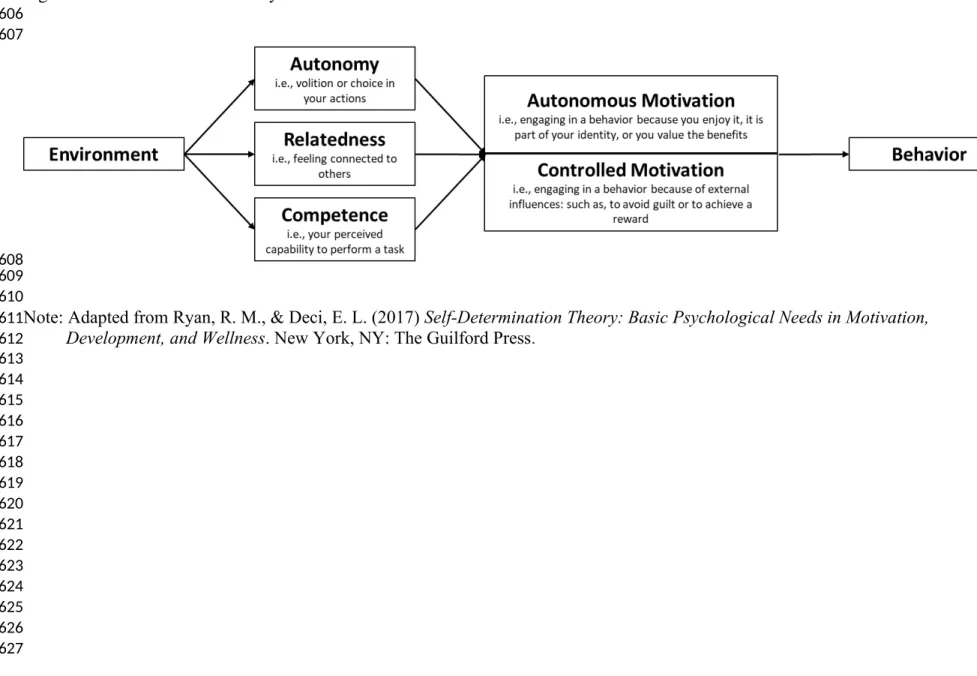
Theoretical tenets. Self-determination theory (SDT) is a meta-theory of motivation and personality that is comprised of six mini-theories (Ryan & Deci, 2017). Similar to HAPA and TPB, SDT examines an individual’s personal factors for engaging in behaviors. SDT diverges from HAPA and TPB because it also considers a person’s environment. In SDT, the environment can positively or negatively influence a person’s three basic psychological needs of autonomy, competence, and relatedness. If these three psychological needs are satisfied, a person’s
motivation to engage in a behavior will be more autonomous; whereas, controlled motivation is more likely to occur when the three basic psychological needs are being thwarted.2 Having a 2 In this chapter, we have chosen to focus only on autonomous and controlled motivation. However, motivation, as per SDT, is much more complex than the description provided in this chapter. We encourage readers to consult Ryan and Deci (2017) for a more detailed description. 179 180 181 182 183 184 185 186 187 188 189 190 191 192 193 194 195 196 197 198 199 200 2 3 4
more autonomous form of motivation is association with increased positive affective, behavioral, and cognitive outcomes (Ryan & Deci, 2017).
[INSERT FIGURE 2]
Empirical examples to understand behavior. SDT has been tested and supported across health behaviors and populations (Phillips & Guarnaccia, 2017). In a physical activity setting, autonomous motivation was found to be consistently and positively related with physical activity participation; whereas, controlled motivation had no relationship (Teixeira, Carraça, Markland, Silva, & Ryan, 2012). Other studies have also supported the relationship between the basic psychological needs and autonomous motivation within a physical activity context (Barbeau, Sweet, & Fortier, 2010; McEwan & Sweet, 2012; Saebu, Sørensen, & Halvari, 2013).
Empirical examples to change behavior. SDT-based interventions have also been tested. For example, Silva and colleagues (2010) demonstrated that participants who were exposed to a SDT-based intervention had greater increases in physical activity and improvements in body composition when compared to a control group. Specifically, participants were provided with autonomy support during the intervention sessions and given techniques to promote competence towards maintaining their physical activity and weight loss goals. Intervention participants also had higher autonomous motivation than the control group (Silva et al., 2010). The intervention from Silva et al. is but one example of an intervention that demonstrates how researchers can promote autonomous motivation, which translates to the uptake of positive health behaviors. See Fortier et al. (2012) for a review of physical activity interventions grounded in SDT.
Application to concussion research. SDT can provide researchers with a lens to conceptualize and identify the environmental factors related to athletes’ basic psychological needs and autonomous motivation. For instance, researchers could aim to understand how 201 202 203 204 205 206 207 208 209 210 211 212 213 214 215 216 217 218 219 220 221 222 223
teammates, coaches, or parents are associated with athletes’ basic psychological needs during concussion recovery. SDT-based interventions could also be designed to teach coaches how to interact with their athletes to foster athletes’ autonomous motivation to engage in safe play or concussion-reporting.
Social Ecological Model
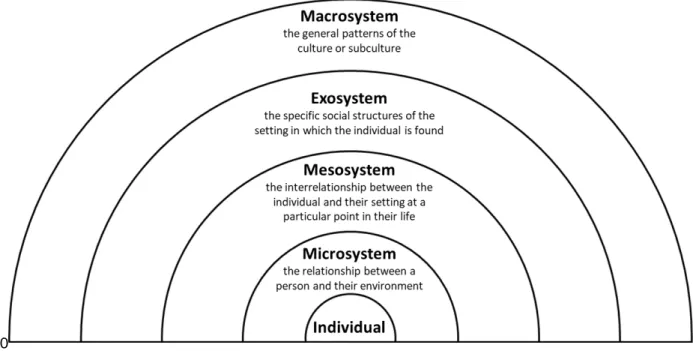
Theoretical tenets. The social ecological model (SEM) of human development is a framework for understanding the interactions between different systems of society. SEM extends from solely understanding (or changing) behavior at the individual or interpersonal levels, by also considering the role of society and social structures. There are five systems of the ecological environment and each of the systems influence behavior change in a different way
(Brofenbrenner, 1977). To summarize briefly, the five systems are: (a) the individual; (b) the microsystem; (c) the mesosystem; (d) the exosystem; and (e) the macrosystem (Figure 3 provides definitions of the systems). According to SEM, all aspects of a person’s environment are
important for behavior change, and the interactions of these systems is necessary for understanding human behavior (Brofenbrenner, 1977).
[INSERT FIGURE 3]
Empirical examples to understand behavior. Researchers have used SEM to help explain health-related behaviors. For example, Thornton et al. (2017) found that participants’ demographic (i.e., being non-Hispanic white ethnicity), psychological (i.e., increased social support) and environmental (i.e., proximity to a park) factors were positively related to
participation in moderate-to-vigorous physical activity. Thus, physical activity participation was influenced across three of SEM’s systems: by (1) the individual (i.e., being non-Hispanic), (2) 224 225 226 227 228 229 230 231 232 233 234 235 236 237 238 239 240 241 242 243 244 245
their microsystem (i.e., proximity to a park), and (3) their exosystem (i.e., increased social support).
SEM has also been used to explain condom use in female sex workers. Larios et al. (2009) found that the social structures that supported access to condoms (i.e., the exosystem) were negatively related to having unprotected sex. Whereas, working in a setting where female sex workers were provided with monetary incentives for unprotected sex was positively related to unprotected sex. Therefore, in this context, the social structures of sex workers (i.e., the exosystem) and the relationship between the sex worker and their setting (i.e., mesosystem) were essential in understanding female sex workers’ condom-use behavior. As such, SEM allows researchers to understand the broader social contexts alongside the individual factors that predict behaviors.
Application to concussion research. SEM may also be pertinent for concussion research given that concussion-related behaviors are embedded within larger social structures that include teams, parents, fans, and media. To date, no research has used SEM to understand concussion-related behaviors. However, Kerr et al. (2014) conducted a systematic review on concussion disclosure and framed their findings in the structures of SEM. In their review, they found that the majority of the published articles (n = 20) explored the individual reasons for not disclosing a concussion, whereas only three articles examined policy level (macrosystem) reasons for the lack on concussion disclosure.
Other applications of SEM in concussion research could involve exploring the
interactions between each of the five systems of SEM and concussion-reporting. For instance, an athlete’s intentions to report a concussion could result more so from the effects of their
macrosystem (i.e., the social construction of toughness in sport) than from their individual 246 247 248 249 250 251 252 253 254 255 256 257 258 259 260 261 262 263 264 265 266 267 268
characteristics (i.e., their own beliefs about concussion-reporting). Once these systems are better understood, interventions targeting athletes’ behaviors or policies/protocols could be developed. The Behaviour Change Wheel
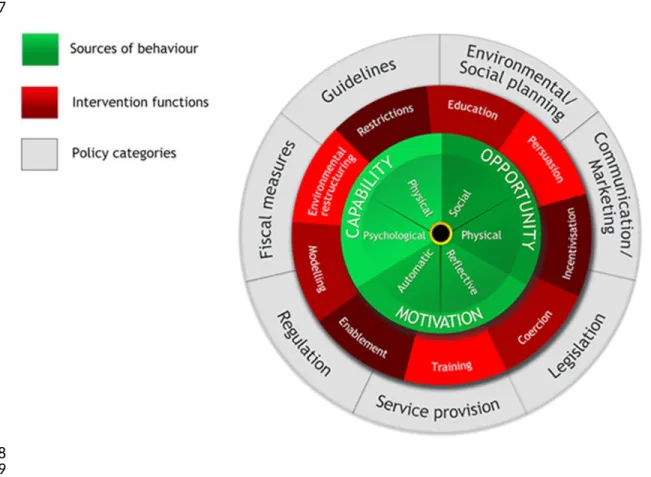
Theoretical tenets. The BCW is a guide to designing and evaluating behavior change interventions and is composed of three layers (Michie, van Stralen, & West, 2011; Figure 4). The first layer is known as COM-B; that Capability, Opportunity, and Motivation are the key
ingredients to performing a Behavior (Michie et al., 2011). The second layer provides nine intervention functions that can be used to target individuals’ capability, opportunity, and
motivation. The third layer identifies seven different types of policies that can be used to deliver the intervention functions. It is important to note that not all intervention functions target all COM-B variables and vice versa. The process through which researchers identify which policy and intervention functions they want to use to change a person’s capability, opportunity, or motivation is called conducting a behavioral analysis. Performing a behavioral analysis prior to designing an intervention is a strength of the BCW.
[INSERT FIGURE 4]
Empirical examples to change behavior. The BCW is a relatively new framework and, as a result, the associated research is limited. In one example, researchers used the BCW to understand how to increase attendance at smoking cessation services (Fulton et al., 2016). Results from Fulton and colleagues’ (2016) behavioral analysis indicated that the intervention functions that were most applicable to their intervention were: education, persuasion, modeling, incentivisation, environmental restructuring, and enablement (Fulton et al., 2016). Thus, the findings from their study (i.e., the behavioral analysis) informed the ingredients that would be necessary for intervention.
269 270 271 272 273 274 275 276 277 278 279 280 281 282 283 284 285 286 287 288 289 290 291
Application to concussion research. There are a number of applications of COM-B for understanding and changing concussion-related behaviors. Specific to adherence to concussion rehabilitation, the COM-B model could be used to understand athletes’ perceptions of how adhering to concussion rehabilitation is related to their short- and long-term health (i.e., capability), and how support from others (i.e., opportunity) is associated with adherence. In turn, once these factors were understood (i.e., the behavior analysis), researchers could design an intervention aimed at improving athletes’ adherence to rehabilitation.
In sum, we have presented and explained four theories that we feel could be applied to understand and change concussion-related behaviors in the future. Below we provide some lessons learned from other fields when applying and testing theory to health behavior change, as well as discuss the implications of theory on future research in the field of concussions.
Implications for Future Research
The use of theory in concussion research is still in its early stages of development. As a result, a recommendation for concussion researchers is to learn from theory-driven research conducted in other health-related domains. Researchers using theory to understand or change concussion-related behaviors should be explicit and identify their frameworks at the forefront of the design of a research project. In doing so, researchers will have to identify and select the theoretical variables they plan on testing, and the analyses they plan on running to ensure proper theory and hypothesis testing. Researchers who are unsure whether their study or intervention is theory-based should consult the Theory Coding Scheme (Michie & Prestwich, 2010). This tool was primarily designed to evaluate the use of theories in interventions, but it can also be used when designing a behavior change intervention (see Sweet, Rocchi, Arbour-Nicitopoulos, Kairy, & Fillion, 2017 as an example).
292 293 294 295 296 297 298 299 300 301 302 303 304 305 306 307 308 309 310 311 312 313 314
How to use Theory to inform Research
Although it may seem intuitive, the first step in building a theory-based study or intervention is taking the time to decide which behavior(s) you would like to understand or change. The behavior you select must be something that can be measured by strong, validated tools. Once the behavior is identified, you can make an informed decision about the theory you should use. Identifying the behavior will also enable you to select the proper measures for the theory you selected. As well, to maximize the impact of a theory-based intervention, ensure that the ingredients of the intervention are directly aimed at changing the theoretical variables and the behavior selected.
Second, if testing a theory, it is critical that you test the entire theory rather than “cherry picking” variables of the theory (Prestwich et al., 2014). As highlighted in Prestwich et al.’s (2014) meta-analysis, few interventions targeted all theoretical constructs from a specific theory. Similarly, Painter, Borba, Hynes, Mays and Glanz (2008) reported that only 7% of studies that used a theory tested at least half of its constructs. These findings are concerning when
considering that theories are conceptualized as interrelated constructs, but these
interrelationships are not being properly tested in health behavior research. Therefore, we urge concussion researchers to include all of the variables of a theory when trying to understand or change concussion-related behaviors.
Third, Michie and Pretwich’s (2010) Theory Coding Scheme is an excellent resource for researchers to consult when designing a theory-based intervention to ensure they account for all dimensions of a theory in their intervention. As Prestwich et al. (2014) found in their meta-analysis, health behavior interventions have rarely aligned components of their interventions with theoretical constructs. In order to be able to determine the effectiveness of a theory-based 315 316 317 318 319 320 321 322 323 324 325 326 327 328 329 330 331 332 333 334 335 336 337
intervention, it is critical that each intervention component is connected to the theoretical constructs you are aiming to foster. A few resources are available to help first classify the components of an intervention. For example, Michie and colleagues’ (2011) taxonomy of behavior change techniques is a comprehensive list and definition of 93 possible intervention techniques (see the supplementary material of Michie et al., 2011). There is also a training course available for individuals who are interested in learning to code behavior change techniques in current interventions (http://www.bct-taxonomy.com/). For researchers conducting interventions that involve interactions between two or more individuals, it is important to use tools that take into account interpersonal techniques of the intervention. Researchers have previously noted that interpersonal techniques are missing from the Michie and colleagues’ (2011) taxonomy of behavior change techniques (Hardcastle & Hagger, 2016). If relevant, researchers could look into the list of relational techniques reported in Hardcastle, Fortier, Blake, and Hagger’s (2017) article or in the Motivational Interviewing Treatment Integrity tool (Moyers, Rowell, Manuel, Ernst, & Houch, 2016). Examples of intervention studies that linked intervention components to theoretical variables can be found in the literature; such as, interventions grounded in SDT (Fortier, Sweet, O’Sullivan, & Williams, 2007; Sweet et al., 2017).
Fourth, health behavior change researchers have recently criticized the continued use of TPB, and some have even called for its “retirement” (Sniehotta, Presseau, & Araújo-Soares, 2014).The reliance of observational designs and lack of experimental evidence (e.g., Rhodes & Dickau, 2012) provide a rationale for this “retirement”, as does the growing awareness of the gap between intentions and behaviors (Sheeran & Webb, 2016). More explicit efforts are needed to examine the intention-behavior relationship, as multiple variables could explain this relationship (Sheeran & Webb, 2016). HAPA, which was explained earlier, suggests action and coping 338 339 340 341 342 343 344 345 346 347 348 349 350 351 352 353 354 355 356 357 358 359 360
planning as variables that can bridge the intention to behavior gap. These variables, and others, could be utilized in concussion research to further understand the relationship between intentions and behavior (see Sheeran & Webb, 2016 for a review). In sum, we recommend that concussion researchers do not take for granted that intentions to engage in a behavior automatically lead to a change in behavior. Researchers are encouraged to find the appropriate theoretical framework or approach that can enhance that relationship in their study.
Conclusions
The recommendations presented in this chapter are in line with current available evidence and were presented with the intent of maximizing the use of theory in concussion research. We feel that concussion researchers are in a good position to continue using theory to understand and change concussion-related behaviors. Selecting, applying, and properly testing theory will help bring a deeper understanding of the psychosocial variables of concussion-related behaviors. Our hope is that this information will be of use to concussion researchers and help them avoid some of the same pitfalls experienced by researchers in other health-related domains.
References
Ajzen, I. (1991). The theory of planned behavior. Organizational Behavior and Human Decision
Processes, 50, 179-211. doi:10.1016/0749-5978(91)90020-T 361 362 363 364 365 366 367 368 369 370 371 372 373 374 375 376 377 378 379 380 381 382 383 384 385
Bandura, A. (2004). Health promotion by social cognitive means. Health Education &
Behavior, 31, 143-164. doi:10.1177/1090198104263660
Barbeau, A., Sweet, S. N., & Fortier, M. S (2010). A path analytic model of self determination ‐ ‐ theory in a physical activity context. Journal of Applied Biobehavioral Research, 14(3), 103-118. doi:10.1111/j.1751-9861.2009.00043.x
Brofenbrenner, U. (1977). Toward an experimental ecology of human development. American Psychologist, 32, 513-531. doi:10.1037/0003-066X.32.7.513
Carraro, N., & Gaudreau, P. (2013). Spontaneous and experimentally induced action planning and coping planning for physical activity: A meta-analysis. Psychology of Sport and Exercise, 14, 228-248. doi:10.1016/j.psychsport.2012.10.004
Colley, R. C., Garriguet, D., Janssen, I., Craig, C. L., Clarke, J., & Tremblay, M. S. (2011). Physical activity of Canadian adults: Accelerometer results from the 2007 to 2009 Canadian Health Measures Survey. Health Reports, 22, 7-14.
Conner, M., & Norman, P. (2017). Health behaviour: Current issues and challenges. Psychology
& Health, 32(8), 895-906. doi: 10.1080/08870446.2017.1336240
Delaney, J. S., Caron, J. G., Correa, J. A., & Bloom, G. A. (2018). Why professional football players chose not to reveal their concussion symptoms during a practice or game. Clinical
Journal of Sport Medicine, 28, 1-12. doi:10.1097/JSM.0000000000000495
de Ridder, D., Kroese, F., Evers, C., Adriaanse, M., & Gillebaart, M. (2017). Healthy diet: Health impact, prevalence, correlates, and interventions. Psychology & Health, 32, 907-941. doi:10.1080/08870446.2017.1316849
Ernsting, A., Gellert, P., Schneider, M., & Lippke, S. (2013). A mediator model to predict workplace influenza vaccination behaviour: An application of the health action process approach. Psychology & Health, 28, 579-592. doi:10.1080/08870446.2012.753072 Fortier, M. S., Duda, J. L., Guerin, E., & Teixeira, P. J. (2012). Promoting physical activity:
Development and testing of self-determination theory-based interventions. International
Journal of Behavioral Nutrition and Physical Activity, 9, 20-34.
doi:10.1186/1479-5868-9-20
Fortier, M. S., Sweet, S. N., O’Sullivan, T. L., & Williams, G. C. (2007). A self-determination process model of physical activity adoption in the context of a randomized controlled trial. Psychology of Sport and Exercise, 8, 741-757. doi:10.1016/j.psychsport.2006.10.006 Fulton, E. A., Brown, K. E., Kwah, K. L., & Wild, S. (2016). StopApp: Using the behaviour
change wheel to develop an app to increase uptake and attendance at NHS Stop Smoking Services. Healthcare, 4, 31-46. doi:10.3390/healthcare4020031
386 387 388 389 390 391 392 393 394 395 396 397 398 399 400 401 402 403 404 405 406 407 408 409 410 411 412 413 414 415 416 417 418 419 420 421 422 423 424 425 426 427 428 429 430 431
Hardcastle, S. J., Fortier, M., Blake, N., & Hagger, M. S. (2017) Identifying content-based and relational techniques to change behaviour in motivational interviewing. Health Psychology Review, 11, 1-16. doi:10.1080/17437199.2016.1190659
Hardcastle, S. J., & Hagger, M. S. (2016) Psychographic profiling for effective health behavior change interventions. Frontiers in Psychology, 6, 1-2. doi:10.3389/fpsyg.2015.01988 Hunt, T. N., Harris, L., & Way, D. (2017). The impact of concussion education on the
knowledge and perceived expertise of novice health care professionals. Athletic Training
Education Journal, 12, 26-38. doi: 10.4085/120126
Kelly, M. P., & Barker, M. (2016). Why is changing health-related behaviour so difficult?
Public Health, 136, 109-116. doi:10.1016/j.puhe.2016.03.030
Kerr, Z. Y., Register-Mihalik, J. K., Marshall, S. W., Evenson, K. R., Mihalik, J. P., &
Guskiewicz, K. M. (2014). Disclosure and non-disclosure of concussion and concussion symptoms in athletes: Review and application of the socio-ecological framework. Brain
Injury, 28, 1009-1021. doi:10.3109/02699052.2014.904049
Kroshus, E., Baugh, C. M., Daneshvar, D. H., & Viswanath, K. (2014). Understanding
concussion reporting using a model based on the theory of planned behavior. Journal of
Adolescent Health, 54, 269-274. doi:10.1016/j.jadohealth.2013.11.011
Kroshus, E., Garnett, B., Hawrilenko, M., Baugh, C. M., & Calzo, J. P. (2015). Concussion under-reporting and pressure from coaches, teammates, fans, and parents. Social Science &
Medicine, 134, 66-75. doi:10.1016/j.socscimed.2015.04.011
Kroshus, E., Garnett, B. R., Baugh, C. M., & Calzo, J. P. (2016). Engaging teammates in the promotion of concussion help seeking. Health Education & Behavior, 43, 442-451. doi:10.1177/1090198115602676
Larios, S. E., Lozada, R., Strathdee, S. A., Semple, S. J., Roesch, S., Staines, H., ... Magis-Rodriguez, C. (2009). An exploration of contextual factors that influence HIV risk in female sex workers in Mexico: The social ecological model applied to HIV risk behaviors.
AIDS Care, 21, 1335-1342. doi:10.1080/09540120902803190
McEwan, D. & Sweet, S. N. (2012). Needs satisfaction, self-determined motivation and health-enhancing physical activity. Health and Fitness Journal of Canada, 5, 3-17.
Michie, S., & Prestwich, A. (2010). Are interventions theory-based? Development of a theory coding scheme. Health Psychology, 29, 1-8. doi:10.1037/a0016939
Michie, S., van Stralen, M. M., & West, R. (2011). The behaviour change wheel: A new method for characterising and designing behaviour change interventions. Implementation Science, 6, 42. doi:10.1186/1748-5908-6-42 432 433 434 435 436 437 438 439 440 441 442 443 444 445 446 447 448 449 450 451 452 453 454 455 456 457 458 459 460 461 462 463 464 465 466 467 468 469 470 471 472 473 474 475 476
Michie, S., Atkins, L., & West, R. (2014). The behaviour change wheel: A guide to designing
interventions. Great Britain: Silverback publishing.
Michie, S. F., West, R., Campbell, R., Brown, J., & Gainforth, H. (2014). ABC of behaviour
change theories. Great Britain: Silverback Publishing.
Moor, H. M., Eisenhauer, R. C., Killian, K. D., Proudfoot, N., Henriques, A. A., Congeni, J. A., & Reneker, J. C. (2015). The relationship between adherence behaviors and recovery time in adolescents after a sports-related concussion: An observational study. International
Journal of Sports Physical Therapy, 10, 225-233.
Moyers, T. B., Rowell, L. N., Manuel, J. K., Ernst, D., & Houck, J. M. (2016). The motivational interviewing treatment integrity code (MITI 4): Rationale, preliminary reliability and validity. Journal of Substance Abuse Treatment, 65, 36-42. doi:10.1016/j.jsat.2016.01.001 Newton, J. D., White, P. E., Ewing, M. T., Makdissi, M., Davis, G. A., Donaldson, A., ... &
Finch, C. F. (2014). Intention to use sport concussion guidelines among community-level coaches and sports trainers. Journal of Science and Medicine in Sport, 17, 469-473. doi: 10.1016/j.jsams.2013.10.240
Painter, J. E., Borba, C. P., Hynes, M., Mays, D., & Glanz, K. (2008). The use of theory in health behavior research from 2000 to 2005: A systematic review. Annals of Behavioral
Medicine, 35, 358-362. doi:10.1007/s12160-008-9042-y
Phillips, A. S., & Guarnaccia, C. A. (2017). Self-determination theory and motivational interviewing interventions for type 2 diabetes prevention and treatment: A systematic review. Journal of Health Psychology, Advanced Online Publication.
doi:10.1177/1359105317737606
Popper, K. R. (1962). On the sources of knowledge and of ignorance. Philosophy and Phenomenological Research, 23, 292-293. doi:10.2307/2104935
Prestwich, A., Sniehotta, F. F., Whittington, C., Dombrowski, S. U., Rogers, L., & Michie, S. (2014). Does theory influence the effectiveness of health behavior interventions? Meta-analysis. Health Psychology, 33, 465-474. doi:10.1037/a0032853
Radtke, T., Scholz, U., Keller, R., & Hornung, R. (2012). Smoking is ok as long as I eat healthily: Compensatory Health Beliefs and their role for intentions and smoking within the Health Action Process Approach. Psychology & Health, 27, 91-107.
doi:10.1080/08870446.2011.603422
Register-Mihalik, J. K., Linnan, L. A., Marshall, S. W., McLeod, T. C. V., Mueller, F. O., & Guskiewicz, K. M. (2013). Using theory to understand high school aged athletes’ intentions to report sport-related concussion: Implications for concussion education initiatives. Brain Injury, 27, 878-886. doi:10.3109/02699052.2013.775508
477 478 479 480 481 482 483 484 485 486 487 488 489 490 491 492 493 494 495 496 497 498 499 500 501 502 503 504 505 506 507 508 509 510 511 512 513 514 515 516 517 518 519 520 521 522
Rhodes, R. E., & Dickau, L. (2012) Experimental evidence for the intertion-behavior relationship in the physical activty domains: A meta-analysis. Health Psychology, 31(6), 724-727. doi: 10.1037/a0027290
Rhodes, R. E., & Pfaeffli, L. A. (2010). Mediators of physical activity behaviour change among adult non-clinical populations: A review update. International Journal of Behavioral Nutrition and Physical Activity, 7(1), 37-48. doi: 10.1186/1479-5868-7-37
Rigby, J., Vela, L., & Housman, J. (2013). Understanding athletic trainers' beliefs toward a multifacted sport-related concussion approach: Application of the theory of planned behavior. Journal of Athletic Training, 48, 636-644. doi: 10.4085/1062-6050-48.3.10 Ryan, R. M., & Deci, E. L. (2017) Self-Determination Theory: Basic Psychological Needs in
Motivation, Development, and Wellness. New York, NY: The Guilford Press
Saebu, M., Sørensen, M., & Halvari, H. (2013). Motivation for physical activity in young adults with physical disabilities during a rehabilitation stay: A longitudinal test of self‐
determination theory. Journal of Applied Social Psychology, 43, 612-625. doi: 10.1111/j.1559-1816.2013.01042.x
Schwarzer, R. (2008). Modeling health behavior change: How to predict and modify the adoption and maintenance of health behaviors. Applied Psychology, 57, 1-29. doi:10.1111/j.1464-0597.2007.00325.x
Schwarzer, R. (2014, October 13). Health Action Process Approach. Retrieved January 29, 2018, from http://www.hapa-model.de/
Sheeran P., & Webb, T. L. (2016). The intention-behavior gap. Social and Personality
Psychology Compass, 10, 503-518. doi:10.1111/spc3.12265
Silva, M. N., Vieira, P.N., Coutinho, S. R., Minderico, C. S., Matos, M. G., Sardinha, L. B., & Teixeira, P. J. (2010). Using self-determination theory to promote physical activity and weight control: A randomized controlled trial in women. Journal of Behavioural Medicine,
33, 110-122. doi:10.1007/s10865-009-9239-y
Sniehotta, F. F., Scholz, U., & Schwarzer, R. (2005). Bridging the intention–behaviour gap: Planning, self-efficacy, and action control in the adoption and maintenance of physical exercise. Psychology & Health, 20, 143-160. doi:10.1080/08870440512331317670 Sniehotta, F. F., Presseau, J., & Araújo-Soares, V. (2014). Time to retire the theory of planned
behaviour. Health Psychology Review, 8, 1-7. doi:10.1080/17437199.2013.869710 Sweet, S. N., Rocchi, M., Arbour-Nicitopoulos, K., Kairy, D., & Fillion, B. (2017). A
telerehabilitation approach to enhance quality of life through exercise among adults with paraplegia: Study protocol. JMIR Research Protocols, 6, e202. doi:10.2196/resprot.8047 Teixeira, P. J., Carraça, E. V, Markland, D., Silva, M. N., & Ryan, R. M. (2012). Exercise, 523 524 525 526 527 528 529 530 531 532 533 534 535 536 537 538 539 540 541 542 543 544 545 546 547 548 549 550 551 552 553 554 555 556 557 558 559 560 561 562 563 564 565 566 567
physical activity, and self-determination theory: A systematic review. International Journal of Behavioral Nutrition and Physical Activity, 9, 78-108. doi:10.1186/1479-5868-9-78
Teng, Y., & Mak, W. W. S. (2011). The role of planning and self-efficacy in condom use among men who have sex with men: An application of the Health Action Process Approach model. Health Psychology, 30, 119-128. doi:10.1037/a0022023
Thornton, C. M., Kerr, J., Conway, T. L., Saelens, B. E., Sallis, J. F., Ahn, D. K., … King, A. C. (2017). Physical activity in older adults: An ecological approach. Annals of Behavioral
WORD COUNT: 5866
Figure 1. Health action process approach 568 569 570 571 572 573 574 575 576 577 578 579 580 581 582 583 584 585 586 587 588 589 590 591 592 593 594
Note: Adapted from Schwarzer, R. (2014, October 13). Health Action Process Approach. Retrieved January 29, 2018, from http://www.hapa-model.de/
595 596 597 598 599 600 601 602 603 604
Figure 2. Self-determination theory.
Note: Adapted from Ryan, R. M., & Deci, E. L. (2017) Self-Determination Theory: Basic Psychological Needs in Motivation, Development, and Wellness. New York, NY: The Guilford Press.
605 606 607 608 609 610 611 612 613 614 615 616 617 618 619 620 621 622 623 624 625 626 627
Figure 3. The social ecological model.
Note: Adapted from Brofenbrenner, U. (1977). Toward an experimental ecology of human development. American Psychologist, 32, 513-531. doi:10.1037/0003-066X.32.7.513. 628 629 630 631 632 633 634
Figure 4. The behaviour change wheel.
Note: From Michie, S., van Stralen, M. M., & West, R. (2011). The behaviour change wheel: A new method for characterising and designing behaviour change interventions.
Implementation Science, 6, 42. doi:10.1186/1748-5908-6-42. Originally published by BioMed Central, open access under Creative Commons Attribution (CC-BY) license. 635 636 637 638 639 640 641 642 643 644 645 646 647 648 649 650 651 652 653 654 655 656 657 658 659 660