Do Personality Traits Modulate the
Effect of Emotional Visual Stimuli on
Auditory Information Processing?
Solange Mardaga and Michel Hansenne
Department of Cognitive Sciences, University of Liège, Belgium
Abstract. Several lines of evidence attest robust relationships between personality dimensions and emotions, including cognitive aspect of emotion. More particularly, many studies reported strong relationships between extraversion, the behavioral activation system (BAS), and the cognitive processing of positive information, on the one hand, and between neuroticism, the behavioral inhibition system (BIS), and the processing of negative information, on the other hand. Recently, DePascalis, Awari, Matteucci, and Mazzocco (2005) reported that personality traits modulated the effect of the emotional visual stimuli on the mismatch negativity (MMN). The aim of the present study was to replicate these data and extend them to other personality dimensions. Auditory MMN was recorded in normal subjects simultaneously to the presentation of emotional pictures selected as neutral, positive, or negative from the International Affective Picture System, and presented in randomized order. The results support the recent finding that personality (namely, BIS and harm avoidance) modulates the influence of emotional (negative) context on auditory information processing. The present findings suggest that the modulation by personality of change detection in the unattended environment as a function of context valence is limited to unpleasant context.
Keywords: personality, emotions, EPRs, mismatch negativity
Introduction
The existence of relations between personality and emotions is well documented, especially between extraversion, the Be-havioral Activation System (BAS) and positive affects, as well as between neuroticism, the Behavioral Inhibition Sys-tem (BIS), and negative affects (e.g., Canli, Sivers, Withfield, Gotlib, & Gabrieli, 2002; Corr, 2002; Gable, Reis, & Elliot, 2000; Gross, Sutton, & Ketelaar, 1998; Heponiemi, Keltikan-gas-Järvinen, Puttonen, & Ravaja, 2003). Many studies have reported that personality consistently modulates the interac-tions between emotion and cognition (Bradley & Mogg, 1994; Gomez & Gomez, 2002; Rusting, 1999). For instance, Gomez and Gomez (2002) found that high-BIS subjects gen-erated more negative words in a word-fragmentation task, recognized more negative words in a word-recognition task, and recalled more negative words in a free word-recall task than low-BIS subjects, whereas high-BAS subjects generat-ed, recognizgenerat-ed, and recalled more positive words in the three tasks than low-BAS subjects. These results indicate that BIS is mainly associated with the processing of unpleasant infor-mation, while BAS is mainly associated with the processing of pleasant information, and more generally, that cognitive processing of emotional information is modulated by person-ality.
Event-related potentials (ERPs) are modifications of the cerebral electric activity that reflect diverse aspects of
cog-nitive processes; they constitute a useful tool to investigate cognition (e.g., attentional processes, memory, language) in normal as well as in psychopathological subjects (Fabia-ni, Gratton, & Coles, 2000). One of the most extensively studied ERPs is the mismatch negativity (MMN; Näätänen, Gaillard, & Mantysalo, 1978), a negative fronto-central component of the auditory ERP with late latency (usually peaking around 200 ms) that is linked to a switch reflecting attention to physical environment change (Näätänen, 2001; Picton, Alain, Otten, Ritter, & Achim, 2000). It is generally elicited by a deviant, low-probability stimulus (e.g., a change in the frequency, intensity, or localization of the tone) in a sequence of standard auditory stimuli. The MMN is presumably generated by a mismatch process between the sensory input from a deviant stimulus and a short-term memory (sensory-memory) trace representing the physical features of the standard stimuli; this process appears to be automatic since the MMN is elicited even by changes in unattended auditory stimuli (Näätänen, 2000, 2001). Re-cent findings have also suggested that the transient auditory sensory-memory representation underlying the MMN is fa-cilitated by a long-term memory representation of the cor-responding stimulus (Winkler, Cowan, Csépé, Czigler, & Näätänen, 1996). This means that some characteristics of the sensory-memory traces involved in the elicitation of this component are stored in a more durable representation and that these memory traces can be reactivated (Winkler & Cowan, 2005).
ERPs can be viewed as an interesting approach to ex-plore the influence of emotions on cognition. Several stud-ies reported that P300 amplitude is modulated by the emo-tional character of information (Amrhein, Mühlberger, Pauli, & Wiedemann, 2004; Delplanque, Silvert, Hot, & Sequeira, 2006; Palomba, Angrilli, & Mini, 1997). For in-stance, Delplanque et al. (2006), within a three-stimulus, visual, oddball protocol with emotional pictures as the nov-el stimuli, reported an increase of P300 amplitude for pleas-ant and unpleaspleas-ant stimuli relative to neutral novel ones. This indicates that the memory updating process indexed by P300 is influenced by the emotional valence and arousal characteristics of information. Some studies also suggested that personality traits could modulate the emotional effects on ERPs (DePascalis & Speranza, 2000; DePascalis, Strip-poli, Riccardi, & Vergari, 2004). DePascalis et al. (2004) reported that anxious (high-BIS) subjects showed larger P300 amplitudes to unpleasant targets than nonanxious subjects, which is consistent with the above-reported rela-tion between BIS and processing of negative informarela-tion. Few studies have investigated the effect of emotional visual stimuli on the MMN. Surakka, Tenhunen-Eskelinen, Hietanen, and Sams (1998) recorded auditory MMN simul-taneously to the presentation of emotional pictures (neutral, positive, and negative). They reported smaller MMN am-plitudes recorded during the presentation of the positive stimuli as compared to MMNs recorded during the presen-tation of neutral and negative stimuli; indicating that a pos-itive, low-arousing context reduces vigilance toward the environment. Recently, DePascalis, Awari, Matteucci, and Mazzocco (2005), with the same protocol as Surakka et al. (1998), found that MMN amplitudes were higher during the presentation of negative stimuli as compared to neutral and positive ones, reflecting increased vigilance within a negative emotional context. Taken together, the results of these two studies suggest that specific valence and arousal characteristics of a visual environment could act as biolog-ical signals of either high or low danger, and consequently increased or reduced need for vigilance to physical envi-ronment change, reflected here by the MMN. Moreover, DePascalis et al. (2005) reported that personality traits in-fluenced the effect of the emotional visual stimuli on the MMN. They found that high-BIS/low-BAS subjects were the most sensitive, and low-BIS/high-BAS subjects the least sensitive to the negative stimulations, indicating that both BIS and BAS modulated sensitivity to unpleasant pic-tures. Interestingly, these results indicate that personality differences in emotional sensitivity modify the earlier stag-es of information procstag-essing.
The aim of the present study was to replicate and extend the above findings showing that personality traits influence
the effect of emotional visual stimuli on automatic infor-mation processing with the Cloninger’s biosocial model. This model posits four innate temperaments: novelty seek-ing (NS), harm avoidance (HA), reward dependence, and persistence; and three acquired characters: self-directed-ness, cooperativeself-directed-ness, and self-transcendence (Cloninger, 1987; Cloninger, Svrakic, & Przybeck, 1993). Particularly interesting in the present context, NS is defined as the ten-dency to respond actively to novel stimuli leading to pursuit of rewards and escape from punishment, and high-NS sub-jects would respond intensely to cues for potential rewards; HA is defined as the tendency to inhibit responses to signals of aversive stimuli that lead to avoidance of punishment and nonreward, and high-HA subjects would respond in-tensely to signals of aversive stimuli (Cloninger, 1987). We, thus, expected that high-NS subjects would be more sensitive to the positive context influence, while high-HA subjects would be more sensitive to the negative context influence.
Methods
Subjects
The study was conducted on a sample of 60 participants (28 males) aged between 18 and 35 years (mean = 22.58, SD = 3.64). They were naïve to the aim of the experiment and to the pictures used in the protocol. All had normal or corrected to normal vision. The Ethical Committee of the University of Liège Psychology School approved the pro-tocol and all subjects gave their informed consent to take part to the study.
The participants completed the French version of the re-vised form of the Temperament and Character Inventory (TCI-R; Cloninger, 1999), the Neuroticism Extraversion Openness Personality Inventory (NEO-PI-R; Costa & Mc-Crae, 1990), the BIS/BAS scales (Carver & White, 1994), and the Sensitivity to Punishment and Sensitivity to Re-ward Questionnaire (SPSRQ; Torrubia, Avila, Moltó, & Caseras, 2001).
Procedure
Auditory MMN was recorded simultaneously to the pre-sentation of visual emotional stimuli. The emotional
stim-uli consisted of 90 colored pictures1 selected as neutral,
pleasant, and unpleasant (30 in each category) from the IAPS (International Affective Picture System; Center for
1 Neutral pictures: 1121, 1302, 1321, 1390, 1560, 1603, 1811, 1942, 2000, 2160, 2220, 2480, 2500, 2580, 5470, 5629, 5920, 5940, 5950, 7620, 7640, 8030, 8041, 8190, 8190, 8200, 8370, 9190, 9411, 9582; pleasant pictures: 1463, 1710, 1722, 1920, 2050, 2170, 2208, 2209, 2303, 2345, 2352, 2550, 2620, 4607, 4610, 4611, 4640, 4651, 4659, 4660, 4666, 4670, 4672, 4680, 7325, 8470, 8501, for women: 4520, 4640, 4658, for men: 4180, 4220, 4290; unpleasant pictures: 1200, 2141, 3071, 3110, 3180, 3230, 3301,3530, 3550, 6020, 6230, 6550, 6570, 6831, 6940, 8230, 9090, 9102, 9120, 9230, 9402, 9420, 9430, 9433, 9560, 9561, 9570, 9630, 9810, 9910.
the Study of Emotion and Attention, 1999). The slides were displayed in randomized order during 18 s, and followed by a 5-s black screen on a 16-inch computer screen (1400 × 1050 pixels, refresh rate 60 Hz) at a distance of approx-imately 1 m from the participants.
At their arrival, the participants completed the personal-ity questionnaires, and the cap containing the electrodes was applied. The recording session consisted of three blocks of 11 min. After each MMN recording session, the participants were presented once again with the same pic-tures and were asked to rate pleasure and emotional arousal for each picture (the rating task lasted about 10 min). The rating scales for picture pleasure and arousal were 9-point (1–9) Likert scales, ranging from 1 = unpleasant to 9 = pleasant and from 1 = calm to 9 = arousing, respectively.
ERP Recording and Data Analysis
ERP recording was conducted while the participants were comfortably seated in a sound-attenuated room. The MMN was elicited by an auditory, passive, oddball protocol with 80% standard stimuli (1000 Hz, 70 dB, 40 ms duration) and 20% deviant stimuli (1100 Hz, 70 dB, 40 ms duration), pre-sented in a pseudo-randomized order, so that at least two frequent tones preceded a rare one. A total of 2070 acoustic stimulations was presented binaurally via headphones at the rate of one trial every second.
The EEG activity was recorded at three sites of the 10–20 system (Fz, Cz, Pz), using Ag/AgCl electrodes, mas-toid for reference, and forehead for ground. All sites were cleaned with acetone and abraded before recording to maintain a resistance below 5 kΩ. EOG was recorded from above and beside the left eye. Amplifier gains were set at 20, with a band pass of 0.05–35 Hz. The EEG was recorded during 900 ms with a 150 ms prestimulus baseline. Trials on which the EEG or EOG exceeded 30 SD of the voltage distribution were rejected automatically (Van de Velde, Ghosh, & Cluitmans, 1999). There were no other rejection criterion, and individual curves were not systematically in-spected visually for artifacts. MMN was defined as the highest negative peak between 100 and 200 ms after stim-ulus onset in the difference-wave obtained by subtracting frequent-tone from deviant-tone waves.
Statistical Analysis
All the statistical analyses were performed with Statistica (6.0) for Windows. The effect of picture categories (neutral, positive, and negative) on pleasure and arousal ratings were analyzed with Friedman ANOVAs, with Wilcoxon test used for paired comparisons. The influence of picture cat-egories (neutral, positive, and negative) on MMN latencies and amplitudes were analyzed with two-way repeated-measure ANOVAs (3 picture categories × 3 electrode loca-Table 1. Mean, median, and SD for all personality dimensions assessed as well as Pearson’s correlations between
person-ality dimensions (correlations in bold are significant at p < .05 threshold)
NS HA RD P SD Coop ST BIS BAS N E O A Con SP SR
Mean 34.02 93.53 114.14 121.49 120.05 108.29 10.33 9.65 34.02 93.53 114.14 121.49 120.05 108.29 10.33 9.65 Median 103.50 92.00 105.00 111.50 139.00 136.00 72.00 21.00 39.00 91.00 114.00 124.00 117.00 109.00 10.00 9.50 SD 12.27 19.08 17.56 15.94 18.03 17.45 4.94 3.82 12.27 19.08 17.56 15.94 18.03 17.45 4.94 3.82 NS 1.00 –0.16 0.19 –0.26 0.02 –0.06 –0.04 –0.15 0.22 0.04 0.36 0.18 –0.26 –0.35 –0.18 0.06 HA –0.16 1.00 –0.10 –0.16 –0.39 –0.07 0.02 0.68 –0.15 0.69 –0.38 –0.10 0.11 –0.16 0.77 0.15 RD 0.19 –0.10 1.00 0.06 0.36 0.51 0.14 0.22 0.04 0.09 0.49 0.09 0.42 0.05 –0.19 0.04 P –0.26 –0.16 0.06 1.00 0.22 –0.05 0.15 0.06 0.22 0.07 0.34 0.04 –0.13 0.80 –0.18 0.16 SD 0.02 –0.39 0.36 0.22 1.00 0.38 –0.12 –0.15 0.00 –0.45 0.38 –0.06 0.28 0.47 –0.44 –0.34 C –0.06 –0.07 0.51 –0.05 0.38 1.00 0.29 0.14 –0.23 –0.06 0.10 0.27 0.75 –0.06 –0.05 –0.29 ST –0.04 0.02 0.14 0.15 –0.12 0.29 1.00 –0.08 –0.20 0.05 –0.00 0.43 0.17 0.02 –0.09 0.03 BIS –0.15 0.68 0.22 0.06 –0.15 0.14 –0.08 1.00 –0.16 0.65 –0.11 –0.10 0.21 –0.00 0.56 0.13 BAS 0.22 –0.15 0.04 0.22 0.00 –0.23 –0.20 –0.16 1.00 0.00 0.21 –0.09 –0.18 0.13 –0.19 0.10 N 0.04 0.69 0.09 0.07 –0.45 –0.06 0.05 0.65 0.00 1.00 –0.10 0.07 –0.14 –0.15 0.63 0.34 E 0.36 –0.38 0.49 0.34 0.38 0.10 –0.00 –0.11 0.21 –0.10 1.00 0.23 –0.02 0.38 –0.46 0.21 O 0.18 –0.10 0.09 0.04 –0.06 0.27 0.43 –0.10 –0.09 0.07 0.23 1.00 –0.08 –0.11 –0.13 0.28 A –0.26 0.11 0.42 –0.13 0.28 0.75 0.17 0.21 –0.18 –0.14 –0.02 –0.08 1.00 –0.06 0.14 –0.38 C –0.35 –0.16 0.05 0.80 0.47 –0.06 0.02 –0.00 0.13 –0.15 0.38 –0.11 –0.06 1.00 –0.21 –0.03 SP –0.18 0.77 –0.19 –0.18 –0.44 –0.05 –0.09 0.56 –0.19 0.63 –0.46 –0.13 0.14 –0.21 1.00 0.15 SR 0.06 0.15 0.04 0.16 –0.34 –0.29 0.03 0.13 0.10 0.34 0.21 0.28 –0.38 –0.03 0.15 1.00
NS = novelty seeking, HA = harm avoidance, RD = reward dependence, P = persistence, SD = self-directedness, Coop = cooperation, ST = self-transcendence, BIS and BAS = Carver & White scales for behavioral activation and inhibition system, N = neuroticism, E = extraversion, O = openness, A = agreeableness, Con = consciousness, SP = sensitivity to reward, SR = sensitivity to punishment.
tions). In order to investigate interactions between MMN and personality data, participants were assigned to groups on the basis of high and low scores for each personality dimension expected to modulate emotional responsivity (namely NS, HA, BIS, BAS, SP, SR, E, and N), with high-and low-subjects selected, respectively, over high-and below the median of the score distribution. Three-way repeated-mea-sure ANOVAs with 3 picture categories × 3 electrode lo-cations × 2 personality groups were performed, with pic-ture categories and electrode locations as within-subject factors. For all ANOVAs, the Greenhouse-Geisser correc-tion was applied to significance levels for effects including a repeated-measure factor, and Student’s t tests were used as post hoc analysis.
Results
The mean, median, and SD for all personality dimensions assessed, as well as Pearson’s correlations between person-ality dimensions, are depicted in Table 1.
Mean pleasure values for neutral, positive, and negative pictures were 5.3, 6.2, and 2.7, respectively, and mean arousal values were 4.7, 5.2, and 5.8. With pleasure rating as the dependent variable, a Friedman ANOVA showed a
significant effect of picture category,χ²(2) = 107.32, p <
.001. Paired comparisons showed significant differences between all picture categories (neutral-positive: T = 129.5, neutral-negative: T < .001, positive-negative: T < .001; all p values < .001). With arousal rating as the dependent vari-able, a Friedman ANOVA showed a significant effect of
picture category,χ²(2)= 42.44, p < .001. Paired
compari-sons showed significant differences between all picture cat-Figure 1. Grand average MMN difference waves recorded
while subjects were presented neutral, positive, and nega-tive pictures.
Figure 2. Mean MMN amplitude recorded within neutral, positive, and negative emotional contexts, at the three re-cording sites (Fz, Cz, and Pz). * indicates a significant dif-ference at p < .05 compared to pleasant pictures.
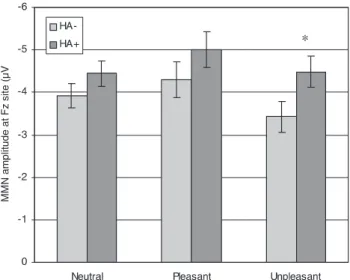
Figure 3. Mean MMN amplitude recorded within neutral, positive, and negative contexts in low- and high-HA groups at Fz location. * indicates a significant difference at p < .05 compared to low-HA subjects.
egories (neutral-positive: T = 301.5, neutral-negative: T = 169.5, all p values < .001; positive-negative: T = 548, p = .007).
The great average curves recorded during the presenta-tion of the three kinds of visual stimuli are depicted in Fig-ure 1. The two-way repeated-measFig-ure ANOVA (3 pictFig-ure categories × 3 electrode locations) conducted with MMN amplitude as the dependent variable revealed a main effect
of electrode location, F(2, 118) = 118.65, p < .001, η² =
0.67, and a significant Electrode × Picture Category
inter-action, F(4, 236) = 3.66, p < .01,η² = 0.06. Paired
compar-isons showed that MMN amplitudes recorded in a pleasant context were larger than in an unpleasant context, at frontal
sites only, t(59)= 2.08, p = .04 (Figure 2).
The three-way ANOVAs revealed a main effect of NS,
F(1, 58) = 5.22, p = .03,η² = 0.08, reflecting that high-NS
subjects show larger MMN amplitudes than low-NS sub-jects, and a marginal effect of HA, F(1, 58) = 3.75, p = .06, η² = 0.06, reflecting that high-HA subjects show larger MMN amplitudes than low-HA subjects. A marginal BIS × Picture Category × Electrode interaction appeared,
F(4, 192) = 2.61, p = .058,η² = 0.05, reflecting that
high-BIS subjects showed larger MMN amplitude at frontal lo-cations within unpleasant context than low-BIS subjects,
t(48) = 2.04, p = .047, but not within neutral or pleasant
context, t(48)= 0.82, p = .42 and t(48)= 0.78, p = .44,
respec-tively. After Greenhouse-Geisser correction, the HA × Pic-ture Category × Electrode interaction did not reach
signif-icance, F(4, 232) = 1.88, p = .14,η² = 0.03, but because
specific expectations had been formulated regarding this dimension, HA groups were compared regarding MMN amplitude observed in different emotional contexts, and high-HA subjects were found to show larger MMN ampli-tude at frontal locations within unpleasant context than
low-HA subjects, t(58)= 2.03, p = .047, but not within
neu-tral or pleasant context, t(58)= 1.25, p = .22 and t(58)= 1.22,
p = .23, respectively (see Figure 3).
No effect reached statistical significance for either two-way or three-two-way ANOVAs performed with MMN latency as the dependent variable.
Discussion
The results of this study showed that pleasant contexts elic-ited larger MMN than unpleasant contexts, reflecting more automatic attentional allocation to the unattended environ-ment when the visual context has a positive valence. This suggests that a pleasant context increased the perceived need for change detection, and, thus, vigilance in the sub-jects. This result diverges from previous results reported either by Surakka et al. (1998) (smaller MMN within pleas-ant context) or DePascalis et al. (2005) (larger MMN with-in unpleasant context). One powith-int that can be advanced to explain this divergence is the difference between the emo-tional arousal of pictures presented in the present study and
in the previous ones. Thus, the pleasant pictures presented here were rated as more arousing than those presented by Surakka et al. (1998) (i.e., 4), and the perception of a pos-itive context as requiring less vigilance might be limited to low-arousing, but not high-arousing pleasant context; in-deed, whereas positive, low-arousing contexts may be a sign of low danger, positive high-arousing contexts may evoke potential reward and, therefore, induce increased vigilance. As well, in the present study, neutral and nega-tive picture ratings were quite close, while they were highly dissimilar in the DePascalis et al. study (2.9 and 6.4); so increased MMN amplitude might be observable only in negative, high-arousing contexts. In summary, it could be argued that the influence of the emotional context on MMN amplitude might be closely related to the emotional arousal resulting from the context, and not only to its valence. In-deed, arousal characteristics of the stimuli on emotional responses has previously been reported as highly relevant by studies using other psychophysiological measures of emotions such as skin-conductance response (Lang, Green-wald, Bradley, & Hamm, 1993). On the other hand, it should be noted that Surakka et al. (1998) reported no dif-ference between MMN amplitudes obtained during the pre-sentation of neutral and negative stimuli, in spite of quite dissimilar arousal ratings (3.5 and 7.1, respectively). Thus, although methodological differences may be advanced to explain why the present study did not replicate previous findings, divergent results reported in previous studies sug-gest that the influence of emotional context on auditory information processing should be considered carefully be-fore further replication.
The present results also revealed personality influences on auditory MMN amplitudes, regardless of emotional context. Namely, high-HA and high-NS subjects showed larger MMN than low-HA subjects and low-NS subjects, respectively. Several studies previously reported relation-ships between MMN amplitude and personality dimen-sions such as HA (Hansenne et al., 2003), neuroticism (Wang, Zhu, Pan, Hu, & Wang, 2001), impulsivity (Fran-ken, Nijs, & VanStrier, 2005), or extraversion (Sasaki, Campbell, Gordon Bazana, & Stelmack, 2000). The reason why both BIS- and BAS-related dimensions were occa-sionally reported to be related to MMN amplitude has still to be clarified, but these results suggest that, asides from emotional differences, personality may influence informa-tion cognitive processing, giving support to the noinforma-tion of personality-related attentional styles.
Finally, personality modulation of the emotional context influence was reported here. Consistent with DePascalis et al. (2005) results, only the negative context influence was modulated by personality, namely HA and BIS scales in the present study and SP/SR scales in the DePascalis study. This result suggests that, although unpleasant context did not elicit increased vigilance per se, it allows the detection of different attentional attitudes across subjects: Anxious subjects (i.e., high-HA and high-BIS subjects) would keep a higher level of attention toward the unattended
environ-ment, within unpleasant contexts, than low-anxious sub-jects, reflecting a consistent defensive, danger-expecting, attitude (Cloninger et al., 1993). This is also consistent with the previously reported higher sensitivity to unpleasant stimuli and a preferential processing of unpleasant material in high BIS-related subjects (e.g., Corr, 2002; Gable et al., 2000; Gomez & Gomez, 2002; Rusting, 1999).
It should be noted that a second experiment conducted in the laboratory (unpublished data) aimed to replicate pre-vious findings with emotional pictures presented, not in randomized order, but by blocks (i.e., pictures from the same category – neutral, pleasant, or unpleasant – were pre-sented by blocks), in order to induce a sustained emotional effect. This experiment was conducted on a separate sam-ple (N = 43). The results showed no difference between MMN amplitudes recorded in emotional or neutral con-texts, at any location; moreover, BIS- and BAS-related per-sonality dimensions were not found to modulate the emo-tional context influence on MMN amplitude. Taken togeth-er with the above-reported exptogeth-eriment findings, this result suggests that personality might, indeed, influence automat-ic attention allocation to the unattended environment as a function of the context valence, but that this modulation is highly dependent on methodological factors, including the mode of context presentation.
In summary, the results of the present study did not rep-licate the findings of Surakka et al. (1998) and DePascalis et al. (2005) regarding emotional context influence on au-ditory MMN amplitude. On the other hand, the present re-sults support the hypothesis that personality modulates the influence of emotional (namely unpleasant) context on at-tentional allocation to unattended environment (here in-dexed by MMN amplitude).
Acknowledgments
We thank Julie Depireux, François Drouguet, Kevin D’Os-tilio, Aline Gillet, and Perrine Lardinois for their technical support and Christel Devue for her review of the manuscript.
References
Amrhein, C., Mühlberger, A., Pauli, P., & Wiedemann, G. (2004). Modulation of event-related brain potentials during affective picture processing: A complement to startle reflex and skin conductance response? International Journal of Psychophysi-ology, 54, 231–240.
Bradley, B.P., & Mogg, K. (1994). Mood and personality in recall of positive and negative information. Behavior Research and Therapy, 32, 137–141.
Canli, T., Sivers, H., Withfield, S.L., Gotlib, I.H., & Gabrieli, J.D.E. (2002). Amygdala response to happy faces as a function of extraversion. Science, 296, 2191.
Carver, C.S., & White, T.L. (1994). Behavioral inhibition, behav-ioral activation, and affective responses to impeding reward
and punishment: The BIS/BAS scales. Journal of Personality and Social Psychology, 67, 319–333.
Center for the Study of Emotion and Attention [CSEA-NIMH]. (1999). International affective picture system: Digitalized pho-tographs. Gainesville, FL: The Center for Research in Psycho-physiology, University of Florida.
Cloninger, C.R. (1987). A systematic method for clinical descrip-tion and classificadescrip-tion of personality variants. Archives of Gen-eral Psychiatry, 44, 573–588.
Cloninger, C.R. (1999). The temperament and character invento-ry-revised. St. Louis, MO: Center for Psychobiology of Per-sonality, Washington University.
Cloninger, C.R., Svrakic, D.M., & Przybeck, T.R. (1993). A psy-chobiological model of temperaments and character. Archives of General Psychiatry, 50, 975–990.
Corr, P.J. (2002). J.A. Gray’s reinforcement sensitivity theory: Tests of the joint subsystem hypothesis of anxiety and impul-sivity. Personality and Individual Differences, 33, 511–532. Costa, P.T., & McCrae, R.R. (1990). The NEO Personality
Inven-tory manual revised. Odessa, FL: Psychological Assessment Resources.
DePascalis, V., Awari, B., Matteucci, A., & Mazzocco, A. (2005). Effect of emotional visual stimuli on auditory information pro-cessing: A test of J.A. Gray’s reinforcement sensitivity theory. Personality and Individual Differences, 38, 163–178. DePascalis, V., & Speranza, O. (2000). Personality effects on
at-tentional shift to emotional charged cues: ERP, behavioral and HR data. Personality and Individual Differences, 29, 217–238. DePascalis, V., Strippoli, E., Riccardi, P., & Vergari, F. (2004). Personality, event-related potential (ERP), and hear rate (HR) in emotional word processing. Personality and Individual Dif-ferences, 36, 873–891.
Delplanque, S., Silvert, L., Hot, P., & Sequeira, H. (2006). Event-related P3a and P3b in response to unpredictable emotional stimuli. Biological Psychology, 68, 107–20.
Fabiani, M., Gratton, G., & Coles, M.G.H. (2000). Event-related brain potentials: Methods, theory, and applications. In J.T. Ca-cioppo, L.G. Tassinary, & G.G. Bernston (Eds.), Handbook of psychophysiology (2nd ed., pp. 53–84). New York: Cambridge University Press.
Franken, I.H., Nijs, I., & VanStrien, J.W. (2005). Impulsivity af-fects mismatch negativity (MMN) measures of preattentive au-ditory processing. Biological Psychology, 70, 161–167. Gable, S.L., Reis, H.T., & Elliot, A.J. (2000). Behavioral
activa-tion and inhibiactiva-tion in everyday life. Journal of Personality and Social Psychology, 78, 1135–1149.
Gomez, A., & Gomez, R. (2002). Personality traits of the behav-ioral approach and inhibition systems: Associations with pro-cessing of emotional stimuli. Personality and Individual Dif-ferences, 32, 1299–1316.
Gross, J.J., Sutton, S.K., & Ketelaar, T. (1998). Relations between affect and personality: Support for the affect-level and affec-tive-reactivity views. Personality and Social Psychology Bul-letin, 24, 279–288.
Hansenne, M., Pinto, E., Scantamburlo, G., Renard, B., Reggers, J., Fuchs, S. et al. (2003). Harm avoidance is related to mis-match negativity (MMN) amplitude in healthy subjects. Per-sonality and Individual Differences, 34, 1039–1048.
Heponiemi, T., Keltikangas-Järvinen, L., Puttonen, S., & Ravaja, N. (2003). BIS/BAS sensitivity and self-rated affects during
experimentally induced stress. Personality and Individual Dif-ferences, 34, 943–957.
Lang, P.J., Greenwald, M.K., Bradley, M.M., & Hamm, A.O. (1993). Looking at pictures: Affective, facial, visceral, and be-havioral reactions. Psychophysiology, 30, 261–273.
Näätänen, R. (2000). Mismatch negativity (MMN): Perspectives for application. International Journal of Psychophysiology, 37, 3–10.
Näätänen, R. (2001). The perception of speech sounds by the human brain as reflected by the mismatch negativity (MMN) and its magnetic equivalent (MMNm). Psychophysiology, 38, 1–21. Näätänen, R., Gaillard, A.W., & Mantysalo, S. (1978). Early
se-lective-attention effect on evoked potential reinterpreted. Acta Psychologica, 42, 313–329.
Palomba, D., Angrilli, A., & Mini, A. (1997). Visual evoked po-tentials, heart rate responses, and memory to emotional picto-rial stimuli. International Journal of Psychophysiology, 27, 55–67.
Picton, T.W., Alain, C., Otten, L., Ritter, W., & Achim, A. (2000). Mismatch negativity: Different water in the same river. Audi-ology and NeurootAudi-ology, 5, 111–139.
Rusting, C.L. (1999). Interactive effects of personality and mood on emotion-congruent memory and judgment. Journal of Per-sonality and Social Psychology, 77, 1073–1086.
Sasaki, T., Campbell, K.B., Gordon Bazana, P., & Stelmack, R.M. (2000). Individual differences in mismatch negativity mea-sures of involuntary attention shift. Clinical Neurophysiology, 111, 1553–1560.
Surakka, V., Tenhunen-Eskelinen, M., Hietanen, J.K., & Sams, M. (1998). Modulation of human auditory information pro-cessing by emotional visual stimuli. Cognitive and Brain Re-search, 7, 159–163.
Torrubia, R., Avila, C., Moltó, J.M., & Caseras, X. (2001). The Sensitivity to Punishment and Sensitivity to Reward Question-naire (SPSRQ) as a measure of Gray’s anxiety and impulsivity dimensions. Personality and Individual Differences, 31, 837–862.
Van de Velde, M., Ghosh, I.R., & Cluitmans, P.J. (1999). Context-related artefact detection in prolonged EEG recordings. Com-puter Methods and Programs in Biomedicine, 60, 183–196. Wang, W., Zhu, S.Z., Pan L.C., Hu, A.H., & Wang, Y.H. (2001).
Mismatch negativity and personality traits in chronic primary insomniacs. Functional Neurology, 16, 3–10.
Winkler, I. & Cowan, N. (2005). From sensory to long-term mem-ory: Evidence from auditory memory reactivation studies. Ex-perimental Psychology, 52, 3–20.
Winkler, I., Cowan, N., Csépe, V., Czigler, I., & Näätänen, R. (1996). Interactions between transient and long-term auditory memory as reflected by the mismatch negativity. Journal of Cognitive Neuroscience, 8, 403–415.
Solange Mardaga Faculty of Psychology
Department of Cognitive Sciences University of Liège 5, boulevard du Rectorat (B32) B-4000 Liège Belgium Tel. +32 4 3663320 Fax +32 4 3662944 E-mail [email protected]