HAL Id: hal-02329480
https://hal.archives-ouvertes.fr/hal-02329480
Submitted on 23 Oct 2019
HAL is a multi-disciplinary open access
archive for the deposit and dissemination of
sci-entific research documents, whether they are
pub-lished or not. The documents may come from
teaching and research institutions in France or
abroad, or from public or private research centers.
L’archive ouverte pluridisciplinaire HAL, est
destinée au dépôt et à la diffusion de documents
scientifiques de niveau recherche, publiés ou non,
émanant des établissements d’enseignement et de
recherche français ou étrangers, des laboratoires
publics ou privés.
Time Domain Traveling Wave Model of Distributed
Feedback semiconductor laser with weak optical
feedback
Mohammed Mehdi Bouchene, Rachid Hamdi, Qin Zou
To cite this version:
Mohammed Mehdi Bouchene, Rachid Hamdi, Qin Zou. Time Domain Traveling Wave Model of
Distributed Feedback semiconductor laser with weak optical feedback. OPTISUD 2019: Topical
Meeting on OPTIcs and Applications to SUstainable Development, Sep 2019, Carthage, Tunis, Tunisia.
pp.4-7. �hal-02329480�
Time Domain Traveling Wave Model of Distributed Feedback
semiconductor laser with weak optical feedback
Mohammed Mehdi Bouchene
1*, Rachid Hamdi
1and Qin Zou
21 Université 8 mai 1945 Guelma, Laboratoire des Télécommunications (LT), Faculté des Sciences et de la
Technologie, 24000-Bp.401, Algérie
2Institut Mines-Télécom, Télécom SudParis, UMR 5157 CNRS, Université Paris-Saclay, 9 rue Charles
Fourier, 91011 Evry Cedex, France
*E-mail: [email protected]
1. Introduction
The Distributed feedback (DFB) semiconductor lasers are widely used in coherent, high speed, long distance optical communications systems due to their attractive properties such as wavelength stability and narrow spectral width [1]. In such systems, external optical feedback happens when a small fraction of the laser output re-enters into the laser cavity from an optical component such as the edge of optical fiber. It is well-established that laser operation could be affected negatively by a small amount of optical feedback [2]. Nevertheless, semiconductor lasers with optical feedback generate a chaotic output which has been used for many important practical applications like secure communication systems and random number generation [3, 4]. Recently, laser designer emphasis on designing semiconductor lasers with high tolerance to optical feedback [5,6].
For numerical simulation, the theoretical framework was provided by the well-known Lang-Kobayashi model [7], this model was derived from the rate equations model and has been used extensively in the last four decades in modeling laser diodes with different types and level of optical feedback. It has been shown that the L-K model is a robust and well researched model and has a very good agreement with the experimental results. In fact, the L-K model was originally developed for the simple Fabry-Pérot Laser diodes and it assumed by many authors to be valid for complicated structure such as DFB laser diodes. However, the L-K model is based on the assumption that the optical fields are uniformly distributed along the laser cavity, therefore it does not take into account the spatial distribution of optical fields and carrier density inside the laser cavity as a result it does not include the spatial-hole burning (SHB), which is now essential in the analysis of DFB semiconductor lasers where these effects are more significant [8]. In addition to that, some important structural parameters of DFB LDs such as diffraction grating and phase-shifts have been ignored in the L-K model [9]. Furthermore, the L-K does not give any information about the spectral characteristics of the laser [10].
In the present paper, we have developed a new approach to investigate the effect of weak external optical feedback on DFB semiconductor lasers by using Time Domain Traveling Wave (TDTW) Model. Although, TDTW model have been already used in modeling Laser diodes with external optical feedback for short external cavities and strong feedback level [11,12]. We focus in this work, on weak feedback regimes. When the DFB laser is subjected to weak optical feedback the lasing state of laser, hence the optical fields inside the laser cavity and boundary conditions change. We express two sets of equations in the time domain for the counter-propagating optical fields deviation by cause of optical feedback. The time delay of reflected light from the external cavity is taken into account in boundary conditions by considering in the equivalent reflectivity of the laser facet submitted to the feedback [13]. Moreover, the multimode operation of the laser, spontaneous emission noise, the spatial distribution and phase of optical fields and structure parameters of the DFB laser are taken into account implicitly in this unified model. The numerical solution of this time domain model is computed directly in the time domain by using the finite difference time domain (FDTD) method.
2. Simulation results and discussion
We have applied the extended TDTWmodel to study an index-coupled quarter phase shifted DFB laser operating at 1550 nm wavelength exposed to different level of weak external optical feedback, the laser parametrs used in numerical simulation are given in [17]. The time step of simulation is 1ps.
The Fig 1.(A) shows the light output power in (mW) versus the injection current in (mA) of solitary laser and for laser exposed to different level of weak optical feedback -80 dB and -45 dB respectively, the calculation of the static characteristics is obtained from the dynamic response by biasing the laser at a
fixed drive current and waits until the laser reaches its steady-state, then calculating the average output power. For solitary laser, the threshold current predicted by the model is approximately:Ith =18.8mA, it
can be observed in Fig. 1. (A) that small reduction of the threshold current when the feedback level is -45 dB, where the threshold current become approximately 16.6 mA that represent a 8% reduction of the total threshold current. One the other hand, it can be observed also an increase of the (L-I) curve slope efficiency as the feedback level increases, our result agrees with the theoretical and experimental results in [15, 16].
Figure 1 (A) L-I characteristics of (DFB) laser exposed to different amounts of optical feedback, (B)Transient response of (DFB) laser with and without optical feedback.
The Fig. 1.(B) shows the transient response of DFB laser feedback without and with feedback level of -50 dB, in both situations the laser takes less than 0.4 ns to reach the steady state condition. We can notice that there is a slight change in the damping ration and turn-on delay time due to feedback that’s as a result of changing the end facet reflectivity at the right end facet. This result is confirmed when calculating the resonance frequency of relaxation.
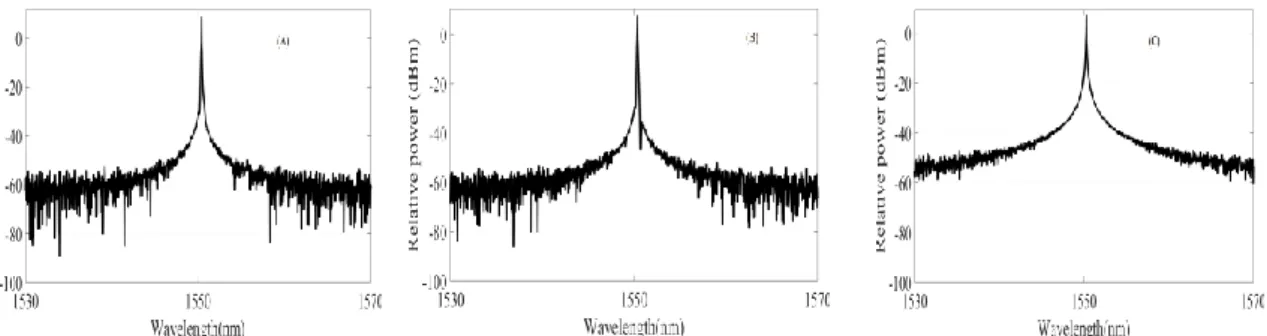
In order to get the optical spectra, we performed a Fourier transform of the electric field on facet submitted to feedback facet after the laser reach stable output. For the simulation of the spectrum, the laser is biased at 45 mA, and the average output power for solitary laser is approximately 7.3 mW. Fig 2. (A) illustrates the spectrum of a solitary DFB laser, the laser linewidth is about 6 MHz which is calculated by the TDTW model by taking the FWHM at the central lasing wavelength of spectrum
Figure 2 Optical spectrum of a: (A) solitary (DFB) laser, (B) with in phase feedback -80 dB, (C) with out of phase feedback -70 dB
The Fig. 2. (B) shows spectrum of the laser subjected to very weak optical feedback of -80 dB and external cavity length 0.4 cm witch correspond to roundtrip delay in the external cavity is 2 ps that match the calculated feedback parameter less than 1 (Regime I)[18], we notice a small reduction of the linewidth from 6 MHz for solitary laser to 4 MHz, as suggested by [14] we conclude that the reflected wave is in phase with the wave inside the laser cavity [14,18,27]. We increase slightly the feedback level to -70 dB, the feedback parameter still less than 1, (Regime I) [ 18], the Fig. 3. (C) shows that the laser linewidth is broaden to 8 MHz, the feedback light is out of phase with the wave inside the laser cavity [14,18,19].
Let’s now consider a feedback level of -65 dB and the external cavity length about 20 cm which correspond to roundtrip time in external cavity 1.32 ns, that match calculated feedback parameter greater than 1, the Fig. 3. (A) shows the calculated spectra, it can be observed in the curve the appearance of the line splitting and mode hopping as result of external cavity modes that lead to poor side-mode suppression ratio (SMSR), that operation corresponds to the transition to out of phase Regime II [18]. We increased the feedback level to -60 dB and change carefully the value of phase of the feedback light, the
spectra of the laser is plotted in Fig. 3. (B), the linewidth of the laser is reduced to 2.7 MHz, that corresponds to in phase Regime II [18, 19]. Let’s further increase the feedback level to -45 dB, the Fig. 3. (C) shows the calculated spectra, we notice that the laser linewidth is reduced to 1 MHz, which represent the narrowest measured linewidth, this correspond to transition to Regime III independent on the phase of the reflected light [14,18].
Figure 3 Optical spectrum of a DFB: (A) out of phase feedback -63dB, (B) out of phase feedback -60 dB, (C) feedback - 45dB
Fig. 4. (A) illustrates the average value of the Relative Intensity Noise (RIN) over a frequency range of [0-10GHz] for device biased at different values of injection current for several levels of weak feedback level, the RIN is calculated in the same manner as in rate equations modeling [20]. It can be seen that weak optical feedback has no effect on the average RIN, this result is demonstrated theoretically and experimentally in [6, 21]. We plot in Fig. 4. (B) the resonance frequency of relaxation oscillations as function of feedback level, it is well known that the modulation frequency must be smaller than the relaxation oscillations frequency of the laser [22]. For solitary laser the resonance frequency of the relaxation oscillations calculated by the TDTW model for drive current at:I=Ith,I=1.3Ith,I=1.9Ith is
respectively 1.96 GHz, 3.6 GHz and 7.2 GHz, for drive current equal to threshold it can be seen that there is no significant change in frequency of relaxation oscillation, but as the drive current increases to
1.3 th
I= I and I=1.9Ith, we notice that a small change in feedback level causes a significant change in the frequency of relaxation oscillations [23], these results demonstrates that the resonance frequency of relaxation oscillations can be easily altered by the weak feedback in order of 1~2 GHz depending on the output power.
Figure 4 (A) Average RIN over frequency range versus external optical feedback level for different values of bias current. (B) Relaxation resonance frequency versus external optical feedback level for different values of bias current.
3. Conclusions
A new theoretical model for distributed feedback semiconductor laser with weak optical feedback has been presented. New fields equations deviations in the time domain have been derived for the change of the lasing state of the laser due to optical feedback. The simulation results are obtained and compared for different values of external cavity parameters. To validate the accuracy of our model we have compared our results with other theoretical and experimental results, which they show a good agreement. Our results also show that the proposed model can be used as a straightforward simulation tool in the analysis of static, dynamic and noise characteristics of DFB laser with weak optical feedback.
References
[1] Agrawal, G. P. (2011). Fiber-optic communication systems. Oxford: Wiley-Blackwell.
[2] Henry, C., & Kazarinov, R. (1986). Instability of semiconductor lasers due to optical feedback from distant reflectors. IEEE Journal of Quantum Electronics, 22(2), 294-301. doi:10.1109/jqe.1986.1072959.
[3] Uchida, A. (2012). Optical communication with chaotic lasers: Applications of nonlinear dynamics and synchronization. Weinheim: Wiley-VCH.
[4] Ohtsubo, J. (2018). Semiconductor Lasers Stability, Instability and Chaos. Cham: Springer International Publishing.
[5] Schaijk, T. T., Lenstra, D., Bente, E. A., & Williams, K. A. (2018). Rate-equation theory of a feedback insensitive unidirectional semiconductor ring laser. Optics Express, 26(10), 13361. doi:10.1364/oe.26.013361.
[6] van Schaijk, T., Lenstra, D., Bente, E. and Williams, K. (2018). Theoretical Analysis of a Feedback Insensitive Semiconductor Ring Laser Using Weak Intracavity Isolation. IEEE Journal of Selected Topics in Quantum Electronics, 24(1), pp.1-8.
[7] Lang, R., & Kobayashi, K. (1980). External optical feedback effects on semiconductor injection laser properties. IEEE Journal of Quantum Electronics,16(3), 347-355. doi:10.1109/jqe.1980.1070479.
[8] Rabinovich, W., & Feldman, B. (1989). Spatial hole burning effects in distributed feedback lasers. IEEE Journal of Quantum Electronics, 25(1), 20-30. doi:10.1109/3.16236.
[9] Alam, M., Karim, M., & Islam, S. (1997). Effects of structural parameters on the external optical feedback sensitivity in DFB semiconductor lasers. IEEE Journal of Quantum Electronics,33(3), 424-433. doi:10.1109/3.556012.
[10] Gallagher, D. F. (2005). Design and simulation of widely tunable lasers using a time domain travelling wave model. Physics and Simulation of Optoelectronic Devices XIII. doi:10.1117/12.605535.
[11] Radziunas, M., Wünsche, H., Krauskopf, B., & Wolfrum, M. (2006). External cavity modes in Lang-Kobayashi and traveling wave models. Semiconductor Lasers and Laser Dynamics II. doi:10.1117/12.663546.
[12] Radziunas, M., Tronciu, V., Luvsandamdin, E., Kurbis, C., Wicht, A. and Wenzel, H. (2015). Study of Microintegrated External-Cavity Diode Lasers: Simulations, Analysis, and Experiments. IEEE Journal of Quantum Electronics, 51(2), pp.1-8.
[13] Favre, F. (1987). Theoretical analysis of external optical feedback on DFB semiconductor lasers. IEEE Journal of Quantum Electronics, 23(1), pp.81-88.
[14] Petermann, K. (1995). External optical feedback phenomena in semiconductor lasers. IEEE Journal of Selected Topics in Quantum Electronics, 1(2), pp.480-489.
[15] Sigg, J. (1993). Effects of optical feedback on the light-current characteristics of semiconductor lasers. IEEE Journal of Quantum Electronics, 29(5), 1262-1270. doi:10.1109/3.236140.
[16] Kallimani, K., & Omahony, M. (1998). Relative intensity noise for laser diodes with arbitrary amounts of optical feedback. IEEE Journal of Quantum Electronics, 34(8), 1438-1446. doi:10.1109/3.704337.
[17] Bouchene, M. M., Hamdi, R., & Zou, Q. (2017). Theorical analysis of a monolithic all-active three-section semiconductor laser. Photonics Letters of Poland, 9(4), 131. doi:10.4302/plp.v9i4.785.
[18] Tkach, R., & Chraplyvy, A. (1986). Regimes of feedback effects in 1.5-µm distributed feedback lasers. Journal of Lightwave Technology, 4(11), 1655-1661. doi:10.1109/jlt.1986.1074666.
[19] Goldberg, L., Taylor, H., Dandridge, A., Weller, J., & Miles, R. (1982). Spectral characteristics of semiconductor lasers with optical feedback. IEEE Journal of Quantum Electronics, 18(4), 555-564. doi:10.1109/jqe.1982.1071581.
[20] Fatadin, I., Ives, D., & Wicks, M. (2006). Numerical Simulation of Intensity and Phase Noise From Extracted Parameters for CW DFB Lasers. IEEE Journal of Quantum Electronics, 42(9), 934-941. doi:10.1109/jqe.2006.880117.
[21] Helms, J., & Petermann, K. (1990). A simple analytic expression for the stable operation range of laser diodes with optical feedback. IEEE Journal of Quantum Electronics, 26(5), 833-836. doi:10.1109/3.55523.
[22] Petermann, K. (1991). Laser diode modulation and noise. Dordrecht: Kluwer.
[23] Spano, P., Piazzolla, S., & Tamburrini, M. (1984). Theory of noise in semiconductor lasers in the presence of optical feedback. IEEE Journal of Quantum Electronics,20(4), 350-357. doi:10.1109/jqe.1984.1072403.