HAL Id: hal-01358578
https://hal.inria.fr/hal-01358578
Submitted on 2 Sep 2016
HAL is a multi-disciplinary open access
archive for the deposit and dissemination of
sci-entific research documents, whether they are
pub-lished or not. The documents may come from
teaching and research institutions in France or
L’archive ouverte pluridisciplinaire HAL, est
destinée au dépôt et à la diffusion de documents
scientifiques de niveau recherche, publiés ou non,
émanant des établissements d’enseignement et de
recherche français ou étrangers, des laboratoires
Miuz: measuring the impact of disconnecting a node
Ivana Bachmann, Patricio Reyes, Alonso Silva, Javier Bustos-Jiménez
To cite this version:
Ivana Bachmann, Patricio Reyes, Alonso Silva, Javier Bustos-Jiménez. Miuz: measuring the impact
of disconnecting a node. 34th International Conference of the Chilean Computer Science Society
(SCCC), Nov 2015, Santiago, Chile. �10.1109/SCCC.2015.7416586�. �hal-01358578�
Miuz: measuring the impact of
disconnecting a node
Ivana Bachmann
∗1, Patricio Reyes
†2, Alonso Silva
‡3, and Javier Bustos-Jim´
enez
§41,4
NICLabs, Computer Science Department (DCC), Universidad de Chile, Chile
2Technological Institute for Industrial Mathematics (ITMATI), Santiago de Compostela,
Spain
3
Nokia Bell Labs, Centre de Villarceaux, Route de Villejust, 91620 Nozay, France
Abstract
In this article we present Miuz, a robustness index for complex networks. Miuz measures the impact of disconnecting a node from the network while compar-ing the sizes of the remaincompar-ing connected components. Strictly speaking, Miuz for a node is defined as the inverse of the size of the largest connected component divided by the sum of the sizes of the remaining ones. We tested our index in attack strategies where the nodes are disconnected in decreasing order of a spec-ified metric. We considered Miuz and other well-known centrality measures such as betweenness, de-gree, and harmonic centrality. All of these metrics were compared regarding the behavior of the robust-ness (R-index) during the attacks. In an attempt to simulate the internet backbone, the attacks were per-formed in complex networks with power-law degree distributions (scale-free networks).
Preliminary results show that attacks based on dis-connecting a few number of nodes Miuz are more dangerous (decreasing the robustness) than the same attacks based on other centrality measures. We be-lieve that Miuz, as well as other measures based on the size of the largest connected component, provides ∗Email: [email protected] To whom correspondence should
be addressed.
†Email: [email protected]
‡Email: [email protected] §Email: [email protected]
a good addition to other robustness metrics for com-plex networks.
1
Introduction
Networks are present in human life in multiple forms from social networks to communication networks (such as the Internet), and they have been widely studied as complex networks of nodes and rela-tionships, describing their structure, relations, etc. Nowadays, the studies go deep into network knowl-edge, and using standard network metrics such as degree distribution and diameter one can determine how robust and/or resilient a network is.
Even though both terms (robustness and re-silience) have been used with the same meaning, we will consider robustness as the network inner capac-ity to resist failures, and resilience as the abilcapac-ity of a network to resist and recover after such failures. However, both terms have in common the methodol-ogy for testing robustness and/or resilience. Usually, they consist on planned attacks against nodes fail-ures or disconnections, from a random set of failfail-ures to more elaborated strategies using well known net-work metrics.
We consider that an “adversary” should plan a greedy strategy aiming to maximize damage with the minimum number of strikes. Under this new philos-ophy of “adversary”, we first present a new network
impact metric called Miuz, which is the inverse of the size of the largest connected component, divided by the sum of the sizes of the remaining ones. Then, we plan a greedy strategy based on recalculating the net-work Miuz-ness after each node disconnection. We discuss the performance of attacks based on Miuz and other centrality measures[1] (in particular, between-ness, degree, harmonic), compared by the robustness index (R-index). Our main conclusion is that the first strikes of a Miuz strategy causes more “damage” than the classical betweenness, degree, and harmonic metrics.
The article is organized as follows, next section presents related work, followed by the definition of Miuz, its attacking strategy, and its simulation re-sults in section 3. Discussions about the main rere-sults and conclusions are presented in sections 4 and 5 re-spectively.
2
Related Work
Over the last decade, there has been a huge interest in the analysis of complex networks and their con-nectivity properties [2]. During the last years, net-works and in particular social netnet-works have gained significant popularity. An in-depth understanding of the graph structure is key to convert data into in-formation. To do so, complex networks tools have emerged [3] to classify networks [4], detect commu-nities [5], determine important features and measure them [1].
The idea of planning a “network attack” using centrality measures has been catching the attention of researchers and practitioners nowadays. For in-stance, Sterbenz et al. [6] used betweenness-centrality (bcen) for planning a network attack, calculating the bcen value for all nodes, ordering nodes from higher to lower bcen, and then attacking (discarding) those nodes in that order. They have shown that discon-necting only two of the top bcen-ranked nodes , their packet-delivery ratio is reduced to 60%, which corre-sponds to 20% more damage than other attacks such as random links or nodes disconnections, tracked by link-centrality and by node degrees.
A similar approach and results were presented by
C¸ etinkaya et al. [7]. They show that after discon-necting only 10 nodes the packet-delivery ratio is reduced to 0%. Another approach, presented as an improved network attack [8, 9], is to recalcu-late the betweenness-centrality after the removal of each node [10, 11]. They show a similar impact of non-recalculating strategies but discarding some-times only half of the equivalent nodes.
Concerning centrality measures, betweenness cen-trality deserves special attention. Betweenness has been studied as a resilience metric for the routing layer [12] and also as a robustness metric for com-plex networks [13] and for internet autonomous sys-tems networks [14] among others.
3
Miuz Attacking Strategy
Given a network N of size N , we denote by C(N \ n) the set of connected components in N after discon-necting node n. The Miuz index for a node n in N is defined as follows: MiuzN(n) = P c∈C(N \n)kck maxc∈C(N \n) kck− 1, if kC(N \ n)k 6= kC(N )k + 1 0 otherwise (1) where kck, with c ∈ C(N \ n), is the size of the con-nected component c of the network N after discon-necting node n (if connected, i.e. if there is an edge between node n and another node of the network). Notice that MiuzN(n) reflects the partition of a
net-work in several sub-netnet-works after the disconnection of node n and how these sub-networks remain inter-connected. Strictly speaking, it compares in size the core network (the largest connected component) with the other remaining sub-networks. MiuzN takes
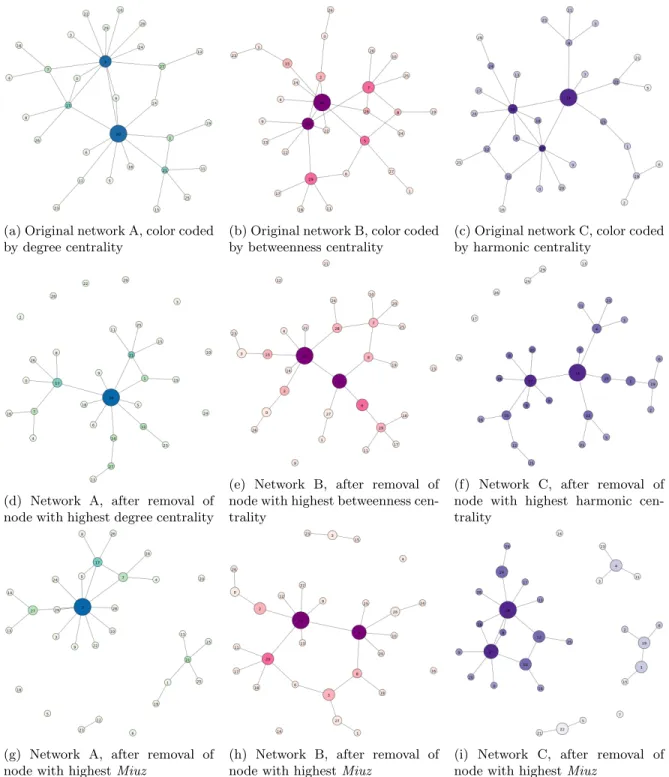
val-ues between 0 (the whole network remains connected) to N − 1 (the whole network is disconnected). Fig-ure 1 shows examples of three networks after discon-necting the node with either highest Miuz, degree, betweenness or harmonic centrality.
3.1
Network Attack Plan
If we plan a network attack by disconnecting nodes with a given strategy, it is widely accepted the use
of centrality measures (such as degree, betweenness, harmonic) because they reflect the importance of nodes in the network [13]. These attack strategies are compared by means of the Unique Robustness Mea-sure (R-index) [15], defined as:
R = 1 N N X Q=1 s(Q), (2)
where N is the number of nodes in the network and s(Q) is the fraction of nodes in the largest connected component after removing Q nodes using a given strategy. Therefore, the higher the R-index, the better in terms of robustness. Our strategy is:
In each step, (re)compute the Miuz index for all the nodes and disconnect the node with the highest Miuz value.
Degree centrality is a simple, easy-to-compute lo-cal (myopic) metric. Despite its simplicity, it is the preferred metric for certain literature [13] under this kind of attacks. Basically, it ranks nodes in terms of their degree (number of edges or connections to other nodes). Betweenness centrality ranks nodes by the number of shortest paths passing throw them. Unlike degree, betweenness centrality is not a local (myopic) metric. It determines the importance of a node by looking at the paths between all of the pairs of remaining nodes. The harmonic centrality is a metric related to the distances to the remaining nodes. It is the sum of the reciprocal of distances to other nodes (with the convention of 1/∞ = 0, used when two nodes are not connected by any path). This metric was widely studied in [16], mainly because of its good mathematical properties.
For a better understanding of network attacks and strategies, see [10, 11, 8, 9].
3.2
Simulations
In an attempt to study the behavior of the internet backbone, we test our strategy in simulated scale-free networks (it means, with power-law degree dis-tributions, that is dist(deg) ∝ x−α) with exponents
α ∈ {2.10, 2.15, 2.20, 2.25, 2.30}. For each α, we sim-ulate 50 networks of size 1000 (i.e., with 1000 nodes). Then, we tested and compared strategies ranked with a multitude of centrality measures [1] in terms of the R-index. However, apart from Miuz, for this arti-cle we selected and reported the results for degree, betweenness and harmonic centrality.
Instead of just compare the robustness, after the removal of all of the nodes, we studied the behavior of the attacks after the only a few strikes. To do so, we define a variant of the R-index which takes into account only the first n strikes of an attack. Thus, for a simultaneous attack (where the nodes are ranked by a metric only once at the beginning), the Ra-index is
defined as: Ra= 1 a a X Q=1 s(Q). (3)
For a sequential attack, the order of node disconnec-tion is recomputed after each disconnecdisconnec-tion. Similar to the R-index, notice that the lower the Ra-index,
the more effective the attack is, since that gives us a higher reduction of robustness.
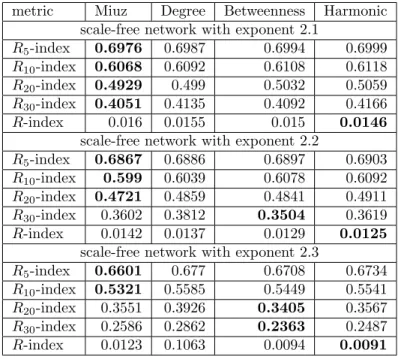
Results are shown in Table 1. We tested sequential attacks: At each strike, the next node to disconnect was the one with the highest metric (whether it be Miuz, Degree, Betweenness or Harmonic centrality) in the current network. The table shows the behavior of the Ra-index as well as the R-index in 50 scale-free
networks (generated as before) with exponent 2.1, 2.2 and 2.3. For each group of networks, we compute the Ra-index for a ∈ {5, 10, 20, 30}, it means, the
variant of R-index after the first 5, 10, 20 and 30 node disconnections. Miuz proves to be very effective in attacks with only a few disconnections. Moreover, Miuz shows that the effectiveness persists over the number of strikes in scale-free networks with lower exponent.
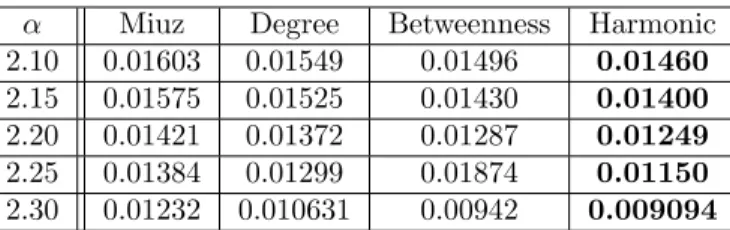
It is interesting to note that, no matter the metric used, the damage decreases in the long term with the number of strikes. Indeed, if we consider a complete attack, disconnecting all the nodes of the network, the R-index shows that an attack based on Harmonic centrality performs better. A comparison of the R-index is shown in Table 2. It is important to notice that R-index is a metric for a general view of
robust-ness, and it gives no information of how fast the net-work is disconnected (further details in Section 4.1).
4
Discussion
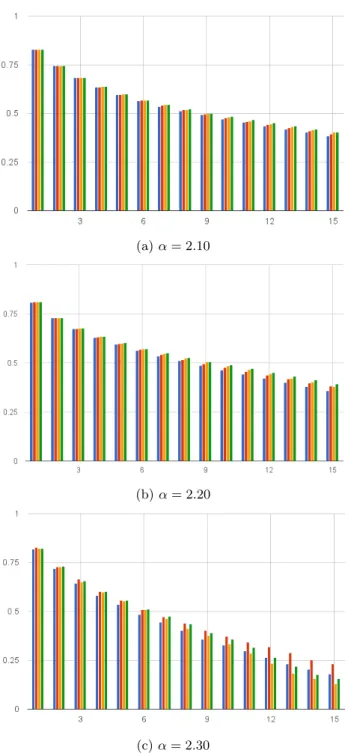
We start analyzing what would be the worst “attack”. In the worst case, a “malicious adversary” will try to perform the maximum damage with the minimum number of strikes, that is, with the minimum number of node disconnections (made by the attacker). In terms of decreasing the size of the largest connected component, Miuz is the best attack strategy during the first strikes. It achieves the disconnection of more than half of the network only after nine strikes for α = 2.10 and after five strikes for α = 2.30 (see Fig. 2).
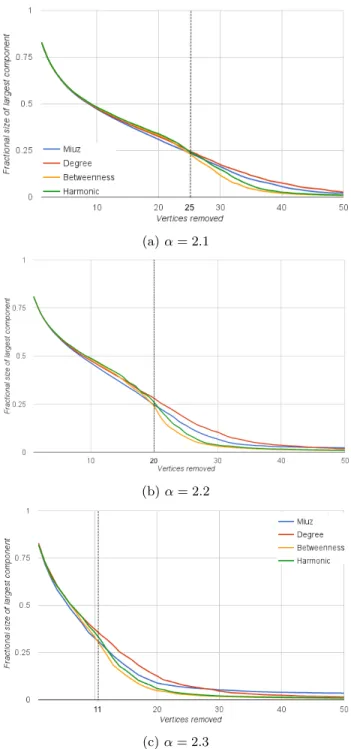
It is important to notice that there is a break-ing point where Miuz is no longer the best attack-ing strategy (Fig. 3). This breakattack-ing point occurs with less strikes as the exponent of the scale-free net-work increases. Nevertheless, as shown in Fig. 3, this breaking point appears after the largest connected component is less than 1/3 of the original network.
4.1
Is the R-index a good metric for
robustness?
From the above discussion it is valid to question whether the R-index is a good measure of robust-ness. Maybe it is important to revisit the definition of network robustness:
“A measure of the decrease of network functionality under a sinister attack”[10]
Therefore, the R-index can be considered as a good robustness metric even though it does not reflect how fast the network is disconnected (as it is shown in Fig. ??).
We suggest that weighted versions of the R-index could be a good compromise. This is the case of the Ra-index proposed in Section 3 which takes into
ac-count the removal of only a percentage of the best ranked nodes (or until the network reaches its perco-lation threshold [10]) could be a more useful metric for robustness and/or resilience in worst-case scenar-ios.
4.2
Revisiting Miuz
Concerning the attacking strategies, it is important to notice that Miuz strategy was designed for discon-necting the network from the first strikes, aiming to get connected components with similar sizes. This is the main reason of its better performance than centrality metrics in a worst-attack scenario. For in-stance, in Fig. 1 we present examples where the Miuz strategy performs better attacks than the ones with other centrality metrics. In subfigure a) Degree-based attack will select node 2 (up) while Miuz selects node 20 (down). In b) Betweenness-based attack will select node 21 while Miuz selects node 18. In c) Harmonic-based attack will select node 25 (left) while Miuz se-lects node 14 (right).
Another interesting property of Miuz occurs when maxn(Miuzn(N )) = 0. In other words, when Miuz
is 0 for any node. In that case, the full network will remain connected no matter which node is discon-nected. Therefore, we suggest a resilience metric as the number (or percentage) of disconnected nodes un-til max(Miuzn(N )) > 0, a pre-defined threshold, or
the percolation threshold [10].
5
Conclusions
and
Future
Work
In this article we have presented Miuz, a robustness index for complex networks defined as the inverse of the size of the remaining largest connected compo-nent divided by the sum of the sizes of the remaining connected components.
We tested our index as a measure to quantify the impact of node removal in terms of the network ro-bustness metric R-index. We compared Miuz with other attacks based on well-known centrality mea-sures (betweenness centrality, degree and harmonic) for node removal selection. The attack strategy used was sequential targeted attack, where every index is recalculated after each removal, and the highest one is selected for the next extraction.
Preliminary results show that Miuz performs bet-ter compared to attacks with classical centrality mea-sures in terms of decreasing the network robustness
Table 1: Robustness against sequential attacks based on different metrics. Table shows mean R-index and mean Ra-index for scale-free networks with exponent 2.1, 2.2 and 2.3. Ra-index corresponds to the equivalent
to R-index, but only disconnecting a nodes. Attacks based on harmonic centrality are more harmful in the long term. However attacks based on Miuz turns out to be more dangerous than the others with only a few strikes.
metric Miuz Degree Betweenness Harmonic scale-free network with exponent 2.1
R5-index 0.6976 0.6987 0.6994 0.6999
R10-index 0.6068 0.6092 0.6108 0.6118
R20-index 0.4929 0.499 0.5032 0.5059
R30-index 0.4051 0.4135 0.4092 0.4166
R-index 0.016 0.0155 0.015 0.0146 scale-free network with exponent 2.2
R5-index 0.6867 0.6886 0.6897 0.6903
R10-index 0.599 0.6039 0.6078 0.6092
R20-index 0.4721 0.4859 0.4841 0.4911
R30-index 0.3602 0.3812 0.3504 0.3619
R-index 0.0142 0.0137 0.0129 0.0125 scale-free network with exponent 2.3
R5-index 0.6601 0.677 0.6708 0.6734
R10-index 0.5321 0.5585 0.5449 0.5541
R20-index 0.3551 0.3926 0.3405 0.3567
R30-index 0.2586 0.2862 0.2363 0.2487
R-index 0.0123 0.1063 0.0094 0.0091
in the worst-attack scenario. Compared to other cen-trality measures, strategies based on Miuz are more dangerous (decreasing the robustness) in the first strikes of the attacks. We suggest that Miuz, as well as other measures based on the size of the largest con-nected component, provides a good addition to other robustness metrics for complex networks.
As future work, we can study improving through new connections an already existing network to make it more robust to attacks, and we can study networks in which the topological space is correlated with the cost of nodes disconnections, nodes which are nearby have a lower cost to be disconnected compared with nodes which are far apart.
References
[1] N. I. Bersano-M´endez, S. E. Schaeffer, and J. Bustos-Jim´enez, “Metrics and models for so-cial networks,” in Computational Soso-cial Net-works, pp. 115–142, Springer, 2012.
[2] R. Albert, H. Jeong, and A. Barabasi, “Error and attack tolerance of complex networks,” Na-ture, vol. 406, pp. 378–82, July 2000.
[3] R. Albert and A.-L. Barab´asi, “Statistical me-chanics of complex networks,” Reviews of Mod-ern Physics, vol. 74, pp. 47–97, Jan. 2002, 0106096.
[4] D. J. Watts and S. H. Strogatz, “Collective dynamics of ’small-world’ networks.,” Nature, vol. 393, pp. 440–2, June 1998.
α Miuz Degree Betweenness Harmonic 2.10 0.01603 0.01549 0.01496 0.01460 2.15 0.01575 0.01525 0.01430 0.01400 2.20 0.01421 0.01372 0.01287 0.01249 2.25 0.01384 0.01299 0.01874 0.01150 2.30 0.01232 0.010631 0.00942 0.009094
Table 2: Mean values of R-index for different disconnection strategies. The harmonic centrality strategy gets the lowest R-index values (in bold) for all of the tested exponents. (The higher the R-index, the better in terms of robustness).
[5] J. Leskovec, K. J. Lang, A. Dasgupta, and M. W. Mahoney, “Statistical properties of community structure in large social and information net-works,” Proceeding of the 17th international con-ference on World Wide Web - WWW ’08, p. 695, 2008.
[6] J. P. Sterbenz, E. K. Cetinkaya, M. Hameed, A. Jabbar, J. P. Rohrer, et al., “Modelling and analysis of network resilience,” in Communica-tion Systems and Networks (COMSNETS), 2011 Third International Conference on, pp. 1–10, IEEE, 2011.
[7] E. K. C¸ etinkaya, D. Broyles, A. Dandekar, S. Srinivasan, and J. P. Sterbenz, “Modelling communication network challenges for future internet resilience, survivability, and disrup-tion tolerance: A simuladisrup-tion-based approach,” Telecommunication Systems, vol. 52, no. 2, pp. 751–766, 2013.
[8] J. Rak and K. Walkowiak, “Survivability of any-cast and uniany-cast flows under attacks on net-works,” in Ultra Modern Telecommunications and Control Systems and Workshops (ICUMT), 2010 International Congress on, pp. 497–503, IEEE, 2010.
[9] A. Sydney, C. Scoglio, M. Youssef, and P. Schumm, “Characterising the robustness of complex networks,” International Journal of Internet Technology and Secured Transactions, vol. 2, no. 3-4, pp. 291–320, 2010.
[10] P. Holme, B. J. Kim, C. N. Yoon, and S. K. Han, “Attack vulnerability of complex networks,” Physical Review E, vol. 65, no. 5, p. 056109, 2002.
[11] W. Molisz and J. Rak, “End-to-end service sur-vivability under attacks on networks,” Journal of Telecommunications and Information Tech-nology, pp. 19–26, 2006.
[12] P. Smith, D. Hutchison, J. P. Sterbenz, M. Scholler, A. Fessi, M. Karaliopoulos, C. Lac, and B. Plattner, “Network resilience: a sys-tematic approach,” Communications Magazine, IEEE, vol. 49, no. 7, pp. 88–97, 2011.
[13] S. Iyer, T. Killingback, B. Sundaram, and Z. Wang, “Attack robustness and centrality of complex networks,” PloS one, vol. 8, no. 4, p. e59613, 2013.
[14] P. Mahadevan, D. Krioukov, M. Fomenkov, X. Dimitropoulos, A. Vahdat, et al., “The inter-net as-level topology: three data sources and one definitive metric,” ACM SIGCOMM Computer Communication Review, vol. 36, no. 1, pp. 17– 26, 2006.
[15] C. M. Schneider, A. A. Moreira, J. S. Andrade, S. Havlin, and H. J. Herrmann, “Mitigation of malicious attacks on networks,” Proceedings of the National Academy of Sciences, vol. 108, no. 10, pp. 3838–3841, 2011.
[16] P. Boldi and S. Vigna, “Axioms for Central-ity,” Internet Mathematics, vol. 10, pp. 222–262,
(a) Original network A, color coded by degree centrality
(b) Original network B, color coded by betweenness centrality
(c) Original network C, color coded by harmonic centrality
(d) Network A, after removal of node with highest degree centrality
(e) Network B, after removal of node with highest betweenness cen-trality
(f) Network C, after removal of node with highest harmonic cen-trality
(g) Network A, after removal of node with highest Miuz
(h) Network B, after removal of node with highest Miuz
(i) Network C, after removal of node with highest Miuz
Figure 1: Effects of attacking strategies. The size shows the Miuz-ness and the color darkness reflects the centrality metric. Metrics were recalculated after node removal.
(a) α = 2.10
(b) α = 2.20
(c) α = 2.30
Figure 2: Effects of sequentially disconnecting nodes on power-law networks, plotting the fractional size of largest component after disconnecting x nodes and using as a selection strategy: Miuz (blue), Degree (red), Betweenness (orange), and Harmonic (green).
(a) α = 2.1
(b) α = 2.2
(c) α = 2.3
Figure 3: Size of the largest fractional connected component and number disconnected nodes. Dashed line shows the breaking point when Miuz is no longer the best attacking strategy for α = 2.1 − 2.3.