HAL Id: hal-02133918
https://hal.insa-toulouse.fr/hal-02133918
Submitted on 20 May 2019
HAL is a multi-disciplinary open access
archive for the deposit and dissemination of
sci-entific research documents, whether they are
pub-lished or not. The documents may come from
teaching and research institutions in France or
abroad, or from public or private research centers.
L’archive ouverte pluridisciplinaire HAL, est
destinée au dépôt et à la diffusion de documents
scientifiques de niveau recherche, publiés ou non,
émanant des établissements d’enseignement et de
recherche français ou étrangers, des laboratoires
publics ou privés.
Shear nonlinear behavior of the Nomex honeycomb core
Juan de Dios Rodriguez-Ramirez, Bruno Castanié, Christophe Bouvet
To cite this version:
Juan de Dios Rodriguez-Ramirez, Bruno Castanié, Christophe Bouvet. Shear nonlinear behavior of
the Nomex honeycomb core. 12th International Conference on Sandwich Structures (ICSS-12), Aug
2018, Lausanne, Switzerland. �hal-02133918�
12th International Conference on Sandwich Structures (ICSS-12) Lausanne - Switzerland, 19–22 August 2018
Edited by T. Keller, L.A. Carlsson & Y. Frostig
SHEAR NONLINEAR BEHAVIOR OF NOMEX HONEYCOMB CORE
Juan de Dios RODRIGUEZ-RAMIREZ1-a, Bruno CASTANIE1-b and Christophe BOUVET1-c
1Institut Clément Ader (ICA), Université de Toulouse, CNRS UMR 5312-INSA-ISAE-Mines Albi-UPS, Toulouse, France.
a [email protected] a [email protected] c [email protected] 1. INTRODUCTION
Sandwich structures are widely used for many different applications since they offer exceptional benefits, providing a high bending stiffness with a very low weight. In aeronautics, sandwich panels are commonly made of Nomex honeycomb, and therefore this core has been studied for decades. Concerning the literature, most of the investigations on honeycomb cores are focused on the compression properties of the structure, for energy absorption applications or impacts on sandwich panels.
In the other hand, there are far fewer studies concerning the understanding of the shear nonlinear behavior of the honeycomb [1], this can be considered a major drawback, knowing that it’s the core who absorbs most of the shear components when a bending force is applied.
To help fill this gap, this work focuses on to study the shear behavior of the honeycomb structure. Several experimental tests are conducted using different boundary conditions to observe the buckling of the cells. This helps to understand the causes of the phenomenological stages that appear when the honeycomb structure is submitted to shear loads.
Finally, a numerical approach is used to simulate the honeycomb response to be able to see on the interior cell walls and to better understand this phenomenon.
2. EXPERIMENTAL STUDY Testing with double lap specimens
The first part of this research consisted into test 12 double lap specimens to determine the shear response of the honeycomb core; 6 specimens oriented in the W and other 6 oriented in the L direction. Of the 6 specimens, 3 were submitted to a continuum displacement, and the other 3 to an incremental cyclic displacement.
While the tests were performed a 3D-DIC was installed to be able to measure the buckling of the cells at the exterior surface of the honeycomb.
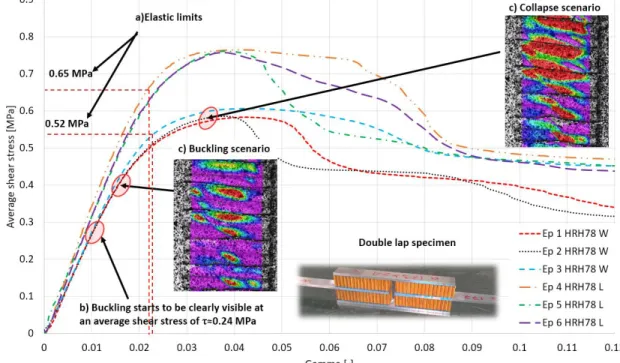
Fig. 1: Description of the shear behavior of the HRH-78 Nomex Honeycomb core a) The elastic limits were detected trough an incremental cyclic testing, b) The buckling of the cells is detected at a relatively low shear stress, c) Buckling scenario of
First A. Author, Second A. Author and Third A. Author
The results showed that the buckling of the cells starts to be visible at relatively low shear stress considering that the shear strength was around 0.58 MPa. By looking the deepness of the buckles, it was observed that the cells buckled predominantly to the inside of the specimen.
Also, the incremental cyclic tests revealed that the honeycomb structure presented a nonlinear elastic behavior beyond the buckling point. Finally, it has been seen that the buckling scenario of the cells was very different at the bifurcation point and at the shear strength limit (0.58 MPa). To explain this behavior a hypothesis was made: this difference is attributed to two different phenomenological phenomena, first the buckling and then the collapse of the cells. And so, an artificial neural network (ANN) was developed that was able to detect the collapse of the alveolus based on the shape of the buckles.
Testing sandwich beam specimens with lateral stabilization
The second part consisted into tests other 6 specimens. This time, the specimens consisted on a sandwich beam that had potting at the borders and at the middle. This was made in the purpose to study how the lateral stabilization (provided by the potting) affected the behavior of the cells.
The sandwich beams were submitted to a classical 3 point bending test and the response of the specimens was compared to the double lap specimens.
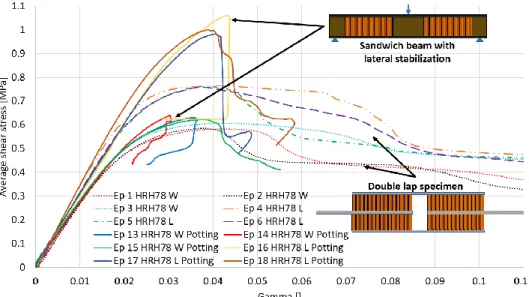
It was detected that the initial behavior of both types of specimens was very similar as the shear modulus was the same. However, there were three principal differences: the linear behavior of the cells was extended, the shear strength was increased by approximately 16% and 35% for the W and L directions respectively, and the collapse of the cells was much more dramatic.
Fig. 2: Comparison of the shear behavior of the same honeycomb structure under two different boundary conditions; Double lap and sandwich bending with lateral stabilization.
The experimental study revealed important aspects of the shear behavior of the honeycomb structure. The shear behavior of the honeycomb structure is mainly a postbuckling behavior. The nonlinear response of the cells can be divided into two phenomenological stages, buckling and collapse. And finally, that the boundary conditions of the cells strongly modify the nonlinear response of the honeycomb structure.
3. NUMERICAL STUDY
To complement this research, a numerical study was also performed by modeling the two types of test specimens that were used in the experimental part. This helps to see some aspects that were not very clear in the experimental part such as the buckling shape of the cells located at the interior of the core and to clarify the influence of the boundary conditions that modifies the nonlinear behavior of the cells.
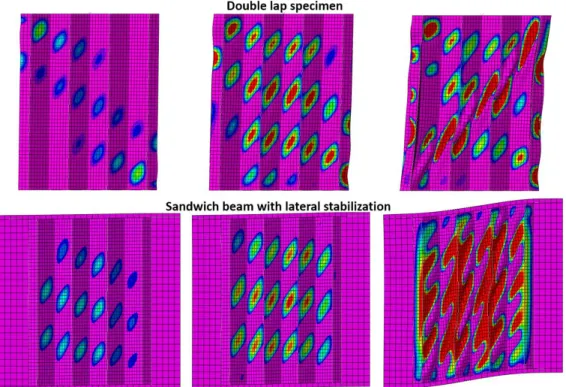
The first part of this study was the modeling of the double lap test. The simulation revealed that the buckling shape of the cells of the exterior and interior part of the specimens were very different due to the lack of stabilization of the surrounding cells. Also, it was possible to find a relation between the shear stress and the rotation of the cell walls.
The second part was the modeling of the lateral stabilized honeycomb structure, where the buckling of the cells and the rotation of the cell walls was also obtained.
The comparison of both buckling shapes between the two types of specimens revealed that for the linear part the buckling is very similar but for the nonlinear behavior it’s completely different, explaining the differences that were found on the experimental part.
First A. Author, Second A. Author and Third A. Author
Fig. 3: Comparison of the buckling of the cells in the interior of the double lap specimen and the sandwich beam with lateral stabilization.
REFERENCES
[1] Seemann R., Krause D. Numerical Modeling of Nomex Honeycomb Sandwich Cores at Meso-Scale Level. Comp. Struct. 2017;159:702–718
[2] Juan de Dios RODRIGUEZ, Bruno CASTANIE, Christophe BOUVET Experimental and numerical analysis of the shear nonlinear behavior of Nomex honeycomb core: application to insert sizing. Composite Structures 2018:193;121-139