HAL Id: hal-01178085
https://hal.inria.fr/hal-01178085
Submitted on 17 Jul 2015
HAL is a multi-disciplinary open access
archive for the deposit and dissemination of
sci-entific research documents, whether they are
pub-lished or not. The documents may come from
teaching and research institutions in France or
abroad, or from public or private research centers.
L’archive ouverte pluridisciplinaire HAL, est
destinée au dépôt et à la diffusion de documents
scientifiques de niveau recherche, publiés ou non,
émanant des établissements d’enseignement et de
recherche français ou étrangers, des laboratoires
publics ou privés.
Intercepting Functions for Memoization: A Case Study
Using Transcendental Functions
Arjun Suresh, Bharath Narasimha Swamy, Erven Rohou, André Seznec
To cite this version:
Arjun Suresh, Bharath Narasimha Swamy, Erven Rohou, André Seznec. Intercepting Functions for
Memoization: A Case Study Using Transcendental Functions. ACM Transactions on Architecture and
Code Optimization, Association for Computing Machinery, 2015, 12 (2), pp.23. �10.1145/2751559�.
�hal-01178085�
Intercepting Functions for Memoization- A case study using
transcendental functions
Arjun Suresh, INRIA/IRISA
Bharath Narasimha Swamy, INRIA/IRISA
Erven Rohou, INRIA/IRISA
Andr´e Seznec, INRIA/IRISA
Memoization is the technique of saving result of executions so that future executions can be omitted when the input set repeats. Memoization has been proposed in previous literature at the instruction level, basic block level and function level using hardware as well as pure software level approaches including changes to programming language.
In this paper, we focus on software memoization for procedural languages like C and Fortran, at the granularity of a function. We propose a simple linker based technique for enabling software memoization of any dynamically linked pure function by function interception and we illustrate our framework using a set of computationally expensive pure functions – the transcendental functions. The transcendental functions are those which cannot be expressed in terms of a finite sequence of algebraic operations (like trigonometric functions, exponential function etc.) and hence are computationally expensive.
Our technique does not need the availability of source code and thus can even be applied to commercial applications as well as applications with legacy codes. As far as users are concerned, enabling memoization is as simple as setting an environment variable. Our framework does not make any specific assumptions about the underlying architecture or compiler tool-chains, and can work with a variety of current architectures. We present experimental results for x86-64 platform using both gcc and icc compiler tool-chains, and for ARM cortex-A9 platform using gcc. Our experiments include a mix of real world programs and standard benchmark suites: SPEC and Splash2x. On standard benchmark applications that extensively call the transcendental functions we report memoization benefits of upto 50% on Intel Ivy bridge and upto 10% on ARM Cortex-A9.
Memoization was also able to regain a performance loss of 76% in bwaves due to a known performance bug in the GNU implementation of pow function. The same benchmark on ARM Cortex-A9 benefited by more than 200%.
Categories and Subject Descriptors: C.2.2 [Programming languages]: Optimization General Terms: Memoization, Transcendental Functions
Additional Key Words and Phrases: Link time optimization, function interception ACM Reference Format:
Arjun Suresh., Bharath Narasimha Swamy., Erven Rohou. and Andr´e Seznec., 2015, Intercepting Functions
for Memoization- A case study using transcendental functions. ACM 0, 0, Article 0 (June 2015), 23 pages.
1. INTRODUCTION
Memoization is a well known technique to improve program execution time by exploiting the redundancy in program execution [Connors and Hwu 1999; Richardson 1992]. The main idea is to save the result of execution of a section of program so that future execution of the same section with same input set can benefit from the saved result.
In memoization schemes, two conditions are important: (1) memoized code should not cause any side-effects;
(2) memoization should always produce the same result for the same input.
At function level by applying these two conditions, pure functions can be defined as:
This work was partially supported by the European Research Council Advanced Grant DAL No 267175. Author’s addresses: A. Suresh, B. N. Swamy, E. Rohou and A. Seznec, INRIA/IRISA, Campus de Beaulieu, 35042 Rennes, France.
Pure Function. A pure function always returns the same result for the same input set and does not modify the global state of the program
Implementing memoization in software at function level is relatively easy in pure func-tional programming languages, because procedures have no side-effects and the parameters to the procedure completely determine the result of procedure computation. A hit in the memoization table can be used to replace the execution of the procedure, and yet semantic correctness is maintained.
Correspondingly, for procedural languages there are two reasons why plain memoization can lead to incorrect program execution. The result of procedure execution can depend on the internal state of execution, such as when the procedure references a pointer or reads a global value. Also, procedures may have side effects such as I/O activity or an update to the internal program state through a memory write.
Consequently, memoization efforts in procedural languages are either to be targeted at pure functions, or special techniques are needed to handle procedures with side effects [Rito and Cachopo 2010; Tuck et al. 2008]. In this work we focus on memoization opportunities in software at function level for procedural languages such as C, Fortran, etc. and target a class of commonly occurring pure functions: the transcendental functions. We present a simple, yet low over-head scheme to memoize calls to transcendental functions by using function interception. Our proposal has the following characteristics.
(1) Dynamic linking: deployed at library procedure interfaces without need of source code, that allows approach to be applied to legacy codes and commercial applications. (2) Independent: optimization potential to multiple software language and hardware
pro-cessor targets
(3) Run-time monitoring: optimization mechanism for tracking effectiveness of memoization within a specific system to only deploy profitable instances of memoization
(4) Environmental controls: framework allows flexible deployment that can be enabled and tailored for individual application invocations.
(5) Simple: our framework is simple to enable from a user perspective, and requires just a change to an environment variable for employing.
2. MOTIVATION
Our memoization framework is meant for any pure function which is dynamically linked, however for the purpose of this study we have chosen long latency transcendental functions to demonstrate the benefits of memoization. We present our analysis of the suitability of transcendental functions for memoization, and our methodology to select target functions to memoize.
Transcendental functions satisfy the two criteria needed for a function to be safely mem-oized. They do not modify global program state for normal inputs (boundary cases are discussed in Section 4.4), and the result of the computation is entirely dependent on the input arguments to the function. Thus doing a lookup for the memoized result will result in the same output as the one with actual execution, and the execution result can be safely substituted without loss of program correctness.
While transcendental functions satisfy the safeness criteria, memoization can be produc-tive and deliver an overall savings in execution time only when the following conditions are satisfied:
(1) arguments of the target function have sufficient repeatability, and their locality can be captured using a reasonably sized look-up table;
(2) total time of table look-up is shorter than a repeat execution of the target transcendental function.
2.1. Repeatability of arguments in transcendental functions
Repeatability in arguments is key to benefit from memoization. We chose a set of commonly occurring computationally expensive transcendental functions from our benchmark set and analysed them for repeatability. From our profile analysis, we find that arguments exhibit three types of repetition behaviour.
(1) There are only a limited number of unique arguments. This is just the behavioural characteristic of the application. Our programs were compiled with the -O3 flag, and we hypothesize that the redundancy in arguments values that we observe is largely due to redundancy in input that could not be caught by static compiler optimizations such as loop invariant code motion. In this case memoization can be expected to catch most of the repetitive calls even with a small look-up table.
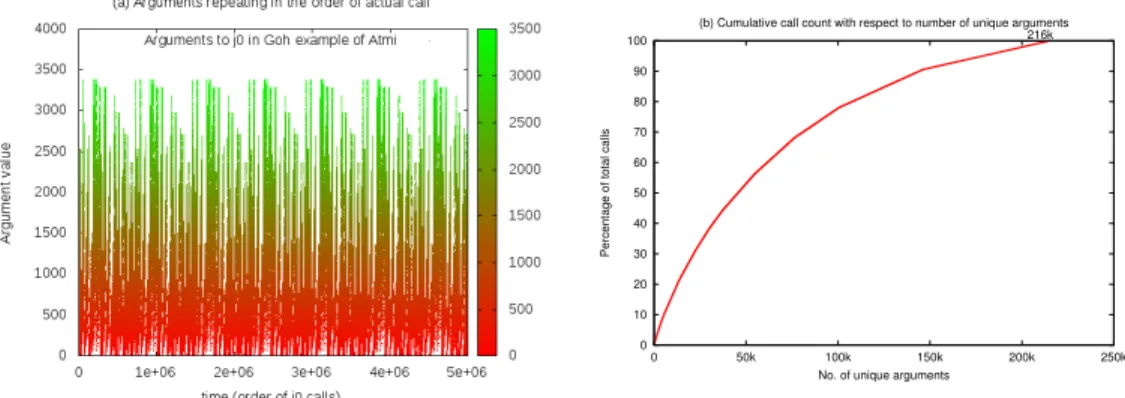
(2) There are a large number of unique arguments but they do exhibit repetitive behaviour. Repetitive behaviour does not necessarily mean arguments are repeating at regular intervals of time. In regular intervals, arguments are coming only from a small range of values as shown in Figure 1 for one of our selected application for memoization-ATMI Goh for the Bessel function j0. In the figure, we can see that there is a pattern getting repeated at a frequency of around 700k calls which is quite a high number for memoization table size. But even inside this regular interval, there are quite a few patterns that get repeated and more of them can be captured with an increased table size. Figure 1 b shows the cumulative count of the number of calls to the j0 function versus the number of unique arguments considered, in the decreasing order of the frequency of their repetition (without considering their actual call order). We used a sliding window for our memoization table (sliding window of size n means at any instant the previous n unique values are in the table) to study the locality of arguments to j0 in ATMI Goh. The percentage captures of repeated arguments for various sliding window sizes are as shown in Table I. There were a total of 21.9 million calls to j0 and as expected, the percentage capture increases with an increase in the sliding window
0 10 20 30 40 50 60 70 80 90 100 0 50k 100k 150k 200k 250k
Percentage of total calls
No. of unique arguments
(b) Cumulative call count with respect to number of unique arguments 216k
Fig. 1. Repetitive behaviour of arguments to j0 in ATMI Goh l
Table I. Repetition of j0 args in ATMI captured with various sliding window sizes
Size of sliding window Captures
4k 8%
16k 13%
64k 28%
size. Out of this 21.9M calls, less than 216k calls were actually having unique arguments (Table V), which means with a sliding window of 216k size we could capture 100% of repetitions.
(3) There are a large number of unique values for arguments. This is a difficult case for memoization. Fortunately this kind of behaviour is very rare among real applications. 2.2. Potential Latency Savings from Memoization
Transcendental functions are computationally intensive, with many functions requiring sev-eral hundreds of cycles to execute. A successful look-up in the memoization table can avoid expensive compute cycles and speed up execution time of the application. However the potential for latency saving has to be traded-off against the overheads of memoization.
An analysis to estimate the potential benefits of memoizing transcendental functions is
given below. Let Tf be the execution time of the memoized function, th be the time when
there is a hit in the memoized table and tmobe the overhead of memoization when there is
a miss in the memoized table. We derive an expression for the fraction of calls that should have arguments repeated (H), for memoization to be effective.
H × th+ (1 − H)(Tf+ tmo) < Tf
H × th+ (X + tmo) − H(X + tmo) < Tf
tmo< H(Tf+ tmo− th)
=⇒ H > tmo
Tf + tmo− th
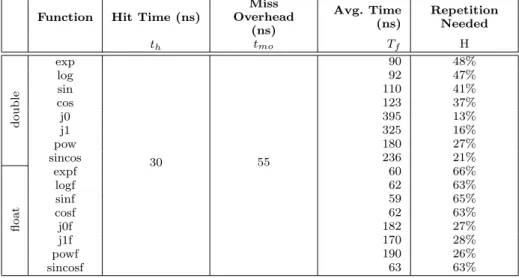
We designed our memoization framework for fast table look-up time and low miss over-head. Table II presents an empirical analysis (using a handwritten micro benchmark) on the performance potential of memoization on a set of long latency transcendental functions that frequently occur in our benchmark applications. Results presented are for an Intel Ivy Bridge processor running at 2 GHz (fully described in Table III). Table hit time for mem-oization is measured to be approximately 30 nanoseconds and miss overhead is nearly 55 nanoseconds. Though we expect miss overhead to be the same as hit time, as both are exe-cuting the same instructions for table lookup, we attribute this time difference to L2 cache latency. While hit would mean that the same entry was accessed before and hence more likely to be in the cache, a miss would mean that the entry might not have been accessed before (and hence more likely not to be in cache). We find that even with a moderate hit rate in the look-up table, these functions have the potential to give performance benefit.
To summarize our analysis, we find that commonly occurring transcendental functions having an execution time of at least 100 clock cycles (about 50 nanoseconds) are good target for software memoization in our framework. In many cases these functions exhibit repetition in their input values and can benefit from memoization even for moderate hit rates in the look up table.
3. RELATED WORK
Memoization has been implemented at various levels of execution – instruction level, block level, trace level and function level, using both hardware and software techniques.
At the hardware level, there are previous works on memoization of instructions where a hardware lookup table avoids the repeated execution of instructions with the same operands. Citron et al. [Citron et al. 1998] have used the term memoing – which essentially is memo-ization – in their work for performing multi-cycle floating point calculations in a single cycle. They assumed a hardware table for memoization and showed that the technique works espe-cially well for multi-media processing. The work of Connors et al. in 1999 [Connors and Hwu 1999], focused on the performance of memoization of trigonometric functions using hard-ware memoization. In his work [Richardson 1992], Richardson has proposed a hardhard-ware
Table II. Profitability analysis of memoizing transcendental functions – 2 GHz Ivy Bridge, GNU lib
Function Hit Time (ns)
Miss Overhead (ns) Avg. Time (ns) Repetition Needed th tmo Tf H double exp 30 55 90 48% log 92 47% sin 110 41% cos 123 37% j0 395 13% j1 325 16% pow 180 27% sincos 236 21% float expf 60 66% logf 62 63% sinf 59 65% cosf 62 63% j0f 182 27% j1f 170 28% powf 190 26% sincosf 63 63%
cache called the result cache to implement memoization for a set of targeted arithmetic computations (multiply, divide, square root) directly in hardware, without compiler or pro-grammer intervention. Then there is memoization at block level [Huang and Lilja 1999] and trace level [Da Costa et al. 2000][Gonz´alez et al. 1999] where the result of a portion of code, either the basic block or trace portion, is memoized so that if the input values used in that code are repeated, result is taken from the lookup table.
At the software level, memoization technique has been used in languages such as Haskell
1and Perl2that support functional programming to save the execution time of functions at
runtime. The presence of closure [Reddy 1988] in functional programming languages gives a ready-to-use mechanism for the programmer to write memoization code.
When memoization is used in procedural languages, special techniques are needed to han-dle procedures with side effects. Rito et al. [Rito and Cachopo 2010] use Software Transac-tional Memory (STM) for function memoization, including impure functions. When memo-ization is found to violate semantic correctness, STM is used to roll-back the program state to the previous correct state. Tuck et al. [Tuck et al. 2008] used software-exposed
hard-ware signatures 3 to memoize functions with implicit arguments (such as a variable that
the function reads from memory). They are able to track changes to implicit arguments, and safely use the memoized result when all explicit arguments to the function repeat, and no implicit arguments have changed since the last function invocation. McNamee and Hall [McNamee and Hall 1998] in their work shows how memoization can be applied to C++ using a language level tool.
An extension of simple memoization is used by Alvarez et al. [Alvarez et al. 2005] in their work of fuzzy memoization of floating point operations. Here, multimedia applications which can tolerate some changes in output are considered and memoization is applied for similar inputs instead of same (instead of a single input, now we have a set of inputs which have the same result). This result in improved performance as well reduction in power consumption without a significant change in the quality of the output. A similar technique is also used by Esmaeilzadeh et al. [Esmaeilzadeh et al. 2012] in their work of using neural accelerators
1http : //www.haskell.org/haskellwiki/M emoization
2http : //perldoc.perl.org/M emoize.html
to accelerate programs using approximation technique. The basic idea is to offload code regions marked as approximatable by the programmer, to a low power neural processor. Since, approximation enhances the scope of memoization , memoization gave them very good results.
Hardware techniques for memoization typically capture short sequences of instructions with a small table, while purely software techniques require the programmer to write a custom implementation of the function for memoization. In this work, we demonstrate a framework that uses large memoization tables to capture longer intervals of repetition to benefit computationally intensive pure functions at the software level without program-mer intervention. Previous approaches have been either at language level or at hardware level, while we are working at an intermediate level, thereby making it both language- and hardware-independent. Using tools like Pin [Luk et al. 2005] or DynamoRIO [Bruening et al. 2003], we can achieve memoization by function interception at binary level. But such binary level approaches have the following restrictions: is limited to supported architectures, a bit slower compared to native execution and is complex to try for a naive user. By using our link time approach for function interception we overcome these problems of binary level approaches and still get the benefit of memoization.
4. MEMOIZATION APPROACH
We implement memoization in a transparent manner by intercepting calls to the dynamically linked math library (libm). We leverage the library pre-loading feature in Linux (using environment variable LD_PRELOAD) to redirect calls to the targeted transcendental functions to a memoized implementation of those functions. The same mechanism exists in Solaris and Mac OS X (for the latter, the variable is DYLD_INSERT_LIBRARIES). Windows also support DLL injection, even though the mechanism is different.
In our technique there is no need for code modification or recompilation – memoization works with legacy binaries that are compiled to link dynamically with the math library as well as commercial applications. We now discuss the design of the look-up table, and provide details on the hash function we use and the overhead involved in memoization. 4.1. Intercepting Loader
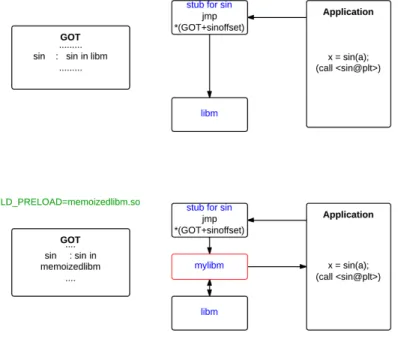
An essential part of our implementation in memoization is to intercept the dynamic func-tion calls. Transcendental funcfunc-tion calls which are dynamically linked are resolved to the corresponding function in the dynamically loaded math library. Working of our interception of these calls is shown in Figure 2. We preload memoized version of the target transcenden-tal functions using LD_PRELOAD environment variable to contain the path to our memoized library, so that memoized implementation takes precedence over standard math library im-plementation4. Thus during the first call to these functions, the address of the corresponding
function in Global Offset Table (GOT) gets filled from our memoized library instead of get-ting filled from actual libm. For other functions, the call is resolved to the standard math library implementation and incurs no runtime overhead.
Algorithm 1 provides a pseudo-code listing our implementation of the memoized function. A fixed size direct mapped hash-table is used as our memoization table. First, a hash-key is generated using the hash function and a table lookup is performed to check for a hit in the table. On a hit, the cached result is read out of the table and returned as the result of the function. On a miss, the call is redirected to the function in the libm library and the result (table[index][1]) is also cached in the memoization table with the argument being the tag (table[index][0]). The layout of our table guarantees that both tag and value are in the same line of the L1 data cache. We also evaluate an associative implementation for our hash-table which is discussed in Section 5.4
Fig. 2. Intercepting dynamic call to sin
ALGORITHM 1: Pseudo code for memoization index = hash(argument)
if table[index][0] 6= argument then table[index][0] = argument
table[index][1] = sin from libm(argument) end if
return table[index][1]
4.2. Hash Function
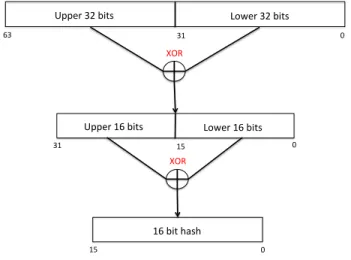
A fast hash function is needed since the evaluation of hash function is on the critical path to table look-up. We designed a simple hash function using the XOR function by repeatedly XORing the bits of the arguments to get the table index. Thus for a double-precision argument with 64 bits, we XOR the higher 32 bits with the lower 32 bits. The same procedure is repeated for the higher 16 bits of the result and the lower 16 bits, and obtain
a 16-bit hash-key which we use directly to index into a hash-table of size 216 entries. This
mechanism is shown in Figure 3. For smaller sized tables we mask off the higher bits to get the required bits. For a function with multiple arguments, for example the pow function with two arguments, we first XOR the arguments and then repeat the same procedure as for functions with single argument.
The value of input arguments is stored in the table entry as a tag to the memoized function result. At the time of look-up, the stored tag values are checked against the incoming input arguments before using the result value. Collisions can occur when different input arguments hash to the same table entry. To evaluate the effectiveness of our hash function, we measured the number of collisions that occurred during the memoized run of our applications (Table V). The simple hash function we designed is fast to compute, as few as five instructions on x86 using xmm registers and the SSE SIMD extension. Yet, it results in a low percentage of collisions as compared to the number of unique values for input arguments.
4.3. Memoization Overhead
Memoization overhead includes the time needed to calculate the hash function and the time spent in table lookup. When table entries are located in a cache closer to the processor, less time is spent in reading out the table entries. On a miss, this additional overhead is added to the function execution time. For the hash function we designed, we experimentally measured the time needed for hash table lookups on an Intel Ivy Bridge processor clocked at 2 GHz (see also Table III for details). We measured successful table lookup time of around 60 clock cycles (approximately 30 nanoseconds) on our benchmark applications. During a
miss in the table, table look-up overhead5 was measured to be nearly 110 clock cycles (55
nanoseconds) which we attribute to the fact that during a miss the table entry is more likely not present in the caches closer to the processor. Both our hit time and miss time compares favourably with the 90–800 clock cycles average execution time of our target transcendental functions.
4.4. Error Handling
For normal inputs (inputs within the domain of the function) transcendental functions do not modify any global variables. But on boundary conditions they do set global error flags and throw exceptions. In order to ensure that program behaviour is not altered by memoization, we only memoize for non-boundary input values. For boundary cases which do set the global error states, results are not memoized. These cases occur for the following functions:
exp. Both overflow (FE_OVERFLOW exception is raised) and underflow (FE_UNDERFLOW is raised) may occur and in both cases ERANGE flag is set.
log. For log (x), ERANGE is set if x is 0 (FE_DIVBYZERO is raised) and EDOM is set if x is negative (FE_INVALID is raised)
5Miss overhead adds to the function execution time when there is a miss in the memoization table.
63 31 0 0 15 31 0 15 XOR XOR
Upper 32 bits Lower 32 bits
Upper 16 bits Lower 16 bits
16 bit hash
pow. For pow(x,y), EDOM is set if x is negative and y is a finite noninteger (FE_INVALID is raised). If x is 0 and y is negative ERANGE is set (FE_DIVBYZERO is raised). ERANGE is also set when the result underflows or overflows.
4.5. Rounding Modes
Math library has a method – fesetround – which can be used to specify the rounding mode to be used. If this method is called in the application, the stored memoized results are no longer valid. Thus, we have to intercept fesetround function and if there is any change in the rounding mode, we have to flush the contents of memoization table.
4.6. Handling Negative Effects
On applications that have a poor locality in the arguments to targeted transcendental functions, memoization may slow down execution time. Due to poor hit rate in the table, function call executions pay the table look-up overhead without benefiting from the use of stored result. To handle this problem, we have implemented a mechanism which can disable memoization in the event of bad effect.
We periodically monitor the number of calls and the number of hits in the memoized table. Once it is found that the hit rate is below the required threshold (as mentioned in Table II) and it is not increasing, we change the jump address in the Global Offset Table (GOT) to that of the original dynamically linked library entry so that future calls to the function goes directly to the original dynamically linked library and there is no interference from the memoized library for any of the future calls to that function. In our implementation, we chose to disable memoization once the number of hits in the memoized table falls below the required threshold. However, to account for different phases of program execution, memoization can also be re-enabled after some time by using a time triggered signal.
5. EXPERIMENTAL RESULTS 5.1. System Set-up
In order to analyse the performance of memoization across compilers and architectures we did our experiments on the following configurations:
(1) Intel Ivy Bridge (GNU compiler); (2) Intel Ivy Bridge (Intel compiler); (3) ARM Cortex-A9 (GNU compiler).
The characteristics of Ivy Bridge and Cortex-A9 are presented in Tables III and IV respec-tively. The Intel compiler also provides its own implementation of the math library.
Based on our criteria for memoization, we picked up a variety of applications both from real life as well as standard benchmark suites that extensively call transcendental functions. Applications with no, or few, calls to these functions are not impacted (neither speed-up nor slowdown), they are not reported here.
For the other applications, memoization has no impact as there are very few calls to memoized libm from them. Our experimental benchmark applications include:
(1) SPEC CPU 2006
We chose six benchmarks: bwaves, gamess, povray, GemsFDTD, tonto and wrf from SPEC CPU 2006 benchmark suite [Henning 2006] with ref inputs, which have a rea-sonable number of calls to transcendental functions. wrf and bwaves are critical in pow function. gamess, and tonto are expensive in exp and sincos calls, while povray has many calls to sin and cos.
(2) SPEC OMP 2001
memo-ization – gafort and equake. gafort has calls to sin in its critical region and equake has both sin as well as cos calls in its critical region.
(3) ATMI
ATMI[Michaud et al. 2007] is a C library for modelling steady-state and time-varying temperature in microprocessors. It is provided with a set of examples and all of them have a large number of calls to Bessel functions j0 and j1.
(4) Population Dynamics
Population Dynamics [Ciss et al. 2013] is a model of aphid population dynamics at the scale of a whole country. It is based on convection-diffusion-reaction equations. The reaction function make heavy use of exp and log using the armadillo library.
(5) Barsky
Barsky [Barsky ] is a Partial Differential Equation solver and contains many calls to sin.
(6) Splash2x
Three applications from Splash 2x of Parsec benchmark suite [Bienia et al. 2008] can benefit from memoization: fmm, ocean cp, and water spatial. fmm is critical in log function, ocean cp in sin and water spatial in exp functions.
5.2. System Configuration
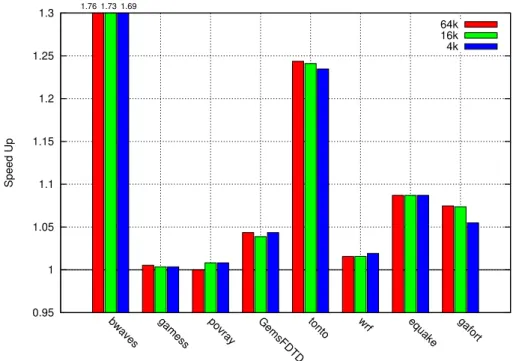
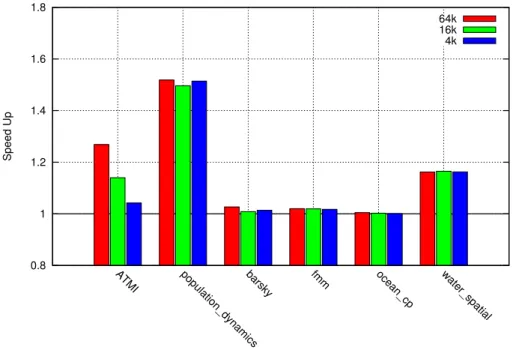
5.2.1. Intel Ivy Bridge. We ran our experiments on an Intel i7 machine under the set-up as described in Table III. We made sure that the Turbo Boost feature [Intel Corporation ] was turned off and CPU clock frequency was set at 2 GHz to ensure reproducible time mea-surements. We used GNU compiler+library as well as Intel compiler+library combinations and ran experiments using different table sizes. The results of the benchmark run under the GNU setup is illustrated in Figures 4 and 5. Figure 6 shows the results for the same configuration but the applications compiled using Intel compiler.
Table III. Experimental set-up on Intel Ivy Bridge
Processor Intel Core i7
L3 cache 8 MB Clock speed 2 GHz RAM 8 GB Linux version 3.11 gcc version 4.8 icc version 9 optimization flag O3 libm version 2.2
5.2.2. ARM Cortex 9.We also ran our experiments on Pandaboard running ARM Cortex A9 processor under the set-up as described in Table IV. The results of the benchmark run under this set-up are given in Figure 9. We could not run splash 2x of PARSEC benchmark suite on ARM because this architecture is not supported. Also, due to memory limitations, all the SPEC benchmarks were run with train inputs on ARM while we were using ref inputs for Intel Ivybridge.
5.3. Discussion of Results
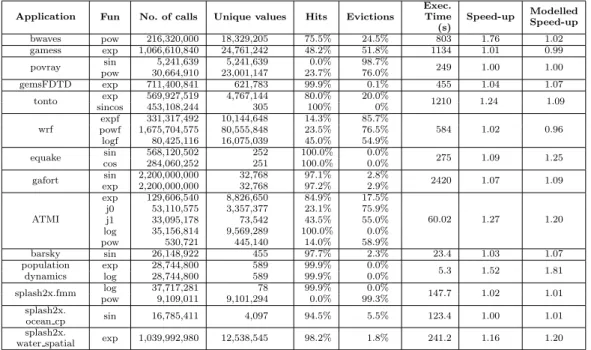
5.3.1. Intel Ivy Bridge (GNU compiler).Table V summarizes the characteristics of applications relevant to memoization, produced on Ivy Bridge with GNU compiler. The columns first report, for each benchmark, the involved transcendental functions, the number of calls to
Table IV. Experimental set-up on ARM Cortex
Processor ARM Cortex A9
L2 cache 1 MB Clock speed 1.2 GHz RAM 1 GB Linux version 3.11 gcc version 4.7 libm version 2.2
Table V. Function call analysis on Intel Ivy Bridge with GNU compiler and 64k table
Application Fun No. of calls Unique values Hits Evictions
Exec. Time (s) Speed-up Modelled Speed-up bwaves pow 216,320,000 18,329,205 75.5% 24.5% 803 1.76 1.02 gamess exp 1,066,610,840 24,761,242 48.2% 51.8% 1134 1.01 0.99 povray sin 5,241,639 5,241,639 0.0% 98.7% 249 1.00 1.00 pow 30,664,910 23,001,147 23.7% 76.0% gemsFDTD exp 711,400,841 621,783 99.9% 0.1% 455 1.04 1.07 tonto exp 569,927,519 4,767,144 80.0% 20.0% 1210 1.24 1.09 sincos 453,108,244 305 100% 0% wrf expf 331,317,492 10,144,648 14.3% 85.7% 584 1.02 0.96 powf 1,675,704,575 80,555,848 23.5% 76.5% logf 80,425,116 16,075,039 45.0% 54.9%
equake cossin 568,120,502284,060,252 252251 100.0%100.0% 0.0%0.0% 275 1.09 1.25
gafort sin 2,200,000,000 32,768 97.1% 2.8% 2420 1.07 1.09 exp 2,200,000,000 32,768 97.2% 2.9% ATMI exp 129,606,540 8,826,650 84.9% 17.5% 60.02 1.27 1.20 j0 53,110,575 3,357,377 23.1% 75.9% j1 33,095,178 73,542 43.5% 55.0% log 35,156,814 9,569,289 100.0% 0.0% pow 530,721 445,140 14.0% 58.9% barsky sin 26,148,922 455 97.7% 2.3% 23.4 1.03 1.07 population exp 28,744,800 589 99.9% 0.0% 5.3 1.52 1.81 dynamics log 28,744,800 589 99.9% 0.0% splash2x.fmm log 37,717,281 78 99.9% 0.0% 147.7 1.02 1.01 pow 9,109,011 9,101,294 0.0% 99.3% splash2x. ocean cp sin 16,785,411 4,097 94.5% 5.5% 123.4 1.00 1.01 splash2x.
water spatial exp 1,039,992,980 12,538,545 98.2% 1.8% 241.2 1.16 1.20
each of them, and the number of unique values. The next two columns report, for a 64k-entry table, the number of hits and evictions due to collisions in the hash table. These two columns do not add up to exactly 100 %: the rest is due to cold misses, i.e. first access to a value. Actual original execution time (in seconds), without memoization is shown is the next column. Speed-up is defined as the ratio of the measured running times: original vs. memoized.
Finally, the modelled Speed-up is computed based on the collected statistics and the estimated function execution time (as shown in Table II), assuming an otherwise ideal scenario, as follows:
S = Actual Runtime
Modelled runtime
Modelled runtime = Total execution time
− (N callssin× Tsin+ N callsexp× Texp)
+ N missessin× (Tsin+ tmo) + N hitssin× th
+ N missesexp× (Texp+ tmo) + N hitsexp× th
0.95 1 1.05 1.1 1.15 1.2 1.25 1.3
bwaves gamess povray GemsFDTD tonto wrf equake gafort
Speed Up
1.76 1.73 1.69
64k 16k 4k
Fig. 4. Memoization of SPEC benchmarks on Intel Ivy Bridge (GNU compiler) for different table sizes
On Intel Ivy Bridge machine using the GNU compiler (Table III), SPEC CPU bench-marks gave benefit ranging between 1% and 24% (see Figure 4). Only bwaves produces an outstanding and unexpected speed-up of 1.76. The large benefit for memoization for bwaves is surprising considering pow on an average takes around 300 clock cycles only. We found
out that this is due to a performance bug in the GNU libm for pow for some inputs6which
causes a slow down even up to 10,000× compared to a normal call. In the case of bwaves
this happens when m is very close to 1 and n is very close to 0.75 for mn. For these input
values, the current implementation is found to take more than 1000× the normal execution time. On memoization this long latency is saved and thus we get high benefit. To a smaller extent, this performance bug (in powf function) has an impact on the speed-up of wrf as well.
All benchmarks use double precision floating point numbers, with the exception of wrf. Single precision functions are faster, and require a higher repetition ratio to be profitable. This is the reason the modelled speed-up drops below 1.0 for wrf.
0.8 1 1.2 1.4 1.6 1.8
ATMI population_dynamicsbarsky fmm ocean_cp water_spatial
Speed Up
64k 16k 4k
Fig. 5. Memoization of selected applications on Intel Ivy Bridge (GNU compiler) for different table sizes
Compared to SPEC benchmarks, other applications give much higher benefit for mem-oization as shown in Figure 5. We get a speed-up of 27% for ATMI (average value for all provided example inputs). This is due to the fact that very expensive Bessel functions – j0 and j1 – are used a lot in these programs. Population dynamics gives 52% speed-up as the memoized functions– log and exp – cover most of the program execution time. Barsky improves by 3% as the memoized function sin covers only a part of the program execution. From the Splash 2x benchmarks, water spatial gave 16%, fmm 2% and ocean cp less than 1% speed up.
Our actual speed-up correlates with the modelled speed-up in most cases. The variation for bwaves and wrf of SPEC 2006 are already discussed and attributed to the performance bug of pow implementation. The other significant variation happened with tonto where the modelled speed-up is 10% and we got 24% actual speed-up. We found that in tonto memoization was causing 13% reduction in instructions retired while there weren’t any significant change in L1 or L2 cache misses due to memoization. Thus, we assume that the main reason for the variation in the modelled and the actual speed-up is due to the variation in the estimated running time of sincos function as shown in Table II and the actual running time of sincos in tonto, as arguments to sincos were different in both cases. The small variation we see in other benchmarks are also attributed to the variation between the actual runtime of transcendental functions and the empirical runtime we used for modelling (shown in Table II).
Memoization substitutes execution of code by a table lookup. Given the size of the table, it might interfere with application’s data in lower level caches. We measured the L1 and L2 miss rates on all the applications. In most of the applications L1 misses got reduced due to memoization but the reduction was less than 1%.
For gafort the L1 miss was increased by 4% and for gamess it was increased by 2%. For ATMI only, increase in L1 miss was abnormally large at 40%. L2 misses were also reduced
for some applications with the maximum being for barsky at 2%. Increase in L2 misses were within 1% for all applications except population dynamics, gamess, povray and ATMI. For population dynamics L2 miss increased by 4.6%, for gamess by 3.1% and for povray by 3.6%. For ATMI L2 miss was very high at 46%. The large cache misses for ATMI is expected as it is very critical in Bessel functions (more than 75% of the execution time is spend in Bessel functions) and so with memoization, the table is intensively used causing a lot more cache misses. This fact is proved by the use of an associative table as discussed in section 5.4.
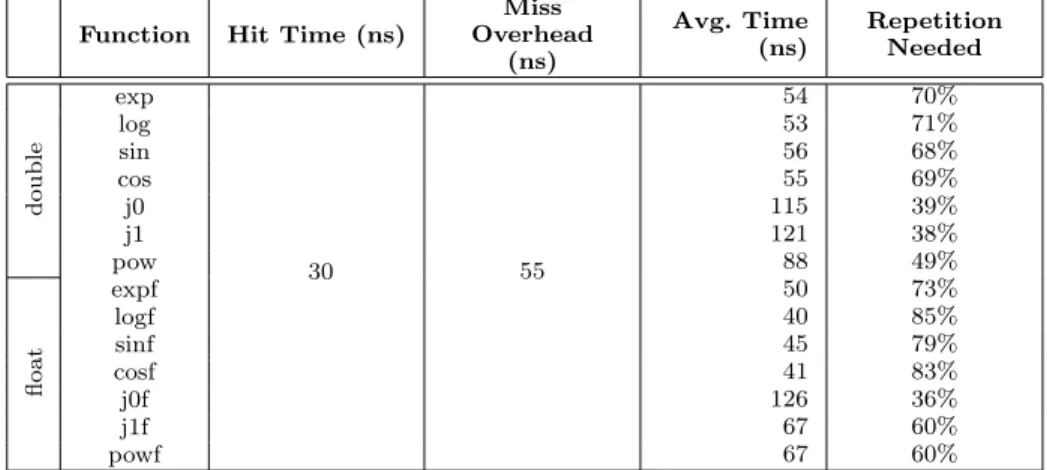
5.3.2. Intel Ivy Bridge (Intel compiler). Figure 6 shows the speed-up with memoization for SPEC benchmarks compiled with the Intel compiler icc. With icc, benefits were reduced to upto 3%. Bwaves is no longer outstanding, as the performance bug is not present in Intel’s implementation. The benefit is reduced to only 3%. The lesser impact of memoization is due to a faster implementation of transcendental functions in Intel’s math library. Table VI reports on the performance of Intel’s implementation of transcendental functions. Runtimes were measured for the same test suite as used for the GNU library in Table II and the runtime difference shows that icc implementations are much superior on Intel Ivy Bridge. Figure 8 plots the profitability curve, i.e. the percentage of repetition needed for a given average execution time. We also identified the location of the considered functions for each compiler. Many functions in Intel’s library have running times close to the break-even point of our memoization implementation: 30 ns require a 100 % repetition.
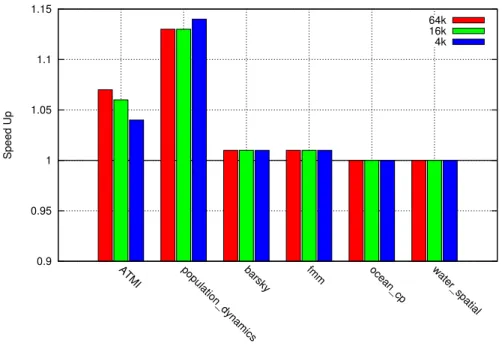
Our other selected applications also gave a low benefit with icc (Figure 7 as the maximum performance benefit went to less than 15% for population dynamics. ATMI gave a perfor-mance gain of upto 7% while barsky and fmm gave only 1%. ocean cp and water spatial did not give any performance gain. We could not compile gafort as the code was not com-patible. In the case of tonto and equake we found that Intel compiler was using its own
custom implementation for sincos called libm sse2 sincos(for equake calls to sin and cos
were replaced by calls to sincos by icc) and hence our memoization scheme could not capture the sincos calls.
Table VI. Profitability analysis of memoizing transcendental functions – 2 GHz Ivy Bridge, Intel lib
Function Hit Time (ns)
Miss Overhead (ns) Avg. Time (ns) Repetition Needed double exp 30 55 54 70% log 53 71% sin 56 68% cos 55 69% j0 115 39% j1 121 38% pow 88 49% float expf 50 73% logf 40 85% sinf 45 79% cosf 41 83% j0f 126 36% j1f 67 60% powf 67 60%
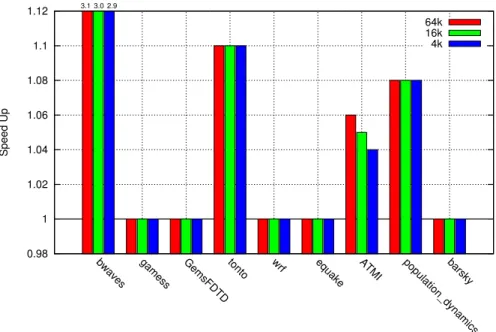
5.3.3. ARM Cortex-A9. On ARM Cortex-A9, the memoization benefit varied compared to that in Intel Ivy Bridge as shown in Figure 9. We found that transcendental functions take more execution time on ARM Cortex-A9, but memoization overhead is also higher as shown in Table VII. A comparison of the profitability curve for ARM Cortex A-9 and Intel Ivy bridge is shown in Figure 10.
0.98 0.99 1 1.01 1.02 1.03 1.04 1.05
bwaves gamess povray GemsFDTD tonto wrf equake
Normalized Speed Up
64k 16k 4k
Fig. 6. Memoization of SPEC benchmarks on Intel Ivy Bridge for different table sizes (icc)
0.9 0.95 1 1.05 1.1 1.15
ATMI population_dynamicsbarsky fmm ocean_cp water_spatial
Speed Up
64k 16k 4k
0 20 40 60 80 100 0 50 100 150 200 250 300 350 400 R epetition needed (%) Avg. time (ns) GNU Intel Profitability curveGNU
Intel
Fig. 8. Profitability curve of memoizing transcendental functions
0.98 1 1.02 1.04 1.06 1.08 1.1 1.12
bwaves gamess GemsFDTD tonto wrf equake ATMI population_dynamicsbarsky
Speed Up
3.1 3.0 2.9
64k 16k 4k
Fig. 9. Memoization of SPEC benchmarks and selected applications on ARM (GNU compiler) for different
table sizes
From the SPEC benchmarks, bwaves and gafort gave gain on memoization with bwaves giving a speed-up upto 3.1 and tonto giving upto 1.1. Compared to on Intel Ivy Bridge, gain for bwaves was more while that on tonto was less. We could not run gafort on ARM due to memory limitation.
Among the other applications, we got performance benefit for ATMI and population dynamics but the gains were lesser as compared to that on Intel Ivy Bridge. Population dynamics gave the same benefit on memoization for all considered table sizes while the
Table VII. Profitability analysis of memoizing transcendental functions – 1.2 GHz ARM Cortex-A9, GNU lib
Function Hit Time (ns)
Miss Overhead (ns) Avg. Time (ns) Repetition Needed th tmo Tf H double exp 44 180 199 54% log 300 41% sin 300 41% cos 300 41% j0 1380 12% j1 1362 12% pow 402 33% sincos 330 39% float expf 100 76% logf 140 65% sinf 95 78% cosf 117 71% j0f 720 21% j1f 800 19% powf 212 52% sincosf 170 59% 0 20 40 60 80 100 0 200 400 600 800 1000 1200 1400 R epetition needed (%) Avg. time (ns)
Profitability curve Ivy Bridge Profitability curve Cortex-A9 Ivy Bridge Cortex-A9
Fig. 10. Profitability curve of memoizing transcendental functions (Intel Ivy bridge & ARM Cortex-A9
with GNU library
benefit for ATMI got reduced with the reduction in size of the memoization table as was the case in Intel Ivybridge.
5.4. Associativity
In an associative hash-table, more entries that can be stored for each hash location, minimiz-ing the chance of collisions, but at the same time increasminimiz-ing the overhead of table look-up. We found that associative hash-tables are beneficial to long latency transcendental functions – specifically the Bessel functions. For other transcendental functions which are relatively
low latency, we found that associativity was causing a negative impact due to the extra overhead of associative table look-up. In this section, we present results for memoization using an associative hash table implementation for Bessel functions and a non-associative implementation for other functions.
The associativity we have chosen is such that for each function call, only one hardware cache line is fetched. To do this we aligned the table storage on a 64 bytes boundary for Intel Ivy Bridge. Now, for double precision functions we used a 4-way associative table as both the 8 byte argument as well as result requires 16 bytes, and four such entries will fit in a cache line. Figure 11 shows the effect of an associative hash table for the Bessel functions in ATMI runs on Intel Ivy Bridge. With a 256k 4-way associative table we got the best performance as we could capture most of the repetitions. A 256k non associative table actually gave worse performance than a 64k non associative table as the hash function worked better for 64k table and a 256k non-associative table polluted the cache a lot more. With associativity we could use the same hash-function for the 256k 4-way associative table and we could maintain the same number of cache line accesses.
Table VIII. Function call analysis for ATMI on Intel Ivy Bridge with GNU compiler and 64k table
Application Func No. of calls Unique values Hits Evictions
Exec. Time (s)
speed-up Modelledspeed-up
ATMI.chipedges exp 3,321,150 6,825 96.7% 3.1% 2.29 1.55 1.38 j0 2,757,132 79,941 43.2% 55.1% j1 1,562,103 73,542 50.5% 46.7% ATMI.Fisher exp 3,099,516 97,966 90.0% 8.4% 0.964 1.27 1.67 j0 600,831 6,537 91.8% 7.2% j1 137,928 10,983 89.7% 3.0% log 1,657,656 1 100.0% 0.0% ATMI.migration exp 62,309,016 8,613,241 68.3% 31.6% 22.216 1.22 1.14 j0 20,475,609 387,220 12.8% 86.9% j1 2,867,004 127,054 83.4% 14.6% log 33,499,158 1 100.0% 0.0% ATMI.onoff exp 347,088 15,228 91.5% 4.6% 2.21 1.00 1.01 j0 181,944 145,863 14.8% 53.0% j1 165,942 78,411 49.2% 23.2% ATMI.Xu exp 12,151,692 5,707 99.8% 0.2% 4.074 2.13 1.81 j0 22,071 7,035 66.7% 2.8% j1 6,063,225 48,822 83.3% 16.2% ATMI.Goh exp 24,240,888 19,949 93.0% 6.9% 17.145 1.36 1.25 j0 21,903,210 215,902 31.2% 68.6% j1 11,179,854 126,075 41.9% 57.6% ATMI.pentium exp 4,744,866 16,380 98.2% 1.5% 2.059 1.08 1.10 j0 1,425,816 1,051,150 5.5% 89.9% j1 1,186,437 685,119 26.8% 67.6% ATMI.ppc1 exp 15,437,310 17,118 97.3% 2.6% 3.741 1.14 1.11 j0 235,788 180,084 16.5% 57.5% j1 7,710,213 6,916,848 6.9% 92.3% pow 358,842 315,934 10.0% 71.8% ATMI.ppc2 exp 4,928,910 17,118 94.8% 4.9% 2.549 1.02 1.07 j0 1,499,778 1,103,571 5.0% 90.6% j1 1,192,023 645,420 28.3% 66.2% pow 114,665 89,224 21.0% 36.3% ATMI.ppc3 exp 2,347,254 17,118 92.8% 6.6% 2.772 1.14 1.08 j0 4,008,396 180,074 21.8% 76.7% j1 1,030,449 857,015 9.1% 84.5% pow 57,214 39,982 24.5% 22.9%
On ARM platform also we tried the same mechanism for associativity. Since, the cache line size is 32 bytes, we used a 2-way associative table. Figure 12 shows the effect of an associative hash table for the Bessel functions in ATMI on ARM plaform. As in the case of Intel Ivy Bridge, associativity gives very good performance on ARM platform also. Again, a 2-way 32k table performs better than a 128k table.
0.5 1 1.5 2 2.5 3 3.5
chipedges Fisher migration onoff Xu Goh pentium ppc1 ppc2 ppc3
Speed Up
64k 64k,4-way 256k 256k,4-way
Fig. 11. Associative table for ATMI (GNU compiler) on Intel Ivy Bridge
0.5 1 1.5 2 2.5 3 3.5
chipedges Fisher migration onoff Xu Goh pentium ppc1 ppc2 ppc3
Speed Up
32k 32k,2-way 128k 128k,2-way
5.5. Call site Analysis
In order to find the importance of call sites for function memoization, we did an analysis per call site and the result is shown in Table IX. We classified the results into three cases: — Single call site: All calls to a memoized function comes from a single call site
— Multiple call sites similar behavior: There are multiple call sites for a memoized function but all of them shows similar behaviour– either repeating or non-repeating– for the input arguments
— Multiple call sites differential behaviour: There are multiple call sites for a memoized function and some of them have repeating behaviour while others have non-repeating behaviour with respect to their input arguments
In the first two cases effectiveness of memoization is independent of the call site, while in the third case doing a call site specific memoization might result in a better memoization result. In our considered benchmarks only wrf and gamess falls into the third category.
Table IX. Function call-site analysis on Intel Ivy Bridge with GNU compiler and 64k table
Application Function Behaviour
bwaves pow povray sin pow tonto exp sincos equake sin gafort sin exp ATMI exp j0 Multiple j1 call-sites log similar pow behaviour barsky sin population dynamics exp log splash2x.fmm pow splash2x.ocean cp sin
splash2x.water spatial exp
GemsFDTD exp
Single call-site
equake cos
splash2x.fmm log
gamess exp Multiple
wrf
expf call-sites
powf differential
logf behaviour
5.6. Hash-table Performance
We compared the performance of our hash function with a simpler approach of considering only the first 16 mantissa bits for indexing and the result is shown in Table X. The result shows that XOR hash function is much better performing than the simpler method while adding two extra XOR operations.
Table X. Masking Hash-function performance analysis on Intel Ivy Bridge with GNU compiler and 64k table
Application Function No. of calls No. of unique values Hit % with XOR Hit % with 16 bits bwaves pow 216,320,000 18,329,205 75.5 75.3
gamess exp 1,066,610,840 24,761,242 48.2 48.1
povray sin 5,241,639 5,241,639 0 0
pow 30,664,910 23,001,147 23.7 0.1 GemsFDTD exp 711,400,840 621,783 99.9 99.9
tonto expsincos 567,927,519453,108,244 4,767,144305 80100 70.293.8
wrf
expf 331,317,492 10,144,648 14.3 14.2 powf 1,675,704,575 80,555,848 23.5 22.9 logf 80,425,116 16,075,039 45 39.7 equake sincos 568,120,502284,060,252 252251 100100 100100
gafort sin 2,200,000,000 32,768 97.1 90 exp 2,200,000,000 32,768 97.2 97.2 ATMI exp 132,927,690 8,826,650 82.8 27.5 j0 53,110,575 3,357,377 23.1 9.2 j1 33,095,178 73,542 43.5 4.5 log 35,156,814 9,569,289 100 100 pow 530,721 445,140 14 13.9 barsky sin 26,148,922 455 97.7 20.6 population dynamics exp 28,744,800 589 99.9 99.9 log 28,744,800 589 99.9 99.9
splash2x.fmm logpow 37,717,2819,109,011 789,101,294 99.90 85.50 splash2x.ocean cp sin 16,785,411 4,097 94.5 24.5 splash2x.water spatial exp 1,039,992,980 12,538,545 98.2 94.5
6. CONCLUSION
We have experimentally demonstrated that software memoization is applicable to many CPU intensive scientific codes written in C or Fortran. Without any modification to the source code we can benefit from the repeated calls to the same function with the same input set. Most of the math intensive programs we tried gave good benefit for memoization. And there is negligible slow down which is guaranteed to be below a few hundred milliseconds as we have a mechanism to disable memoization during such instances.
Even for double precision values, we have obtained reasonable or very good hit rate in the memoization table for a variety of benchmark applications. We also found that a memoization table of upto 64k size worked well on Intel Ivy bridge as well as ARM Cortex A-9.
In conclusion, we benefit from memoizing any function with the following characteristics: (1) Expensive: execution time in the order of 100 clock cycles on average, or more. (2) Side-effect free: always returns the same result for the same input set, and does not
modify the global program state.
(3) Repeated arguments: the function must be called repeatedly with the same arguments. (4) Critical: the function to be memoized must be critical with respect to the overall
pro-gram run. Otherwise, the benefit of memoization will be negligible.
We have demonstrated memoization for transcendental functions, but the same strategy can be used for any dynamically linked function and this will be investigated in our future work. Memoization is guaranteed to give a performance boost if the program is intensive in the memoized function calls and arguments are repetitive. Even in the case of non repetitive arguments, due to the disable mechanism, memoization would not cause any slow down.
Our memoization approach is architecture neutral and works for any executable where the function to be memoized is dynamically linked. The only requirement of memoization
approach is to store the hash-table in memory which requires 216 double-precision entries
in the hash-table amounting to 1 MB of physical memory for each memoized function, which is very much acceptable for a modern computer. Being done during execution stage, our technique does not need the availability of any source code and hence can be applied
to commercial applications as well as legacy codes. Moreover, using this mechanism is as simple as setting an environmental variable.
7. FUTURE WORK
We have got reasonable amount of performance improvement through memoization of tran-scendental functions in a variety of programs. To improve the effectiveness of memoization, we plan to extend our framework as follows:
(1) Use of approximation: Currently we are memoizing the exact value of arguments/results. But in many domains like media streaming, we require only an approximate value. So, we can do an approximation on the memoized values and this can improve our hit rate in the memoized table
(2) Use of runtime support for memoization: Currently our memoization scheme does not do any work at runtime other than to turn off memoization if there is a negative impact. We plan to do more work at runtime like finding user functions which are memoizable at run time, doing speculative memoization etc. With the support of a runtime code replacement framework like PADRONE [Riou et al. 2014] we can do memoization of a function at runtime even without the need of LD_PRELOAD.
REFERENCES
C. Alvarez, J. Corbal, and M. Valero. 2005. Fuzzy memoization for floating-point
mul-timedia applications. Computers, IEEE Transactions on 54, 7 (July 2005), 922–927.
DOI:http://dx.doi.org/10.1109/TC.2005.119
Vishal Aslot, Max Domeika, Rudolf Eigenmann, Greg Gaertner, Wesley B. Jones, and Bodo Parady. 2001. SPEComp: A New Benchmark Suite for Measuring Parallel Computer Performance. In Workshop on OpenMP Applications and Tools. 1–10.
Sandra Barsky. This is a program to solve nonlinear 2-D PDE using one-step linearization. http://www. mgnet.org/mgnet/Codes/barsky/nl.c
Christian Bienia, Sanjeev Kumar, Jaswinder Pal Singh, and Kai Li. 2008. The PARSEC Benchmark Suite: Characterization and Architectural Implications. In Proceedings of the 17th International Conference on Parallel Architectures and Compilation Techniques (PACT ’08). ACM, New York, NY, USA, 72–81. DOI:http://dx.doi.org/10.1145/1454115.1454128
D. Bruening, T. Garnett, and S. Amarasinghe. 2003. An infrastructure for adaptive dynamic optimiza-tion. In Code Generation and Optimization, 2003. CGO 2003. International Symposium on. 265–275. DOI:http://dx.doi.org/10.1109/CGO.2003.1191551
Mamadou Ciss, Nicolas Parisey, Fabrice Moreau, Charles-Antoine Dedryver, and Jean-S´ebastien Pierre.
2013. A spatiotemporal model for predicting grain aphid population dynamics and optimizing insecticide sprays at the scale of continental France. Environmental Science and Pollution Research (2013), 1–9. Daniel Citron, Dror Feitelson, and Larry Rudolph. 1998. Accelerating Multi-media Processing by
Imple-menting Memoing in Multiplication and Division Units. In Proceedings of the Eighth International Conference on Architectural Support for Programming Languages and Operating Systems (ASPLOS VIII). ACM, New York, NY, USA, 252–261. DOI:http://dx.doi.org/10.1145/291069.291056
Daniel A. Connors and Wen-Mei W. Hwu. 1999. Compiler-Directed Dynamic Computation Reuse: Rationale and Initial Results. In Proceedings of the 32nd Annual International Symposium on Microarchitecture (MICRO).
Amarildo T Da Costa, Felipe MG Fran¸ca, and MC Eliseu Filho. 2000. The Dynamic Trace Memorization
Reuse Technique. In Proceedings of the 22nd International Conference on Parallel Architectures and Compilation Techniques. IEEE Computer Society, 92–92. http://www.computer.org/csdl/proceedings/ pact/2000/0622/00/06220092.pdf
H. Esmaeilzadeh, A. Sampson, L. Ceze, and D. Burger. 2012. Neural Acceleration for General-Purpose Approximate Programs. In Microarchitecture (MICRO), 2012 45th Annual IEEE/ACM International Symposium on. 449–460. DOI:http://dx.doi.org/10.1109/MICRO.2012.48
Antonio Gonz´alez, Jordi Tubella, and Carlos Molina. 1999. Trace-level reuse. In Parallel Processing, 1999.
Proceedings. 1999 International Conference on. IEEE, 30–37. http://ieeexplore.ieee.org/xpls/abs all. jsp?arnumber=797385
John L. Henning. 2006. SPEC CPU2006 Benchmark Descriptions. SIGARCH Comput. Archit. News 34, 4 (Sept. 2006), 1–17. DOI:http://dx.doi.org/10.1145/1186736.1186737
Jian Huang and David J Lilja. 1999. Exploiting basic block value locality with block reuse. In High-Performance Computer Architecture, 1999. Proceedings. Fifth International Symposium On. IEEE, 106–114. http://ieeexplore.ieee.org/xpls/abs all.jsp?arnumber=744342
Intel Corporation. Intel Turbo Boost technology. http://www.intel.com/content/www/us/en/
architecture-and-technology/turbo-boost/turbo-boost-technology.html
Chi-Keung Luk, Robert Cohn, Robert Muth, Harish Patil, Artur Klauser, Geoff Lowney, Steven Wallace, Vijay Janapa, and Reddi Kim Hazelwood. 2005. Pin: building customized program analysis tools with dynamic instrumentation. In In PLDI 05: Proceedings of the 2005 ACM SIGPLAN conference on Programming language design and implementation. ACM Press, 190–200.
Paul McNamee and Marty Hall. 1998. Developing a Tool for Memoizing Functions in C++. SIGPLAN Not. 33, 8 (Aug. 1998), 17–22. DOI:http://dx.doi.org/10.1145/286385.286386
Pierre Michaud, Andr´e Seznec, Damien Fetis, Yiannakis Sazeides, and Theofanis Constantinou. 2007. A
Study of Thread Migration in Temperature-constrained Multicores. ACM Trans. Archit. Code Optim. 4, 2, Article 9 (June 2007). DOI:http://dx.doi.org/10.1145/1250727.1250729
Uday Reddy. 1988. Objects As Closures: Abstract Semantics of Object-oriented Languages. In Proceedings of the 1988 ACM Conference on LISP and Functional Programming (LFP ’88). ACM, New York, NY, USA, 289–297. DOI:http://dx.doi.org/10.1145/62678.62721
Stephen E. Richardson. 1992. Caching Function Results: Faster Arithmetic by Avoiding Unnecessary Com-putation. Technical Report. Sun Microsystems, Inc. Mountain View, CA, USA.
Emmanuel Riou, Erven Rohou, Philippe Clauss, Nabil Hallou, and Alain Ketterlin. 2014. PADRONE: a Platform for Online Profiling, Analysis, and Optimization. In DCE 2014 - International workshop on Dynamic Compilation Everywhere. Vienna, Austria. http://hal.inria.fr/hal-00917950
Hugo Rito and Jo˜ao Cachopo. 2010. Memoization of Methods Using Software Transactional Memory
to Track Internal State Dependencies. In Proceedings of the 8th International Conference on the Principles and Practice of Programming in Java (PPPJ ’10). ACM, New York, NY, USA, 89–98. DOI:http://dx.doi.org/10.1145/1852761.1852775
James Tuck, Wonsun Ahn, Luis Ceze, and Josep Torrellas. 2008. SoftSig: Software-exposed Hardware Sig-natures for Code Analysis and Optimization. In Proceedings of the 13th International Conference on Architectural Support for Programming Languages and Operating Systems (ASPLOS XIII). ACM, New York, NY, USA, 145–156. DOI:http://dx.doi.org/10.1145/1346281.1346300