HAL Id: tel-02385204
https://tel.archives-ouvertes.fr/tel-02385204
Submitted on 28 Nov 2019HAL is a multi-disciplinary open access archive for the deposit and dissemination of sci-entific research documents, whether they are pub-lished or not. The documents may come from teaching and research institutions in France or abroad, or from public or private research centers.
L’archive ouverte pluridisciplinaire HAL, est destinée au dépôt et à la diffusion de documents scientifiques de niveau recherche, publiés ou non, émanant des établissements d’enseignement et de recherche français ou étrangers, des laboratoires publics ou privés.
Content Delivery Networks as a Service (CDNaaS)
Louiza Yala
To cite this version:
Louiza Yala. Content Delivery Networks as a Service (CDNaaS). Networking and Internet Architecture [cs.NI]. Université Rennes 1, 2018. English. �NNT : 2018REN1S097�. �tel-02385204�
THÈSE DE DOCTORAT DE
L’UNIVERSITE DE RENNES 1
COMUE UNIVERSITE BRETAGNE LOIRE Ecole Doctorale N°601
Mathèmatique et Sciences et Technologies de l’Information et de la Communication Spécialité : Informatique
Par
« Louiza Yala »
« Content Delivery Network as a Service (CDNaaS) »
Thèse présentée et soutenue à RENNES , le 23 Novembre 2018
Unité de recherche : IRISA
Rapporteurs avant soutenance :
Hind Castel, Professeur Télécom Sud Paris
Abdelhamid Mellouk, Professeur Université de Paris 12
Composition du jury :
Hind Castel, Professeur, Télécom Sud Paris. Rapporteur Adlen Ksentini, MDC-HDR, Eurecom. Directeur de thèse
Bertrand Mathieu, Ingénieur de recherche, Orange. Examinateur Abdelhamid Mellouk, Professeur Université de Paris 12. Rapporteur Daniel Négru, MDC-HDR, Université de Bordeaux. Examinateur César Viho, Professeur, Université de Rennes 1. Examinateur
T
ABLE OF
C
ONTENTS
Resumé en Français 1
1 Thesis Introduction 7
1.1 Motivation . . . 7
1.2 Contributions of the Thesis . . . 8
1.3 Organization of the Manuscript . . . 10
2 Context 13 2.1 Introduction . . . 13
2.2 Content Delivery Network (CDN) . . . 14
2.3 Network Functions Virtualization (NFV) . . . 18
2.4 MEC in NFV environment . . . 20
2.5 Conclusion . . . 22
3 An architecture for on-demand service deployment and provision over a telco CDN 25 3.1 Introduction . . . 25
3.2 State of the art . . . 26
3.2.1 ISP-CDN collaboration and Telco CDN . . . 26
3.2.2 Data center virtualization . . . 29
3.2.3 Network Functions Virtualization (NFV) . . . 29
3.3 A Framework for CDNaaS provision . . . 31
3.3.1 Features . . . 31
3.3.2 Architecture . . . 31
3.3.3 Implementation . . . 35
3.3.4 vCDN flavors . . . 36
3.3.5 Our framework in the context of the ETSI NFV-MANO specification . . 36
3.3.6 Service deployment time . . . 37
3.4 Enabling technologies and their performance . . . 40
3.4.1 Virtualization technologies and testbed configuration . . . 41
3.4.2 Startup time comparison . . . 43
3.4.3 Performance of a generic HTTP service . . . 43
4 TABLE OF CONTENTS
3.5 Conclusion . . . 53
4 Ressource management and VNF placement 55 4.1 Introduction . . . 55
4.2 State of the art . . . 57
4.3 Cost- and availability-aware VNFs placement context . . . 64
4.4 A QoE-aware virtual CPU resource allocation algorithm . . . 65
4.4.1 System model . . . 66
4.4.2 An algorithm for the minimum cost solution . . . 67
4.4.3 Performance evaluation . . . 68
4.5 A model for joint vCPU-to-VM allocation and VM placement . . . 70
4.5.1 Preliminaries . . . 71
4.5.2 Cost model . . . 71
4.5.3 Availability model . . . 72
4.5.4 Problem formulation . . . 73
4.6 Solving a relaxed version of the problem . . . 74
4.6.1 Deciding on the number of VMs to launch . . . 76
4.6.2 VM placement and vCPU distribution . . . 78
4.7 A Genetic Algorithm as an alternative approach . . . 80
4.8 Performance evaluation . . . 82
4.8.1 Cost vs. availability tradeoff . . . 83
4.8.2 Performance comparison . . . 85
4.9 A note on the relevance with ETSI NFV . . . 91
4.10 A note on network resource allocation . . . 92
4.11 Conclusion . . . 92
5 Ultra-reliable and low latency VNFs placement in a MEC-NFV environment 95 5.1 Introduction . . . 95
5.2 State of the art . . . 96
5.3 Problem formulation . . . 98
5.3.1 Latency model . . . 98
5.3.2 Availability model . . . 99
5.3.3 Cost model . . . 100
5.3.4 Objective . . . 101
5.4 A Genetic Algorithm for VM placement to guarantee an uRLLC system . . . . 102
5.5 Numerical results . . . 103
TABLE OF CONTENTS 5
6 Conclusions and perspectives 109
6.1 Results obtained during the thesis . . . 109 6.2 Perspectives . . . 110
Acronymes 113
Publications from the thesis 115
L
IST OF
F
IGURES
2.1 Content Delivery Network overview. . . 14
2.2 Layered architecture of a CDN [86] . . . 15
2.3 Architectural components of a CDN [25] . . . 16
2.4 System components of a delivery network of the CDN provider Akamai [82] . 18 2.5 Functional blocks of NFV architecture [80] . . . 19
2.6 MEC system . . . 21
2.7 MEC in NFV reference architecture [72] . . . 21
3.1 CDNaaS architectural components [31]. . . 32
3.2 Testbed configuration. An OpenStack setup with two compute nodes was created. The OpenStack controller was collocated with one of them. A se-parate machine was hosting our CDNaaS orchestration services (customer API, SO, SIDR, RO), over which we carried out vCDN service deployment requests. The average RTT in each path was configured to d. . . 38
3.3 Time until a vCDN deployment on a single data center becomes fully opera-tional, under different experimental settings. . . 39
3.4 Time until a vCDN deployment in a single data center becomes fully operatio-nal as a function of the number of VNF instances to be launched, when VM images are already cached. . . 40
3.5 Time until a vCDN deployment in a single data center becomes fully operatio-nal as a function of the number of VNF instances to be launched, when VM images are not cached. For the case of a remote data center, image transfer times dominate the overall service instantiation time. . . 40
3.6 HTTP request throughput for increasing numbers of parallel connections. We compare the use of docker and kvm and the impact of utilizing more CPU resources. . . 44
3.7 HTTP request throughput for various object sizes and for increasing numbers of concurrent connections. . . 45
3.8 Comparison of the response time distributions of a virtualized vs. a containe-rized HTTP server, for different numbers of concurrent connections. Parallel HTTP connections request a minimal embedded object (43-byte empty GIF file). . . 46
8 LIST OF FIGURES 3.9 Response time distributions for different sizes of the requested objects. . . . 47 3.10 Response time distributions for a server hosted in a kvm VM as the number of
available vCPUs scales, for different numbers of parallel HTTP connections. Clients request a minimal embedded object (43-byte empty GIF file). . . 47 3.11 Average QoE as a function of the number of parallel users accessing a HD
video from a web server. Each point is the mean of a few hundreds of QoE samples (MOS values), presented with 95% confidence intervals. . . 50 3.12 Interruption frequency (in interruptions/minute) as server load grows. . . 50 3.13 Empirical CDF of the QoE of video samples for two different server loads
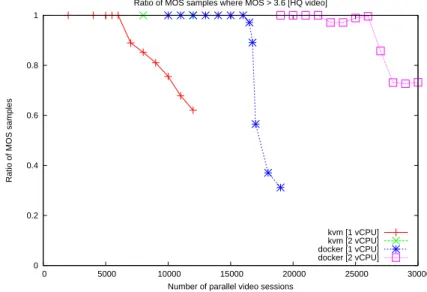
when the service is hosted in a kvm virtual machine. . . 51 3.14 Probability that quality in a sample is acceptable (i.e., MOS > 3.6). . . 52 4.1 Comparison of a QoE-aware with a fixed resource allocation mechanism.
De-pending on its configuration, the baseline scheme may lead to under- or over-provisioning. Our QoE-driven approach, on the other hand, derives an assi-gnment which minimizes cost respecting the quality constraint. . . 69 4.2 Execution time of our QoE-aware algorithm for increasing topology sizes (i.e.,
numbers of regions/POPs.) Each point is the mean value of 50 iterations. . . 70 4.3 Solution space. The straight lines represent cost and availability constraints.
The filled boxes are the assignments selected as optimal by our TRAP algo-rithm under different policies, while the empty boxes are feasible but subopti-mal solutions. . . 84 4.4 Availability and cost as a function of the selected policy. . . 84 4.5 Performance of different placement schemes for the same policy and
increa-sing numbers of available PMs. . . 86 4.6 Performance of different placement schemes for the same configuration
(num-ber of available PMs) as a function of the applied policy (criteria weights). . . 87 4.7 Comparison between our two-step heuristic (TRAP) and our GA in terms of
the cost objective for different policies (lower is better). . . 88 4.8 Comparison between our two-step heuristic (TRAP) and our GA in terms of
the availability objective for different policies (higher is better). . . 88 4.9 Execution time of the GA as a function of the number of generations (G). . . 89 4.10 Execution time of our GA as a function of the pool size (S). . . 89 4.11 Performance of the GA as the size of the pool (S) increases. . . 89 4.12 Performance of the GA as the number of generations (G) increases. . . 89 4.13 Execution time as a function of the number of available PMs for different
LIST OF FIGURES 9 5.1 Availability and latency as functions of the selected policy. . . 104 5.2 MEC servers utilization as a function of the policy. . . 104 5.3 Evolution of cost with the latency-oriented policy. The straight line represents
the cost constraint (budget). . . 104 5.4 Box-plot showing VMs’ impact on the average latency of a service deployment. 104 5.5 Availability as a function of the number of VMs. The straight line represents
the availability constraint. . . 104 5.6 Cost objective value as a function of the number of VMs. The straight line
represents the cost constraint. . . 104 5.7 Comparison between our GGA and CPLEX in terms of the objective for a
specific policy. . . 107 5.8 Execution time as a function of the number of PMs for our GGA and CPLEX. 107
L
IST OF
T
ABLES
3.1 Startup times for a kvm Debian image and a docker container . . . 43 3.2 Chunk sizes (bytes) for our test H.264/AVC DASH video sequences. . . 45 3.3 Summary of results. QoE as a function of the number of parallel users (streams)
accessing a video service hosted on a single-core kvm-based web server/cache VNF. . . 52 4.1 State of the art classification according to the criteria considered. . . 64 4.2 Summary of notation for QoE-aware vCPU resource allocation . . . 67 4.3 Summary of notation for joint vCPU-to-VM allocation and VM placement . . . 75
R
ESUMÉ EN
F
RANÇAIS
Dans les réseaux de diffusion de contenu appelés Content Delivery Network (CDN), les serveurs et leur centre de données (data center) sont géographiquement distribués. De part leurs différents emplacements, ils distribuent selon les besoins, régionalement le service aux utilisateurs finaux. Ceci dans le but de fournir à ces derniers une haute disponibilité et de plus grandes performances. De nos jours, les CDNs servent une grande partie du contenu Internet, y compris (i) les objets web tels que le texte, les graphiques et les scripts, (ii) les objets téléchargeable tels que les fichiers multimédias (vidéos), les applications comme celles du commerce électronique, et (iii) le streaming en directe ou à la demande tels que Netflix, Amazon, etc. Les fournisseurs cherchent à exploiter la virtualisation en mettant à profit les plates-formes de virtualisation appelées Network Functions Virtualization (NFV) afin de déployer des ressources (caches, CPU...) sous forme de fonctions de réseau vir-tuelle (VNF) remplaçant les appareils physiques. La virtualisation des CDN (vCDN) peut amener plusieurs avantages, notamment le fait de pouvoir s’adapter aux nouvelles condi-tions de fonctionnement telles que la création, la suppression ou même la modification des composants CDN en les programmant seulement à distance (par exemple la planification d’une mise en service).
L’objectif de cette thèse est d’étudier et d’évaluer les avantages de la virtualisation des réseaux de diffusion de contenu (CDN) vidéo dans le cloud computing, afin de proposer des algorithmes de placement et d’instantiation de fonction virtuelle au sein d’un cloud fédéré qui est un cloud décentralisé dont le fonctionnement est uniforme et les services sont de types différents (indépendants).
Contributions et organisation de la thèse
Nous commençons par introduire dans le chapitre 2 le contexte de cette thèse en listant différents articles de la littérature qui abordent des sujets pertinents. Ces sujets traitent les réseaux de diffusion de contenu et l’évolution des fonctions de réseau virtualisées. Notons aussi que dans chaque chapitre de contribution, nous détaillons un état de l’art en rapport avec le problème localement traité.
Chapitre 0 – Resumé en Français
que nous avons implémenté et qui permet à un opérateur de réseau de virtualiser son infrastructure CDN (vCDN) et de la louer à des fournisseurs de contenu, cet act est ap-pelé louer son logiciel (ou sa plateforme) en tant que service ou en anglais Software as a Service (SaaS). Dans notre cas la plateforme CDN en tant que service, appelée CDN as a Service (CDNaaS). Cette flexibilité permet à l’opérateur de proposer des solutions CDN moins couteuses et plus flexibles. Un exemple de flexibilité est que le virtuel CDN instancié par le fournisseurs de contenu (que nous désignons comme clients) puisse être couplé à d’autres infrastructures CDN. Ceci permet au client, en prenant avantage de la présence régionale de l’opérateur, d’utiliser l’infrastructure louée pour répondre à une augmentation du trafic dans certaines régions. D’un point de vu fournisseur CD-NaaS, notre conception permet une utilisation plus efficace des ressources, comparé à un modèle de réservation de ressources moins dynamique (allocation statique des ressources). L’architecture logicielle proposée comprend différents blocs fonctionnels, communiquant via des interfaces bien spécifiées. Il est possible de dissocier les blocs de leur emplacement physique, ce qui permet au fournisseur CDNaaS d’exécuter cha-cun d’eux en tant que fonction virtuelles de façon autonome, sur sa propre infrastruc-ture cloud. L’un des principaux blocs de notre architecinfrastruc-ture : le Service Orchestrator (SO), a pour but la coordination du déploiement des services vCDN. Après réception d’une requête d’un client, le SO déploie et place le VNF adéquat, prenant en compte les exigences du service, les spécifications de la demande et la qualité demandée par le client (incluse dans la demande du service), ainsi que la capacité opérationnelle du fournisseur. Les détails techniques sont pris en charge par le Resource Orchestrator (RO), tels que la gestion des adresses IP pour les instances déployées, mais aussi l’implémentation du service nécessaire (par exemple, configurer la planification du dé-marrage du serveur DNS afin de gérer de manière appropriée la géolocalisation ou la configuration des instances virtuelles du cache à partir des requêtes proxy de l’utilisa-teur vers les serveurs d’origine). Notons que cette politique peut différer selon le type de vCDN disponible chez l’opérateur.
Notre solution offre aux clients, une interface nord (Northbound RESTful API) (dé-tailler dans le manuscrit chapitre 3), à travers laquelle ils demandent le déploiement d’un vCDN sur le telco Cloud. En utilisant l’API, le client spécifie ses besoins en termes de nombre de demande qu’il souhaite couvrir par région, c’est à dire qu’il donne le nombre d’utilisateurs final à qui il souhaite offrir le service dans une région donnée. Il exprime aussi ses contraintes de performance, en terme de qualité moyenne souhai-tée et un temps de réponse désiré, etc. L’interface nord lui assure un contrôle suffisant au niveau du service, en faisant abstraction du réseau interne et des détails
structure. Quand le service est déployé avec succès, l’API renvoie un point d’entrée à l’instance vCDN afin que le client puisse accéder/gérer son déploiement.
2. Dans le but d’avoir une allocation optimale des ressources, notre proposition (deuxième contribution de cette thèse qui correspond au chapitre 4) est en mesure de combiner les informations fournies lors de la demande par le client (par exemple une éstimation du nombre d’utilisateur/flux vidéo par région) avec les données du réseau et de l’infra-structure de calcul. Il est important de connaitre les capacités des dites technologies et de se baser sur la relation entre la charge du service et l’expérience de l’utilisateur. Ceci afin de décider d’une bonne allocation des ressources, un bon placement et une gestion en temps réel. Tout cela en minimisant le coût opérationnel du point de vu fournisseur et en offrant le niveau de service convenu avec le client. Une partie des résultats que nous présentons dans ce manuscrit sont l’aboutissement de ces derniers points, à savoir économiser les ressources tout en satisfaisant la demande du client. Nous proposons de quantifier la relation entre la charge du serveur et l’expérience de l’utilisateur. Pour ce faire, nous avons mesuré les performances d’un serveur vidéo HTTP utilisant une seule CPU virtuelle en présence de plusieurs sessions vidéo paral-lèles. Une vCPU dans notre système est une l’unité de la ressource qui correspond à un coeur CPU. L’approche est centrée utilisateur car elle se base sur la qualité de ser-vice que le client souhaite offrir à ses utilisateurs finaux. D’un point de vue spécifique nous avons quantifié empiriquement la relation entre la charge "workload" du service et la qualité d’expérience QoE du service vidéo. À travers les résultats obtenus, nous remarquons un temps de lecture de la vidéo avec une QoE supérieure à un seuil bien défini. Ceci peut être traduit dans un Service Level Agreement (SLA)1 d’un format
dif-fèrent, où le client peut, s’il le souhaite, assurer que les utilisateurs finaux bénéficient d’un niveau de QoE acceptable pour plus d’un pourcentage spécifique du temps de vi-sionnage de la vidéo. Les différents tests effectués ont permis de mieux comprendre le potentiel et les capacités des technologies de virtualisation vis-à-vis de notre vision du CDNaaS et à les utiliser pour concevoir des stratégies appropriées, telles que la déter-mination de façon optimale du nombre de ressources à déployer et leur configuration. Grâce à ces stratégies de virtualisation, il est possible de répondre à la demande des clients et d’élaborer des politiques de prix pour le service CDN virtuel offert.
Dans cette partie de la contribution nous avons modélisé le problème d’allocation de ressources en problème d’optimisation, nous proposons ensuite un algorithme pour
1. Engagement de niveau de service, c’est un contrat dans lequel un fournisseur de contenu (ou de service) s’engage à fournir un ensemble de services à un ou plusieurs clients.
Chapitre 0 – Resumé en Français
le résoudre. Nos résultats de simulation montrent l’importance de la QoE-awareness pour efficacement aborder le compromis entre la qualité de service et le coût.
3. Par la suite, dans la troisième contribution (suite du chapitre 4), nous proposons une formule d’optimisation du problème de placement des instances virtuelles (dans notre cas vCPUs et VMs) dans des machines physiques (PMs). Nous proposons un mo-dèle pour l’allocation conjointe de vCPU-à-VM et le placement des VMs dans les PMs. Nous nous sommes plus précisement intéressé aux objectifs de la disponibilié du ser-vice et du coût qu’engendre un déploiement d’un serser-vice CDN qui sont des objectifs contradictoire. Ces critères nous ont conduit à proposer une formulation multi-objectif pour les deux problèmes. Le problème de placement de virtuelles machines est connu pour sa difficulté de résolution. C’est pour cela que nous avons traité ce problème multi-objectif en résolvant sa version relaxée à l’aide d’un algorithme que nous propo-sons. Nous avons d’abord trouvé le nombre dit optimal de VMs ensuite en prenant ce dernier comme entrée, l’algorithme trouve le nombre adéquat de PM et distribue uni-formément les vCPUs parmi eux. En assouplissant les hypothéses du problème, nous avons proposé des algorithmes heuristiques polynomiaux pour le résoudre. Nos expé-riences montrent que les solutions obtenus par notre algorithme sont très proche de l’optimal, tout en étant plus rapide qu’un algorithme exact fourni par le solveur commer-cial d’IBM CPLEX2. De plus, nous avons comparé notre solution avec deux approches
de placement de base. Les résultats obtenus ont largement démontré la supériorité de notre solution vis à vis des deux approches de base.
Nous avons aussi comparé notre méthode avec une méta-heuristique : l’algorithme génétique, inspiré de l’état de l’art [106], que nous avons défini comme solution alter-native, les résultats de ce dernier se rapprochent de l’optimal CPLEX et des résultats obtenus par notre heuristique.
4. Dans l’avant dernier chapitre 5 qui correspond à la dernière contribution nous avons étudié la manière avec laquelle nous pouvions utiliser nos précédents modèles dans un réseau mixte à savoir faire du placement VNF dans un cloud fédéré et dans un edge cloud, prenant les différents avantages de l’un et de l’autre. L’un des avantages des edge cloud est le temps de latence ultra-faible appelé ultra Reliable Low-Latency Communications (uRLLC). De part cet avantage, nous adaptons dans le chapitre 5, notre modèle afin de prendre en compte le edge cloud. Notre méthode permet d’abord de classer les ressources cloud en se basant sur leur latence d’accès au service ou à
2. http ://www-01.ibm.com/software/commerce/optimization/cplex-optimizer/
l’application. Ensuite en utilisant cette classification nous avons proposé une formula-tion du problème de placement, où les objectifs sont la minimisaformula-tion de la latence et la maximisation de la disponibilité du service. Nous avons adapté l’algorithme génétique précédemment cité et comparé avec les résultats du solveur CPLEX. Nos résultats ont montré que notre solution est proche de l’optimal tout en minimisant le temps pour trouver la solution.
5. Nous concluons ce manuscrit par le chapitre 6, dans lequel nous résumons nos travaux en rappelant l’objectif de cette thèse, la problématique traitée et comment nous y avons répondu. Nous finissons par illustrer quelques perspectives de travaux futurs.
CHAPTER1
T
HESIS
I
NTRODUCTION
1.1 Motivation
With the emergence of popular video-streaming platforms that offer online content ser-vices for video such as Amazon and Netflix, Content Delivery Network (CDN) will carry more than 70% of the global Internet traffic by 2021 [15]. This new paradigm will inspire the internet architectures to go beyond this problem. This is especially due to the ever-increasing user expectations at low cost making the delivery of high Quality of Experience (QoE) and high user satisfaction for multimedia services more important than ever.
In particular, the problem is that in one hand content distributed over the top creates a bidirectional dependence between CDN and network providers: CDN customers, and, in turn, end users, depend on the underlying network infrastructure, and user experience is affected by its conditions. Network operators, on the other hand, are vulnerable to the traffic dynamics caused by time-varying shifts in content demand. At the same time, network providers wish to take advantage of their regional presence and proximity to the end users to enter the content delivery market.
This has led to the emergence of telco CDNs, which are content delivery infrastructures owned and operated by network providers. In this case, the network operator installs data centers at its points of presence (or other points strategically located in its network) and offers a CDN service advertising high-performance delivery due to user proximity. From the perspective of a content provider, traditional and telco CDNs are not competitive, but, rather, complementary services: a telco has the advantage of proximity to end users, but typically this is limited to specific geographic locations where it has presence. On the contrary, tradi-tional CDN players compete offering a global service.
To achieve the emergence of the Telco Cloud, existing technologies such as Network Functions Virtualisation (NFV) and Software Defined Networking (SDN) arised to satisfy both Internet Service Provider (ISP) and Content Provider (CP). In this thesis we study the
Chapter 1 – Thesis Introduction
role of a virtual Content Delivery Network (vCDN) in improving the end-users QoE while saving on service providers’ costs and offering high service availability. In the next section, we outline our contributions in building a system that creates and manages virtual instances of CDN, whereby CDN Virtual Network Functions (VNF) are instantiated and strategically placed over a telco cloud, close to the end-users.
1.2 Contributions of the Thesis
The main objective of this thesis is to study and evaluate the benefits of virtualizing the CDN by means of cloud computing technologies. For this purpose several issues have been addressed. The significant contributions of the thesis are:
1. First, we propose an architecture which allows a network operator to virtualize its CDN infrastructure and lease it to content providers on demand [30, 32]. Our approach, which is in line with current standardization efforts on Network Functions Virtualiza-tion, improves on resource management and service provision flexibility compared to traditional telco CDNs. It can be viewed as an evolution of the telco CDN model, thus having the potential of empowering the role of telecom operators in the content delivery value chain. In particular our design features a Representational State Transfer (REST) Application Programming Interfaces (API) which enable content providers to lease vir-tual CDN resources on demand. Our scheme involves multiple blocks, communicating via well-specified interfaces. This decouples their operation from any physical location, allowing the Content Delivery Network as a Service (CDNaaS) provider to execute any of these blocks autonomously as virtual functions over its own cloud infrastructure. One of the most significant advantages of our design is to expose open APIs to customers, but also among the components of our architecture, and to design with extensibility in mind, so that our scheme can be extended towards a generic Any-as-a-Service model. In this first contribution we also carried out experiments to explore the capabilities and the limitations of the virtualization technologies that we apply by comparing kvm Virtual Machine (VM) with Docker containers.
2. Second, since our scheme allows content providers to express service demand speci-fications and QoE constraints, we used the results from the previous contribution and these specifications to derive resource placement algorithms that aim to optimally sa-tisfy user demand and save on operators’ cost. In particular the placement algorithm can be used to decide on an initial virtual resource allocation for the specific vCDN instance. We were motivated by the fact that QoE-awareness is critical in the process of deciding on an initial virtual resource allocation for the specific vCDN instance. An
1.2. Contributions of the Thesis
allocation of virtual resources for a vCDN deployment request may lead to situations where user demand cannot be satisfied with the desirable quality (e.g., when the num-ber of CPU resources allocated is not capable of handling the load of many parallel video streams), or, conversely, to over-provisioning, when more resources than neces-sary are utilized, leading to increased cost for the operator. In this direction we made the second contribution [107], wherein we carried out extensive measurements of an HTTP video service running on top of a virtualization platform to measure the capabi-lities of the latter from a QoE-centric viewpoint. Based on the obtained measurements we derived an expression of user experience as a function of video server load. This relationship is then used by a novel measurement-driven resource allocation algorithm which aims to cover a target end-user demand (i.e., parallel video streams per region) by minimizing the used computing resources, while respecting (customer) QoE and (operator) capacity constraints. Using simulations on a real Points of Presence (PoP) topology, we demonstrate the advantages of QoE awareness and the importance of our empirical measurements. Our algorithms achieve their goals while being efficient in terms of running time.
3. In the third contribution, we provide solutions to the distribution of the previous virtual resources among VMs. Then we solve the problem of distributing the latter on Physical Machines (PMs). For that we capture the conflicting objectives of service availability and deployment cost by proposing a multi-objective optimization formulation for the problem of joint compute resource allocation and VM placement [108]. Since the latter is computationally hard to solve efficiently, we proposed a polynomial-time heuristic algorithm to solve a relaxed version of the problem. We showed experimentally that the derived solutions are close to the optimal, while at the same time being significantly faster than an exact algorithm provided by a commercial solver. We also showed that our approach outperforms two baseline schemes (random placement and first-fit), as well as a Genetic Algorithm inspired from the state of the art which we consider as an alternative solution.
4. In the fourth and final contribution, we continue to focus on placement algorithms. The difference with the previous contribution is that we not only take into account centralized cloud servers, but we integrated edge servers. The previous placement algorithm aims to reduce deployment costs, increase the users’ QoE, ensure service availability, etc., ignoring Mobile (or Multi-Access) Edge Computing (MEC) applica-tions’ constraints in terms of low latency. This could lead MEC application instances to be instead deployed to central cloud hosts, as the NFV Orchestrator NFV Orches-trator (NFVO) and its related placement algorithms do not differentiate between MEC
Chapter 1 – Thesis Introduction
applications and other VNFs. We fill this gap by proposing a placement algorithm tai-lored to ultra-Reliable Low-Latency Communication (uRLLC) services in the context of a MEC in NFV environment. Our proposition classifies all cloud resources (central and edge cloud) according to their access latency to the user data plane. Then, the place-ment algorithm is formulated as an optimization problem, where the objectives are to minimize latency and to maximize service availability (reliability); these correspond to the main deployment criteria for uRLLC services. We provide solutions to this problem by proposing a suitable Genetic Algorithm, but also by using the CPLEX solver as a benchmark. Our experimental results show that our solutions are close to the optimal, while simultaneously it takes considerably less time to derive them than an exact al-gorithm provided by CPLEX. We have also shown how our method can reduce delays and still provide a highly-available service.
1.3 Organization of the Manuscript
The rest of the thesis is organized as follow.
Chapter 2 overviews the state of the art in CDNs identifying relevant CDN architectures. We investigate the integration of the virtualization in the cloud and CDN making them more flexible. We also highlight the ISP-CDN interactions and the emergence of telco CDN. Then we describe the emergence of NFV as a key technology in service delivery. Finally we outline the Mobile Edge Computing (MEC) in NFV environment by reporting a reference architec-ture.
In chapter 3, after an in-depth study of the state of the art in telco CDNs, data center vir-tualization and NFV we present our architecture for CDNaaS provision and an experimental evaluation of the capacity of candidate virtualization technologies which can support our vision.
Chapter 4 starts by an extensive analysis of the state of the art on VNF placement al-gorithms and a classification of these alal-gorithms according to the criteria considered (pla-cement contraints). Then, the chapter addresses issues of VNF pla(pla-cement and resource allocation by proposing a QoE-aware method to optimize the amount of vCDN resources al-located across the regions where the telco cloud operator has presence. The aim is to serve a content provider’s vCDN deployment request under quality and capacity constraints. Our model for joint vCPU-to-VM allocation and VM placement among PMs is also presented in this chapter. The chapter also provides our proposition of the heuristic solution for a relaxed
1.3. Organization of the Manuscript
version of the problem. We compare our heuristic with an adaptation of a Genetic Algorithm from the state of the art. Finally we present experimental results on the performance of our scheme compared with heuristics widely used in the literature, the aforementioned Genetic Algorithm, and an exact solution.
In chapter 5 we introduce uRLLC and the MEC environment. We present the state of the art for the particular problem of placing VNFs in a hybrid environment which merges centra-lized and edge resources in a deployment of a service. We present our formulation of the VNF placement problem for uRLLC and we show our solutions to this problem by adapting the precedent proposed Genetic Algorithm comparing its results with CPLEX solver. We also show how our method can reduce delays and still provide a highly-available service.
Finally, we conclude the thesis in chapter 6 where we also present perspectives and future directions for our work.
CHAPTER2
C
ONTEXT
2.1 Introduction
The cloud computing is gaining high momentum for hosting and delivering services over the Internet. There are three main cloud computing service models: Infrastructure as a ser-vice(IaaS), platform as a Service (PaaS) and software as a service (SaaS). The key issue in IaaS delivery is how to efficiently virtualize the computing and storage resources of all phy-sical machines to provision a large number of virtual machines. An example of SaaS which is the main subject of this thesis is the Content Delivery Network (CDN). Indeed nowadays, Internet traffic is dominated by data distributed. Content distributed over the top creates a bi-directional dependence between CDN and network providers: CDN customers, and, in turn, end users, depend on the underlying network infrastructure, and user experience is affected by its conditions. Network operators, on the other hand, are vulnerable to the traffic dyna-mics caused by time-varying shifts in content demand. At the same time, network providers wish to take advantage of their regional presence and proximity to end users to enter the content delivery market.
This has led to the emergence of telco CDNs, i.e., content delivery infrastructures owned and operated by network providers. In this case, the network operator installs data centers at its points of presence (or other points strategically located in its network) and offers a CDN service advertising high-performance delivery due to user proximity. From the perspective of a content provider, traditional and telco CDNs are not competitive, but, rather, comple-mentary services: A telco has the advantage of proximity to end users, but typically this is limited to specific geographic locations where it has presence. On the contrary, traditional CDN players compete offering a global service.
In this chapter, we introduce the context of this thesis and we review the literature in CDNs architectures. Furthermore, we define the NFV paradigm which is one of the key enablers of virtualized CDN addressed in this thesis. Finally, we introduce the MEC in NFV architecture, a new line of research followed during the thesis.
Chapter 2 – Context
2.2 Content Delivery Network (CDN)
Nowadays technologies evolve with the need to deliver diverse content on a minimum time and at high speed. CDN from its first appearance in [22] as a solution in the processing of the large content (media, audio and video) on the web and until now is designed to meet those challenges. Both the distribution of media resources and the minimization of the service deployment are important for the content provider, the service operator and the end-user. Designing a CDN architecture leads to have an overview of the end-users and ensure that they receive an optimized Content Delivery. With CDNs, contents are distributed to cache servers close to users. In particular, CDNs have various Points of Presence (PoP) with cache (surrogate) servers (close to the end-user) that store copies of the original content [85].
FIGURE 2.1 illustrates the basic overview of the CDN. As can be seen from this figure a
CDN replicates content from the original server to cache servers in different locations all over the world in order to deliver content to the end-users (refer as clients in the figure) within a reasonable time.
FIGURE2.1 : Content Delivery Network overview.
Few works presented the layered architecture of CDNs [86, 3]. The idea is to highlight the main protocols used in CDNs in a layered manner. According to [86] the main layers are: (i) Basic Fabric layer which is the lowest layer of a CDN; it provides the infrastructural resources such as networking infrastructure, Symmetric multiprocessing (SMP), file servers, etc. All these components are running different software systems, i.e, operating systems. (ii)
2.2. Content Delivery Network (CDN)
Communication and connectivity layer provides CDN Internet protocols in addition to the classical internet protocols (TCP/UDP, FTP). The CDN protocols used for communication, caching and delivery of a content are: Internet Cache Protocol (ICP), Hypertext Caching protocols (HTCP) and Public Key Infrastructures (PKI) respectively. (iii) CDN layer is the key component of the layered architecture, providing CDN services, CDN types and different types of content such as text, images, audio, video, etc, to the user. (vi) End-users layer is at the top of the layered system which consists of a local interface where the end-user can request a CDN by accessing the content provider’s web site. FIGURE2.2 represents the
layered architecture of a CDN.
FIGURE2.2 : Layered architecture of a CDN [86]
The European Telecommunications Standards Institute (ETSI) proposes a standard CDN functional architecture [25]. The high level components architecture is presented in FI -GURE 2.3. Each component has its own features, which are:
• The Content Deployment component generates copies of the content within the CDN. The content deployment is also in charge of the delivery, storage resources and the establishment of the optimal deployment policy of the replica servers in the deployment of a content.
Chapter 2 – Context
FIGURE 2.3 : Architectural components of a CDN [25]
• The Request Routing component finds the appropriate replica servers for the client request for content. It keeps an overview of the content stored in the CDN.
• The content Delivery component is the main contact with the end user; it delivers the content.
• The Accounting component records the usage of the CDN, which can be used as a traffic monitoring.
• The Billing component uses information from the Accounting one, for example in order to report the state of the traffic.
• The Content Preparation component is responsible for the transcoding, encryption or other functions of this type.
• The Content Ingestion component prepares the content for acquisition.
Other organizations of standardization such as IETF [87] propose a CDN Interconnection (CDNI) where the objective is to model the communication between administered CDNs in order to increase their outreach. The CDNI standard allows an authoritative upstream CDN to use the infrastructure of an autonomous CDN that can offer the best content delivery
2.2. Content Delivery Network (CDN)
service. This communication includes the addition of a content, its modification (update, delete, convert, adapt, etc.) between multiple CDNs.
From the industrial side, the commercial provider Akamai is considered as a global leader in the CDN market [82]. Nowadays Akamai delivers up to 30% of the world’s web traffic. The followed approach aims to reach all edges of the Internet by deploying data centers in a large number of end-user ISPs [82]. The main components of Akamai CDN’s architecture are:
• The mapping system translates the domain name typed by the user into the IP address of the closest edge server.
• The edge server as part of the edge server platform handles the request received from nearby users and serves the requested content.
• The edge server platform is a large deployment of multiple servers located all around the world.
• The transport system is responsible of delivering the requested content from the origin server to the edge server.
• The communications and control system distribute control messages and status infor-mation such as updates when needed.
• The data collection and analysis system gather information such as network data. • The management portal provides information on the way that the content and
applica-tions are served to the end users. It also provides reports on audience demographics and traffic metric
FIGURE 2.4 illustrates the mentioned components of the CDN architecture of Akamai [82].
The collaboration between CDN providers and ISPs is the key to provide contents in good quality. In this spirit Akamai proposes Aura Licensed CDN [1], which consists of offering their CDN services to their customers. The advantage is that the operator (ISP) can own and operate the CDN. Another type of ISP-CDN collaboration is the Telco CDN where the Operators develop their own CDN infrastructure. The Telco CDN is the subject of this thesis which we detail in section 3.2. To empower their role in the content delivery value chain our position is that the Telco CDN can open up to take advantage on the virtualization and cloud management framework in order to lease infrastructures on demand in a flexible and dynamic manner. One advantage to content delivery is its inherent network awareness, and the proximity to end-users. This can be exploited to improve user experience while saving on cost. Our positon is more deeply detailed in the next chapter.
Chapter 2 – Context
FIGURE2.4 : System components of a delivery network of the CDN provider Akamai [82]
As mentioned previously, we believe that the Telco CDN has to exploit the virtualization and virtual CDN. This is where NFV comes in. NFV is a group of multiple networks which can operate on a given physical network [14]. Given its big impact in both industrial and research bodies and its importance in the achievement of this thesis we detail in the next Section this new paradigm and we present implementations of NFV platforms from the state of the art.
2.3 Network Functions Virtualization (NFV)
Network Functions Virtualization was introduced in 2012 by ETSI [24] in a consortium of ISPs. The goal was to specify requirements for the deployment of Network Functions as software on Commercial Off-The-Shelf (COTS) hardware. One of the main objectives was to reduce cost which leads to multiple approaches and propositions. The ETSI describes a high-level function architectural framework and design of NFV [80], depicted in FIGURE2.5:
The main components of the ETSI NFV architecture [80,70] are:
• The Network Function Virtualization Infrastructure (NFVI) block includes the software and the hardware resources needed to run the VNFs. The shared physical resources are the computing network, storage and hardware.The virtual layer is the abstraction of the shared physical resources. In practice, these virtual resources are represen-ted in one or multiple Virtual Machines (VMs), except for the virtual network which is
2.3. Network Functions Virtualization (NFV)
FIGURE2.5 : Functional blocks of NFV architecture [80]
represented as virtual links and nodes.
• A VNF is an implementation of a network function and can include one or more internal components. This make a deployment of a VNF over one or multiple VMs.
• The Virtualized Infrastructure Manager (VIM) as its name indicates, is responsible for the control and the management of the interaction of a VNF with the software resources (computing, storage and network) as well as their virtualization. It is also responsible for the resource allocation when requested by the VNF manager.
• The orchestrator or NFV orchestrator (NFVO) is responsible for the orchestration and the management of the NFVI and software resources. The NFVO has a global view of the system.
• Operation Support System (OSS) and Business Support System (BSS) are external entities representing the service provider. They include the collection of systems and management applications that service providers use to operate their business.
After the NFV architectural framework, ETSI proposes a reference architecture of mana-gement and orchestration for the provisioning of NFV called NFV-MANO [77]. In particular NFV-MANO consists of the three main blocks represented on the right in FIGURE2.5.
Chapter 2 – Context
An example of NFV-MANO implementations is the cloudNFV project1 which is a platform
for implementing NFV based computing and Software Defined Networks (SDN). In the same spirit an effort in VNF-as-a-Service worth noticing is T-NOVA [27, 105], an EU-funded FP7 project aiming to offer a marketplace for VNFs, where VNF providers will be making available their functions to be deployed over the infrastructure of a network or cloud service provider, developing the necessary support for VNF brokering, management and service delivery. Our architecture is in line with the NFV MANO reference architecture and it is detailed in the next chapter.
2.4 MEC in NFV environment
Another line of research explored in this thesis is Mobile (or Multi-access) Edge com-puting (MEC), which is a key component in future 5G mobile communication systems. In particular, MEC is built on recent advances in mobile cloud computing [61]. MEC comes with the development of mobile devices as a solution for the intensive computation and de-lay sensitivity of mobile applications [64]. The ETSI [73] refers to MEC as a system where computing resources are installed within the Radio Access network (RAN)2close to mobile
devices. ETSI has also published documents that (i) define interfaces to interconnect MEC applications with the mobile network data plane to interact with the user data, (ii) specify interfaces to run MEC applications within a virtualization platform, and (iii) provide MEC ser-vices to leverage the mobile operator, by exposing low-level RAN information to third-party application developers, allowing the development of context-aware services. MEC is more mature and ready to be deployed compared to FoG, where the first release of the architec-ture has been recently issued,3 and mainly targets IoT services. FIGURE 2.6 illustrates the
MEC system. It can be seen that the computing equipment, the mobile Edge host (ME host), is installed close to the base stations (BS). The difference between Edge and Central cloud is that in the former the computing is managed locally by the network operator. This can reduce access latency to the service/application.
Edge computing is becoming a key pillar of 5G, especially because of its low latency during a service deployment. The fact that it is at the edge close to users helps to satisfy the user request in a minimum delay, while longer delays are noticed in cloud computing, where datacenters are not necessarily close to the user. However in terms of resources
1. http://www.cloudnfv.com/WhitePaper.pdf
2. In a RAN, radio sites provide radio access and coordinate management of resources across the radio sites. A device is wirelessly connected to the core network, and the RAN transmits its signal to various wireless endpoints, and the signal travels with other networks’ traffic: https://www.sdxcentral.com/5g/definitions/radio-access-network/
3. https://www.openfogconsortium.org/ra/
2.4. MEC in NFV environment
FIGURE 2.6 : MEC system
the traditional cloud is better supplied. This brings ETSI [72] to investigate a new line of work namely MEC in NFV architecture. Bringing both technologies together (MEC-NFV), by integrating the edge within the traditional cloud will lead to create a set of APIs within small datacenters at the edge.
The ETSI reference architecture of MEC-in NFV is illustrated in FIGURE 2.7. This
archi-tecture allows an easy integration of MEC elements such as Mobile Edge platform (MEP), Mobile Edge Orchestrator (MEO) and Mobile Edge platform Management (MEPM) within
the NFV environment [72]. As can be seen there are common components with the NFV
reference architecture presented in the previous section.
FIGURE 2.7 : MEC in NFV reference architecture [72]
We summarize the main components of the ETSI MEC reference architecture in an ETSI NFV environment in the following [72]:
• NFV Orchestrator (NFVO): the role of the NFVO is to instantiate the virtual resources for the MEC applications as well as for the MEP.
• Mobile Edge Platform (MEP): in this architecture the MEP is run as a VNF where it stores service instance templates and provides them to the NFVO to take deployment decision.
• Mobile Edge Platform Manager (MEPM): is responsible for the ME platform element management, the lifecycle management of the ME application and the host level po-licies management. It also maintains information on available ME services in the ME system. It also interacts with the OSS for fault configuration and performance manage-ment
• Mobile Edge Application Orchestrator (MEAO): this component has the view of the whole ME system, it maintains the information about all the deployed ME hosts, the services, the available resources in each host, the ME applications that are instantiated and the topology of the network. The MEAO is also responsible for installing the ME applications in the system, checking their integrity, authentication and validation. More specifically, the MEAO is in charge of the placement of MEC applications,and their instantiation using the NFVO.
In this context, Sciancalepore et al. [95] designed a double-tier MEC-NFV architecture. Their approach is aligned with the ETSI NFV MANO specifications previously presented. The proposed scheme introduces a new management subsystem in order to provide application-oriented orchestration capabilities which are offered to the mobile edge applications and their management. Our vision on MEC is presented in chapter 5 where we focus on a placement scheme that takes into account edge cloud in an NFV environment, and consider specific criteria such as latency, in view of supporting uRLLC.
2.5 Conclusion
To better understand the context of this thesis, we introduced in this chapter two main subjects, namely CDNs and NFV. We defined the traditional CDN and its derivatives such as managed CDN and the telco CDN. We also presented multiple architectures of a CDN where we defined each key components. Then we described the expansion of NFV as a key technology in content/service delivery and we highlighted the key architectures of NFV the NFV-MANO. Finally, we explored the state of the art on MEC in NFV environment. All these challenges inspire us to propose in the next chapter, a design and implementation of an architecture for on-demand deployment of a vCDN infrastructure over a telco cloud. In particular, given that the service is provided over a virtualization platform, we carry out an extensive measurement campaign where we evaluate the performance of key enabling
2.5. Conclusion
technologies for our vision (in our case, virtualization based on kvm and containerization based on docker).
CHAPTER3
A
N ARCHITECTURE FOR ON
-
DEMAND
SERVICE DEPLOYMENT AND PROVISION
OVER A TELCO
CDN
3.1 Introduction
Internet traffic is dominated by data distributed over Content Delivery Network (CDN) in-frastructures, and the current Internet ecosystem is, to a significant extent, shaped by the interactions of different key actors with often conflicting objectives, including Over-the-Top (OTT) content providers, IP transit providers, CDN infrastructure providers and ISPs [63].
In this chapter, with cloud orchestration frameworks and NFV as our enabling technolo-gies, we present our design. Our scheme offers the flexibility to a telecom operator to lease its CDN infrastructure in a dynamic manner, providing a virtual CDN (vCDN) service that can be deployed on demand over the operator’s private cloud. This can be considered as an evo-lution towards opening a telco CDN to potentially (but not exclusively) smaller-scale content providers. Our basic design goals are (i) to offer a well-specified, extensible northbound interface to customers, which will allow them to express service demand specifications and performance constraints, ensuring them sufficient control at the service level, but abstracting internal network and infrastructure details, and (ii) to be able to combine customer-provided demand dimensioning information (e.g., target number of users/video streams per region) with network and compute infrastructure awareness for optimal resource allocation. For the latter, we argue for a measurement driven approach: It is important to know the capabilities of the underlying technologies and be aware of the relationship between service workload and user experience in order to take informed resource allocation, placement, and real-time management decisions, maintaining the level of service agreed with the customer while mini-mizing operational costs; the experimental results we present in this work serve to this end. Our work thus aims to provide the technical elements to build mechanisms for cost- and quality-optimized CDNaaS provision. These elements consist in the architecture support to develop algorithms and mechanisms for service delivery (resource allocation, service
place-Chapter 3 – An architecture for on-demand service deployment and provision over a telco CDN
ment, and elastic resource/service management included) and in the necessary quantitative insight to guide them. We consider these mechanisms, however, as a separate line of re-search which deserves attention in its own right and focus on them in chapter 4.
This chapter is organized as follows: In Section 3.2 we overview the state of the art in Telco cloud, data center virtualization and NFV. In Section 3.3 we present our design and implementation of a cloud-based architecture for the provision of a virtual CDN service tailo-red to telecom providers. We also present results of testbed experiments from our prototype implementation on top of OpenStack [83]. In Section 3.4 we carry out an extensive experi-mental campaign to explore the capabilities and limitations of the virtualization technologies we apply, quantifying the relationship between workload and performance from a system operator and a user perspective.
3.2 State of the art
3.2.1 ISP-CDN collaboration and Telco CDN
Telco Content Delivery Network (Telco CDN) is born due to the exploding high definition video streaming traffic. It provides services which save on traffic toward the Internet [60]. Telco CDN involves the installation and management of CDN servers by the Internet Service Providers (ISPs) within their network. Telco CDN has been created for network operators to optimize resources for content delivery, in an Internet Service Provider (ISP) managed CDN infrastructure [60].
In typical CDNs, content delivery functionality is replicated across a number of servers, po-tentially at a global scale. Content providers delegate the process of delivering their content to CDNs, and the latter select the most appropriate servers to respond to user requests for content items, balancing among maximizing user experience, minimizing delivery cost, and optimally managing CDN server load. CDN performance critically depends on the conditions in the underlying network path between the user and the content location, which however, being managed by network providers, is outside the control of the CDN. Without CDN-ISP collaboration, the CDN relies on estimates which are often not accurate. On the other hand, this network-unaware server selection process can cause unpredictable traffic shifts which can significantly impact the operation of the ISP network. Therefore, both ISPs and CDNs face a fundamental challenge, which is analyzed by Frank et al. [33] along with a thorough description of the technical issues and typical architectures for content delivery over the Internet.
3.2. State of the art
Incentives for collaboration between ISPs and CDNs thus emerge and different strategies can be followed, from a non-cooperative case, where the CDN operates over the top in a network-agnostic manner, to the case where the ISP deploys and controls its own CDN infra-structure, which is the target environment for our work. This can happen either by developing its own content delivery solution, or by acquiring a license to CDN software (licensed CDN), potentially sharing revenue with the CDN provider. For example, the architecture that we pro-pose implies a telecom-operated CDN and many of the technical and managerial challenges stemming from the need for ISP-CDN collaboration are alleviated, since the whole infrastruc-ture is administered by a single entity. Other options involve CDN operators directly installing their servers inside the ISP network and/or setting up specific interconnection agreements.
Poese et al. [89] elaborate on mechanisms for the ISP to offer assistance to the CDN, without it being necessary for each party to reveal sensitive details about their internal wor-kings. They propose enhancements to the ISP’s DNS infrastructure in order to direct user requests to the most appropriate server, taking into account optimization criteria set by the ISP and aiming to improve user experience. In this context, NetPaaS [34] provides the inter-faces and the management tools to CDN operators to deploy their service in an ISP-assisted manner, at the same time offering informed user request to content server assignment. It operates for both physical CDN deployments (bare metal servers placed by the CDN in the ISP network) and virtual ones, if they are supported. Our approach assumes a different ow-nership model, i.e., the ISP is in full charge of the underlying infrastructure and the CDN service. Second, in our case, the customer is the content provider which requests the de-ployment of a CDN service in a SaaS manner, while for NetPaaS the service offering is at the infrastructure or the platform level and the CDN is in full control of the virtual resources. Third, the resource allocation decision in our case is carried out fully by the service opera-tor (ISP) based on measurement-driven empirical models. We should further note that our focus is more on the infrastructure support for CDNaaS provision, including an NFV-MANO-compatible architecture design (detailed in the next Section), than on CDN-service-level details. As such, our system can support various CDN-level functionalities and can further expand towards supporting licensed CDN cases, where the service operator deploys and controls the licensed CDN software as a set of VNFs.
Herbaut et al. [42] analyzed the ISP-CDN collaboration models by using game-theoretic tools, identifying that this collaboration can be implemented on top of an NFV infrastructure and can be mutually beneficial under certain circumstances. In that model, the NVF platform is hosted by the ISP and forms a marketplace where CDN operators can upload VNFs, which can in turn be chained by the ISP into different types of CDN services and under
Chapter 3 – An architecture for on-demand service deployment and provision over a telco CDN
different pricing options. Business-wise, our approach (presented in Section 3.3) is more on the telco CDN side, and, thus, more ISP-centric: The network provider fully controls both the NFV/cloud platform and the content delivery service. Technology-wise, although both approaches share some common ground, we focus more on the technical aspects of such a scheme, providing a detailed architecture design and its implementation.The NF-as-a-Service approach of T-NOVA project mentioned in chapter 2 shares similarities with our work, but the overall target application and business environment is different. Our architecture is designed and optimized for content delivery. Resource management and other relevant low-level deployment decisions are taken by the operator, based on customer demand and constraints, and accurate knowledge of the structure and conditions of its infrastructure.
A driving force behind the deployment of telecom-operator-owned content delivery infra-structures is the fact that telcos aim at empowering their role in the content delivery value chain by exploiting their key advantages of network control and end-user proximity, a role that is traditionally challenged by over-the-top content delivery without their strong involve-ment. The economics of such vertically integrated CDNs are studied by Mailllé et al. [65], who make some interesting observations on the incentives of an ISP to operate its own CDN: In the face of competition with other ISPs not operating a CDN, and depending on the price sensitivity of users, while from a user experience and a regulator perspective a vertically integrated CDN is always beneficial, for their specific model settings there are cir-cumstances under which the ISP has incentives not to run its own CDN. This implies that the decision of a network operator to run a CDN should be carefully studied. Although there is generally a clear business case for ISP-CDN integration, as also demonstrated by network providers rolling out their own CDN infrastructures, a study of such incentives and economic interactions between the involved actors is outside the scope of this thesis.
Despite some key advantages with respect to network awareness, which can improve user experience and thus, potentially, increase the customer base, telco CDNs are limited by their regional coverage. A strategy to overcome this limitation is CDN federation, which is also a subject of the IETF CDN Interconnection (CDNI) Working Group [17]. Given the com-plementary competitive advantages of telco and traditional CDNs, Lee et al. [56] perform a game-theoretic analysis of the strategic interactions between the two types of players. Im-portantly, they study the conditions that can lead to alliances among telco CDNs and provide evidence that if a telco CDN properly manages to offer better service quality exploiting its competitive advantages (e.g., joint traffic engineering and content distribution), market bene-fits are possible. Telco CDN federation can take various forms. As Lee et al. show [56], there are cases under which the potential for full resource pooling and revenue sharing among
3.2. State of the art
the federation is beneficial, although in most cases resource pooling on its own brings more benefits to each individual telecom operator. Regarding critical decisions that a telco CDN operator needs to take, Kamiyama et al. [51] study and identify these decisions such as the regional placement of data centers, and where and how to cache content.
Spagna et al. [99] propose an overview of some challenges, design goals and principles for a telco CDN.
3.2.2 Data center virtualization
Our work is conceptually related with the Virtualized Data Center (VCD) abstraction [39]. In both cases, following a customer request, a set of cloud resources are allocated, operating in isolation on a shared infrastructure, potentially scaling dynamically. However, the VCD abs-traction is closer to the Infrastructure-as-a-Service (IaaS) model, where the customer leases resources in the form of VMs with specific compute, storage and bandwidth guarantees, appearing as a dedicated (but virtual) data center for the execution of arbitrary platforms and applications. The vCDN mostly follows the SaaS model: The customer (content pro-vider) requests for the instantiation of a virtual CDN infrastructure on top of a telco cloud for the diffusion of its content. As such, the infrastructure- and platform-level functionality is managed by the service operator. The content provider is agnostic to the infrastructure and potentially even the platform being used. We should note that at the data center network level, the necessary network virtualization functionality needs to be in place in order to offer the appropriate traffic isolation and network resource provisioning in a naturally multi-tenant environment.
3.2.3 Network Functions Virtualization (NFV)
NFV has been proposed in order to take advantage of virtualized technologies to of-fer a way to design, deploy and manage networking services [70], and is becoming a key technology for future large-scale service delivery [49]. NFV involves carrying out in software networking tasks that were traditionally performed by costly, special-purpose hardware. It is facilitated by developments in cloud computing and networking technologies, which have helped run such functionality on top of commodity hardware, offering on-demand scaling and automatic reconfiguration capabilities, decoupling the necessary service logic from the underlying hardware [41], and at the same time allowing (i) network operators to deploy and manage services with more flexibility and reduced capital and operational expenses, including space and energy costs, (ii) third-party application/service providers to innovate the market, lowering the technological barriers stemming from compatibility issues, and (iii) telecom equipment vendors to focus on the functionality of their solutions and to expand
Chapter 3 – An architecture for on-demand service deployment and provision over a telco CDN
their service portfolio. In NFV, services can be decomposed into a set of VNFs which are implemented in software running on one or more physical servers [70].
Mijumbi et al. [70] highlight the limitations of NFV and its relationship with the Software Defined Networking (SDN) and cloud computing. The authors survey the state-of-the-art in NFV, focusing on different challenges such as operating and capital expenses (OPEX1 and
CAPEX2).
NFV is being applied to a diverse set of functions. In our architecture (next Section), the basic components such as service orchestration, virtual infrastructure management, etc. and the components of the CDN service (caches, load balancers, name servers, etc.) are implemented as VNFs.
In another context, Yousaf et al. [110] propose SoftEPC, a design which takes advantage of cloud computing technologies to virtualize the Evolved Packet Core (EPC) of the 3GPP LTE/EPS mobile cellular network architecture, so that the network can respond more effi-ciently to dynamic traffic demands. Taleb et al. [100] provide an overview of the challenges and design alternatives to achieve this EPC-as-a-Service vision.
It should be noted that intense NFV standardization efforts are currently underway. As mentioned in the previous chapter, the ETSI has specified a Management and Orchestra-tion framework for NFV (NFV-MANO [77]), and one of the proposed NFV use cases is the provision of virtualized CDN services [79, Use Case #8]. We put our design in the context of NFV-MANO in Section 3.3.5.
One of the challenges in NFV is appropriate function placement. Clayman et al. [16] pro-pose a VNF management and orchestration framework and experiment with different virtual router placement algorithms. In a similar spirit, Moens and De Turck [75] present a theore-tical model for VNF resource allocation, focusing on an environment where a base load is handled by physical hardware, and virtual resources are used on demand to deal with load bursts.
1. OPerating EXpenditure: the cost needed to operate the network, i.e., site rental, leased line, electricity, operation and maintenance and upgrade [13].
2. CAPital EXpenditure: the expenditure related to network construction which covers the network planning to site acquisition, RF hardware, baseband hardware, software licenses, leased line connections, installation, civil cost and site support such as power and cooling [13].
3.3. A Framework for CDNaaS provision
Network functions are traditionally subordinated in specific hardware which makes it is dif-ficult to add a new service because of high cost and system stability. These issues have been addressed by proposing to place virtualized services on demand in Cloud data centers. As pointed out by Wood et al. [104], the flexibility offered by NFV comes with a performance cost due to virtualization. They therefore identify the need for a carefully designed NFV platform, coupled with a sophisticated SDN control plane. Our work addresses such challenges, by experimentally quantifying the performance capabilities of core enabling virtualization tech-nologies, and by offering expressive management and control interfaces to customers and flexible service representations, which enable to focus on optimal virtual service construction considering customer and operator cost, performance, and quality constraints.
3.3 A Framework for CDNaaS provision
3.3.1 Features
We present an architecture which allows a network operator to virtualize its CDN infra-structure and lease it to content providers on demand. Our approach can be viewed as an evolution of the telco CDN model, offering the operator the flexibility to provide lower-cost CDN solutions. These could appear more attractive to small-to-medium content providers, but other options are possible. For instance, the virtual CDN instantiated by a customer can be coupled with other CDN infrastructures; the flexibility offered by our design allows the cus-tomer to, e.g., use the leased infrastructure to respond to predicted traffic surges at specific regions, taking advantage of the network operator’s regional presence. From the perspec-tive of the CDNaaS provider, our design allows for more efficient use of its infrastructure resources, compared to a less dynamic resource reservation model with static allocation of data center resources to customers. Our approach can also operate transparently over fede-rated clouds, which can be a strategy that telecom operators may follow to address potential limitations due to restricted geographical coverage.
3.3.2 Architecture
Our design involves various functional blocks, communicating via well-specified interfaces. This decouples their operation from any physical location, allowing the CDNaaS provider to execute any of these blocks autonomously as virtual functions over its own (or any) cloud infrastructure. Our layered and modular design also aims to abstract the details of the un-derlying cloud infrastructure and thus avoid lock-in to a specific cloud management platform. One of our core design principles is to expose open APIs to customers, but also among the