arXiv:0710.5391v1 [hep-ph] 29 Oct 2007
The soft and the hard pomerons: elastic scattering and unitarisation
J.R. Cudell1†, A. Lengyel2, E. Martynov3, O.V. Selyugin4
1[email protected], AGO dept., Universit´e de Li`ege, 4000 Li`ege, Belgium 2[email protected], Inst. of Electron Physics, 88000 Uzhgorod, Ukraine,
3[email protected], Bogolyubov Institute for Theoretical Physics, 03143 Kiev, Ukraine, 4[email protected], Bogoliubov Theoretical Laboratory, 141980 Dubna, Russia
Abstract
The hard pomeron component needed to reproduce small-x data seems
to be present in elastic scattering at moderate energy. If this is the case, it is likely that the total cross section at the LHC will be appreciably larger than previously expected.
1 The effective trajectory
Historically, hadronic exchanges have been remarkably well described by the simple-pole model of Donnachie and Landshoff [1], which assumes that, at high energy, the hadronic amplitude is dominated by a simple-pole pomeron:
A(s, t) = C(t)s1.08+0.25t (1)
The first question is whether this simple model extends to other processes, and in particular to those measured at HERA.
H1 and ZEUS have done amazingly good and useful measurements, and extracted very precise information on F2, as well as on pomeron-dominated processes such as quasi-elastic
vector-meson production, or DVCS. This means that we have a very precise picture of the pomeron, and of the dependence of its properties on Q2 and t. If we represent pomeron
ex-change by a simple pole corresponding to a trajectoryα(t) = α(0) + α′t, its contribution to F2
would be proportional toxα(0)−1 while its contribution to quasi-elastic scattering would go as
σ ∼ W4(α(t)−1). All the data lead to the following effective properties (see e.g. [2]):
• the intercept varies with Q2 and with the massM of the produced meson. Its value is
always constrained by1.08 < α(0) < 1.45, and increases with Q2 andM2.
• The slope α′ of the trajectory is not universal: it is lower in processes containing a hard
scale, such as J/ψ production, and is constrained by 0.16 GeV−2> α′ > 0.08 GeV−2.
Unfortunately, because the masses andQ2 are external variables, it is not possible that the tra-jectory associated with a simple pole depends on them. One may get such a behaviour via more complicated singularities in the complexj plane. Nevertheless, it is striking to observe that
dif-ferent processes lead to the same bounds on the effective intercept, and that both intercept and slope join smoothly with the original Donnachie-Landshoff soft pomeron.
†
2 Regge theory and the two-pomeron picture
This observation prompted Donnachie and Landshoff to extend their original model by adding a new contribution to it [3]: the hard pomeron. The hadronic elastic amplitude thus becomes
A2→2(s, t) = X
i
Ci(Q2, M2, t)sαi(t)
In general, several trajectories are needed to reproduce all the data, but the two dominant ones at high energy are the hard and the soft pomerons. Both are supposed to have universal trajectories. The effective intercept thus comes from mixing these two pomerons with coefficients that depend onQ2 and M . Following these ideas, Donnachie and Landshoff were able to reproduce all the
data from HERA. The hard pomeron intercept was fitted toαH(0) = 1.4372, so that the small-x
measurements ofF2were reproduced [4]. The fit was then extended to higher values ofx [5], and
was made compatible with DGLAP evolution [6], so that partonic distributions could be obtained from it [7]. These ideas were also applied to vector-meson quasielastic photoproduction [8], which are also well reproduced in a 2-pomeron model, when the couplings of the pomerons depend on the mass of the produced meson. The fits to these processes, which now involve an interference between the hard and the soft pomeron, lead to compatible values for the hard-pomeron intercept, and to an estimate for its slope: α′
H ≈ 0.1 GeV−2, while the soft pomeron
trajectory remains as in Eq. (1).
So the addition of a hard pomeron leads to a good description of the data at HERA. But if the hard pomeron is a universal exchange, then one would expect it to be present even in soft data. It is indeed unlikely that the couplings become exactly zero for all on-shell light hadrons, especially if we remember that they vary in photoproduction with the mass of the produced mesons. This prompted us to reconsider the fits to total cross sections and to the real part of the elastic amplitude.
3 The hard component of soft data
The main motivation of [9] was in fact to understand why the soft pomeron model of Eq. (1) could provide a good fit to total cross sections for√s ≥ 5 GeV, while it failed to reproduce the data forρ(0) [10]. Hence the paper used integral dispersion relations in a rather careful way, and
tried to check whether lifting totally the degeneracy of the dominant meson trajectories would help. It was then found that if one added a new crossing-even trajectory, its intercept would automatically go to a value around 1.4, and the quality of the fit would become comparable to that of the best parameterisations of [10]. A careful analysis of the results shows that the main improvement comes from the fit toπp and Kp data, while the pp and ¯pp fit is not affected. In
fact the coefficient of the hard pomeron is essentially zero in this case, which explains why this contribution was not considered before [11]. The reason for this decoupling is clear: the inclusion of a hard pomeron makes the cross sections rise very fast, so that unitarity corrections must be considered between the ISR and the SppS energies¯ 1.
So our strategy was to fit data below 100 GeV, which gave us the following results:
• the hard pomeron intercept is
αH = 1.45 ± 0.01; 1
• if we write the coefficients of the amplitude for ab → ab elastic scattering as gagb, we
obtain an inverse hierarchy:
gK ≈ 1.1gπ ≈ 3.2gp.
The hard pomeron seems to couple more to smaller objects.
• As the amplitude is described by simple-pole singularities, its terms should obey Regge
factorisation, which can be tested by deriving the amplitude forγγ scattering from the
amplitudes forpp and γp scattering. The resulting cross section does reproduce the LEP
measurement, favouring the deconvolution with PHOJET. The hard pomeron singularity must then be rather close to a simple pole.
After this study, three of us considered the off-forward case [12]. We limited ourselves to the first cone|t| < 0.5 GeV2, so that we would not have to deal with multiple exchanges, or with the question of the odderon, and found that many data sets had problems at small|t|, so that we
also used|t| > 0.1 GeV2. The elasticap amplitude is then given by Aap2→2 = CHapFHp(t)FHa(t)sαH + C
ap S F
p
S(t)FSa(t) + meson contributions,
withFi(0) = 1. The dataset we fitted to includes all the available data for pp, ¯pp, Kp and πp
elastic scattering, which we extracted from the HEPDATA system [13], checked, and compiled in a unique format. The resulting database2, contains about 10000 points, more than 2000 of which fall in thet interval considered here, and at√s ≤ 100 GeV. Because of this large number
of points, we were able to extract the form factorsFi(t) directly from the data, by fitting small
intervals tj ± ∆tj to constant Fi(tj), and by later fitting smooth curves to these values. The
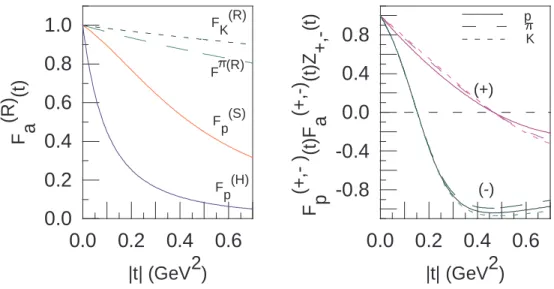
resulting form factors are shown in Fig. 1. There is enough data in the proton case to distinguish between the hard pomeron and the soft pomeron, but we had to assume they were degenerate in the πp and Kp cases. For the meson exchanges, we assumed that C = +1 and C = −1 trajectories were not degenerate, and found that both form factors had zeroes which we took into account by multiplying standard form factors by a function Z(t) which is asymptotically 1 but
changes sign att ≈ −0.15 GeV2 for the C = −1 trajectory and at t ≈ −0.47 GeV2 for the
C = +1 meson tractory.
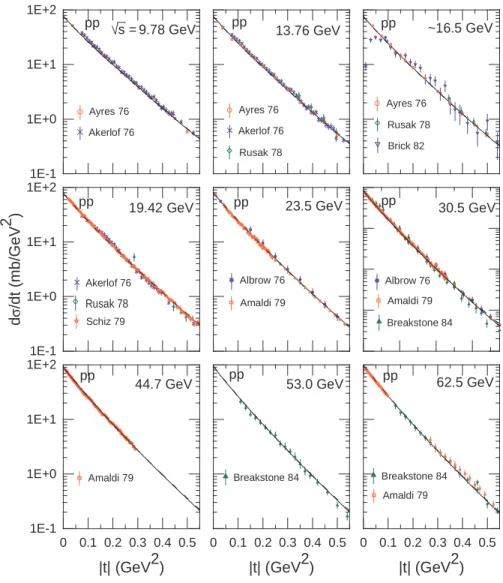
Using direct extraction of the form factors from data produces a remarkably good fit, with aχ2/dof = 0.95, partially shown in Fig. 2. Note that we had to exclude a few datasets which
had gross disagreements with the others (about 100 points). Besides the form factors, it also produces trajectories for the pomerons. We find that
αS = 1.07 + 0.3t (2)
αH(t) = 1.45 + 0.1t (3)
Although the central value of the hard pomeron slope is in perfect agreement with [8], one must mention that it has a large error, as it is correlated with the choice of form factor for the hard pomeron.
0.0
0.2
0.4
0.6
|t| (GeV
2
)
0.0
0.2
0.4
0.6
0.8
1.0
F
a
(R
) (
t)
-0.8
-0.4
0.0
0.4
0.8
F
p
(+
)
(t
)F
a
(+
,-) (
t)
Z
+
,-(t
)
0.0
0.2
0.4
0.6
|t| (GeV
2
)
F p (H) F p (S) F K (R) F (R) p K (-) (+)Fig. 1: Form factors for the various exchange terms, for|t| ≤ 0.5 GeV2. The left figure gives the form factors of the two pomerons which are different in the proton case, but taken as identical for mesons (F(R)is the pomeron form factor for both soft and hard pomerons in that case). The right figure shows the form factor of the dominant C =±1 meson exchanges.
4 Unitarisation and high energies
As explained above, we have had to consider the hard pomeron at low energy√s ≤ 100 GeV. In order to make contact with higher-energy data, and with LHC physics, it is clear that multiple ex-changes have to be considered. The problem of their inclusion is however far from solved. Con-siderable progress has been made recently in addressing the unitarisation of the BFKL pomeron in a perturbative setting, based on the idea of the saturation of the gluon density. Although there seems to be some relation between the equations describing parton saturation and conventional unitarisation schemes [14], it is far from clear whether one can extend these perturbative methods to a soft regime.
In [10], it was shown that a variety of analytic parameterisations leads to a total LHC cross section between 85 and 117 mb. We showed in [9] that a model including a hard pomeron could lead to a cross section compatible with these limits, provided one used an extended eikonal scheme.
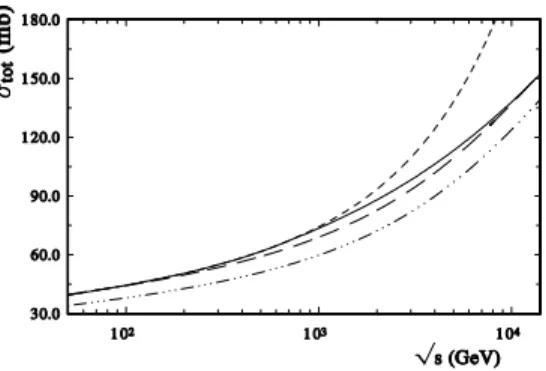
However, two of us have considered in [15] more traditional schemes, i.e. the saturation of the profile function when it reaches the black-disk limit, or the standard one-channel eikonal. The former has the advantage to keep the simple-pole nature of the hard pomeron, so that the low-energy fit is not affected, whereas the latter implies a refitting, which however does not change the parameters significantly. Interestingly, both schemes predict a large cross section at the LHC, of the order of 150 mb, as show in Fig. 2. It thus seems possible to evade the bound presented in [10], provided a universal hard pomeron trajectory is present even in soft scattering. Note that such a trajectory would have consequences not only for the total cross section, but also for the value of theρ parameter and for the slope of the differential cross section B(t), hence it is very
1E-1 1E+0 1E+1 1E+2 1E-1 1E+0 1E+1 1E+2 d σ /d t (m b /G e V 2 ) 1E-1 1E+0 1E+1 1E+2 0 0.1 0.2 0.3 0.4 0.5 |t| (GeV2) 0 0.1 0.2 0.3 0.4 0.5 |t| (GeV2) 0 0.1 0.2 0.3 0.4 0.5 |t| (GeV2)
9.78 GeV 13.76 GeV ~16.5 GeV
19.42 GeV 23.5 GeV 30.5 GeV
44.7 GeV 53.0 GeV 62.5 GeV
pp pp pp pp pp pp pp Akerlof 76 Ayres 76 Akerlof 76 Ayres 76 Ayres 76 Akerlof 76 Rusak 78 Rusak 78 Brick 82 Schiz 79 Albrow 76 Amaldi 79 Amaldi 79 Breakstone 84 Albrow 76 Rusak 78
Amaldi 79 Breakstone 84 Breakstone 84
Amaldi 79
pp pp
s =
Fig. 3: The total cross section as a function of√s, for the bare amplitude (short dashes), a saturated amplitude (plain
curve), an eikonalised amplitude (dash-dot-dot), and for a refitted eikonal (long dashes).
5 Conclusion
The idea of universal exchanges of Regge trajectories is an old one, which has been very fruitful in describing hadronic scattering data. It may in fact be the only way to get a grasp on these processes, which escape perturbation theory. The data of HERA have taught us that a hard sin-gularity is present inγ(∗)p scattering for large Q2 and for large masses. It is natural to assume
that such a singularity is also present in other hadronic processes, even at smallQ2or for small masses. We have found that the inclusion of a hard pomeron in fits to soft data appreciably im-proves the description of the data at energies below 100 GeV. The coupling of the hard pomeron is then only a few percents of that of the soft pomeron, but this is enough to reach the black disk limit around 1 TeV. One then needs to worry about multiple exchanges, and this makes predictions for the LHC quite uncertain.
One can say that the observation of a cross section lower than 117 mb would disfavour the ideas presented here, as the unitarisation scheme needed would have to use strong rescatterings, which have no reason to disappear at low energy. On the other hand, the observation of a cross section higher than 117 mb would be a strong indication that a hard singularity is there in soft data. If this is the case, rescattering/saturation effects will modify not only σtot but alsoρ and
B(t). It thus seems a good idea to devise a strategy to measure these quantities in an independent
way at the LHC.
Acknowledgements: The authors would like to thank P.V. Landshoff for helpful discussions and M.
Diehl for his careful editing. O.S. gratefully acknowledges financial support from FRNS and would like to thank the University of Li`ege where part of this work was done.
References
[1] A. Donnachie and P. V. Landshoff, Phys. Lett. B296, 227 (1992).hep-ph/9209205. [2] ZEUS Collaboration, A. Levy, Acta Phys. Polon. B33, 3547 (2002).hep-ex/0206048;
H1 Collaboration, R. Devenish (2002).hep-ex/0208043.
[3] A. Donnachie and P. V. Landshoff, Phys. Lett. B437, 408 (1998).hep-ph/9806344. [4] A. Donnachie and P. V. Landshoff, Phys. Lett. B518, 63 (2001).hep-ph/0105088.
[5] A. Donnachie and P. V. Landshoff, Phys. Lett. B533, 277 (2002).hep-ph/0111427.
[6] J. R. Cudell, A. Donnachie, and P. V. Landshoff, Phys. Lett. B448, 281 (1999).hep-ph/9901222. [7] A. Donnachie and P. V. Landshoff, Phys. Lett. B550, 160 (2002).hep-ph/0204165.
[8] A. Donnachie and P. V. Landshoff, Phys. Lett. B478, 146 (2000).hep-ph/9912312.
[9] J. R. Cudell, E. Martynov, O. V. Selyugin, and A. Lengyel, Phys. Lett. B587, 78 (2004).hep-ph/0310198. [10] COMPETE Collaboration, J. R. Cudell et al., Phys. Rev. Lett. 89, 201801 (2002).hep-ph/0206172. [11] J. R. Cudell et al., Phys. Rev. D65, 074024 (2002).hep-ph/0107219.
[12] J. R. Cudell, A. Lengyel, and E. Martynov, Phys. Rev. D73, 034008 (2006).hep-ph/0511073. [13] M. Whalley. DPDG-97-02.
[14] O. V. Selyugin and J. R. Cudell, PoS DIFF2006, 057 (2006).hep-ph/0611077. [15] J. R. Cudell and O. V. Selyugin (2006).hep-ph/0612046.