Manuscript Type: Regular Research Article
Running head: Procedural abilities in children with SLI
Article Title: PROCEDURAL LEARNING IN SPECIFIC LANGUAGE IMPAIRMENT: EFFECTS OF SEQUENCE COMPLEXITY
Authors: Audrey Gabriel1, Christelle Maillart1, Nicolas Stefaniak2, Caroline Lejeune1, Lise Desmottes & Thierry Meulemans1
1
Department of Cognitive Science, University of Liège, Liège, Belgium
2
CLEA, Department of Psychology, University of Reims Champagne-Ardenne, Reims, France
Please, address correspondence to: Audrey Gabriel
Department of Cognitive Science, University of Liège B38, Rue de l'Aunaie, 30
4000 Liège - Belgium Tel: 0032 43665989 Fax: 0032 43662394
E-mail: [email protected]
Word count for abstract: 190 words Word count for manuscript: 5100 words
ABSTRACT
According to the procedural deficit hypothesis (PDH), abnormal development in the procedural memory system could account for the language deficits observed in specific language impairment (SLI). Recent studies have supported this hypothesis by using a serial reaction time (SRT) task, during which a slower learning rate is observed in children with SLI compared to controls. Recently, we obtained contrasting results, demonstrating that children with SLI were able to learn a sequence as quickly and as accurately as controls. These discrepancies could be related to differences in the statistical structure of the SRT sequence between these studies. The aim of this study was to further assess, in a group of 21 children with SLI, the PDH with second-order conditional sequences, which are more difficult to learn than those used in previous studies. Our results show that children with SLI had impaired procedural memory, as evidenced by both longer reaction times and no sign of sequence-specific learning in comparison with typically developing controls. These results are consistent with the PDH proposed by Ullman and Pierpont (2005) and suggest that procedural sequence-learning in SLI children depends on the complexity of the to-be-learned sequence.
Key words: Language Development Disorders, Child Language, Serial Learning, Motor skills, Reaction time task, statistical structure.
INTRODUCTION
Children with specific language impairment (SLI) are characterized by poor language skills despite relatively intact abilities in other domains (Schwartz, 2009). However, several recent studies have demonstrated that these children also possess subtle processing inefficiencies that extend beyond language to other cognitive domains, such as working memory, processing speed, and attention (Gillam, Montgomery, & Gillam, 2009; Windsor & Kohnert, 2009). The extent of these non-linguistic deficits and their relationships to the more obvious language deficits in children with SLI are not yet clear.
Ullman and Pierpont (2005) proposed the Procedural Deficit Hypothesis (PDH) as a potential explanation for the combination of linguistic and non-linguistic deficits observed in children with SLI. The PDH is based on the Declarative/Procedural model of language learning (Ullman, 2001), according to which lexical acquisitions are closely associated with declarative memory processes. As for the procedural memory system, it is responsible for learning several aspects of grammar, including the learning and use of rule-governed aspects of syntax, morphology, and phonology (Ullman, 2001, 2004). Under this model, declarative memory would process the binding of conceptual, phonological, and semantic representations, while procedural memory would underlie aspects of rule-learning and would be particularly important for sequential learning. Ullman and Pierpont’s (2005) PDH suggested that language impairments (especially grammar problems) in children with SLI could be explained by abnormalities of brain circuitry underlying procedural memory, principally involving connections between frontal cortex and basal ganglia. This inefficient circuitry leads to impairments in procedural memory abilities, including implicit sequence learning, grammar, and various other tasks, as well as non-procedural functions, such as working memory and auditory processing that also depend on this basal ganglia/frontal circuitry. In contrast, medial temporal lobe structures that underlie learning and consolidation
in declarative memory are relatively intact and may play an important compensatory role in performing functions that are normally largely subserved by procedural memory, such as rule-governed aspects of grammar.
A common method for assessing procedural learning abilities is the serial reaction time (SRT) task (Nissen & Bullemer, 1987). In this task, participants are instructed to react as quickly and accurately as possible to the locations of stimuli that appear in one of four locations on a computer screen by pressing the corresponding keys on the keyboard. Unbeknownst to the participant, the stimuli follow a repeated sequence. Usually, sequence learning is demonstrated by longer reaction times (RTs) in a transfer block (when a new sequence is presented) compared to the last of several learning blocks, when the same sequence had been presented repeatedly (and presumably learned in a procedural manner). Several studies (Tomblin, Mainela-Arnold, & Zhang, 2007; Lum, Gelgec, & Conti-Ramsden, 2010; Lum, Conti-Ramsden, Page, & Ullman, 2011) have used deterministic SRT tasks (i.e., the sequence is repeated identically throughout learning blocks without irregularities) to investigate procedural learning in children with SLI. In all these studies, participants learned a 10-element sequence and children with SLI showed slower learning rates in comparison with controls, supporting the PDH interpretation. Moreover, in the Tomblin et al. (2007) study, the learning rate in the SRT task was correlated with the severity of the grammatical deficits but not vocabulary weaknesses. The authors interpreted their results in accordance with the PDH by suggesting that poor procedural learning might underlie the grammatical impairment observed in children with SLI. However, our group (Gabriel, Stefaniak, Maillart, Schmitz, & Meulemans, in press) has recently obtained contrasting results with a sample of children with SLI that demonstrated similar deterministic procedural learning abilities to their typically developing (TD) peers, regardless of the magnitude of their grammatical deficits.
A possible explanation for the inconsistent findings between these studies is the characteristics of the sequences, since Gabriel et al. (in press) used an 8-element sequence while Tomblin et al. (2007) and Lum et al. (2010; 2011) used 10-element sequences. Because the difficulty to learn the sequence depends on its statistical structure (Jiménez, 2008), it is possible that the contrasting null finding in the Gabriel et al. (in press) study could be accounted for by differences in the structure of the sequence used.
There are several statistical characteristics of the sequence that can affect procedural learning. For instance, learning of frequency information can facilitate sequential learning, but is only possible when some elements in a sequence occur more commonly than others. In the case of a 10-element sequence with four possible locations, some locations are inevitably presented more often than others. On a somewhat higher level, learning can also be based on the predictive information held in the first-order transitions of the sequence (i.e., knowing the probability that one location is followed by another). For example, in the sequence “132342134142”, each sequence element has the same probability (.25). However, one can learn that some first-order transitions occur more often in the sequence than others: the probability is .67 for some transitions (13, 21, 34, and 42), .33 for other transitions (14, 23, 32, and 41), and 0 for the remaining ones (12, 24, 31, and 43). So, learning of such sequences might depend on learning of first-order conditional (FOC) information.
In contrast, a second-order conditional sequence (SOC) – for example, 121342314324 - contains no predictive first-order information because all first-order transitions (12, 13, 14, 21, 23, etc.) occur equally often. In other words, it is possible to predict a location, but only if we consider the two elements that precede the location (i.e., one can predict that the location 2 is followed by 1 only if it is also preceded by 1). Whereas FOC sequence learning is based on the prediction of a location by the immediate preceding location, SOC sequence learning requires more complex, second-order knowledge. It is typically observed that higher-order
transitions are more difficult to learn than lower-order transitions in the SRT task (Deroost et al., 2006). Thus, although the 8-element sequence used in the Gabriel et al. (in press) study was shorter than the 10-element sequence used in both Tomblin et al. (2007) and Lum et al. (2010; 2011), it is not clear whether the 8-element sequence was easier to learn, since each location occurred with the same frequency, in contrast to studies that used 10-element sequences. Indeed, in the 8-element sequence, SOC sequence learning was necessary to predict transitions, whereas FOC could be used in the 10-element sequence. Thus, in order to investigate whether the null finding in our previous results (Gabriel et al., in press) could be simply explained by the fact that we used a shorter, easier sequence than other studies, we investigated SRT performance in children with SLI by using 12-element SOC sequences, which are more complex (regarding both their length and their statistical structure) than those used in previous studies.
Our purpose was to determine to what extent sequence learning in SLI varies based on the statistical properties of the sequence. We adopted a similar methodology to our previous study (Gabriel et al., in press), except that we used a longer, 12-element SOC sequence. Given that ample research has demonstrated that knowledge acquired during sequence learning is predominantly motoric in nature (Deroost & Soetens, 2006) and that children with SLI tend to present deficits during tasks with fine motor components (Schwartz & Regan, 1996), we used a touchscreen as a response mode in order to ensure that children with SLI were not at a disadvantage compared to controls. Indeed, in our previous studies (Gabriel et al., in press; 2011), when the children with SLI had to respond by means of a touchscreen, they responded as quickly and as accurately as their TD counterparts, which was not the case when the keyboard was used as response mode.
In order to assess Ullman and Pierpont’s (2005) PDH, we also investigated whether the sequential learning abilities in children with and without SLI are associated with
individual differences in grammar. According to the PDH, a positive correlation should exist between performance on grammatical tasks and the learning in the SRT task, because both measures are thought to be mediated by procedural learning abilities.
Theoretically, if procedural memory is preserved for non-linguistic information in SLI, these children should be able to learn the sequence as efficiently as controls, regardless the kind of sequence used. Conversely, if children with SLI present a specific procedural deficit for learning sequences with more complex statistical structure, they should not be able to learn the 12-element SOC sequence as well as controls. This finding would suggest that the null finding from our previous study (Gabriel et al., in press), in which we used a shorter SOC sequence (8-element long sequence), could be accounted for by ceiling effects, in which learning was similar between groups due to the ease of the sequence.
METHOD Participants
Forty-six children aged 7 to 11 years served as study participants. No participant had previously taken part in other SRT studies. Children with SLI were recruited from a special educational setting for children with severe language disabilities, where they had received a previous clinical diagnosis of SLI by a professional (speech-language pathologists or child neurologists). All children were Caucasian. The social and occupational group of the children’s family was defined on the basis of the head of the household’s occupation. Two categories of parental occupational levels were established: skilled worker or unskilled worker / unemployed or homemaker. Both categories are referred to as medium and low occupational level, respectively. Children were matched by their parents’ current occupational title. Thus, only seven of the children (with or without SLI) came from low-occupational level families in which both parents are unemployed or homemaker, and two thirds of the participants came from
high-occupational level families in which at least one parent is a skilled worker or unskilled worker (employed, workers or agricultural labourers) but not manager.
TD peers were recruited from schools near the University of Liège (Belgium). All children were French monolingual native speakers, had no history of psychiatric or neurological disorders, and had no neurodevelopmental delay or sensory impairment, as determined by parent report on a medical history questionnaire. Each child with SLI was matched with a child with TD based on socioeconomic status, gender, Perceptual Reasoning Index (WISC-IV; Wechsler, 2005), and age. Moreover, TD peers presented neither language impairment nor other learning impairments. We received parental informed written consent for all participants. The local research ethics committee approved the study, which was carried out in accordance with the guidelines of the Helsinki Declaration. All children were tested individually in a quiet room at their school.
Due to the lack of specific standardized tests, the diagnostic of specific language-impaired French children is a significant challenge for language pathologists. Thus, we administered both a battery of standardized and non-standardized language tests to children in order to establish a profile of weaknesses for each child with SLI and to examine the relationships between SLI in French and procedural learning. Note that the language scores were only used to create a more homogeneously diagnosed group of SLI and not to confirm diagnostic status. Thus, in addition to a previous diagnosis of SLI, for inclusion criteria in the current study, we required chronological age-normed scores lower than or equal to -1.25 SD in two or more of four language tests (see below) as well as a Perceptual Reasoning Index of 80 or higher on the Wechsler Intelligence Scales for Children, Fourth Edition (WISC-IV; Wechsler, 2005). All children with SLI scored in the impaired range on at least one expressive grammar measure, and the majority of the participants (17 out of 23) also demonstrated impairment at least one receptive grammar measure.
Four language tests were administered: two receptive and two expressive language measures. Receptive vocabulary was assessed with the Echelle de Vocabulaire en Images Peabody (EVIP; Dunn Thérault-Whalen, Dunn, 1993), a French version of the Peabody Picture Vocabulary Test (PPVT; Dunn & Dunn, 1981). Receptive grammar knowledge was assessed with the Epreuve de COmpréhension Syntaxico-SEmantique (ECOSSE; Lecocq, 1996), a standardized French version of the Test for Reception of Grammar (TROG, Bishop, 1989). Two expressive subtests of the Clinical Evaluation of Language (SENTENCE PRODUCTION1 and WORD REPETITION2) from the Evaluation du Langage Oral (ELO; Khomsi, 2001) battery were also administered. Finally, visual selective attention skills were assessed with the selective attention subtest of the NEuroPSYchological assessment (NEPSY; Korkman, Kirk, & Kemp, 2003), a published and normed subtest of the French version of the NEPSY (Korkman, Kirk, & Kemp, 1998).
TD children were administered the same tests as children with SLI, and all scored within the normal range on all measures. Participant characteristics are reported in Table 1.
< INSERT TABLE 1 ABOUT HERE >
Exclusion criteria included being unwilling or unable to complete the task due to fatigue, gross motor limitations, being unable to successfully complete the 20-trial pre-test, or displaying extreme RTs that were more than 2 SDs from the group mean. Two children with SLI and their TD peers were excluded because they demonstrated RTs that were 2 SD from the mean of SLI group.
Stimulus materials and procedure
SRT task. The experiment consisted of seven blocks of a four-choice RT task. One
experimental block consisted of a 12-element SOC sequence repeated eight times. Thus, each
1
The Sentence Production subtest contains 25 items assessing productive morphosyntactic abilities, the child is instructed to complete sentences read by the examiner.
2
Word Repetition is a subtest assessing phonological abilities, which requires repeating 32 words read by the examiner. Omissions, substitutions of phonemes or syllables, distortions, and additions are all scored as incorrect.
block was composed of 96 trials. There were six learning blocks (Block 1 to Block 6) and one transfer block (Block 7). The same SOC sequence (3-4-2-3-1-2-1-4-3-2-4-1) was repeated from Block 1 to Block 6 for a total of 576 learning trials. Within the transfer block, another 12-element-long SOC sequence (3-4-1-2-4-3-1-4-2-1-3-2) was repeated eight times. Thus, there were also 96 trials in the transfer block. In total, children completed 672 trials.
In each trial, a stimulus (a cartoon character) appeared in one of four possible locations (one of the four corner windows of a scene). Half of the participants were trained using the first sequence for Blocks 1-6 and the second sequence for Block 7 (the transfer block); this design was reversed for the other half of the participants. To demonstrate sequence learning, we will compare RTs between Blocks 6 and 7. Longer RTs in the transfer block compared to the final learning block indicate procedural learning for the first sequence. Stimulus presentation and recording of RT and accuracy were performed using E-Prime Software (Psychology Software Tools, Inc., Sharpsburg, PA). Participants were seated behind a computer screen that was open at a 180° angle with the keyboard. The average eye/screen distance was 70 cm. The SRT task was designed to make the task more attractive for children. More specifically, a scene with four windows (i.e., the locations where the stimuli might appear) remained constantly displayed on a 15’’ PC screen (see Figure 1). Two windows were on the second floor (upper left and right) and two windows were on the ground floor (lower left and right). The distances between both the horizontal and vertical windows were 25 and 14.5 centimeters, respectively. As shown in Figure 1, the touchscreen was placed on the laptop screen and was the same size as the monitor. Moreover, the laptop screen was folded back to place the touchscreen at the same level as the keyboard in order to prevent the screen from moving when the children touched it. The touchscreen was used to assure that children with SLI, who typically also have fine motor limitations, were not disadvantaged in responding to stimuli compared to controls (Gabriel et al., in press). Finally, an advantage in
using a touchscreen for young children is that subjectively, it appears to assist in keeping them interested and engaged in the tasks (Bavin, Wilson, Maruff, & Sleeman, 2005). To motivate the children to perform to the best of their abilities, the task was presented as a game in which the child had to catch a character to liberate his/her friends. In order to achieve their mission, the children had to catch each character as fast and as accurately as possible. At the beginning of the SRT task, participants were free to spontaneously choose one arm according to their hand preference. Once they had chosen their hand, the children were not allowed to use the other hand at any point during the task. The task was a continuous choice reaction time procedure. The character was removed once a target had been chosen (the character was removed on error trials as well), or when 4000 ms had elapsed. No feedback was given following errors. The next character appeared after a 250 ms response-stimulus interval.
The SRT task was administered in one session lasting approximately 25 minutes. Participants were given a break after each experimental block. The task began with a series of 20 randomly-generated practice trials before the first block. Participants were not informed of the presence of a sequence.
RESULTS
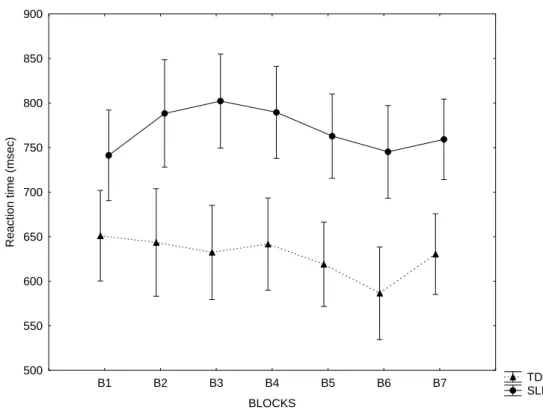
We focused on reaction times, which constituted the main dependent measure. For each group, the mean of the median RTs for correct responses only were calculated for each block (see Figure 2), as is common practice in studies using a SRT task (Nissen & Bullemer, 1987). We first performed an ANOVA using Block (6 levels: Blocks 1-6) as a
within-participants variable, and Group (2 levels: TD and SLI) as a between-within-participants variable. Results showed a significant effect of Group, F(1, 40) = 18.53, MSE = 69048, p < .001,p² =
.31, indicating that children with SLI had overall longer RTs than TD children. A significant effect of Block was also observed, F(5, 200) = 5.26, MSE = 3281, p < .001, p² = .11,
blocks was different in both groups, as shown by the significant interaction effect, F(5, 200) = 2.41, MSE = 3281, p< .05, p² = .057. In order to determine whether the effect differed
between groups, we performed planned comparisons with Blocks (2 levels: Block 1 vs. Block 6) and Group (2 levels: SLI vs. TD). This analysis showed a significant difference between Block 1 and Block 6 for controls, F(1,40)= 9.15, p<.05, but not for children with SLI,
F(1,40)= .03, p=.85. Thus, our results show differences in RT improvement during the
learning blocks between both groups.
Because learning is considered to be sequence-specific when RTs slow down from the last learning block (i.e., Block 6) to the transfer block (i.e., Block 7), we performed an
ANOVA with Block (2 levels: Block 6 vs. Block 7) as a within-participants variable and Group (2 levels: TD and SLI) as a between-participants variable. As expected, this analysis showed a significant main effect of Group, F(1, 40) = 19.08, MSE = 22730, p < .001, p² =
.32, and a main effect of Block, F(1, 40) = 10.74 MSE = 1642, p < .001,p² = .21, with
quicker RTs in Block 6 than Block 7. However, the Group by Block interaction was not significant, F(1, 40) = 2.87, MSE = 1642, p = .09,p² = .06, with a medium effect size (Field,
2005), suggesting that the magnitude of the RT difference between Blocks 6 and 7 does not differ significantly between groups.
Because children with SLI responded significantly more slowly than controls throughout the task (similarly to previous studies: Tomblin et al., 2007; Lum et al., 2010; 2011), we computed a “learning index” for each participant to control for these differences in baseline RTs with the equation (Block 7-Block 6)/ (Block 6+Block 7) (e.g., Meulemans et al., 1998). The mean for children with SLI was .011 (SD= .046), while the mean learning index for the TD group was .039 (SD= .036). A t-test showed that the learning indexes differed between groups t (1,40) = 2.12, p <.05). Based on the effect size observed between the groups (d = 0.67), which could be considered as large (Cohen, 1988), we calculated the statistical power
which was .89. Indeed, single-sample t-tests (two-tailed) indicated that learning for the SLI
group was not significant, t(21) = 1.12, p = .27, with a medium effect size (Cohen, 1988); these results contrast with those obtained by their TD peers, who showed an average learning index that was significantly greater than zero, t(21) = 4.85, p < .001. This finding indicates that the TD group, but not the SLI group, demonstrated significant sequence-specific learning.
< INSERT FIGURE 2 ABOUT HERE >
On the whole, these results reveal that children with SLI responded more slowly than did their TD peers. Across learning blocks, children with SLI did not show as much improvement in RT as did TD participants. Furthermore, their sequential learning index did not differ significantly from chance. Therefore, the data from this study suggest that children with SLI exhibit reduced procedural learning in comparison to their TD peers, which would therefore limit their ability to detect complex sequential information.
Relationships between procedural memory and language measures. In accordance
with Lum et al. (2011), we examined Pearson product-moment correlations between procedural memory and language variables for each language ability measure. Further, we performed these correlations separately for TD and SLI groups. For procedural memory, we computed z-scores (generated with respect to controls) for the SRT learning indices. For lexical and grammatical abilities, we used the normative z-scores of the receptive vocabulary (EVIP) test and of the expressive (ELO: sentences production) and receptive (ECOSSE) tests of grammar.
For SLI participants, receptive lexical abilities (r = .33, p = .14) were not significantly correlated with SRT learning indices, although medium to large effect sizes (Cohen, 1988) were observed. Thus, it is possible that this correlation was non-significant due to a lack of statistical power, because 69 children would be needed to reach a power of .80. On the other hand, receptive grammatical abilities and expressive grammatical abilities (respectively: r =
.48, p = .027; r = .47, p =.029) strongly correlated with the SRT learning indices, with a large effect size (Cohen, 1988). For TD children, the ELO (r = .11, p = .63), ECOSSE (r = .25, p = .26), and EVIP (r = .27, p = .22) were not significantly correlated with SRT learning indices.
Overall, the observed correlations between grammatical abilities and procedural learning are congruent with predictions of the PDH (Ullman & Pierpont, 2005). Specifically, we found that both poor receptive and poor expressive grammatical abilities were associated with poor procedural memory in children with SLI (see also Tomblin et al., 2007), although an association between lexical abilities and procedural learning was not observed (for this latter result, one cannot exclude the possibility of a lack of statistical power, however).
DISCUSSION
In the current study, we investigated sequence learning with a SRT task in children with SLI and matched controls. Previous SRT studies involving children with SLI have yielded mixed results, ranging from impaired (Lum et al., 2010, 2011; Tomblin et al., 2007) to preserved deterministic (Gabriel et al., in press) and probabilistic (Gabriel et al., 2011; Hedenius et al., 2011) sequence learning. However, it is difficult to interpret results from the deterministic SRT studies, because they used different statistical structures: Tomblin et al. (2007) and Lum et al. (2010; 2011) used a 10-element long sequence, while Gabriel et al. (in press) used an 8-element sequence. Thus, we can hypothesize that sequence learning in SLI may depend on the statistical properties of the sequence. Although an 8-element sequence may seem easier, a 10-element sequence allowed the participants to use frequency information and first-order conditional transition probabilities to facilitate procedural learning. In order to determine whether the discrepancies between previous studies were simply related to the length of the sequence (i.e., an 8-element sequence would be easier to learn than 10-element ones, resulting in seemingly intact sequence learning in the SLI group), we administered a visual SRT task to children with and without SLI using a 12-element long
SOC sequence which is more complex than those used in previous studies. Our predictions were the following: if procedural memory is preserved in children with SLI, they should learn the SOC sequence similarly to controls. Conversely, it might be that children with SLI, though able to learn simple sequences, present a procedural deficit for complex statistical structure sequences; in this case, they should not be able to learn the 12-element SOC sequence as well as controls.
Results of the current study show reduced procedural learning performance in SLI. Indeed, in addition to the fact that children with SLI were slower than their TD peers, their sequence-specific learning was lower: in contrast to controls, they did not exhibit above chance learning for the 12-element SOC sequence. Thus, this study suggests that, although children with SLI are able to learn simpler sequences (i.e., when they are exposed to a SOC 8-element sequence in which each 8-element is presented with equal frequency; see Gabriel et al., in press), they may present procedural deficits for sequences characterized by more complex statistical structures, such as with a 12-element SOC sequence. These data suggest that children with SLI are more affected by the statistical structure of the sequences in SRT tasks than controls.
Contrary to our previous study in which children with SLI were as quick as controls when a touchscreen was used as response mode, in the current study, children with SLI were slower than their TD peers, despite the use of a touchscreen. This group difference was found in both the transfer and learning blocks, suggesting that the differences in processing speed were not specifically associated with the learning of the sequential information in the task. These data indicate that the speed of response in a SRT task is affected in SLI, a finding consistent with a growing body of literature indicating RT differences in children with SLI, even on relatively easy perceptual-motor tasks (e.g., Kohnert Windsor, & Ebert, 2009). Given the equivalent response times in our previous studies (Gabriel et al., 2011; in press), we did
not screen for motor impairment in the current study; we only required performance above chance on the SRT pre-test. However, it appears that children with SLI in this study had impaired processing speed compared to controls. Therefore, contrary to the results of our previous studies (Gabriel et al., 2011; Gabriel et al., in press), the use of a touchscreen may not guarantee that the effect of the motor difficulties of the children with SLI would be suppressed. While the touchscreen clearly reduces the fine motor constraints of the task, it does not mitigate the gross motor difficulties that are also observed in children with SLI (Webster, Majnemer, Platt, & Shevell, 2005).
An alternative explanation for the slowed response times could relate to the high comorbidity between SLI and Attention Deficit/Hyperactivity Disorder (ADHD). About 20 to 40% of children with SLI have also ADHD (Oram, Cardy, Tannock, Johnson, & Johnson, 2010; Spaulding et al., 2008). However, in the current study, children with SLI scored similarly to controls on the selective attention subtest of the NEPSY (see Table 1). Moreover, two recent studies (Barnes, et al., 2010; Vloet, Marx, Kahraman-Lanzerath, 2010) observed that children with ADHD respond as quickly as controls on SRT tasks. Therefore, the group differences do not appear to be attributable to differences in selective attention.
Finally, Ullman and Pierpont (2005) proposed that grammatical problems in SLI could be understood in terms of an impaired procedural memory system. In the current study, the ability to extract and learn the regularities in the motor SRT task was significantly correlated with a measure of receptive and expressive grammar in the SLI group. In TD children, grammatical and lexical abilities were not correlated with procedural memory. Moreover, whereas procedural memory was initially thought to mainly support grammar knowledge (Tomblin et al., 2007), some authors have suggested that procedural memory could be associated with lexical knowledge as well (see Evans et al., 2009). Finally, the Lum et al. studies showed that grammatical abilities were associated with procedural memory in TD
children, but with declarative memory in children with SLI (Lum et al., 2011). However, our previous studies (Gabriel et al., 2011; in press) have not found an association between grammatical ability and SRT sequence learning. Thus, the link between language measures and procedural learning has garnered mixed findings and needs to be explored more thoroughly in further research. Nevertheless, this discrepancy in the results could be at least partly explained by the fact that different samples of children with SLI present with varying severities of language problems across the SRT studies. Spaulding, Plante, and Farinella (2006) demonstrated that even if studies used the same cut-off criteria to define language impairment, this approach does not guarantee equivalency with respect to diagnostic accuracy because standardized tests differ in specificity and sensitivity. Therefore, the children with SLI from our study and from the Tomblin et al. and Lum et al. studies could be different in the severity of their language impairment. Indeed, Lum and Bleses (2012) suggested that in the studies by Tomblin et al. (2007)3 and Lum et al. (2010) showing impaired procedural learning in SLI, children with SLI had both expressive and receptive language problems. In the present study, seventeen children with SLI were impaired (scores equal or 1.25 SD below the mean) on both expressive and receptive measures of grammatical knowledge. In comparison, in the Lum and Bleses (2012) study showing comparable levels on the procedural memory task between children with or without SLI, nearly all the children with SLI had language problems confined to the expressive domain. Perhaps a full investigation of the PDH requires a sample where most of the participants possess deficits in both domains.
In conclusion, this study suggests that procedural memory processes assessed through a SRT task are impaired in children with SLI when the task requires learning of sequences characterized by their complex statistical structure. Indeed, the SLI group was slower than
3
Moreover, Tomblin et al. (2007) chose the kindergarten measures to characterize the participants in their study because at this age, individual differences remain among children with regard to grammatical and lexical knowledge. They have found that by 8th grade, the individual differences in grammatical skills were diminished due to ceiling effects on the tests that they used.
their TD peers, with a learning index that was not significantly different from chance. Therefore, taking into consideration these results and those obtained in our previous study (Gabriel et al., in press), one might suggest that children with SLI are able to extract regularities up to a point (e.g., when they are confronted with shorter sequences), but they experience learning difficulties when the sequential information is more complex, such as with a SOC 12-element sequence. On the whole, these data suggesting that the procedural learning difficulties observed in SLI depend on the characteristics of the sequence to learn are consistent with the PDH of Ullman and Pierpont (2005). These results also help to better circumscribe and understand the extent of the procedural memory deficit in children with SLI. Nevertheless, further studies will be needed to explain the discrepancies between studies regarding non-linguistic sequence learning abilities in children with SLI (particularly with probabilistic sequences), and to determine whether, and under which conditions, these difficulties are limited to complex statistical structures.
References
Barnes, K.A., Howard, J.H., Howard, D.V., Kenealy, L., & Vaidya, C.J. (2010). Two forms of implicit learning in childhood ADHD. Developmental Neuropsychology, 35(5), 494-505.
Bavin, E. L., Wilson, P. H., Maruff, P., & Sleeman, F. (2005). Spatio-visual memory of children with specific language impairment: Evidence for generalized processing problems. International Journal of Language & Communication Disorders, 40(3), 319-332.
Bishop, D. (1989). Test for reception of grammar. Toronto: Pearson Canada Assessment. Bishop, D. (2000). How does the brain learn language? Insights from the study of children
with and without language impairment. Developmental Medicine & Child
Neurology, 42(2), 133-142.
Coady, J. A., & Evans, J. L. (2008). Uses and interpretations of non-word repetition tasks in children with and without specific language impairments (SLI). International Journal of
Language & Communication Disorders, 43(1), 1-40.
Corkum, P.V., & Siegel, L.S. (1993). Is the Continuous Performance Task a valuable research tool for use with children with Attention-Deficit-Hyperactivity Disorder? Journal of
Child Psychology & Psychiatry, 34, 1217-1239.
Deroost, N., Kerckhofs, E., Coene, M., Wijnants, G., & Soetens, E. (2006). Learning sequence movements in a homogenous sample of patients with Parkinson’s disease.
Neuropsychologia, 44(10), 1653–1662.
Deroost, N., & Soetens, E. (2006a). Perceptual or motor learning in SRT tasks with complex sequence structures. Psychological Research, 70, 88–102.
Dunn, L. M., & Dunn, L. M. (1981). Peabody picture vocabulary test - revised: Manual for
forms L and M. Circle Pines, MN: American Guidance Service.
Dunn, L. M., Thériault-Whalen, C. M., & Dunn, L. M. (1993). Echelle de vocabulaire en
images Peabody: Adaptation française du Peabody Picture Vocabulary Test. Toronto,
Canada: Psycan.
Ebert, K.D. (in press). Sustained attention in children with primary language impairment: A meta-analysis. Journal of Speech, Language, and Hearing Sciences.
Ellis Weismer, S., & Hesketh, L. (1996). Lexical learning by children with specific language impairment: Effects of linguistic input presented at varying speaking rates. Journal of
Speech and Hearing Research, 39, 177-190.
Evans, J. L. (2002). Variability in comprehension strategy use in children with SLI: A dynamical systems account. International Journal of Language & Communication
Disorders, 37(2), 95-116.
Finneran, D.A., Francis, A.L., & Leonard, L.B. (2009). Sustained attention in children with specific language impairment (SLI). Journal of Speech, Language, and Hearing
Research, 52, 915-929.
Field, A. (2005). Discovering Statistics Using SPSS for Windows, (second ed), Sage, London. Gabriel, A., Maillart, C., Guillaume, M., Stefaniak,N., & Meulemans, T. (2011). Exploration
of serial structure procedural learning in children with language impairment. Journal of
the International Neuropsychological Society, 17, 1–8.
Gabriel, A., Stefaniak, N., Maillart, C., Schmitz, X., & Meulemans, T. Unimpaired
Procedural visual learning abilities in children with specific language impairment.
Gillam, R.B., Montgomery, J., & Gillam, S. (2009). Attention and memory in child language disorders. In R. Schwartz (Ed.), Handbook of child language disorders (pp. 201-215). New York, NY: Psychology Press.
Gomez, R.L., & Gerken, L.A. (1999). Artificial grammar learning by 1-year-olds leads to specific and abstract knowledge. Cognition, 70, 109–135.
Hedenius, M.; Persson, J.; Tremblay, A.; Adi-Japha, E.; Verissimo, J.; Dye, C. D.; et al., Ullman, M.T. (2011). Delayed motor skill acquisition in kindergarten children with language impairment. Research in Developmental Disabilities, 32(6), 2362-2375.
Hsu, H. J., & Bishop, D. V. M. (2010). Grammatical difficulties in children with specific language impairment (SLI): is learning deficient? Human Development, 53, 264-277. Jimenez, L. (2008). Implicit sequence learning in a search task. Quarterly Journal
Experimental Psychology, 61:1650-1657.
Khomsi, A. (2001). Evaluation du langage oral. Paris: Les Editions du Centre de Psychologie Appliquée.
Kohnert, K., Windsor, J., & Ebert, K.D. (2009). Primary or “Specific” Language Impairment and children learning a second language. Brain and Language, 109, 101-111.
Korkman, M., Kirk, U., & Kemp, S. (1998). Nepsy, A developmental neuropsychological
assessment. San Antonio, TX: The Psychological Corporation.
Korkman, M., Kirk, U., & Kemp, S. (2003). Nepsy, Bilan neuropsychologique de l’enfant. Paris: Editions du Centre de Psychologie Appliquée.
Lecocq, P. (1996). Epreuve de Compréhension Syntaxico-Sémantique, Villeneuve d'Ascq: Presses Universitaires du Septentrion.
Leonard, L. (1998). Children with specific language impairment. Cambridge, MA: MIT Press.
Leonard, L. B., Weismer, S. E., Miller, C. A., Francis, D. J., Tomblin, J., & Kail, R. V. (2007). Speed of processing, working memory, and language impairment in children.
Journal of Speech, Language, and Hearing Research, 50(2), 408-428.
Lum, J. & Bleses, D. (2012). Declarative and procedural memory in Danish speaking children with specific language impairment. Journal of Communication Disorders, 45(1), 46-58. Lum, J.A.G., Gelgec, C., & Conti-Ramsden, G. (2010). Research report: Procedural and
declarative memory in children with and without specific language impairment.
International Journal of Language & Communication Disorders, 45, 1-19.
Lum, J.A.G., Conti-Ramsden, G., Page, D.K., Ullman, M., T. (2011). Working, Declarative and Procedural Memory in Specific Language Impairment. Cortex, 1-17.
Marton, K. (2006). Commentaries: Do nonword repetition errors in children with specific language impairment reflect a weakness in an unidentified skill specific to nonword repetition or a deficit in simultaneous processing? [Comment/Reply].
Applied Psycholinguistics, 27(4), 569-573.
Marton, K., & Schwartz, R. G. (2003). Working Memory Capacity and Language Processes in Children with Specific Language Impairment. Journal of Speech, Language, and
Hearing Research, 46(5), 1138-1153.
Meulemans, T., Van der Linden, M., & Perruchet, P. (1998). Implicit sequence learning in children. Journal of Experimental Child Psychology, 69, 199-221.
Montgomery, J. W. (2005). Effects of input rate and age on the real-time language processing of children with specific language impairment. International Journal of Language &
Communication Disorders, 40(2), 171-188.
Nissen, M.J., & Bullemer, P. (1987). Attentional requirements of learning: Evidence from performance measures. Cognitive Psychology, 19, 1-32.
Oram Cardy, J. E., Tannock, R., Johnson, A. M., & Johnson, C. J. (2010). The contribution of processing impairments to SLI: Insights from attention-deficit/hyperactivity disorder. Journal of Communication Disorders, 43(2), 77-91. Schwartz, R.G. (2009). Specific language impairment. In R.G. Schwartz (Ed.), Handbook of
child language disorders (pp. 3-43). New York, NY: Psychology Press.
Schwartz, M., & Regan, V. (1996). Sequencing, Timing and Rate Relationships between Language and Motor Skill in Children with Receptive Language Delay. Developmental
Neuropsychology, 12, 255–270.
Spaulding, T.J., Plante, E., & Farinella, K.A. (2006). Eligibility Criteria for Language Impairment. Is the Low End of Normal Always Appropriate? Language, Speech, and
Hearing Services in Schools (37) 61-72.
Spaulding, T.J., Plante, E., & Vance, R. (2008). Sustained selective attention skills of preschool children with specific language impairment: Evidence for separate attentional capacities. Journal of Speech, Language, and Hearing Research, 51, 16-34.
Stevens, C., Fanning, J., Coch, D., Sanders, L., & Neville, H. (2008). Neural mechanisms of selective auditory attention are enhanced by computerized training: Electrophysiological evidence from language-impaired and typically developing children. Brain Research,
1205, 55-69.
Tomblin, B., Mainela-Arnold, E., & Zhang, X. (2007). Procedural learning in children with and without specific language impairment. Journal of Child Language Learning and
Development, 3, 269-293.
Ullman, M. T., Bergida, R., & O’Craven, K. (1997). Distinct fMRI activation patterns for regular and irregular past tense. Neuroimage, 5, S549.
Ullman, M.T. (2001). A neurocognitive perspective on language: The declarative/procedural model. Nature Reviews Neuroscience, 2, 717–726.
Ullman, M.T. (2004). Contributions of memory circuits to language: The declarative/procedural model. Cognition, 92: 231-270.
Ullman, M.T., & Pierpont, E.I. (2005). Specific language impairment is not specific to language: The procedural deficit hypothesis. Cortex, 41, 399-433.
Vloet, T.D., Marx, I., Kahraman-Lanzerath, B., Zepf, F.D., Herpertz-Dahlmann, B., & Konrad, K. (2010). Neurocognitive performance in children with ADHD and OCD.
Journal Abnormal Child Psychology, 38(7), 961-969.
Webster, R. I., Majnemer, A., Platt, R. W., & Shevell, M. I. (2005). Motor function at school age in children with a preschool diagnosis of developmental language impairment. The
Journal of Pediatrics, 146, 80-85.
Wechsler, D. (2005). Echelle d’intelligence de Wechsler pour enfants et adolescents –
quatrième édition – WISC IV. Paris: Les Editions du Centre de Psychologie Appliquée.
Weismer, S. E., & Hesketh, L. J. (1996). Lexical learning by children with specific language impairment: Effects of linguistic input presented at varying speaking rates. Journal of
Speech & Hearing Research, 39(1), 177-190.
Windsor, J. & Kohnert, K. (2009). Processing speed, attention, and perception: Implications for child language disorders. In R.G. Schwartz (Ed.), The Handbook of Child Language
Table 1
Descriptive Statistics for the Different Measures Administered
Variables
TD SLI
t for Group difference
M SD Range M SD Range Gender 3 g, 20 b 3 g, 20 b N/A Age (months) 115 18 87 to 143 116 19 86 to 141 t(44) = -.10 Perceptual-RI 96 9.8 81 to 114 95 9.7 81 to 119 t(44) = .40 NEPSY 10.6 3.15 4 to 17 9.08 2.48 4 to 13 t(44) = 1.81 EVIP 110 9.9 87 to 128 85 15.2 49 to 109 9 children scored below-1.25 SD t(44) = 5.75 *** ECOSSE .15 .41 .09 to -1.14 -2.47 1.91 -6.65to -.69 17 children scored below-1.25 SD t(43) = 6.34*** ELO (words repetition) .73 .85 - 1.67 to 1.67 -28.9 25.1 -98.3 to -5.4 23 children scored below-1.25 SD t(44) = 7.63 *** ELO (sentences production) .74 .73 -1.44 to 1.72 -4.3 2.5 -12.7 to -1.47 23 children scored below-1.25 SD t(44) = 9.99 ***
Note. RI= Reasoning Index;
NEPSY, French version of the NEuroPsychological assessment (NEPSY, Korkman, Kirk, & Kemp, 2003), Z-scores with M=0, SD=1 (a minimum of 0 and a maximum of 45).
EVIP, French version of Peabody Picture Vocabulary Test (Dunn & Dunn, 1981), standard scores with M=100, SD=15;
Performance QI = Block Design, Picture Completion, and matrix subtests of the Wechsler Primary Scale of Intelligence – Revised (Wechsler, 4th Edition), standard scores with M=100, SD=15;
ECOSSE, French adaptation of the Test for Reception of Grammar TROG (Bishop, 1989), Z-scores with M=0, SD=1 (a minimum of 0 and a maximum of 92);
ELO, Evaluation du langage oral (Khomsi, 2001), Z-scores with M=0, SD=1 (sentences production: a minimum of 0 and a maximum of 25; words repetition: a minimum of 0 and a maximum of 32);
The very poor word repetition performance measured in children with SLI is due to the lack of errors expected in older children.
Figure captions
Figure 1: Schematic representation of computer display for the SRT task used in Experiment.
On each trial, a figure appeared at one of four possible locations (one of the four corner windows of a scene): position 1 (upper left), 2 (upper right), 3 (lower left), or 4 (lower right).
Figure 2: Mean reaction times (RTs) for each block plotted separately for children with SLI
(circles) and TD children (triangles) during the SRT task. Blocks 1–6: Learning blocks; Block 7: transfer block. Learning is indicated by the RT-increase in the transfer Block 7 compared to the final learning Block 6. Error bars represent standard error of the mean
Figure 1 C hil d R ese arc h er A B OV E B E L OW
Figure 2 TD SLI B1 B2 B3 B4 B5 B6 B7 BLOCKS 500 550 600 650 700 750 800 850 900 R e ac ti o n ti m e ( m s e c )
ACKNOWLEDGMENTS
The support for the conduct of this research was provided by the University of Liège (doctoral fellowship for fields not eligible for FRIA). We thank the teachers, children and the families who generously contributed their time. We also thank Mike Sugarman and John Woodard who have volunteered to serve as the consultants for this paper. We thank Camille Bidinger and Emilie Noupré their assistance with this research as well.We acknowledged (a) that the information in this manuscript and the manuscript itself has never been published either electronically or in print and (b) that there is no conflict of interest. Correspondence concerning this article should be addressed to A. Gabriel, Department of Cognitive Science, B38 Street of l'Aunaie, 30, 4000 Liège, Belgium.