HAL Id: hal-01668421
https://hal.archives-ouvertes.fr/hal-01668421
Submitted on 15 Mar 2018
HAL is a multi-disciplinary open access
archive for the deposit and dissemination of
sci-entific research documents, whether they are
pub-lished or not. The documents may come from
teaching and research institutions in France or
abroad, or from public or private research centers.
L’archive ouverte pluridisciplinaire HAL, est
destinée au dépôt et à la diffusion de documents
scientifiques de niveau recherche, publiés ou non,
émanant des établissements d’enseignement et de
recherche français ou étrangers, des laboratoires
publics ou privés.
A three step supercritical process to improve the
dissolution rate of Eflucimibe
Élisabeth Rodier, Hubert Lochard, Martial Sauceau, Jean-jacques
Letourneau, Bernard Freiss, Jacques Fages
To cite this version:
Élisabeth Rodier, Hubert Lochard, Martial Sauceau, Jean-jacques Letourneau, Bernard Freiss, et al..
A three step supercritical process to improve the dissolution rate of Eflucimibe. European Journal
of Pharmaceutical Sciences, Elsevier, 2005, 26 (2), pp.184-193. �10.1016/j.ejps.2005.05.011�.
�hal-01668421�
A three step supercritical process to improve the dissolution
rate of Eflucimibe
Elisabeth Rodier
a,∗, Hubert Lochard
a,b, Martial Sauceau
a, Jean-Jacques Letourneau
a,
Bernard Freiss
b, Jacques Fages
aaEcole des Mines d’Albi-Carmaux, LGPSD-UMR CNRS 2392, 81013 Albi, France bInstitut de Recherche Pierre Fabre, BP 92, 81603 Gaillac, France
Abstract
The aim of this study is to improve the dissolution properties of a poorly-soluble active substance, Eflucimibe by associating it with !-cyclodextrin. To achieve this objective, a new three-step process based on supercritical fluid technology has been proposed. First, Eflucimibe and cyclodextrin are co-crystallized using an anti-solvent process, dimethylsulfoxide being the solvent and supercritical carbon dioxide being the anti-solvent. Second, the co-crystallized powder is held in a static mode under supercritical conditions for several hours. This is the maturing step. Third, in a final stripping step, supercritical CO2 is flowed through the matured powder to extract the residual solvent. The
coupling of the first two steps brings about a significant synergistic effect to improve the dissolution rate of the drug. The nature of the entity obtained at the end of each step is discussed and some suggestions are made as to what happens in these operations. It is shown the co-crystallization ensures a good dispersion of both compounds and is rather insensitive to the operating parameters tested. The maturing step allows some dissolution-recrystallization to occur thus intensifying the intimate contact between the two compounds. Addition of water is necessary to make maturing effective as this is governed by the transfer properties of the medium. The stripping step allows extraction of the residual solvent but also removes some of the Eflucimibe which is the main drawback of this final stage.
Keywords: Supercritical fluid; !-Cyclodextrin; Eflucimibe; Solid dispersion; Inclusion complex
1. Introduction
Improving the dissolution properties of a poorly soluble active substance is a major concern of the pharmaceutical industry. It implies increasing dissolution rates and improv-ing permeation through biological membranes. Eflucimibe is typical of these non-soluble molecules. Its chemical for-mula is C29H43NO2S (S-enantiomer of 2′,3′,5′-trimethyl-4′
-hydroxy-"-dodecylthio-phenylacetanilide) with a chemical Abbreviations: AUC, area under the curve; CD, cyclodextrin; DMSO,
dimethylsulfoxide; DSC, differential scanning calorimetry; GPC, gas phase chromatography; HPLC, high performance liquid chromatography; NMR, nuclear magnetic resonance; RT, room temperature; SAS, supercritical anti-solvent; SDS, sodium dodecyl sulfate
∗Corresponding author. Tel.: +33 563 493 153; fax: +33 563 493 025. E-mail address: [email protected] (E. Rodier).
structure as shown onFig. 1(Junquero et al., 2001). It displays hypocholesterolemic properties inhibiting acyl-coenzyme A: cholesterol acyltransferase (ACAT), thus leading to lower serum cholesterol concentration.
Supercritical particle generation processes are a new and efficient route for improving the bioavailability of pharma-ceutical active compounds (Fages et al., 2004). In a previous paper, we have shown that the supercritical antisolvent pro-cess (SAS) can improve the dissolution rate of Eflucimibe by a tenfold increase in the specific surface area of the powder (Lochard et al., 2002). This improvement has however proved to be insufficient; therefore an association with cyclodextrins has been investigated.
Cyclodextrins (CD) are a family of cyclic oligosaccha-rides which can form inclusion complexes with large organic molecules (Stella and Rajewski, 1997), thus improving their
Fig. 1. Formula of Eflucimibe.
dissolution rate. The most common are the "-, #-, and !-cyclodextrins formed by, respectively, six, seven and eight glucose units. They are of the form of a truncated cone with a hydrophilic outer surface containing a hydrophobic cav-ity into which a drug can be encased to give a non-covalent bonded inclusion complex either in a solid phase or in an aqueous solution (Cabral Marques, 1994). This complex-forming process is equivalent to a molecular encapsulation.
In aqueous solutions, the complex formation occurs by a process in which water molecules located inside the cavity are replaced by the whole drug molecule or some lipophilic structure of the molecule, thus lowering the energy of the system (Loftsson and Masson, 2001). Many characterization techniques can be used to contribute to proofs of the complex-ation. Mechanisms of solid phase inclusion have been less elucidated and the characterization of the complexes formed is less obvious. Solid complexes have commonly been anal-ysed by differential scanning calorimetry (DSC) (Giordano et al., 2001) and they can also be analysed by infrared (IR) or X-ray spectroscopy. However, none of these three tech-niques have given undisputable evidence of the existence of a complex. They can only deliver pieces of information about interacting molecules suggesting a new entity, which may be more generally a solid dispersion. The best evidence
of inclusion in solid phase might be given by nuclear mag-netic resonance (NMR) analysis or by a differential solubility method (Van Hees et al., 2002).
Hence, one has to be cautious when characterizing a drug-CD solid mixture, because as in a physical mixture there is no effective chemical interaction between the different compo-nents and their characteristics remain unchanged. A solid dis-persion implies an intimate contact between the components to generate interaction between them (Yalkowsky, 1999). Their characteristics are thus changed: the melting point of a component may be decreased and its solubility increased. Besides, a solid solution is a mixture at the molecular scale. Usually, the miscibility (especially considering organic com-pounds) between compounds is partial and a solid solution is composed of one component in small quantity dispersed into the other (Craig, 2002). An inclusion complex is, therefore, a specific case of a solid dispersion in which the active sub-stance is dispersed at the molecular level and included in CD cavities.
Several techniques have been used for the preparation of solid complexes. These include kneading, freeze drying or grinding but they are time and energy consuming (Gil et al., 2004). Supercritical carbon dioxide (SC CO2) is
sug-gested as a new complexation medium due to its properties of improved mass transfer and increased solvating power. Dif-ferent supercritical fluid techniques can be applied depending on the solubility of the guest molecule: extraction and perco-lation through a CD packed bed (Charoenchaitrakool et al., 2002), co-crystallization by SAS process (Foster et al., 2002) or complexation using a static method (Van Hees et al., 1999). In the present study, we have applied such processes to Eflucimibe by combining the two last processes and com-plementing them by adding a final stripping step in order to extract residual solvent. Here, we discuss this new process which comprises three consecutive steps, a co-crystallization
performed in a SAS configuration, a batch step where the powder is held for a certain time in supercritical CO2, named
the maturing step and finally a solvent stripping step. In addi-tion, we have investigated the nature of the entity obtained.
2. Experimental set-up, materials and methods
2.1. The experimental set up and the different configurations
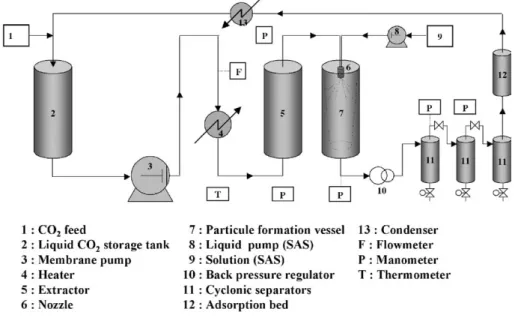
The experiments were carried out in a multifunctional pilot plant (Separex Champigneulles, France). A flowsheet of the apparatus is shown onFig. 2. Carbon dioxide is cooled and stored in a liquid CO2storage tank (2). It is circulated
and pressurized by a membrane pump (Lewa, Germany) (3). Compressed CO2then passes through a heat exchanger (4)
and becomes supercritical.
For the SAS experiments, dimethylsulfoxide (DMSO) was used as the solvent and the antisolvent was CO2. !-CD and
Eflucimibe were both dissolved in DMSO. This solution was injected into the CO2stream coming from (5) by means of a
HPLC pump (8) (Gilson, USA). Both flows were mixed in the mixing chamber of the nozzle (Spraying System, France), and the resulting mixture was sprayed into the expansion vessel (7). The powder formed was collected in a Teflon®porous bag placed in the expansion vessel (7). Then, the CO2-solvent
mixture was depressurized (10) and separated in cyclonic separators (11). After purification by passage through a bed of activated carbon (12) and cooling (13), the condensed CO2
was recycled to the liquid CO2storage tank (2).
In the batch step configuration, 7 g of Eflucimibe/CD pow-der (with a molar ratio of 1/2) were wetted by 2.33 g of ultrapure water (corresponding to 25 mass% of total pow-der) and placed in the 2 l extraction vessel (5). The vessel was filled with supercritical CO2at the desired pressure and
temperature and left for several hours without any agitation. The vessel was then slowly depressurized and the powder removed.
During the solvent stripping step, supercritical CO2was
run for two hours through the powder contained in a stainless steel basket (7). Experimental conditions are given inTable 1.
2.2. Materials
CO2(purity 99.995%) was supplied by Air Liquide S.A.,
DMSO (purity >99%) was obtained from Aldrich. !-CD with an initial mass water content of 8.7% was supplied by Wacker (Cavamax W8 pharma). Eflucimibe, the active compound (MW = 469.73 g/mol) was provided by Pierre Fabre Labo-ratories, Gaillac, France (Ribet et al., 2002).
2.3. Characterization
The powders obtained were characterized by an envi-ronmental scanning electron microscope XL30 ESEM FEG, (Philips Netherlands).
Table 1
Experimental conditions of the three-step process basic case and varying parameters
Co-crystallization step; semi-continuous step
Flowrates CO2: 20 kg/h Solution: 1 ml/min Autoclave conditions P = 27 MPa T = 40◦C Ratios Mass, CO2/DMSO: 350 Molar, Eflucimibe/CD: 1/2 Varying parameters Ratios
CO2/DMSO mass ratio: from 50 to 350 (CO2flowrate kept
constant)
Eflucimibe/CD molar ratio: from 1/1 to 1/3 (Eflucimibe content kept constant)
Maturing step; batch step
Components
Eflucimibe/CD mixture: co-crystallized powder Water: 25 mass% of the total mixture Autoclave conditions
P = 30 MPa T = 100◦C
Operating time: 6 h Varying parameters
Eflucimibe/CD mixture: different physical mixtures or co-crystallized mixture
Operating time: from 1 to 16 h
Stripping step; semi-continuous step
CO2flowrate: 20 kg/h Autoclave conditions P = 27 MPa T = 65◦C Operating time: 2 h Varying parameters Autoclave conditions P: from 10 to 30 MPa T: 40 or 65◦C.
The composition of the powder obtained was determined after each step. Eflucimibe content was measured by HPLC, residual DMSO content by GPC and water content with a Karl Fisher titrator. !-CD content was then deduced from all these results. The HPLC had a C8 column, (Lichro-spher 60 RP-select B, Merck), 25× 0.4 cm packed with 5 $m particles. The mobile phase was acetonitrile (volume per-centage of 82%) and purified water (volume perper-centage of 18%), with a flow rate of 1 ml/min. The detector was a UV spectrophotometer set at 220 nm. The GPC had a column DB624, polycyanophenylsiloxane 6%-polydimethylsiloxane
Table 2
Characteristics of the co-crystallized powder Mean value Standard deviation, homogeneity Standard deviation, reproducibility Eflucimibe mass content (%) 11.4 0.5 0.5 DMSO mass content (%) 4.9 0.2 0.8 Water mass content (%) 6.8 0.8 Dissolved drug concentration at 2 h ($g/ml) 105.1 3.0
94% 30 m× 0.32 mm with a film thickness of 1.8 $m. The temperature programme was; 40◦C for 5 min, then rose to 50◦C at a rate of 2◦C/min, then to 95◦C at a rate of 5◦C/min, then to 180◦C at a rate of 10◦C/min and finally set to 180◦C for 5 min. The detector was a FID set at 250◦C. Eflucimibe, DMSO and water contents are given in mass percentage of the total powder mixture.
In vitro dissolution studies were performed at 37± 1◦C to
estimate the improvement in dissolution rate. A mass of pow-der mixture containing 50 mg of Eflucimibe was put into a 100 ml erlenmeyer containing 50 ml of aqueous solution con-taining sodium-dodecyl-sulfate (5 w/v%), and stirred with a magnetic stirrer at a speed of 400 rpm. Samples of 2 ml of the suspension were removed at fixed time intervals so as not to modify the dissolving medium. They were filtered through a polypropylene membrane having a cut-off diameter of 0.45 $m. The concentration of dissolved drug, expressed in micrograms of Eflucimibe per ml of solution, was then measured by HPLC. In this way, the dissolution kinetics were established and the equilibrium solubility estimated after 20 h of dissolution. It should be noted that performing a disso-lution test without adding any surfactant to the dissolving medium is impossible in our case due to the fact that the water solubility of Eflucimibe is undetectable (less than 4 $g/ml). Besides, the release rates were not measured in sink condi-tions and do not strictly describe the intrinsic properties of the delivery system. However, all tests were performed under the same conditions and allowed us to compare the behaviour of the resulting three-step processed mixtures.
The DSC thermograms were performed with a Perkin-Elmer, DSC-7 calorimeter equipped with a thermal flux cell device. The DSC patterns of the samples (2–3 mg) were obtained between 40 and 140◦C at a heating rate of 5◦C/min under a N2gas stream. By integrating the melting peak of
the crystalline drug in DSC thermograms, and knowing the total drug content independently, it is possible to calculate the amount of non-crystalline Eflucimibe according to:
non-crystalline drug content= 1 − crystalline drug content in treated mixture total drug content in treated mixture non-crystalline drug content= 1 −(drug weight/mixture weight)!Hfcrystalline drug in mixture/!Hfpure drug
HPLC measured
!Hf being the melting enthalpies calculated on DSC
ther-mograms, in J/g.
This non-crystalline part corresponds to the drug, which could no longer be visualized on the DSC thermograms, i.e. the drug molecules interacting with CD (usually assumed to be complexed molecules) and possibly, amorphous aggre-gates dispersed among CD matrix. Thermal analysis has been widely used to characterize inclusion complexes, especially to assess their stoichiometry (Giordano et al., 2001). It must, however, be complemented by other analyses, when avail-able, to demonstrate drug-CD interaction but here it allows us to evaluate the evolution of the mixture throughout the process.
3. Main results
3.1. Preliminary characterization of materials
It has been previously established that Eflucimibe is poorly soluble in supercritical CO2 (mole fraction of 5.71× 0−7
at 27.4 MPa and 35◦C) (Sauceau et al., 2004) and insol-uble in water. On a DSC thermogram, the onset tem-perature giving the melting point of the Eflucimibe was at Tmelting= 128.9± 0.7◦C and the heat of fusion was
!Hmelting= 76± 1 J/g. The solubility was estimated to be
100± 10 $g/ml, according to the dissolution test given above. This solubility was unchanged for a physical mixture of Eflucimibe and !-CD (Fig. 6) The DSC curve (Fig. 5(a)) of this physical mixture showed a broad endothermic peak between 50 and 100◦C corresponding to the water loss of the !-CD followed by endothermic peaks corresponding to conformational transition of the Eflucimibe at 111◦C and to the fusion of the Eflucimibe close to 129◦C, respectively. The initial drug powder is a rather pure polymorphic form.
Furthermore, we can find in the literature that the !-CD is insoluble in supercritical CO2and its solubility in water is
23.2 g/100 ml, RT (Giordano et al., 2001). The solubility of water in supercritical CO2is 4.625 g/l at 30 MPa and 85◦C
or 1.79 g/l at 30 MPa and 50◦C (Wiebe and Gaddy, 1941). One has to be careful that these last solubilities are for free pure water.
SEM microscope pictures of SAS-processed Eflucimibe and of !-CD are given onFig. 3(a) and (b).
3.2. The co-crystallization step
This step is conducted according to a standard SAS config-uration as previously described for crystallizing Eflucimibe alone (Lochard et al., 2002).
Fig. 3. ESEM pictures of SAS processed Eflucimibe (a), and of raw Cavamax !-CD(b).
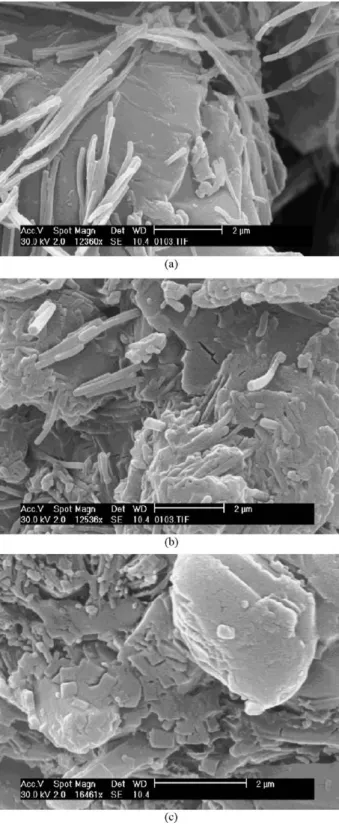
The powder resulting from the co-crystallization step is shown on Fig. 4(a). Large CD particles and drug fibres deposited on them can easily be distinguished. Measured characteristics of this powder are given in Table 2. The composition homogeneity of the powder was tested by char-acterizing four samples taken from the same experiment at different positions in the porous bag. The reproducibility of the experimental procedure was tested by performing the same experiment three times. This showed that the powder obtained can be considered to be homogeneous and that the experiments were reasonably reproducible.
The Eflucimibe melting temperature in the physical mix-ture of Fig. 5(a) is 128.9◦C. For the co-crystallized pow-der, we observed a melting temperature of 126.0± 0.6◦C. This latter result is a mean value calculated from all the 29 co-crystallization experiments performed. In addition, a part of the Eflucimibe contained in the mixture after co-crystallization is not visible by DSC corresponding to the non-crystalline part defined above.
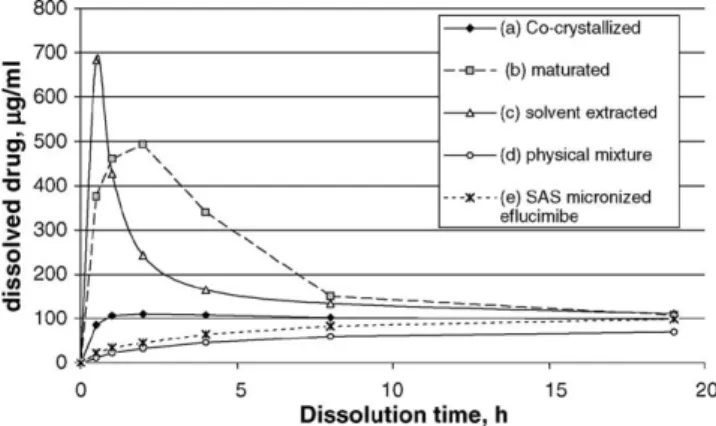
After this step, the dissolved drug concentration was higher than that of the physical mixture with the same profile
Fig. 4. SEM pictures of !-cyclodextrin/Eflucimibe after co-crystallization (a); after co-crystallization and maturing step (b); and after final stripping step (c).
(Fig. 6(b)). It was no longer correlated to the specific sur-face of the powder as was the case with the SAS-processed Eflucimibe alone (Lochard et al., 2002) but was correlated to the presence of CD. This presence renders this step insensi-tive to the main operating parameters. For instance, the mass
Fig. 5. Typical DSC curve physical mixture (a); co-crystallized powder (b); powder after crystallization and maturing step (c); and powder after co-crystallization, maturing step and stripping (d).
Fig. 6. Dissolution curves of crystallized powder (a); powder after co-crystallization and maturing step (b); powder after co-co-crystallization, matur-ing step and strippmatur-ing (c); physical mixture (d); and SAS micronized Eflu-cimibe (e).
ratio CO2/DMSO applied during the co-crystallization SAS
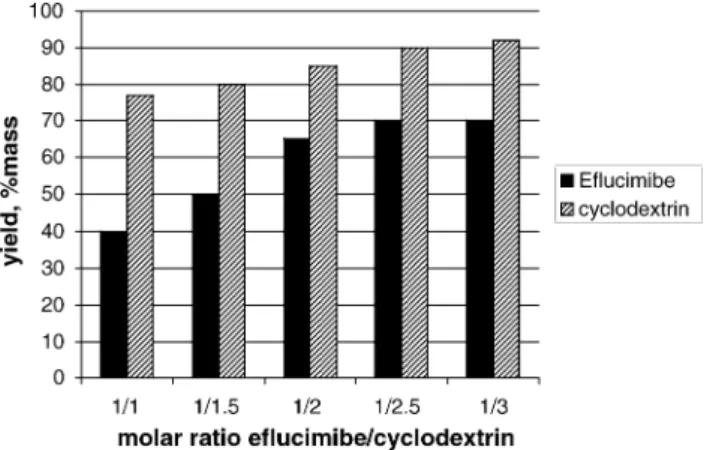
experiment, was varied between 50 and 350, but had no effect on the composition and dissolved drug concentration of the resulting powder (Fig. 7). On the contrary, decreasing the molar ratio of Eflucimibe to CD in the initial mixture from 1/1 to 1/3 increased the drug crystallization yield from 40 to 70% (w/w) (Fig. 8). This yield is defined as the ratio between
Fig. 7. Co- crystallization step: component mass content, % (errors± 0.6 for Eflucimibe,±0.7 for DMSO and water) and dissolved drug concentration, $g/ml× 10−1(error± 0.4), in function of the solvent/antisolvent ratio.
the mass of powder formed and the mass of powder initially dissolved in DMSO.
3.3. The maturing step
After the static step and as seen onFig. 4(b) the drug fibres are not so clearly distinguishable from CD particles, and these fibres seem to be shorter. Furthermore, we can observe only a very small Eflucimibe melting peak on the DSC thermogram (Fig. 5(c)) and the modification of the drug dissolution profile on which a peak appears with a maximum value as high as 500 $g/ml (Fig. 6(c)).
The influence of CO2density and viscosity is presented
in Table 3. Here, CO2 density was evaluated with the
Peng–Robinson EOS (Peng and Robinson, 1976), the viscos-ity with the Altunin correlation (Altunin and Sakhabetdinov, 1972). Eflucimibe solubility in supercritical CO2was
calcu-lated by using the density-based correlation and the associ-ated parameters proposed bySauceau et al. (2003). It appears that non-crystalline drug content increases – as well as the dis-solved drug concentration – when CO2density and viscosity
decrease and when temperature increases. The maturing step is limited by mass transfer and enhanced by a low CO2
sol-vent power. In addition, the influence of the operating time of this static step has been studied. A classical saturation-shape evolution was noticed: i.e. up to 6 h, the powder composition
Table 3
Effect of the maturing step on-crystalline content and dissolved drug concentration of the Eflucimibe obtained as a function of CO2density and viscosity CO2
solubility of Eflucimibe T (◦C) P (MPa) ρ(kg/m3) µ(Pa s) S Eflucimibe/CO2 (×107, mole fraction) Non-crystalline Eflucimibe (mass%)
Dissolved drug concentration at 2 h ($g/ml) 100 10 278 2.40× 10⁻⁵ 54 98.8 678.4 40 10 564 3.78× 10⁻⁵ 1 88.5 522.9 100 30 644 4.70× 10⁻⁵ 571 88.6 503 80 30 734 5.41× 10⁻⁵ 169 84.1 596.5 40 20 830 6.16× 10⁻⁵ 5 82.3 487.9 60 30 831 6.26× 10⁻⁵ 46 83.2 499 40 30 928 7.20× 10⁻⁵ 11 73.8 336.9
Table 4
Maturing step, dissolved drug concentrations and specific surface areas as a function of the initial mixture
Eflucimibe Initial powder SAS treated Co-crystallized Cyclodextrin Initial Cavamax SAS treated Co-crystallized BET specific surface of the mixture (m2/g) 2.3 17.1 8.6
BET specific surface of the Eflucimibe alone (m2/g) 7.5 54 –
Dissolved drug concentration at 2 h of the mixture, just after mixing the powders ($g/ml)
19 69 100
Dissolved drug concentration at 2 h of the mixture, after adding maturing water ($g/ml)
33 58 88
Dissolved drug concentration at 2 h of the mixture, after the maturing step ($g/ml)
141.6 150.3 670
was modified and dissolution kinetics increased, whilst after 6 h both remained constant.
We have also studied the effect of the initial mixture com-position. Three mixtures having the same mass composition were wetted, placed in the autoclave and submitted to the maturing step under the same arbitrary conditions (at 30 MPa, 100◦C for 16 h). The first mixture was composed of the initial drug and CD, the second mixture was of the initial drug and CD crystallized separately by SAS process and the third mix-ture contained the initial drug and CD co-crystallized by SAS.
Table 4shows the dissolved drug concentration after 2 h for each mixture at different stages: just after mixing, just after adding water, and after the static maturing step. This table also shows the specific surface area of the mixtures. Compar-ison of the first and the second mixtures before the static step confirms that the amount of dissolved drug increases with the specific surface area. Comparing the second and the third mixtures, it appears that the amount of dissolved drug is no longer correlated to the specific surface area. In addition, the static step enhances the dispersion of the drug into the CD matrix and thus increases the dissolved drug concentration in all cases. However, the improvement of the compound disso-lution is significantly higher when co-crystallized powder is used. In conclusion, a strong synergistic effect is obtained by coupling the co-crystallization and the static steps (Fig. 8).
Fig. 9 shows the dissolved drug content after 2 h, as a function of non-crystalline drug ratio for all the
co-Fig. 8. Co-crystallization step, component yield as a function of the molar ratio introduced.
crystallization and co-crystallization/static step experiments, which were performed. A linear correlation is seen between the dissolved co-crystallized/maturated drug concentration and the non-crystalline amount of drug. Inversely, the dissolved drug concentration of the co-crystallized pow-der seems to be independent of the non-crystalline drug ratio.
Finally, an important point concerns the presence of water in the powder mixture. Experiments have shown that if no water is added in the maturing step there is no mod-ification of the initial mixture. Hence, water is a crucial component. Furthermore, the addition of water to the mix-ture without performing the maturing step is not suffi-cient to improve the dissolution characteristics of the drug (Table 4).
3.4. The stripping step
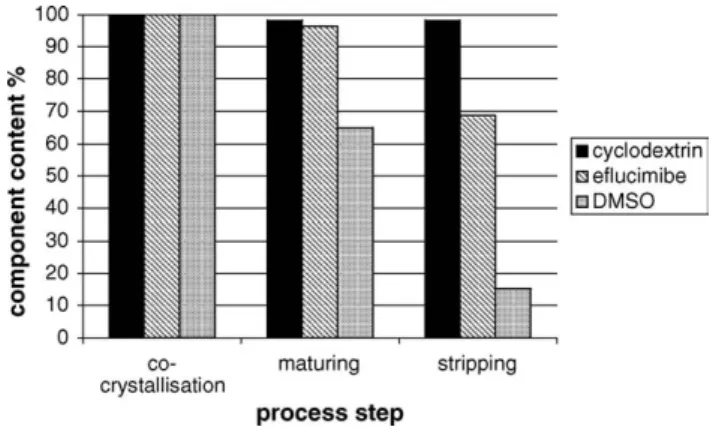
The powder is observed to have a homogeneous aspect after the stripping step, (Fig. 4(c)). This can be correlated to the complete disappearance of the Eflucimibe melting peak (Fig. 5(d)) and to a sharper and higher dissolution peak (Fig. 6(d)). Fig. 10shows the evolution of the content of DMSO, Eflucimibe and CD throughout the three steps of the
Fig. 9. Drug dissolved drug concentration at 2 h as a function of the ratio of non-crystalline drug.
Fig. 10. Component content (in percentage of component content in co-crystallization step) through the three steps of the process.
process. The average solvent content of the powder obtained is about 10,000 ppm, which is twice the pharmaceutical stan-dard for a class III solvent. The aim of the stripping step was to decrease the solvent content, but in fact, drug extraction also occurred whatever the experimental conditions. Decreasing the solvent below this threshold is possible, but an additional extraction of active substance will be unavoidable which is the main drawback of this step. However, it is the Eflucimibe not associated with the CD, which was extracted. In addition, the stripping step also dehydrates the CD. The water con-tent falls from roughly 13 mass% to 2–3 mass% during the stripping step. This explains the rapid increase in the initial dissolved drug concentration due to the enhanced hygroscop-icity of the drug–CD mixture. The removal of water from the hydrated CD could result in void spaces in place of the removed molecules. Because of the structural weakness of the CD matrix it can easily be penetrated by water when perform-ing a dissolution test, thus enhancperform-ing the initial dissolution rate (Yalkowsky, 1999).
3.5. Dissolution kinetics
The dissolution kinetics evolves in the following way. First, the dissolving medium diffuses into the CD matrix con-taining Eflucimibe. Then, Eflucimibe is dispersed into the dissolving medium and is temporarily stabilized into SDS micelles corresponding to the maximum dissolved drug con-centrations on Fig. 6. Then follows a recrystallization of Eflucimibe leading back, after a sufficient period of time (at least 20 h), to the solubility of pure Eflucimibe in this dissolv-ing medium, (that is around 100 $g/ml). Accorddissolv-ing to this scenario, the increase in dissolved drug concentration does not correspond to a true dissolution of the active substance, but to the generation of a metastable colloidal dispersion of SDS micelles including drug. Finally, the acceleration of the dissolution kinetics after the stripping step may be due to the acceleration and amplification of the first dissolution step, that is the diffusion of the aqueous medium through the dehy-drated CD matrix.
4. The three-step process: nature and evolution of the obtained powder
4.1. The Eflucimibe/γ-CD mixture: previous studies
Previous molecular modelling showed that a complex for-mation could occur in the case of this mixture (Gil, 2001). However, NMR analyses, performed in aqueous solutions (Ribet et al., 2002) concluded to the absence of this complex. In the solid state, X-Ray analyses showed that the diffrac-trogram of the maturated mixture was different from that corresponding to a physical mixture thus suggesting that a new entity was synthesized. In addition, the Eflucimibe melting peak partially disappeared on DSC thermograms. Therefore, although the entity obtained is different from a physical mixture, there is a lack of evidence for a true inclu-sion complex.
4.2. Evolution of the mixture through the three steps
The co-crystallized powder might be composed of two solid dispersions. Firstly, a dispersion of Eflucimibe in CD exhibiting no apparent peak on the DSC results since Eflu-cimibe would no longer be in a crystalline state. Secondly, some CD would be dispersed in the remaining crystalline Eflucimibe particles which would induce a decrease of the melting temperature compared to that of pure Eflucimibe as is seen on DSC thermograms. In addition,Fig. 9shows that the dissolved drug concentration remains independent of the non-crystalline drug content. It seems that a minimum degree of dispersion of the drug-CD mixture is required to attain the maximum dissolved drug concentration of 100 $g/ml. Beyond this dispersion threshold, the dissolution properties no longer evolve or this evolution is undetectable with our dissolution test. Moreover, Sertsou and co-workers claim that solid solutions can be formed by anti-solvent co-precipitation (Sertsou et al., 2002). Undergoing precipitation, plasticiza-tion and resulting high molecular mobility allow molecular rearrangement inducing the formation of a solid solution. If applied to the co-crystallized powder, this would mean that crystallization mechanisms are rather different from those involved in the case of pure Eflucimibe. In this latter case, nucleation was mainly homogeneous but it could be hetero-geneous during co-crystallization, which could explain the insensitivity of the powder properties to the process parame-ters.
As for the maturated powder, the melting peak of Eflucim-ibe decreases from step to step along the process (seeFig. 5) and this decrease can be correlated to the increase of the dissolved drug concentration (seeFig. 9). The drug-CD mix-ture may no longer be a mere solid dispersion. Furthermore, the addition of water is a key-factor in this step. Water was added when preparing the powder mixture, and this acted as a solvent for the mixture thus dissolving more CD than Eflucimibe. Then, the mixture was put in the autoclave under static conditions and the maturing step began. A part of the
water could then dissolve into supercritical CO2 while the
other part could remain on the surface of the solid partially dissolving the CD. Note that the solubility of the water present in our autoclave, that is water saturated with dissolved CD and bound water on solid CD surface, may be less than the ones given in Section3.1which were for free water. The result-ing supersaturation ratio, even if supersaturation is very low, can induce recrystallization of CD. The way this CD recrys-tallizes could be driven by the minimization of the contact surface between powder and fluid, as in an Oswald ripening phenomenon (Mullin, 1992). For our batch system (contents of the autoclave) the variation of its free enthalpy, G, is: dG= −S dT + V dP + γSdA
S being the entropy, V the volume of the system, γSthe
inter-facial tension of the solid, A its surface area.
Once the temperature T and the pressure P are fixed, the free enthalpy can only be minimized by varying the contact surface between fluid and solid. A process of particle coarsen-ing implies that when solid particles are surrounded by their own saturated solution there is a tendency for the smaller par-ticles to dissolve and the solute to be deposited onto the larger particles. In addition, ripening implies a diffusion of solute molecules towards the solid surface, which may be favoured by an increase in temperature. This hypothesis implies that a certain degree of supersaturation is maintained at the solid surface, thus water has to remain partly on solid surface and CO2solvent power has to remain low enough.
Small quantities of Eflucimibe dissolve in supercritical CO2, thus slightly decreasing the drug content in the mixture,
which does not favour the formation of an interacting mixture. Once again, the solvent power of supercritical CO2 has to
remain low enough.
Eventually, the stripping step may not modify the nature of the maturated mixture. As explained earlier, it dehydrates the powder, leading to an increase in the dissolved drug con-centration, and it extracts free Eflucimibe not well dispersed with CD.
5. Conclusion
In order to enhance the dissolved drug concentration of Eflucimibe, a new process using supercritical CO2and !-CD
is proposed which leads to the formation of a solid disper-sion of Eflucimibe and !-CD. This process comprises three steps: (1) a semi-continuous co-crystallization by a super-critical anti-solvent process generating a solid dispersion, (2) a batch maturing step during which the powder mixture evolves towards a more intimate mixture, and (3) a final semi-continuous stripping step where residual solvent is extracted with some Eflucimibe and water.
Co-crystallization by SAS ensures a very fine dispersion of the hydrophobic drug in the hydrophilic CD powder. The crystallization mechanisms seem to be different from previ-ously studied SAS crystallization of pure Eflucimibe since
the process parameters here have very little influence on this step. The main degree of freedom remains the way the antisol-vent and the solution are contacted together, as is commonly admitted in SAS experiments.
The second or maturing step, in which the co-crystallized powder is wetted and is held under supercritical conditions for a few hours, leads to an interacting mixture with an enhanced dissolved drug concentration. This formation is favoured by a low CO2 density and therefore by a low solvent power.
An increase in temperature, which enhances the molecule mobility in the supersaturated phase at the solid surface, may also be favourable. As for the mechanisms involved, it is suggested that water is a solvent for the mixture, which par-tially dissolves and recrystallises with a rearrangement of the compounds as in a ripening phenomenon, thus enhancing the dispersion of Eflucimibe into CD.
Finally, a stripping step extracts the residual solvent. A potential drawback of this step is the simultaneous extraction of some active substance. Therefore, it should be improved, for instance by studying the influence of the process param-eters.
The main novelty of this process lies in the coupling of these three steps, exhibiting a strong synergistic effect in the improvement of the dissolved drug concentration of the drug. Such processed powder has been tested in animal studies (unpublished data) and shows a large and significant improve-ment in the in vivo bioavailability: it was multiplied by ten (considering the AUC) in dog studies.
References
Altunin, V., Sakhabetdinov, M., 1972. Viscosity of liquid and gaseous car-bon dioxide at temperature 200–1300 K and pressure up to 1200 bars. Teploenergetika 8, 85–88.
Cabral Marques, H.M., 1994. Structure and properties of cyclodex-trins. Inclusion complex formation. Rev. Port. Farm. XLIV (2), 77– 83.
Craig, D.Q.M., 2002. The mechanisms of drug release from solid disper-sions in water-soluble polymers. Int. J. Pharm. 231, 131–144. Charoenchaitrakool, M., Dehghani, F., Foster, N.R., 2002. Utilization of
supercritical carbon dioxide for complex formation of ibuprofen and methyl-beta-cyclodextrin. Int. J. Pharm. 239, 103–112.
Fages, J., Lochard, H., Letourneau, J.-J., Sauceau, M., Rodier, E., 2004. Particle generation for pharmaceutical applications using supercritical fluid technology. Powder Technol. 141, 219–226.
Foster, N.R., Mammucari, R., Dehghani, F., 2002. Coprecipitation of phar-maceuticals using gas antisolvent technique. In: Besnard, M., Cansell, F. (Eds.), Proceedings of the 8th Meeting on Supercritical Fluids. Bor-deaux, France, Tome I, pp. 321–326.
Gil A., 2001. Recherche de complexation entre une nouvelle entit´e chim-ique et des cyclodextrines par co-broyage et malaxage. Ph.D. of the Paris XI University.
Gil, A., Chamayou, A., Leverd, E., Bougaret, J., Baron, M., Couarraze, G., 2004. Evolution of the interaction of a new chemical entity, Eflucimibe with !-cyclodextrin during kneading process. Eur. J. Pharm. Sci. 23, 123–129.
Giordano, F., Novak, C., Moyano, J.R., 2001. Thermal analysis of cyclodextrins and their inclusion compounds. Thermochim. Acta 380, 123–151.
Junquero, D., Bruniquel, F., N’Guyen, X., Autin, M., Patoiseau, J.-F., Degryse, A.-D., Colpaert, F.C., Delhon, A., 2001. F 12511, a novel ACAT inhibitor, and atorvastatin regulate endogenous hypercholesterolemia in a synergistic manner in New Zealand rabbits fed a casein-enriched diet. Atherosclerosis 155, 131– 142.
Lochard, H., Rodier, E., Sauceau, M., Letourneau, J.-J., Fages, J., 2002. Particle generation by SAS process: effect of operating conditions on the specific surface area of the powder. In: Besnard, M., Cansell, F. (Eds.), Proceedings of the 8th Meeting on Supercritical Fluids. Bordeaux, France, Tome I, pp. 109–114.
Loftsson, T., Masson, M., 2001. Cyclodextrins in topical drug formula-tion: theory and practice. Int. J. Pharm. 225, 15–30.
Mullin, J.W., 1992. Crystallization, third rev. ed. Butterworth-Heinemann, Oxford.
Peng, D.-Y., Robinson, D., 1976. A new two-constant equation of state. Ind. Eng. Chem. Fundam. 15, 59–64.
Ribet, J.-P., Pena, R., Chauvet, A., Patoiseau, J.-P., Autin, J.-M., Segonds, R., Basquin, M., Autret, J.-M., 2002. Polymorphisme cristallin de l’Eflucimibe. Polymorphisme cristallin et medicament. Ann. Pharm. Fr. 60 (3), 177–186.
Sauceau, M., Letourneau, J.-J., Richon, D., Fages, J., 2003. Enhanced density-based models for solid compound solubilities in
supercriti-cal carbon dioxide with cosolvents. Fluid Phase Equilib. 208, 99– 113.
Sauceau, M., Letourneau, J.-J., Freiss, B., Richon, D., Fages, J., 2004. Solubility of Eflucimibe in supercritical carbon dioxide with or with-out co-solvent. J. Supercrit. Fluids 31, 133–140.
Sertsou, G., Butler, J., Scott, A., Hempenstall, J., Rades, T., 2002. Factors affecting incorporation of drug into solid solution with HPMCP during solvent change co-precipitation. Int. J. Pharm. 45, 108–299. Stella, J.V., Rajewski, R.A., 1997. Cyclodextrins: their future in drug
formulation and delivery. Pharm. Res. 14 (5), 556–567.
Van Hees, T., Piel, G., Evrard, B., Otte, X., Thunus, L., Delattre, L., 1999. Application of supercritical carbon dioxide for the preparation of a piroxicam beta-cyclodextrin inclusion compound. Pharm. Res. 16 (12), 1864–1870.
Van Hees, T., Piel, G., Henry De Hassonville, S., Evrard, B., Delat-tre, L., 2002. Determination of the free/included piroxicam ratio in cyclodextrin complexes: comparison between UV spectrophotometry and differential scanning calorimetry. Eur. J. Pharm. Sci. 15, 347–353. Wiebe, R., Gaddy, V.L., 1941. Vapor phase composition of carbon-dioxide–water mixtures at various temperaturess and at pressures to 700 atmospheres. J. Am. Chem. Soc. 63, 475–477.
Yalkowsky, S.H., 1999. Solubility and solubilization in aqueous media. Oxford University Press.