arXiv:1512.08520v1 [astro-ph.SR] 28 Dec 2015
SPITZER MICROLENSING PROGRAM AS A PROBE FOR GLOBULAR CLUSTER PLANETS.
ANALYSIS OF OGLE-2015-BLG-0448
Rados law Poleski1,2, Wei Zhu1, Grant W. Christie3, Andrzej Udalski2, Andrew Gould1, Etienne Bachelet4,
Jesper Skottfelt5, Sebastiano Calchi Novati6,7,8,
and
M. K. Szyma´nski2, I. Soszy´nski2, G. Pietrzy´nski2,9, L. Wyrzykowski2, K. Ulaczyk2,10, P. Pietrukowicz2,
Szymon Koz lowski2, J. Skowron2, P. Mr´oz2, M. Pawlak2
(OGLE group),
C. Beichman6, G. Bryden11, S. Carey11, M. Fausnaugh1, B. S. Gaudi1, C. B. Henderson11,A, R. W. Pogge1,
Y. Shvartzvald11,A, B. Wibking1, J. C. Yee12,B
(Spitzer team),
T. G. Beatty13, J. D. Eastman12, J. Drummond14, M. Friedmann15, M. Henderson16, J. A. Johnson12, S. Kaspi15,
D. Maoz15, J. McCormick17, N. McCrady16, T. Natusch3,18, H. Ngan3, I. Porritt19, H. M. Relles20, D. H. Sliski21,
T.-G. Tan22, R. A. Wittenmyer23,24,25, J. T. Wright13
(µFUN group),
R. A. Street4, Y. Tsapras26, D. M. Bramich27, K. Horne28, C. Snodgrass29, I. A. Steele30, J. Menzies31,
R. Figuera Jaimes28,32, J. Wambsganss26, R. Schmidt26, A. Cassan33, C. Ranc33, S. Mao34
(RoboNet project),
V. Bozza7,35, M. Dominik28,36, M. P. G. Hundertmark5, U. G. Jørgensen5, M. I. Andersen37, M. J. Burgdorf38,
S. Ciceri39, G. D’Ago7,8,35, D. F. Evans40, S.-H. Gu41, T. C. Hinse42, N. Kains43, E. Kerins43, H. Korhonen44,5,
M. Kuffmeier5, L. Mancini39, A. Popovas5, M. Rabus45, S. Rahvar46, R. T. Rasmussen47, G. Scarpetta7,8,
J. Southworth40, J. Surdej48, E. Unda-Sanzana49, P. Verma8, C. von Essen47, Y.-B. Wang41, O. Wertz48
(MiNDSTEp group)
Draft version December 31, 2015
ABSTRACT
The microlensing event OGLE-2015-BLG-0448 was observed by Spitzer and lay within the tidal radius of the globular cluster NGC 6558. The event had moderate magnification and was intensively observed, hence it had the potential to probe the distribution of planets in globular clusters. We measure the proper motion of NGC 6558 (µcl(N, E) = (+0.36 ± 0.10, +1.42 ± 0.10) mas yr−1) as well
as the source and show that the lens is not a cluster member. Even though this particular event does not probe the distribution of planets in globular clusters, other potential cluster lens events can be verified using our methodology. Additionally, we find that microlens parallax measured using OGLE photometry is consistent with the value found based on the light curve displacement between Earth and Spitzer.
Department of Astronomy, Ohio State University, 140 W. 18th Ave., Columbus, OH 43210, USA
2Warsaw University Observatory, Al. Ujazdowskie 4, 00-478 Warszawa, Poland
3Auckland Observatory, Auckland, New Zealand 4
Las Cumbres Observatory Global Telescope Network, 6740 Cortona Drive, suite 102, Goleta, CA 93117, USA
5
Niels Bohr Institute & Centre for Star and Planet Formation, University of Copenhagen, Øster Voldgade 5, 1350 -Copenhagen K, Denmark
6
NASA Exoplanet Science Institute, MS 100-22, California Institute of Technology, Pasadena, CA 91125, USA
7Dipartimento di Fisica “E.R. Caianiello”, Universit`a di Salerno, Via Giovanni Paolo II 132, 84084, Fisciano, Italy
8Istituto Internazionale per gli Alti Studi Scientifici (IIASS), Via G. Pellegrino 19, 84019 Vietri sul Mare (SA), Italy
9Universidad de Concepci´on, Departamento de Astronomia, Casilla 160C, Concepci´on, Chile
10Department of Physics, University of Warwick, Coventry CV4 7AL, UK
11Jet Propulsion Laboratory, California Institute of Technol-ogy, 4800 Oak Grove Drive, Pasadena, CA 91109, USA
12Harvard-Smithsonian Center for Astrophysics, 60 Garden Street, Cambridge, MA 02138, USA
13Department of Astronomy and Astrophysics and Center for Exoplanets and Habitable Worlds, The Pennsylvania State University, University Park, PA 16802, USA
14
Possum Observatory, Patutahi, New Zealand
15
School of Physics and Astronomy, Tel-Aviv University, Tel-Aviv 69978, Israel
16Department of Physics and Astronomy, University of Montana, 32 Campus Drive, No. 1080, Missoula, MT 59812, USA
17
Farm Cove Observatory, Centre for Backyard Astrophysics, Pakuranga, Auckland, New Zealand
18
AUT University, Auckland, New Zealand 19
Turitea Observatory, Palmerston North, New Zealand 20
Citizen Scientist 21
The University of Pennsylvania, Department of Physics and Astronomy, Philadelphia, PA, 19104, USA
22Perth Exoplanet Survey Telescope, Perth, Australia 23
School of Physics and Australian Centre for Astrobiology, UNSW Australia, Sydney, NSW 2052, Australia
24
Australian Centre for Astrobiology, University of New South Wales, Sydney 2052, Australia
25
Computational Engineering and Science Research Centre, University of Southern Queensland, Toowoomba, Queensland 4350, Australia
26Astronomisches Rechen-Institut, Zentrum f¨ur Astronomie der Universit¨at Heidelberg (ZAH), 69120 Heidelberg, Germany
27Qatar Environment and Energy Research Insti-tute(QEERI), HBKU, Qatar Foundation, Doha, Qatar
28SUPA, School of Physics & Astronomy, University of St Andrews, North Haugh, St Andrews KY16 9SS, UK
29Planetary and Space Sciences, Department of Physical Sciences, The Open University, Milton Keynes, MK7 6AA, UK
1. INTRODUCTION
The Spitzer gravitational microlensing project has as its principal aim the determination of the Galactic dis-tribution of planets (Gould et al. 2014). This primarily means using Spitzer to measure “microlens parallaxes” πE and thereby estimate the distances of the
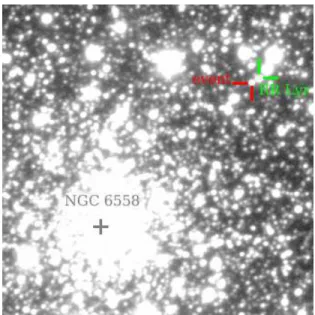
individ-ual lenses. By comparing this overall distance distribu-tion to the one restricted to events showing planetary signatures one can determine whether planets are more common in, for example, the Galactic disk or the bulge (Calchi Novati et al. 2015a; Yee et al. 2015). Among the 170 microlensing events observed during the 2015 cam-paign (Calchi Novati et al. 2015b), one event showed a potential for a very different probe of the “Galactic dis-tribution of planets”, namely of the frequency of planets in globular clusters (relative to disk or bulge stars). The event OGLE-2015-BLG-0448 lay projected against the globular cluster NGC 6558 (Fig. 1), and therefore the lens was potentially a member of this cluster. The lens mass is measured if one knows the relative lens-source parallax and the angular size of the Einstein ring ra-dius (Refsdal 1964). In the case of a globular cluster lens, one can in principle derive the lens mass based on the Einstein timescale measurement alone (knowing the
30
Astrophysics Research Institute, Liverpool John Moores University, Liverpool CH41 1LD, UK
31
South African Astronomical Observatory, PO Box 9, Observatory 7935, South Africa
32
European Southern Observatory, Karl-Schwarzschild-Str. 2, 85748 Garching bei M¨unchen, Germany
33
Sorbonne Universit´es, UPMC Univ Paris 6 et CNRS, UMR 7095, Institut d’Astrophysique de Paris, 98 bis bd Arago, 75014 Paris, France
34National Astronomical Observatories, Chinese Academy of Sciences, 100012 Beijing, China
35Istituto Nazionale di Fisica Nucleare, Sezione di Napoli, Napoli, Italy
36Royal Society University Research Fellow 37
Niels Bohr Institute, University of Copenhagen, Juliane Maries Vej 30, 2100 København Ø, Denmark
38
Meteorologisches Institut, Universit¨at Hamburg, Bun-desstraße 55, 20146 Hamburg, Germany
39
Max Planck Institute for Astronomy, K¨onigstuhl 17, 69117 Heidelberg, Germany
40
Astrophysics Group, Keele University, Staffordshire, ST5 5BG, UK
41
Yunnan Observatories, Chinese Academy of Sciences, Kunming 650011, China
42
Korea Astronomy & Space Science Institute, 776 Daedukdae-ro, Yuseong-gu, 305-348 Daejeon, Republic of Korea
43Jodrell Bank Centre for Astrophysics, School of Physics and Astronomy, University of Manchester, Oxford Road, Manchester M13 9PL, UK
44
Finnish Centre for Astronomy with ESO (FINCA), V¨ais¨al¨antie 20, FI-21500 Piikki¨o, Finland
45
Instituto de Astrof´ısica, Facultad de F´ısica, Pontificia Universidad Cat´olica de Chile, Av. Vicu˜na Mackenna 4860, 7820436 Macul, Santiago, Chile
46Department of Physics, Sharif University of Technology, PO Box 11155-9161 Tehran, Iran
47Stellar Astrophysics Centre, Department of Physics and Astronomy, Aarhus University, Ny Munkegade 120, 8000 Aarhus C, Denmark
48
Institut d’Astrophysique et de G´eophysique, All´ee du 6 Aoˆut 17, Sart Tilman, Bˆat. B5c, 4000 Li`ege, Belgium
49
Unidad de Astronom´ıa, Fac. de Ciencias B´asicas, Uni-versidad de Antofagasta, Avda. U. de Antofagasta 02800, Antofagasta, Chile
A
NPP fellow BSagan Fellow
Fig. 1.— Finding chart for OGLE-2015-BLG-0448. We marked the center of the globular cluster NGC 6558 (core radius and half-light radius of 0.′03 and 2.′15, respectively), the event (base-line brightness I = 16.34 mag), and the neighboring RR Lyr star OGLE-BLG-RRLYR-14873 (mean brightness I = 15.52 mag). North is up, East is left. The image is 1.′5 × 1.′5.
cluster distance and proper motion from the literature; Paczy´nski 1994). In reality, significant uncertainties are introduced by the dispersion of bulge source proper mo-tions that is comparable to the cluster proper motion.
Here we present a new method to determine whether the lens from a microlensing event seen projected against a cluster is in fact a cluster member, employing obser-vations of the Spitzer spacecraft as a “microlensing par-allax satellite”. The method is to compare the direc-tion of the heliocentric projected velocity ˜vhel with that of the proper motion of the cluster relative to the mi-crolensed source µcl,s. As is well known, ˜vhel can be
subject to a four-fold degeneracy in direction (Refsdal 1966; Gould 1994), but within those degenerate solutions can be very precisely measured by a parallax satellite (Calchi Novati et al. 2015a). Therefore, if µcl,s can also
be measured precisely, the hypothesis of the cluster lens can be tested with high precision.
The analyzed event was unusually sensitive to plan-ets, independent of the possibility that the lens might be a cluster member. First, the source star is a low-luminosity giant, meaning that photometry from both ground and space was unusually precise. Second, it reached magnification Amax ≈ 13 as seen from both
Earth and Spitzer. Such moderate magnification events are substantially more sensitive to planets than typi-cal events (Mao & Paczy´nski 1991; Gould & Loeb 1992). The combination of these factors led to relatively inten-sive monitoring from the ground and exceptionally in-tensive monitoring from Spitzer, which further increased the event’s planet sensitivity. We show that residuals for Spitzer data and point-lens model can be fitted with a Saturn-mass ratio double-lens model. We do not claim planet detection because Spitzer photometry of neigh-boring constant stars shows systematic trends that could mimic the planetary signal if superimposed on a purely point lens (Paczy´nski 1986) light curve. The only known planet in a globular cluster is in a system of white dwarf
and pulsar (Richer et al. 2003; Nascimbeni et al. 2012). The light curve of OGLE-2015-BLG-0448 is analyzed here for two different purposes: to measure the microlens parallax and to estimate the planet sensitivity. The avail-able ground-based data are survey observations by the Optical Gravitational Lens Experiment (OGLE) project and the follow-up observations taken by three groups: Microlensing Follow Up Network (µFUN), RoboNet, and Microlensing Network for the Detection of Small Terres-trial Exoplanets (MiNDSTEp). For parallax determina-tion we use only OGLE photometry; Survey long-term monitoring is crucial in deriving event timescale and par-allax. OGLE photometry is also well-characterized and systematic trends in the data are at a relatively low level. On the other hand, the planet sensitivity is the highest if many data points are taken close to the light curve maximum (Griest & Safizadeh 1998). The field including OGLE-2015-BLG-0448 is observed rarely by the OGLE survey, hence, the OGLE light curve does not contribute much to the planet sensitivity. The follow-up data give us much more information with this regard: they are taken from multiple sites allowing better time-coverage and reduced dependence on weather at a single site, and they can be also taken with much higher cadence because many telescopes are targeted on a single event. However, extending the event coverage by most of the follow-up observatories is not possible because of their limited re-sources or the chosen observing strategy. Additionally, many events get faint far from the peak and the smaller telescopes photometry in dense stellar region may be af-fected by systematic trends that could corrupt the mea-surements of the event timescale and parallax. Hence, the ground-based measurements of the event timescale and parallax are best done with the OGLE data only, but follow-up observations are included for the planet sensitivity calculations.
We describe the observations in Section 2. In Sec-tion 3 we analyze first the ground-based light curve alone and then the combined Spitzer and ground-based light curves. We measure the microlens parallax πE and the
closely related relative velocity projected on the observer plane ˜vhel, which are required to determine the lens lo-cation. In Section 4, we measure the proper motions of NGC 6558 and of the source star in the same frame of reference, which allows us to determine their relative proper motion, µcl,s. The fact that its direction is
in-consistent with that of ˜vhel proves that the lens is not in the cluster. Having eliminated this possibility, in Sec-tion 5, we demonstrate that the lens (host star) almost certainly lies in the Galactic bulge, implying that it is a low-mass star and that the tentative planet would there-fore be a cold Neptune. The planet sensitivity of the event, which will eventually be required for the determi-nation of the Galactic distribution of planets is analyzed in Section 6. We conclude in Section 7. We discuss the tentative planet detection in Appendix A.
2. OBSERVATIONS
2.1. OGLE Alert and Observations
On 2015 March 20, the OGLE survey alerted the com-munity to a new microlensing event OGLE-2015-BLG-0448 based on observations with the 1.4 deg2camera on
the 1.3m Warsaw Telescope at the Las Campanas
Ob-servatory in Chile (Udalski et al. 2015) using its Early Warning System (EWS) real-time event detection soft-ware (Udalski et al. 1994; Udalski 2003). Most OGLE observations were taken in the I band, and V band obser-vations are only used to determine the source properties. At equatorial coordinates (18h10m14.s38, − 31◦45′09.′′4),
Galactic coordinates (0.◦20, −6.◦01), this event lies in
the OGLE field BLG573, implying that it is observed at roughly once per two nights (cf. Fig. 15 from Udalski et al. 2015). We analyze 65 datapoints col-lected during the 2015 bulge season before HJD′ ≡
HJD − 2450000 = 7301.6 (Oct 6th) and supplement them
with 73 datapoints from 2014. To account for underes-timated uncertainties that are reported by the image-subtraction software we multiplied the uncertainties by a factor of 1.8, so that the point-lens parallax model re-sults in χ2/dof ≈ 1.
2.2. Spitzer Observations
OGLE-2015-BLG-0448 was announced by the Spitzer team as a target on 2015 May 19 UT 20:45 (HJD′ = 7162.4), about 2.5 weeks before the beginning of the 2015 Spitzer observations (proposal ID: 11006, PI: Gould) and 3.5 weeks before this particular object could be observed (HJD′ = 7187.1) due to Sun-angle restrictions. The
rea-son for this early alert was that the source was bright and appeared to be heading for relatively high magnification, making it relatively sensitive to planets. According to the protocols of Yee et al. (2015), planet detections (and sensitivity) can only be claimed for observations after the Spitzer public selection date (or if the event was later se-lected “objectively”, which was not possible for this event due to low OGLE cadence). Furthermore, without a pub-lic alert, the event would not have attracted attention for the intensive follow-up required to raise sensitivity to planets. The Spitzer cadence was set at once per day, and this cadence was followed during the second week of the campaign, when OGLE-2015-BLG-0448 came within Spitzer’s view.
However, the Yee et al. (2015) protocols also prescribe that once all specified observations are scheduled, any additional time should be allocated to events that are achieving relatively high magnification during the next week’s observing window, with the cadence of these events rank-ordered by the 1 σ lower limit of expected magnification. Based on this, OGLE-2015-BLG-0448 was slated for cadences of 4, 8, 8, and 4 per day dur-ing weeks 3, 4, 5, and 6, respectively. Due to the fact that it lay far to the east, OGLE-2015-BLG-0448 could be observed right to the end of the campaign at HJD′ = 7222.78. Altogether we collected 210 epochs, each consisting of six 30s dithers. The photometry was obtained with a modified version of Calchi Novati et al. (2015b) pipeline, which fits the centroid and brightness of every stars for each frame separately. The errorbars reported by this pipeline are a nearly linear function of the measured flux, hence, we assumed the errorbars are equal to the value of this linear function multiplied by the factor 4.3 that brings χ2/dof to 1 for the parallax
point source model.
2.3. µFUN Observations
As one of the few very bright Spitzer events, and one that was not intensively monitored by microlensing
sur-veys (and so required follow-up to achieve reasonable planet sensitivity), OGLE-2015-BLG-0448 was targeted by µFUN, including the following five small-aperture telescopes from Australia and New Zealand: the Auck-land Observatory 0.5m (R band), the Farm Cove vatory 0.36m (unfiltered, Pakuranga), the PEST Obser-vatory 0.3m (unfiltered, Perth), the Possum ObserObser-vatory 0.36m (unfiltered, Patutahi), and the Turitea Observa-tory 0.36m (R band, Palmerston North). µFUN also observed the event regularly using the dual ANDICAM optical/IR camera on the 1.3m SMARTS telescope at CTIO, Chile. Almost all the optical observations are in the I band. The IR observations are all in H but these are for source characterization and are not used in the fits. Follow-up photometric data were also taken by the Wise Collaboration on their 1.0m telescope at Mitzpe Ramon, Israel. A limited number of additional measurements were taken using two 0.7m MINiature Ex-oplanet Radial Velocity Array (MINERVA) telescopes at Mt. Hopkins, USA (Swift et al. 2015).
All µFUN data were reduced using DoPhot soft-ware (Schechter et al. 1993). The photometry of this event is hampered by an ab-type RR Lyrae vari-able OGLE-BLG-RRLYR-14873 (Kunder et al. 2008; Soszy´nski et al. 2011) that lies projected at 2.′′4 from the
event (Fig. 1), has I-band amplitude of 0.23 mag, and pe-riod of 0.67 d. Because DoPhot fits separately for the flux of each star at each epoch, it is ideally suited to remove the effects of this neighboring variable, even when the point spread functions (PSFs) of the two stars overlap, as they frequently do for the smaller µFUN telescopes. By contrast, plain vanilla image-subtraction algorithms fit only for variations centered at the source and so in-clude residuals from neighboring PSFs, if these overlap. Unfortunately, DoPhot failed to separately identify the source in PEST data and so these could not be used. Possum data showed unusual scatter and were also ex-cluded.
2.4. RoboNet Observations
RoboNet observed OGLE-2015-BLG-0448 from three Las Cumbres Observatory Global Telescope Network (LCOGT) sites in its southern hemisphere ring of 1.0m telescopes: CTIO/Chile, SAAO/South Africa, and Sid-ing SprSid-ing/Australia (Brown et al. 2013). Different tele-scopes at the same site are indicated as A, B, and C. Two CTIO telescopes (A and C) were equipped with the new generation of Sinistro imagers that consist of 4k × 4k Fairchild CCD-486 Bl CCDs and offer a field of view of 27′ × 27′. Other telescopes support SBIG
STX-16803 cameras with Kodak KAF-16803 front illu-minated 4k × 4k pix CCDs, used in bin 2 × 2 mode with a field of view of 15.8′ × 15.8′. All observations
were made using SDSS-i′ filters. Standard debiasing,
dark-subtraction, and flat fielding were performed for all datasets by the LCOGT Imaging Pipeline, after which Difference Image Analysis was conducted using the RoboNet Pipeline, which is based around DanDIA (Bramich 2008; Bramich et al. 2013).
LCOGT employed its TArget Prioritization algorithm (Hundertmark et al. 2015) to select a sub-set of events from the Spitzer target list based on their predicted sen-sitivity to planets, which were drawn from Spitzer tar-gets that fell in regions of lower survey observing cadence.
OGLE-2015-BLG-0448 was given priority because it fell within such a region, and due to the added scientific value of the proximity of the globular cluster.
2.5. MiNDSTEp Observations
The MiNDSTEp consortium observed OGLE-2015-BLG-0448 using the Danish 1.54 m telescope at ESOs La Silla Observatory, Chile and the 0.35m Schmidt-Cassegrain telescope at Salerno University Observatory, Italy. The Danish telescope provides two-colour Lucky Imaging photometry using an instrument consisting of two Andor iXon+ 897 EMCCDs with a dichroic split-ting of the signal at 655 nm into a red and a visual part, thereby collecting light from 466 nm to 655 nm (“ex-tended V ”) in the visual camera and from 655 nm to ap-proximately 1050 nm (“extended Z”) in the red sensitive camera. The camera covers a 45′′× 45′′ field of view
on the 512 × 512 pixel EMCCDs with a scale of 0.09 arcsec/pixel and were operated at a frame rate of 10 Hz and a gain of 300 e−/photon. On-line reductions and
off-line re-reductions were performed with the Odin software (Skottfelt et al. 2015), which is based on the DanDIA im-age subtraction and empirical PSF fitting. The Salerno data were taken in the I band with a SBIG ST-2000XM CCD, and the images were reduced using a locally devel-oped PSF fitting code. In total the Danish telescope has reported 148 V -band and 182 Z-band data points, and the Salerno University telescope 98 data points to the light curve of OGLE-2015-BLG-0448 with the data col-lection strategy informed and implemented by means of the ARTEMiS system (Automated Terrestrial Exoplanet Microlensing Search Dominik et al. 2008).
We phased the residuals from the preliminary model with the pulsation period of the nearby RR Lyr and found significant contamination in the case of Salerno as well as LCOGT CTIO A and SSO B data. To cor-rect for this contamination, we decomposed each of these datasets into source flux, blending flux, and scaled OGLE light curve of the RR Lyr. The contribution of the RR Lyr was then subtracted. Errorbars for every follow-up dataset were scaled so that χ2/dof ≈ 1.
3. LIGHTCURVE ANALYSIS
We begin by fitting a simple five parameter model: (t0, u0, tE, πE) to the OGLE data. Here (t0, u0, tE) are
the standard Paczy´nski (1986) parameters, i.e., time of maximum light, impact parameter (scaled to θE), and
Einstein timescale, all as seen from Earth. The remaining two parameters are the microlens parallax vector πE
πE≡ πrel θE µgeo µgeo; tE= θE µgeo, (1)
where θEis the angular Einstein radius
θ2 E≡ κM πrel; κ ≡ 4G c2AU ≃ 8.14 mas M⊙ , (2)
M is the lens mass, and πrel ≡ AU(D−1L − D −1 S ) and
µgeoare the lens-source relative parallax and proper mo-tion, respectively, the latter in the geocentric frame at the peak of the event as seen from the ground.
Ground-based parallax models suffer from a two-fold degeneracy in u0 (Smith et al. 2003). Table 1 presents
Fig. 2.— Point-lens fit (with parallax) to Spitzer and OGLE light curves of OGLE-2015-BLG-0448. The model (light blue line) fits the OGLE data (black points) quite well, but there are strong residuals in the Spitzer data (red points and dark blue line), par-ticularly near the start of the observations. The green line shows the planetary lens model for the Spitzer data, which is discussed in Appendix A. The green long-dashed line in the lower plot shows the difference between the Spitzer point-lens and double-lens models.
parameters of the models with u0 > 0 and u0 < 0 that
have almost the same χ2. We note that both models have
similar πE,E but slightly different πE,N, and πE,N > 0 at
2.2σ level. The fit to the OGLE data without parallax is worse by ∆χ2= 10.
After fitting the OGLE data with a point-lens model, we analyze the OGLE and Spitzer data jointly. The par-allax point-lens fit (Figure 2) shows significant systematic residuals in the Spitzer but not in the OGLE data. Such a possibility was anticipated by Gould & Horne (2013), who suggested that space-based parallax observations might uncover planets that are not detectable from the ground because the spacecraft probes a different part of the Einstein ring. However, it has never previously been observed.
The Spitzer residuals are qualitatively similar to those analyzed by Gaudi et al. (2002) for OGLE-1999-BUL-36. They found that this form of residuals could be explained either by a low mass-ratio companion (q ≪ 1) with pro-jected separation (normalized to θE) s < 1, or by light
curve distortions induced by the accelerated motion of the observer on Earth, i.e., orbital parallax (Gould 1992). However, in the present case, the latter explanation is ruled out because the parallax is measured (and already incorporated into the fit) from the offsets in the observed (t0, u0) as seen from Earth and Spitzer,
πE,±±≃ AU D⊥ (∆τ, ∆β±±); ∆τ ≡ t0,⊕− t0,sat tE ; (3)
∆β±±≡ ±u0,⊕− ±u0,sat.
Here, D⊥ is the Earth-satellite separation projected on
the sky (changes from 0.84 to 1.31 AU over the course of Spitzer observations) and where the subscripts ⊕ and
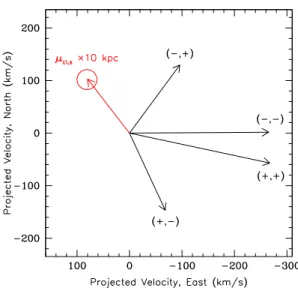
Fig. 3.— Comparison of directions of astrometrically measured µs,cl (red) with four degenerate projected velocities ˜vhel based on microlensing data. The proper motion measurement has been scaled by an arbitrary distance (10 kpc) so that it has the same units and approximately same size as the projected velocities. The direction of µs,clis inconsistent with any of the four ˜vhel. Hence, the lens does not belong to the cluster.
“sat” indicate parameters as measured from Earth and the satellite, respectively. The four solutions are speci-fied (±±) according to the signs of u0as seen from Earth
and Spitzer respectively. See Gould (2004) for sign con-ventions. Table 2 lists four possible solutions, including the heliocentric projected velocity,
˜
vhel= ˜vgeo+ v⊕,⊥; v˜geo= πE π2
E
AU
tE , (4)
where v⊕,⊥(N, E) = (−0.6, 28.3) km s−1 is the velocity
of Earth projected on the sky at the peak of the event. The (−+) solution is preferred over the other ones by ∆χ2 = 6.7 because OGLE data prefer π
E,N > 0 and
this solution has the highest πE,N. The comparison of
Tables 1 and 2 shows that the OGLE parallax measure-ment (that is based on slight light curve distortion) is consistent with the OGLE+Spitzer result (that is based on the difference in t0 and u0 between the two
observa-tories). Figure 3 displays the projected velocity vectors for these four solutions.
There are only three possible causes of Spitzer point-source point-lens residuals: a binary (or planetary) companion to the lens, a binary companion to the source, or an unmodeled systematics in the light curve. Binary-source explanations for the residuals are basically ruled out by the fact that no sign of source binarity is seen in the OGLE light curve. Of course, one possible explanation for the lack of binarity effects would be an extremely red source, which has so much less flux in I-band than in Spitzer ’s 3.6µm that it simply does not show up in the OGLE data. However, the source is a red giant, so there are very few stars on the color-magnitude diagram (CMD) that are significantly redder. For two of the solutions (++ and −−) in Table 2, the source follows the same trajectory as seen from Earth and Spitzer, just separated in time. Hence, binary-source solutions are obviously inconsistent with the OGLE data. For the
TABLE 1
OGLE-2015-BLG-0448 Point-Lens Parameters based on OGLE data Parameter Unit u0> 0 u0< 0 χ2 125.1 125.0 t0 day 7213.153 7213.153 ±0.016 ±0.016 u0 0.0874 −0.0876 ±0.0016 ±0.0017 tE day 61.23 60.83 ±0.84 ±0.95 πE,N 0.113 0.180 ±0.052 ±0.081 πE,E −0.104 −0.111 ±0.034 ±0.037 (Fb/Fbase)OGLE −0.002 −0.004 ±0.019 ±0.020
other two solutions, the second source could pass farther from the lens as seen from Earth compared to the Spitzer by a factor ≈ 1 + (u0,sat+ u0,⊕)/u0,sat′ ≈ 1 + 0.16/u0,sat′ where u0,sat′ is the impact parameter of the source’s companion as seen by the Spitzer. Given the slow development of the deviation, u0,sat′ & 0.1, implying that this ratio of impact parameters is . 2.6. The source is already close to the reddest stars on the CMD, hence, the amplitudes of deviation have to be similar to the ratio of impact parameters, which is clearly ruled out by the data. Notwithstanding these general arguments, we fit for binary-source solutions. We confirm that they are not viable. The binary lens models with planetary mass ratio are discussed in Appendix A.
4. PROPER MOTION MEASUREMENTS 4.1. NGC 6558 Proper Motion Measurements in
Literature
The first measurement of the NGC 6558 proper mo-tion was presented by V´asquez et al. (2013). Stars on the upper red giant branch (I < 16.5 mag) and bluer than bulge giants were selected as cluster members and the mean proper motion of these stars was reported: µcl(N, E) = (0.06±0.14, 0.52±0.14) masyr−1. The bluer red giants were chosen because the metallicity of the clus-ter stars is lower than the bulge red giants. Hence, clusclus-ter members on the giant branch are expected to be bluer. However, the bulge red giants show significant metallic-ity spread (Zoccali et al. 2008) and thus some bulge red giants can be mistaken for cluster members. Therefore, one expects the V´asquez et al. (2013) measurement to be biased toward smaller proper motion values. Addi-tionally, the cluster proper motion relative to the bulge could be underestimated because cluster members may have been included in the ensemble used to establish the “bulge” frame.
Rossi et al. (2015) published the only other NGC 6558 proper motion: µcl(N, E) = (0.47 ± 0.60, −0.12 ± 0.55) mas yr−1. In their approach cluster member
selec-tion and frame alignment (needed for any proper moselec-tion measurement) were combined into one iterative process. The CMD decomposed into cluster and field stars can be used to diagnose the reliability of this process. The most prominent cluster feature on the CMD is the blue horizontal branch defined by the stars of V > 16 and
(V − I) < 0.9. The decomposed CMDs for the cluster and the field reveal a very similar number of stars in this region, even though we do not expect field stars with these properties. The problems with decomposing blue horizontal branch stars suggests that the iterative pro-cess used to select cluster members and measure proper motions, failed in this case.
4.2. NGC 6558 Proper Motion Measurement From
OGLE-IV Data
We use two different methods to measure the proper motion of NGC 6558. In both cases, we make use of 5 years of OGLE-IV observations of this field. We first es-tablish a “Galactic bulge reference frame” by identifying red giant stars from the CMD on the chip where the clus-ter lies, but excluding a circle of radius 1.′52 around the
cluster itself52. We note that for the immediate purpose
of this paper, it is not important whether this reference frame is contaminated by non-bulge stars because we will measure the proper motion of the source in the same frame. However, the general utility of this measurement does require that this be the bulge frame, and the red giants are the best way to define this. Because the ref-erence frame is defined by 2000 stars whose dispersion is about 2.7 mas yr−1 in each direction, it is randomly
off-set from the “true bulge frame” by 0.06 mas yr−1in each
direction.
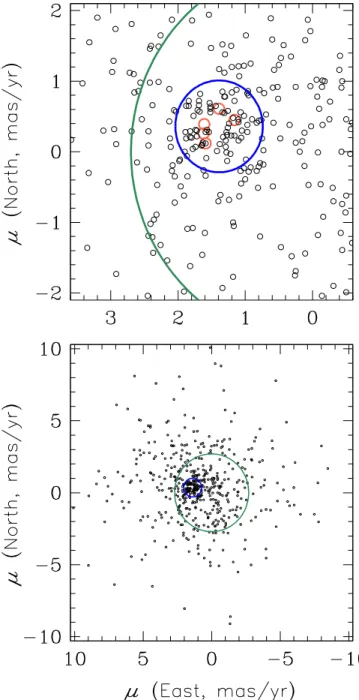
In the first method, we measure the proper motion of each star I < 18 mag within a radius of 0.′87 from
the cluster center. We fit the resulting distribution of 518 proper motion measurements to the sum of two two-dimensional Gaussians, described by a total of four pa-rameters, i.e., the cluster proper motion µcl, a single
isotropic “cluster” dispersion σcl (actually mostly due to
measurement error rather than intrinsic dispersion), and the fraction of all stars in the sample that belong to the cluster, p. The second Gaussian is assumed to have the same properties as the bulge population, i.e, a centroid at (0, 0) and a dispersion (2.7, 2.7) mas yr−1.
We find p = 24 ± 3%, σcl= 0.65 mas yr−1, and
µcl,1(N, E) = (+0.36±0.08, +1.39±0.08) masyr−1. (5) See Figure 4.
In the second method, we measure the proper mo-tions of five spectroscopically confirmed cluster members (Zoccali et al. 2008; Dias et al. 2015), and find
µcl,2(N, E) = (+0.37±0.08, +1.47±0.09) masyr−1, (6)
where the error is determined from the scatter. See the upper panel of Figure 4. Since these are consistent at the 1 σ, we combine the two measurements to obtain
µcl(N, E) = (+0.36 ± 0.06, +1.42 ± 0.06) mas yr−1. (7)
We remind the reader that these errors are relative to the frame, which is what is relevant to our current appli-cation. Since the frame itself has errors of 0.06 mas yr−1,
the total error in this value in the “true bulge frame” is 0.08 mas yr−1.
52
The NGC 6558 cluster core radius and half-light radius are 0.′03 and 2.′15, respectively. The cluster tidal radius is 102.50times the core radius (Harris 1996, 2010 edition). OGLE-2015-BLG-0448 lies 58.′′5 from the center.
Fig. 4.— Proper motions of stars within 0.′87 of the center of NGC 6558 based on OGLE-IV data. The distribution was fit to the sum of two Gaussians, one for the bulge, centered at (0,0) and with the known bulge dispersion σ = 2.7 mas yr−1(green cle), and the other with freely fit center and dispersion (blue cir-cle). This gives one measure of the cluster proper motion in the bulge frame µcl(N, E) = (+0.36 ± 0.08, +1.39 ± 0.08). In a second method, we take the average proper motion of five spectroscopi-cally confirmed cluster members (small red circles, upper zoomed panel only), which yields µcl(N, E) = (+0.33 ± 0.08, +1.49 ± 0.08). Since these are consistent, we combine them to yield Equation (7).
4.3. Proper Motion of Source Star
We measure the proper motion of the OGLE-2015-BLG-0448 source in the same frame:
µs(N, E) = (−1.81 ± 0.40, −0.27 ± 0.40) mas yr−1. (8) We estimate the error in two ways. First, we note that the two methods of measuring µcl revealed scatters of
0.65 mas yr−1 and 0.18 mas yr−1 for the two star
sam-ples with median brightness of I ≈ 17.2 mag and I ≈ 14.2 mag, respectively. Given that the OGLE-2015-BLG-0448 source has a baseline magnitude of Ibase = 16.34,
we adopt an intermediate value of 0.40 mas yr−1. Second,
substantial experience from regions where two OGLE fields overlap, shows that proper-motion errors are typi-cally at about this level for I ≈ 16.5 mag stars.
The relative proper motion between the cluster and the source-star is
µcl,s(N, E) = (+2.17±0.40, +1.69±0.40) masyr−1. (9)
4.4. Lens Is Not Cluster Member
We put the proper motion vector µcl,s (Equation (9))
on Figure 3 in order to test whether its direction is con-sistent with any of the lens-source projected velocities. Because µcl,s and ˜vhel have different units, µcl,s must
be multiplied by a dimensional quantity in order to be displayed on the same plot. We call this Drel for reasons
that will become clear. We have chosen Drel = 10 kpc
simply because the vectors are then roughly the same size. The µcl,s is clearly inconsistent with any of the
four values of ˜vhel, hence the lens is definitely not in the cluster.
However, if µcl,s had been consistent with one of the
˜
vhel, then the Drel required to make the two vectors in Figure 3 align would have provided an additional test for cluster membership. That is,
˜ vhel µl,s = AU πrel → Drel, (10)
where µl,s is the lens-source relative proper motion,
which for our purposes can be taken as identical to the cluster proper motion, because |µl,s−µcl,s| ≤ |µl−µcl| =
vl,cl/DL.0.2 mas yr−1. Here vl,clis the lens velocity in
the cluster frame.
If, for example, µcl,s had been in exactly the opposite
direction to the one measured, it would have been consis-tent in direction with ˜vhel,+−. Then, identifying the lens as in the cluster would have implied πrel,cl,s ≃ 100 µas.
This would have been an implausible value because the cluster is believed to be at D ≈ 7 kpc, i.e, πcl≈ 140 µas,
which would imply πs= 40 µas, i.e., DL= 25 kpc. That
is, the Drel required to align µcl,s and ˜vhel provides a
powerful consistency check on the identification of the lens as a cluster member.
5. LOCATION OF LENSING SYSTEM
For a large fraction of past planetary microlensing events, θE is measured from the finite source effects,
since the model then yields ρ = θ∗/θE and the
an-gular source radius θ∗ is easily measured (Yoo et al.
2004). Unfortunately, this event contains no caustic crossings or cusp approaches so this standard method cannot be applied. Calchi Novati et al. (2015a) showed that for events with measured parallaxes πE, the lens
distance (and hence the mass) could be estimated kine-matically, with relatively small error bars. However, of the 21 events analyzed there, all but one had pro-jected velocities that either were quite large ˜vhel >
700 km s−1 or were consistent in direction with Galactic
rotation. The first group are easily explained as Galac-tic bulge lenses πrel .0.02 mas, since µ = ˜vhelπrel/AU =
3 mas yr−1(˜v/700 km s−1)(π
rel/0.02 mas), which is a
typi-cal value for bulge lenses. The second group are easily ex-plained as lenses rotating with the Galactic disk, with the magnitude of ˜vhelgiving a rough kinematic distance
esti-mate πrel ≃ µsgrA∗AU/˜vhel and µsgrA∗ = 6.38 mas yr−1
is the proper motion of SgrA*. The one exception was OGLE-2014-BLG-0807, for which the favored solutions had ˜vhel ≈ 200 km s−1.
The best model (−+) in Table 2 has ˜vhel =
161.2(4) km s−1, while the models (++) and (−−) that
fit the data slightly worse, predict ˜vhel = 270 km s−1.
Neither of the ˜vhel vectors is aligned with Galactic disk rotation, hence there is a low probability that the lens is in the Galactic disk. The measured pro-jected velocity could be explained by a bulge lens if the lens-source relative parallax were larger than typical. The line of sight toward the event at Galactic coordinates (l, b) = (0.◦20, −6.◦01) crosses the two
arms of the bulge X-shaped structure (Nataf et al. 2010; McWilliam & Zoccali 2010; Gonzalez et al. 2015). Hence, it is possible that the lens is in the closer part of the bulge and the source is much further away and the relative parallax is higher than typical. Even in this case the ˜vhel = 270 km s−1 solutions would be preferred over
˜
vhel = 160 km s−1, i.e., contrary to the least-squares fits
to the OGLE data. In either case, the most probable lens location is in the closer part of the bulge.
6. PLANET SENSITIVITY
With peak magnifications of 11 (from ground) and 14 (from Spitzer ), and average cadences of 36 per day (ground-based survey plus follow-ups) and 6 per day (for Spitzer ), event OGLE-2015-BLG-0448 is among the Spitzer 2015 events that are most sensitive to planet per-turbations. Therefore, we present the planet sensitivity of this event here, it will also be required for the determi-nation of the Galactic distribution of planets, no matter whether the planet detection in this event is real or not. We compute the planet sensitivity of this event using the method that was first proposed by Rhie et al. (2000) and further developed by Yee et al. (2015) and Zhu et al. (2015) to include space-based observations. Details of the method can be found in the latter two references. In brief, we first measure the planet sensitivity S as a function of q and s. For each set of (q, s), we generate 300 planetary light curves that vary in angle between the source trajectory and the lens binary axis, α, but have other parameters fixed to the observed values. For each simulated light curve, we then find the best-fit single-lens model using the downhill simplex algorithm. The devi-ation between the simulated data and its best-fit single-lens model is quantified by χ2
SL. For a subjectively
cho-sen event, which is the case of OGLE-2015-BLG-0448, we first fit the simulated data that were released before the selection date tselectand find χ2SL,select. If χ2SL,select> 10,
we regard the injected planet as having been noticeable and thus reject this α; otherwise we compare χ2
SL from
the whole light curve with our pre-determined detection threshold, and consider the injected planet as detectable if χ2
SL> χ2threshold. The sensitivity S(q, s) is the fraction
of α values for which the planet is detectable. We as-sume ¨Opik’s law in s, i.e., a flat distribution of log s, and compute the integrated planet sensitivity S(q).
We adopt the following detection thresholds, which are more realistic than that used in Zhu et al. (2015): C1: χ2
SL > 300 and at least three consecutive data points
showing > 3 σ deviations; or C2: χ2
SL> 500. C1 is used
mainly to recognize sharp planetary anomalies. Some of these anomalies might not be treated as reliable detec-tions with only the current data, because of the low χ2
SL.
However, they are nevertheless significant enough to trig-ger the automatic anomaly detection software and/or at-tract human attentions, either of which would lead to dedicated follow-up observations of the anomalies and thus confirm these otherwise marginal detections. C2 as a supplement of C1 intends to capture the long-term weak distortions that may not show sharp deviations.
The calculation of planet sensitivity requires ρ as an in-put. Here we estimate ρ following the prescription given by Yee et al. (2015): ρ = θ∗/θE where θE = πrel/πE.
The parallax πE is well measured thanks to a
combi-nation of the OGLE and the Spitzer data, hence be-low we need to estimate only πrel and θ∗. The
lens-source relative parallax can be easily found under the assumption that the lens is in the closer arm of the X-shaped structure and the source is in the further arm. We follow Nataf et al. (2015) who in detail mod-eled properties of the X-shaped structure in OGLE-III fields. The two centroids of RC luminosity functions corrected for extinction are IRC1,0 = 14.210 mag and
IRC2,0= 14.715 mag for the event location (average
val-ues for fields BLG169 and BLG170). For absolute RC brightness of MI,RC= −0.12 mag the corresponding
dis-tances are 7.3 and 9.3 kpc, hence, πrel= 0.028 mas.
To calculate θ∗we assume the source I-band brightness
and (V −I) color are the same as the baseline object: Is=
16.337 mag and (V − I)s= 1.589 mag (Szyma´nski et al.
2011). This is justified because none of our models predicts significant blending. We corrected for extinc-tion using Nataf et al. (2013) extincextinc-tion maps and ob-tain: Is,0 = 15.711 mag and (V − I)s,0 = 1.046 mag.
This (V − I)s,0 corresponds to (V − K)s,0 = 2.419 mag
(Bessell & Brett 1988). The Kervella et al. (2004) color-surface brightness relation gives θ∗ = 3.4 µas. Finally,
ρ = θ∗πE/πrel = 0.019 and 0.011 for (−+) and (−−)
models, respectively.
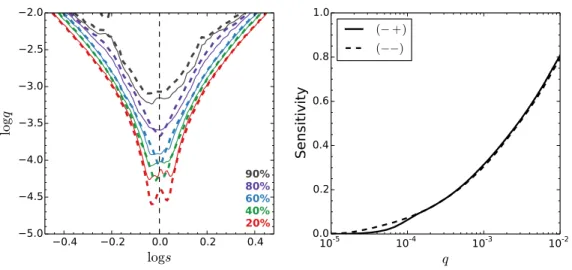
We plot all the ground-based data in Figure 5. The highest contribution to the planet sensitivity comes from the Auckland and LCOGT CTIO A datasets. We compute the planet sensitivity for two out of four possible solutions, (−−) and (−+), and show the results in Figure 6. Both solutions show substantial planet sensitivity (> 10%) down to q = 10−4. The
(−+) solution shows slightly higher sensitivity for q & 2 × 10⁻⁴, mostly because observations taken from
the satellite and Earth are probing different regions in the Einstein ring, as has been discussed in Zhu et al. (2015) and the reader can also see Figure 7 here for a demonstration. At smallest q values the (−+) solu-tion is less sensitive than the (−−) solusolu-tion, because the larger source size (ρ = 0.019) smears out subtle features due to small planets. Figure 7 shows the detectability of planets with mass ratio q = 1.70 × 10⁻⁴
as functions of planet positions for both investigated solutions. It is clear that the tentative planet detec-tion reported here can only happen in the (−+) soludetec-tion.
7. CONCLUSIONS
The event OGLE-2015-BLG-0448 presented a number of unique properties. It lay projected within tidal ra-dius of the globular cluster. The maximum magnification reached was relatively high both for Spitzer and ground-based observations. It was also intensively monitored both from the ground and from space. All these proper-ties made it a potential probe of the population of planets in globular clusters.
We analyzed the event photometry from both Spitzer and ground-based telescopes: the OGLE survey and follow-up networks of µFUN, RoboNet, and MiNDSTEp. Microlens parallax was measured using the difference in event properties as seen from ground and space. The result confirmed the microlens parallax measured using only the OGLE data. Additionally, long-term astrometry of OGLE images was used to measure proper motions. We measured the proper motion of globular cluster NGC 6558 and the event source. Our analysis reveals that the lens could not be a cluster member. The same methods can be used for other potential cluster lens events that are observed by satellites.
We found that the Spitzer light curve reveals signif-icant trends in residuals of the point-source point-lens model. The only two plausible causes of these trends are problems with Spitzer photometry or a planetary com-panion to the lens. We do not claim planet detection, but provide results of planetary model fitting in case the event photometry is proven correct.
The OGLE project has received funding from the National Science Centre, Poland, grant MAESTRO
2014/14/A/ST9/00121 to AU. Work by WZ and AG was supported by NSF AST 1516842. Work by YS & CBH was supported by an appointment to the NASA Postdoctoral Program at the Jet Propulsion Labora-tory, administered by Oak Ridge Associated Universi-ties through a contract with NASA. Work by JCY, AG, and SC was supported by JPL grant 1500811. Work by JCY was performed under contract with the Cali-fornia Institute of Technology (Caltech)/Jet Propulsion Laboratory (JPL) funded by NASA through the Sagan Fellowship Program executed by the NASA Exoplanet Science Institute. This publication was made possi-ble by NPRP grant # X-019-1-006 from the Qatar Na-tional Research Fund (a member of Qatar Foundation). Work by SM has been supported by the Strategic Prior-ity Research Program “The Emergence of Cosmological Structures” of the Chinese Academy of Sciences Grant No. XDB09000000, and by the National Natural Sci-ence Foundation of China (NSFC) under grant numbers 11333003 and 11390372. MPGH acknowledges support from the Villum Foundation. This work makes use of observations from the LCOGT network, which includes three SUPAscopes owned by the University of St An-drews. The RoboNet programme is an LCOGT Key Project using time allocations from the University of St Andrews, LCOGT and the University of Heidelberg together with time on the Liverpool Telescope through the Science and Technology Facilities Council (STFC), UK. This research has made use of the LCOGT Archive, which is operated by the California Institute of Technol-ogy, under contract with the Las Cumbres Observatory. Operation of the Danish 1.54m telescope at ESOs La Silla observatory was supported by The Danish Coun-cil for Independent Research, Natural Sciences, and by Centre for Star and Planet Formation.
APPENDIX TENTATIVE PLANET
The point source model fitted to the Spitzer data resulted in residuals with significant trends. Here we discuss the possibility that these residuals were caused by the companion to the lens.
The only possible binary-lens solutions must have planetary mass ratios q ≪ 1 and separations satisfying |s − s−1| ≈
0.5, i.e., log s ≈ ±0.11, which follows from simple arguments. First, the source passes the lens at u0 ≈ 0.08 as seen
from both Earth and Spitzer. Since neither light curve is perturbed at peak, this already implies that the central caustic is small. Such small central caustics require either s ≪ 1, s ≫ 1, and/or q ≪ 1. However, if either of the first two held, there could not be a significant perturbation at the point that it is observed at usat≈ 0.5. That is, the event
timescale tE≈ 60 days is set by the unperturbed OGLE light curve. Hence, the fact that the Spitzer curve experiences
an excess roughly 30 days before peak implies that there is a caustic structure at usat≈ 30/60 = 0.5.
Thus, q ≪ 1. In this planetary regime, such caustics occur when the planet is aligned to one of the two unperturbed images of the primary lens at u = |s − s−1|, i.e., s = | − u ± (u2+ 4)1/2|/2. Hence, | log s| ≈ 0.11.
Finally, the fact that the Spitzer light curve is perturbed while the OGLE light curve is not, implies (as in the above binary source analysis), that the source passes on opposite sides of the lens (+− or −+ solutions). The preference of (−+) in Table 2 makes it the best solution.
We consider four different topologies obeying the above constraints. First, s < 1 with the source (seen by Spitzer ) passing between the two triangular caustics for this topology. Second, s < 1 with the source passing outside one of these caustics. Third, s > 1. For each topology, we insert a series of seed solutions as a function of q and allow all parameters to vary. We find that the first and the third topologies never match the observed morphology of the Spitzer light curve because their relative demagnification zones do not align to the relative “dip” in the Spitzer light curve at about HJD′ = 7200. The second topology always converges to the same solution, which we present in Figure 8. The
model Spitzer light curve is shown in Figure 2 by green line. The single lens parameters are consistent with the (−+) solution in Table 2: t0 = 7213.161(14), u0= −0.0870(10), tE = 61.16(16) d, πE,N = 0.1140(12), πE,E = −0.1088(10),
and Fb/Fbase,OGLE = 0.002(11). The additional binary lens parameters are: α = 189.◦71(25), s = 0.7870(50), and
q = 1.70(32) × 10−4. The χ2/dof = 209.7/331 is better by χ2 = 127.7 than the point-lens solution, and better by
systematics seen in Spitzer residuals.
The light curve lacks close approach to the caustics, which is uncommon among published microlensing planets (Zhu et al. 2014). Without the caustic approach we are unable to constrain the source size relative to θE. We note
that Yee et al. (2013) found a planetary signal below the reliability threshold in MOA-2010-BLG-311 event that also lies close to a globular cluster (NGC 6553 in that case).
REFERENCES Bessell, M.S., & Brett, J.M. 1988, PASP, 100, 1134
Bramich, D.M. 2008, MNRAS, 386, L77. Bramich, D.M. et al, 2013, MNRAS, 428, 2275.
Brown, T.M., Baliber, N., Bianco, F.B. et al., 2013, PASP, 125, 1031
Calchi Novati, S., Gould, A., Udalski, A., et al., 2015a, ApJ, 804, 20
Calchi Novati, S., Gould, A., Yee, J.C., et al., 2015b, ApJ, 814, 92 Dias, B., Barbuy, B., Saviane, I., et al. 2015, A&A, 573, 13 Dominik, M., Horne, K., Allan, A., et al. 2008, AN, 329, 248 Dominik, M., Jørgensen, U.G., Rattenbury, N.J., et al. 2010, AN,
331, 671
Gaudi, B.S., Albrow, M.D., An, J., et al. 2002, ApJ, 566, 463 Gonzalez, O.A., Zoccali, M., Debattista, V.P., Alonso-Garc´ıa, J.,
Valenti, E. & Minniti, D. 2015, A&A, 583, L5 Gould, A. 1992, ApJ, 392, 442
Gould, A. 1994, ApJ, 421, L75 Gould, A. 2004, ApJ, 606, 319
Gould, A., Carey, S., & Yee, J. Galactic Distribution of Planets from Spitzer Microlens Parallaxes Spitzer Proposal ID#11006 Gould, A. & Horne, K. 2013, ApJ, 779, 28
Gould, A. & Loeb, A. 1992, ApJ, 396, 104 Griest, K. & Safizadeh, N. 1998, ApJ, 500, 37 Harris, W.E 1996, AJ, 112, 1487
Hundertmark, M.P.G. et al., 2015, in prep.
Kervella, P., Bersier, D., Mourard, D. et al. 2004, A&A, 428, 587 Kunder, A., Popowski, P., Cook, K.H., & Chaboyer, B. 2008, AJ,
135, 631
Mao, S., & Paczy´nski B. 1991, ApJ, 374, L37 McWilliam, A., & Zoccali, M. 2010, ApJ, 724, 1491
Nascimbeni, V., Bedin, L.R., Piotto, G., De Marchi, F., & Rich, R.M. 2012, A&A, 541, 144
Nataf, D.M., Udalski, A., Gould, A., Fouqu´e, P., & Stanek, K.Z. 2010, ApJ, 721, L28
Nataf, D.M., Gould, A., Fouqu´e, P. et al. 2013, ApJ, 769, 88 Nataf, D.M., Udalski, A., Skowron, J. et al. 2015, MNRAS, 447,
1535
Paczy´nski, B. 1986, ApJ, 304, 1
Paczy´nski, B. 1994, Acta Astron., 44, 235 Refsdal, S. 1966, MNRAS, 134, 315 Refsdal, S. 1964, MNRAS, 128, 295
Rhie, S.H., Bennett, D.P., Becker, A.C., et al. 2000, ApJ, 533, 378 Richer, H.B., Ibata, R., Fahlman, G.G., & Huber, M. 2003, ApJ,
597, 45
Rossi, L.J., Ortolani, S., Barbuy, B., Bica, E., & Bonfanti, A. 2015, MNRAS, 450, 3270
Schechter, P.L., Mateo, M., & Saha, A. 1993, PASP, 105, 1342 Skottfelt, J., Bramich, D. M., Hundertmark, M., et al. 2015,
A&A, 574, A54
Smith, M., Mao, S., & Paczy´nski, B. 2003, MNRAS, 339, 925 Soszy´nski, I., Dziembowski, W.A., Udalski, A., et al. 2011, Acta
Astron., 61, 1
Szyman´nski, M.K., Udalski, A., Soszy´nski., I., et al. 2011, Acta Astron., 61, 83
Swift, J.J., Bottom, M., Johnson, J.A., et al. 2015, JATIS, 1, 2 Udalski, A. 2003, Acta Astron., 53, 291
Udalski, A., Szyma´nski, M.K. & Szyma´nski, G. 2015, Acta Astron., 65, 1
Udalski, A., Szyma´nski, M., Ka lu˙zny, J., Kubiak, M., Mateo, M., Krzemi´nski, W., & Paczy´nski, B. 1994, Acta Astron., 44, 317 V´asquez, S., Zoccali, M., Hill, V., et al. 2013, A&A, 444, 91 Yee, J.C., Hung, L.-W., Bond, I.A., et al. 2013, ApJ, 769, 77 Yee, J.C., Gould, A., Beichman, C., et al. 2015, ApJ, 810, 155 Yoo, J., DePoy, D.L., Gal-Yam, A. et al. 2004, ApJ, 603, 139 Zhu, W., Penny, M., Mao, S., Gould, A., & Gendron, R. 2014,
ApJ, 788, 73
Zhu, W., Gould, A., Beichman, C., et al. 2015, ApJ, 814, 129 Zoccali, M., Hill, V., Lecureur, A., et al. 2008, A&A, 486, 177Z
TABLE 2
OGLE-2015-BLG-0448 Point-Lens Parameters based on OGLE and Spitzer data
Parameter Unit (++) (−−) (+−) (−+) χ2 346.5 344.1 380.3 337.4 t0 day 7213.135 7213.136 7213.116 7213.146 ±0.014 ±0.014 ±0.014 ±0.014 u0 0.0863 −0.0866 0.0853 −0.0874 ±0.0010 ±0.0010 ±0.0010 ±0.0010 tE day 61.91 61.68 62.51 61.02 ±0.51 ±0.51 ±0.52 ±0.51 πE,N −0.0174 0.0008 −0.1321 0.1142 ±0.0005 ±0.0005 ±0.0014 ±0.0012 πE,E −0.0912 −0.0956 −0.0870 −0.1088 ±0.0009 ±0.0009 ±0.0008 ±0.0010 (Fb/Fbase)OGLE 0.013 0.009 0.026 −0.002 ±0.011 ±0.011 ±0.011 ±0.011 ˜ vN,hel km s−1 −56.93 1.77 −146.84 129.67 ±1.30 ±1.22 ±0.41 ±0.36 ˜ vE,hel km s−1 −267.54 −265.28 −67.96 −95.78 ±0.80 ±0.85 ±0.37 ±0.41
Fig. 5.— Ground-based light curve of OGLE-2015-BLG-0448. Different colors represent different datasets. For clarity, the follow-up data were averaged in bins separately chosen for each dataset. The bins were set based on comparison of the uncertainty of the mean point and the change of the model brightness over the bin timespan. For each bin the uncertainty of the mean point is smaller than the maximum difference between the model brightness and the mean model value. There are 462 bins that are based on 1638 follow-up data points.
−0.4 −0.2 0.0 0.2 0.4 logs −5.0 −4.5 −4.0 −3.5 −3.0 −2.5 −2.0 log q 20% 40% 60% 80% 90% 10-5 10-4 10-3 10-2 q 0.0 0.2 0.4 0.6 0.8 1.0 Se nsi ti vi ty (− +) (−−)
Fig. 6.— Planet sensitivity results of OGLE-2015-BLG-0448. The sensitivity as a function of two parameters, S(q, s), is shown on the left panel, and on the right is shown the integrated sensitivity S(q) when a flat distribution of s in log s is assumed. In both panels we show the sensitivities of two solutions (−+) (solid) and (−−) (dashed).
−1 0 1 x −1 0 1 y (−−) −1 0 1 x (− +) Earth Spitzer 50 <χ2 < 100 100 <χ2 < 200 200 <χ2 < 500 500 <χ2 <1000 χ2 >1000
q =1.70 ×10
−4Fig. 7.— The χ2distributions of simulated OGLE-2015-BLG-0448 light curves with a q = 1.7 × 10⁻⁴planet placed at different positions (x, y). The left panel shows the result for the (−−) solution, and the right panel shows that for the (−+) solution. The black/red lines indicate the source trajectories as seen from Earth/Spitzer. The lens is placed at (0, 0), and the position of the tentative planet is shown as a filled gray dot. Note that the tentative planet could only be detected in the (−+) solution.
Fig. 8.— Source trajectory as seen from Spitzer (violet) and Earth (black). The central caustic is located at (θx, θy) = (0, 0) and two triangular planetary caustics are at θx/θE = s − 1/s ≈ −0.48. The circles indicate apparent source positions at the epoch when Spitzer and OGLE data were taken.