HAL Id: hal-01788422
https://hal.archives-ouvertes.fr/hal-01788422
Submitted on 5 Mar 2019HAL is a multi-disciplinary open access
archive for the deposit and dissemination of sci-entific research documents, whether they are pub-lished or not. The documents may come from teaching and research institutions in France or abroad, or from public or private research centers.
L’archive ouverte pluridisciplinaire HAL, est destinée au dépôt et à la diffusion de documents scientifiques de niveau recherche, publiés ou non, émanant des établissements d’enseignement et de recherche français ou étrangers, des laboratoires publics ou privés.
Optimization of infrared heating system for the
thermoforming process
Maxime Bordival, Sylvia Andrieu, Fabrice Schmidt, Yannick Le Maoult, Serge
Monteix
To cite this version:
Maxime Bordival, Sylvia Andrieu, Fabrice Schmidt, Yannick Le Maoult, Serge Monteix. Optimiza-tion of infrared heating system for the thermoforming process. ESAFORM 2005 -8th ESAFORM conference on material forming, Apr 2005, Cluj-Napoca, Romania. p.925-928. �hal-01788422�
1 INTRODUCTION
In a typical thermoforming process, a polymeric sheet is heated to its forming temperature and brought into contact with a mold of the desired shape. Owing to the low polymer thermal conductivity (0.29 W/m/K for PET), the heating step is performed using infrared lamps, which enable short thermoplastic sheet heating times. The final thickness of the part, and consequently the final product quality, is drastically controlled by the initial temperature distribution inside the sheet. For this reason, optimizing the heating stage is crucial in order to ensure an improved process control.
The thermal problem during thermoforming process results from a coupling of conductive, convective and radiative three-dimensional unsteady transfers. Moreover, the modelling of heating device, composed by different rows of lamps associated to reflectors, is complex. Thus, to find optimum process parameters, inverse methods are generally used.
1.1 Thermoforming optimization approaches
Different recent optimization process investigations have been studied by using commercial software such as POLYFLOW® [1] and T-SIM® [2]. Some investigators, as Wang and Nield [3], developed their own thermoforming simulation software. Both of these studies, based on mechanical stage simulation, focused on evaluating the possibility to obtain uniform thickness by controlling the initial polymer sheet temperature field. However, ovens parameters were not linked to the temperature distribution.
Duarte and Covas [4], and Throne [5], proposed algorithms to solve the inverse heating problem, in order to find the heater temperature pattern associated to a uniform sheet temperature field. Both of these studies were based on solving the one-dimensional unsteady heat conduction problem, using radiative and convective boundary conditions. As a conclusion, no inverse method has been used to find oven optimum geometric parameters.
ABSTRACT: Determining an optimum processing window in thermoforming process is critical in the aim of achieving high quality parts. The infrared heating step is crucial, the final thickness distribution of the thermoformed part being closely related to the initial temperature field inside the sheet. To reduce the time needed to dimension the heating device, an automatic optimization method of ovens geometric parameters has been developed. In a first time, a simple analytical model, coupled to a non linear constrain optimization method (Sequential Quadratic Programming), permits to find the best set of parameters, according to a cost function representing for example the heat flux uniformity. Then, with these optimized parameters, an accurate raytracing method is used to compute the irradiation resulting from the interaction between lamps and thermoplastic sheet. Finally, control volume method is implemented to solve the three dimensional transient heat transfer equation, where the radiation source is approximated by a diffusion Rosseland model. Key words: thermoforming process, infrared heating, control volume method, raytracing method, Rosseland model, SQP optimization.
Optimization of infrared heating system for the thermoforming process
M. Bordival
1, F.M. Schmidt
1, Y. Le Maoult
1, S. Monteix
2 1CROMeP -Ecole des Mines d’Albi CarmauxCampus Jarlard - 81000 Albi, France
URL: www.enstimac.fr e-mail: [email protected]; [email protected]
2Philips Lighting
Chem Montrichard - 54700 Pont a Mousson, France
URL: www.lighting.philips.com e-mail: [email protected]
ABSTRACT: Determining an optimum processing window in thermoforming process is critical in the aim of achieving high quality parts. The infrared heating step is crucial, the final thickness distribution of the thermoformed part being closely related to the initial temperature field inside the sheet. To reduce the time needed to design the heating device, an automatic optimization method of ovens geometric parameters has been developed. In a first time, an analytical model, coupled to a non linear constrain optimization method (Sequential Quadratic Programming), permits to find the best set of parameters, according to a cost function representing for example the heat flux uniformity. Then, with these optimized parameters, an accurate raytracing method is used to compute the irradiation resulting from the interaction between lamps and thermoplastic sheet. Finally, control-volume method is implemented to solve the three-dimensional transient heat transfer equation, where the radiation absorption is approximated by the diffusion Rosseland model. Key words: thermoforming process, infrared lamp, radiative heat transfer, control-volume method, raytracing method, Rosseland model, SQP optimisation.
Optimization of infrared heating system for the thermoforming process
M. Bordival
1, S. Andrieu
1, F.M. Schmidt
1, Y. Le Maoult
1, S. Monteix
2 1CROMeP -Ecole des Mines d’Albi CarmauxCampus Jarlard - 81000 Albi, France
URL: www.enstimac.fr e-mail: [email protected]; [email protected]
[email protected]; [email protected]
2Philips Lighting
Chem. Montrichard - 54700 Pont à Mousson, France
1.2 Goals of the present study
We propose an inverse method, permitting to optimize the oven geometry, and to obtain a three-dimensional temperature pattern at the end of the heating stage. This method can be decomposed into three coupling steps:
• Optimization of the heat flux over the sheet
surface, using an analytical model coupled to a non linear constrain optimization method (Sequential Quadratic Programming). The goal is to find the best set of oven geometric parameters.
• Accurate simulation of radiative transfers, based
on raytracing method, with optimized parameters obtained in the first step.
• Computation of the 3D temperature pattern, using
THERMORAY, a heat transfers solver (developed in CROMeP [6]) based on control-volume method. The absorption of the irradiation calculated in the second step, is approximated using the Rosseland model.
2 HEAT BALANCE EQUATION
In its classical form, the heat balance equation can be written as: ) .( ) .( ) .( ) .(→ −∇ → =∇ ∇→ −∇ → ∇ = c r r p dt q q k T q dT c ρ (1)
where T = temperature, qc = conduction heat flux,
qr = radiation heat flux, ρ = density, cp = specific
heat, k = thermal conductivity. To compute the temperature distribution through the thickness of the sheet, this equation is solved using a 3D control-volume software, named THERMORAY [6].
2.1 Control-volume method
The sheet is meshed using cubic or hexahedral elements called control volumes. The equation (1) is integrated over each control volume and over the time from t to t+∆t: dt d n q dt d n q dt d t T c t e r t e c t e p ∂ Ω =+ Γ − Γ ∂ ∆ Γ → → ∆ Γ → → ∆ Ω ) . ( ) . (
ρ
(2)where
Ω
e = control volume. The unknown temperaturesare computed at the cell centres of each element. Different ways exist to approximate the radiation heat flux absorption. One of them is the Rosseland model.
2.2 Rosseland approximation
This method allows to approximate the irradiation absorption. Though it avoids long computation times, it is reserved to optically thick media [7]. The main idea of this approximation is to consider that the irradiation is diffused inside the medium. Thus, the heat balance equation is solved in a pure conduction approach; in other words, the radiation heat flux reduces to:
∇ ∇
− =
∇.(→qr) . kRoss (T)→T (3)
Optical properties inside the polymer are taken into account via the Rosseland conductivity defined as:
3 ) ( 3 16 T T K k Ross Ross =
σ
(4)where
σ
= Stefan-Boltzmann constant, Kross =Rosseland mean coefficient obtained versus temperature by integration over the frequency:
ν ν ν ν ν κ d dT T dB d dT T dB T KRoss ∞ ∞ × = 0 0 ( , ) 1 ) , ( ) ( 1 ) ( 1 (5)
where
κ
= absorption coefficient,ν
= frequency, B = black body intensity (Planck function).2.3 Raytracing method
In order to compute the irradiance, a raytracing method has been implemented [8]. This method permits to model accurately the IR lamps, taking into account emitters geometry and optical properties, which depend on temperature and frequency, as well as back reflectors.
2.4 Analytical model
Raytracing method is very accurate. Unfortunately, it is also very slow. In order to reduce the time consumed by the optimisation step, an analytical model is used. It is based on the expression of the irradiance of a surface element, from an isotropic emitter point. Meshing Nl lamps in Ns elements, and using irradiance additive property, the irradiance E on a rectangular sheet element is given by (6).
[
+]
= NL S i N j ij ij ij ij x H H P E 2 3 2 2 4 1 π (6)Where Pij = power emitted by each source point, and
Hij, xij defined as shown in figure 1.
Fig. 1. Analytical model: adopted notations.
3 INFRARED OVEN OPTIMIZATION
The analytical computation of irradiance is coupled to an optimization method, to automatically modify oven geometric parameters at each iteration, as shown in figure 2. The problem being non linear, continuous, and constrained, an adapted Sequential Quadratic Programming method is used in Matlab® [9].
Fig. 2. Heat transfer simulation / optimization coupling.
3.1 Cost function
The optimisation objective is mathematically represented by a cost function F to minimize, function of oven geometric parameters X. We propose to establish the function (7) related to radiation heat flux uniformity at the surface of the sheet, and to a desired mean value of irradiance.
OBJ OBJ E E X E X X F( )= 0.5 (0 )+0.5 ( ( )− ) σ σ (7) 2 , ) ( 1 ) ( = n − j i ij E E n X with σ (8)
where E(X) = mean irradiance computed at each iteration, EOBJ = desired mean irradiance,
σ
(X) =standard deviation of computed irradiances at each iteration,
σ
0 = standard deviation of computedirradiances with initial conditions, n = number of sheet surface elements. This function permits to obtain not only a uniform irradiance field, but a desired mean value of irradiance too.
3.2 Parameters
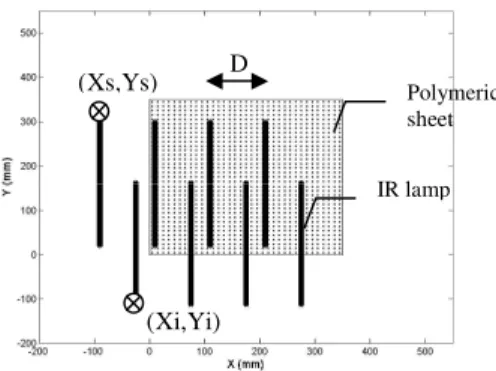
Both process and geometric parameters can be included in the optimisation. In this study, we focus on geometry only. Parameters concerned are: IR lamps positions for the two rows (Xs, Ys, Xi, Yi), the
distance between lamps and sheet (H), and the distance between lamps (D), as shown in figure 3.
Fig. 3. Adopted configuration / parameters notation.
3.3 Constraints
Geometric parameters are bounded. For example the distance between lamps must be greater than 20 mm, not to damage IR lamps. These constraints can be expressed as inequality relations between several parameters. For example: Xs + 3D < 550.
4 APPLICATION
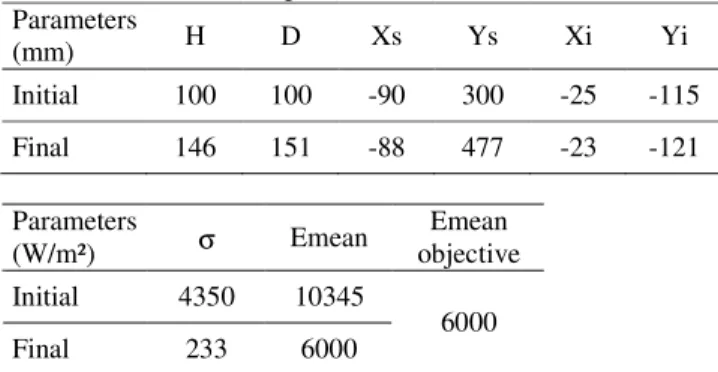
The method developed is used to optimize the geometry of an oven constituted of eight lamps Philips 1 KW clear, according to the cost function (7). The objective mean value of irradiance is 6000 W/m². Dimensions of the PSB (PolyStyrene Black) sheet are: 350x350x2 mm. It is meshed into 1225 rectangular elements. Results are reported in table 1.
Analytical Model Irradiance field over the Sheet
Cost Function Computation Sequentiel Quadratic Programming Optimum ? Initial Process
Parameters Geometry Initial
Sheet and Infrared Lamps Meshing
Updated Process Parameters Updated Geometry Optimized parameters Raytracing / control-volume method Temperature field No Yes
Non participative medium
Hij Xij dS d Isotropic emitter (Xs,Ys) D Polymeric sheet IR lamp (Xi,Yi)
Table1. Initial and final parameters Parameters
(mm) H D Xs Ys Xi Yi Initial 100 100 -90 300 -25 -115 Final 146 151 -88 477 -23 -121
CPU time: 385 s (AMD Athlon XP 2600+, RAM: 500 Mo). Number of iterations: 26.
For the raytracing, 563 million of rays are followed. The value of the convective coefficient, applied at sheet surface during heating stage, is 15 W/m²K. The value of the PSB thermal diffusivity is 1.92 .10-7
m²/s.
Fig. 4. Front surface temperature distribution after 15 s heating. Initial and updated oven geometry.
Fig. 5. Convergence curve.
As it is shown in figures 4, a more homogeneous temperature distribution over the sheet surface is obtained using updated oven geometry, even after 15 s heating. The maximum temperature difference is around 3°C.
5 CONCLUSIONS
A complete numerical model of the heating stage has been developed. Using THERMORAY, a control-volume software, and the raytracing method, the 3D heat balance equation is solved with convective and radiative boundary conditions. The irradiation absorption is approximated by the Rosseland model. Concerning the optimization, the SQP algorithm coupled to an analytical model, permits to design optimally ovens geometry, in order to increase the surface temperature uniformity. The future work will consist in taking into account reflectors in optimization, which are generally used to increase the process efficacy. Moreover it is crucial to enlarge the model to optically thin media, and thus, to compute the irradiation absorption using a more accurate method.
ACKNOWLEDGEMENTS
This study was funded and supported by Philips, Lighting Division.
REFERENCES
1. T.M. Marchal, Optimization of the Thermoforming Process: A Few Industrial Examples, In: SPE Annual
Technical Conference - ANTEC’98, Brookfield (1998)
701-707.
2. P. Novotny, P. Saha and K. Kouba, Optimization of Thermoforming, In: SPE Annual Technical Conference -
ANTEC’99, Brookfield (1999) 841-844.
3. C. -H. Wang and H.F. Nield, Temperature Optimization for improved Thickness Control in Thermoforming, In:
Journal of Materials Processing & Manufacturing Science.8 (1999) 113-126.
4. F.M. Duarte and J.A. Covas, Heating Thermoplastic sheets for Thermoforming Solution to Direct and Inverse Problems, Plastics, Rubber and Composites Processing
and Applications.26 (1997) 213-221.
5. J.L. Throne, Radiant Heat Transfer in Thermoforming, In:
SPE Annual Technical Conference - ANTEC’95,
Brookfield (1995) 510-821.
6. S. Monteix, F.M. Schmidt and Y. Le Maoult, Experimental Study and Numerical Simulation of Preform or Sheet Exposed to Infrared Radiative Heating, In: Journal of Materials Processing Technology.119, (2001) 90-97.
7. M. Modest, Radiative Heat Transfer, McGraw-Hill, Inc (1993).
8. S. Cai, Development and application of Radiative Heat
Transfer using raytracing method, Ecole des Mines de
Paris (1992).
9. Optimization Toolbox For Use With Matlab, The MathWorks (2002), User’s Guide, Version2.
Parameters
(W/m²) σ Emean objective Emean Initial 4350 10345
Final 233 6000 6000
Initial Final