OATAO is an open access repository that collects the work of Toulouse
researchers and makes it freely available over the web where possible
Any correspondence concerning this service should be sent
to the repository administrator:
[email protected]
This is an author’s version published in:
https://oatao.univ-toulouse.fr/22308
To cite this version:
Panzoli, David and Pons Lelardeux, Catherine and Lagarrigue,
Pierre Communication and knowledge sharing in immersive
learning games. (2015) In: 7th International Conference on Games
and Virtual Worlds for Serious Applications (VS-Games 2015), 16
September 2015 - 18 September 2015 (Skövde, Sweden).
Communication and knowledge sharing in
an immersive learning game
David Panzoli
∗†§, Catherine Pons-Lelardeux
∗§and Pierre Lagarrigue
∗‡§ ∗CUFR Jean-Franc¸ois Champollion, Albi, FranceEmail: [email protected]
†IRIT UMR 5505, Toulouse, France ‡Institut Cl´ement Ader EA 814, Toulouse, France
§Serious Game Research Network
Abstract—Learning games are becoming a serious contender to real-life simulations for professional training, particularly in highly technical jobs where their cost-effectiveness is a sizeable asset. The most appreciated feature of a learning game is to provide in an automatic way to each learner an integrated feedback in real time during the game and, ideally, a personally meaningful debriefing at the end of each session. Immersive learning games use virtual reality and 3D environments to allow several learners at once to collaborate in the most natural way. Managing the communication on the other hand has proven so far a more difficult problem to overcome. In this article, we present a communication system designed to be used in immersive learning games. This innovative system is neither based on voice-chat nor branching dialogues but on the idea that pieces of information can be manipulated as tangible objects in a virtual environment. This system endeavours to offer the simplest and most intuitive way for several learners to acquire and share knowledge in an immersive virtual environment while complying with the requirements of a reliable assessment of their performance. A first experiment with nurse anaesthetist students gives evidence that this simple communication system is apt to support lifelike behaviours such as consultation, debate, conflict or irritation.
Keywords—Immersive learning game, collaborative environ-ment, data modelling.
I. CONTEXT AND RELATED WORK
The 3D Virtual Operating Room project [1] (3DVOR) is a serious game dedicated to improving the communication inside the operating room between the surgeon, the nursing staff and the anaesthetist. Miscommunication accounts for a high percentage of the different failures arising during a surgery [2] and likely to provoke irreparable injuries to the patient, or death. 3DVOR is a collaborative and immersive experience, where the learners are expected to follow the procedures of a surgery (protocols, checklists, etc.) from the admission of the patient until their transfer into the recovery room. Doing so, the objective of the game is to highlight the importance of sharing knowledge and maintaining a good assessment of the current situation for the decision-making to be effective and efficient, even in emergency situations.
3DVOR is set in a realistic environment where several locations (OR, pre- and post-operating rooms) have been carefully modelled and furnished. All along a game session, the game spies on the users and records every bit of their activity in order to guide them through the scenario and deliver a debriefing at the end of the game. The interaction
model proposed by the game to the users is very typical. Users are presented with a first-person perspective of the environment which reflects realistically the actual locations of the surgeon, the nurse or the anaesthetist. The player is not enabled to move but the environment can be scrolled left or right, simulating the head movements. Objects and other characters can be interacted with by means of predefined actions and interactions (open/close a drawer, power on/off an appliance, read a document, ask something to someone, and so on). Upon being clicked, an object displays a specific contextual menu listing the interactions as textual labels. Clicking on a label triggers the corresponding interaction, which is expected to have an impact on the environment and possibly entail further interactions. Unlike the interactions, the communications between users, however, is nothing typical and has necessitated the design of an innovative system.
Traditionally in games, communication systems must com-promise between traceability and naturalness.
The most natural communication system that comes to mind is natural explicit communication outside of the game, meaning talking to each other. Voice-chatting through headset and microphone is a very common way to let people commu-nicate. Besides, this interface makes it easy for the game to record the communications. However, understanding natural language is far from trivial for a computer, let alone under-standing the context and the meaning of each utterance. Natural language understanding (NLU) is still considered prone to recurring failures, and therefore traceability is compromised. As a result, most games focusing on communication skills and team-working knowledgeably use a voice-chat system and give up on the possibility to automate – even partially – the debriefing. This is the case for Clinispace [3] (Innovation in Learning Inc.) and 3DiTeams [4] (Duke Medical Center and Virtual Heroes), two learning games for healthcare training inside which the human supervisor must be part of the game in order to listen to the conversation and use them for debriefing the players once the session is over. In spite of the difficulty, one successful usage of NLU in a game must be noted, in the game Fac¸ade [5], where the player can talk naturally to the non-playing characters (NPCs) and would get an appropriate response most of the time. This suggests that such a system could as well be used for debriefing a game session, how-ever unreliably. Besides, related domains of application like embodied conversational agents, which are virtual agents able
to demonstrate verbal and non-verbal communication [6], and conversational intelligent tutoring systems [7] have reported significant advances in natural language processing techniques, and the benefits of using them are increasingly advocated [8]. Chat systems are easier to manage since the voice recogni-tion stage is unnecessary. However, understanding the content remains as much a problem. Moreover, chat is less natural, less efficient, since at least voice-chat keeps the hand of the player free for actually playing the game. Chat systems are nonetheless very common in games. Historically, Lucasfilm’s Habitat [9] was the first game to allow multiple human players to communicate in a shared virtual environment via text-chatting. In second life, a chat console is at hand for the players to communicate with each other or with chat-bots. Chat-bots are virtual characters controlled by a script and whose answers are based on the syntactic analysis (i.e. parsing keywords) of the learner’s utterances. For instance, in the Indiana University Medical School Virtual Clinic [10], one can converse with a virtual patient in order to investigate their condition and formulate a diagnosis.
The pinnacle of traceability in games consists in using dialogue trees. In a dialogue tree, every utterance, question or answer is scripted in a tree-like structure. The system is very common in single-player adventure games to design the dialogues between the player and a non-playing character. Each line of dialogue from the NPC calls for several responses from the player, each of which continues the dialogue the same way a tree is being explored by an algorithm. Obviously, the drawback of this technique is the work required to think ahead and write every line of dialogue. This is even more complex when both the interlocutors must be proposed several choices. Therefore, in a multi-player context, not only is the task Herculean but it seems near-impossible to provide for every discussion that the players are likely to engage in, even in a controlled context where the topics of discussion are controlled. Despite the limitations of this technique, traceability is optimal since the objects manipulated have been designed in advance and are therefore known and easily recorded. Predefined dialogues are therefore frequently in use in learning games, provided adequate authoring tools are resorted to in order to ease the writing [11].
The fact is unquestionable that in a collaborative and team-working-focused learning game, communication between the learners is a feature that cannot be put aside. The requirements of such a communication system are defined as follows: Firstly, the ways of communication must be intuitive enough for the learners to engage in conversations naturally; Secondly, every information shared must also be easily captured and understood by the game so as to deliver the most relevant feedback to the learners individually or to the team as a whole; Thirdly, in a collaborative learning game, NPCs are likely to be resorted to to replace missing players or to play uninteresting roles, educationally-wise [12]. Those NPCs must be considered as fully equal partners (FEPs) [13]. Therefore, not only must they be in capability to understand the communications of the learners as much as their actions, but they must as well be able to participate in those communications.
In this paper, we describe a communication system which attempts to mimic the way information is shared and spread
in a group, although restricted to a very specific context. The system has been designed with the goal of being the simplest and the most usable model able to comply with the above-mentioned requirements. As a consequence, the reader must keep in mind that the system has been deliberately designed to present some limitations with respect to how communication is usually understood in a general context. Particularly, the communication system presented in this paper does not intend to simulate natural communication, either verbal nor non-verbal. In concrete terms, we define communication in this research as a set of means and skills to acquire, share and use knowledge related to the training activity and the game objectives. The next section describes the data model of the virtual interactive environment. The knowledge used for the players to communicate is grounded on this data model.
II. THE INTERACTIVE ENVIRONMENT
The game (illustrated in Fig. 2) runs on a web browser and is merely controlled using a mouse. Although each player sees and interacts with a subjective view of the scene, depending on their avatar’s location inside the environment, the data model of the environment is centralised and hosted on a server. Recent technologies (Node.js and socket.io) allows for the application to run in real-time and interactions undertaken by each player are sent to the server which performs adequate changes in the model and broadcast them onto each user’s client applications within milliseconds. This allows several players to carry out collaborative sequences of actions in real time and very naturally.
The model of the virtual environment has been described in details in [14]. Synthetically, the environment is represented as a set of objects, each of which being itself represented by a set of attributes. Attributes refer to variable features of the objects which can take several values (on/off, open/closed, wrapped/unwrapped, full/empty, dead/alive and so on). For practical reasons, the value of an attribute is a boolean. For instance, ECG.on=true means the ECG (object) is powered on. Attributes may refer to visual or functional features so that objects inside the environment can be displayed differently depending on the values of (some of) their attributes. Attributes can be changed by the users by means of interactions. Inter-actions are presented to the player as labels on a contextual menu displayed when the object is clicked. Interactions can be allowed or not depending on preconditions that must be evaluated in real time when the contextual menu is requested by the player on an object.
The model has proved to work reliably in single- and multi-player mode, allowing for multiple multi-player’s collaboration while successfully managing to maintain an up-to-date and consistent “state” of the environment for each player. In the next sections, we demonstrate that the model also caters for the content of the communications between the players.
III. COMMUNICATION MANAGEMENT
The specifications for the communication system were established keeping in mind the critical requirement for the game to analyse the communications and their content in an automated way. The communication system was also thought in accordance with the skills of the audience targeted by the
TABLE I. APIECE OF INFORMATION CAN BE PRESENTED DIFFERENTLY FOLLOWING THE CONTEXT.
information : Patient.anxious context label
positive The patient is anxious. negative The patient is calm.
inspect Evaluate the anxiety of the patient. request Is the patient anxious?
game. A preliminary unpublished study showed that surgeons, doctors, nurses and medical students were mostly unfamiliar with computer games and uncomfortable with exotic set-ups like mouse-following point-of-view or keyboard and mouse combination. A modelling choice was made to keep the communications as simple to use as the interactions, that is to develop a system where only a mouse was required. The system is based on two principles: giving information a “virtually tangible” representation for the players to see, grasp and manipulate it like objects in the environment, and providing a new set of interactions for manipulating informa-tion and knowledge. This way, we understand communicainforma-tion, in the context of a learning game, as an uninterrupted flow of matter-specific information circulating among the players. Uncontextual communication like small talking is obviously out of the scope of this definition.
A. Information representation
Pieces of information allowed in the game for learners to communicate are facts about the environment. Facts, straight-forwardly issued from the objects, are pairs of attribute/value, meaning that every attribute from every object is likely to be used as information. For instance, ECG.on=true and patient.asleep=false both represent information (the ECG is powered on; the patient is awake). For the sake of intelligibility, a piece of information is associated to a label before being displayed to the player. Depending on the context, one piece information can be translated into four different labels. There are 4 contexts: when the value is true (positive information) or false (opposite information), when the value is unknown (must-be-inspected information) and when the piece of information is meant as a question (request information). For instance, Table I lists the different meanings associated to the attribute Patient.anxious depending on these contexts.
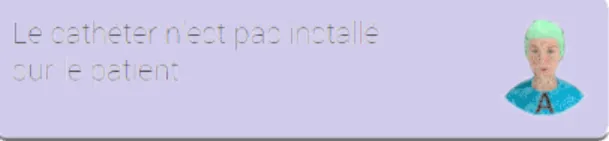
Inside the virtual environment, every piece of information is represented as a floating bubble where the label is displayed (illustration in Fig.1) along with the source(s) or sender(s) of the information which are depicted by thumbnails representing the corresponding characters. The background colour of the bubble also gives a hint regarding what or whom is concerned by the information. Table II lists the colours used in the game.
Fig. 1. An information bubble representing ‘the catheter is not installed on the patient” which was sent to the player by the anaesthetist nurse.
The bubbles are listed on a specific panel on the right and fittingly named the memory panel since it holds every piece of
TABLE II. COLOURS ARE ASSOCIATED TO INFORMATION BUBBLES IN ORDER TO HELP THE PLAYER DURING THE RETRIEVAL PROCESS
color meaning
blue information concerns the patient
green information concerns a conversation involving the patient violet information is about an equipment
yellow information refers to a vote
orange information refers to a document or a field within a document
knowledge known by the learner (in the context of the game obviously). Incoming information bubbles pile down in the memory list so that the most recent are on top, in direct sight of the player, whereas the least recent are quickly pushed down the hidden zone of the scrollbar. This mechanism has two interesting properties with regards to the game educational objectives. Firstly, only the most recent information is at hand of the player for quickly sharing with team-mates or using in the environment. The knowledge of the procedures is therefore a valuable asset for anticipating the importance of each information and being one step ahead of the team, which in a collaborative training context is a rewarded behaviour. Secondly, the large amount of bubbles continuously piling down the list makes it time consuming to scroll and seek a piece of information within less recent knowledge. Filters have been designed in order to facilitate the retrieval of a specific piece of information on the basis of contextual cues given by the player. Indeed, knowledge in memory can be filtered by means of ticking check-boxes (filtering on the roles involved) and/or pointing at the objects in the environment (filtering on the object concerned). The ability to identify the context of the information needed (by whom was it sent, whom or what object was concerned, etc.) and to use the filters adequately is another rewarded skill helping improve the performance of the learner.
Playing the game, the team of learners will be given the opportunity to explore several scenarios, all of which are dealing with hazardous and adverse situations that can be avoided or recovered by an efficient communication. Besides a good knowledge of the protocols, the patient safety in the operating room is tied to a handful of good practices: to collect information from the environment (objects, team-mates) in order to maintain an up-to-date knowledge of the current situation; when made aware of a new information, to be able to assess how important it is to each other team-mate (with regard to their occupation in the OR) and share the information accordingly; and finally, to refer to one’s knowledge of the situation when a collaborative decision needs to be made. For every one of these tasks, an interaction was designed and implemented.
B. Gathering information
Information can be collected from the objects (furniture, medical equipment, documents) or from the other players (see next section). To collect a piece of information from an object, the player has to click on it in order to display the contextual menu. Inside the menu, a list of attributes is displayed along with the interactions available for this object. In the contextual menu, the values are always hidden to the player as only the “inspect” labels of the attributes are displayed (see Table I). In order to learn about its value (i.e. get the entire meaningful information), the player must click on the label and collect
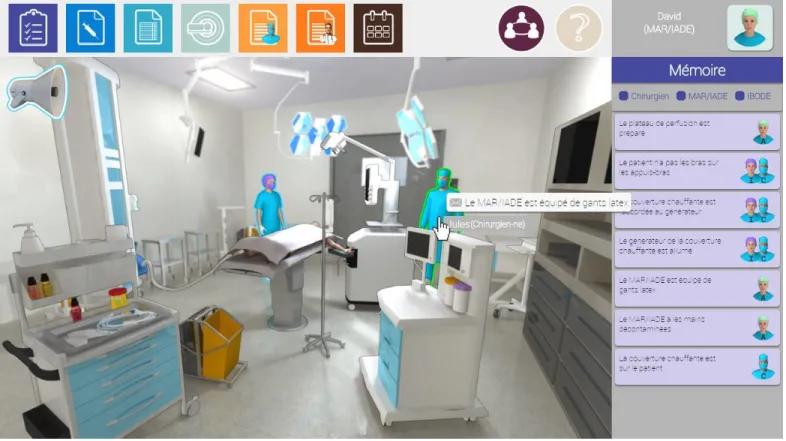
Fig. 2. This image is a screenshot from the game. The main panel is the 3D environment from the point of view of the player, including the objects, furniture and other characters. Every interactive object is highlighted when hovered and a tag with its name is displayed around the mouse cursor. The menu bar at the top contains links to open the documents (which are not spread throughout the environment for an easier access). The second to last icon on the bar can be used to trigger a vote about one among several predefined topics. The “memory” panel at the right of the screen contains every piece of information gathered by the learner. When the screenshot was captured, a piece of information was being transmitted from David the anaesthetist (the player) to Jules the surgeon. The tag says: “the anaesthetist is equipped with gloves”.
the information. That way, the game keeps a record of every information acknowledged by the player during the game session. This mechanism is essential since letting the players see and learn new information without the system knowing about it would hinder the accuracy of the debriefing.
Fig. 3. Clicking a document icon on the game screen’s top bar displays a realistic depiction of the document (for instance in this screenshot, the security check-list used in France). Documents are objects that can be interacted with (changing values, ticking boxes, etc.) and from which information can be collected.
C. Communication between players
Sending information to a team-mate is simple as dragging and dropping the corresponding bubble to their character. In Fig. 2, a piece of information is being sent by the player to another character. When a player is being talked to, a pop-up appears in the middle of their game screen. Merely clicking on the pop-up acknowledges the communication and the information bubble is placed on the memory panel. A player can also broadcast information to everyone at the same time by dropping the bubble in the environment, or on the speaker icon (top-left of the game screen).
Upon being received, an already existing information in memory is pulled to the top of the panel. The object/attribute couple is what makes two pieces of information come under scrutiny every time a new information is received. The value of the attribute and the source are two varying properties of a piece of information. Depending on them, various interpretations are likely to be made by the learner, as Table III shows. When the exact same piece of information is repeated, it is simply pulled up to the top without any other form of processing. When the entering piece of information updates the previous one, the bubble is updated, pulled to the top and flashes for a few seconds. When an existing piece of information is confirmed by a new one, the corresponding bubble inside the learner’s panel is added a thumbnail depicting the sender or the player’s avatar, depending on
TABLE III. APIECE OF INFORMATION IS INTERPRETED DIFFERENTLY DEPENDING ON THE CONTEXT.
same value different value
same source information is being repeated information is being updated different
source
information is being con-firmed by a third party
conflicting information, some of which is necessarily inac-curate
whether the piece of information was sent by a team-mate or collected by the player themselves. Finally, when an entering piece of information causes a conflict, both the new and the old bubbles are pulled to the top and flash for a few seconds. It is the player’s responsibility to investigate and solve the problem. Sending information is an intentional action undertaken by a player when they feel some knowledge they have acquired is of any importance to another player and therefore should be shared. This proactive behaviour denotes a good knowl-edge of the situation and/or a good experience, although in practice a significant part of the communication is likely not to be anticipated but delivered on request. To that end, the communication system offers the ability for a player to ask some information to another player. The interaction process is similar to collecting information from an object, only that the value of the information is not available directly. In practice, say player A means to ask player B some information. The list of available questions is presented to A by the contextual menu associated to B. The questions are almost straight translations of all available pieces of information in the memory of B, only put in the interrogative form using the request label (as described in Table I). At this stage, the actual value of the piece of information is hidden to A, since only the objects and the attribute are necessary. Information unknown to B is absent from the list and therefore unavailable for A to ask. The pending request is notified to B by a window popping-up overlaying their game screen, just like any other information sent. The request window however contains two additional buttons for player B to send a quick acknowledgement of receipt translating their intent. “It’s not my role” intends to tell player A that their question is very likely to remain unanswered whereas “I’m on it” supposedly means the information is to be sent shortly. In whatever case, whether player B will indulge or not is out of the responsibility of the player alone.
D. Collaborative decision making
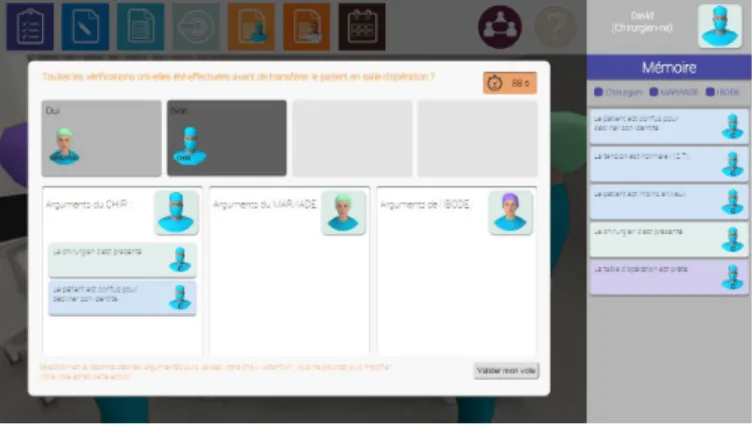
Votes can be cast at any time during the game by any player. A vote is a question on a selected topic about which all the players are requested to give their opinion. The vote is limited in time (in the experiment of section IV, the time limit was set to 90 seconds). During the vote, the game is paused and disabled. The players are free to select an answer, and a thumbnail of their character is placed in the corresponding box for the other players to see each other’s decisions in real time. Each player is also allowed to drag and drop information bubbles in provided spaces. They stand for arguments or evidence to support their vote or convince team-mates.
When the time is out, the player who triggered the vote is responsible for selecting the final decision. Whether or not the final decision reflects the opinion of the majority is the responsibility of this player. Similarly, the other players
have the right not to acknowledge this decision and take a counteraction. Making decisions and acting in the stead of the players is out of the scope of the vote mechanism. However, recording the arguments and the outcome in order to use these data for debriefing is clearly an added benefit of the learning game.
Fig. 4. The players are voting. The surgeon has a different opinion than the anaesthetist and tries to use arguments to plead their cause. The nurse has not voted yet.
IV. EXPERIMENT
Each scenario in 3DVOR has been designed to be played in standalone mode (without trainer’s intervention), in supervised mode (with teacher’s intervention) or in blended mode (with asynchronous trainer’s intervention).
A. Context and practice
The experiment took place during a course at the anaes-thetist nurse school of Toulouse in March 2015. The learning game was used by a teacher to evaluate their student’s knowl-edge of procedures, as part of the curriculum. The experiment had no impact on their grades. The experiment consisted of 3 game sessions, each with a different group of students. Each group played the same scenario – a hazardous situation where both the risks of operating the wrong patient and of missing the surgical site are high – which is specifically dealing with risk-management and teamwork. In the scenario, each role has access to a limited number of documents of the patient records and therefore the players are encouraged to communicate to share this fragmented knowledge. The objective consists in looking after the patient from their arrival in pre-operating room until the end of the anaesthesia procedure. In order to assess the performance of the students, the scenario embeds a set of metrics to measure how well the standard procedures are applied. Communication with the patient is an important element of this scenario as well. Positive communication, like informing the patient or telling them jokes, must be used to counter effect the many anxiety-provoking actions of the procedure and balance the patient’s anxiety within a comfort zone.
Considering that all the learners were inexperienced anaes-thetist nurse students, the teacher asked them to pair-up so that each team would be composed of 3 teams of 2 students (see Fig. 5). Each team would then have to play a role in the game: the surgeon, the anaesthetist and the nurse. The rules
Fig. 5. Three (times two) players and the trainer take part in each session of the experimentation. While the learners are playing, the trainer supervises the game in real time and uses the supervisor’s tools to take control of the session when necessary.
of the experiment were clearly stated at the beginning of each session. Oral communication was allowed within a team but forbidden outside, as only the game communication system must be used.
B. Supervisor’s tools
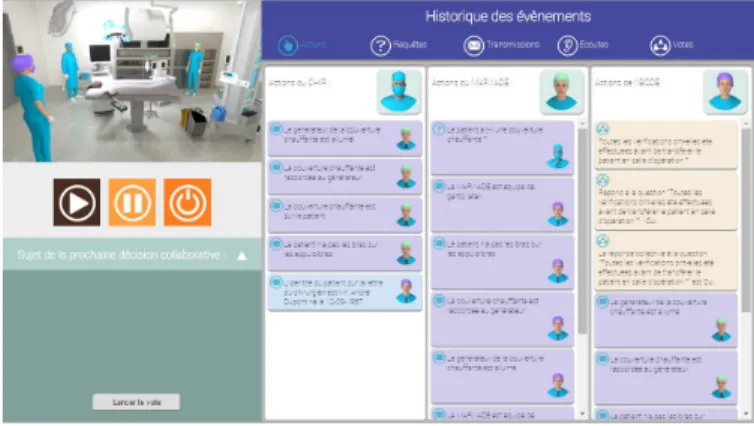
During each game session, the trainer uses a supervisor’s panel (illustrated in Fig. 6) which contains a set of tools to follow in real time the progress of the scenario. Visualisation tools include:
• A detailed view of the actions being carried out and the pieces of information being exchanged by the learners, and
• A more synoptic view of the state of progress of the scenario against the objectives.
Control tools enable the trainer to actually take control of the game:
• The game can be paused/resumed for the trainer and the learners to review the situation if it gets confused or if the team is unable to advance the scenario (lack of experience or lack of trust in someone’s decision).
• The game can also be reset to start over.
• To encourage the team to work collaboratively, the trainer can cast a vote on a topic of his/her choice and doing so force the learners to make a decision. Finally, the supervisor’s tools also include a debriefing panel where the objectives of the scenario are synthesised at the end of a session. The completion or failure of each objective is mentioned so that the learners are led to understand their mistakes on their own. It can also be used to support a more elaborate (i.e. at the scale of the team) analysis of the scenario in retrospect, conducted by the supervisor. The debriefing tools, the data model representing the objectives and the technical know-how used to link them to the scenario and the communication are deliberately not detailed in this article.
Fig. 6. The supervisor’s tools are grouped in a panel where the game can be observed in real time or taken control of.
C. Playtests and results
During the three sessions of the experiment, every interac-tion within the game was computer-recorded for analysis. Ev-ery session (see Fig. 5) and post-session individual interviews were recorded on camera for assisting and corroborating the analysis of quantitative data.
In a general way, the data collected express a strong involvement of all the learners towards the game, which is confirmed by the recordings showing enthusiastic and lively behaviours. Table IV presents the interaction count per session sorted by category (due to a technical issue, the records for sessions 3 are missing). Based on these figures, several observations and hypotheses can be formulated.
• No interaction has been left unused, which indicates the different interactions seem to have been under-stood by the learners.
• The quantity of information collected from objects is significantly higher than other related interactions like transmissions or requests. This behaviour denotes a systematic information scavenging of the environment by the learners and points out that on several occa-sions, the team may have temporarily lost track of the scenario. This problem is independent from the com-munication system and can be explained by the fact the learners in this experiment were not experienced surgeons, anaesthetists and nurses but students. Table V counts how many times each document has been accessed by each learner. Some documents were made inaccessible to specific roles in the game to reflect the fact that for instance the anaesthesia record can only be read and understood by the anaesthetist. Besides, the game in general and this scenario in particular are centred on sharing information and therefore letting all the practitioners in the OR have access to every information would be nonsensical. In the table, an inaccessibility is mentioned as “non-applicable” (n/a). Unlike the information inside the environment (see para-graphs above), information from the documents were accessed parsimoniously, as the low figures in the table indicate. This indicates that the learners were well aware of the interest and the utility of this information and therefore the documents were only accessed on purpose. Again, this is consistent
TABLE IV. COMMUNICATION-RELATED ACTIONS UNDERTAKEN BY THE LEARNERS SORTED BY CATEGORY.
Dialogue Action Collection Listening Transmission Vote requests answers to requests actions on object info. collected from object info. lis-tened info. trans-mitted votes answers to votes votes val-idated arguments arguments withdrawn session 1 23 17 38 234 11 15 10 31 13 47 3 session 2 18 6 29 286 5 15 5 21 6 31 0 mean values 20.5 11.5 33.5 260 8 15 7.5 26 9.5 39 1.5
TABLE V. READINGS OF THE PATIENT FILE AND OTHER DOCUMENTS RECORDED DURING THE SECOND SESSION.
Checklist MRI Surgical planning
Anaesthesia record
Liaison form
Nurse 18 n/a 5 n/a 3
Anaesthetist 1 n/a 4 2 0
Surgeon 5 2 0 n/a 0
with observations made in the operating room and with the expectations of the scenario.
The “talk to everyone” feature, represented by a speaker at the top left of the screen, was very scarcely used and perhaps most of the learners could not figure how to use it properly and safely preferred the one-to-one communication scheme. However, this cannot be interpreted as a failure to collaborate as the vote feature was on the other hand often used. On average, the team of learners took 7,5 collaborative decisions (votes) per session. It was observed that during a vote in the game, the learners tended to argue much more than in real life, and they clearly failed to identify the most relevant information likely to rest their case unquestionably. As a result, deadlocks were reached on some occasions and the intervention of the trainer was necessary.
In a more general context, the communication system revealed incapable to solve ingrained conflicts. When facing adversity, some learners were clearly and firmly disagreeing with the rest of the team, and would refuse to communicate by systematically answering “It’s not my role” to every question. Video records show irritated gestures from the learners on these occasions. Interviews conducted after the sessions have revealed the learners wish they could have used some chat system ultimately.
V. CONCLUSION
Natural collaborative action in an immersive environment is certainly an important feature for learning games to close the gap to the level of realism offered by role playing, real life simulators and training set-ups of the like. Communicating and sharing knowledge is even more important for the learners to actually be trained efficiently. Yet, this aspect of a game has received very little attention so far. In this paper, we have presented a communication system offering a way for players to exchange knowledge in real time, which is to our belief the very purpose of communication in the workplace. Indeed, our definition of communication, as manipulating pieces of information, is clearly specific to the objectives of a learning game. Yet, although it is not as expressive a communication system as a chat or a voice-chat, it enables for the game to understand the exchanges between the players and use that knowledge for debriefing the players, or at least facilitating the task of the trainer. Besides, how each piece of information is interpreted remains the responsibility of the players sending and receiving it.
A first experiment with the system has revealed the strengths and gaps of our communication system. The game has received a positive welcome from the audience and the data recorded from the sessions have confirmed the successful appropriation by the players of the various interaction abilities designed for them to communicate. On the negative side, we learnt experimentally that the communication system did not grant enough expressiveness to the learners to help them solve every conflict. Conflictual situations, we consider, are likely to thrive in a collaborative environment if the communication is not optimal. Future work will therefore address this issue by conducting further experiments dedicated to better under-standing collaborative decision making.
ACKNOWLEDGEMENT
The steering committee of 3DVOR is composed of Pr. Pierre Lagarrigue, M.D. Ph.D. Vincent Lubrano, M.D. Ph.D. Vincent Minville and Catherine Pons-Lelardeux. The scenarios used in the game were designed by Thomas Rodsphon and Vincent Lubrano from the Toulouse University Hospital. The experiment described in section IV has been conducted under the supervision of Christiane Paban, Hoang-Minh Truong and Am´elie Lafitte. The authors are also grateful to the designers and programmers of the game: Cyrielle Guimbal, Jules de Guglielmi and Romain R´egis.
REFERENCES
[1] P. Lagarrigue, V. Lubrano, V. Minville, and C. Pons-Lelardeux. (2012) The 3dvor project. [Online]. Available: http://3dvor.univ-jfc.fr/ [2] L. Kohn, J. Corrigan, and M. Donaldson, To err is human: building a
safer health system. Washington: National Academy Press, 2000. [3] D. Parvati and W. L. Heinrichs, “Clinispace: A multiperson 3d
on-line immersive training environment accessible through a browser,”
Medicine Meets Virtual Reality 18: NextMed, vol. 163, p. 173, 2011.
[4] J. M. Taekman, N. Segall, E. Hobbs, and M. Wright, “3diteams– healthcare team training in a virtual environment,” Anesthesiology, vol. 107, no. A2145, p. A2145, 2007.
[5] M. Mateas and A. Stern, “Natural language understanding in faade: Surfacetext processing,” Proceedings of the Conference on Technologies
for Interactive Digital Storytelling and Entertainment (TIDSE), 2004.
[6] J. Cassell, Embodied conversational agents. MIT press, 2000. [7] V. Rus, S. DMello, X. Hu, and A. Graesser, “Recent advances in
conversational intelligent tutoring systems,” AI Magazine, vol. 34, no. 3, pp. 42–54, 2013.
[8] B. Hennigan, “Making the case for nlp in dialogue systems for serious games,” 8th International Conference on Natural Language Processing
(JapTAL), 1st Workshop on Games and NLP, 2012.
[9] C. Morningstar and R. F. Farmer, “The lessons of Lucasfilm’s Habitat,” in The First International Conference on Cyberspace, M. Benedikt, Ed., May 1990. [Online]. Available: http://www.fudco.com/chip/lessons.html [10] M. T. Johnson and M. Clary, “A second life virtual clinic for medical student training,” 2008, second Life Education Community Conference (SLEDcc’08).
[11] D. Mori, R. Berta, A. De Gloria, V. Fiore, and L. Magnani, “An easy to author dialogue management system for serious games,” J. Comput.
Cult. Herit., vol. 6, no. 2, pp. 10:1–10:15, May 2013. [Online].
[12] M. Sanselone, S. Sanchez, C. Sanza, D. Panzoli, and Y. Duthen, “Control of non-playing characters in a medical learning game with Monte Carlo Tree Search (regular paper),” in IEEE Conference on
Com-putational Intelligence and Games, Dortmund, Germany, 26/08/2014-29/08/2014. http://www.computer.org: IEEE Computer Society, aot 2014, pp. 208–215.
[13] D. Thomas and L. Vlacic, “Collaborative decision making amongst human and artificial beings,” in Intelligent Decision Making: An
AI-Based Approach. Springer, 2008, pp. 97–133.
[14] D. Panzoli, M. Sanselone, S. Sanchez, C. Sanza, C. Lelardeux, P. La-garrigue, and Y. Duthen, “Introducing a design methodology for multi-character collaboration in immersive learning games (regular paper),” in Proceedings of the Sixth International Conference on Virtual Worlds
and Games for Serious Applications (VS-Games14). University of Malta: IEEExplore digital library, 09–12/09/2014 2014, p. (electronic medium).