HAL Id: hal-02924388
https://hal.umontpellier.fr/hal-02924388
Submitted on 1 Dec 2020HAL is a multi-disciplinary open access archive for the deposit and dissemination of sci-entific research documents, whether they are pub-lished or not. The documents may come from teaching and research institutions in France or abroad, or from public or private research centers.
L’archive ouverte pluridisciplinaire HAL, est destinée au dépôt et à la diffusion de documents scientifiques de niveau recherche, publiés ou non, émanant des établissements d’enseignement et de recherche français ou étrangers, des laboratoires publics ou privés.
Mg 3 (BH 4 ) 4 (NH 2 ) 2 as Inorganic Solid Electrolyte
with High Mg 2+ Ionic Conductivity
Ronan Le Ruyet, Benoit Fleutot, Romain Berthelot, Yasmine Benabed,
Geoffroy Hautier, Yaroslav Filinchuk, Raphael Janot
To cite this version:
Ronan Le Ruyet, Benoit Fleutot, Romain Berthelot, Yasmine Benabed, Geoffroy Hautier, et al.. Mg 3 (BH 4 ) 4 (NH 2 ) 2 as Inorganic Solid Electrolyte with High Mg 2+ Ionic Conductivity. ACS Applied Energy Materials, ACS, 2020, 3 (7), pp.6093-6097. �10.1021/acsaem.0c00980�. �hal-02924388�
1
Mg3(BH4)4(NH2)2 as Inorganic Solid Electrolyte
with High Mg
2+
Ionic Conductivity
Ronan Le Ruyet,a,d Benoît Fleutot,a,d Romain Berthelot,b,d Yasmine Benabed,c,e Geoffroy
Hautier,c Yaroslav Filinchuk,c and Raphaël Janota,d,*
a Laboratoire de Réactivité et Chimie des Solides (LRCS), Université de Picardie Jules Verne,
UMR 7314 CNRS, 33 Rue Saint Leu, Amiens 80039, France.
b ICGM, Univ. Montpellier, UMR 5253 CNRS, ENSCM, Montpellier, France.
c Institute of Condensed Matter and Nanosciences, Université catholique de Louvain, Place L.
Pasteur 1, Louvain-la-Neuve 1348, Belgium.
d Réseau sur le Stockage Electrochimique de l’Energie (RS2E), FR 3459 CNRS, 33 Rue Saint
Leu, Amiens 80039, France.
e Department of Chemistry, Université de Montréal, Montreal, H3T1J4, Canada.
* Corresponding author: Raphaël Janot: [email protected]
Co-authors: Ronan Le Ruyet: [email protected]
Benoît Fleutot: [email protected]
Romain Berthelot: [email protected]
Yasmine Benabed:[email protected]
Geoffroy Hautier:[email protected]
2
Abstract
Mg3(BH4)4(NH2)2 compound was synthesized through the investigation of the Mg(BH4)2
-Mg(NH2)2 phase diagram; its crystal structure was solved in a tetragonal unit cell with the space
group I-4. Interestingly, Mg3(BH4)4(NH2)2 has a high thermal stability with a decomposition
temperature above 190°C and exhibits a high Mg2+ ionic conductivity of 4.1x10⁻⁵ S.cm-1 at
100°C with a low activation energy (0.84 eV). The reversible Mg deposition/stripping was
demonstrated at 100°C when using Mg3(BH4)4(NH2)2 as solid electrolyte. Thus,
Mg3(BH4)4(NH2)2 is a compound that could help to develop rechargeable Mg-ion solid-state
batteries.
Keywords: ionic conductor, Mg-ion battery, borohydride, crystal structure, impedance
spectroscopy
In order to develop rechargeable batteries with better energy density and more sustainable
materials than the lithium-based batteries, post-Li-ion technologies are being developed.1
Among them, magnesium-based batteries are studied as Mg has the advantages of being
abundant in the earth crust (21100 ppm vs. 10 ppm for Li),2 to have a low redox potential
(-2.356 V vs. NHE) and a high volumetric capacity (3833 mAh.cm-3 vs. 2046 mAh.cm-3 for Li).
Nevertheless, the development of Mg batteries is slowed down by the difficulty of finding
proper electrolytes. Until now, most of the liquid electrolytes used in Mg-ion batteries were
made on Cl-containing salts (e.g. Grignard reagents), which cause severe corrosions to the
electrochemical cell if the working potential is too high.3,4 Recent progress has been made with
fluoro-alkoxy-borates salts, such as Mg(B(hfip)4)2 with hfip = OCH(CF3)2, which are
3
hydroborate and carbo-borate based compounds (e.g. Mg(BH4)2 and Mg(CB11H12)2) were also
recently investigated as Mg2+ salts.6 These liquid electrolytes remain however limited for high
energy density devices due to reactions occurring at the electrolyte/positive electrode interface.
In addition, all these liquid electrolytes suffer from the use of ether-based solvents (often THF
or DME) which are very volatile and flammable. Finally, quite recently, it has been
demonstrated that the long thought non-dendritic formation in the case of Mg-ion batteries is
false: several groups have reported that Mg dendritic growth can also occur and lead to fatal
failures.7-8
As for Li-ion and Na-ion batteries, there is an increasing interest for all-solid-state
batteries in the case of Mg-ion as it could definitively solve the issues of solvent leakage and
flammability. In addition, it could possibly allow the use of Mg metal at the negative electrode
without any magnesium dendritic formation if the solid electrolyte pellet is dense enough. Thus,
inorganic solid electrolytes could largely improve rechargeable Mg batteries if their ionic
conductivity and electrochemical stability window are high. Unfortunately, inorganic solid
compounds with Mg2+ cations have very low ionic conductivities, due to the very sluggish
diffusion of divalent Mg2+ in the solid. Two recent reviews give a nice picture of the family of
materials exhibiting decent Mg2+ ionic conductivities.9,10 Among them, the NASICON-like
phosphates (e.g. MgZr4(PO4)6) show a high ionic conductivity of about 10-3 S.cm-1, however at
high temperature (800°C),11 and thus are unsuitable for Mg2+ rechargeable batteries. Searching
for compounds with higher conductivities, and similarly to what is known for lithium, oxygen
can be replaced by sulfur in Mg2+ ionic solid conductors. Indeed, sulfide glasses and
glass-ceramics (e.g. MgS-P2S5) show an improved Mg2+ cation mobility at lower temperatures, but
the ionic conductivity is still too low for applications (around 10-8 S.cm-1 at 200°C).12 A recent
class of materials with high ionic conductivities are the ternary spinels,13 such as MgSc
2Se4 (10 -4 S.cm-1 at 25°C), but unfortunately, these conductivities are accompanied by high electronic
4
ones (about 4x10⁻⁸ S.cm-1), which impede their possible use as solid electrolytes.14 As a matter
of fact, similarly to the recently developed Mg2+ salts based on Mg(BH
4)2 for liquid electrolytes,
the most interesting materials for solid electrolytes are today based on the same compound and
derivatives.15 Very recent studies have shown the possibility to reach high ionic conductivities
of about 10-5 S.cm-1 close to room temperature by adding neutral molecules to Mg(BH 4)2. In
this manner, Mg(en)1(BH4)2 with en being ethylene-diamine, Mg(BH4)2-NH3 and
Mg(BH4)2(NH3BH3)2 reach ionic conductivities of 6x10⁻⁵ S.cm-1 at 70°C,16 8.5x10⁻⁵ S.cm-1 at
70°C,17 and 8.4x10⁻⁵ S.cm-1 at 40°C,18 respectively. The latter is indeed the solid compound
with the highest Mg2+ ionic conductivity reported so far. The ionic conductivity enhancement
when adding these neutral N-H containing molecules is attributed to a network of dihydrogen
N-H+….-H-B bonds allowing a high degree of structural flexibility, as already observed in the
field of hydrogen storage materials,19 and to the large volume of the tetrahedra surrounding the
Mg2+ cations allowing a facilitated Mg2+ ionic motion.
In the literature, Mg(BH4)(NH2) compound was reported to have an ionic conductivity of
1x10⁻⁶ S.cm-1 at 150°C,20 but we have recently demonstrated that this conductivity could be
improved up to 3x10⁻⁶ S.cm-1 at only 100°C by synthesizing a glass-ceramic-like material.21
This was due to the presence of an unknown additional amorphous compound that was assumed
as another phase existing in the Mg(BH4)2-Mg(NH2)2 binary system. Indeed, in similar systems
such as LiBH4-LiNH2, several compounds can be obtained for different compositions.22
Searching for other magnesium ionic conductors, we explored different compositions in the
hitherto unknown Mg(BH4)2-Mg(NH2)2 binary phase diagram (cf. Figure S1) by ball-milling
and annealing of various mixtures of Mg(BH4)2 and Mg(NH2)2.
After ball-milling and annealing at 120°C of a Mg(BH4)2:Mg(NH2)2 mixture in the 2:1
molar ratio (see the supporting information for the detailed synthesis conditions), a crystalline
5
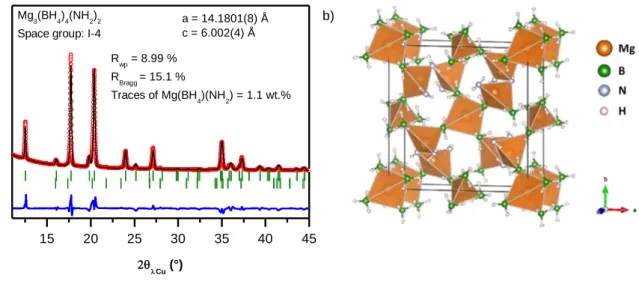
S1 for the experimentally determined Mg(BH4)2-Mg(NH2)2 binary phase diagram). The
corresponding XRD pattern has been well indexed in a tetragonal unit cell (cf. Figure 1a) like
other compounds in the Mg(BH4)2-Mg(NH2)2 phase diagram, for instance: Mg(BH4)(NH2)
(space group: I41),23 Mg(NH2)2 (space group: I41/acd)24 and δ-Mg(BH4)2 (space group:
I41/acd)25. From Rietveld refinement with the space group I-4, it was possible to propose a
crystal structure for the so-called Mg3(BH4)4(NH2)2 with tetragonal cell parameters a =
14.1801(8) Å and c = 6.002(4) Å (cf. Figure 1b). Only few additional weak peaks of
Mg(BH4)(NH2) can be observed (i.e. a content of only 1.1 wt.% as found from Rietveld
refinement). 15 20 25 30 35 40 45 b) Rwp = 8.99 % RBragg = 15.1 % Traces of Mg(BH4)(NH2) = 1.1 wt.% Cu (°) Mg3(BH4)4(NH2)2 Space group: I-4
a = 14.1801(8) Å c = 6.002(4) Å a)
Figure 1. a) Rietveld refinement of the XRD diagram of Mg3(BH4)4(NH2)2 and b) its crystal
structure drawn with the software VESTA.
Crystal structure of Mg3(BH4)4(NH2)2, solved in the space group I-4, is shown in Figure
1b. The presence of some weak peaks allowed to exclude the screw axis 41 and the glide planes.
Twelve Mg atoms per cell are distributed over three crystallographic sites, the anions were also
attributed to three sites: 8 + 8 for BH4 groups and one 8-fold position for NH2 (cf. Table S1).
6
contacts, as well as by much narrower N-Mg-N angles compared to rather open B…Mg…B, as
also seen in the crystal structures of Mg(NH2)2 and Mg(BH4)2. A possible anionic site disorder
cannot be firmly excluded due to the small difference in the X-ray scattering power for the BH4
and NH2 anions, however it not supported the distinctly different structural chemistry of the
anions. The B-H distance of 1.15 Å and N-H of 0.9 Å were taken as typical values for the
apparent bond lengths for X-ray diffraction studies, the H-B-H and H-N-H angles were fixed
as ideally tetrahedral (109.47°). The positions and the orientations of the anions, determined
using the software FOX with the help of H…H anti-bump restraints, were fixed in the latter
refinement. The experimental structure was DFT-optimized, improving accuracy of hydrogen
positions (the major difference with the experimental structure is related to the anions’
orientations) and validating the experimental conclusions. The full crystallographic parameters
can be found in Table S1. Two Mg sites (Mg1 and Mg2) are in the center of tetrahedra made of
four (BH4)- anions as in Mg(BH4)2 and one site (Mg3) is in the center of a tetrahedron made of
two (BH4)- anions and two (NH2)- anions as in Mg(BH4)(NH2). The calculated density for
Mg3(BH4)4(NH2)2 crystal structure is very low: 0.904 g.cm-3. This low crystallographic density
is attractive for a solid-state electrolyte as it allows obtaining good ionic percolation in
composite electrodes with a relatively low weight of electrolyte, thus ensuring reasonable
electrochemical gravimetric capacities for the composite electrodes.
Infrared spectroscopy was performed on this Mg3(BH4)4(NH2)2 compound (cf. Figure S2)
and reveals N-H and B-H stretching/bending bands at very similar wave numbers to those found
for the precursors, Mg(BH4)2 and Mg(NH2)2, and to the other compound in the binary diagram:
Mg(BH4)(NH2). More specifically, two strong N-H stretching bands are observed at 3270 and
3326 cm-1 which are characteristic values of (NH
2)- anion close to Mg2+ and it must be noticed
that no band is visible around 3150-3200 cm-1, thus confirming the absence of imide (NH)
7
bands are split into two compared to the spectrum of Mg(BH4)(NH2), which agrees well with
the XRD refinement showing two different Wyckoff positions for the B atoms (vs. only one
position in the case of Mg(BH4)(NH2)).
The thermal stability of Mg3(BH4)4(NH2)2 was evaluated by Thermogravimetric Analysis
(TGA) coupled with Differential Thermal Analysis (DTA) measurements (cf. Figure S3). Very
importantly, no mass loss or exo/endothermic phenomenon was observed up to 190°C under
argon. Only a slight decrease of the mass (less than 0.1 %) can be observed starting around
190°C, which is probably related to the beginning of the compound decomposition. Above
200°C, the compound readily decomposes forming a foamy material due to gas releases (a
mixture of H2 and NH3). Nevertheless, the fact that Mg3(BH4)4(NH2)2 remains stable at
temperatures up to 190°C is very interesting, especially when compared to the recently reported
compounds obtained by the addition of a neutral molecule to Mg(BH4)2 (molecules such as en
= C2H4(NH2)2, NH3, or NH3BH3). These compounds are indeed clearly less thermally stable
than Mg3(BH4)4(NH2)2: Mg(en)1(BH4)2 has a phase transition at 75°C and starts to be
decomposed at 100°C, Mg(BH4)2-NH3 is decomposed at 138°C,26 whereas
Mg(BH4)2(NH3BH3)2 melts at 48°C and starts to be decomposed at 85°C.27 Even,
Mg(BH4)(NH2), the only other compound reported in the Mg(BH4)2-Mg(NH2)2 phase diagram,
becomes amorphous around 150°C and starts to be decomposed at 200°C (cf. Figure S1).
Owing to the good thermal stability of Mg3(BH4)4(NH2)2, its ionic conductivity was
measured on pellets by Electrochemical Impedance Spectroscopy (EIS) as a function of
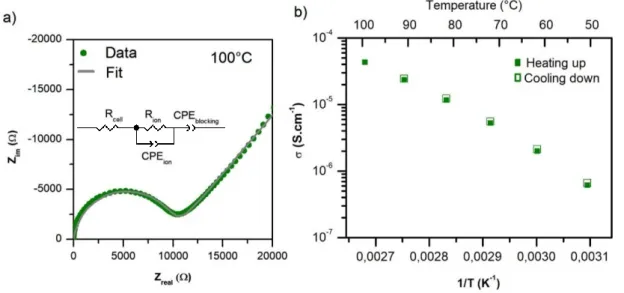
temperature. All Nyquist plots show the same shape as the one recorded at 100°C (cf. Figure
2a) i.e. only one semicircle at high frequency, that is attributed to the ionic conduction in the
material, followed by a straight line at low frequency, that is the capacitance caused by the ion
blocking electrodes placed on both sides of the pelletized sample. The ionic conductivity
8
are among the highest recorded for a purely inorganic Mg2+ solid ionic conductor at such low
temperatures. We can notice that the conductivity values remain exactly the same upon cooling
(and upon the subsequent heating/cooling cycles not shown here) confirming that the sample
does not undergo any thermal degradation. Actually, the impedance spectroscopy
measurements were performed up to 100°C, a much lower temperature than the degradation
temperature of above 190°C previously determined by TGA/DTA.
It is interesting to compare the high conductivity of 4.1x10⁻⁵ S.cm-1 at 100°C with the one
of 3x10⁻⁶ S.cm-1 that we have previously obtained at the same temperature for a Mg(BH
4)(NH2)
glass-ceramic material. Mg3(BH4)4(NH2)2 compound has undoubtedly an improved ionic
conductivity and a higher thermal stability. The activation energy for the ionic conduction of
Mg3(BH4)4(NH2)2 was found to be 0.84 eV from the plot of ln(.T) as a function of 1/T. This
activation energy is low, indicating a high mobility of the Mg2+ cations. Indeed, Ea extracted
from the plot of ln(.T) as a function of 1/T is the addition of the energy needed to form the
mobile charge carrier (Ef) and the energy barrier for its migration (Em).28 If Ea is low, then the
Mg2+ cations are easily formed and/or have a favourable path and low energy barrier to migrate.
In both cases, the low activation energy (0.84 eV) means a better mobility of the Mg2+ cations
compared to similar compounds with higher activation energies.
The lowest activation energies reported in inorganic solid Mg2+ electrolytes were
0.83-0.88 eV in MgZr4(PO4)6 and related materials.29,30 The activation energy of Mg3(BH4)4(NH2)2
is also much lower than the ones measured for other Mg(BH4)2-based solid electrolytes: 1.2,
1.47, 1.6, and 2.0 eV for Mg(BH4)(NH2), Mg(BH4)2(NH3BH3)2, Mg(en)1(BH4)2, and
Mg(BH4)2-NH3,respectively. The good mobility of Mg2+ in Mg3(BH4)4(NH2)2 is not fully
understood yet but it might be linked to its unique crystal structure in which Mg2+ cations
occupied mixed sites between tetrahedra made of four (BH4)- anions and others made of two
9
in the DFT-optimized structure). Deeper structural characterizations, if possible on single
crystals, could be also useful to check the possible formation of vacancies, especially on the N
crystallographic sites, which could promote largely the Mg2+ mobility.
Figure 2. a) Nyquist plot obtained by EIS at 100°C for Mg3(BH4)4(NH2)2 and b) the ionic
conductivity as a function of 1/T.
As Mg3(BH4)4(NH2)2 is among the compound with the highest Mg2+ ionic conductivity,
it was important to prove that reversible Mg deposition/stripping is possible and that its use as
electrolyte in all solid-state Mg-ion batteries could be realized. In order to determine the
Electrochemical Stability Window (ESW), cyclic voltammetry measurements were done at
100°C on a composite working electrode (WE) made by mixing Mg3(BH4)4(NH2)2 with 10
wt.% of carbon black, the latter needed to bring electrons in the material and, thus, to really
evaluate its electrochemical stability. This composite WE was separated from the Mg counter
electrode by a layer of pure Mg3(BH4)4(NH2)2.
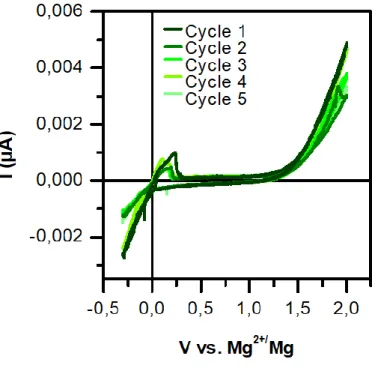
When starting the cyclic voltammetry with a sweep towards low potentials first, a strong
reduction peak assigned to Mg deposition is clearly visible below 0 V vs. Mg2+/Mg (cf.
10
upon oxidation. The coulombic efficiency at this first cycle is about 20 %, which might be
improved by a better mixing of the carbon with the solid electrolyte (here simply made with an
agate mortar). No reduction peak other than the Mg deposition occurred so the
Mg3(BH4)4(NH2)2 solid electrolyte is stable at low potentials. This result is interesting because
solid electrolytes often react with a metallic anode. On the other side, the oxidation of the
Mg3(BH4)4(NH2)2 solid electrolyte is unfortunately observed with an onset potential of about
1.48 V vs Mg2+/Mg. This oxidation is irreversible and the exact reaction occurring is not fully
identified, but it is most probably related to the oxidation of the (NH2)- moieties. It is noteworthy
that the coulombic efficiency of the Mg deposition/stripping remains around 20 % for the first
5 cycles meaning that the decomposition products formed upon oxidation do not affect this
process. The ESW of Mg3(BH4)4(NH2)2 ranges from 0 to 1.48 V vs. Mg2+/Mg which is similar
to the ESWs previously reported for Mg(en)1(BH4)2 and Mg(BH4)2(NH3BH3)2 (i.e. 0 to 1.2 V
vs. Mg2+/Mg for both of them).
Figure 3. Cyclic voltammetry measurement at 100°C and 0.05 mV.s-1 of a cell made of
11
In conclusion, a compound with the Mg3(BH4)4(NH2)2 stoichiometry was synthesized
when exploring the Mg(BH4)2-Mg(NH2)2 binary phase diagram. The crystal structure of
Mg3(BH4)4(NH2)2 was solved in a tetragonal unit cell with the I-4 space group, where the Mg2+
cations occupy three different Wyckoff sites in distorted tetrahedra. Interestingly, the
Mg3(BH4)4(NH2)2 compoundhas a thermal stability up to 190°C, which is higher than those of
the compounds recently reported, based on addition of neutral molecules to Mg(BH4)2. The
ionic conductivity of Mg3(BH4)4(NH2)2 is among the highest ever measured at low temperatures
for a purely inorganic Mg2+ ionic conductor with a value of 4.1x10⁻⁵ S.cm-1 at 100°C and a low
activation energy (0.84 eV). Its electrochemical stability window was determined as ranging
from 0 to 1.48 V vs. Mg2+/Mg, which are common voltages for Mg-(BH
4-)-(NHx) based solid
electrolytes. The reversible Mg deposition/stripping was demonstrated at 100°C and
Mg3(BH4)4(NH2)2 is indeeda very interesting Mg2+ ionic conductor that could help to develop
better rechargeable Mg-ion batteries.
Acknowledgements
The RS2E (French network on electrochemical energy storage) is acknowledged for the PhD
funding of Ronan Le Ruyet (STORE-EX Labex Project ANR-10-LABX-76-01) and the
Communauté Française de Belgique for the support under grant ARC 18/23-093. Matthieu
Courty (LRCS, UPJV, Amiens) is also thanked for the thermal analysis measurements. The
present research benefited from computational resources made available on the Tier-1
supercomputer of the Fédération Wallonie-Bruxelles, infrastructure funded by the Walloon
12
Supporting Information Available
Experimental section including conditions for material synthesis, characterizations and
electrochemical measurements; Table listing the parameters for the experimentally solved and
the DFT-optimized structures of the new Mg3(BH4)4(NH2)2 compound; computational methods.
Figures showing the experimentally determined Mg(BH4)2-Mg(NH2)2 binary phase diagram,
the infrared spectra of Mg(BH4)2, Mg(NH2)2, Mg(BH4)(NH2) and Mg3(BH4)4(NH2)2 and, the
thermal stability of the Mg3(BH4)4(NH2)2 compound.
References
(1) Larcher, D; Tarascon J.-M. Towards Greener and More Sustainable Batteries for Electrical
Energy Storage. Nat. Chem. 2015, 7, 19–29.
(2) Anderson, D. L. Theory of the Earth 1998.
(3) Muldoon, J.; Bucur, C. B.; Gregory, T. Electrolyte Roadblocks to a Magnesium
Rechargeable Battery. Angew. Chemie Int. Ed. 2017, 56, 12064–12084.
(4) Deivanayagam, R.; Ingram, B. J.; Shahbazian-Yassar, R. Progress in Development of
Electrolytes for Magnesium Batteries. Energy Storage Mater. 2019, 21, 136–153.
(5) Zhao-Karger, Z.; Liu, R.; Dai, W.; Li, Z.; Diemant, T.; Vinayan, B. P.; Bonatto Minella, C.;
Yu, X.; Manthiram, R.; Behm, R. J.; Ruben, M.; Fichtner, M. Toward Highly Reversible
Magnesium–Sulfur Batteries with Efficient and Practical Mg[B(hfip)4]2 Electrolyte. ACS
Energy Lett. 2018, 3, 2005–2013.
(6) Tutusaus, O.; Mohtadi, R.; Arthur, T. S.; Mizuno, F.; Nelson E. G.; Sevryugina, Y. V. An
Efficient Halogen-Free Electrolyte for Use in Rechargeable Magnesium Batteries. Angew.
Chemie Int. Ed. 2015, 54, 7900–7904.
(7) Ding, M.S.; Diemant, T.; Behm, R. J.; Passerini, S.; Giffin, G. A. Dendrite Growth in Mg
13
A1983-A1990.
(8) Davidson, R.; Verma, A.; Santos, D.; Hao, F.; Fincher, C.; Xiang, S.; Van Buskirk, J.; Xie,
K.; Pharr, M.; Mukherjee, P.; Banerjee, S. Formation of Magnesium Dendrites during
Electrodeposition. ACS Energy Lett. 2019, 4, 375−376.
(9) Jaschin, P. W.; Gao, Y.; Li, Y.; Bo S.-H. A Materials Perspective on Magnesium-Ion-Based
Solid-State Electrolytes. J. Mater. Chem. A 2020, 8, 2875-2897.
(10) Zhan, Y.; Zhang, W.; Lei, B.; Liu, H.; Li, W. Recent Development of Mg Ion Solid
Electrolyte. Front. Chem. 2020, 8, 125.
(11) Ikeda, S.; Takahashi, M.; Ishikawa, J.; Ito, K. Solid Electrolytes with Multivalent Cation
Conduction. 1. Conducting Species in Mg-Zr-PO4 System. Solid State Ionics 1987, 23, 125–
129.
(12) Yamanaka, T.; Hayashi, A.; Yamauchi, A.; Tatsumisago, M. Preparation of Magnesium
Ion Conducting MgS-P2S5-MgI2 Glasses by a Mechanochemical Technique. Solid State
Ionics 2014, 262, 601–603.
(13) Canepa, P.; Bo, S.-H.; Gautam, G. S.; Key, B.; Richards, W. D.; T. Shi, T.; Tian, Y.; Wang,
Y.; Li; J.; Ceder, G. High Magnesium Mobility in Ternary Spinel Chalcogenides. Nat.
Commun. 2017, 8, 1759.
(14) Wang, L.; Zhao-Karger, Z.; Klein, F.; Chable, J.; Braun, T.; Schür, A.; Wang, C.; Guo, Y.;
Fichtner, F. MgSc2Se4-A Magnesium Solid Ionic Conductor for All‐Solid‐State Mg
Batteries? Chem. Sus. Chem. 2019, 12, 2286-2293.
(15) Paskevicius, M.; Jepsen, L. H.; Schouwink, P.; Cerný, R.; Ravnsbæk, D.; Filinchuk, Y.;
Dornheim, M.; Besenbacher, F.; Jensen T. R. Metal Borohydrides and Derivatives -
Synthesis, Structure and Properties. Chem. Soc. Rev. 2017, 46, 1565-1634.
(16) Roedern, E.; Kühnel, R.-S.; Remhof, A.; Battaglia, C. Magnesium Ethylenediamine
14
(17) Yan, Y.; Dononelli, W.; Jorgensen, M.; Grinderslev, J. B.; Lee, Y.-S.; Cho, Y. W.; Cerny,
R.; Hammer, B.; Jensen, T. R. The Mechanism of Mg2+ Conduction in Amine Magnesium
Borohydride Promoted by a Neutral Molecule. Phys. Chem. Chem. Phys., DOI:
10.1039/d0cp00158a
(18) Kisu, K.; Kim, S.; Inukai, M.; Oguchi, H.; Takagi, S.; Orimo, S. Magnesium Borohydride
Ammonia-Borane as a Magnesium Ionic Conductor. ACS Appl. Energy Mater., DOI:
10.1021/acsaem.0c00113
(19) Jepsen, L. H.; Ley, M. B.; Lee, Y.; Cho, Y. W.; Dornheim, M.; Jensen, J. O.; Filinchuk,
Y.; Jørgensen, J.; Besenbacher F.; Jensen, T. R. Boron–Nitrogen Based Hydrides and
Reactive Composites for Hydrogen Storage. Materials Today 2014, 17, 129-135.
(20) Higashi, S.; Miwa, K; Aoki, M.; Takechi, K. A Novel Inorganic Solid State Ion Conductor
for Rechargeable Mg Batteries. Chem. Commun. 2014, 50, 1320–1322.
(21) Le Ruyet, R.; Berthelot, R.; Salager, E.; Florian, P.; Fleutot, B.; Janot, R. Investigation of
Mg(BH4)(NH2)-Based Composite Materials with Enhanced Mg2+ Ionic Conductivity. J.
Phys. Chem. C 2019, 123, 10756–10763.
(22) Borgschulte, A.; Jones, M. O.; Callini, E.; Probst, B.; Kato, S.; Züttel, A.; David W. I.;
Orimo, S. Surface and Bulk Reactions in Borohydrides and Amides. Energy Environ. Sci.
2012, 5, 6823.
(23) Noritake, T.; Miwa, K.; Aoki, M.; Matsumoto, M.; Towata, S.; Li, H.-W.; Orimo, S.
Synthesis and Crystal Structure Analysis of Complex Hydride Mg(BH4)(NH2). Int. J.
Hydrogen Energy 2013, 38, 6730–6735.
(24) Jacobs, H. Die Kristallstruktur des Magnesiumamids. Zeitschrift fur Anorg. und Allg.
Chemie 1971, 382, 97–109.
(25) Dimitrievska, M.; White, J. L.; Zhou, W.; Stavila, V.; Klebanoff, L. E.; Udovic, T. J.
15
Vibrational Spectroscopy and First-Principles Calculations. Phys. Chem. Chem. Phys. 2016,
18, 25546–25552.
(26) Yang, Y.; Liu, Y.; Li, Y.; Gao, M.; Pan, H. Synthesis and Thermal Decomposition
Behaviours of Magnesium Borohydride Ammoniates with Controllable Composition as
Hydrogen Storage Materials. Chem. Asian J. 2013, 8, 476–481.
(27) Jepsen, L. H.; Ban, V.; Møller, K. T.; Lee, Y.-S.; Cho, Y. W.; Besenbacher, F.; Filinchuk,
Y.; Skibsted, J.; Jensen, T. R. Synthesis, Crystal Structure, Thermal Decomposition, and 11B
MAS NMR Characterization of Mg(BH4)2(NH3BH3)2. J. Phys. Chem. C 2014, 118, 12141–
12153.
(28) Famprikis, T.; Canepa, P.; Dawson, J. A.; Islam, S.; Masquelier, C. Fundamentals of
Inorganic Solid-State Electrolytes for Batteries. Nature Mat. 2019, 18, 1278-1291.
(29) Adamu, M.; Kale, G. M. Novel Sol–Gel Synthesis of MgZr4P6O24 Composite Solid
Electrolyte and Newer Insight into the Mg2+-Ion Conducting Properties using Impedance
Spectroscopy. J. Phys. Chem. C 2016, 120, 17909–17915.
(30) Imanaka, N.; Okazaki, Y.; Adachi, G. Divalent Magnesium Ionic Conduction in the
Magnesium Phosphate-Based Composites. Chem. Lett. 1999, 28, 939–940.
16