Behavioral, Physiologic, and
Habitat Influences on the
Dynamics of Puumala virus
Infection in Bank Voles
(Clethrionomys glareolus)
Sophie Escutenaire,* Patrice Chalon,† Florence De Jaegere,‡ Lucie Karelle-Bui,† Georges Mees,† Bernard Brochier,* Francine Rozenfeld,‡ and Paul-Pierre Pastoret†
Populations of bank voles (Clethrionomys glareolus) were monitored during a 4-year study in southern Belgium to assess the influence of agonistic behavior, reproductive status, mobility, and distribution of the rodents on the dynamics of Puumala virus (abbreviation: PUUV; genus: Hantavirus) infection. Concor-dance was high between data from serologic testing and results of viral RNA detection. Wounds resulting from biting or scratching were observed mainly in adult rodents. Hantavirus infection in adults was associ-ated with wounds in the fall, i.e., at the end of the breeding season, but not in spring. In addition, sexually active animals were significantly more often wounded and positive for infection. Hantavirus infection was associated with higher mobility in juvenile and subadult males. Seroconversions observed 6 months apart also occurred more frequently in animals that had moved longer distances from their original capture point. During nonepidemic years, the distribution of infection was patchy, and positive foci were mainly located in dense ground vegetation.
antaviruses (family Bunyaviridae) are rodent-borne zoonotic agents responsible for human diseases called hemorrhagic fever with renal syndrome (HFRS) in Europe and Asia and hantavirus pulmonary syndrome (HPS) in the Ameri-cas (1,2). Viral transmission occurs through inhalation of aero-sols from the urine, saliva, or feces of infected rodents and possibly through biting (3–5). Hantavirus infection persists in reservoir species apparently without causing clinical signs (6). In experimentally infected rodents, the virus is distributed in different organs (including lungs, kidneys, intestines, and sali-vary glands) and elicits the production of antibodies that may be detected lifelong, while the viremia is generally transient (4,7,8). In the wild, adult rodents are generally more often infected than younger animals. The age-dependent prevalence may result from protection of newborns by maternal antibod-ies and from higher risk of infection for sexually mature rodents through fighting, mating, or communal nesting (9–12). In Europe, Puumala virus (PUUV), which causes a mild form of HFRS in humans, is carried by bank voles (Clethrionomys
glareolus) (13). No data are available on the dynamics of
PUUV infection in bank vole populations according to behav-ioral patterns. Most seroconversions recorded in a capture-mark-recapture (CMR) study of PUUV transmission occurred during the breeding season and in sexually mature voles, with a prevalence bias in favor of mature males (10). Aggressive encounters in adults and the occupation of exclusive territories
by breeding females are characteristic of the breeding season in bank voles (14–16).
We studied the influence of aggressive behavior, reproduc-tive status, and mobility of bank voles on the prevalence of PUUV infection. Along with behavioral and physiologic fac-tors, we studied the influence of habitat on bank vole distribu-tion. Two HFRS outbreaks were reported in Belgium in 1996 (224 cases) and in 1999 (124 cases) (17,18). Our survey was conducted from 1996 to 1999 in southern Belgium, where most patients had been reported during the epidemic years. In our trapping sites, rodent population densities were the highest in 1996 and 1999, as was the prevalence of PUUV infection, with 41 (19.2%) of 213 and 259 (39.3%) of 659, respectively, of bank voles positive (19; S. Escutenaire, unpub. data). Materials and Methods
Study areas
From 1996 through 1999, trapping was conducted twice a year (October–November and April–May) at 21 sites distrib-uted in five localities of southern Belgium. All sites were located in broad-leaved or mixed pine and broad-leaved for-ests. Four of the 21 trapping sites, at Thuin, Montbliart, Momignies, and Couvin, were selected for a CMR survey (19). Each CMR site contained mapped areas with dense or low ground vegetation. The dense ground vegetation included thickets of brambles (Rubus sp.), shrubs (including Corylus
avellana, Sambucus racemosa, Prunus spinosa, Cytisus sco-parius, Crataegus monogyna, Salix caprea, and Lonicera
per-*Pasteur Institute, Brussels, Belgium; †University of Liège, Liège, Bel-gium; and ‡University of Brussels, Brussels, Belgium
iclymenum) and dense populations of plants such as Pteridium aquilinum and Epilobium angustifolium. The low ground
veg-etation comprised herbs (Carex pilulifera, Anthoxanthum
odo-ratum, Luzula pilosa, Dryopteris carthusiana, Teucrium scorodonia, Scrophularia nodosa, and Silene dioica) or sparse
brambles located under dense spruce (Picea abies) or oak (Quercus robur, Q. petraea) foliage.
Sampling Procedure
On each CMR site, we constructed a 10 X 10 grid of 100 live traps (Sherman Live Trap Co., Tallahassee, FL; Toma-hawk Live Trap Co., TomaToma-hawk, WI) spaced at 10-meter intervals. Traps were set for four consecutive nights. Rodents were anesthetized with isoflurane (Forène, S.A. Abbott, Lou-vain-La-Neuve, Belgium), individually marked by toe-clip-ping, and released at their original place of capture after a blood sample was collected from the retroorbital sinus. Organs (lungs, liver, kidneys, and spleen) were also collected from any animals found dead in traps. In spring 1999, 120 traps were added to expand the CMR grids, as described (19). On the 17 trapping sites where CMR was not done, 23 to 30 live traps were placed along transects at 5-m intervalsfor two to four consecutive nights. The trapped animals were humanely killed, and their blood and organs were collected.
Data Collection
All rodents were examined for sex and weight. Pregnant and lactating females and males with testicles in scrotal posi-tion were considered sexually active. Weight limits to distin-guish adult, subadult, and juvenile categories were inferred from the analysis of prevalence of infection and reproductive status, according to body mass of rodents. Mass classes, which differed over time (19), were <16 g (juveniles), 16–18 g (sub-adults), and >18 g (adults) in fall 1996, in spring 1997 and in 1999, and <13 g (juveniles), 13–15 g (subadults), and >15 g (adults) in fall 1997 and in 1998. From spring 1997 on, we recorded the presence of wounds associated with a bite or a scratch on the head (ear perforation or muzzle injuries) of bank voles.
Serologic Screening and Viral RNA Detection
Sera of rodents trapped from fall 1996 to fall 1998 were screened by an immunoglobulin (Ig) G enzyme-linked immun-osorbent assay (ELISA), with PUUV CG18-20, Hantaan virus (HTNV) 76-118, and Dobrava-Belgrade virus (DOBV)– infected Vero E6 cell lysates as viral antigens (19). Sera col-lected in 1999 were screened by using a PUUV IgG ELISA kit (Progen Biotechnik, Heidelberg, Germany) (19).
Viral RNA was detected in ground-up lungs by means of reverse transcription (RT) polymerase chain reaction (PCR) test (19). Two nested PCRs with small (S)- or medium (M)-segment oligonucleotides were done to amplify the cDNA. The expected size of the amplified fragments was 205 base pairs (bp) (nucleotide [nt] 1033–1237) and 310 bp (nt 2463– 2772) for the S and M genomic segments, respectively.
Data Analysis
The total number of rodents marked and released during a trapping session was used as an indicator of population size on each CMR site. Capture points of all rodents trapped in the grids were mapped. According to the distribution, we deter-mined the pairs of adult voles with overlapping home ranges. Home range overlap was considered when rodents were cap-tured at the same trap station or when the areas enclosed by the capture points overlapped (20,21). Distances between trapping points of recaptured voles were measured to estimate rodent movements.
Statistical analysis of data was done by chi-square test, Pearson correlation, and Student’s t test. Pairs of adult rodents with overlapping home ranges were analyzed according to sex and serologic or PCR status. Data for each criteria were pro-cessed as binomial distributions.
Results
Serologic and RT-PCR Data
IgG antibodies against PUUV were detected in 318 (26.3%) of 1210 bank vole sera collected from fall 1996 through fall 1999. PUUV genomic fragments were amplified in 38 (13.7%) of 277 lung samples. Of 179 bank voles tested both by ELISA and RT-nested PCR, 169 (94.4%) had concor-dant results. Viral RNA was detected in the lungs of 19 (73.1%) of 26 seropositive animals and in three seronegative ones. As serum and tissues were not available for all rodents and as the concordance between results of serologic testing and PCR was high, data from both tests were pooled for fur-ther analysis. Rodents positive by ELISA or PCR or both were considered positive for PUUV infection.
Frequency of Wounds
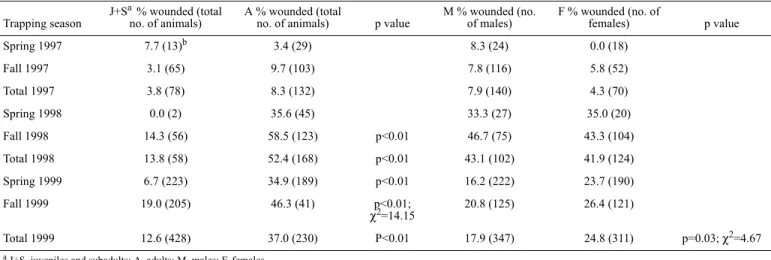
Trapping data from spring 1997 through fall 1999 showed that the proportion of wounded bank voles was significantly (chi square 4.73, p=0.03) higher in autumn (150 [25.3%] of 593) than in spring (99 [19.8%] of 501). Adults were signifi-cantly (p<0.01) more often injured than juveniles and sub-adults in 1998 and 1999 (Table 1). The proportion of injured subadults (42 [18.5%] of 227) was also significantly (chi square 12.63; p<0.01) higher than that of wounded juveniles (20 [7.7%] of 259) in 1998 and 1999. Although no difference was observed between either sex in 1997 and 1998, the pro-portion of wounded animals during the 1999 epidemic year was significantly (p=0.03) higher in females than in males (Table 1).
Association between Wounds and Prevalence of Infection
When the fall prevalence rates were compared within mass classes, injured adults were significantly (p<0.01) more often positive than nonwounded ones, although no difference in prevalence was observed in the spring (Table 2). The preva-lence in 1999 was significantly (chi square 12.14; p<0.01)
higher in subadults (61 [31.4%] of 194) than in juveniles >13 g (25 [15.5%] of 161). Subadults were also more often wounded.
Despite the difference in frequency of wounds between males and females in 1999, the prevalence of infection in adult females (79 [62.7%] of 126) was not higher than in adult males (71 [67.6%] of 105). During the fall of the nonepidemic years (1997 and 1998), the proportion of positive adult males (18 [14.5%] of 124) was significantly higher (chi square 4.40; p=0.04) than that of adult females (6 [5.9%] of 102) although no significant difference in wound frequency was observed between either sex.
Influence of the Reproductive Status of Adults
Data from spring 1997 through spring 1999 showed a cor-relation (r=0.97; p<0.01) between the number wounded and the number of sexually active adult males (Figure 1). The prevalence of infection was significantly higher (chi square 4.31; p=0.04) in sexually active males (10 [24.4%] of 41) than in other adult males (8 [10.1%] of 79) in fall but not in spring. The analysis of wounded animals also showed that in fall,
sex-ually active males still tended to be more often positive (8 [29.6%] of 27) than the other males (1 [7.7%] of 13).
Pregnant and lactating voles were significantly (chi square 5.47; p=0.02) more often wounded (81 [43.1%] of 188) than other adult females (18 [26.9%] of 67). The prevalence of infection was also significantly (chi square 4.77; p=0.03) higher in breeding females (72 [38.7%] of 186) than in non-breeding ones (16 [23.9%] of 67). Wounded animals showed no statistically significant difference in prevalence between sexually active (28 [34.6%] of 81) versus sexually inactive adult females (8 [44.4%] of 18).
Recapture of Rodents
Fifty-three bank voles were recaptured on the grids during subsequent trapping periods. For all but one animal, the recap-ture occurred 6 months after the first trapping. Twelve (22.6%) rodents were found positive during both capture sessions, and Table 1. Relationship between frequency of wounds and the age and sex of bank voles
Trapping season J+S
a % wounded (total
no. of animals) A % wounded (total no. of animals) p value M % wounded (no. of males) F % wounded (no. of females) p value
Spring 1997 7.7 (13)b 3.4 (29) 8.3 (24) 0.0 (18) Fall 1997 3.1 (65) 9.7 (103) 7.8 (116) 5.8 (52) Total 1997 3.8 (78) 8.3 (132) 7.9 (140) 4.3 (70) Spring 1998 0.0 (2) 35.6 (45) 33.3 (27) 35.0 (20) Fall 1998 14.3 (56) 58.5 (123) p<0.01 46.7 (75) 43.3 (104) Total 1998 13.8 (58) 52.4 (168) p<0.01 43.1 (102) 41.9 (124) Spring 1999 6.7 (223) 34.9 (189) p<0.01 16.2 (222) 23.7 (190) Fall 1999 19.0 (205) 46.3 (41) p<0.01; χ2=14.15 20.8 (125) 26.4 (121) Total 1999 12.6 (428) 37.0 (230) P<0.01 17.9 (347) 24.8 (311) p=0.03; χ2=4.67
a J+S, juveniles and subadults; A, adults; M, males; F, females.
Table 2. Prevalence of Puumala virus infection in adult bank voles, by presence of wounds Trapping season Wounded % positive (no. tested) Not wounded % positive (no. tested) p value Spring 1997 0.0 (1) 21.4 (28) Fall 1997 20.0 (10) 8.6 (93) Spring 1998 6.3 (16) 6.9 (29) Fall 1998 15.3 (72) 5.9 (51) Spring 1999 68.2 (66) 68.3 (123) Fall 1999 68.4 (19) 36.4 (22) p=0.04; χ2=4.19 Spring (1997–1999) 55.4 (83) 51.1 (180) Fall (1997–1999) 25.7 (101) 11.4 (166) p<0.01; χ2=9.16
Figure 1. Linear regression in bank voles between the number wounded and the number of sexually active adult males. Significance of correla-tion: p<0.01. Data used for the analysis were collected from spring 1997 through spring 1999. The scrotal position of testicles was not inspected in fall 1999.
two (3.8%) 8-g juveniles were seropositive when first trapped and seronegative 6 months later. Twenty-two (41.5%) rodents were negative both times, and 17 (32.1%) seroconverted between the first and the second trapping. Of the 17 rodents that seroconverted, nine were juveniles or subadults at first capture and eight were adults. The proportion of animals that acquired wounds between the spring and the fall tended to be higher in rodents that seroconverted (4 [44.4%] of 9) than in the ones that remained negative (3 [25.0%] of 12), although the difference was not statistically significant (p=0.35). Movement within CMR Sites
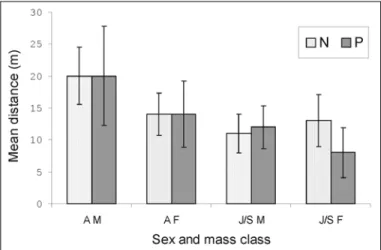
Of the rodents caught more than once during the 4-day ses-sions, 83 (27.5%) of 302 were trapped at one position only. Adult males were the most mobile, with a mean distance between capture points of 20 m (Figure 2). The distances cov-ered by the positive and the negative bank voles did not differ significantly (Figure 2). However, juvenile or subadult (>13 g) males that had moved distances of >20 m were significantly (chi square 3.86; p=0.05) more often positive than the less mobile ones with prevalence rates of 43.8% (7/16) and 19.6% (11/56), respectively. Mean distance covered was negatively correlated with the population density in adults (correlation coefficient [r] 0.84; p<0.01) and in juveniles and subadults (r 0.93; p<0.01). The rodents were the least mobile during the 1999 epidemic year.
Males that seroconverted between two trapping periods had moved a significantly (Student t value 3.16; p=0.01) longer distance from their original capture point (mean dis-tance 70 m) than males that remained negative (mean disdis-tance 29 m). Furthermore, the proportion of males and females that were captured at distances >60 m from the original trapping point was significantly (chi square 6.95; p<0.01) higher in the group that seroconverted (9 [52.9%] of 17) than in the group that remained negative (3 [13.6%] of 22).
Distribution in the CMR Sites
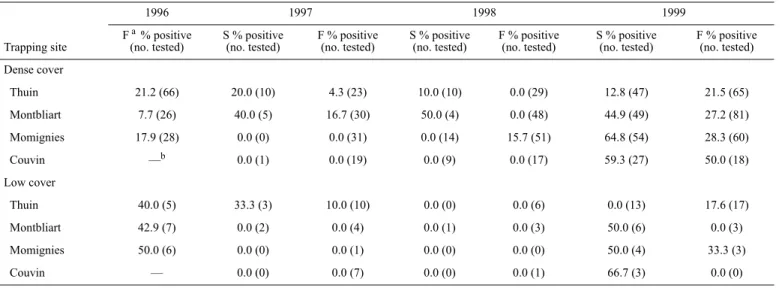
The proportion of captures in the area with dense ground vegetation (Figure 3) was 83.0% (318/383) at Thuin, 87.8% (316/360) at Montbliart, 95.5% (340/356) at Momignies, and 90.8% (118/130) at Couvin. At all sites, the proportion of cap-tures was significantly (p<0.01) higher in dense ground vege-tation than in the other part of the grid. Comparison of prevalence of infection between both types of vegetation did not show significantly higher rates in dense ground cover (Table 3). During the nonepidemic years (1997 and 1998), however, positive animals were detected only twice in low ground cover of Thuin but were trapped seven times in dense ground vegetation of Thuin, Montbliart, and Momignies (Table 3, Figure 3).
Among adult rodents that had overlapping home ranges in the CMR sites, there were significantly more male pairs (65 of 173) and fewer female pairs (26 of 173) than expected by chance (binomial probabilities<0.01; proportion of males 52.1%). Statistical evidence of association was found between Figure 2. Mean distances (m) between capture points of positive and
negative bank voles for PUUV infection in the four capture-mark-recap-ture (CMR) grids. N, negative; P, positive; AM, adult males; AF, adult females; J/S M, juvenile and subadult males; J/S F, juvenile and sub-adult females. Error bars represent 95% confidence intervals.
Figure 3. Distribution of trapped bank voles through 1996–1999 and representation of the vegetation cover. On each grid, the 100 live traps are represented by white, light, or dark gray squares. LC, low cover; DC, dense cover provided by ground vegetation. Number in parenthe-ses is the number of traps in the area.
the home range overlap and the serologic and PCR status for PUUV infection. The number of pairs including two positive animals (24/173) was higher and the number of pairs com-posed of a positive and a negative animal (41/173) was lower than expected by chance (binomial probabilities<0.01; preva-lence of infection 22.2%).
Discussion
A widespread distribution of hantavirus infection has com-monly been reported in rodent hosts during HFRS and HPS epidemics (19,22,23). Transmission of the virus is higher after sudden increases in rodent population density assumed to be related to favorable ecologic conditions (profusion of food or mild weather) (24,25). In some field studies, the prevalence of infection in rodents during non epidemic periods did not appear to be immediately related to population density (19,26– 29). Social behaviors and habitat features have been proposed as additional factors influencing the dynamics of infection in the wild (29–32). In rats (Rattus norvegicus) and deer mice (Peromyscus maniculatus), which are the hosts of Seoul virus (SEOV) and Sin Nombre virus (SNV), respectively, agonistic encounters could play a role in viral transmission, as suggested by the higher prevalence of infection in wounded adults (9,32– 35).
In our study, wounds resulting from biting or scratching were mainly observed in sexually mature bank voles. Wounded adults were more likely than nonwounded ones to be positive for infection in fall (i.e., at the end of the breeding season) but not in spring. Aggressive encounters would there-fore play an important role in PUUV transmission during the breeding season, while behaviors such as communal nesting or mutual grooming would be determinant factors in the dynam-ics of infection during the winter. Aggressive behaviors begin at the onset of sexual maturity and are probably testosterone dependent in males (14). The proportion of injured animals
and the prevalence of infection were higher in adult breeding males and breeding females than in other adults. These obser-vations underline the close relationship between aggressive-ness and breeding activities, which could be associated risk factors for hantavirus infection. In contrast with results from previous studies of wild rats and deer mice (9,32,33), adult males were not wounded more often than adult females. How-ever, the prevalence of infection was significantly higher in adult males than in adult females during the fall of the nonepi-demic years (1997 and 1998). Sex-related physiologic, immu-nologic, or behavioral characteristics might therefore be additional factors involved in the transmission of infection. In experimentally infected rats, males were more likely than females to shed SEOV in saliva and through multiple routes (urine, feces, and saliva) (36). They were also found to shed virus in saliva and feces longer than did females (37). Although no similar studies have been performed in bank voles, the observations of SEOV in rats could indicate that fighting results in more efficient viral transmission in males than in females, who generally direct their aggression toward female intruders (14). In addition, males frequently spread small quantities of urine and feces to mark their territory and to indicate their social status during the breeding season (38). Thus, olfactory exploration of conspecific shelters and home ranges might also expose males to a higher risk of infection than females.
Movements and distribution of bank voles are also factors involved in the dynamics of PUUV infection. The association of hantavirus infection with longer distances traveled in juve-nile and subadult males and in animals captured 6 months apart underlines the importance of mobility in viral transmis-sion. The difference of prevalence between either sex in fall 1997 and 1998 may also be linked to the higher mobility of adult males compared with adult females. Our observations corroborate results from a previous study of deer mice in Table 3. Prevalence of Puumala virus infection by location and type of ground vegetation
Trapping site
1996 1997 1998 1999
F a % positive
(no. tested) S % positive (no. tested) F % positive (no. tested) S % positive (no. tested) F % positive (no. tested) S % positive (no. tested) F % positive (no. tested) Dense cover Thuin 21.2 (66) 20.0 (10) 4.3 (23) 10.0 (10) 0.0 (29) 12.8 (47) 21.5 (65) Montbliart 7.7 (26) 40.0 (5) 16.7 (30) 50.0 (4) 0.0 (48) 44.9 (49) 27.2 (81) Momignies 17.9 (28) 0.0 (0) 0.0 (31) 0.0 (14) 15.7 (51) 64.8 (54) 28.3 (60) Couvin —b 0.0 (1) 0.0 (19) 0.0 (9) 0.0 (17) 59.3 (27) 50.0 (18) Low cover Thuin 40.0 (5) 33.3 (3) 10.0 (10) 0.0 (0) 0.0 (6) 0.0 (13) 17.6 (17) Montbliart 42.9 (7) 0.0 (2) 0.0 (4) 0.0 (1) 0.0 (3) 50.0 (6) 0.0 (3) Momignies 50.0 (6) 0.0 (0) 0.0 (1) 0.0 (0) 0.0 (0) 50.0 (4) 33.3 (3) Couvin — 0.0 (0) 0.0 (7) 0.0 (0) 0.0 (1) 66.7 (3) 0.0 (0) aF, fall; S, spring.
which adult males living in patchy vegetative habitats were more mobile and also more often infected than adult males in dense shrub habitats (32). However, our data suggest that the mobility of bank voles was the lowest during the epidemic years. The high prevalence of infection during these years may have resulted from the high population densities, which allowed frequent encounters between rodents. Home range overlap among positive adult voles was more frequent than expected by chance. This observation could reflect a focal dis-tribution of infected animals or may indicate that viral trans-mission occurs more readily between animals sharing parts of their home ranges. Direct and repeated contacts with infected conspecifics or contacts with recently shed infectious urine or feces could represent risk factors for closest neighbors within a wild breeding colony. The frequent overlap of home ranges recorded in adult males may therefore be one of the factors increasing the risk of infection in males when compared with females.
In our four CMR grids, the type of vegetation influenced the distribution of the rodents. During nonepidemic years, pos-itive animals were more frequently trapped in dense ground vegetation where brambles were abundant. If trapping success indicates preferred habitat, then areas with dense ground cover could constitute foci for bank voles, allowing PUUV to persist during the low prevalence periods. A discontinuous distribu-tion of the rodents could limit viral transmission, as suggested by the absence or low number of positive animals in the iso-lated groups from the low ground cover in Thuin (Figure 3). An uneven distribution of positive rodents related to the vege-tation cover has been observed in Peromyscus species (28,32,33,39,40) with more restricted and well-defined focal ranges during periods of low population densities (31). A cor-relation was also found between prevalence of SNV infection and habitat characteristics; negative sites were associated with low and homogeneous vegetation cover (29).
We have suggested that a threshold in population density may be a determinant factor for the persistence of PUUV infection at a site (19). In this study, behavioral and physio-logic factors, such as aggressiveness, mobility and reproduc-tive status of bank voles, were shown to influence the prevalence of PUUV infection. The habitat determines the dis-tribution of the rodents and therefore also constitutes a crucial element influencing the hantavirus enzootic cycle.
Acknowledgments
The authors thank R. Verhagen, I. Thomas, Y. Brostaux, and T. Kervyn for useful advice and P. Heyman for helpful assistance. We also thank T. Avsic-Zupanc for providing antigens and G. van der Groen and G. Beelaert for providing hantavirus strains.
This work was financially supported by a grant from the Belgian National Fund for Scientific Research (F.N.R.S.).
Dr. Escutenaire completed doctoral studies in the Department of Immunology-Vaccinology, Faculty of Veterinary Medicine, Univer-sity of Liège, Belgium, on the epidemiology of hantavirus infection in
wild mammals in Belgium. Her research focuses on rodent commu-nity factors involved in the dynamics of hantavirus infection.
References
1. Enria DA, Briggiler AM, Pini N, Levis S. Clinical manifestations of New World hantaviruses. Curr Top Microbiol Immunol 2001;256:117–3. 2. Linderholm M, Elgh F. Clinical characteristics of hantavirus infections on
the Eurasian continent. Curr Top Microbiol Immunol 2001;256:135–51. 3. Dournon E, Moriniere B, Matheron S, Girard PM, Gonzalez JP, Hirsch F,
et al. HFRS after a wild rodent bite in the Haute-Savoie and risk of expo-sure to Hantaan-like virus in a Paris laboratory. Lancet 1984;1:676–7. 4. Yanagihara R, Amyx HL, Gajdusek DC. Experimental infection with
Puumala virus, the etiologic agent of nephropathia epidemica, in bank voles (Clethrionomys glareolus). J Virol 1985;55:34–8.
5. Tsai TF. Hemorrhagic fever with renal syndrome: mode of transmission to humans. Lab Anim Sci 1987;37:428–30.
6. Meyer BJ, Schmaljohn CS. Persistent hantavirus infections: characteris-tics and mechanisms. Trends Microbiol 2000;8:61–7.
7. Lee HW, Lee PW, Baek LJ, Song CK, Seong IW. Intraspecific transmis-sion of Hantaan virus, etiologic agent of Korean hemorrhagic fever, in the rodent Apodemus agrarius. Am J Trop Med Hyg 1981;30:1106–12. 8. Hutchinson KL, Rollin PE, Peters CJ. Pathogenesis of a North American
hantavirus, Black Creek Canal virus, in experimentally infected
Sigmo-don hispidus. Am J Trop Med Hyg 1998;59:58–65.
9. Glass GE, Childs JE, Korch GW, LeDuc JW. Association of intraspecific wounding with hantaviral infection in wild rats (Rattus norvegicus). Epi-demiol Infect 1988;101:459–72.
10. Bernshtein AD, Apekina NS, Mikhailova TV, Myasnikov YA, Khlyap LA, Korotkov YS, et al. Dynamics of Puumala hantavirus infection in naturally infected bank voles (Clethrionomys glareolus). Arch Virol 1999;144:2415–28.
11. Mills JN, Ksiazek TG, Peters CJ, Childs JE. Long-term studies of hantavi-rus reservoir populations in the Southwestern United States: a synthesis. Emerg Infect Dis 1999;5:135–42.
12. Hjelle B, Yates T. Modeling hantavirus maintenance and transmission in rodent communities. Curr Top Microbiol Immunol 2001;256:77–90. 13. Brummer-Korvenkontio M, Vaheri A, Hovi T, von Bonsdorff CH,
Vuori-mies J, Manni T, et al. Nephropathia epidemica: detection of antigen in bank voles and serologic diagnosis of human infection. J Infect Dis 1980;141:131–4.
14. Gipps JHW. The behaviour of bank voles. Symposium of the Zoological Society of London 1985;55:61–87.
15. Viitala J, Hoffmeyer I. Social organization in Clethrionomys compared with Microtus and Apodemus: social odours, chemistry and biological effects. Ann Zool Fennici 1985;22:359–71.
16. Gliwicz J. Individuals and populations of the bank vole in optimal, subop-timal and insular habitats. J Anim Ecol 1989;58:237–47.
17. Ducoffre G. Surveillance des Maladies Infectieuses par un Réseau de Laboratoires de Microbiologie. Tendances Epidémiologiques 1983–1998. Brussels: Institut Scientifique de la Santé Publique, Section d’Epidémiol-ogie; 1999.
18. Heyman P, Vervoort T, Escutenaire S, Degrave E, Konings J, Vanden-velde C, et al. Incidence of hantavirus infections in Belgium. Virus Res 2001;77:71–80.
19. Escutenaire S, Chalon P, Verhagen R, Heyman P, Thomas I, Karelle-Bui L, et al. Spatial and temporal dynamics of Puumala hantavirus infection in red bank vole (Clethrionomys glareolus) populations in Belgium. Virus Res 2000;67:91–107.
20. Mazurkiewicz M. Spatial organization of the population. In: Petrusewicz K, editor. Ecology of the bank vole. Acta Theriol 1983;Suppl 1:117–28. 21. Viitala J, Hakkarainen H, Ylönen H. Different dispersal in Clethrionomys
and Microtus. Ann Zool Fennici 1994;31:411–5.
22. Brummer-Korvenkontio M, Henttonen H, Vaheri A. Hemorrhagic fever with renal syndrome in Finland: ecology and virology of nephropathia epidemica. Scand J Infect Dis Suppl 1982;36:88–91.
23. Childs JE, Ksiazek TG, Spiropoulou CF, Krebs JW, Morzunov S, Maupin GO, et al. Serologic and genetic identification of Peromyscus maniculatus as the primary rodent reservoir for a new hantavirus in the southwestern United States. J Infect Dis 1994;169:1271–80.
24. Stone R. The mouse-piñon nut connection. Science 1993;262:833. 25. Young JC, Mills JN, Enria DA, Dolan NE, Khan AS, Ksiazek TG. New
World hantaviruses. Br Med Bull 1998;54:659–73.
26. Douglass RJ, Van Horn R, Coffin KW, Zanto SN. Hantavirus in Montana deer mouse populations: preliminary results. J Wildl Dis 1996;32:527–30. 27. Graham TB, Chomel BB. Population dynamics of the deer mouse
(Per-omyscus maniculatus) and Sin Nombre virus, California Channel Islands.
Emerg Infect Dis 1997;3:367–70.
28. Mills JN, Ksiazek TG, Ellis BA, Rollin PE, Nichol ST, Yates TL, et al. Patterns of association with host and habitat: antibody reactive with Sin Nombre virus in small mammals in the major biotic communities of the southwestern United States. Am J Trop Med Hyg 1997;56:273–84. 29. Boone JD, Otteson EW, McGwire KC, Villard P, Rowe JE, St. Jeor SC.
Ecology and demographics of hantavirus infections in rodent populations in the Walker River Basin of Nevada and California. Am J Trop Med Hyg 1998;59:445–51.
30. Glass GE, Livingstone W, Mills JN, Hlady WG, Fine JB, Biggler W, et al. Black Creek Canal Virus infection in Sigmodon hispidus in southern Flor-ida. Am J Trop Med Hyg 1998;59:699–703.
31. Abbott KD, Ksiazek TG, Mills JN. Long-term hantavirus persistence in rodent populations in Central Arizona. Emerg Infect Dis 1999;5:102–12. 32. Root JJ, Calisher CH, Beaty BJ. Relationships of deer mouse movement,
vegetative structure, and prevalence of infection with Sin Nombre virus. J Wildl Dis 1999;35:311–8.
33. Bennett SG, Webb JP Jr, Madon MB, Childs JE, Ksiazek TG, Torrez-Mar-tinez N, et al. Hantavirus (Bunyaviridae) infections in rodents from Orange and San Diego counties, California. Am J Trop Med Hyg 1999;60:75–84.
34. Calisher CH, Sweeney W, Mills JN, Beaty BJ. Natural history of Sin Nombre virus in western Colorado. Emerg Infect Dis 1999;5:126–34. 35. Douglass RJ, Wilson T, Semmens WJ, Zanto SN, Bond CW, Van Horn
RC, et al. Longitudinal studies of Sin Nombre virus in deer mouse-domi-nated ecosystems of Montana. Am J Trop Med Hyg 2001;65:33–41. 36. Klein SL, Bird BH, Glass GE. Sex differences in immune responses and
viral shedding following Seoul virus infection in Norway rats. Am J Trop Med Hyg 2001;65:57–63.
37. Klein SL, Bird BH, Glass GE. Sex differences in Seoul virus infection are not related to adult sex steroid concentrations in Norway rats. J Virol 2000;74:8213–7.
38. Rozenfeld FM, Le Boulangé E, Rasmont R. Urine marking by male bank voles (Clethrionomys glareolus Schreber, 1780; Microtidae, Rodentia) in relation to their social rank. Can J Zool 1987;65:2594–601.
39. Korch GW, Childs JE, Glass GE, Rossi CA, LeDuc JW. Serologic evi-dence of hantaviral infections within small mammal communities of Bal-timore, Maryland: spatial and temporal patterns and host range. Am J Trop Med Hyg 1989;41:230–40.
40. Kuenzi AJ, Morrison ML, Swann DE, Hardy PC, Downard GT. A longi-tudinal study of Sin Nombre virus prevalence in rodents, southeastern Arizona. Emerg Infect Dis 1999;5:113–7.
Address for correspondence: Sophie Escutenaire, Rabies Department, Pasteur Institute, 642 rue Engeland, 1180 Brussels, Belgium; fax: 32-2-373-3286; e-mail: [email protected]
Types of Articles
Perspectives. Articles should be under 3,500 words and should include refer-ences, not to exceed 40. Use of subheadings in the main body of the text is rec-ommended. Photographs and illustrations are encouraged. Provide a short abstract (150 words) and a brief biographical sketch of first author. Articles in this section should provide insightful analysis and commentary about new and reemerging infectious diseases and related issues. Perspectives may also address factors known to influence the emergence of diseases, including microbial adaptation and change, human demographics and behavior, technol-ogy and industry, economic development and land use, international travel and commerce, and the breakdown of public health measures. If detailed methods are included, a separate section on experimental procedures should immedi-ately follow the body of the text.
Synopses. Articles should be under 3,500 words and should include refer-ences, not to exceed 40. Use of subheadings in the main body of the text is rec-ommended. Photographs and illustrations are encouraged. Provide a short abstract (150 words) and a brief biographical sketch of first author—both authors if only two. This section comprises concise reviews of infectious dis-eases or closely related topics. Preference is given to reviews of new and emerging diseases; however, timely updates of other diseases or topics are also welcome. If detailed methods are included, a separate section on experimental procedures should immediately follow the body of the text.
Research Studies. Articles should be under 3,500 words and should include references, not to exceed 40. Use of subheadings in the main body of the text is recommended. Photographs and illustrations are encouraged. Provide a short abstract (150 words) and a brief biographical sketch of first author—both authors if only two. Report laboratory and epidemiologic results within a pub-lic health perspective. Although these reports may be written in the style of tra-ditional research articles, they should explain the value of the research in public health terms and place the findings in a larger perspective (i.e., "Here is what we found, and here is what the findings mean").
Policy and Historical Reviews. Articles should be under 3,500 words and should include references, not to exceed 40. Use of subheadings in the main body of the text is recommended. Photographs and illustrations are encour-aged. Provide a short abstract (150 words) and a brief biographical sketch.
Articles in this section include public health policy or historical reports that are based on research and analysis of emerging disease issues.
Dispatches. Articles should be 1,000–1,500 words and need not be divided into sections. If subheadings are used, they should be general, e.g., “The Study” and “Conclusions.” Provide a brief abstract (50 words); references (not to exceed 15); figures or illustrations (not to exceed two); and a brief biograph-ical sketch of first author—both authors if only two. Dispatches are updates on infectious disease trends and research. The articles include descriptions of new methods for detecting, characterizing, or subtyping new or reemerging patho-gens. Developments in antimicrobial drugs, vaccines, or infectious disease pre-vention or elimination programs are appropriate. Case reports are also welcome.
Commentary. Thoughtful discussions (500–1,000 words) of current topics. Commentaries may contain references but should not include figures or tables. Another Dimension. Thoughtful essays, short stories, or poems on philosoph-ical issues related to science, medphilosoph-ical practice, and human health. Topics may include science and the human condition, the unanticipated side of epidemic investigations, or how people perceive and cope with infection and illness. This section is intended to evoke compassion for human suffering and to expand the science reader's literary scope. Manuscripts are selected for publication as much for their content (the experiences they describe) as for their literary merit.
Letters. This section includes letters that present preliminary data or comment on published articles. Letters (500–1,000 words) should not be divided into sections, nor should they contain figures or tables. References (not more than 10) may be included.
Book Reviews. Short reviews (250–500 words) of recently published books on emerging disease issues are welcome. The name of the book, publisher, and number of pages should be included.
News and Notes. We welcome brief announcements (50–150 words) of timely events of interest to our readers. (Announcements may be posted on the journal Web page only, depending on the event date.) In this sec-tion, we also include summaries (500–1,000 words) of emerging infectious disease conferences. Summaries may provide references to a full report of conference activities and should focus on the meeting's content.