HAL Id: hal-01171093
https://hal.archives-ouvertes.fr/hal-01171093
Submitted on 2 Jul 2015
HAL is a multi-disciplinary open access
archive for the deposit and dissemination of
sci-entific research documents, whether they are
pub-lished or not. The documents may come from
teaching and research institutions in France or
abroad, or from public or private research centers.
L’archive ouverte pluridisciplinaire HAL, est
destinée au dépôt et à la diffusion de documents
scientifiques de niveau recherche, publiés ou non,
émanant des établissements d’enseignement et de
recherche français ou étrangers, des laboratoires
publics ou privés.
Semi-compositional Method for Synonym Extraction of
Multi-Word Terms
Amir Hazem, Béatrice Daille
To cite this version:
Amir Hazem, Béatrice Daille. Semi-compositional Method for Synonym Extraction of Multi-Word
Terms. 9th edition of the Language Resources and Evaluation Conference (LREC 2014), ELRA, May
2014, Reykjavik, Iceland. �hal-01171093�
Semi-compositional Method for Synonym Extraction of Multi-Word Terms
Amir HAZEM and Béatrice DAILLE
Laboratoire d’Informatique de Nantes-Atlantique (LINA) Université de Nantes, 44322 Nantes Cedex 3, France [email protected],[email protected]
Abstract
Automatic synonyms and semantically related word extraction is a challenging task, useful in many NLP applications such as question answering, search query expansion, text summarization, etc. While different studies addressed the task of word synonym extraction, only a few investigations tackled the problem of acquiring synonyms of multi-word terms (MWT) from specialized corpora. To extract pairs of synonyms of multi-word terms, we propose in this paper an unsupervised semi-compositional method that makes use of distributional semantics and exploit the compositional property shared by most MWT. We show that our method outperforms significantly the state-of-the-art.
Keywords:Synonyms, Multi-word terms, Compositionality, Distributional semantics, Unsupervised methods
1.
Introduction
Identifying synonyms and more generally semantically re-lated words is currently based on the following paradigms: distributional, lexicon-based and multilingual approaches. The former that is the most popular relies on the distri-butional hypothesis that puts forward the idea that words with similar meaning tend to occur in similar contexts (Har-ris, 1954). Hence, semantically related words are ranked according to the similarity of their contexts. There have been many studies based on distributional paradigm (Hin-dle, 1990; Grefenstette, 1994; Lin, 1998; Hagiwara, 2008; Ferret, 2010). Lin (1998) for instance, introduced the idea that words sharing more syntactic relations are more likely to be semantically related. This idea has been extended to the syntactic path level by (Hagiwara, 2008) in order to ac-count for less direct syntactic dependencies. The lexicon-based approach exploits the word definitions of general-language dictionaries or terminology banks. Synonyms are extracted according to the similarity between vertices in graphs (Blondel and Senellart, 2002). The last approach to address synonym extraction adopts a multilingual sce-nario under the assumption that words with similar trans-lational contexts tend to be semantically related (Wu and Zhou, 2003; van der Plas and Tiedemann, 2006; Andrade et al., 2013).
Beyond all these paradigms, it is not obvious to make a clear distinction between synonyms and other semantically related words (Lin et al., 2003; van der Plas and Tiede-mann, 2006). Concerning the distributional method, Resnik (1993:18) states that «It would seem that the information captured using distributional methods is not precisely syn-tactic, nor purely semantic - in some sense the only word that appears is distributional. ». If we want to characterize this semantic proximity, we will encounter classical lexical semantic relationships such as synonymy, antonymy, hy-peronymy, co-hyponymy and meronymy, and non-classical lexical semantic relationships such as action/agent (Morris and Hirst 2004).
All these approaches were applied to the detection of sin-gle word synonyms and multi-word unit synonyms were
mostly ignored. Dealing with specialized languages and romance languages, multi-word terms that are composed of multi-word strings are by far the more frequent terms. It is thus important to identify synonymic variants of multi-word terms.
This paper reports on an ongoing investigation dealing with the synonym extraction of multi-word terms (MWT) in spe-cialized monolingual corpora. We adopt the principle of compositionality to generate MWT synonyms, but unlike (Hamon and Nazarenko, 2001), we do not use a dictionary to propose synonyms of the parts of the MWT but we ex-ploit the semantically-related words that are provided by a distributional method, adding a few constraints. We will demonstrate that this semi-compositional method is able to find in a monolingual corpora MWT synonyms whereas a dictionary-based method will not.
The remainder of this paper is organized as follows. Sec-tion 2. describes the principle of composiSec-tionality and syn-onymy. Section 3. presents our approach. Section 4. de-scribes the different linguistic resources used in our ex-periments. Section 5. evaluates the contribution of all the approaches on the quality of MWT synonym extraction through different experiments. Sections 6. and 7. present our discussion and conclusion.
2.
Compositionality and synonymy
A general admitted definition of composition proposed by Partnee et al. 1990 is that “a compound expression is com-posional if its meaning is a function of the meaning of the parts and of the syntactic rule by which they are combined”. Hammon and Nazarenko (2001) assumed that synonymy of MWT is compositional if their parts are synonyms. They defined three rules to detect synonymy relations. Given the complex candidate terms CCT1= (T1, E1)and
CCT2= (T2, E2)and syn(CT1, CT2)a synonym relation
between the candidate terms CT1 and CT2, the following
inferences rules are used:
• R2: E1= E2∧ syn(T1, T2) ⊃ syn(CCT1, CCT2)
• R3: syn(T1, T2) ∧ syn(E1, E2) ⊃ syn(CCT1, CCT2)
Rule R1means that the heads are identical and the
expan-sions are synonymous (collecteur général (general collec-tor)/collecteur commun (common collector)). Synonym ex-traction of single-word terms such as général in this exam-ple is carried out using a dictionary of synonyms.
Kracht (2007) notes that expressions and their parts are usu-ally ambiguous and that a meaning can only be assigned to their analyses. We illustrate this remark with the analysis of multi-word term synonyms that are recorded in termi-nology banks. Examining the parts of synonymic MWTs of the wind-energy domain sharing at least one common content part, we face miscellaneous relationships:
• Synoyms: energy output/energy production given by Termium1where output/production are synonyms;
• Hyperonyms: turbine noise/turbine sound given by Grand dictiontionnaire terminologique2 where sound
is an hyperonym of noise or implantación de las máquinas/implantación de aerogeneradores given by the Lexique panlatin where máquina ’machine’ is an hyperonym of aerogenerador;
• Undefined: nuclear plant/nuclear station given by Termium with no relation between plant and station or arbre lent/arbre primaire ’low speed shaft’ given by Terminalf with no relation between lent ’slow’ and primaire’primary’.
Our hypothesis is that distributional semantics that is pro-vided by semantic-related words could be of some help to discover MWT synomyms. We need for this task to adapt the compositional method proposed by (Hamon and Nazarenko, 2001).
3.
Semi-Compositional Method
Our method is inspired by the work of (Morin and Daille, 2012). The authors improve the alignment of equivalent terms from comparable corpora by using compositional method and context-based projection. We apply the same idea to the task of MWT synonym extraction. We start from the assumption that MWT and their synonyms follow the principle of compositionality. For example, the synonym of énergie renouvelable (renewable energy)can be obtained by first extracting each part of the MWT; then, finding the semantically related words of énergie (energy) and/or renouvelable (renewable)with distributional methods; fi-nally, filtering all expressions using monolingual special-ized corpora. Our semi-compositional method differs from the method of (Hamon and Nazarenko, 2001) in two points: (i) the way to extract synonyms of single-word terms and (ii) the length of MWTs.
1http://www.btb.termiumplus.gc.ca 2http://www.oqlf.gouv.qc.ca/
3.1. Distributional Method
Instead of using a dictionary that will provide synonyms of each lexical element of the MWT, our method exploits distributional relationships. We follow the assumption that two words are more likely to be semantically related if they share the same lexical contexts. For a source word ws
i, we first build its context vector vws
i. The vector vw s i contains all the words that co-occur with ws
i within
win-dow of n words. Let us denote by occ(ws
i, wjs) the
co-occurrence value of ws
i and a given word of its context
ws
j. The process of building context vector is repeated for
all words of the monolingual specialized corpus. An as-sociation measure such as the point-wise mutual informa-tion (noted MI) (Fano, 1961), the log-likelihood (noted LL) (Dunning, 1993) or the discounted odds-ratio (noted DOR) (Laroche and Langlais, 2010) is used to score the strength of correlation between a word and all the words of its con-text vector. Finally, a similarity measure is used to score each target word wt
i with respect to the target context
vec-tor, vt ws
i. Various vector similarity measures can be used, for instance the cosine similarity (Salton and Lesk, 1968) (noted COS) or the weighted Jaccard index (noted JAC) (Grefenstette, 1994). The candidate synonyms of the word wsi are the target words ranked following their similarity
score.
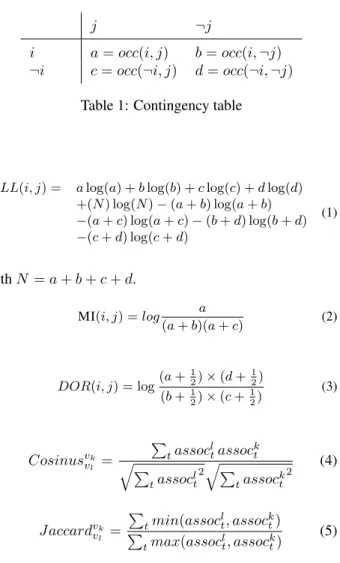
Hereafter the used association and similarity measures:
j ¬j
i a = occ(i, j) b = occ(i, ¬j)
¬i c = occ(¬i, j) d = occ(¬i, ¬j)
Table 1: Contingency table
LL(i, j) = a log(a) + b log(b) + c log(c) + d log(d) +(N ) log(N ) − (a + b) log(a + b) −(a + c) log(a + c) − (b + d) log(b + d) −(c + d) log(c + d) (1) with N = a + b + c + d. MI(i, j) = log a (a + b)(a + c) (2) DOR(i, j) = log(a + 1 2) × (d + 1 2) (b +12) × (c +12) (3) Cosinusvk vl = P tassocltassockt q P tassoclt 2qP tassockt 2 (4) Jaccardvk vl = P tmin(assoclt, assockt) P tmax(assoclt, assockt) (5) with assocl
t for instance that refers to a given association
3.2. Length of MWTs
In contrast to (Hamon and Nazarenko, 2001) method, our semi-compositional method is not limited to MWT composed of two elements. It can be applied to MWT of any length as long as they follow the rules R1 and
R2 (Hamon and Nazarenko, 2001). We extend the rules
from (Hamon and Nazarenko, 2001) to the semantic level and generalize them to MWT of any length. We extend the compositional rules R1 and R2 by replacing
syn(CCT1, CCT2) which means synonym relation
be-tween CCT1 and CCT2 by sem(CCT1, CCT2), which
means semantic relation between CCT1 and CCT2. RG1
corresponds to the generalized rule R1 (respectively, RG2
corresponds to the generalized rule R2) and T1, T2, E1, E2
can be MWTs. In addition, we remove the rule R3relying
on the results of (Hamon and Nazarenko, 2001) where they have shown that is the less productive and reliable rule. We obtain the following rules:
• RG
1 : T1= T2∧ sem(E1, E2) ⊃ sem(CCT1, CCT2)
• RG
2 : E1= E2∧ sem(T1, T2) ⊃ sem(CCT1, CCT2)
Table 2 illustrates some MWT synonym examples in French, English and Spanish from the wind energy cor-pus that are attested MWT synonyms in wind energy ter-minology banks. Most of the examples of Table 2 fol-low the rule that one of the parts of the MWT and its synonym remain unchanged (wind turbine/wind machine, power supply/energy supply, énergie renouvelable/énergie durable, etc.). For each MWT, we alternatively fix the left part and extract the semantically related words of the right part (and vice-versa, fix the right part and extract the se-mantically related words of the left part). This corresponds to rules RG
1 and R2G. We filter the obtained MWTs
accord-ing to the n-grams extracted from the specialized corpora. One drawback of this method is the impossibility to treat synonyms that do not follow the above cited rules, for in-stance, the MWT moulin à vent ’windmill’ and its synonym éolienne’wind turbine’. We do not address this particular case in this paper.
4.
Experimental Setup
In this section, we will describe the data and the different parameters used in our experiments.
4.1. Corpora and reference lists
The experiments have been carried out on the French/English/Spanish specialized corpus from the domain of wind energy of 400,000 words3. The corpus
has been normalized through the following linguistic pre-processing steps: tokenization, part-of-speech tagging, and lemmatization. To build our reference lists, we selected the French MWT pairs from the Terminalf4linguistic resource.
3Wind energy corpora can be downloaded from the
website http://www.lina.univ-nantes.fr/ ?Ressources-linguistiques-du-projet.html
4http://www.terminalf.scicog.fr
English term synonyms wind turbine wind machine power supply energy supply power plant electricity plant savonius model savonius type energy output energy production sea wind farm offshore wind farm wind farm wind power plant wind turbine aeroturbine
French term synonyms énergie renouvelable énergie durable centrale électrique centrale éolienne unité de stockage dispositif de stoskage arbre primaire arbre lent
force du vent vitesse du vent éolienne moulin à vent
Spanish term synonyms ángulo de paso ángulo de calaje extremo de la pala punta de la pala mapa de vientos mapa eólico
coeficiente de potencia coeficiente de rendimiento implantación de las máquinas implantación de aerogeneradores aerogenerador torre eólica
Table 2: Examples of English/French/Spanish synonyms of multi-word terms recorded in terminology banks of the wind energy domain
From 84 MWTs of the wind energy domain, we obtained 34 French MWT synonyms as a result of filtering out SWT synonyms and after checking that the MWT synonyms occur in the specialized corpora. For English, we selected the MWT pairs from the glossary of wind energy from the online book (Gipe, 2004) and from the linguistic resource Termium5. As a result of filtering and of corpus projection,
we obtained 20 English MWT pairs. For Spanish, we found 64 MWT listed in the Lexique panlatin de l’énergie éolienne6. Applying the same filtering process than French
and English, we obtained 26 Spanish MWT pairs. The small size of the reference lists can be explained by the fact that the term should follow the principle of monosemy and mononymy recalled by Bowker and Hawkins (2006:83): a term should be applied to a single concept, and a concept should be designed by only one term. So, synonyms of terms are rare phenomena. Another reason is that small specialized corpora contain a limited set of specialized terms.
4.2. Dictionary-based method
We used as baseline the method proposed by (Hamon and Nazarenko, 2001). To extract French synonyms of
single-5http://www.btb.termiumplus.gc.ca/
tpv2alpha/alpha-eng.html?lang=eng
6http://www.bt-tb.tpsgc-pwgsc.gc.ca/btb.
word terms we used the on-line dictionary DES 7. DES
Contains 49,168 entries and 201,511 synonym relations. The initial database has been constructed from seven dic-tionaries. The extraction of English synonyms has been conducted using the lexical database WordNet8. WordNet
contains aproximatly 117,000 synsets. The main relation among words in WordNet is synonymy.
4.3. Distributional Method Settings
Using the distributional method, three major parameters need to be set:
1. The size of the window used to build the context vec-tors (Morin et al., 2007; Gamallo, 2008)
2. The association measure (the log-likelihood (Dun-ning, 1993), the point-wise mutual information (Fano, 1961), the discounted odds-ratio (Laroche and Langlais, 2010),...)
3. The similarity measure (the weighted Jaccard index (Grefenstette, 1994), the cosine similarity (Salton and Lesk, 1968),...)
To build the context vectors we chose a 7-window size. We used MI, LL and DOR as association measures and COS and JAC as similarity measures.
We use the mean average precision MAP (Manning et al., 2008) to evaluate the quality of the system.
M AP = 1 |W | |W | X i=1 1 Ranki (6)
where |W | corresponds to the size of the evaluation list, and Rankicorresponds to the ranking of a correct synonym
candidate i.
5.
Results
In this section we present the experimental results con-ducted on the French/English/Spanish wind energy corpus for the extraction of MWTs synonyms. We refer to the method of (Hamon and Nazarenko, 2001) as "baseline" and refer to our method as "Semi-Comp".
Method French English Spanish Baseline 0.25 3.63 8.09 Semi-Comp(MI-COS) 27.4 32.6 24.7 Semi-Comp(DOR-COS) 26.8 27.2 14.2
Semi-Comp(LL-JAC) 31.4 36.1 18.8
Table 3: Results on the wind energy corpus (MAP%) We can see from Table 3 that the Semi-Compositional ap-proach outperforms significantly the baseline for all lan-guages. The Semi-Compositional approach obtains 31.4% of MAP for the French corpus (LL-JAC configuration), 36.1% of MAP for the English corpus (LL-JAC config-uration) and 24.7% of MAP for the Spanish corpus (MI-COS configuration) while the baseline could only obtain 0.25%, 3.63% and 8.09% of MAP for the three corpora.
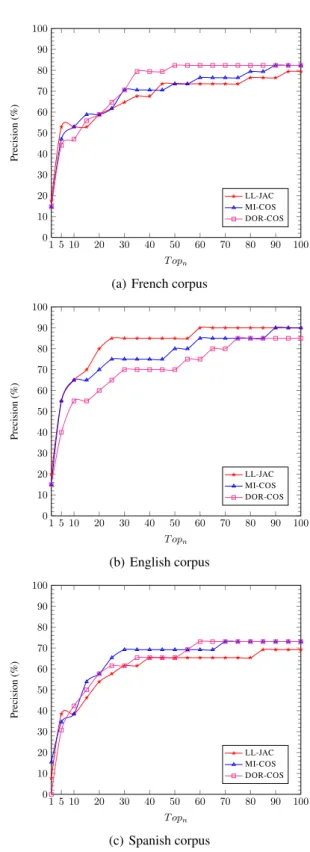
7http://www.crisco.unicaen.fr/des/ synonyms 8http://wordnetweb.princeton.edu/perl/ webwn/ 1 5 10 20 30 40 50 60 70 80 90 100 0 10 20 30 40 50 60 70 80 90 100 T opn Precision (%) LL-JAC MI-COS DOR-COS
(a) French corpus
1 5 10 20 30 40 50 60 70 80 90 100 0 10 20 30 40 50 60 70 80 90 100 T opn Precision (%) LL-JAC MI-COS DOR-COS (b) English corpus 1 5 10 20 30 40 50 60 70 80 90 100 0 10 20 30 40 50 60 70 80 90 100 T opn Precision (%) LL-JAC MI-COS DOR-COS (c) Spanish corpus
Figure 1: Comparison (T opn) of different configurations of
the Semi-Compositional approach on the French, the En-glish and the Spanish corpus
Figure 1 shows the behavior of the Semi-Compositional approach according to different configurations. For the French corpus, we can note that the configuration LL-JAC gives the best precision for top1 and top5. It is
then significantly outperformed by the configuration DOR-COS (from top35) and slightly outperformed by the
config-uration MI-COS (from top60). The results of MI-COS in
contrastive.
Concerning the English corpus, the results are quite differ-ent comparing to the results of the French corpus. As we can see, the LL-JAC configuration always outperforms the two other configurations except from top5to top10and for
the last tops where the MI-COS configuration shows the same precision. We can also see that the DOR-COS con-figuration is always outperformed except for top1and from
top75to top85where it shows the same results as MI-COS.
The results are more contrastive for the Spanish corpus. We can nonetheless observe that the MI- COS configuration performs the best in general.
It is not straightforward to choose the best configuration according to the results of Figure 1. That said, we can sup-pose that a tuning process or a combination of the different configurations should be a suitable alternative.
There are terms of which the synonym appears at the first position of the synonym list such as for English: lattice construction/lattice tower, drive train/power train, nominal speed nominal power, for French: éolienne offshore/éolienne en mer, générateur synchrone/machine synchrone machine à induction générateur à induction, site éolien/parc éolien, for Spanish: torre eólica/turbina eólica, coeficiente de rendimiento/ coeficiente potencia im-plantación máquina/imim-plantación aerogeneradores. Some of them such as lattice construction/lattice tower are col-locations in the sense that lattice accepts only a right con-text either construction or tower. When the synonym is closed to the first position, we notice that the candidate synonyms that appears before are either flexional or deriva-tional variants such as for generador asíncrono, the mor-phological variants generador sincrónicos and generador sincrónicosappear just before the recorded synonym gen-erador a inducción, or other synomyms such as for frein à disque, the recorded synonym frein mécanique appears at Top3whether frein aérodynamique which appears before is
a valid synonym too. Of course, the distributional analysis fails for a few MWTs when the recorded synonym appears too far in the list or when it is simply not found. If we de-cide to filter out the MWT synonym candidates that are not sharing the same syntactic structure than the term, we can obtain the recorded synonym at the first position: for the term viento aparente, the recorded synonym viento rela-tivoof N A structure appears at Top14and all the candidate
MWT synomyns that appear before share other grammati-cal structures viento fuerza/ N N, viento denominar/N V.
6.
Discussion
Few approaches to extract synonyms of MWTs have been proposed so far. To our knowledge, only (Hamon and Nazarenko, 2001) addressed this task following the prin-ciple of compositionality. The weak results obtained by the baseline can be explained by two facts: (i) in special-ized corpora, dictionaries of synonyms are often not avail-able; (ii) relying on lexicons from the general domain can lead to irrelevant or off-topic MWTs as shown in our ex-periments. The main contribution of our approach is the use of distributional analysis instead of dictionaries. Distri-butional analysis allows us to identify semantically related words that will be used to discover MWT synonyms
us-ing the compositionality principle. We also highlight the fact that MWT synomyms are not always composed of the synonyms of its elements, and that distributionally related words is suitable for this task. Finally, our method is not limited to MWTs composed of two elements. It can be ap-plied to any MWT that follows the rules RG
1 and RG2. If we
have demonstrated that MWT synonyms could be discov-ered by distributional analysis, we still need to improve the precision in order to obtain valid synonym candidates at the first positions. Several filters and ranking methods should be proposed to improve the ranking and to filter out wrong synonym candidates.
7.
Conclusion
We presented in this paper a semi-compositional method for synonym extraction of multi-word terms. Based on the principal of compositionality and distributional seman-tics, our method has shown significant improvements while compared to the state-of-the-art approach for the discov-ering of MWT synomyms. If more investigation is cer-tainly needed for particular cases, the encouraging results lend support the idea that combining compositionality with distributional semantics is a relevant way to handle MWT synonym extraction. For future work, we will explore syn-onym extraction of MWT that are not compositional (SWT) and conversely, explore synonyms of SWT that are MWTs.
Acknowledgments
The research leading to these results has received fund-ing from the French National Research Agency under grant ANR-12-CORD-0020 (CRISTAL project).
8.
References
Daniel Andrade, Masaaki Tsuchida, Takashi Onishi, and Kai Ishikawa. 2013. Synonym acquisition using bilin-gual comparable corpora. In International Joint Con-ference on Natural Language Processing (IJCNLP’13), Nagoya, Japan.
Vincent D. Blondel and Pierre Senellart. 2002. Automatic extraction of synonyms in a dictionary.
Lynne Bowker and Shane Hawkins. 2006. Variation in the organization of medical terms - exploring some motiva-tions of term choice. Terminology, 12(1):79–110. Ted Dunning. 1993. Accurate Methods for the Statistics of
Surprise and Coincidence. Computational Linguistics, 19(1):61–74.
Robert M. Fano. 1961. Transmission of Information: A Statistical Theory of Communications. MIT Press, Cam-bridge, MA, USA.
Olivier Ferret. 2010. Testing semantic similarity mea-sures for extracting synonyms from a corpus. In Nico-letta Calzolari, Khalid Choukri, Bente Maegaard, Joseph Mariani, Jan Odijk, Stelios Piperidis, Mike Rosner, and Daniel Tapias, editors, LREC.
Otero Gamallo. 2008. Evaluating two different methods for the task of extracting bilingual lexicons from compa-rable corpora. In Proceedings of LREC 2008 Workshop on Comparable Corpora (LREC’08), pages 19–26, Mar-rakech, Marroco.
P. Gipe. 2004. Wind power: renewable energy for home, farm, and business. Chelsea Green Pub. Co.
Gregory Grefenstette. 1994. Explorations in Automatic Thesaurus Discovery. Kluwer Academic Publisher, Boston, MA, USA.
Masato Hagiwara. 2008. A supervised learning approach to automatic synonym identification based on distribu-tional features. In Proceedings of the ACL-08: HLT Stu-dent Research Workshop, pages 1–6, Columbus, Ohio, June. Association for Computational Linguistics. Thierry Hamon and Adeline Nazarenko. 2001. Detection
of synonymy links between terms: experiment and re-sults. In Recent Advances in Computational Terminol-ogy, pages 185–208. John Benjamins.
Zellig S Harris. 1954. Distributional structure. Word. Donald Hindle. 1990. Noun classification from
predicate-argument structures. In ACL, pages 268–275.
Marcus Kraft. 2007. Compositionality: The very idea. Re-search on Language and Computation, 5(3):287–308. Audrey Laroche and Philippe Langlais. 2010. Revisiting
Context-based Projection Methods for Term-Translation Spotting in Comparable Corpora. In Proceedings of the 23rd International Conference on Computational Lin-guistics (COLING’10), pages 617–625, Beijing, China. Dekang Lin, Shaojun Zhao, Lijuan Qin, and Ming Zhou.
2003. Identifying synonyms among distributionally sim-ilar words. In IJCAI-03, Proceedings of the Eighteenth International Joint Conference on Artificial Intelligence, Acapulco, Mexico.
Dekang Lin. 1998. Automatic retrieval and clustering of similar words. In Proceedings of the 36th Annual Meet-ing of the Association for Computational LMeet-inguistics and 17th International Conference on Computational Lin-guistics - Volume 2, ACL ’98, pages 768–774, Strouds-burg, PA, USA. Association for Computational Linguis-tics.
D Christopher Manning, Prabhakar Raghavan, and Hinrich Schütze. 2008. Introduction to information retrieval. Cambridge University Press.
Emmanuel Morin and Béatrice Daille. 2012. Revising the compositional method for terminology acquisition from comparable corpora. In 24th International Conference on Computational Linguistics, Proceedings of the Con-ference: Technical Papers, Coling’12, pages 1797–1810, Mumbai, India.
Emmanuel Morin, Béatrice Daille, Koichi Takeuchi, and Kyo Kageura. 2007. Bilingual Terminology Mining – Using Brain, not brawn comparable corpora. In Pro-ceedings of the 45th Annual Meeting of the Association for Computational Linguistics (ACL’07), pages 664–671, Prague, Czech Republic.
J. Morris and G. Hirst. 2004. Non-classical lexical se-mantic relations. In HLT-NAACL Worlshop on Compu-tational Lexical semantics (CLS’04), pages 46–51. ACL. Barbara H. Partnee, Alice ter Meulen, and Robert E. Wall. Mathematical Methods in Linguistics, volume 30 of Studies in Linguistics and Philosophy. Dordrecht, kluwer edition.
P. Resnik. 1993. Selection and Information: A class-based
approach to lexical relationships. Ph.D. thesis, Univer-sity of Pennsylvania.
Gerard Salton and Michael E. Lesk. 1968. Computer eval-uation of indexing and text processing. Journal of the Association for Computational Machinery, 15(1):8–36. Lonneke van der Plas and Jörg Tiedemann. 2006. Finding
synonyms using automatic word alignment and measures of distributional similarity. In 21st International Con-ference on Computational Linguistics and 44th Annual Meeting of the Association for Computational Linguis-tics ACL’06, Sydney, Australia.
Hua Wu and Ming Zhou. 2003. Optimizing synonym ex-traction using monolingual and bilingual resources. In In Proceedings of the second international workshop on Paraphrasing, page 72.