Assessing hydro-climatic uncertainties on hydropower
generation
Mémoire
Fatemeh Movahedinia
Maîtrise en génie des eaux
Maître ès sciences (M.Sc.)
Québec, Canada
iii
RÉSUMÉ
Dans le cadre de ce travail, nous avons quantifié l’impact des incertitudes hydrologiques et climatiques sur la production hydroélectrique dans le bassin de la rivière Gatineau. L’approche mise en œuvre repose sur des simulations climatiques, la modélisation hydrologique et l'optimisation de l'exploitation des réservoirs.
Les résultats hydrologiques confirment ce que d’autres études ont déjà montré, à savoir un hydrogramme plus contrasté, marqué par une fonte des neiges plus précoce et un volume de crue plus important, suivi d’une saison estivale plus sèche que par le passé. En termes de production d’énergie, cela se traduit par une production attendue d’énergie supérieure mais également plus variable. Ce gain d’énergie se produit essentiellement à la fin de l’hiver-début du printemps et fait suite aux précipitations plus importantes sur le bassin au cours de l’hiver. Compte tenu des caractéristiques physiques du système (capacités de stockage et de turbinage), les modifications du régime hydrologique entrainent des déversements supplémentaires, essentiellement pendant la fonte des neiges.
v
ABSTRACT
This research quantifies the impact of hydrological and climatic uncertainties on hydropower generation in the Gatineau River basin. The proposed approach is based on climate simulations, hydrological modeling and optimization of reservoir operation.
Hydrological results from this study confirm what other studies have shown, a more mixed hydrograph marked by earlier snow melting and greater flood volume, followed by drier summers than in the past. In terms of energy production, this translates into an expected increase in energy but also in a more variable production. This gain of energy mainly occurs in the late winter-early spring and follows the higher rainfall in the basin during the winter. Given the physical characteristics of the system (storage and turbine capacity), changes in the hydrological regime entail additional spills, mainly during snowmelt.
vii
TABLE OF CONTENTS
RÉSUMÉ ... iii
ABSTRACT...v
TABLE OF CONTENTS ... vii
LIST OF TABLES ... ix
LIST OF FIGURES ... xi
ACKNOWLEDGEMENTS ... xiii
Chapter 1: Introduction ...1
1.1. Research Context ...1 1.2. Research Objectives ...1 1.3. Thesis Outline ...2Chapter 2: Review of Studies on Climate Change Impacts on Water
Resources and Hydropower ...3
2.1. Climate Change Impacts on Hydrological Regime ...3
2.2. Climate Change Impacts on Hydropower Production ...4
Chapter 3: Methodology ...7
3.1. General Description of the System ...7
3.2. Description of Data ...8
3.3. The Hydrological Model Calibration Procedure ... 10
3.4. Hydro-Climatic Projection Chain ... 11
3.5. The Reservoir Optimization Problem ... 11
3.6. Performance Evaluation ... 13
3.7. Assumptions ... 14
Chapter 4: Results and Discussion ... 15
4.1. Calibration and Validation Performance ... 15
4.2. Climate Change Impacts on Climate Variables ... 15
4.2.1. Precipitation and Temperature Impact ... 15
4.3. Climate Change Impacts on Hydrological Regimes ... 16
4.3.1. Stream Flow Impact ... 16
4.4. Climate Change Impacts on the Water Resource System ... 18
4.4.1. Reservoir Operation Rules ... 19
4.4.2. Energy Generation Impact ... 20
4.4.3. Measures of System Performance With Respect to Energy Generation ... 22
4.4.4. Uncertainty of Unproductive Spill Impact ... 23
Chapter 5: Conclusions and Recommendations ... 25
viii
5.2. Recommendations for Future Research... 26
REFERENCES ... 27
ANNEXES ... 31
Appendix A: Hydrographs ... 31
Appendix B: Mean Annual Water Storages ... 32
Appendix C: Monthly Energy Generations ... 32
ix
LIST OF TABLES
Table 1: Calibration and validation performance (NSEsqrt [-]) of hydrological models at each subbasin ... 15
xi
LIST OF FIGURES
Figure 1: (a) Map of the Ottawa River drainage basin with the Gatineau River. (b) The Gatineau
River watershed (five subbasins). (c) Water resource system schematic ...8
Figure 2: The process of hydrologic projection ...9
Figure 3: Twenty hydrological models structure (adapted from Seiller et al., 2012) ... 10
Figure 4: Optimization of the reservoir operation problem (adapted from Labadie, 2004) ... 12
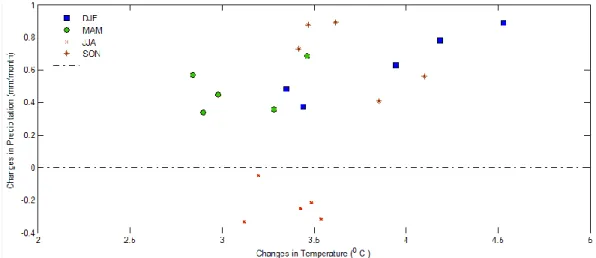
Figure 5: Scatter plot of seasonal changes in precipitation and temperature between future and reference period for the Gatineau River watershed ... 16
Figure 6: The total, hydrological models and natural climate of the overall mean flow evolution (between REF and FUT, %) for the Gatineau River watershed ... 17
Figure 7: The total, model and climate member uncertainty with the constructed member sets from five climatic members (twenty-five sets) for the Gatineau River watershed ... 18
Figure 8: Baskatong reservoir monthly water storage for FUT (2041-2070) and REF (1961-1990) periods for different climate natural variability, including twenty lumped hydrological models ... 19
Figure 9: The total, hydrological models and natural climate of the overall mean energy generation evolution (between REF and FUT, %) for the Gatineau River watershed ... 20
Figure 10: (a) Box plot and (b) CDF plot of annual energy generation including five climate members per lumped conceptual model (150 values) for the Gatineau system ... 21
Figure 11: The box plot of the average monthly relative changes of energy generation between FUT and REF conditions for Gatineau system for different climate members, each box plot includes twenty lumped conceptual models ... 22
Figure 12: Cumulative Distribution Function of reliability (a) and vulnerability (b) of the entire system regarding the energy generation for FUT and REF projections ... 23
Figure 13: The box plot (Top) and CDF plot (Bottom) of projected total annual energy spills for the entire system (blue ranges represent FUT and gray ones represent REF) ... 24 Figure 14: Benefit foregone due to spillage losses (annual pattern) for the entire Gatineau system 24
xiii
ACKNOWLEDGEMENTS
I would like to express my gratitude to Professor Amaury Tilmant for his guidance and knowledge through the period of preparation of the thesis plan and the research itself. I would also like to extend my appreciation to Professor François Anctil for presenting this opportunity to me and his continued support.
I am thankful to Professor Geneviève Pelletier for her comments that have definitely improved my thesis.
Very special thanks to Gregory Seiller for sharing his expertise and knowledge of Matlab programming. He always responded to my queries that really helped me have better knowledge about my simulation results.
I extend my gratitude to Dr. Philipp Meier and Dr. Guilherme Fernandes Marques for opening my mind to the interesting world of research and encouraging me to go ahead.
Thanks also to all the my supportive colleagues and friends, Gregory, Diane, Mabrouk, Youen Jérôme, Flora, Islem, Anne, Slim, Darwin, Annie-Claude, François, Benoit, Antoine, Sepideh, Sonya and Nicolas for providing a good atmosphere in our group and for useful discussions.
My greatest appreciation goes to my parents and my siblings who encouraged me in all my decisions and made my studies possible. Without their support, love and the convictions they passed on to me, I would perhaps never have made my way into a technical institute and a scientific degree.
An important thanks goes to my brother Amir for always believing in me, for his endless encouragement, unwavering support and timely advice. He always reminded me to take deep breathes at times when I felt like exploding from all the pressure. Thanks to him for questioning me about my ideas, helping me think rationally and for hearing my problems.
I also place on record, my sense of gratitude to one and all who, directly and indirectly, have lent their helping hand in this venture.
1
Chapter 1: Introduction
1.1. Research Context
In the twenty-first century, global climate change has become one the greatest challenges facing human societies. Rising temperatures and changes in precipitation patterns are expected to be the result of increased greenhouse gas emissions including carbon dioxide. Because various human activities depend on water, it is expected that the water sector will play a pivotal role in adaptation strategies (Harrison and Whittington, 2002).
In the energy sector, the production of hydroelectricity will be affected if the hydrological regime of the rivers is altered by climate change. Although there are many works devoted to climate change impacts on hydropower generation, some research questions have so far been little explored, especially those related to some sources of uncertainty. In the context of climate change, there are different sources of uncertainty related to climate (global climate simulation, future levels of gas emissions and natural variability) and to the modeling techniques and approaches used in realizing the impact study (hydrological model, calibration method, downscaling method and adaptation strategies). To the best of our knowledge, uncertainties associated with the hydrological model structure and the climate natural variability have not been extensively studied.
Typically, the modeling of climate change impacts on a given water resources system requires a large number of phases, each bringing its own uncertainties. Understanding the relative contribution of each source of uncertainty is therefore a prerequisite to the understanding of climate change impacts and the design, analysis and implementation of adaptation strategies.
The scope of this research is to explore the potential impacts of climate change by considering the sensitivity analysis (the choice of hydro-meteorological tools) on reservoir operation, including hydropower production. More specifically, this work confronts uncertainties related to natural climate variability and to lumped hydrological model structures in the context of climate change impacts on a specific water resources system in Quebec.
1.2. Research Objectives
This work investigates possible impacts of climate change on the hydrological regime of the Gatineau River basin and assesses the relative contribution of the uncertainties that come from the lumped hydrological model structures and the climate natural variability.
The specific objectives are to:
1. Carry out a hydrological modeling of the Gatineau River basin under a reference and future periods to assess the alteration of the flow regime due to climate change;
2
2. Explore the uncertainty of the hydrologic processes by repeating (1) for various hydrological model structures (up to twenty);
3. Explore the uncertainty associated with the natural variability of the climate by repeating (2) for five climate members provided by Environment Canada; and
4. Assess the impact of climate change on the production of energy using an optimization-based reservoir operation model of the cascade of power stations in the Gatineau River basin.
1.3. Thesis Outline
This thesis contains five chapters organized as follows:
Chapter two describes an overview of the literature useful in this area of study.
Chapter three deals with the material and methods adopted for this study. It gives a brief description of the case study and the data used. Also, this chapter provides a brief description of the sources of the uncertainty for assessing climate change impacts on hydrological regimes and hydropower production.
Chapter four discusses the results of the impact of climate change on hydrological regimes as well as the impacts on hydropower production and reservoir operation. Particularly, analysis of the potential prediction uncertainties induced by hydrological model structures and climate natural variability is discussed in this chapter. This chapter highlights the results of hydropower simulations and the changes on hydropower systems that could be expected in the future by considering various indicators.
And finally, Chapter five contains a summary of the main results, the conclusions and recommendations for future research work.
3
Chapter 2: Review of Studies on Climate Change Impacts
on Water Resources and Hydropower
Many studies have analyzed the hydrological impacts of climate change. However, little attention is paid to the uncertainties associated with the modeling process. Moreover, the number of studies dealing with the impact of climate change on the operation of water resource systems is also limited.
2.1. Climate Change Impacts on Hydrological Regime
In recent years, a great effort has been devoted to investigate the impact of climate change on the hydrological regime in different regions of the world. The projection of future river flows is affected by different sources of uncertainty in the hydro-climatic modeling chain such as gas emission scenarios, global climate modeling, downscaling and hydrological modeling.
Seiller and Anctil (2013) investigated the impacts of climate change on the hydrological regime of a Canadian river addressing the uncertainties that come from lumped hydrological modeling structures and natural climate variability, illustrated by several members from the same global model, potential evapotranspiration formulations and snowmelt modules. They found that natural climate variability is a major source of uncertainty followed by potential evapotranspiration formulas, hydrological model structures and snow modules.
Minville et al. (2008) applied ten climate projections that were obtained from five general circulation models (GCMs) and two greenhouse gas emission scenarios (GHGES). They worked on a Canadian river and they noticed that the largest uncertainty came from GCM related to downscaling and hydrological modeling.
Ludwig et al. (2009) investigated hydrological model complexity and its response under climate change by employing the distributed model PROMET, the semi-distributed model HYDROTEL and a lumped model (HSAMI). Authors mentioned that the levels of complexity of the hydrological models play a considerable role when evaluating climate change impacts.
Muerth et al. (2012) used a complex model chain consisting of four different global climate models, downscaled by three different regional climate models, an exchangeable bias correction algorithm, a separate method to scale RCM outputs to the hydrological model scale and several hydrological models with different level of complexity to assess the impact of different hydro model concepts while Kay et al. (2006) compared six different sources of uncertainty: gas emission scenarios, global climate modeling (GCM), climate downscaling, natural variability (which is disclosed by calculating GCM runs from slightly modified initial conditions), and hydrological model structures and parameters.
4
Poulin et al. (2011) investigated model structure uncertainty and parameter equifinality in climate change studies at a Canadian site. They concluded that model structure uncertainty has more important role in determining the impact of climate change than parameter uncertainty.
Velázquez et al. (2013) studied the impact of climate change on water resources with the incorporation of different hydrological models to investigate the uncertainty that arises from hydrological models for two catchments; one located in Southern Quebec (Canada) and one in Southern Bavaria (Germany).They used different hydrological indicators: an overall mean flow, the 2-year return period low flow, the 2-year return period high flow and the Julian day of spring-flood at half volume. They noticed that the choice of model significantly affects the climate change response of selected hydrological indicators, especially those related to low flows.
Whitfield and Cannon (2000) investigated climatic variation and hydrology in Canada 1976-to 1995. In general, temperature was warmer in recent periods, especially in the summer and fall and more pronounced for western and eastern parts of Canada. Southern portions of Ontario, Quebec, Nova Scotia, and the Yukon showed warmer temperatures in January as well as in June and July. Regarding precipitation, a decrease will be more widespread in northern Canada and also south of Canada but there are some exceptions such as minimal decreases in precipitation in Southern Quebec, Eastern Newfoundland, and southern portions of Southern Ontario. They found hydrographs with an earlier spring flood, higher winter flow and lower summer flow.
Along the same lines, many earlier studies (Gleick and Chaleki, 1999; McCabe and Wolock, 1999; Hamlet and Lettenmaier, 1999; Lettenmaier et al., 1992; Lettenmaier and Gan, 1990) confirmed that the recognized shifts of peak discharge in seasonal runoff are associated with (or caused by) reduced winter snow accumulation, earlier peak snowmelts, higher winter runoff, higher evapotranspiration, and thus, lower summer and autumn stream flows.
2.2. Climate Change Impacts on Hydropower Production
Global climate change is expected to have a strong impact on water resources (Intergovernmental Panel on Climate Change (IPCC), 2007). Hydropower production, depending on river flow, is sensitive to total runoff (quantity and timing). Therefore, an increase in climate variability even with no change in the average annual runoff could impact hydropower output and performance.
Canada produces sixty percent of its electricity from hydropower. It is the third largest hydro generator in the world. Quebec, British Columbia, and Ontario generate the majority of hydroelectric power in Canada. In Quebec, more than ninety-five percent of electrical generation comes from hydroelectric sources (EIA, 2010).
Hydropower resource potential depends on factors such as topography, the volume, the variability and seasonal distribution of runoff. Not only are these regionally and locally determined, but an
5 increase in climate variability, even with no change in average runoff, can lead to reduced hydropower production unless more reservoir capacities are built and operations are modified to account for the new hydrology that may result from climate change (Kumar et al., 2011).
IPCC (2007b) and Bates et al. (2008) found both positive and negative regional effects on hydropower production (on different continents), mainly following the expected changes in river runoff. For instance, hydropower production in Northern Quebec would likely benefit from greater precipitation and more open-water conditions, but hydropower plants in Southern Quebec would likely be affected by lower water levels (Ouranos, 2004). In North America, hydropower production is known to be sensitive to total runoff, to its timing, and to reservoir levels (Bates et al. 2008). Minville et al. (2009a) employed one distributed hydrological model and three climate models forced with SRES A2 green house gas emission scenarios to investigate the management adaptation potential of a Canadian river in light of climate change. They compared all the changes in three future projection periods from 2010 to 2099. They analyzed the adaptation of water resource system management by considering the trends of reservoir levels, hydropower production, power plant efficiency and spillage. In general, they found that the significant changes in hydropower plants are linked to changes in hydrological regimes. With regards to the efficiency of power plants, a reduction in 2050 and 2080 was shown. However, the efficiency increases in 2020. These changes are statistically significant for power plants in the context of annual mean flow efficiency. Also, they inferred that changes in the annual and seasonal mean unproductive spills were significant for nearly all of the future periods. In their next piece of work, Minville et al. (2009b) considered thirty climate projections including five climate models, two greenhouse gas emission scenarios and three temporal horizons with one lumped conceptual hydrological model over the same site in Quebec, Canada. They concluded that the changes in hydrological regimes (annual mean flow) could directly impact hydropower. But seasonal flow changes show different trends that do not involve the same trajectory for seasonal hydropower, especially in the spring. They revealed that unproductive spills increased from upstream to downstream because of low storage capacities in upstream reservoirs with the increased flow.
Iimi (2007) noticed that there are three main impacts of climate change on hydropower projects. First, changes in hydrological regimes and hydropower operations have to be reconsidered to take into account hydrological periodicities or seasonality change. Second, changes in climate variability may lead to floods or droughts or other extreme climate events. Finally, changing hydrology and possible extreme events increase the impact of sediment risks and measures. An unexpected amount of sediment will lower turbine and generator efficiency, resulting in a decline in energy generated.
Many studies have addressed the effects of climate change on hydropower generation in California, but such analyses have been largely restricted to large lower-elevation water supply reservoirs
6
(Lund et al. 2003; VanRheenen et al. 2004) or a few individual hydropower systems (Vicuna et al. 2008 and 2009).
Raje and Mujumdar (2010) evaluated climate change impacts on multi-reservoir performances and adaptive policies for the future. They used three climate scenarios A2, A1B, and B1, and two GCMs: CGCM2 and MIROC3.2 with two future time slices, 2045-2065 and 2075-2095. They used stochastic dynamic programming to drive optimal policies in order to maximize reliability with respect to multi-reservoirs for flooding, hydropower and irrigation. They found that the mean monthly storage will decrease as a result of the hydrologic impacts of climate change. Climate changes have negative impacts on mean monthly energy generation, especially for monsoon month. In this work, four performance indices such as reliability, resiliency, vulnerability and deficit ratio power were calculated for standard operation policy and stochastic dynamic programming operation. They concluded that reservoir performance was adversely impacted under climate change. Madani and Lund (2009) investigated the potential impacts of climate change on high-elevation hydropower generation in California using the application of the Energy-Based Hydropower Optimization Model (EBHOM) that is based on energy flows and storage instead of water volume balances.
Scheafli et al. (2007) evaluated the impact of climate change on hydropower production and quantified modeling uncertainty by several indicators in the Swiss Alps. They presented their results through three types of modeling uncertainties such as climate scenario, hydrological, glacier evolution and management modeling uncertainty. They showed that climate change potentially has a statistically significant negative impact on system performance.
Carless and Whitehead (2013) studied the impacts of climate change on hydroelectric generation for a system in Mid Wales (the Plynlimon Flume catchment). They applied the IHACRES approach with two future periods covering the 2020s (2010-2039) and the 2080s (2070-2099). The climate change impacts on hydrology show shifts in flow regimes, especially during summer and winter conditions. In their study, it is noted that despite large changes in seasonal flow, the annual output of energy generation is almost unchanged due to the loss of energy generation in the summer that is compensated by increased power generation in winter months. Also, these authors suggested that planners and developers of hydropower plants might consider changing the size of their plants to take advantage of higher flows in winter months in future periods.
7
Chapter 3: Methodology
Introduction
The analysis of climate change impacts on hydrological regimes and water resource systems is carried out by simulating the system behavior for the reference (control) period and for a future horizon. This simulation can be accomplished in three stages with the aid of three types of models. First, a climate model is required to simulate the climate variables (future local climate variables). Then, a hydrological model is used to transform these climate variables into reservoir inflows. Finally a reservoir management model is employed to simulate the operation of the system using the inflows generated by the hydrological model.
In addition, to gain key information about the performance of hydrological regimes and water resource management, Overall Mean Flow (OMF), Reliability and Vulnerability (RV) indicators are applied in the context of climate change. The analysis of the performance of the hydropower system relies on energy generation, firm energy, unproductive spills, and reservoir drawdown-refill cycles. This chapter presents the case study and the water management model developed to analyze potential climate change impacts on a water resources system.
3.1. General Description of the System
The Gatineau River watershed is located in the southwestern portion of the province of Quebec. The Gatineau River rises in lakes north of the Baskatong reservoir and flows south to join the Ottawa River (Figure 1.a). The main river channel length is about 400 kilometers. The watershed’s area is about 23,700 km², which covers parts of the administrative regions of Abitibi-Témiscamingue, Lanaudière, Laurentides, Mauricie and Outaouais. The Gatineau River watershed is subdivided into five subbasins: Baskatong (12540 km²), Cabonga (2201 km²), Maniwaki (5040 km²), Paugan (2700 km²) and Chelsea (1200 km²) from upstream to downstream (Figure 1.b). Cabonga, is the most challenging for simulation, since lakes and reservoirs occupy a large portion of the area: the gauging curve used to convert water levels to stream flow can be affected by wind variations and generate some errors in measurement (Boucher et al., 2011).
The Gatineau River watershed flows are highly regulated by reservoirs, and the highest flows occur usually in spring due to snow melts. In general, the watershed is characterized by a continental climate. The climate is warm and humid during the summer, and generally wet, cold and snow covered in the winter. Still, the climatic variation is significant between the north and the south regions of the area. The watershed is used mainly for hydropower production. It contains three hydro power plants that managed by Hydro-Quebec with the respective installed capacity of 50, 219 and 148 MW for the Baskatong, Paugan and Chelsea power plants (Figure 1.c).
8
3.2. Description of Data
Historical data such as hydrological and meteorological data are provided by the Centre d’expertise hydrique du Québec (CEHQ). Climatic data comes from the Canadian Global Climate Model (CGCM version 3, IPCC, 2009), fed with the SRES A2 scenario (Nakicenovic et al., 2000). Future climate projections need to be spatially downscaled from low-resolution GCMs to the watershed scale (Maurer and Hidalgo, 2010). Data were dynamically downscaled by the Canadian Regional Climate Model (CRCM version 4.2.3, Christensen et al., 2004; Fowler et al., 2007). Consortium Ouranos provided downscaled climatic data for the reference simulation (REF, 1961-1990) and future projection period (FUT, 2041-2070). The climate natural variability is depicted by five climatic members (A21 to A25). They were bias-corrected to reduce deviations between REF and observations on precipitation and temperature. Monthly correction factors were computed for each climatic member on the thirty-year monthly average minimum and maximum temperatures and were applied on each member in order to keep their respective variance. Precipitation was corrected using the LOCal Intensity (LOCI) scaling method (Schmidli et al., 2006), adjusting mean monthly precipitation in terms of frequencies and intensity over thirty years.
Hydro-meteorological Data
The historical hydro-meteorological data such as daily precipitation (mm), maximum and minimum temperature (˚C), and observed discharge (mm) were available for the Gatineau River watershed. The historical time series cover years 1969-2005. The Canadian Regional Climate Model (CRCM) produced reference and future climate data.
Reservoir Plant Cabonga Baskatong Paugan Chelsea b) c) a)
Figure 1: (a) Map of the Ottawa River drainage basin with the Gatineau River. (b) The Gatineau River watershed (five subbasins). (c) Water resource system schematic
9 Precipitation is the primary variable in determining hydrological characteristics and changes in quantity, timing and intensity that will have an important effect on many aspects of the hydrological cycle including the alteration of river flows. The balance between water entering the catchment as precipitation and leaving through evapotranspiration determines the quantity and timing of catchment runoff. The latter eventually becomes the river flow changes in both precipitation and PET, which are expected as a result of climate change, and changes in river flow are also anticipated. Figure 2 schematically shows the procedure of simulations, applying the hydro-climatic chain.
Conceptual Hydrological Model
Lumped conceptual rainfall runoff models have been widely used in hydrology for many years. Hydrological models convert climatic inputs into runoff and are used in water resource design and operation (Lan Anh, 2008). In this study, twenty lumped conceptual hydrological models are used. Their selection is mainly based on known performance and structural diversity.
Figure3 shows the structural diversity of the twenty lumped hydrological models used in this study. This Figure embodies the "inputs" (precipitation, melting, and evapotranspiration) and "model output" (flow rate), as well as different types of "storage" such as surface or interception store (Sf), soil storage (S), lower soil or root zone storage(Ss), overland flow routing storage (RS), interflow (delayed) routing storage (RSs), groundwater storage, which can be assimilated in some cases for a slow routing (N) and main routing storage that can be assimilated to a quick routing (R).The number of free parameters varies between four and ten, and the number of storage, between two and seven.
Figure 2: The process of hydrologic projection
Output
PET
Snow Module
Hydrological
Models Calibration/ Simulation QREF, QFUT
P T F ut ur e a nd R ef er e nc e Cl im at e V a ria bles
10
Potential Evapotranspiration Formulation and Snow Module
In this study, one snow module and one potential evapotranspiration (PET) formula are considered. Snow accumulation and melt are simulated with the CemaNeige (N1) snow accounting module (Valery, 2010) based on the degree-day approach. There are two free parameters in this module: the melting rate and the snowpack thermal state coefficients. The PET formula selected for this study is Oudin (E23).It is a radiation-based formula that uses only the temperature as an input. Investigation of the sensitivity of the hydrological simulation to snow modeling and potential evapotranspiration formulas is beyond the scope of this work, but they remain sources of uncertainty in the modeling process.
3.3. The Hydrological Model Calibration Procedure
In this work, the Split Sample Test (SST) is used for calibration and validation procedures. The Split Sample Test, according to Klemeš ( 986a), is defined as a calibration based on one time period and a validation, based on another period. We used the period of 1969 to 1988 for calibration and 1988 to 2005 for validation, based on hydrological years.
The automatic optimization algorithm used to calibrate parameter values is the shuffled complex evolutionary algorithm (SCE-UA) (Duan, 2003). The mean of the square error calculated on the root-squared flows was selected as an objective function presented as:
√
∑ √ √(1)
11 Where N is the total number of observations; Qobs is the observed value and Qsim is the simulated value.
The efficiency of the models for both periods is discussed in terms of the NSEsqrt criterion (Nash and Sutcliff, 1970), a measure of agreement between observed and simulated values. NSEsqrt values range from negative infinity to 1, the latter indicating a perfect model simulation, and is calculated as:
∑ √ √
∑ √ √ ⃑⃑⃑⃑⃑⃑⃑⃑⃑⃑⃑⃑⃑⃑
(2)
3.4. Hydro-Climatic Projection Chain
It is worth underlining that the impacts of climate change on water resources and hydrological regimes encompassing different sources of uncertainty. In this study, the hydro-climatic chain is constructed with twenty lumped conceptual models and five climatic members for different projections along with one PET formula and one snow module for the Gatineau River watershed with five subbasins. The projections consist in a large number of time series for each subbasin which lead to 100 (twenty models× five climatic members) projections for the reference period (REF, 1961-1990) and 100 (twenty models× five climatic members) projections for the future period (FUT, 2041-2070).
In addition, the projection results will be transferred to the optimization tools with a total simulation of 200 runs for FUT and REF in the management model, to investigate the impact of climate change on hydropower production.
Due to the limited number of climatic members, we considered twenty-five sets (permutation of five climatic members). The advantage of this series construction is that it takes into account the natural variability of the climate. In this case, the number of values for the total uncertainty is 500 realizations (twenty models× twenty-five member set).
3.5. The Reservoir Optimization Problem
Reservoir optimization models are common for guiding reservoir operations under different conditions. Two major approaches exist for optimization, deterministic or stochastic depending on whether the hydrologic uncertainty is considered or not. An extensive review of available techniques for optimization and simulation can be found in Labadie (2004).
Hydrologic uncertainty in reservoir optimization can be considered by either explicit (ESO) or implicit (ISO) stochastic optimization methods (Tickle and Goulter, 1994). ESO integrates probabilistic descriptions of the input variables (reservoir inflows), thus directly accounting for uncertainty when optimizing the policies. Instead, ISO evaluates operation policies on a number of equally likely input
12
time series of river discharges, thus indirectly including uncertainty. Theoretically, the operation policies obtained by applying ISO are valid only for the input time series used. However, compared to ESO, ISO can be formulated to represent an optimization problem more closely (Karamouz and Houck, 1987; Rani and Moreira, 2009) and yields lower computational costs (Roefs and Bodin, 1970). In this study, the reservoir operation problem is solved using the ISO approach.
The reservoir operation problem is a sequential decision making problem as illustrated in Figure 4.
Where is the vector of inflows during period ; is n-dimensional set of control or decision variables during period ; is the vector of volume in storage at the beginning of time period , is the length of the operational time horizon, and is the cost/benefit of system operation during period .
This sequential decision-making problem can be solved by trying to maximize (minimize) the sum of benefits (cost) of the system over T periods:
∑
(3)
Where is a terminal value function and is discount factor for determining the present
values of future benefits (or costs).
The most important constraints are the mass balance equation (Eq.4), the upper and lower bounds on storage (Eq.5) and on releases (Eq.6):
(4)
(5)
(6)
Where is the system connectivity matrix; is the vector of spills; is the vector of evaporation losses; is the vector of demands, diversions, or depletions from the system; and are vectors
13 with the minimum and maximum storage volumes, respectively; and are vectors with the minimum and maximum releases, respectively.
Selection of the Optimization Model
To solve the optimization problem (Eq.3-Eq.6), we use the ResPRM model (O’Connell and Harou, 2011). ResPRM (the Prescriptive Reservoir Model) is a reservoir optimization software that can be used in conjunction with other HEC (the Hydrologic Engineering Center) models. This model uses deterministic optimization to provide a set of optimal storage allocations and reservoir releases. For the evaluation of the impact of climate change on hydropower production, we focused on reservoirs that are currently used to produce power.
This tool is used to optimize the system behavior under the observed climate for the control period of 1961-1990 and under future climate scenarios for the period of 2041-2070 for five climatic members and twenty models.
Note that the time-series data used by the model must be in DSS (the Data Storage System) format which is a database system designed to efficiently store and retrieve scientific data that is typically sequential. HEC’s Data Storage System (HEC-DSS, 2009) is used for storage and retrieval of the input and output time-series for this model.
3.6. Performance Evaluation
Two risk criteria, reliability and vulnerability, are used to analyze the performance of the system with respect to preestablished thresholds (Simonovic and Li, 2004 and Hashimoto et al., 1982).
The main interest of this present application focused on electricity production. A threshold ( ) corresponds to firm energy which is defined when 90% of the energy generation probability demands is met.
Assuming satisfactory values ( ) in the time series are those equal to or greater than some threshold , then:
Index signifies a satisfactory or unsatisfactory state of the system. The reliability indicator
can be defined as:
∑
Where, T is the total number of simulated time periods.
(8) (7)
14
The vulnerability is defined here as the maximal difference between the reference ( ) and the calculated values of a certain variable of energy generation ( ). Hence, it is computed as:
{
[
]
3.7. Assumptions
Four key assumptions are made in this study: (1) the operating rules generated by optimization are adapted to the new hydrological regime; (2) the twenty models cover structural uncertainty; (3) five climatic members are sufficient to represent the natural climate variability; and (4) by employing the Implicit stochastic programming the system’s performances are overestimated.
15
Chapter 4: Results and Discussion
The results that pertain to the entire system are discussed in the body of this chapter. The rest of the results that refer to more specific aspects (subbasins and power plants) are found in the Appendix.
4.1. Calibration and Validation Performance
Performance results for calibration and validation of the twenty lumped conceptual models for the five subbasins are synthesized in Table 1. These results illustrate the difficulty of recognizing a single hydrological model that offers good performance (based on the structure of the models and their features). The result for each subbasin is promising for the NSEsqrt coefficient (as discussed in section 3.3).
Table 1: Calibration and validation performance (NSEsqrt [-]) of hydrological models at each subbasin
Sub-basin Baskatong Paugan Chelsea Maniwaki Cabonga
Model Cal Val Cal Val Cal Val Cal Val Cal Val
Md1 0.76 0.86 0.76 0.78 0.72 0.70 0.66 0.65 0.44 0.48 Md2 0.76 0.82 0.76 0.74 0.72 0.67 0.76 0.76 0.36 0.45 Md3 0.75 0.86 0.75 0.72 0.69 0.60 0.68 0.61 0.44 0.48 Md4 0.69 0.84 0.69 0.65 0.65 0.56 0.61 0.55 0.42 0.46 Md5 0.76 0.87 0.76 0.78 0.74 0.70 0.74 0.79 0.45 0.52 Md6 0.76 0.86 0.76 0.71 0.72 0.62 0.75 0.71 0.38 0.44 Md7 0.75 0.80 0.75 0.72 0.71 0.60 0.69 0.64 0.39 0.43 Md8 0.72 0.75 0.72 0.65 0.70 0.60 0.70 0.66 0.41 0.40 Md9 0.76 0.86 0.76 0.73 0.70 0.61 0.64 0.65 0.43 0.50 Md10 0.71 0.86 0.71 0.78 0.66 0.70 0.61 0.66 0.40 0.51 Md11 0.76 0.86 0.76 0.73 0.74 0.67 0.72 0.73 0.42 0.48 Md12 0.76 0.84 0.76 0.73 0.66 0.63 0.69 0.64 0.35 0.38 Md13 0.77 0.86 0.77 0.77 0.73 0.67 0.76 0.80 0.42 0.45 Md14 0.73 0.83 0.73 0.74 0.70 0.66 0.73 0.73 0.45 0.49 Md15 0.74 0.85 0.74 0.73 0.72 0.63 0.64 0.60 0.42 0.48 Md16 0.77 0.87 0.77 0.76 0.74 0.63 0.70 0.66 0.41 0.50 Md17 0.76 0.85 0.76 0.75 0.73 0.67 0.75 0.80 0.46 0.50 Md18 0.75 0.82 0.75 0.79 0.72 0.67 0.68 0.70 0.44 0.51 Md19 0.76 0.85 0.76 0.80 0.69 0.70 0.66 0.74 0.44 0.51 Md20 0.77 0.86 0.77 0.79 0.74 0.70 0.76 0.78 0.42 0.49
Highest Val Perf Md16,Md5 Md19 Mds(1,5,10,19,20) Md17,Md13 Md5
Lowest Val Perf Md8 Md4,Md8 Md4 Md4 Md12,Md8
4.2. Climate Change Impacts on Climate Variables
4.2.1. Precipitation and Temperature Impact
Seasonal variability of climate data is presented in a scatter plot in Figure 5, for the Gatineau River basin. This Figure shows the changes (FUT and REF periods) in precipitation as a function of changes in temperature projected by each climatic member. For the entire system, there is inter-member variability that is more pronounced in the winter season (December to February, DJF) for which the increases in temperature are stronger compared to the other seasons. This is characterized by a larger dispersion on the scatter plots.
In a broad sense, we can see that there will be notably more water in winter from precipitation increases and less water in summer. In general, for precipitation as well as temperature, the same
16
tendency is expected as the lowest uncertainty between climate natural variability is in summer and the highest is in winter and autumn.
4.3. Climate Change Impacts on Hydrological Regimes
4.3.1. Stream Flow Impact
Figure 6 illustrates the annual OMF (the interannual average daily flow over a selected period) for the Gatineau River watershed. A complete set of simulated hydrographs are provided in Appendix A. The intent of this study is to generate an understanding of the relative change in variable values from REF and FUT periods, [(OMFFUT-OMFREF/OMFREF ] in percentage (%). The outcomes,
therefore, provide an understanding of the range of the potential consequences of climate change (the uncertainty of climate natural variability and twenty individual hydrological models) on water resources.
The uncertainty in Figure 6 for the entire system is constrained between the upper and lower limits of +40.99% and +4.01%, for a span of 36.98%. For each box and whisker plot, the middle line represents the median projected parameter, and the top and bottom of the open rectangle (the box) represents the 25th and 75th percentiles of the projections, respectively. The values of +11.11 and +21.06% depict the 0.25 and 0.75 quartiles, respectively with an interquartile range of+9.95% and a median value of+16.18% for the overall uncertainty.
Hereafter in each model uncertainty’s graph, the dashed line shows the mean of each hydrological model through five climate members. The mean changes are important for Md8 (27.23%), but the opposite holds with Md3 (10.32%), which has the lowest mean value. The largest uncertainty occurs with Md08, ranging from 9.11 to 23.33% and the smallest uncertainty, with Md03 which span reaches 11.34% (between +17.97% and +6.63%). The standard deviation (Std) of the median OMF
Figure 5: Scatter plot of seasonal changes in precipitation and temperature between future and reference period for the Gatineau River watershed
17 relative change for the hydrological model is 4.46%. The disparity in the climate natural variability graph for each climate member is low, which indicates low variability of modeling tools (hydrological model structures). The largest disparity occurs for member#3 with +24.91%. The lowest disparity comes from member#4 with +13.62%, representing a difference of +11.29% (Std 5.93%).
The results representing the overall mean flow relative changes between REF and FUT confirm that changes differ greatly from one climatic member to the other and illustrate the significance of climate natural variability in this context. Therefore, it can be concluded that the uncertainty of climate natural variability is more important than lumped conceptual hydrological model structures as depicted by the standard deviation value, which is larger than for the lumped conceptual models.
Comparison of Twenty-five Climatic Member Set Uncertainty in Terms of
Flow
In this section, we investigate the impact of climate change uncertainty based on twenty-five climatic member sets, which are constructed from five climatic members of scenario SRES A2 and also the uncertainty that arises from twenty lumped conceptual models. The advantage of this series’ construction is that it takes into account more of the natural variability of the climate and also limits uncertainty.
Figure 7 illustrates the relative changes of OMF from REF and FUT for each type of tool in the box plot of OMF total uncertainty (500 values), the box plot of the lumped conceptual models, and the box plot of climate natural variability (twenty-five sets) for the entire system. In this context, the interquartile ranges of box plots represent the inner sensitivity to the other modeling tools, and the median values illustrate the uncertainty by each tool.
Figure 6: The total, hydrological models and natural climate of the overall mean flow evolution (between REF and FUT, %) for the Gatineau River watershed
18
In this Figure, the global uncertainty (first panel) varies from +40.99% (Md8F3R3) to -1.27% (Md3F4R5) with a median value of 16.42%, while the interquartile range (IQR) is 9.25% with a percentile of 20.95% (75th percentile) and 11.65% (25th percentile).
For different hydrological models, the median OMF relative change fluctuates from Md8 to Md3 with the values of 27.4% and 9.58%, correspondingly. The median change value (17.82%) depicts the sensitivity of the lumped models with a standard deviation value of 4.33%. The interquartile range of hydrological models ranges from 10.54% (Md17) to 7.40% (Md10). In this context, Md8 behaves differently, as identified by Seiller et al. (2012).
From the climate natural variability point of view, the median value changes between F3R3 climate member set with the value of 24.13% to F4R5 (4.28%) with the standard deviation of 5.25% of the projected median which is larger than the standard deviation of the hydrological models. From the five groups of twenty-five members’ sets, the third group shows greater differences (8.56%) between median values of member sets while the fourth group indicates the lowest deviation (7.95%) of median. Group one to five refers to climatic members of the reference period considering the five climatic members of the future period (i.e. group-four refers to the climatic member-four of the reference period with the five climatic members of the future period). The interquartile range is curbed between 7.48% (F3R5) and 2.18% (F2R2), expressing lower inner sensitivity. It can be observed in this diagram that the inner sensitivity of the hydrological models is higher than the climate natural variability’s inner sensitivity.
4.4. Climate Change Impacts on the Water Resource System
Climate change can induce significant changes in the management of a water resource system, particularly on uses that are highly dependent on hydrological regimes, such as hydropower
Figure 7: The total, model and climate member uncertainty with the constructed member sets from five climatic members (twenty-five sets) for the Gatineau River watershed
19 production. This section analyzes the impact of climate change on the Gatineau River system. To achieve this, an optimization tool (Chapter 3, section 3.5) is used to optimize the operation of the system for different climatic scenarios for the reference period (1961-1990) and under future climate projection for the period of 2041-2070. The main objective of this section is to assess the impact of both climatic and hydrological uncertainties on energy generation.
4.4.1. Reservoir Operation Rules
This section addresses the climate change impacts on reservoir storages. Baskatong, Paugan and Chelsea are the three hydropower stations with storage (Figure 1). Figure 8 illustrates the Baskatong reservoir storage resulting from twenty hydrological models with five climatic members. We can see that the refill phase is shorter for the future period (2041-2070). This is the result of an earlier spring snowmelt (spring peak shift) due to early runoff. From the end of the summer to February, results portray a reduction in storage volume in future condition for all climate natural variability. At the beginning of the high flow season, the storage volumes are similar but the refill phase is much faster than for the REF period.
The reservoir storage in Paugan (Appendix B) exhibits the same behavior as Baskatong. However, the variability between the models is more pronounced. To have a better view of this result, we should work on a shorter time step, which the model was not able to implement.
Water planners and hydropower operators should consider that the operating rules have to be regionally changed based on the results (individual models) to create adaptive reservoir operation rules under climate change.
Figure 8: Baskatong reservoir monthly water storage for FUT (2041-2070) and REF (1961-1990) periods for different climate natural variability, including twenty lumped hydrological models
20
4.4.2. Energy Generation Impact
Figure 9 shows the relative changes in energy generation for the entire Gatineau River system. Results are given for the five climatic members and the twenty hydrological models. We can see that the overall uncertainty ranges from +0.97% (Md11Mb4) to +31.35% (Md8Mb3) with a median value of 13.11%. In other words, there is considerable uncertainty regarding the annual energy output of the system with an expected annual increase of 10-19%. It should be noted that none of the scenarios involves a reduction of power output.
The median OMF relative change per lumped model fluctuation confirms the sensitivity to the lumped model selection. The minimum relative changes across climate members, is for Md3 with the value of 8.56%. The mean relative change of energy generation across all models is close to member#1.
The analysis of climate natural variability reveals more variability in relation to lumped conceptual models. The maximum relative change is provided by member#3 (19.34%). The minimum changes are provided by member#2 (13.17%). The mean projected for the five climate members varies from 19.76% (member#3) to 9.71% (member#5).
For a robust estimation of energy generation in the context of climate projection and in order to decrease the uncertainty of climate natural variability, we can put each climate member in thirty years (150 values) together for all lumped models. Figure 10 shows the box plot (top) and the cumulative distribution function (CDF) of this series for the reference and future periods.
From Figure 10a, the median total energy generation in the future period per lumped conceptual model varies from 3.18 (Md8) to 2.853 TWh (Md2). The highest interquartile value is achieved by Md12 (0.53 TWh).The lowest is achieved by Md1 (0.38 TWh). In the reference period (the left box plot), the behavior of models is more uniform than the future period. The median values are from
Figure 9: The total, hydrological models and natural climate of the overall mean energy generation evolution (between REF and FUT, %) for the Gatineau River watershed
21 2.84 (Md4) to 2.52 (Md8) TWh with a difference of 0.31 TWh. The highest and lowest interquartile range is obtained by Md16 and Md20 and corresponds to 0.52 and 0.33 TWh, respectively.
Figure 10b shows the non-exceedance probability of the optimized annual energy generation over thirty years for the REF and FUT periods, which have been combined with five climate members (150 values) for each lumped conceptual model. The blue line bounds the envelope of the future period and the grayed line with the reference period (Figure 10b). The variability (the width of the envelope) of twenty models in the future period is larger than in the reference period.
Firm energy is defined as the amount of energy that can be guaranteed 90% of the time. We can see from Figure 10b that, depending on the scenario, firm energy can range between 2.1 to 2.7 TWh.
In wet years, more than 50% of the energy generation can be achieved between 2.85 and 3.19 TWh. The constant slope of the CDF curve, which implies the uniformity of the density in FUT, shows a convergence of individual models to 3.5 TWh at the end of this period. In fact, the alternative view in the CDF plot would suggest that the length of horizontal lines changes rather quickly (there is a high probability here relative to the energy generation) in the middle range and ultimately more slowly (the same at the start) in the upper end with large values. The long-left side tail of the CDF plot in REF is a result of low values that occurs in drought years.
REF
FUT
Figure 10: (a) Box plot and (b) CDF plot of annual energy generation including five climate members per lumped conceptual model (150 values) for the Gatineau system
22
Monthly Energy Generation
The average monthly energy generation’s relative changes between FUT and REF (%) at each power plant are presented in Appendix C. Figure 11 shows the monthly energy generation as a percentage for the entire Gatineau River system.
The first observation is that a more pronounced peak energy generation is captured in winter-spring months (with increased median values) which are due to hydrological regime impacts under climate change.
Another observation is that the summer months (the same trend for all members) show lower inner variability than the other seasons. This study is helpful for water managers to be able to estimate the projection uncertainty, providing options and inspirations, opening stakeholders’ minds to potentially make new choices in their management’s decisions and operation policies in response to a changing climate.
4.4.3. Measures of System Performance With Respect to Energy Generation
The two performance indices (reliability and vulnerability) are computed for total energy generation of the entire Gatineau River system under climate natural variability and hydrologic variability shown in Figure 12a and Figure 12b.
In these Figures, the blue line represents future projection and the gray line indicates the reference period. The results include all mentioned hydrologic models and climate natural variability (100 values) for future and reference periods.
Figure 11: The box plot of the average monthly relative changes of energy generation between FUT and REF conditions for Gatineau system for different climate members, each box plot includes twenty lumped conceptual models
23 The reliability (Figure 12a) of the reference period is less than the future condition, which confirms good system performance under climate change impact. More than 65% of time, the reliability of the system is 100% in the future period, while in the reference period, the system will not experience a reliability of 100%. In Figure 12b, future condition is notable for less vulnerability than for the reference period. As we expected, the vulnerability at each conceptual model is defined when the reliability of those models are under 100%. In the future projection, more than 70% of the time there is no vulnerability in the system, whereas for the reference period vulnerability is 390 GWh more than 50% of the time.
Overall, by considering all identified sources of modeling uncertainties, we can confirm that climate change will favorably affect the reservoir’s performance in terms of energy generation. The indicator values for the reference and future periods are strictly different. The reliability and vulnerability values for the reference period are worse than they are for the future condition. Increased vulnerability as well as decreased reliability is expected due to projected decreases in inflows at the reservoirs.
4.4.4. Uncertainty of Unproductive Spill Impact
Figure 13 illustrates the total annual energy spill for the entire system with 150 values (thirty years by five members). In this Figure, blue plots represent FUT and gray plots represent REF. The bold CDF plot at each range in FUT and REF indicates the multi-model average of twenty models.
(a)
(b)
Figure 12: Cumulative Distribution Function of reliability (a) and vulnerability (b) of the entire system regarding the energy generation for FUT and REF projections
24
Appendix D presents the average monthly spill distribution for different climate members compiled with twenty hydrological models for each power plant and demonstrates which are more involved in spill production.
The general behavior on the annual scale of the total spill shows an increase in future spills. The cross signs indicate the outlier of spill data. Increased total annual energy spills are due to the increased inflows into the reservoir (as discussed in section 4.3). The frequency of the total annual spill in Figure 13b shows that energy is spilled by the system 65% of times under the future climate (35% of the time, there is no spill) and 20% of times under the reference climate.
Assuming that the value of energy is (US$50/MWh), Figure 14 indicates that the benefit foregone can exceed US$10 million of year with an exceedance probability of 5% in the future (blue envelope).
REF FUT
Figure 13: The box plot (Top) and CDF plot (Bottom) of projected total annual energy spills for the entire system (blue ranges represent FUT and gray ones represent REF)
25
Chapter 5: Conclusions and Recommendations
5.1. Concluding Remarks
In this study, we analyzed the uncertainties associated with (i) the choice of the hydrological model structure and (ii) the climate natural variability in the Gatineau River basin. We also proposed a procedure for the quantitative assessment of the CC impact on the hydropower system in the Gatineau basin.
The key findings of the study are:
The analysis of the potential impacts of climate change reveals that, from July to September, the amount of rainfall will be reduced, while the opposite (more precipitation) will be observed during the rest of the year. The climate projection suggests a temperature increase over the basin for all seasons. This will affect the snowpack and thus the timing and extent of spring snowmelt.
The results regarding the OMF changes for the Gatineau watershed indicate that climate natural uncertainty is more important than the uncertainty derived from the hydrological structures. We can therefore conclude that climate natural variability plays an important role in our ability to provide a diagnosis on the impacts of climate change on the hydrologic regime of a river.
In this study, the HEC-ResPRM model was used to assess the impact of projected climate change on hydropower production of the Gatineau system. Changes in runoff yield changes in hydropower generation. As expected, during much of the year (except for the summer season), energy generation under climate natural variability will increase. Energy generation during the period of February-May for future climate is also higher than in the reference period. This is due to the increased peak runoff (warmer temperature, snow melting and an increase in precipitation) and the limited capacity of the multireservoir system to accommodate those hydrological changes.
The modified hydrological regime implies that the operating rules should be changed to maximize the production of electricity. More specifically, since the refill phase starts sooner and is also faster, the extent and timing of the depletion phase of the reservoir is critical for the production of energy before and after the spring season. This change is consistent across all climatic members.
When it comes to firm energy, results show that the reliability of the water system will tend to increase in the future, with some exceptions for conceptual models under different climate natural variability. Consequently, the vulnerability of the system will decrease over time in future projection.
26
The optimization results of the three power plants show more spills in the future conditions than in the reference period. Water is spilled during spring snowmelt because of the limited storage capacity of the existing reservoirs. The hydrologic impact of climate change is likely to result in more spills in the future, annually and seasonally with some exceptions. Enhanced management and mitigation strategies are required to account for the future climate influences on hydropower production.
5.2. Recommendations for Future Research
This section aims to suggest areas of future research and different extensions of this study. By applying the proposed methodology in this study, a decision-making framework may be further developed and applied to hydropower and water resource system to minimize the damage of climate change.
The generalization of this conclusion would require application to more sites. However, the differences in catchment properties (e.g., soil type and topography) can also influence the uncertainty from the hydrological model structures (e.g., Key et al., 2009). For future work, it is recommended to use different general circulation models (GCMs), green house gas emission scenarios (GHGEs), regional climate modeling (RCMs, downscaling methods), water resource programming models (explicit stochastic programming) , PET formulas, snow modules, hydrological indicators, other types of hydrological models (physical models), and different future horizons according to data available. For the sake of completeness of the research, the application of different GCMs is recommended but as Aronica and Bonaccorso (2013) stressed, different GCMs often provide inconsistent future scenarios.
Perhaps a single realization of thirty years of climate variability is not enough to consider all of the existent variability. It is recommended to use a longer data period in this context.
Effective practices could lessen the impact or intensity of climate change on hydropower and some of the economic effects. Without preventative measures, current practices will lead to annual losses in hydropower potential and reliability in future climates. A robust methodology and in-depth studies are required to assess the threat that climate change may pose to the existing installation and potential hydropower productions. Further study is needed on the changing adaptive policies for water resource system and modifying power plant infrastructures in order to decrease unproductive spills and increase hydropower generation.
27
REFERENCES
Aronica, G.T.and Bonaccorso, B.,: Climate change effects on hydropower potential in the Alcantara river basin in Sicily (Italy), Earth Interactions, dio:10.1175/2012EI000508.1, 2013.
Bates, B.C., Kundzewicz, Z.W., Wu, S. and Palutikof, J.P.,: Climate Change and Water, Technical Paper of the Intergovernmental Panel on Climate Change. Geneva: IPCC Secretariat, 2008.
Boucher, M.-A., Anctil, F, Perreault, L, and Tremblay, D.,: A comparison between ensemble and deterministic hydrological forecasts in an operational context, journal of Advances in Geosciences, 2011.
Carless, D.and Whitehead, P.G.,: The potential impacts of climate change on hydropower generation in Mid wales, Hydrology Research, dio: 10.2166/nh.2012.012 , 2013.
Christensen NS, Wood AW, Voisin N, Lettenmaier DP, Palmer RN : The effects of climate change on the hydrology and water resources of the Colorado river basin. Clim Change 62: 337–363, 2004. Duan, Q.,: Global Optimization for Watershed Model Calibration, in: Calibration of Watershed Models, edited by: Duan, Q., Gupta, H., Sorooshian, S., Rousseau, A., and Turcotte, R.,Water Science and Application, Vol. 6, American Geophysical Union, Washington, USA, 89–104, 2003. Energy Information Administration (EIA): International Energy Review, US Department of Energy, http://www.eia.gov, 2010.
Fowler, H. J., Biennkinsop, S., and Tebaldi, C.: Linking climate change modelling to impacts studies: recent advances in downscaling techniques for hydrological modelling. International Journal of Climatology, 27,1547-1578, 2007.
Gleick, P.H. and Chaleki, E. L.,: The impacts of climatic changes for water resources of the Colorado and Sacramento-San Joaquin River basins. J. Amer. W. Res. Assn., 35 (6), 1429-1441, 1999.
Hamlet, A. F., and Lettenmaier, D. P.,: Effects of climate change on hydrology and water resources in the Columbia River Basin. Journal of the American Water Resources Association 35(6):1597-1623, 1999.
Harrison, G. P. and Whittington, H. W.,: Susceptibility of the Batoka Gorge hydroelectric scheme to climate change. Journal of Hydrology 264, 230-241, 2002.
Hashimoto, T., Stedinger, J. R., and Loucks, D. P.,: Reliability, resiliency and vulnerability criteria for water resource system performance evaluation, Water Resources. Res., 18(1), 14 – 20, doi:10.1029/ WR018i001p00014, 1982.
HEC-DSSVue: HEC Data Storage System Visual Utility Engine, User's Manual,version 2.0, CEIWR-HEC,2009.
Iimi, A.,: Estimating Global Climate Change Impacts on Hydropower Projects: Applications in India, Sri Lanka and Vietnam, The World Bank, 2007.
Intergovernmental Panel on Climate Change (IPCC): Impacts, adaptation and vulnerability. Contribution of Working Group II to the Fourth Assessment Report of the Intergovernmental Panel of Climate Change, Intergovernmental Panel on Climate Change, Cambridge, U.K.,2007.



![Table 1: Calibration and validation performance (NSEsqrt [-]) of hydrological models at each subbasin](https://thumb-eu.123doks.com/thumbv2/123doknet/6746619.186136/29.918.166.804.449.748/table-calibration-validation-performance-nsesqrt-hydrological-models-subbasin.webp)