in Montreal and Mexico City: The examples of youth-police relations in Saint-Michel and Iztapalapa
Julie-Anne Boudreau, Diane E. Davis, Nathalie Boucher, Olivier Chatel, Clémence Élizabeth, Laurence Janni, Alain Philoctète, Héctor SalazarSalame
Laboratoire Ville et ESPAces politiques (VESPA)
Institut national de la recherche scientifique Centre - Urbanisation Culture Société
Janvier 2012
Constructing youth citizenship in Montreal and Mexico City: The examples of youth-police relations in Saint-Michel and Iztapalapa
Julie-Anne Boudreau, Diane E. Davis, Nathalie Boucher, Olivier Chatel, Clémence Élizabeth, Laurence Janni, Alain Philoctète, Héctor SalazarSalame
Directed by/dirigé par:
Julie-Anne Boudreau and/et Diane E. Davis Prepared by/preparé par:
Julie-Anne Boudreau, Nathalie Boucher, Olivier Chatel, Diane E. Davis, Clémence Élizabeth, Laurence Janni, Alain Philoctète, and/et Héctor Salazar Salame With the collaboration of/avec la collaboration de: Antoine Noubouwo
Partly translated into English by/ partiellement traduit vers l’anglais par:
Nathalie Boucher, Joana Borrero Luz, and/et Alexia Bhéreur-Lagounaris
Project financed by/un projet finance par: Centre Metropolis du Québec
Canada Research Chair in Urbanity, Insecurity, and Political Action/Chaire de recherche du Canada sur l’urbanité, l’insécurité et l’action politique
Diffusion :
Institut national de la recherche scientifique Centre – Urbanisation Culture Société 385, rue Sherbrooke Est
Montréal (Québec) H2X 1E3 Téléphone : (514) 499-4000 Télécopieur : (514) 499-4065
www.ucs.inrs.ca
ISBN 978-2-89575-267-7
Dépôt légal : - Bibliothèque et Archives nationales du Québec, 2012 - Bibliothèque et Archives Canada
Avant-propos
Ce rapport est issu d’une courte mais intense recherche comparative mettant en parallèle les quartiers de Saint-Michel à Montréal et les sept barrios d’Iztapalapa à Mexico. Ce projet comparatif est né d’une collaboration précédente avec le Réseau continental de recherche sur l’informalité dans les métropoles (RECIM). Il a été financé par le Centre Métropolis Québec et la Chaire de recherche du Canada sur l’urbanité, l’insécurité et l’action politique.
À Montréal, les recherches ont été menées par Clémence Elizabeth et Alain Philoctète sous la supervision de Julie-Anne Boudreau. Au Mexique, elles ont été conduites par Héctor Salazar Salame sous la supervision de Diane E. Davis. Les objectifs de recherche ont été discutés dès le départ avec nos partenaires, le Centre international pour la prévention de la criminalité (CIPC) et le Centre national de prévention du crime (CNPC) au Canada. Suite à la phase de cueillette des données, une rencontre a eu lieu afin de discuter des résultats préliminaires. Nos partenaires ont également fourni des commentaires sur la première ébauche de ce rapport. Nous les remercions pour leur enthousiasme durant tout ce processus, tout particulièrement Rolando Ochoa du CIPC et Mary-Anne Kirvan du CNPC. Bien entendu, toutes inexactitudes qui pourraient subsister dans ce rapport ne sont attribuables qu’aux auteurs.
Plusieurs personnes ont facilité cette recherche, tout particulièrement lorsque nous étions sur le terrain. Nous désirons tout d’abord remercier les jeunes avec qui nous avons parlé. Il n’est pas toujours facile de faire confiance à des chercheurs qui posent parfois des questions sur des sujets sensibles. C’est donc avec grande reconnaissance que nous soulignons leur confiance, leur volonté de nous confier leur histoire et de nous partager leurs idées éclairantes. À Montréal, nous aimerions aussi saluer le support d’Harry Delva et son équipe de jeunes patrouilleurs de la Maison d’Haïti qui nous ont énormément aidés à tisser des liens avec les jeunes. Nous remercions aussi Vincent Richer, qui était alors commandant du poste de police de quartier à St-Michel (PDQ 30) et qui nous a permis de parler avec les policiers. Soulignons également la contribution d’Anie Samson, maire de l’arrondissement, et Nawal Bekhechi, son attaché politique, qui nous ont donné accès à de nombreux documents sur la prévention dans le quartier. Finalement, une reconnaissante toute particulière va aux membres du Laboratoire Ville et ESPAces politiques (VESPA) qui ont contribués parfois dans des délais serrés à rendre ce rapport possible : Nathalie Boucher, Laurence Janni, Alexia Bhéreur-Lagounaris, Antoine Noubouwo, Olivier Chatel et Joana Borrero Luz, merci de votre souplesse, de vos idées inspirantes et de votre enthousiasme.
Au Mexique, nous voudrions remercier chaleureusement Epifanio Margarito Ruiz Urrea (Margarito pour les intimes), sans qui le travail de terrain aurait été impossible. Il nous a généreusement donné accès à ses contacts, ses amis et sa maison. De même, nous aimerions souligner l’apport du coordonnateur général de la sécurité publique d’Iztapalapa, Lic. Rosario Novoa Peniche. Non seulement nous a-t-elle octroyé plusieurs entrevues, mais elle nous a également ouvert la porte pour rencontrer les officiers locaux et métropolitains de sécurité publique. Elle a facilité l’organisation de patrouilles avec les policiers d’Iztapalapa et ceux de la région métropolitaine. Nous tenons finalement à remercier Carlos Salazar pour son soutien au début de cette étude et pour les nombreuses heures qu’il a consacré à transcrire les 30 heures d’entretiens que nous avons faits à Iztapalapa.
Enfin, un mot sur les langues utilisées dans cette recherche : ce rapport, ses documents adjacents et les discussions avec les membres des équipes, les partenaires et les chercheurs de Mexico ont été rédigé en anglais puisque c’était la seule langue commune. Par contre, sur les terrains, nous avons travaillé en espagnol au Mexique et en français à Montréal. Nous espérons trouver le budget nécessaire pour le traduire vers le français. Le sommaire exécutif est cependant disponible dans les deux langues.
Foreward
This report is the result of a short but intense comparative research project that took place in parallel in the neighbourhood of Saint-Michel in Montreal and the seven barrios of Iztapalapa in Mexico City. The idea for this comparison came from previous team member collaborations within the framework of the Réseau continental de recherche sur l’informalité dans les métropoles (RECIM). The project was financed by the Quebec Metropolis Center and the Canada Research Chair in Urbanity, Insecurity, and Political Action.
In Montreal, research was conducted by Clémence Élizabeth and Alain Philoctète, under the supervision of Julie-Anne Boudreau. In Mexico, research was conducted by Héctor Salazar Salame, under the supervision of Diane E. Davis. Research objectives and questions were discussed with our partners, the International Centre for the Prevention of Crime (ICPC) and the National Crime Prevention Centre of Canada (NCPC) at the beginning of the project. Following data collection, another meeting was held in order to discuss preliminary results and our partners provided comments on the first draft of this final report. We wish to thank them for their enthusiasm throughout this project, particularly Rolando Ochoa from the ICPC and Mary-Anne Kirvan from the NCPC. Any remaining inaccuracies that may exist are, of course, the sole responsibility of the authors of this report.
There are many people that made this project possible, particularly in the field. We wish to start by thanking the youths with whom we spoke. It is not always easy to trust researchers when they come and ask questions about sometimes sensitive issues. For their trust, their willingness to speak, and their enlightening ideas, we wish to salute these youths. In Montreal, we also wish to acknowledge the support of Harry Delva and his team of youth patrollers from the Maison d’Haïti, who helped us immensely in approaching youths. Thank you as well to Vincent Richer, who was Commandant of the neighbourhood police station (PDQ 30) in Saint-Michel, for letting us speak to his team, and to Anie Samson, Borough Mayor, and her political aide, Nawal Bekhechi, who gave us access to a number of documents on the prevention projects of the neighbourhood. Finally, a special acknowledgement goes to the team at the Laboratoire Ville et ESPAces politiques (VESPA) who all contributed at the last minute to make this report possible, despite very tight deadlines: Nathalie Boucher, Laurence Janni, Alexia Bhéreur-Lagounaris, Antoine Noubouwo, Olivier Chatel and Joana Borrero Luz, merci de votre souplesse, de vos idées inspirantes et de votre enthousiasme.
In Mexico, we wish to warmly thank Epifanio Margarito Ruiz Urrea (Margarito for short), without whom fieldwork would have been impossible. He generously gave us access to his barrio, his friends and his house. Similarly, we wish to acknowledge the help of the Public Security General Coordinator in Iztapalapa, Lic. Rosario Novoa Peniche. She not only granted us numerous interviews, but also gave us access to public security officials at the borough and city level, as well as allowing us to go on a ride-along with police in Iztapalapa, and was the catalyst for getting the ride-ride-along with Metropolitan police officers. Lastly, thanks are due to Carlos Salazar for his support during the early stages of this research and for his invaluable work transcribing the over thirty hours of interviews conducted in Iztapalapa.
Finally, a note on language: this report, as well as all working documents used in our discussion with partners and researchers in Mexico, was written in English as this was the common language of all on the team. However, we worked in Spanish in Mexico and in French in Montreal. Should we find the budget, the final report will also be translated into French. An executive summary is however available in both languages.
CONTENT
AVANT-PROPOS ... III FOREWARD ... V LIST OF FIGURES ... VII LIST OF ABBREVIATIONS ... VIII
INTRODUCTION ... 1
1.1 Research objectives ... 3
1.1.1 Objective 1: understanding the relation between informal milieus and the construction of citizenship ...3
1.1.2 Objective 2: understanding why urban fears continue to focus on youth despite the implementation of prevention programs ...5
1.2 Research questions ... 8
1.3 Methodology ... 9
1.3.1 Mexico City ...10
1.3.2 Montreal ...13
PART I: THE CASE OF SAINT-MICHEL IN MONTREAL ... 19
1. THE SAINT-MICHEL NEIGHBOURHOOD ... 19
1.1 Population ... 19 1.1.1 Households ...20 1.1.2 Education ...20 1.1.3 Diversity - Immigration ...20 1.1.4 Economy ...21 1.2 Building - Housing ... 21 1.2.1 Housing ...21 1.2.2 Built environment ...21 1.3 Criminality ... 23
2. INSTITUTIONAL ACTIONS AND PROGRAMS FOR GANG PREVENTION IN SAINT-MICHEL ... 27
2.1 Federal programs ... 27
2.1.1 Crime Prevention Action Fund ...27
2.1.2 Youth Gang Prevention Fund (YGPF) ...27
2.1.3 Communities at risk: Security Infrastructure Program (SIP) ...28
2.2 Provincial programs ... 29
2.3 Municipal and borough programs ... 33
2.4 The structure of the municipal police service in Montreal (SPVM) ... 34
2.5 The neighbourhood: community and local stakeholders ... 35
2.5.1 An important consultation group: VSMS ...36
2.5.3 Borough (institution) ... 37
2.5.4 Les Monarques (community sports project) ... 37
2.5.5 La Maison d’Haïti (community organization) ... 37
2.5.6 Mon resto Saint-Michel (food security and insertion) ... 38
2.5.7 PACT de rue (Youth workers) ... 38
2.5.8 Tandem (a city program delegated to a community organization) ... 38
2.5.9 SPVM (law enforcement) ... 39
2.5.10 Maison des jeunes par la grand’ porte (community organization) ... 40
3. YOUTHS AS ACTORS IN SAINT-MICHEL ... 41
4. THE ROLE OF THE POLICE IN THE CONSTRUCTION OF YOUTH CITIZENSHIP IN SAINT-MICHEL ... 50
5. OTHER ACTORS IN THE SAINT-MICHEL NEIGHBOURHOOD ... 59
6. YOUTH-POLICE INTERACTIONS IN SAINT-MICHEL ... 65
6.1 Negotiation ... 67
6.2 Avoidance ... 71
6.3 Confrontation ... 72
PART II: THE CASE OF THE SEVEN BARRIOS IN IZTAPALAPA, MEXICO CITY ... 75
7. THE SEVEN BARRIOS OF IZTAPALAPA, MEXICO CITY ... 75
7.1 Iztapalapa ... 75
7.2 The seven barrios ... 78
7.2.1 Demography and marginalization in the seven barrios ... 79
7.2.2 Physical characteristics of the seven barrios ... 79
7.2.3 Community actors, tradition, and gangs ... 82
8. INSTITUTIONAL ACTIONS AND PROGRAMS FOR GANG PREVENTION IN IZTAPALAPA ... 84
8.1 Structure of policing in Iztapalapa and the seven barrios ... 84
8.1.1 Policía Sectorial ... 84
8.1.2 Policía Auxiliar Sector 56 ... 84
8.1.3 Coordination and tensions among Sectoriales and Auxiliares in Iztapalapa ... 86
8.1.4 Other police actors ... 88
8.2 Youth crime prevention programs operating in Iztapalapa ... 89
8.2.1 Unidad de Seguridad Escolar (USE) ... 89
8.2.2 Unidad Especial de Combate al Delito de la PA 56 ... 91
9. YOUTHS AS ACTORS IN THE SEVEN BARRIOS OF IZTAPALAPA ... 94
9.1 Youths as actors and perceptions of their environment ... 94
9.1.1 The day-to-day life of youths in the seven barrios ... 94
9.1.2 Drug use and gangs in the seven barrios ... 95
9.1.3 The importance of being recognized and known ... 97
9.1.4 Youth perceptions of their barrios ... 98
9.2 Youth perceptions of police ... 101
9.2.1 La Mordida ... 101
9.2.2 Government bonuses and planting evidence ... 102
9.2.3 Police aggression and discrimination ... 103
9.2.4 Lack of understanding regarding their needs ... 104
9.2.5 Perceptions and indifference regarding what police do ... 105
9.2.6 What would youths do if they were officers for a day? ... 105
10.THE ROLE OF THE POLICE IN THE CONSTRUCTION OF YOUTH CITIZENSHIP IN THE SEVEN BARRIOS OF IZTAPALAPA ... 106
10.1 Police officers’ perceptions of youth in the seven barrios ... 107
10.1.1 An environment that reinforces negative youth behaviour ... 107
10.1.2 Drug and alcohol consumption and aggression towards police ... 108
10.1.3 Youths mimicking their environment ... 108
10.1.4 A narrow view of the world ... 110
10.1.5 Police as enemies ... 110
10.1.6 Using a human rights discourse to skirt the law ... 111
10.2 Police officers’ logic of action ... 111
10.2.1 The role of a police officer ... 112
10.2.2 Approaching youths peacefully ... 112
10.2.3 Judgment calls: when and how to engage youths ... 112
10.2.4 Additional resources that officers would like ... 113
10.2.5 Police knowledge of crime prevention programs ... 114
10.2.6 Looking to their own future ... 115
11.YOUTH-POLICE INTERACTIONS IN THE SEVEN BARRIOS OF IZTAPALAPA ... 115
PART III: LESSONS FROM THE COMPARISON OF MONTREAL AND MEXICO CITY ... 121
12.THE IMPORTANCE OF BUILDING TRUST ... 123
13.CONSTRUCTING CITIZENSHIP ... 126
14.NEED FOR FURTHER RESEARCH ... 130
TOWARDS CONCLUSIONS AND ACTION ... 133
14.1 Youths as actors ... 133
14.2 The role of the police in the construction of youth citizenship ... 135
14.3 Youth-police interactions: a typology of mode of relation ... 136
14.4 Ideas for action ... 137
BIBLIOGRAPHY ... 139
APPENDICES ... 145
INTERVIEW GUIDELINES – YOUTHS ... 145
INTERVIEW PROFILES – YOUTHS IN MONTREAL ... 151
INTERVIEW PROFILES – POLICE AND LOCAL ACTORS IN MONTREAL ... 151
OBSERVATION DETAILS IN MONTREAL ... 152
LIST OF EVENTS IN WHICH THE TEAM PARTICIPATED IN MONTREAL ... 152
List of figures
Figure 1: Snapshot of interviews in Mexico City ...12
Figure 2: Snapshot of interviews in Montreal ...14
Figure 3 : Localization of the two sites of observation ...15
Figure 4 : Louis-Joseph Papineau High School’s main entrance ...15
Figure 5 : 6th Avenue, in the Louis-Joseph Papineau High School neighbourhood ...16
Figure 6 : François-Perrault High School ...17
Figure 7 : François-Perrault Park ...17
Figure 8: Localization of the Saint-Michel neighbourhood ...19
Figure 9: Land use in Saint-Michel ...22
Figure 10: Chronology of the development of street gangs, 1980-2011 ...23
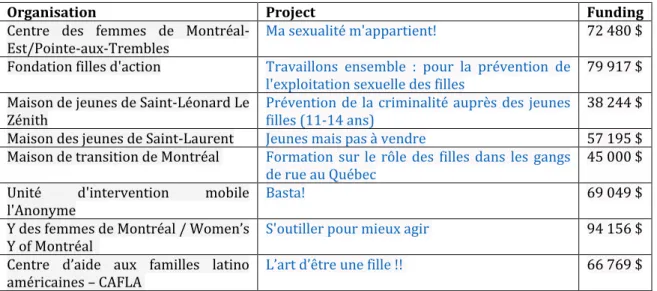
Figure 11 : Projects funded through the Prevention Program of Recruitment of Youths For The Purpose of Sexual Exploitation by Street Gangs, 2009-2010 ...30
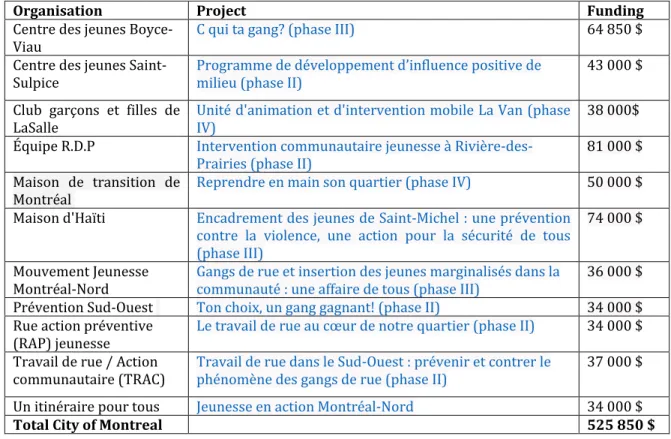
Figure 12: Projects funded through the programme for the redistribution money coming from criminal products, 2010-2011 ...32
Figure 13: Boroughs targeted by the City of Montreal’s fight against street gangs ...33
Figure 14: The analytical category of an urban logic of action ...48
Figure 15: The analytical category of an actuarial logic of action ...49
Figure 16: Synthesis of interactions observed in the François-Perrault Park and its surroundings ...65
Figure 17: Synthesis of interactions observed near the Louis-Joseph Papineau High School ...66
Figure 18: Three democratic theories on negotiation ...68
Figure 19: Representation of recurrent situations of interaction in the François-Perrault Park ...72
Figure 20: Representation of a situation of interaction near the Louis-Joseph Papineau High School ...73
Figure 21: Map of Mexico City ...75
Figure 22: Map of Iztapalapa neighbourhoods ...76
Figure 23: Marginalization in Iztapalapa ...77
Figure 24: Map of the seven barrios ...78
Figure 25: Demographic information and marginality in the seven barrios ...79
Figure 26: The maze of alleyways in the seven barrios ...80
Figure 27: State of street lights in the seven barrios ...81
Figure 28: Iztapalapa metro station ...82
Figure 29: Barrio carnival ...83
Figure 30: Police officers on Segways in Iztapalapa ...85
Figure 31: Unidad de Seguridad Escolar ...90
Figure 32: Unidad Especial de Combate al Delito de la PA 56 ...92
Figure 33: Barrio reggeton dance ...95
List of abbreviations
Abb. French or Spanish English translation
ASME Action Saint-Michel Est Action Saint-Michel East
CLSC Centre local de services communautaires Local Community Service Centre DPJ Direction de la protection de la jeunesse Direction of Youth Protection
GAJ Groupe Action Jeunesse Youth Action Group
ICPC International Centre for the Prevention
of Crime
MAP Module d’action par projet Action Module by Project
NCPC National Crime Prevention Centre
of Canada
PDQ Poste de quartier Police Neighbourhood Quarter
PSI Programme de suivi intensif Intensive Monitoring Program
RECIM Réseau continental de recherche sur Continental research network on
l’informalité dans les métropoles informality in cities
SIP Security Infrastructure Program
SPVM Service de police de la ville de Montréal Police Service of the City of Montreal
USE Unidad de Seguridad Escolar School Safety Unit
VESPA Laboratoire Ville et ESPAces politiques Laboratory City and Political Spaces
VSMS Vivre Saint-Michel en santé Living Healthily in Saint-Michel
Introduction
Montreal has witnessed cyclical concerns about youth violence and street gangs. The threat is often “politically” constructed. Currently, Mexico City is struggling with a pervasive sense of insecurity. While the threat in Canada was largely attributed to mafias and organized crime throughout the 1990s (Sheptycki 2003), fear has crystallised on the figure of the young gang member in Mexico and Canada in the past few years. As Ungar writes,
[y]outh thus become objects of collective fear, seen not as individuals but for the anxieties they cause and the jarring cultural changes they are seen to embrace. The particular impulsiveness of youths, wrapped up in their hostility to tradition and authority, only serves to aggravate these tensions. (Ungar 2009: 208)1
As a result, youths become the target of police action in public spaces. New repression measures are implemented, such as zero-tolerance policies or anti-gang operations, combined with a strengthened set of preventive actions ranging from youth brigades, to participatory youth projects, to community policing. In Montreal, preventive programs are generously financed by the Quebec Government and the Government of Canada. The money is channelled in priority boroughs selected on the basis of their scoring on a set of risk factors (such as household socio-economic status, school dropout rates, number of single-parent households, proportion of immigrants, general state of the built environment, the presence of gang activities in the borough, etc.). In Mexico City, particularly under the mayorship of Lopez Obrador (2000-2005), police reforms focused on community-run policing programs. The City of Mexico now has several programs for “at-risk” youths, including community youth brigades. Notably, and as discussed in greater detail in the Mexico section, today the Policía Sectorial, which is centrally overseen by the City, manages an outreach program for youth in schools that attempts to connect youth and police in a non-threatening environment. In addition to the citywide effort, Iztapalapa, the only borough in Mexico City with Auxiliary police directly under its command, also has a small team of Auxiliary police officers that implement similar efforts within the delegación. These programs are the closest thing to gang prevention efforts conducted by police in this borough.
Such area-based approaches to crime prevention are reflected in the United Nations Guidelines for the Prevention of Crime (2002) and the earlier United Nations Guidelines for the Prevention of Urban Crime (1995), which call for a local approach to
1 As we will see, it is not always that simple. In Iztapalapa in Mexico City, while youth are indeed hostile towards authority
(i.e. police), they do not seem to be rebelling against tradition, which in the barrios seems to reinforce the types of actions they undertake.
problem solving, taking into account the context of vulnerability to being victimized and/or to offending, as well as local resources. Situational approaches build on the “broken windows theory” (Wilson and Kelling 1982) among others, and community crime prevention, which includes consideration of such issues as social capital. The literature on street gangs by criminologists or psychologists (Goldstein 1991; Thornberry et al. 1993; Hawkins 1998) are also relevant. The concern is generally to find causal relationships between background factors (or risk factors) and illegal or violent acts, in order to point towards elements in which to intervene preventively.
Over the course of the 1990s, this came to be known as the “new penology” (Feely and Simon 1992), which positions the criminal as a statistical probability to manage. Crime is not conceptualized as transgression; it is understood as the result of the accumulation of risk factors in a territory or an individual. Following this logic, the prevention system aims more to neutralize danger by regulating risks than by punishing or rehabilitating individuals. The stigmatizing effects of this (such as ghettoizing and/or racial profiling) have been largely documented by urban geographers and sociologists (Davis 1998; Symons 1999; Romero 2006; Wacquant 2006; Dikeç 2007). The work of Philoctète at the Maison d’Haïti in Saint-Michel in Montreal (confirmed by the data presented here) has documented how youths perceive the stigmatizing effects of prevention programs and research on their neighbourhood.
Yet Saint-Michel has been very innovative in its approach to issues of street crime and insecurity in the borough, developing a comprehensive crime prevention approach which encompasses a range of socio-cultural, developmental and structural concerns. The neighbourhood police work on an area-based logic given the administrative structures in place, but recognize Saint-Michel as a community as well. The neighbourhood has seen many projects beyond gang prevention: support services of all types, work with migrant communities, cross-sector partnerships, community mobilization, etc. As Fady Dagher, former Police Commandant in Saint-Michel, said in a presentation at the 12th UN Congress in Salvador, they are trying to explicitly move from “zero tolerance” to “tolerance”. Much of this local approach is focused on the neighbourhood and the immediate community. Yet, a previous project has shown how moving around the city is important to youths and contributes greatly to their development (Cissé and Boudreau 2009; Guthrie 2009; Boudreau, Janni, and Chatel, 2011; see also Madzou and Bacqué 2008). This mobile and fluid aspect of youths’ everyday life is not always taken into account in prevention projects in Montreal and Mexico City.
The developments in Saint-Michel are encouraging, but the youths to whom we spoke still feel at a distance from these programs and labelled as “vulnerable”. The previous research conducted by VESPA has highlighted depoliticization (making delinquency a technical, rather than a publicly debatable problem) as an important effect of these preventive approaches (Boudreau, Janni, and Chatel 2011). It became clear that one of the important effects of preventive measures framed by “at-risk” categorizations is to deny youths any sense of meaningful socio-political agency. As a street worker stated, “it is important to humanize the gang. In it, there are individuals with broken lives” (November 18, 2008, our translation). Viewing gangs as a technical problem of risk management depoliticizes the issue, while stripping youths of individual and group subjectivity. They are seen as vulnerable to gang recruitment rather than as individuals and groups able to act intentionally and autonomously. Parazelli’s (2004) work with street youths in Montreal demonstrates how they create their own autonomous space of action in reaction to the effects of this risk management logic of preventive action. Fortunately, some innovative projects on youth participation are seeking to counteract this (ICPC Youth Resource Guide 2010). With this project, we seek to contribute to this search for solutions.
1.1 Research objectives
1.1.1 OBJECTIVE 1: UNDERSTANDING THE RELATION BETWEEN INFORMAL MILIEUS AND THE CONSTRUCTION OF CITIZENSHIP
The two areas compared in this project were selected because they are targeted by gang prevention programs for “at-risk” youths and they are known for their histories of informality.2 While policies framing prevention programs largely function on a clearly delimited area-based logic, we prefer to speak in terms of informal milieus. This leaves open the question of boundaries. We worked from the definition provided by youths themselves, whether they act on the basis of a clearly defined “turf” or whether they show a more mobile and fluid rapport to space. The milieu is a spatialized, but also a social notion with specific economic, cultural and political characteristics. Davis (2007) has shown that in milieus with histories of informality, there is a concentration of violence caused by competition between mafias controlling illicit activities in this space and formal commercial interests that want to develop the area. This is particularly visible in Mexico’s historical center or the Émilie Gamelin Park in Montreal, to give two examples. But even far from the city center in residential neighbourhoods such as Saint-Michel and the seven barrios of Iztapalapa, where informal activities flourish,
2 We define informality as all activities (that may be unregulated but not necessarily illegal) escaping from state control
inhabitants find themselves in spaces “where networks of obligations and reciprocities are not necessarily coincident with or loyal to the institutions of the nation-state, and where sub-local or transnational networks of reciprocity are more significant for their daily lives” (Davis 2010: 407). Networks of reciprocities and obligations between undocumented immigrants are one example, but we should also consider networks of street vendors that are more visible in Mexico. “At-risk” youths are categorized as vulnerable implicitly, because of their positioning in such social and physical spaces with histories of informality. Does this mean, however, that they are not political and social actors? In order to find elements of the answer, this research seeks to better understand the mechanisms behind youth action that may be influenced by their milieu and other structural factors.
The intuition was that “at-risk” youths do not see themselves as social and political outsiders (Becker 1963), but try to act politically as citizens, even if they may sometimes use illicit means. Indeed, as they construct an “alternative network of
commitment” (the gang, criminalized or not), they seek recognition by expressing their identity (tags, dress code, name). Katz (1988) has brilliantly shown how the indifferent attitude adopted by many (being tough), or even their posture of rupture (being alien, being mean), are in fact gestures of relation to others. Even destruction is part of a
series of tactics for struggling with what the adolescent experiences as a spatially framed dilemma—a challenge to relate the “here” of his personal world to the phenomenal worlds of others who he experiences as existing at a distance, somewhere over “there”. (Katz 1988: 112)
Given that we are particularly interested in youths’ relations with the police (and more broadly the state), this clearly implies differentiated power. But we need to specify what kinds of power relations are developed between youths and police. Domination, authority, seduction, manipulation, coercion and so on do not unfold in the same manner on the ground. The kinds of relations existing between youths and police in the two neighbourhoods studied may vary from conflict to avoidance and all the nuances in- between. It varies between the two neighbourhoods as well, if only because of different political contexts and degrees of distinction between the state, the rule of law, and the police. In the exacerbated context of police corruption in Mexico, for instance, negotiation may be a dominant mode of relation between youths and police (Davis 2006; Castillo Berthier and Jones 2009), but our intuition was that we could also find negotiated relationships in Montreal (albeit on different issues or of a different intensity), and not necessarily illicit. We are used to speaking of negotiated relationships in the context of corruption, but our comparative research demonstrates that negotiated relationships occur on a continuum from the illicit (in the case of
corruption) to the licit (in the case of trust-building actions at the local scale). These licit forms of negotiation on the part of the police may sometimes help legitimize the rule of law and the political system, rather than undermine it as in the case of corruption. Even in strong regulatory contexts, informal negotiation often occurs because of the higher costs of formal interventions. This is most visible when dealing with minor problems.
Through our examination of how youths and police interact, we wished to see whether youths make claims on police officers, whether they act contentiously, and whether they see their acts as being a challenge to power (as political gestures). In return, do police officers see them as vulnerable or as autonomous citizens? If the relationship between them takes on a more negotiated than conflicting form, can we still speak of prevention programs as contributing to forming citizens? If citizenship implies practices of contentious claim-making, would informal negotiating practices (bending the rules or freely interpreting them) contribute to achieving the objective set out by prevention programs: forming future citizens? Our research shows that prevention programs sometimes offer new (and safer) venues for interpersonal negotiation. These negotiating practices link police and youth to each other in an interpersonal relationship that tends to have the indirect effect of also linking youth to the rule of law and the political order. This is turn strengthens or at least acknowledges youth citizenship.
1.1.2 OBJECTIVE 2: UNDERSTANDING WHY URBAN FEARS CONTINUE TO FOCUS ON YOUTH DESPITE THE IMPLEMENTATION OF PREVENTION PROGRAMS3
The project further aspires to contribute to the broad literature on urban insecurity (Smith 1996; Body-Gendrot 2001; Pain 2001; Hubbard 2003; Macek 2006; Sorkin 2007; Kern 2010; Boudreau and de Alba, 2011; Boudreau and Woods 2011). Most studies on street gangs assume that they are urban (the city is their scene), but rarely do they reflect on this urban-ness and its impact on their logic of action. This is probably due to the predominance of studies by criminologists or psychologists, who do not reflect systematically on urbanity. Yet unlike certain mafias, in their origins, gangs were born in cities, most often in their geographic and social margins (White 1943). From an Urban Studies perspective, we wonder if this urban milieu affects the way they act. Urban sociology, from Wirth (1938) to Sennett (1970), has sought to qualify the urban way of life and its consequences on individual practices and identities. Others, such as Rémy (1990) or Bourdieu (1979), have insisted on codes that structure relationships in a
3 One of the difficulties in many neighbourhoods is that there is no comprehensive and systematic response in place for
children, youth and families that are at risk within various systems – health, education, housing – that is related to crime prevention. There may be time limited projects at best.
context of interactional density in cities, these codes being more accessible to certain privileged groups than to others (urbanity defined as civility). This is at the core of debates on youth violence in France, focused on the notion of incivility (Roché 2002).
Processes of urbanization bring new sets of economic, social, political, and cultural conditions that affect how people act and interact (Boudreau 2010). Urbanization brings more needs for mobility, changing the area-based logic of action prevailing in the modern state system. It requires being able to act rapidly and swiftly as urban rhythms accelerate. It creates complex situations entangled with one another. This makes evaluating the future consequences of an act more difficult. The complexity, fluidity, and rapidity of urban life pose challenges to how people plan and strategize. As more and more people live in urban settings, these characteristics of social, economic, and cultural life come to define the contemporary period. Pedrazzini (1994) suggests that youth in neighbourhoods marked by histories of informality have understood these transformations more than state actors. They have adopted an urban logic of action more attuned to the contemporary period. His work shows how “at-risk” youths in Caracas construct a “culture of emergency” and ruse. They know how to act not only strategically (preventively), but tactically (reactively). This points to a logic of action very different from what putatively drives state action. When youths in Parisian banlieues are said to perpetrate “incivilities” or when youths in street gangs are said to be “a-social”, the underlying discourse is that they act in a way that is difficult to understand from a modern rational perspective.4
Bauman (2005) argues that urban fluidity and complexity is a source of anxiety because it contrasts with modern rationality. Modern rational action is thought to result from calculating the costs and benefits of anticipated consequences (Darwall 2002). Anticipating consequences presupposes control of the unknown, of the uncertain. Such rationality underlies actuarial calculations and risk management techniques sustaining more traditional prevention programs (Borraz 2008). Similarly, civility and social behaviour is considered to rest on people’s ability to self-control and integrate social norms, that is, to minimize uncertainties and act with strategic precaution (Goffman 1959). This type of cautious and socially strategic behaviour was not observed by Pedrazzini in his work with “at-risk” youths in Caracas. Could the gap between the
socially expected logic of action and the way youths act in relation to their urban milieu be a more profound source of discomfort than the violence they may perpetrate? If this is the case, it would redefine the problems that the more traditional
4 In the context of Belfast, Hamill (2011) shows that youth continue to engage in petty criminal activity even when they
know they will be severely punished by Paramilitaries. This seemingly “irrational” behaviour is understandable only if we go beyond the modern rational logic of action. Hamill suggests that this behaviour could be explained by the fact that it is the only way youth can acquire status as they have no work or educational prospects.
prevention programs are aiming to address and pursue the direction suggested by participatory initiatives. In addition to working on “socializing” “at-risk” youths, trying to inculcate in them “civility” and appropriate behaviour by intervening at early stages of their development (as the influential psycho-education theses of R. Tremblay suggest) would also imply recognizing different logics of action and negotiating with them. This would mean changing the state’s ways of acting as much as youth’s (designing intervention programs through the incorporation of the uncertainty factor).
There is an emerging literature in the field of risk management that explores how uncertainty makes its way in actuarial calculations and prevention tools (particularly with regards to environmental risks). There are also studies exploring how programs and policies are designed to play on citizens’ emotions more than their rationality: the colour-coding terrorist alert system in the U.S. (Massumi 2006), airport security measures and the evaluation of facial expressions of emotions (Adey 2009), and so on (Thrift 2004). Although not applied to youth prevention programs, these initiatives demonstrate that policies and programs can indeed be designed with a logic of action closer to what we can observe from youth. On the ground, studies have shown how
police officers often act with less precaution or less “rationality” than is expected of them (see particularly Brodeur 2003; Klinger 1997). This project seeks to better understand these dynamics interactively with youth. By analyzing how (inter)action unfolds i.e. the shape it takes, the logics of youth and police, and how they evolve in the course of the interaction (processes of accommodation, adjustments, etc.) in concrete situations, we produced a typology of modalities and logics of action that may inspire how intervention programs can be designed differently. This will lead to novel forms of youth engagement (not merely education or disciplining), which can in turn result in safer cities and greater commitment to the state’s envisaged community.
The project is thus focused on social processes in two different settings: Montreal and Mexico City. By comparing dynamics of interaction in two politically and institutionally different contexts, we are trying to do more than simply compare prevention programs and evaluate their local results. We also seek to generate new analytic insight about what works in what context and why. Describing the programs in place, their rationale and their implementation was merely the first step. By zooming in on everyday interactions (and not on interactions during planned events of social mediation, for instance), we then analysed social relations. This brought a fresh set of ideas about the nature of everyday relations between police and youth and when they seemed to work best, information that will hopefully be reproducible in future program design. In short, the research did not simply produce a comparison of programs (best
practices) but also a typology of how youth and police interact in situations, why they do so, and whether these interactions are constructive or not. By uncovering logics of relational action, we may transform the way we conceptualize preventive intervention and encourage participatory initiatives. This can enhance the police capacity to build on youths’ more “grounded” urban knowledge and may be helpful for police practice. It also helps in understanding the milieu in which youths act and the reasons for acting the way they do.
1.2 Research questions
Most socio-anthropological approaches look at gangs from the inside, as a form of social organization (Thrasher 1927; Sanchez-Jankowski 1991; Bourgois 1995; Agier 1999) that is seductive and attractive (Katz 1988; Campbell 2005), and is in search of recognition and legitimacy (Peddrazzini et al. 1994). Yet, not much attention has been given to externally-oriented or relational gestures: how do they enter in contact or interface with the state (most specifically the police)? How do they constitute themselves as actors in their neighbourhood, in the city at large, in society? The micro-unfolding of interactions between youth and police is rarely examined, the assumption being that such interactions are conflicting, repressive, or dominating. Specific attention is given by criminologists to interactions in planned settings of community social mediation or at school (Hamel et al. 2003). If “street-level” or everyday interactions are considered, they tend to be discussed from the point of view of the police (Klinger 1997). In this project, we wish to zoom in on these “fortuitous” interactions in order to better understand:
1) Whether and how “at-risk” youths constitute themselves as individual and collective social and political actors? What image of themselves do they seek to project? What means do they develop to act?
2) Whether and how police officers recognize “at-risk” youths’ subjectivity and capacity to act socially and politically (are they seen as vulnerable, dangerous, annoying, lucrative, collaborative, innovative, etc.)? This question is about police perceptions. We have also been concerned with a sub-question: how do police officers enable or constrain youths’ subjectivity and capacity to act socially and politically?
3) How and where specifically do youths and police interact in everyday neighbourhood situations? On what modes are these interactions unfolding (conflict, domination, negotiation, accommodation, etc.)?
4) What are, comparatively, the underlying logics of action guiding youths and police? Is there a predominance of strategizing (anticipating consequences, projecting an act into the future) or more insistence on tactical reactive and often unpredictable movements? Is their logic of action motivated by conflict, cooperation, negotiation, etc.? Do they think of their space of action on a territorial (area-based) or fluid and mobile basis? We have sought to be attentive to both motivations and logics of action (how action unfolds). It might be that what one party identifies as domination (youths), another would identify as negotiation (police), for example, owing to the status, power, or territoriality ascribed to the interaction. We paid special attention to theorizing the role of mobilities and youth/police relationships to territory in the construction of citizenship.
5) What other social actors mediate these interactions, in what ways (and spaces), how and why? (families, political leaders (formal and informal), merchants, and miscellaneous other adults – with attention paid to gender patterns). It may be that the presence or absence of mediating actors in the police-youth relation is what determines a) the nature of citizenship or b) the extent to which residents still associate youths with fear and crime.
1.3 Methodology
In Montreal and Mexico, we used the following broad criteria for selecting the neighbourhoods in which fieldwork was to be conducted:
The neighbourhood is targeted for gang prevention and interventions, has active prevention programs
The neighbourhood has a history of informal activities because this is implicitly why they have been identified as concentrations of risk factors. It is important to better understand street culture/life, where interactions are more likely to take place
In each neighbourhood, we identified specific sites of observation where there are police-youth encounters (near housing complexes, schools, subway stations, etc.). These encounters are not organized (as in community meetings or social mediation) but are simply daily encounters through police patrols. Our goal is to qualify the types of encounters, not necessarily to measure the intensity of youth-police interactions
In both places, the data collection consisted of:
More than 30 in-depth interviews with youths, police, and local actors for each case
Systematic observations in the selected public sites, as well as participation in community activities with the police
A policy review of youth policing and urban insecurity in each city
The two cases being very different, particular challenges forced us to adapt our methodology to local situations. These circumstances are briefly described below.
1.3.1 MEXICO CITY
Upon receipt of funding for the research project, it remained unclear what geographic area of Mexico City would be studied. Thus, the first methodological step was selecting the geographic location that would serve as the backdrop for the study. Ultimately, the seven neighbourhoods in Iztapalapa were chosen for two reasons. Firstly, Iztapalapa has some of the highest rates of marginalization (e.g. poverty and unemployment) in Mexico City and is generally regarded as one of the city’s most violent boroughs and a hotbed for criminal activity. This reality fits the contextual requirements under which the research questions were to be explored. At the same time, it creates a dangerous environment for research of this nature. Specifically, the level of violence and illicit activities in certain neighbourhoods and areas of the borough make them prohibitively dangerous to travel through or within, especially for long periods of time. Nonetheless, while the seven neighbourhoods ultimately selected for the study have a high rate of marginalization and are conflictive, they were sufficiently accessible to Héctor Salazar Salame for the purpose of conducting this research.
It should be noted that even in areas of the borough where a researcher may face lesser eminent danger (including the seven neighbourhoods), it is critical to have local connections that facilitate access to its residents’ trust, and in turn, their willingness to be interviewed. In other words, it was important to have a mediating party that served as a social translator/facilitator between residents and the researcher, both for reasons of safety and access. Against this backdrop, through connections Héctor Salazar Salame made during the first two weeks of February 2010, he was introduced to a local resident of one of the seven neighbourhoods selected for the study who agreed to serve this role.
Successfully enlisting the support of Mr. Epifanio Margarito Ruiz Urrea (Margarito for short)5 is the second reason for our decision to focus on these seven neighbourhoods of Iztapalapa for this research project.
Once the geographic area of study was selected, Héctor Salazar Salame began data collection, including interviews with local government officials, residents, and police officers, as well as first-person observation of social relations in the neighbourhoods. Between February 28 and March 28, he spent approximately 180 hours in the seven neighbourhoods (an average of 9 hours per day). Of the 180 hours, approximately 60 were spent interviewing youths and police, and activities such as eating and setting up meetings. The remaining 120 were active observation hours. Active observation was by and large conducted by traveling with Margarito on a moped through the neighbourhoods at various hours of the day (from as early as 9am to as late as 3am). Ultimately, it is not an exaggeration to state that he traveled through and observed social interactions or lack thereof on just about every street, alleyway, and main thoroughfare at least once in the morning, afternoon, evening and late at night. During the active observation periods, he kept a keen eye out for police and youth locations and activities, and interactions between these two actors. Notably, however, he never witnessed a youth-police interaction first hand. In part, he attributes this fact to his active observation model that largely consisted of mobile observation. For safety reasons, he deemed it too risky to spend large amounts of time stationary, particularly at night. He attempted to conduct stationary observations in public places during the day, but as discussed further in this document, youths tend to be the most active once the sun goes down.
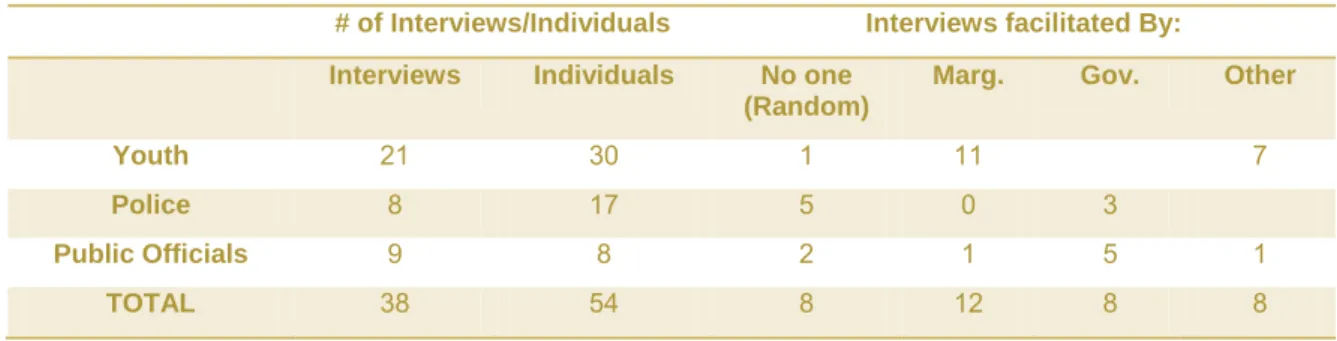
Most of the interviews Héctor Salazar Salame conducted with police officers and youths took place on the street when he encountered these actors throughout his active observation activities. Interviews with public officials were pre-arranged and took place in the interviewees’ offices. A detailed table of the interviews conducted for this research can be found in the Appendices. Figure 1 below presents a snapshot of these interviews. In total, he conducted 38 semi-structured, recorded interviews representing 54 unique individuals. Note that the total was actually 56, yet he excluded two youth interviews because they were not from the seven barrios studied. In all cases, interviewees were introduced to the research project and presented a verbal dictation of the informed consent form both before recording began and at the beginning of the
5 Note that the umbrella research project agreed to pay Mr. Margarito a financial support commensurate to his lost wages,
recorded interview. All agreed verbally to be recorded and to participate in the interview. All youths and police and all but two public official interviews were transcribed. Copies of the transcriptions and the recordings are all safely stored electronically.
Figure 1: Snapshot of interviews in Mexico City
# of Interviews/Individuals Interviews facilitated By: Interviews Individuals No one
(Random)
Marg. Gov. Other
Youth 21 30 1 11 7
Police 8 17 5 0 3
Public Officials 9 8 2 1 5 1
TOTAL 38 54 8 12 8 8
As reflected in the table, the vast majority of youth interviews were conducted one-on-one. Five youth interviews were group interviews with two to four participants each. Eleven of the youth interviews were directly facilitated by Margarito; three were facilitated by the director of a Secondary School for Working Adults who was kind enough to allow access to the school and identify students that met the age range and resided in the neighbourhoods; two were facilitated by a taco stand owner who knows Margarito and knows some youths that drop by to eat at her stand; one was facilitated by the father of the interviewee; and one was facilitated by the sister of the interviewee. By the facilitation of an interview, we refer to an introduction to the interviewee. At no time did any of the “facilitators” coach the interviewees or interject during the interviews so as to steer the conversation. On various occasions, Héctor Salazar Salame attempted to introduce himself directly to youth to ask for an interview. Every time he did so, except on one occasion, he was denied. In short, without the support of stated facilitators, particularly Margarito who is well known in the neighbourhoods, this research would not have been possible.
Eight interviews with police were conducted for the research project, five of which were random, meaning that Héctor Salazar Salame approached officers walking or driving the beat to request an interview. Government officials facilitated three interviews: the Borough Government facilitated the first with the special prevention unit of Auxiliary Police of the Iztapalapa. This interview included six officers. The Borough Government also facilitated the second, which consisted of interviewing two Auxiliary police
officers during a ride-along throughout Iztapalapa. The third was facilitated by the Metropolitan Police department’s Unidad de Protección Escolar, which consisted of a ride-along to various presentations at schools in Iztapalapa with two officers.
Héctor Salazar Salame conducted nine interviews with current and past public officials including: the current General Coordinator for Public Security in Iztapalapa, the trainer of all Auxiliary police officers in the Municipality; the former president of the Municipality; a public outreach government public servant; the youth programs coordinator for the Municipality and one of her district coordinators; the principal at the secondary school for working adults located in the seven neighbourhoods; and the head of the special prevention unit of the borough’s Auxiliary Police. He was able to schedule most of these interviews through door knocking, phone calls and referrals thereafter. As an example of the latter, the General Coordinator for Public Security connected and introduced him to the Auxiliary Police trainer.
In addition to the aforementioned formal interviews, Héctor Salazar Salame held scores of informal conversations with local residents during the course of his research. Combined, his active observation, and formal and informal interviews with actors in the seven neighbourhoods allow him to paint a relatively nuanced picture of the spatial and social dynamics of the neighbourhoods, though by no means can he consider himself an expert on the topic, let alone a nativo of the area.
1.3.2 MONTREAL
In Montreal, we knew from the beginning that we would focus on Saint-Michel, having conducted research there since 2008. Data collection was primarily conducted by Alain Philoctète, who had conducted an internship at the Maison d’Haïti during the summer of 2008 and wrote his Master’s thesis on the neighbourhood (Philoctète 2011), and Clémence Élizabeth, who was doing a five-month internship in Montreal between March and August 2011. Olivier Chatel, who had completed an internship at the Direction de la diversité sociale de la Ville de Montréal in 2010, was also employed by the community organization Tandem Saint-Michel during our fieldwork. Olivier also wrote his Master’s thesis on the neighbourhood (Chatel 2011).
We therefore had a good knowledge of the area before starting this research. Given that we began data collection during the winter, street observations were delayed until the weather made it possible. We firstly focused on interviews with youths. In total, we formally interviewed 23 youths, eight of whom were youth patrollers from the Maison
d’Haïti (see Appendices for details). In addition, we conducted nine interviews with other local actors (including six with police officers). Figure 2 shows how interviewees were approached.
Figure 2: Snapshot of interviews in Montreal
# of Interviews/Individuals Interviews facilitated By: Interviews Individuals No one
(Random) Youth patrollers Youth 23 23 14 9 Police 4 6 4 0 Public Officials 3 4 3 0 TOTAL 30 33 21 9
It was not easy, as in Mexico City, to approach youths. Youth patrollers played an important role in giving us access, either by arranging interviews directly, or by introducing Clémence Élizabeth and Alain Philoctète informally to youths during our observations periods. We tried to vary in terms of ethnic origins (although we have a majority of Haitians) and between males and females.
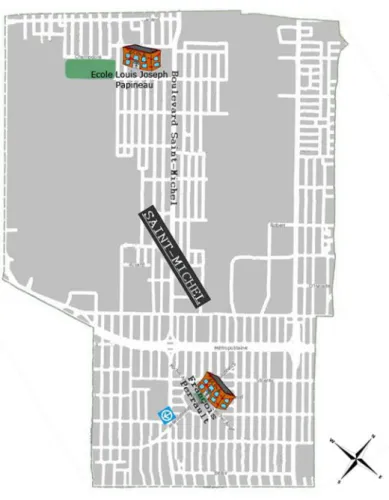
In order to observe interactions between youth and police officers, we chose two sites particularly frequented by both groups: the exits of two important public mixed high schools in Saint-Michel, Louis-Joseph Papineau and François-Perrault (Figure 3). In the Quebec school system, high schools (which follow elementary school) admit students from 12 to 17 years old and last five cycles of one year each. When completed, students receive a high school diploma and can, if they wish, go to college for two or three years before heading to university.
Our first site of observation was Louis-Joseph Papineau High School, in the northern part of St-Michel, 3 km north-west of the Saint-Michel subway station. This school, unsightly architecturally speaking, is quite badly positioned in the School Board ranking because of its academic credentials and “student behaviour”. Figure 4 illustrates the main entrance of the school. There is another entrance, but it is not commonly used.
Figure 3 : Localization of the two sites of observation
Almost adjacent to the school is the Collège Reine-Marie, a high school for girls, many of whom come from other neighbourhoods. We observed no interactions at all between students from these two schools, despite their proximity. Contrasts between the two populations seemed important to maintain for the young girls. Around this school are two pizzerias along the Saint-Michel Boulevard, the Café Louvain (apparently private), and a convenience store on Louvain Avenue. This street leads to the Champdoré Park, which has soccer fields, American football, basketball courts, and a playground for children. Our observation site included the school and the park. The neighbourhood around the school is highly residential, as shown in the picture below.
Figure 5 : 6th Avenue, in the Louis-Joseph Papineau High School neighbourhood
On Saint-Michel Boulevard, 900 meters further, is the Maison d’Haïti. It is worth mentioning that all students wear a uniform: a dark blue t-shirt (the colour of the neighborhood gangs, see police section on page 51) and black trousers. The girls of the Collège de Reine-Marie have a very different outfit: a white blouse, checked skirt and white tights.
Our second observation site was the François-Perrault High School and its park, located in the southern part of St-Michel. Students of this school do not wear a uniform. It is an area more frequented than the Papineau surroundings, thanks to the Saint-Michel subway station that is 300 metres away.
Figure 6 : François-Perrault High School
Around the park, one can find a few fast food restaurants, highly frequented by the school students. The PDQ 30, the Saint-Michel Police Station, is 700 meters away on Saint-Michel Boulevard. This park is very popular amongst the youths, particularly since its redesign in 2000. It is indeed a very welcoming park, with a free outdoor pool, tennis courts, a soccer field (not very well maintained, unfortunately), a basketball court, and an ice rink (converted into a basketball court during the summer months). There are many tables and with its hexagonal shape, it is easy to cruise around it by car, which is very convenient for police patrols. Adjacent to the park are some of the borough hall offices (as seen on the right hand side of the photo on the right – Figure 7) and a public library.
Figure 7 : François-Perrault Park
We completed around ten periods of observation after class hours in each site, for two hours or more, with a tape recorder (to record notes) a GPS, and a camera on each site. During these periods of observation, Alain Philoctète and Clémence Élizabeth walked around the site, looking for youths (what they were doing, where they were, what they were wearing), for police patrols, and noting reactions of other people passing by. They
were specifically looking for police-youth interactions, direct or indirect. The GPS enabled us to map where they walked around during the observation period, and thus to exactly locate where an interaction occurred. Notes were recorded with a small microphone attached to their coats. Photos were taken only rarely in order to avoid intimidating people and solely to capture the general landscape. As soon as they came back to the office, recorded notes were transcribed (see Appendices for details).
PART I: THE CASE OF SAINT-MICHEL IN MONTREAL
1. THE SAINT-MICHEL NEIGHBOURHOODSaint-Michel is a neighbourhood situated in the northern central part of the Island of Montreal, in the Villeray-Saint-Michel-Parc-Extension borough.
Figure 8: Localization of the Saint-Michel neighbourhood
Source: Laboratoire VESPA
The Saint-Michel neighbourhood is marked by the development of the Francon and Miron quarries, built in 1912 for the extraction of the rock used in the fabrication of cement and that now occupy 40 % of the neighbourhood, and by the absence of urban planning until the 1970s. The neighbourhood is also divided by the Metropolitan Highway. One consequence of this lack of planning is the juxtaposition of both housing and industry in some areas.
1.1 Population
In 2006, the neighbourhood population was quite stable with 55,029 inhabitants. The percentage of persons under 18 years old is 22.8%, a higher rate than the Montreal average, which is 18%. While Saint-Michel saw a rise of 2.5% in its total population between 1996 and 2001, it gained 11% more youths between 10 and 14 years old over the same period (Côté 2009).
1.1.1 HOUSEHOLDS
Saint-Michel is a family neighbourhood. Indeed, 66.5% of the total 22,090 households are families, which is more than the Montreal average (57.1%). Even the number of families with children (48.2%) is higher than the city average (35.7%). What is notable in the neighbourhood is the proportion of single-parent families (19.9%); Saint-Michel occupies the first rank in this category (the Montreal average is 11.4%). Between 1996 and 2001, the number of single-parent families grew by almost 13%. The Police Service of the City of Montreal (SPVM) concludes that “the precarious economic situation in which many of those families live, as well as the more widespread childcare deficiency, is not unrelated to the emergence, among young people, of adaptation problems (emotional, social, academic, etc.) associated to delinquency" (Côté 2009). Indeed, the Local Community Service Centre (CLSC) Saint-Michel is ranked fifth (out of 29) regarding the number of cases reported by the Direction de la Protection de la Jeunesse (DPJ).
1.1.2 EDUCATION
The neighbourhood is poorly educated with 29.9% of the 25 to 64 years old population lacking a high school diploma (13.5% in Montreal), and only 18.4% have a university degree (40.9% in Montreal) (Côté 2009).
1.1.3 DIVERSITY -IMMIGRATION
Since the Second World War, Saint-Michel has been an immigration neighbourhood. After the war, a high number of Italian immigrants settled in the neighbourhood where the land was affordable and the quarries offered work. From the 1970s onwards, a new wave of immigrants arrived, mainly Haitians and Latinos. During the 1990s, the immigration pattern was affected by an important number of Haitians and a higher number of North Africans.
As a result, almost half of the inhabitants are immigrants (46.8%), ranking the neighbourhood fifth in comparison to other neighbourhoods in Montreal (the average is 30%). One inhabitant out of eleven is born outside Canada and immigrated within the last five years into the neighbourhood (Côté 2009). The second generation of immigrants of 15 years old and more represents 13.3% of the total population, while 50% are visible minorities (against an average of 24.4% in Montreal). We noted in the interviews that not only do most of the young Blacks in the neighbourhood speak Creole (in addition to French), but it is also a fashionable trend.
1.1.4 ECONOMY
For the first half of the 20th century, Saint-Michel was a prosperous industrial and mining neighbourhood. The 1960s marked the beginning of the economic decline, which reached its peak in the 1980s with the economic crisis. The neighbourhood is ranked third in Montreal for its unemployment rate (7.6% in 2006). The workers’ profile is quite different than the rest of Montreal, with 17.5% unskilled labour (i.e. one worker out of six), against an average of 7.3%. Only one worker out of eight belongs to the category of professionals and managers.
The direct consequences of this lack of employment and of the workers’ profile is the inhabitants’ low incomes. The proportion of households that declare incomes between $10,000 and $60,000 is higher than the average, and less than one household out of 20 admits incomes higher than $80,000. More importantly, one household out of four reports low income (Côté 2009), that is a household that dedicates 64% or more of its income to food, housing and clothing. Saint-Michel is therefore one of the most underprivileged neighbourhoods in Montreal.
1.2 Building - Housing
1.2.1 HOUSING
Between 2001 and 2006, the number of housing units built was less than 10% of the Montreal average. The proportion of housing that needs major repair is 17% higher than average. Moreover, in Saint-Michel, seven out of ten housing units are occupied by tenants. The households invest a large part of their budget in housing. An important consequence of this family-oriented and warm neighbourhood (where everybody knows everybody) is that the people of Saint-Michel move less frequently than those living elsewhere and there are fewer new residents each year (2.9% compared to 4.8% in Montreal).
1.2.2 BUILT ENVIRONMENT
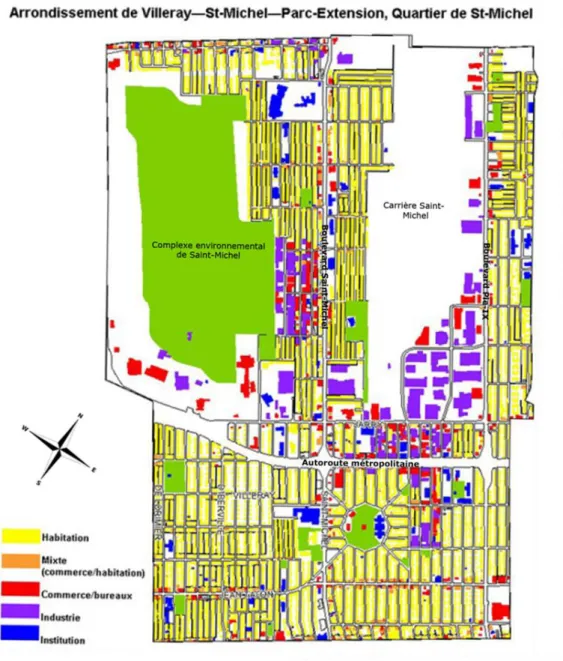
The neighbourhood is crossed from east to west by the Metropolitan Highway. The main roads north-south are the Pie-IX Boulevard and the Saint-Michel Boulevard. Along these roads, and Jean-Talon Street, are most of the services and shops. The neighbourhood is quite accessible, thanks to the subway (Saint-Michel station) and to the various bus lines.
The Saint-Michel neighbourhood is firstly a residential area, but one can find a high number of industries on the north side of the Metropolitan Highway, and in particular in the eastern part of the Saint-Michel quarry, along the Pie-IX Boulevard where vegetation and houses are both present. The intense urban development without planning that occurred after the Second World War is responsible for much pollution and noise in certain sectors adjacent to industries. Moreover, the conversion of the Miron quarry into a landfill in the 1960s contributed to the degradation of the quality of life in the neighbourhood.
Figure 9: Land use in Saint-Michel
Considering its population weakened by the difficulties of integration, a difficult economic situation for households and a neighbourhood affected by noise, as well as its visual aspects and the lack of infrastructure, it is unsurprising that the area is considered “at-risk”.
1.3 Criminality
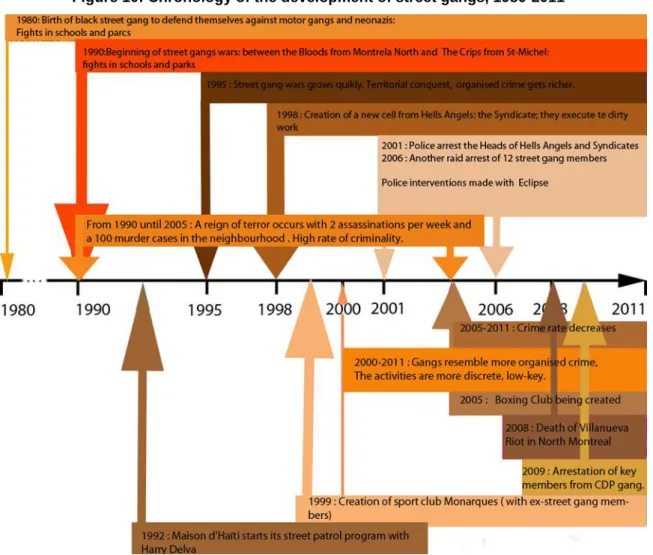
The neighbourhood also has a history of gang-related criminality.
Figure 10: Chronology of the development of street gangs, 1980-2011