arXiv:1012.2278v1 [astro-ph.EP] 10 Dec 2010
December 13, 2010
WASP-34b: a near-grazing transiting sub-Jupiter-mass exoplanet in
a hierarchical triple system
⋆
B. Smalley
1, D.R. Anderson
1, A. Collier Cameron
2, C. Hellier
1, M. Lendl
3, P. F. L. Maxted
1, D. Queloz
3,
A. H. M. J. Triaud
3, R. G. West
4, S. J. Bentley
1, B. Enoch
2, M. Gillon
5,3, T. A. Lister
6, F. Pepe
3, D. Pollacco
7,
D. Segransan
3, A. M. S. Smith
1, J. Southworth
1, S. Udry
3, P. J. Wheatley
8, P. L. Wood
1, J. Bento
81 Astrophysics Group, Keele University, Staffordshire, ST5 5BG, United Kingdom
2 SUPA, School of Physics and Astronomy, University of St. Andrews, North Haugh, Fife, KY16 9SS, UK 3 Observatoire de Gen`eve, Universit´e de Gen`eve, 51 Chemin des Maillettes, 1290 Sauverny, Switzerland 4 Department of Physics and Astronomy, University of Leicester, Leicester, LE1 7RH, UK
5 Institut d’Astrophysique et de G´eophysique, Universit´e de Li`ege, All´ee du 6 Aoˆut, 17, Bˆat. B5C, Li`ege 1, Belgium 6 Las Cumbres Observatory, 6740 Cortona Dr. Suite 102, Santa Barbara, CA 93117, USA
7 Astrophysics Research Centre, School of Mathematics & Physics, Queen’s University, University Road, Belfast, BT7 1NN, UK 8 Department of Physics, University of Warwick, Coventry CV4 7AL, UK
Received ¡date¿ / accepted ¡date¿
ABSTRACT
We report the discovery of WASP-34b, a sub-Jupiter-mass exoplanet transiting its 10.4-magnitude solar-type host star (1SWASP J110135.89-235138.4; TYC 6636-540-1) every 4.3177 days in a slightly eccentric orbit (e = 0.038 ± 0.012). We find a planetary mass of 0.59 ± 0.01 MJup and radius of 1.22+0.11−0.08 RJup. There is a linear trend in the radial velocities of 55±4 m s−1y−1
indicating the presence of a long-period third body in the system with a mass >∼ 0.45 MJupat a distance of >∼ 1.2 AU from the host
star. This third-body is either a low-mass star, white dwarf, or another planet. The transit depth ((RP/R∗)2= 0.0126) and high impact
parameter (b = 0.90) suggest that this could be the first known transiting exoplanet expected to undergo grazing transits, but with a confidence of only ∼ 80%.
Key words.planets and satellites: general – stars: individual: WASP-34 – techniques: photometry – techniques: spectroscopy – techniques: radial velocities
1. Introduction
The majority of the known exoplanets have been discovered us-ing the radial velocity technique (Mayor & Queloz 1995). In re-cent years, however, an ever increasing number have been dis-covered as a result of group-based and space-based transit search survey projects. Transiting exoplanets allow parameters such as the mass, radius, and density to be accurately determined, as well as their atmospheric properties to be studied during their transits and occultations (Charbonneau et al. 2005; Southworth 2009; Winn 2009).
The SuperWASP project has robotic observatories in the Canary Islands and South Africa. The wide angle survey is designed to find exoplanets around relatively bright stars in the V-magnitude range 9 ∼ 13. A detailed description of the SuperWASP project is given in Pollacco et al. (2006).
In this paper we report the discovery of WASP-34b, an exoplanet in orbit around its V = 10.4 mag. host star 1SWASP J110135.89-235138.4 in the constellation Crater. We present the WASP-South discovery photometry, together with Euler Telescope photometry and CORALIE radial velocity mea-surements.
⋆ Radial velocity and photometric data are only available in
elec-tronic form at the CDS via anonymous ftp to cdsarc.u-strasbg.fr (130.79.128.5)or via http://cdsarc.u-strasbg.fr/viz-bin/qcat?J/A+A/???/A??
2. Observations
2.1. WASP-South photometry
The host star WASP-34 (1SWASP J110135.89-235138.4; CD-23 9677; TYC 6636-540-1; GSC 06636-00540) was observed within two WASP-South camera fields during the periods 2006 May 4 to June 20 and 2007 January 4 to June 1, and in 3 fields during the period 2008 January 1 to May 28. A total of 35 351 data points were obtained. The pipeline-processed data were de-trended and searched for transits using the methods described in Collier Cameron et al. (2006), yielding a detection of a periodic, transit-like signature with a period of 4.3177 days and a depth of 0.011 magnitudes (Fig. 1).
2.2. Spectroscopic observations with CORALIE
Spectroscopic observations were obtained with the CORALIE spectrograph on the Swiss 1.2m telescope. The data were processed using the standard pipeline (Baranne et al. 1996; Queloz et al. 2000; Pepe et al. 2002). A total of 24 radial veloc-ity (RV) and line bisector span (Vspan) measurements were made
between 2009 December 1 and August 1 (Table 1). The bisector spans are a measure of the asymmetry of the cross-correlation function and, based on our experience, have standard errors of
≈2σRV.
The RV measurements show velocity variations with the same period as the transit light curve, but with a relatively
Fig. 1. WASP photometry of WASP-34 folded on the orbital of period of 4.3177 days (upper panel). The lower-panel shows the photometry binned in 0.001 phase steps and centred on the tran-sit. The solid line is best-fit MCMC solution (see Sect. 4) Table 1. Radial velocity (RV) and line bisector spans (Vspan)
measurements for WASP-34 obtained by CORALIE spectra.
BJD–2 400 000 (UTC) RV (km s−1) V span(km s−1) 55166.8238 49.7903 ± 0.0044 −0.0413 55168.8183 49.9372 ± 0.0043 −0.0295 55170.8431 49.7923 ± 0.0042 −0.0275 55172.8238 49.9253 ± 0.0046 −0.0540 55174.8487 49.8141 ± 0.0041 −0.0499 55175.8479 49.7973 ± 0.0039 −0.0376 55176.8227 49.8806 ± 0.0042 −0.0327 55179.8417 49.7888 ± 0.0041 −0.0350 55180.8558 49.8611 ± 0.0041 −0.0401 55181.8211 49.9414 ± 0.0042 −0.0382 55182.8513 49.8765 ± 0.0049 −0.0405 55184.8546 49.8432 ± 0.0044 −0.0282 55186.8291 49.9058 ± 0.0046 −0.0142 55190.8501 49.9152 ± 0.0045 −0.0438 55261.7732 49.7686 ± 0.0049 −0.0303 55262.6716 49.8191 ± 0.0041 −0.0375 55372.5070 49.8731 ± 0.0050 −0.0401 55375.6012 49.8797 ± 0.0070 −0.0128 55376.5162 49.8956 ± 0.0080 −0.0249 55380.5162 49.8922 ± 0.0048 −0.0383 55391.4963 49.7631 ± 0.0053 −0.0275 55399.4711 49.7695 ± 0.0048 −0.0249 55403.4675 49.8159 ± 0.0049 −0.0133 55410.4711 49.8913 ± 0.0049 −0.0437
large scatter in the residuals (16.1 m s−1) to a circular orbit fit. Analysis of these residuals shows a trend as a function of time of 55±4 m s−1y−1, with an F-test revealing that this is significant at > 99.9% level (Fig. 2). The amplitude of the RV variations and the absence of any correlation with RV of the line bisector spans (Vspan) in Fig. 3 indicates that it is highly improbable that
the RV variations are due to an unresolved eclipsing binary or chromospheric activity (Queloz et al. 2001).
2.3. Euler Telescope photometry
We observed two transits (March 3 and April 12, 2010) of WASP-34b with the 1.2m Euler Telescope. All data were taken
Fig. 2. Residuals to the periodic orbital fit (∆RV) as a function of
time. There is a clear long-term trend in the systemic velocity of 55±4 m s−1y−1.
Fig. 3. Line bisectors (Vspan) as a function of RV for WASP-34.
Bisector uncertainties of twice the RV uncertainties have been adopted. There is negligible correlation between Vspan and the
stellar RV.
in the RGband and, owing to the brightness of the target (mag.
R=9.81), with slight defocus. While for the first transit there was no guiding available at the telescope, we made use of a new absolute tracking (ABTR) mode for the second observation. The ABTR performs tracking by computing the location of light sources on each science frame and matching them with a cata-logue. This way, the exact position of each image is found and drifts from the nominal position are corrected by adjusting the telescope pointing between the exposures. As a result the target is kept on the same pixel during the whole transit.
The reduction was the same for both transits. After correct-ing the images for bias, overscan and flatfield, we performed aperture photometry on the data. The flux was extracted for all stars in the field and the final light curve was obtained from differential photometry of the target and a reference source ob-tained by combining the 3 brightest reference stars. We reached a r.m.s. photometric precision of 4.2 m mag. min−1for the
tran-sit of March 3 and 1.4 m mag. min−1 for the transit of April 12
(Fig. 4). This improvement can mainly be attributed to the use of the ABTR. As the stars were kept on the same pixels, flat field effects were greatly reduced.
Fig. 4. Euler Telescope transit photometry. The solid line is the best-fit main-sequence-constrained MCMC solution, while the dashed-line is that for the non-main-sequence-constrained solu-tion.
3. Spectral Analysis
The individual CORALIE spectra of WASP-34 were co-added to produce a single spectrum with an average S/N of around 100:1. The standard pipeline reduction products were used in the anal-ysis.
The analysis was performed using the methods given in Gillon et al. (2009) and Smalley (2005). The Hα line was used to determine the effective temperature (Teff), while the Na i D and
Mg i b lines were used as surface gravity (log g) diagnostics. The parameters obtained from the analysis are listed in Table 2. The elemental abundances were determined from equivalent width measurements of several unblended lines. A value for micro-turbulence (ξt) was determined from Fe i using the method of
Magain (1984). The quoted error estimates include that given by the uncertainties in Teff, log g and ξt, as well as the scatter due to
measurement and atomic data uncertainties.
The projected stellar rotation velocity (v sin i) was deter-mined by fitting the profiles of several unblended Fe i lines. A value for macroturbulence (vmac) of 2.3 ± 0.3 km s−1 was
as-sumed, based on the recent calibration of Bruntt et al. (2010), and an instrumental FWHM of 0.11 ± 0.01 Å, determined from the telluric lines around 6300Å. A best-fitting value of v sin i = 1.4 ± 0.6 km s−1was obtained.
The lack of any measurable lithium in the CORALIE spec-tra implies that WASP-34 is a relatively old star, with an age of
>
∼5 Gy (Sestito & Randich 2005). The measured v sin i of
WASP-34 implies a rotational period of Prot ≃ 34 ± 15 days, which
yields a gyrochronological age of ∼ 6.7+6.9−4.5Gy using the relation of Barnes (2007), which is consistent with the lithium age. In many respects WASP-34 is very similar to the Sun.
4. Planetary system parameters
To determine the planetary and orbital parameters the CORALIE radial velocity measurements were combined with the photom-etry from the WASP and Euler Telescopes in a simultaneous fit using the Markov Chain Monte Carlo (MCMC) technique. The details of this process are described in Collier Cameron et al. (2007) and Pollacco et al. (2008). Four sets of solutions were used: with and without the main-sequence mass-radius con-straint for both circular and floating eccentricity orbits. In all
Table 2. Stellar parameters of WASP-34.
Parameter Value RA (J2000.0) 11h01m35.89s Dec (J2000.0) −23◦51′38.4′′ V mag. 10.4 Distance 120 ± 15 pc Teff 5700 ± 100 K log g 4.5 ± 0.1 ξt 0.9 ± 0.1 km s−1 v sin i 1.4 ± 0.6 km s−1 [Fe/H] −0.02 ± 0.10 [Si/H] +0.08 ± 0.08 [Ca/H] +0.06 ± 0.15 [Ti/H] +0.09 ± 0.06 [Cr/H] −0.02 ± 0.07 [Ni/H] +0.03 ± 0.07 log A(Li) <0.8 Spectral Type G5 M⋆ 1.01 ± 0.07 M⊙ R⋆ 0.93 ± 0.12 R⊙
Notes. The spectral type is that listed as G5 in the Yale Zone Catalogue
(Schlesinger & Barney 1943), which agrees with that implied from Teff
(Gray 2008, Table B.1). M⋆and R⋆are estimated using the (Torres et al.
2010a) calibration.
Table 3. System parameters for WASP-34b.
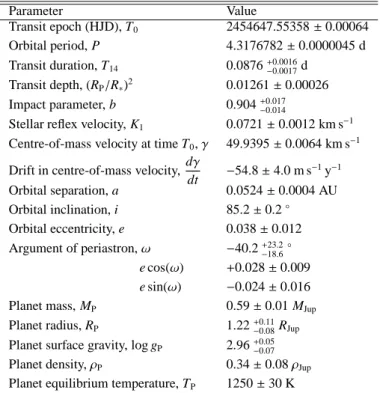
Parameter Value Transit epoch (HJD), T0 2454647.55358 ± 0.00064 Orbital period, P 4.3176782 ± 0.0000045 d Transit duration, T14 0.0876+0.0016−0.0017d Transit depth, (RP/R∗)2 0.01261 ± 0.00026 Impact parameter, b 0.904+0.017 −0.014
Stellar reflex velocity, K1 0.0721 ± 0.0012 km s−1
Centre-of-mass velocity at time T0, γ 49.9395 ± 0.0064 km s−1
Drift in centre-of-mass velocity,dγ
dt −54.8 ± 4.0 m s −1y−1 Orbital separation, a 0.0524 ± 0.0004 AU Orbital inclination, i 85.2 ± 0.2◦ Orbital eccentricity, e 0.038 ± 0.012 Argument of periastron, ω −40.2+23.2 −18.6 ◦ e cos(ω) +0.028 ± 0.009 e sin(ω) −0.024 ± 0.016 Planet mass, MP 0.59 ± 0.01 MJup
Planet radius, RP 1.22+0.11−0.08RJup
Planet surface gravity, log gP 2.96+0.05−0.07
Planet density, ρP 0.34 ± 0.08 ρJup
Planet equilibrium temperature, TP 1250 ± 30 K
Notes. The planet equilibrium temperature, TP, assumes a Bond albedo
of A = 0 and even redistribution of heat around the planet.
cases we have included a linear trend in the systemic velocity,
dγ
dt, as a free parameter. Limb-darkening uses the four-coefficient
model of Claret (2000) for the r-band, for both WASP and Euler photometry.
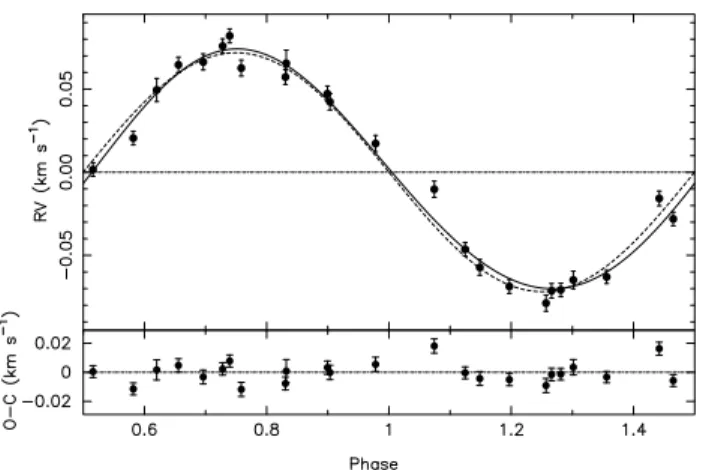
With the main-sequence constraint imposed but the eccen-tricity floating, a value of e = 0.038 ± 0.012 is found, which is significant at the 99.3% level (Lucy & Sweeney 1971, Eq. 21). The radial velocity measurements are well fitted by this orbital
Fig. 5. Radial velocity measurements relative to the systemic-mass velocity including the long-term drift, dγdt, compared to the eccentric orbital solution for WASP-34b (solid line). The dashed-line is the corresponding circular orbital solution.
solution and the linear long-term drift (Fig. 5). However, a F-test is a more reliable guide to the significance of the eccen-tricity (Lucy & Sweeney 1971, Eq. 27). The eccentric orbit fit has χ2 = 57.4, compared to χ2 = 68.5 for a circular orbit. We
adopt the null hypothesis that the underlying orbit is truly cir-cular but recognise that an eccentric fit to noisy and unevenly sampled data will always lead to a spurious improvement in χ2.
The probability that an improvement in the fit could have arisen by chance with the addition of 2 fitting parameters, e cos(ω) and e sin(ω), is 17.1%. While this is too high to confidently claim de-tection of eccentricity, it does not confirm that the orbit is truly circular. Hence, given there is some evidence for a non-circular orbit, we present the system parameters for the eccentric solu-tion (Table 3). The impact parameter and transit depth suggest that the planet could be in a grazing transit.
Relaxing the main-sequence constraint yields a larger stellar radius (1.20±0.09 R⊙) and lower surface gravity (log g = 4.3), which is marginally inconsistent with the spectroscopic log g. The planetary radius increases to 1.82+0.82
−0.48 RJupand the impact
parameter also rises to 0.98+0.08
−0.06. The planetary density now
drops to 0.11+0.15
−0.08 ρJup, which would be similar to that found
for WASP-17b (Anderson et al. 2010). While the fit to the tran-sit lightcurves is only slightly different (Fig. 4), the uncertain-ties in the planetary parameters are now rather large, indicating that the near-grazing nature of the transit is poorly constrained by the available photometry. Consequently, we adopt the main-sequence-constrained eccentric solution.
5. Discussion
WASP-34b is a sub-Jupiter mass exoplanet transiting a G5 host star every 4.3177 days. A simultaneous fit to transit photome-try and radial-velocity measurements gave a planetary mass of 0.59 ± 0.01 MJupand radius of 1.22+0.11−0.08RJup.
In many respects the WASP-34b system looks like transit-ing version of 51 Peg (Mayor & Queloz 1995) with similar pe-riods, separations, masses and host stars. Of the known transit-ing system, WASP-34b joins an increastransit-ing number of exoplan-ets with masses ∼ 0.5MJupand radii ∼ 1.0RJup, such as
WASP-22b (Maxted et al. 2010), WASP-25b (Enoch et al. 2010), HAT-P-24b (Kipping et al. 2010) and HAT-P-25b (Quinn et al. 2010).
Of these systems, the similarity to WASP-22b is striking consid-ering that it too has a linear trend in radial velocities due to a third-body in the system.
5.1. Properties of the third body
The significant linear trend in the radial velocities of 55
±4 m s−1y−1, noted in Sect. 2.2, indicates the presence of a third
body in the system with a long period. Using the constant accel-eration method of Winn et al. (2009) the third body satisfies
Mcsin ic
ac2
= 0.307 ± 0.022, (1)
where Mcand ac are the mass (in MJup) and orbital separation
(in AU) of the third body. Given that the period of this outer body must be greater than at least twice the RV data baseline, Pc>∼ 490 days and, using Kepler’s third law, ac>∼ 1.2 AU. Hence
Mc>∼ 0.45 MJup.
Using literature photometry we estimated the bolometric flux at the Earth to be fbol = 1.97 ± 0.10 × 10⁻⁹erg s−1cm−2, which
gives Teff = 5740 ± 140 K using the Infrared Flux Method
(IRFM) (Blackwell & Shallis 1977), which is in excellent agree-ment with the spectroscopic temperature determination. The modified IRFM method of Smalley (1993) suggests that a main-sequence companion would be cooler than ∼4000 K (M-type or later). There is a GALEX (Morrissey et al. 2007) near-UV flux measurement for WASP-34, and this is in in agreement with that predicted for a star of this temperature. This is no significant UV excess that could be attributed to a hot compact stellar com-panion, but this does not exclude the possibility of a cool white dwarf companion. Thus, we expect that the companion object is either a low mass star (M-type or cooler), cool white dwarf or another planet in a wide long-period orbit. Further radial veloc-ity measurements are required to constrain the orbit.
5.2. Grazing nature of the system
The transit depth ((RP/R∗)2= 0.0126) and high impact parameter (b = 0.90) suggest that WASP-34b could be the first transiting exoplanet known to undergo grazing transits. For a transit to be truly grazing, we require
b + RP/R⋆>1 (2)
and that this grazing criterion is significant compared to the observational uncertainties. For WASP-34b we find a value of 1.016 +0.017−0.014 for the grazing criterion. Hence, we might ex-pect grazing transits, unlike the near-grazing transits of TrES-2 (O’Donovan 2006) and HAT-P-14b (Torres et al. 2010b), which have grazing criteria of 0.972±0.007 and 0.968±0.022, respec-tively. Figure 6 shows the 10 000 MCMC posteriors for RP/R⋆ and b. A total of 89.6% of these satisfy the grazing criterion. If the grazing criterion were equal to unity, then we would expect 50% of the points to be higher and 50% to be lower than one. Using the odds ratio test (Kipping et al. 2010), we find a 82.8% probability (1.4-σ) that the system is truly grazing. However, this is lower than a 3-σ value which would be a reasonable limit for detection of a truly grazing system. Hence, we conclude that WASP-34b has near-grazing transits.
The eccentricity (e) and argument of periastron (ω) are such that the occultation impact parameter will be
Fig. 6. Plot of the MCMC posteriors b and RP/R⋆. The solid-line indicates the position of the stellar limb, i.e. b + RP/R⋆ = 1. A total of 89.6% of the points lie above the line and are grazing solutions.
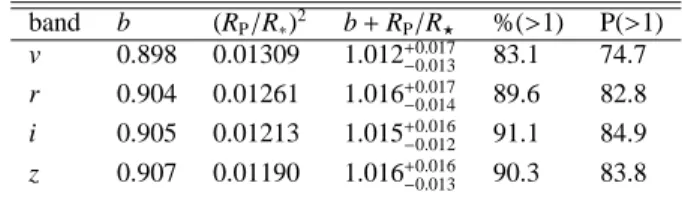
Table 4. Effect of limb-darkening on the derived impact param-eter, b, and transit depth, (RP/R∗)2, for various filter bands. The grazing criterion, b + RP/R⋆, is given along with the percentage of MCMC posteriors that are grazing,%(>1), and the confidence values, P(>1). band b (RP/R∗)2 b + RP/R⋆ %(>1) P(>1) v 0.898 0.01309 1.012+0.017 −0.013 83.1 74.7 r 0.904 0.01261 1.016+0.017 −0.014 89.6 82.8 i 0.905 0.01213 1.015+0.016 −0.012 91.1 84.9 z 0.907 0.01190 1.016+0.016 −0.013 90.3 83.8
Hence, bocc+ RP/R⋆ = 0.974 ± 0.035 with only 19.2% of the MCMC posteriors greater than 1. Therefore, the occultations of the planet behind the star are expected to be total. However, the uncertainties in the orbital elements are such that is a possibility that the occultations could be partial.
For transits with large b, the limb-darkening coefficients are extremely correlated to both RP/R∗ and b (Kipping & Bakos 2010). In order to investigate the effects of limb-darkening on the inferred grazing nature of the system, we re-ran our MCMC analysis using limb-darkening coefficients for different filter bands (Table 4). Compared to the r-band results, there are small but noticeable, differences. Hence, this heuristic demonstrates that there is a 75 ∼ 85% probability that the transit is actually grazing.
The near-grazing nature of the system makes it sensitive to additional planets, via changes to transit duration and shape. Given that there is evidence for another object in the WASP-34 system, further monitoring of the transits is required.
Acknowledgments
WASP-South is hosted by the South African Astronomical Observatory and their support and assistance is gratefully ac-knowledged. M. Gillon acknowledges support from the Belgian Science Policy Office in the form of a Return Grant. We thank the referee, David Kipping, for his constructive and helpful com-ments on the original manuscript.
References
Anderson, D.R., Hellier, C., Gillon, M., et al. 2010, ApJ, 709, 159 Baranne, A., Queloz, D., Mayor, M., et al. 1996, A&AS, 119, 373 Barnes, S.A. 2007, ApJ, 669, 1167
Blackwell, D.E. & Shallis, M.J., 1977, MNRAS, 180, 177
Bruntt H., Bedding T.R., Quirion P.-O., et al., 2010, MNRAS, 405, 1907 Charbonneau, D., Allen, L.E., Megeath, S.T., Torres, G., & Alonso, R. 2005,
ApJ, 626, 523
Claret, A., 2000, A&A, 363, 1081
Collier Cameron, A., Pollacco, D.L., Street, R.A., et al. 2006, MNRAS, 373, 799 Collier Cameron, A., Wilson, D.M., West, R.G., et al. 2007, MNRAS, 380, 1230 Enoch, B., Collier Cameron, A., Anderson, D.R., et al., 2010, MNRAS, in press
(arXiv1009.5917)
Gillon, M., Smalley, B., Hebb, L., et al. 2009, A&A, 496, 259
Gray, D.F., 2008, The observation and analysis of stellar photospheres, 3rd Edition (Cambridge University Press), p. 507.
Kipping, D.M. & Bakos, G.A., 2010, ApJ, submitted (arXiv1006.5680) Kipping, D.M., Bakos, G.A., Hartman, J., et al., 2010, ApJ, accepted
(arXiv1008.3389)
Lucy, L.B., & Sweeney, M.A. 1971, AJ, 76, 544 Magain, P. 1984, A&A, 134, 189
Maxted, P.F.L., Anderson, D.R., Gillon, M., et al. 2010, AJ, 140, 2007. Mayor, M., & Queloz, D. 1995, Nature, 378, 355
Morrissey P., Conrow T., Barlow T.A. et al., 2007, ApJS, 173, 682 O’Donovan, F.T., Charbonneau, D., Mandushev, G., 2006, ApJ, 651, 61 Pepe, F., Mayor, M., Galland, F., et al. 2002, A&A, 388, 632
Pollacco, D.L., Skillen, I., Collier Cameron, A., et al. 2006, PASP, 118, 1407 Pollacco, D.L., Skillen, I., Collier Cameron A., et al. 2008, MNRAS, 385, 1576 Queloz, D., Mayor, M., Weber, L., et al. 2000, A&A, 354, 99
Queloz, D., Henry, G.W., Sivan, J.P., et al. 2001, A&A, 379, 279
Quinn, S.N., Bakos, G.A., Hartman, J., 2010, ApJ, submitted (arXiv1008.3565) Schlesinger, F., & Barney, I. 1943, Trans. Astron. Obs. Yale Univ., 14, 1 Sestito, P., & Randich, S., 2005 A&A, 442, 615
Smalley, B. 1993, MNRAS, 265, 1035
Smalley, B. 2005, Mem. Soc. Astron. Ital. Suppl., 8, 130 Southworth, J. 2009, MNRAS, 394, 272
Torres, G., Andersen, J. & Gim´enez, A, 2010a, A&A Rev., 18, 67 Torres, G., Bakos, G.A., Hartman, J., et al. 2010b, ApJ, 715, 458 West R.G., Anderson D.R., Gillon M., et al. 2009, AJ, 137, 4834 Winn, J.N., 2009, IAU Symposium, 253, 99