O
pen
A
rchive
T
OULOUSE
A
rchive
O
uverte (
OATAO
)
OATAO is an open access repository that collects the work of Toulouse researchers and makes it freely available over the web where possible.This is an author-deposited version published in : http://oatao.univ-toulouse.fr/ Eprints ID : 14286
To cite this version : Wang, Guiquan and Abbas, Micheline and Climent, Eric Numerical Simulation of Neutrally Buoyant Particles in Turbulent Couette Flow. (2015) In: Dispersed two-phase flows 2015, 22 September 2015 - 24 September 2015 (Toulouse, France).
(Unpublished)
Any correspondance concerning this service should be sent to the repository administrator: [email protected]
Numerical Investigation of Particle Laden Plane Couette Flow
Authors : Guiquan Wang
1, Micheline Abbas
2&EricCliment
11
Institut de Mécanique des Fluides de Toulouse. CNRS-INPT-UPS - France
2
Laboratoire de Génie Chimique, Toulouse. CNRS-INPT-UPS - France
Proposed topic: Hydrodynamics of dispersed flows
Key words: Transition to turbulence, particle suspensions, two-way coupling, plane Couette
flow.
Speaker: Guiquan Wang/
[email protected]
Nowadays, the mechanisms of turbulence modulation by particles and their dependence on different physical properties (particle size, concentration and inertia) are still poorly understood and are widely open for fundamental investigation (Balachandar& Eaton, Ann. Rev. Fluid Mech. 2010). After the experiments of Matas et al. PRL 2003, fully resolved numerical simulations of pressure-driven particle-laden flows clearly revealed that particles of finite-size (with respect to the hydraulic diameter)at moderate concentration have a significant impact on the unsteady nature of the flow reducing the threshold of the transition from laminar to turbulent regimes. Particles enhance the transverse turbulent stress components and modify the flow rotational structures (Loisel et al. Phys.
Fluids 2013, Yu et al. Phys. Fluids 2013, Lashgari et al. PRL 2015). However this effect depends on
the particle concentration and on the particle size in a non-monotonous way while the nature of the interaction between the particles and the flow rotational structures is not yet fully understood.
This work aimsto understand the modulation of turbulence by particles under controlled macroscopic shear stress and bulk Reynolds number (plane Couette flow).We perform resolved two phase flow simulations with the aid of the Force-Coupling Method. The minimum flow unit is used (Hamilton et
al.JFM 1995), with different ratios of Couette gap width to particle diameter, Reynolds numbers and
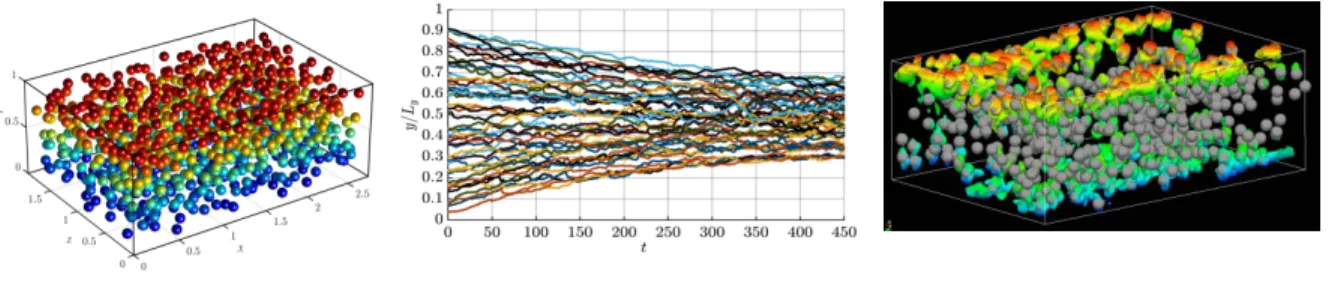
concentrations. Results on the particle distribution (fig. 1 left), their interaction with the large scale structures (fig. 1 right), and the induced modification of the flow turbulence properties will be analyzed and discussed.