O R I G I N A L A R T I C L E
Belgian multicenter experience with intestinal
transplantation
Laurens J. Ceulemans,1,2Diethard Monbaliu,1,2Arnaud De Roover,3Olivier Detry,3Roberto I. Troisi,4 Xavier Rogiers,4Raymond Reding,5Jan P. Lerut,5Dirk Ysebaert,6Thierry Chapelle6and
Jacques Pirenne1,2
1 Abdominal Transplant Surgery, University Hospitals Leuven, Leuven, Belgium 2 Department of Microbiology and Immunology, KU Leuven, Leuven, Belgium
3 Department of Abdominal Surgery and Transplantation, University Hospital of Li!ege, Li!ege, Belgium
4 Department of General and Hepatobiliary Surgery, Liver Transplantation Service, Ghent University Hospital, Ghent, Belgium 5 Department of Abdominal Surgery and Transplantation, University Hospitals Saint Luc – UCL, Brussels, Belgium
6 Department of Hepatobiliary and Transplantation Surgery, Antwerp University Hospital, Antwerp, Belgium
Keywords
Belgium, Eurotransplant, intestinal failure, intestinal transplantation, multivisceral transplantation.
Correspondence
Jacques Pirenne MD, PhD, Abdominal Transplant Surgery, University Hospitals Leuven, Herestraat 49, B-3000 Leuven, Belgium.
Tel.: +32 16 348727; fax: +32 16 348743;
e-mail: [email protected] Conflicts of interest
None of the authors has any conflict of interest to disclose in relation to the study. Received: 9 January 2015
Revision requested: 3 February 2015 Accepted: 27 May 2015
doi:10.1111/tri.12615
Summary
Intestinal transplantation (ITx) has evolved from an experimental procedure toward a clinical reality but remains a challenging procedure. The aim of this sur-vey was to analyze the multicenter Belgian ITx experience. From 1999 to 2014, 24 ITx in 23 patients were performed in Belgium, divided over five centers. Median recipient age was 38 years (8 months–57 years); male/female ratio was 13/10; six were children; and 17 adults. Intestinal failure was related to intestinal ischemia (n = 5), volvulus (n = 5), splanchnic thrombosis (n = 4), Crohn (n = 2), pseudo-obstruction (n = 2), microvillus inclusion (n = 2), Churg-Strauss (n = 1), necrotizing enterocolitis (n = 1), intestinal atresia (n = 1), and chronic rejection (n = 1). Graft type was isolated ITx (n = 9), combined liver-ITx (n = 11) and multivisceralTx (n = 4). One was a living donor-related transplan-tation and five patients received simultaneously a kidney graft. Early acute rejec-tion occurred in 8; late acute rejecrejec-tion in 4; and chronic rejecrejec-tion in 2. Two patients developed a post-transplant lymphoproliferative disease. Nine patients have died. Among 14 survivors at last follow-up, 11 have been transplanted for more than 1 year. None of the latter has developed renal failure, and all were nutritionally independent with a Karnofsky score > 90%. One-/five-year patient and graft survivals were 71.1%, 62.8%, 58.7% and 53.1%, respectively. Based on this experience, ITx has come of age in Belgium as a lifesaving and potentially quality of life restoring therapy.
Introduction
Over the last two decades, intestinal transplantation (ITx) has evolved from an experimental procedure toward a valuable and lifesaving treatment for patients suffering from intestinal failure (IF) and invalidating complications of total parenteral nutrition (TPN) [1,2]. However, ITx still remains a challenging surgical, medical, and immuno-logical procedure whose long-term results remain inferior to those obtained in other solid abdominal organ
trans-plantations. This is due to the strong organ immunogenic-ity and the subsequent need for profound and chronic immunosuppression (IS) with its associated side effects [1,3]. The decision to transplant these patients has there-fore to be taken carefully, and ITx has been relatively rarely applied in Belgium compared to certain North American centers [2,4,5]. To increase the donor pool and optimize organ exchange, Belgium actively participates in the Eurotransplant (ET) organization which is a collabora-tive framework of 8 European countries [6].
The aim of this national survey was to analyze the overall Belgian ITx experience.
Patients and methods Belgian experience
The Belgian experience has been collected based on a ret-rospective survey organized by the Belgian Liver and Intes-tine Advisory Committee (Be-LIAC). Patient-specific data forms of the Intestinal Transplant Registry (ITR) and an additional questionnaire-based survey were gathered until May 31st, 2014 [7]. The data collection comprised overall activity, recipient and donor characteristics, blood group (ABO) compatibility, donor–recipient human leukocyte antigen (HLA) A-/B-/DR-mismatches, panel reactive anti-bodies (PRA), cross-match, waiting time, graft type, ische-mia time, surgical technique, immunosuppressive regimen, intensive care unit (ICU) and hospital stay, rejec-tion, post-transplant lymphoproliferative disease (PTLD), renal function, and finally 1-/5-year patient and graft sur-vival rates. The renal function was analyzed pretransplant, and at 1-/3-/5-year post-transplant by the estimated glo-merular filtration rate (eGFR) which was calculated according to the formula for adults adapted from Levey: 186*(serum creatinine!1.154)*(age!0.203)*1.212 (if patient is black)*0.742 (if female) [8]. For children, the adapted Schwartz formula was used: 0.413*(height/serum creati-nine) [9].
At last follow-up, a cross-sectional analysis of TPN inde-pendence, weight evolution, and Karnofsky score (clinical scoring for performance status from the physician’s per-spective) of the patients who were transplanted for more than 1 year was performed. Data were collected by two researchers (LC, JP), entered and tabulated using Excel (Microsoft Office 2013), and exported to Graphpad Prism 5 (GraphPad Software Inc., La Jolla, CA, USA). Results are reported as median (range) and survival curves were deter-mined following Kaplan–Meier.
Results
Response rate to Belgian survey
Five of seven Belgian transplantation centers performed at least one ITx and all completed the survey.
Activity
Between March 1999 and June 2014, 24 ITx were per-formed in 23 patients: 15 ITx were perper-formed at the Uni-versity Hospitals Leuven, 5 (of them 1 re-Tx) at the University Hospital of Li!ege, 2 at the University Hospital of Ghent, 1—which was the first in Belgium—at the
sity Hospital of Saint-Luc in Brussels, and 1 at the Univer-sity Hospital of Antwerp.
Data abstraction is reported in detail in Table 1.
Recipient demographics, indications, waiting time
Age of the 23 patients at the time of their first transplant was 37 years 5 months (8 months–56 years 8 months). The male/female ratio was 13/10. Six patients (26%) were pediatric (< 18 years) and 17 (74%) were adult. Preopera-tive body mass index (BMI) was 19.3 kg/m2 (10.9– 39.3 kg/m2). All patients suffered from IF and associated life-threatening complications such as repetitive infection, venous access problems, or liver failure. IF was a conse-quence of anatomical or functional short bowel syndrome due to intestinal ischemia (n = 5), volvulus (n = 5), dif-fuse splanchnic thrombosis (n = 4), Crohn’s disease (n = 2), chronic intestinal pseudo-obstruction (n = 2), microvillus inclusion disease (n = 2), Churg-Strauss vas-culitis (n = 1), necrotizing enterocolitis (n = 1), intestinal atresia (n = 1), and chronic rejection of the first allograft (n = 1). The latter patient, a 9-year-old boy, was the only patient who was re-transplanted, 6 years after removal of the first graft. PRA was negative in all, apart in the latter (100%) and the first ITx in this cohort (40%). At time of ITx, 11 patients (45.8%) were in hospital and 13 (54.2%) at home. Time on the waiting list was 5 months (2 days– 2 years 8 months).
Donor demographics Deceased donors
The cause of death of the 23 deceased donors was an iso-lated head trauma (n = 11; 48%), intracranial bleeding (n = 6; 26%), anoxia (n = 3; 13%), suicide (n = 2; 9%), and CO intoxication (n = 1; 4%). Donor age was 16 years (3 months–38 years). Sixteen donors (70%) were male and 7 (30%) female. Their body mass index was 17.9 kg/m2 (11.4–27.7 kg/m2). Stay on the ICU prior to procurement was 2.5 days (1–9 days). The donor/recipient weight ratio was 0.91 (0.4–1.5).
Living donor
A 34-year-old female (blood group: O+; weight: 44 kg; height: 168 cm) received an intestinal allograft from her 59-year-old mother (blood group: O+; weight: 50 kg; height: 160 cm). This donor/recipient weight ratio was 1.14 [10].
In the donor, no signs of malabsorption and/or steatho-rea were observed postdonation. She had obstipation pre-operatively which disappeared postpre-operatively and evolved in a normal bowel movement pattern. Interestingly, daily
Table 1. Intestinal transplant (ITx) characteristics of 24 ITx performed in Belgium between March 1999 and June 2014. Patient number Recipient Graft Donor Donor –recipient match Patient number Ischemic time
Leuven protocol deceased donor Induction IS Post-op stay (days) Rejection (days post-op)
Graft loss (days post-op)
Alive/death Age at Tx Pediatric/ Adult Gender Indication Type Pancreas graft size Cadaveric/ living Age Gender ABO compatibility HLA A/B/DR mismatch Cold (hour) Warm (hour) ICU (days) Hospital (days) Early acute Late acute Chronic
Died (days post-op) Cause ofdeath 1 1 y 1 mo Pediatric M volvulus cLi-ITx Half Cadaveric 3 mo M Identical 221 1 NA NA No None NA 92 13 92 Sepsis (bacterial) 2 55 y 7 mo Adult F Ischemia cLi-ITx Half Cadaveric 37 y F Identical 021 2 06:30 00:40 Yes Simulect 11 116 4321 NSAID 3 56 y 7 mo Adult F Ischemia cLi-ITx Half Cadaveric 13 y M Identical 111 3 05:00 00:50 Yes Simulect 16 208 4 38 y 2 mo Adult F Enterocollitis ITx Cadaveric 17 y M Compatible 222 4 03:17 00:40 No ATG 3 127 47 70 441 Intracranial bleeding 5 2 y 8 mo Pediatric M Volvulus cLi-ITx Half Cadaveric 3 y F Compatible 021 5 06:37 00:37 Yes Simulect 31 684 6 25 y 10 mo Adult F Pseudo- obstruction ITx Cadaveric 16 y F Identical 102 6 03:45 00:35 Yes Simulect 8 100 7 2 y 3 mo Pediatric M Microvillus inclusion ITx Cadaveric 1 y 2 mo M Compatible 212 7 06:33 00:15 No None 6 117 13 565 568 8 52 y 1 mo Adult M Ischemia cLi-ITx + colon + KTx Full Cadaveric 26 y F Compatible 121 8 05:20 00:33 No Simulect 2 41 45 Sudden death 9 8 mo Pediatric M Intestinal atresia cLi-ITx Full Cadaveric 6 mo M Identical 222 9 06:40 00:55 No Simulect 6 58 10 41 y 6 mo Adult F Volvulus + EH ITx + KTx Cadaveric 7 y M Identical 221 10 05:21 00:27 Yes Simulect 11 60 1403 11 43 y 5 mo Adult M PVT (APL) MvTx + colon Full Cadaveric 16 y M Identical 112 11 06:15 00:28 No Simulect 12 136 33 67 (partial) 118 Sepsis (Aspergillus) 12 34 y 4 mo Adult F Churg-strauss ITx Living 59 y F Identical 111 12 02:52 00:22 / Simulect 3 120 22 + 87 213 213 1781
Complicated intestinal failure
13 40 y 5 mo Adult F Ischemia ITx Cadaveric 16 y M Identical 222 13 04:45 00:35 Yes ATG 6 70 125 + 239 254 Sepsis (Aspergillus) 14 9 y Pediatric F Volvulus cLi-ITx + colon Full Cadaveric 9 y M Identical 120 14 05:42 00:32 Yes ATG 11 90 15 53 y 6 mo Adult M Pseudo- obstruction cLi-ITx + colon + KTx Full Cadaveric 29 y F Compatible 221 15 06:26 00:35 No None 12 32 32 Sepsis (bacterial) 16 48 y 8 mo Adult M PVT cLi-ITx Full Cadaveric 38 y M Compatible 221 16 09:31 01:15 No Simulect 18 21 8 + 21 22 Pseudoaneurysm (Candida) 17 36 y 7 mo Adult F Volvulus cLi-ITx Full Cadaveric 17 y F Compatible 121 17 05:40 00:24 Yes Simulect 10 155 18 56 y 8 mo Adult F Crohn + EH ITx + KTx Cadaveric 9 y M Identical 222 18 04:53 00:31 Yes Simulect 11 56 19 29 y 10 mo Adult M Crohn ITx Cadaveric 14 y F Identical 222 19 03:50 00:36 Yes Simulect 2 167 18 550 20 9 y 1 mo Pediatric M Retransplant MvTx + colon Full Cadaveric 5 mo M Compatible 202 20 06:22 00:26 No None 5 30 153 21 52 y 9 mo Adult M Ischemia ITx Cadaveric 21 y M Identical 111 21 03:40 NA No Simulect 4 61 22 22 y 10 mo Adult M PVT (NET) MvTx Full Cadaveric 21 y M Identical 120 22 05:00 00:24 Yes Simulect 6 70 20 23 3 y 8 mo Pediatric M Microvillus inclusion cLi-ITx Full Cadaveric 1 y 6 mo M Compatible 212 23 02:19 00:22 Yes Simulect 9 70 24 47 y Adult M PVT (cirrhosis) MvTx + KTx Full Cadaveric 31 y M Compatible 122 24 05:19 00:30 Yes Simulect 14 125 Tx, transplantation; y, year; mo, month; M, male; F, female; EH, enteric hyperoxaluria; PVT, portal vein thrombosis; APL; antiphospholipid syndrom e; NET, neuro-endocrine tumor; HLA, human leuko-cyte antigen; NA, not available; NSAID, nonsteroidal anti-inflammatory drugs.
statin intake could be stopped due to a drop in cholesterol levels after donation.
ABO compatibility, HLA-mismatches, and cross-match ABO blood group was compatible in 10 transplants (42%) and identical in 14 (58%). As there was no attempt at HLA matching between donors and recipients at the moment of transplantation, this resulted in a mean donor–recipient HLA A-/B-/DR-mismatch of 1/2/1. No difference was found between those who died (mean HLA mismatch: 1/2/ 1) and those who survived (mean HLA mismatch: 1/2/1). Cross-matches were negative in all, apart from the retrans-plant case.
Type of graft and surgical technique
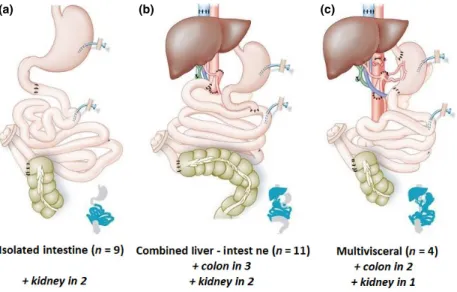
Three different types of grafts were transplanted (Fig. 1, Panel a–c). An isolated small bowel was transplanted in nine patients (37.5%)—of whom 2 received an additional kidney for secondary enteric hyperoxaluria as previously reported [11]—; 11 patients (46%) underwent a combined liver and ITx (cLi-ITx)—of whom 3 received an additional colon and 2 an additional kidney—; and 4 patients (16.5%) had a multivisceral Tx (MvTx) of whom 2 received an additional colon and 1 a simultaneous kidney transplant. All 11 cLi-ITx were performed according the Omaha technique as described by Sudan et al. [12]. Inter-estingly, apart from the first 4 cLi-ITx performed in Brus-sels and Leuven (before 2005) in whom the tail of the pancreas graft was stapled before implantation, all other
transplanted liver-intestinal grafts (n = 7) included a full pancreas as was the case in the 4 MvTx, according to the technique described by Tzakis et al. [13]. In the latter patients, splanchnic exenteration was followed by en-bloc transplantation of stomach, duodenum, pancreas, and small bowel. Three of them underwent embolization of the superior mesenteric artery and celiac trunk prior to splanchnic exenteration in order to minimize blood loss [14]. From the living donor, one-third (200 cm) of the distal small bowel was procured and transplanted accord-ing to the technique described by Gruessner et al. [15]— paying attention to leave 25 cm of donor distal ileum intact for vitamin B12 resorption. Overall, cold ischemia time was 5 h 20 min (2 h 19 min–9 h 31 min) and warm ischemia time was 32 min (22–75 min). Primary closure of the abdomen could be achieved in 22 procedures (91.7%). In 2 cases (8.3%) additional mesh repair was required. Two patients, of whom the first was the living-related ITx and the second a 9-year-old girl, received sub-cutaneous self-inflatable tissue expanders pretransplant to create additional skin and facilitate abdominal closure. In both, the abdomen could be closed after transplantation without difficulties.
Immunosuppressive treatment
Induction IS was given to 20 ITx recipients (83.3%), of which 17 received Basiliximab (anti-IL2) and 3 ATG (Thy-moglobuline). All patients received tacrolimus-based main-tenance IS: In triple therapy with azathioprine and steroids in 16 patients (66.7%); two patients (8.3%) were treated
(a) (b) (c)
Figure 1 Three types of intestinal transplantation were performed in the Belgian experience. Panel a: isolated intestinal transplantation (n = 9; 37.5%), two received an additional kidney Panel b: combined liver and intestinal transplantation (n = 11; 46%) of which four were combined with a pancreatic head and seven with a full pancreas; three received an additional colon and two an additional kidney Panel c: multivisceral transplantation (n = 4, 16.5%); two received an additional colon and one an additional kidney.
with mycophenolate mofetil instead of azathioprine; six patients (25%) received dual therapy with tacrolimus and steroids. Two months after transplantation, one patient (MvTx) received additional therapy with an m-Tor inhibitor because the histology of the explant specimen revealed a metastatic pancreatic neuro-endocrine tumor. One year later, the patient remains disease-free. Another patient who developed a PTLD was also switched to an m-TOR inhibi-tor.
In 13 consecutive ITx (54.2%) from the same center (University Hospitals Leuven)—who received their graft from a deceased donor—an immunomodulatory protocol was applied [16,17]. This protocol aims to redirect the allo-immune response toward the intestinal allograft from a cytotoxic toward a regulatory response by activation of T-regulatory cells. The protocol was experimentally proven and consists in: peri-transplant donor-specific-blood trans-fusion (DSBT) (activates T-regulatory cells); avoiding high-dose steroids/calcineurin inhibitors (abrogates DSBT-effect/inhibits T-regulatory cells); and maneuvers reducing reperfusion injury (among them glutamine administration and anti-TNF alpha) and endotoxin translocation (bowel decontamination).
Post-transplant hospital stay
First post-transplant ICU stay was 9 days (2–31 days), and post-transplant hospital stay was 3 months (21 days– 2 years).
Rejection
In most cases, diagnosis of rejection was made on biopsy and treated with high-dose steroids (Solu-Medrol!; 3 * 500 mg–1 g/day), and—if unresponsive—by muromo-nab-CD3, thymoglobulin or immunoglobulins.
Early biopsy-proven rejection (within the first 3 months post-Tx) occurred in 8 cases (33.3%). Six of them (75%) (patients who were not treated with the immunomodula-tory protocol) lost their graft of whom 5 died and 1 was re-transplanted; the other two rejections were reversible with steroids.
Late biopsy-proven acute rejection (after the first 3 months post-Tx) occurred in four of 16 (25%) grafts that survived longer than 3 months; one should take into account that five grafts were lost within the first 3 months and that three patients did not yet reach 3 months survival at the moment of data collection. One of these four patients died due to sepsis, in the remaining three patients, rejection was reversed.
Chronic rejection with subsequent graft loss was seen in two cases (8.3%). Both patients received an isolated graft and both endured an acute rejection at respectively
7 months and 1 year 7 months post-Tx. Following trans-plantectomy, they were considered for MvTx; the first patient was re-transplanted 6 years later and was doing well at last follow-up, the second ITx patient (living-related donation) unfortunately could not be listed for this proce-dure in Belgium as being a non-ET resident (Poland). She finally died (without access to re-transplantation) 4 years after transplantectomy.
Post-transplant lymphoproliferative disease
Two patients (8.7%) developed PTLD. A 5-year-old child developed severe myelodysplasia 4 years after cLi-ITx. To limit the disease progression, IS therapy was stopped. Bone marrow transplantation was refused, and at last follow-up (3 years 6 months later), the patient was doing well with-out any IS and a fully functioning graft. The second patient was a 9-year-old child who developed Epstein–Barr-virus-induced PTLD after receiving his second ITx. He was trea-ted with rituximab and solely received an m-Tor inhibitor as IS. Two years later, at last follow-up, the child was doing well with a fully functioning graft.
Renal function
Evolution of eGFR is shown in Fig. 2. The median pre-transplant eGFR was 91 ml/min (except of 3 who were on dialysis pretransplant). At 1-year (63 ml/min), 3-year (63 ml/min) and 5-year post-transplant (61 ml/min), the renal function remained stable and none of the patients required chronic dialysis post-transplant.
Figure 2 The estimated glomerular filtration rate (eGFR) was analyzed pretransplant (median: 91 ml/min) (except of three who were on dialy-sis pretransplant). At 1-year (63 ml/min), 3-year (63 ml/min), and 5-year post-transplant (61 ml/min), the renal function remained stable and none of the patients required chronic dialysis post-transplant.
Survival and cause of death
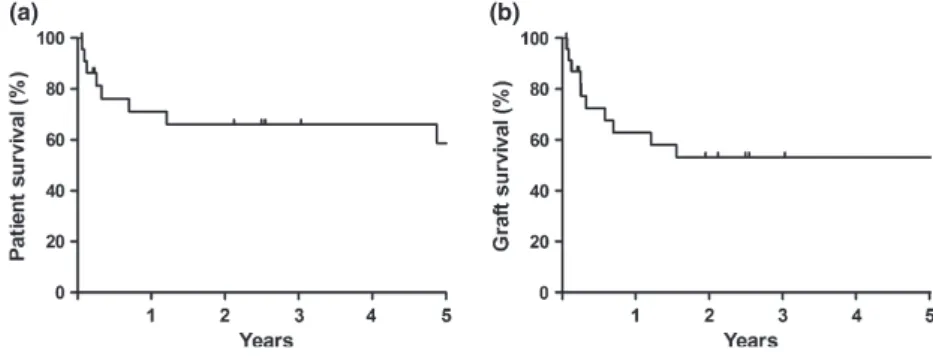
One- and 5-year patient survival rates were 71.1% and 58.7%, respectively (Fig. 3, Panel a). With a median patient follow-up of 2 years 6 months (20 days–12 years), 14 patients (60.9%) survived, and 9 died (39.1%). Survival of the patients who died was 4 months (22 days–11 years 10 months). Causes of death were as follows: sepsis (n = 4) (two bacterial and two Aspergillus related), intracranial bleeding (n = 1), mycotic aneurysm-related hemodynamic shock (n = 1), nonsteroidal anti-inflammatory drug (NSAID)-induced enteropathy (n = 1), complicated IF after graft loss (n = 1), and unexplained sudden death (n = 1).
One- and 5-year graft survivals (death uncensored) were 62.8% and 53.1%, respectively (Fig. 3, Panel b). Graft survival at last follow-up was 1 year 9 months (22 days– 12 years). Of the 14 patients who were alive at last follow-up, one lost his graft due to chronic rejection and was re-transplanted. Six (66.7%) of 9 deceased patients died with a functioning graft whereas 3 (33.3%) had lost their graft prior to death. The reasons for their graft loss were early acute rejection (n = 1), late acute rejection (n = 1), and chronic rejection (n = 1).
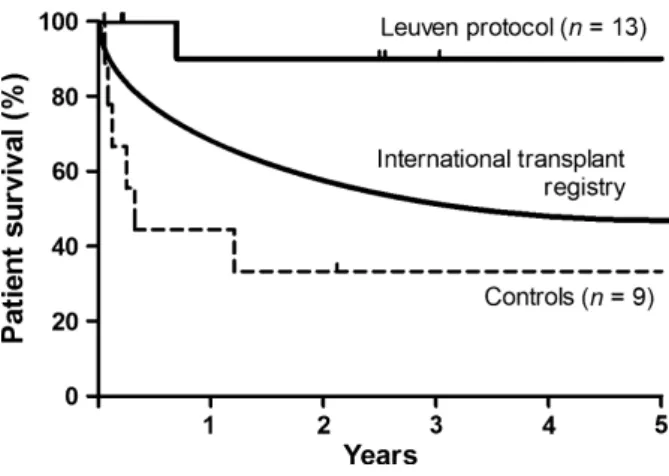
The 5-year patient survival rate of the 13 consecutive ITx recipients—who received their graft from a deceased donor —and were treated with an immunomodulatory protocol was 90%, which is higher compared to the other nine patients who did not receive the protocol and had a sur-vival of 33% (log rank, P = 0.0055) (Fig. 4).
Cross-sectional analysis at last follow-up of 11 surviving patients who were transplanted for more than 1 year Follow-up of the 11 patients was 7 years 2 months (2 years 1 month–12 years). These survivors had a functioning graft and were TPN—and intravenous fluid—free. This was reflected by their weight and BMI gain of 12.3 kg and 2.6 kg/m2, respectively. The Karnofsky performance score
was > 90%, reflecting resumption of their normal daily activities.
Discussion
In contrast to liver or kidney failure, for which solid organ transplantation is widely accepted as the best treatment regarding survival and quality of life, TPN still represents the first line of treatment for end-stage IF [1]. TPN indeed significantly improves outcome of IF, resulting in a current 1- and 5-year survival rate of 91% and 70% (vs. 77% and 58% for ITx, according to the last era (2000–2013) reported by the ITR) [18,19]. However, long-term TPN may lead to life-threatening complications such as liver failure, impaired venous access or recurrent infections. In these sit-uations, ITx represents a lifesaving option with—poten-tially—a benefit of restoring the daily activities, like in the Belgian cohort where all surviving patients achieved nutri-tional independence and a high Karnofsky performance score (> 90%) [2,20].
Apart from very few historical procedures, it was only with the introduction of tacrolimus by Starzl (University of Pittsburgh) that short-term results improved and that ITx became a clinical reality [21]. Following encouraging results from Pittsburgh in the early nineties interest for ITx rose worldwide with the first Belgian ITx performed in 1999. Recently however, the ITR reported a decline in the annual rate of ITx from 200/year in 2008 till only 100/year in 2012 [7,22]. This might be attributed to an improvement in TPN and IF-management and vascular access with respec-tively fewer liver failure and line-related complications [23,24].
The same decline is seen within ET where the highest annual rate of ITx was recorded in 2008, when 16 patients received an intestinal graft (Fig. 5). From then, a steadily decrease with only 5 ITx procedures in 2013, has been observed [6]. From the first ITx in 1987 until May 31, 2014, 160 ITx were performed within four ET countries (Germany, Austria, the Netherlands, and Belgium), divided over 17 transplant centers (accounting for 5.5% of the worldwide ITx experience). This incidence is in stark con-trast to the North American centers which represent more than 75% of the global ITx activity, resulting in a highly skewed literature reporting [7,22]. As mentioned, in
(a) (b)
Figure 3 One- and 5-year patient (Panel a)/graft (death uncensored; Panel b) survival rates (Kaplan–Meier analysis).
Belgium five ITx centers (of seven Tx centers) performed 24 ITx. This is a relatively high number of centers for a small population (11 million inhabitants), but, one should real-ize that medical care in Belgium has not been centralreal-ized (compared to the Netherlands and the UK). However, cur-rently the number of active centers has reduced and at the moment of writing, the only Belgian ITx candidates (n = 2) were listed at one center (University Hospitals Leu-ven). This is consistent with the ITR data which indicate that the number of active ITx centers has reduced from 87 to 46 worldwide [7].
ITx patient characteristics in Belgium, however, are quite different to the profile reported by the ITR, with pediatric ITx representing only 26% of the total activity in Belgium versus 56% in the ITR [22]. We have no clear explanation for this discrepancy. The liver sparing lipid free/poor TPN
management and strict hygienic line policies have been standard in Belgium for more than a decade and this may have led to less referral for intestinal and liver transplanta-tion. Alternatively, and particularly at the start of the pro-gram, too late referral of moribund patients who were too sick to undergo ITx may have played a role. Finally, pediat-ric cadavepediat-ric organ donation in Belgium is relatively low. Currently, children have no prioritization on the waiting list for ITx. The only exception (for children and adults) is the cLi-ITx or MvTx who receive prioritization over all liver (except high-urgency) and isolated ITx candidates. This is the so-called Eurotransplant mandatory exchange sta-tus.
Indications for ITx on the other hand are quite similar between Belgium and the ITR, with short bowel syndrome due to ischemia or volvulus being the most frequent. In contrast to cLi-ITx representing the most frequently trans-planted type of graft in the Belgian experience (46%) versus 31% in the ITR, the isolated intestinal graft is most fre-quently transplanted worldwide (according to the ITR, 45%) versus 37.5% in the Belgian experience. Although MvTx has been performed less frequently (16.5% in Bel-gium versus 23.5% according the ITR) indications such as splanchnic thrombosis are increasing [22,25].
MvTx has become a viable lifesaving surgical option for patients suffering from extensive porto-mesenteric throm-bosis who remain unresponsive to medical treatment or surgical shunt techniques [25]. However, extensive abdom-inal surgery in these patients is challenging and frequently complicated by major, uncontrollable bleeding, requiring massive transfusion, with considerable morbidity, and mortality. The four MvTx cases, reported herein, were very similar as complete portal thrombosis—extending deeply into all venous mesenteric branches—had caused conges-tion of the entire small bowel in all of them, thereby decreasing the absorptive function and making these patients TPN dependent. MvTx was the only feasible
Figure 4 The 5-year patient survival rate of 13 consecutive intestinal transplant recipients—who received their graft from a deceased donor —and were treated with an immunomodulatory protocol was 90%, which is higher compared to the other nine patients who did not receive the protocol and had a survival of 33% (log rank, P = 0.0055) (Kaplan– Meier analysis). In the same era (2000–2013) worldwide, 5-year patient survival according to the International Transplant Registry was 58%.
Figure 5 Intestinal transplant (ITx) activ-ity within Belgium (white bars) and Euro-transplant (ET) (black bars) between 1987 and May 31, 2014.
option and treatment that could fully restore the anatomi-cal portal drainage of the intestine. In three cases, complete preoperative embolization of the superior mesenteric artery and celiac trunk safely facilitated native organ exenteration prior to MvTx. Details of this strategy were recently reported by the first author of this paper [14].
Interesting and particularly challenging in ITx candidates is preoperative renal failure and the indication for simulta-neous kidney transplantation. From the 24 ITx performed in Belgium, 5 also received a kidney graft (21%). Three of the Belgian patients were on dialysis, and the fourth and fifth patient already had a severely impaired renal function with a pretransplant eGFR of 34 and 37 ml/min, respec-tively. We believe that inclusion of a renal allograft in case of limited renal function pretransplant (GFR< 30–40 ml/ min) should be strongly considered. Indeed, ITx and expo-sure to calcineurin inhibitors has a well-known negative effect on renal function and, in turn, post-transplant renal impairment increases the mortality rate by a factor up to 6 [26,27].
Another pitfall in ITx resides in the closure of the abdominal wall. Previous repeated surgery and enterectomy frequently results in a shrunken hostile abdominal domain and decreased abdominal wall elasticity [28]. Preferentially donors which are smaller in size should be selected. In the Belgian experience, the donor/recipient weight ratio of 0.92 fitted within the generally recommended ratio of 0.76–1.1 [29]. The technique of pretransplant tissue expansion was successfully applied in two patients reported herein.
Similar to the ITR data, most Belgian patients received induction IS (Basiliximab or ATG) (83% in Belgian cohort versus 72% in the ITR) and tacrolimus-based maintenance IS. Overall rejection rate in the Belgian cohort was 45%, a figure slightly lower than reported by most centers (50– 60%). This might be explained by inclusion of more than half of the patients in an immunomodulatory protocol described in details elsewhere and based on the administra-tion of DSBT under low levels of IS and in a low-inflamma-tory environment [16,17]. Indeed, the incidence of rejection in this cohort was relatively low: 2 (15%) patients developed early acute rejection, 3 (23%) late acute rejection and none chronic rejection. All rejections were reversible. Under this protocol, applied in 13 consecutive ITx from deceased donors, only two patients (15%)—who both received an isolated ITx—died. One to an invasive Asper-gillosis (following antirejection therapy) at 8.5 months, the other to an unforeseen NSAID-induced graft enteropathy almost 12 years after ITx [30].
For this cohort of patients who received the immuno-modulatory protocol, six received a liver-containing graft. Therefore, one cannot exclude that the favorable outcome could be attributed in part to the “liver-protective” effect. However, it is known that this effect applies particularly in
the long term, is far from universal, and does not systemati-cally override rejection.
Although gastroenterologists and general physicians have become aware of the therapeutical and lifesaving option of ITx for a selected number of patients, the procedure unfor-tunately remains confronted with long waiting times and a mortality rate on the waiting list of up to 50%. Therefore early referral, adequate evaluation and timely activation on the waiting list are advocated [31]. For selected patients, and non-ET residents who have no access to the organ pool (as in the case described herein), living-related donation might avoid this waiting list. To our knowledge, only two other living-related ITx were performed within ET. The first successful living-related intestinal graft donation worldwide was performed by Deltz in Kiel (Germany) on August 8, 1988 [32] and the second in Frankfurt am Main (Germany) [33]. Although living donation might offer sev-eral advantages like: (i) planned procedure with a limited cold ischemia time; (ii) the possibility of HLA matching; and (iii) the ability to transplant at the optimal moment for the recipient, experience remains limited.
Conclusion
ITx has come of age in Belgium as a life-saving treatment in selected patients with reduced life expectancy due to IF and significant complications from TPN. During the last 15 years, 24 ITx were performed in five centers, accounting for 15% of the ET activity. Five-year patient and graft sur-vival rates of 62.8% and 53.1%, respectively, were achieved, which is similar to long-term results reported by the ITR. All survivors were nutritionally independent and experi-enced an improved Karnofsky performance score.
Authorship
LC and JP: Designed the paper, Reviewed literature, Col-lected data, Wrote the paper and Contributed important ideas. DM, ADR, OD, RT, XR, RR, JL, DY and TC: Designed the paper, Collected data and Contributed important ideas.
Funding
No funding was provided for this study.
Acknowledgements
The study was performed on behalf of the Belgian Liver and Intestine Advisory Committee (Be-LIAC). J Pirenne has received unrestricted grants of Astellas and Roche. J Pirenne and D Monbaliu are holders of a CAF chair in abdominal transplant surgery.
References
1. Fishbein TM. Intestinal transplantation. N Engl J Med 2009; 361: 998.
2. Abu-Elmagd KM, Kosmach-Park B, Costa G, et al. Long-term survival, nutritional autonomy, and quality of life after intestinal and multivisceral transplantation. Ann Surg 2012; 256: 494.
3. Berger M, Zeevi A, Farmer DG, Abu-Elmagd KM. Immuno-logic challenges in small bowel transplantation. Am J Trans-plant 2012; 12: S2.
4. Abu-Elmagd KM, Costa G, Bond GJ, et al. Five hundred intestinal and multivisceral transplantation at a single cen-ter: major advances with new challenges. Ann Surg 2009; 250: 567.
5. Vianna R, Kubal C, Mangus R, Fridell J, Tector J. Intesti-nal and multivisceral transplantation at Indiana Univer-sity: 6 years0experience with 100 cases. Clin Transpl 2009; 219.
6. Eurotransplant Network. https://www.eurotransplant.org/ cms/. (accessed May 6, 2015)
7. International Intestinal Transplant Registry (ITR), part of the Intestinal Transplant Association (ITA). http://www.in-testinaltransplant.org/itr/. (accessed May 6, 2015)
8. Levey AS, Stevens LA, Schmid CH, et al. A new equation to estimate glomerular filtration rate. Ann Intern Med 2009; 150: 604.
9. Schwartz GJ, Mu~noz A, Schneider MF, et al. New equations to estimate GFR in children with CKD. J Am Soc Nephrol 2009; 20: 629.
10. Darius T, Monbaliu D, Aerts R, et al. Living related intesti-nal transplantation for Churg-Strauss syndrome: a case report. Transpl Proc 2010; 42: 4423.
11. Ceulemans LJ, Nijs Y, Nuytens F, et al. Combined kidney and intestinal transplantation in patients with enteric hyper-oxaluria secondary to short bowel syndrome. Am J Trans-plant 2013; 13: 1910.
12. Sudan DL, Iyer KR, Deroover A, et al. A new technique for combined liver/small intestinal transplantation. Transplan-tation 2001; 72: 1846.
13. Tzakis AG, Kato T, Levi DM, et al. 100 multivisceral trans-plants at a single center. Ann Surg 2005; 242: 480.
14. Ceulemans LJ, Jochmans I, Monbaliu D, et al. Preoperative arterial embolization facilitates multivisceral transplantation for portomesenteric thrombosis. Am J Transplant 2015; doi: 10.1111/ajt.13336. accepted for publication 25 March 2015 15. Gruessner RW, Sharp HL. Living-related intestinal
trans-plantation: first report of a standardized surgical technique. Transplantation 1997; 64: 1605.
16. Pirenne J, Kawai M. Tolerogenic protocols for intestinal transplantation. Transpl Immunol 2004; 13: 131.
17. Ceulemans LJ, Koshiba T, Kitade H, et al. Intestinal trans-plantation: from the laboratory to the clinics. P Belg Roy Acad Med 2014; 3: 1.
18. Pironi L, H"ebuterne X, Van Gossum A, et al. Candidates for intestinal transplantation: a multicenter survey in Europe. Am J Gastroenterol 2006; 101: 1633.
19. Pironi L, Goulet O, Buchman A, et al. Outcome on home parenteral nutrition for benign intestinal failure: a review of the literature and benchmarking with the European prospec-tive survey of ESPEN. Clin Nutr 2012; 31: 831.
20. Sudan DL. Treatment of intestinal failure: intestinal trans-plantation. Nat Clin Pract Gastroenterol Hepatol 2007; 4: 503. 21. Todo S, Tzakis A, Reyes J, et al. Clinical small bowel or
small bowel plus liver transplantation under FK 506. Trans-plant Proc 1991; 23: 3093.
22. Grant D, Abu-Elmagd K, Mazariegos G, et al. Intestinal transplant registry report: global activity and trends. Am J Transplant 2015; 15: 210.
23. Wales PW, Kosar C, Carricato M, de Silva N, Lang K, Avit-zur Y. Ethanol lock therapy to reduce the incidence of cathe-ter-related bloodstream infections in home parenteral nutrition patients with intestinal failure: preliminary experi-ence. J Pediatr Surg 2011; 43: 951.
24. Pironi L, Joly F, Forbes A, et al. Long-term follow-up of patients on home parenteral nutrition in Europe: implica-tions for intestinal transplantation. Gut 2011; 60: 17. 25. Vianna RM, Mangus RS, Chandrashekhar K, Fridell JA,
Beduschi T, Tector AJ. Multivisceral transplantation for dif-fuse portomesenteric thrombosis. Ann Surg 2012; 255: 1144. 26. Ojo AO, Held PJ, Port FK, et al. Chronic renal failure after
transplantation of a nonrenal organ. N Engl J Med 2003; 349: 931.
27. Watson MJ, Venick RS, Kaldas F, et al. Renal function impacts outcomes after intestinal transplantation. Trans-plantation 2008; 86: 117.
28. Gerlach UA, Pascher A. Technical advances for abdominal wall closure after intestinal and multivisceral transplanta-tion. Curr Opin Organ Transplant 2012; 17: 258. 29. Fishbein TM, Bodian CA, Miller CM. National sharing of
cadaveric isolated intestinal allografts for human transplan-tation: a feasibility study. Transplantation 2000; 69: 859. 30. Ceulemans LJ, De Hertogh G, Van Cromphaut S, Vermeire
S, Pirenne J. Non-steroidal anti-inflammatory drug-induced intestinal graft loss twelve years after transplantation. Trans-plantation 2015; 99: e18.
31. Fecteau A, Atkinson P, Grant D. Early referral is essential for successful pediatric small bowel transplantation: the Cana-dian experience. J Pediatr Surg 2001; 36: 681.
32. Deltz E, Schroeder P, Gebhardt H, Gundlach M, Engemann R, Timmermann W. First successful clinical small intestine transplantation. Tactics and surgical technic. Chirurg 1989; 60: 235.
33. Veit M, Liese J, Juratli M, Ulrich F, Bechstein W-O, Moench C. Graft loss for rejection after living related small bowel transplantation between HLA-identical brothers. Abstract # P29 at 7th ELITA-ELTR meeting, Innsbruck, Austria. Trans-plant Int 2011; 24: 17.