Science Arts & Métiers (SAM)
is an open access repository that collects the work of Arts et Métiers Institute of
Technology researchers and makes it freely available over the web where possible.
This is an author-deposited version published in: https://sam.ensam.eu Handle ID: .http://hdl.handle.net/10985/17738
To cite this version :
Pierre RAIMBAUD, Frédéric MERIENNE, Pablo FIGUEROA, Florence DANGLADE, Ruding LOU, José Tiberio HERNANDEZ - BIM-based mixed reality environments to improve AEC task
performance - In: 2nd Workshop CATAÏ, Colombie, 2019-10-23 - 2nd Workshop CATAÏ - 2019
Any correspondence concerning this service should be sent to the repository Administrator : [email protected]
improve AEC task performance
Pierre Raimbaud1,2[0000−0002−5584−8100], Frederic
Merienne1[0000−0003−4466−4776], Pablo Figueroa2[0000−0001−5412−8630], Florence
Danglade1, Ruding Lou1, and Jose Tiberio Hernandez2[0000−0002−5035−4363] 1 LiSPEN, Arts et Metiers, Institut Image, Chalon-sur-Saone, France
[email protected], [email protected], [email protected],[email protected]
2
Systems and Computing Engineering, Imagine Group, Universidad de los Andes, Bogota D.C., Colombia
[email protected], [email protected], [email protected]
Abstract. The Building Information Modelling (BIM) currently con-tributes to deeply modify the Architecture, Construction and Engineer-ing (AEC) industry by improvEngineer-ing data management, task plannEngineer-ing, and architecture design etc. Nevertheless, other technologies have also joined this revolution, with the aim of allowing experts to perform better their tasks with them than with only the BIM, particularly mixed reality (MR). However, MR applications can take very diverse forms, because of the multiple design choice possibilities: multiple data sources from the BIM (3D model, worksite monitoring, simulations. . . ), multiple possi-bilities of visualisations in MR (visual effects, 4D. . . ) and multiple MR interactions (move, write, say, grasp. . . ). Behind MR application design choices, there is a task for which the application has been created. Yet, having BIM-based MR environments that really allow to respond to the original need and that improve task performance is a current difficulty. In this paper, we present our proposal of a methodology for going from BIM to BIM-based mixed reality environments. Our inputs are the AEC tasks which are likely to benefit from being performed in a mixed reality environment, their performance measures (efficiency and effectiveness), and BIM data. Our target is to provide BIM-based mixed reality en-vironments that support specific AEC tasks, and to prove thanks to appropriate indicators that the task performance has improved in MR compared to traditional methods. Thus, we present here the results from our first case studies and their impact on the methodology evolution. Finally, our ongoing and future works are discussed in the last sections. Keywords: BIM · mixed reality · design choice · task performance
1
Introduction
1.1 Context
The Architecture, Construction and Engineering (AEC) industry is a sector which has changed in the last decades, particularly with the Building Information
2 BIM-based mixed reality environments to improve AEC task performance Modelling (BIM), a new concept or methodology. This relies on centralising all the construction project data, and updating them during the whole life-cycle of the building. Data can be interdisciplinary models (2D and 3D), costs, supplier contracts, and a building life-cycle is composed of five main phases [1]: the preconception phase, the design phase, the construction phase, the operation, and the maintenance. For all phases, the BIM can help, and for that, many BIM tools are used, each one having its own purpose, from energy analysis to health and safety management. Nonetheless, other technologies can also help and be complementary with BIM technology, such as machine learning tools [2], or sensor technologies and the Internet of Things [3]. In our current research project, we focus on mixed reality (MR), which allows to create virtual environments. These can be made from data coming from reality, from virtual modelling, or from both. This is usually called the virtuality-reality continuum [4] ; the term mixed reality encompasses both the concept of augmented reality [4] and virtual reality [4]. Thus, in a MR application, data can come from multiple sources ; in the AEC field, it can be 3D models from a BIM authoring software [5] (virtual), or videos from drones (real). Additionally, the visualisations chosen to show these data, and the interactions provided to the users can also be multiple. Thus, design choices are bountiful when creating MR applications for AEC purposes. 1.2 Problem
The BIM methodology and the BIM tools allow the AEC industry to improve the construction process, regardless of the phase, the involved stakeholders or the performed tasks [6][7]. However, for some tasks, human expertise is and will still be mandatory, no matter the help that the BIM tools can supply ; in these cases, BIM tools and data could be used either as inputs, or as automated ap-proximated results, to facilitate decision-making. Additionally, as shown in the literature, other technologies could be linked to BIM to enhance human exper-tise, such as Geographic Information Systems (GIS) [8], or mixed reality [9][10]. In these two last studies, the authors justified the added-value of MR by measur-ing the performance of the experts with their application when performmeasur-ing and comparing it with the results using traditional methods. Here the measures are duration, number of correct answers [9] and time, errors, interaction accuracy, subjective questions about collaboration effectiveness [10].
Thus, according to this current state, some may wonder how MR should be used in a BIM context and how to evaluate its added-value. Based on these two questions, we seek for a methodology for designing MR applications in an ”AEC-BIM context”, and to ensure valuable implementations. For that, we also ask for using measures to both estimate the added-value of mixed reality (in terms of efficiency and effectiveness) and also to improve continuously this methodology.
2
Methodology
In this research project, we propose a methodology for obtaining MR design choices through an analysis of the AEC tasks for which a BIM-based MR
ap-plication is developed. Then, we propose to apply it on case studies, resulting in building MR applications prototypes. Finally, we propose to conduct exper-iments in these MR environments measuring task performance to evaluate and compare them to traditional tools, in terms of efficiency and effectiveness. With these applications, we aim to help to tackle current gaps in civil engineering.
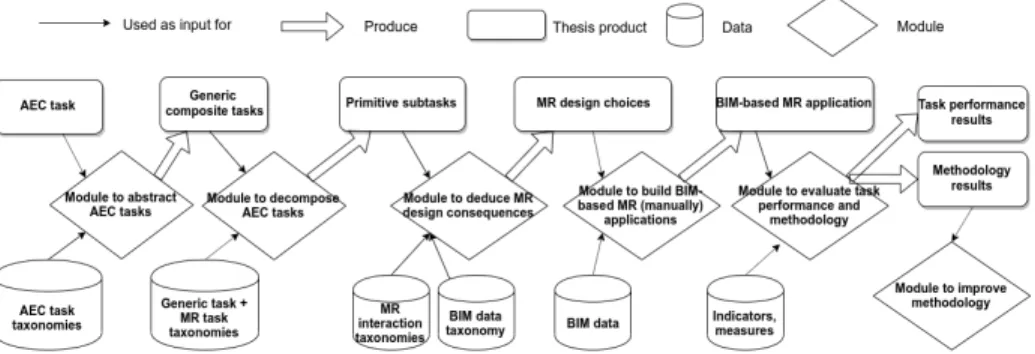
In this paper, we want first to present our methodology. As our BIM-based MR applications aim allow one or several kinds of stakeholders of an AEC project to better complete a specific task, our methodology relies on different taxonomies about tasks present in the literature: taxonomies of AEC tasks [11], taxonomies of generic task [11][12], and taxonomies of tasks in mixed reality [12][13][15][16]]. Figure1 presents our methodology steps: first, our idea is to go from a field-specific naming (sometimes very close to the AEC jargon), to a generic naming, thanks to the abstraction and decomposition of AEC tasks into generic simplest subtasks. Then, these subtasks (WHY) can drive design choices for the applica-tions, helping to make decisions about 1) the content/data (WHAT), and 2) the idioms (HOW) - a set of idioms can be defined as distinct approaches for creating or manipulating visual representations, i.e. the interactions (how to perform) and the visualisation (how to represent). Finally, MR applications are built based on these WHAT and HOW, and we measure the quality of the applications, and of the methodology itself, to repeat and improve this methodology.
Fig. 1. Our methodology for building effective and efficient BIM-based mixed reality environments, according to the AEC tasks
3
Results from preliminary case studies
As preliminary work, we built and evaluated MR application prototypes, for three different case studies. Note that these studies led to three scientific pub-lications [19][20][21]. Then, usability and efficiency measures applied in each experiment helped us to build, correct, and formalise incrementally our method-ology, resulting in what is explained in this paper (Figure 1). In this section, we present these cases studies and their MR applications.
4 BIM-based mixed reality environments to improve AEC task performance 3.1 Architecture design review of a nursery
Our first case study (Figure 2) was about a nursery construction project, where the architect and future final users wanted to review the architectural design according to the future usages (WHY). If we would have used task abstraction and decomposition, we would have had as subtasks: navigate in architectural model, check light exposition, confirm design, and check building usability for future operation. In this study [19], we wrote a previous version of our method-ology, wondering which BIM data would be useful, how it should be shown, and how to perform in this environment. The data (WHAT) used were sun simula-tions and the architectural BIM model, interacsimula-tions (HOW) were navigation by teleportation, and visualisation was realistic (shadows). However, some interac-tions were missing (annotate), and measures were not taken neither to compare performance (time, number of annotations), nor for improving our methodology.
Fig. 2. Architecture design of the nursery in our virtual reality application [19]
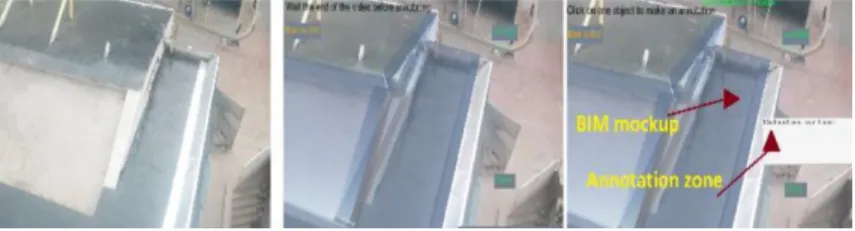
3.2 Construction supervision from BIM models and drone videos Our second case study [20] focused on improving construction supervision, which is necessary to ensure planning enforcement, by allowing off-site supervision and comparisons between as-built (from drone videos) and as-planned design (from BIM models). Thanks to superimposition in MR (Figure 3, b) and c)), inspectors could estimate differences to make their report and enrich the BIM model.
Fig. 3. From left to right: a) video of the building from a drone, b) MR visualisation: superimposition of the video and the BIM model c) MR interaction: annotations [20]
We understood with this study that design choices were driven by the AEC task: real and virtual data were necessary (WHAT), navigation by points of interest was very useful to focus only on the new elements at T time (HOW-interactions), and superimposition with transparency was mandatory to see dif-ferences (HOW-visualisation). In this study, measures for evaluating the method-ology were taken (positive feedback) but comparative measures missed.
4
Ongoing and future work
Thanks to our methodology, we have seen that we can more easily build MR prototypes ; thus, in this research project, we propose to focus on two chal-lenges: 1) the design clash analysis and 2) the dynamic hazard identification, both identified as gaps in the civil engineering literature [17][18].
4.1 Ongoing work: BIM design coordination, clash analysis
BIM models coordination is mandatory since experts usually made their design independently and then fusion them, resulting in an interdisciplinary model. Thus, design clashes are common, but they can be detected automatically by current BIM tools. However, clash resolution still requires human expertise. In this third case study [21], by applying our methodology, it is possible to receive design choices, such as discrimination colours between discipline (HOW – vi-sualisation), free movements and annotation positioning (HOW – interactions). Figure 4 shows our MR application following them.
Fig. 4. From left to right: clashes examples; annotations in MR: narrows, spheres [21]
Our priority now is to implement ways to measure (and compare) both task performance and methodology accuracy. A preliminary experiment tended to indicate that experts solved the design clashes faster (measure: time) and better (measure: grade solution) with our MR application rather than using current computer screen tools. Nonetheless, the application must still be improved and the experiment repeated with more experts to get more conclusive results. 4.2 Future work: hazard identification
Our future case study is about the hazard identification task performed by safety inspectors (specialised civil engineers). If we apply abstraction and decomposi-tion as explained in our methodology, this task is composed by substasks such
6 BIM-based mixed reality environments to improve AEC task performance as observing the hazardous zones, analysing the hazards, and estimating their probability, severity and size... Thus, task performance could be measured us-ing indicators such as the time spent to identify the hazards, and the number of (correct) hazards detected, and compare with the results with current tools. According to the substasks, two or three inputs for the application (WHAT) are required: the design model of the construction, the 4D BIM simulation (over time), and if possible automated hazard partial detection. Expected results are that, with our tool, it will take less time and more hazards will be identified.
5
Conclusion
The BIM allows to improve the construction process through data centralisation and computational power for simulations. Mixed reality can also help by im-proving task performance; nonetheless, a MR tool is usually created to perform one task. Thus, AEC tasks must be understood for a great integration in a MR environment, and this environment must be created accordingly. That is why we proposed a methodology where AEC tasks are abstracted and decomposed into subtasks, which are implementable in MR, and which induce MR design choices. Given this method, we proposed to apply it on two different cases to try to tackle the challenges they presented: design clash analysis and hazard iden-tification. As future line of research work, we propose to build these two MR applications, according to the design choices coming from our methodology, and to evaluate and compare task performance using them or traditional tools.
References
1. X.Xu, L.Ma, L.Ding, A framework for BIM-enabled life-cycle information man-agement of construction project (2014) International Journal of Advanced Robotic Systems, 11 (1), art. no. A126, https://doi.org/10.5772/58445
2. A.Braun, A.Borrmann, Combining inverse photogrammetry and BIM for automated labeling of construction site images for machine learning, Au-tomation in Construction, vol. 106, (2019), 102879, ISSN 0926-5805, https://doi.org/10.1016/j.autcon.2019.102879
3. S.Tang, D.R. Shelden, C.M. Eastman, P.Pishdad-Bozorgi, X.Gao, A review of build-ing information modelbuild-ing (BIM) and the internet of thbuild-ings (IoT) devices integration: Present status and future trends, Automation in Construction, vol. 101, (2019), pp. 127-139, ISSN 0926-5805, https://doi.org/10.1016/j.autcon.2019.01.020
4. P. Milgram, H. Takemura, A. Utsumi, F. Kishino, Augmented Reality: A class of displays on the reality-virtuality continuum, (1994) Proceedings of Telemanipulator and Telepresence Technologies, vol. 2351, https://doi.org/10.1117/12.197321 5. https://www.accasoftware.com/en/bim-authoring Last accessed on 20/10/19 6. S.Azhar, Building information modeling (BIM): Trends, benefits, risks, and
chal-lenges for the AEC industry, (2011) Leadership and Management in Engineering, 11 (3), pp. 241-252. https://doi.org/10.1061/(ASCE)LM.1943-5630.0000127 7. A.A. Enshassi, L.Abuhamra, S.Alkilani, Studying the benefits of building
in the Gaza strip (2018) Jordan Journal of Civil Engineering, 12 (1), vol. 2, 1, pp. 87-98, http://hdl.handle.net/20.500.12358/26583
8. X. Liu, X.Wang, G.Wright, J.C.P.Cheng, X.Li, R.Liu, R. A state-of-the-art review on the integration of Building Information Modeling (BIM) and Geographic Infor-mation System (GIS), (2017), ISPRS International Journal of Geo-InforInfor-mation, 6 (2),https://doi.org/10.3390/ijgi6020053
9. J. Chalhoub, S. K. Ayer, Using Mixed Reality for electrical construction design communication, Automation in Construction, vol. 86, (2018), pp 1-10, ISSN 0926-5805, https://doi.org/10.1016/j.autcon.2017.10.028
10. K. El Ammari, A. Hammad, Remote interactive collaboration in facilities manage-ment using BIM-based mixed reality, Automation in Construction, vol. 107, (2019), 102940, ISSN 0926-5805, https://doi.org/10.1016/j.autcon.2019.102940
11. P.S.Dunston, X.Wang, A hierarchical taxonomy of aec operations for mixed reality applications (2011) Electronic Journal of Information Technology in Construction, vol. 16, pp. 433-444. ISSN: 1874-4753
12. R. Proctor, and H.Van Zandt Human Factors in Simple and Complex Systems, (1994), Allyn & Bacon
13. M.A. Muhanna, Virtual reality and the CAVE: Taxonomy, interaction challenges and research directions, Journal of King Saud University - Computer and In-formation Sciences, Volume 27, Issue 3, 2015, Pages 344-361, ISSN 1319-1578, https://doi.org/10.1016/j.jksuci.2014.03.023
14. D.A.Bowman, D.Koller, L.F.Hodges: Travel in Immersive Virtual Environments: An Evaluation of Viewpoint Motion Control Techniques. In: Virtual Reality Annual International Symposium, pp. 45–52. IEEE Press, New York (1997) https://doi.org/10.1109/VRAIS.1997.583043
15. D.A.Bowman, D.B.Johnson, L.F.Hodges. Testbed Evaluation of Virtual Envi-ronment Interaction Techniques. In VRST ’99: Proceedings of the ACM sym-posium on Virtual reality software and technology, pp. 26–33. ACM, 1999. https://doi.org/10.1162/105474601750182333
16. D.A Bowman and L.F Hodges, Formalizing the Design, Evaluation, and Appli-cation of Interaction Techniques for Immersive Virtual Environments. Journal of Visual Languages and Computing 10, 37–53 (1999)
17. I.D, Tommelein, and S.Gholami, Root Causes of Clashes in Building Information Models. (2012) IGLC 2012 - 20th Conference of the International Group for Lean Construction.
18. S.Zhang, K.Sulankivi, M.Kiviniemi, I.Romo, C.M.Eastman, J.Teizer, BIM-based fall hazard identification and prevention in construction safety planning, Safety Science, vol. 72, (2015), pp. 31-45, ISSN 0925-7535, https://doi.org/10.1016/j.ssci.2014.08.001
19. P.Raimbaud, F.Merienne, F.Danglade, R.Lou, J.Hernandez, P.Figueroa, Smart Adaptation of BIM for Virtual Reality, Depending on Build-ing Project Actors’ Needs: The Nursery Case, 667-668, (2018), https://doi.org/10.1109/VR.2018.8446288
20. P.Raimbaud, R.Lou, F.Merienne, F.Danglade, P.Figueroa, J.Hernandez. BIM-based Mixed Reality Application for Supervision of Construction. 1903-1907, (2019), https://doi.org/10.1109/VR.2019.8797784
21. P.Raimbaud, M.B.Palacios, J.P Romero Cortes, P.Figueroa, R.Lou, F.Danglade, F.Merienne, J.Hernandez, A Virtual Reality and BIM Approach for Clash Resolu-tion, Accepted, In press