HAL Id: dumas-01962991
https://dumas.ccsd.cnrs.fr/dumas-01962991
Submitted on 21 Dec 2018
HAL is a multi-disciplinary open access archive for the deposit and dissemination of sci-entific research documents, whether they are pub-lished or not. The documents may come from teaching and research institutions in France or abroad, or from public or private research centers.
L’archive ouverte pluridisciplinaire HAL, est destinée au dépôt et à la diffusion de documents scientifiques de niveau recherche, publiés ou non, émanant des établissements d’enseignement et de recherche français ou étrangers, des laboratoires publics ou privés.
Can intercrop control aphid populations and their
ability to spread non-persistently transmitted virus ?
Sidonie Loïez
To cite this version:
Sidonie Loïez. Can intercrop control aphid populations and their ability to spread non-persistently transmitted virus ?. Life Sciences [q-bio]. 2018. �dumas-01962991�
1
AGROCAMPUS OUEST
D
IPLOME D’
INGENIEURA
GRONOMES
PECIALISATION ENP
ROTECTION DESP
LANTES ET DEL
’E
NVIRONNEMENTC
AN
I
NTERCROP
C
ONTROL
A
PHID
P
OPULATIONS AND THEIR
A
BILITY TO
S
PREAD
N
ON
-P
ERSISTENTLY
T
RANSMITTED
V
IRUS
?
Author :
Sidonie LOÏEZ
Jury president: Ivan SACHE (APT)
Jury members : Christophe LEMAY (ACO) Manu PLANTEGENEST (ACO) André CHABERT (ACTA)
Supervisors : Brian FENTON John BADDELEY Robin WALKER
Host Institution : Scotland Rural College Ferguson Building, Craibstone Estate,
Aberdeen AB21 9YA
Scotland
3
Engagement de non plagiat
Principes
- Le plagiat se définit comme l’action d’un individu qui présente comme sien ce qu’il a pris a autrui.
- Le plagiat de tout ou parties de documents existants constitue une violation des droits d’auteur ainsi qu’une fraude caractérisée
- Le plagiat concerne entre autres : des phrases, une partie d’un document, des données, des tableaux, des graphiques, des images et illustrations.
- Le plagiat se situe plus particulièrement à deux niveaux : Ne pas citer la provenance du texte que l’on utilise, ce qui revient à le faire passer pour sien de manière passive. Recopier quasi intégralement un texte ou une partie de texte, sans véritable contribution personnelle, même si la source est citée.
Consignes
- Il est rappelé que la rédaction fait partie du travail de création d’un rapport ou d’un mémoire, en conséquence lorsque l’auteur s’appuie sur un document existant, il ne doit pas recopier les parties l’intéressant mais il doit les synthétiser, les rédiger à sa façon dans son propre texte. - Vous devez systématiquement et correctement citer les sources des textes, parties de textes, images et autres informations reprises sur d’autres documents, trouvés sur quelque support que ce soit, papier ou numérique en particulier sur internet.
- Vous êtes autorisés à reprendre d’un autre document de très courts passages in extenso, mais à la stricte condition de les faire figurer entièrement entre guillemets et bien sûr d’en citer la source.
Sanction
En cas de manquement à ces consignes, la DEVE/le correcteur se réservent le droit d’exiger la réécriture du document sans préjuger d’éventuelles sanctions disciplinaires.
Engagement
:Je soussigné LOIEZ Sidonie, Reconnaît avoir lu et m’engage à respecter les consignes de non plagiat A Aberdeen le 8 Septembre 2018
4 Insects, in particular aphids, can cause important damage to crops. Until now, chemicals are the most efficient, and widely used method to reduced infestation. Yet, new regulations require good environmental practices, to protect soil and human health. To comply with these, the introduction of higher crop diversity within one field might be a solution. Intercrops (i.e. association in time and space of different crops in a field) have mostly been studied for its agronomic advantages (increase in yield, enhancement of soil properties, economic benefits). However, only a few studies have focussed on the impact of intercrops towards pests. In the present study, implemented in the SRUC-Aberdeen campus, field and greenhouses experiment were carried out on the ability of intercrop to either reduce aphid infestation or non-persistent virus transmission. Barley-legume intercrops were compared to a barley sole crop. The system tested both plant species (bean or pea) and arrangement (row or mix) toward Sitobion avenae. All intercrops showed a 30% reduction in aphid numbers during the whole experiment. Intercrops with pea were more efficient to reduce S. avenae numbers at the development of the colonies. However, no distinction between the intercrops was observed at the peak of the colonies. Although a higher number of beneficial was found in the barley sole crop, intercrops seem to be efficient to control aphid development in the field. PVY transmission from Myzus
persicae in a potato-barley intercrop showed no differences compare to sole potatoes. In this
system intercrop was not efficient to reduce virus spreading.
Key-words: Intercrops, cereal-legume, S. avenae, virus transmission, PVY, M. persicae
Les insectes, en particulier les pucerons, sont responsables d’importants dégâts dans les cultures. Jusqu'à maintenant, les insecticides sont le moyen de lutte le plus efficace et le plus utilisé. Cependant, des réglementations récentes imposent de bonnes pratiques pour préserver la santé humaine et celle des sols. Pour y répondre, l’introduction d’une plus grande diversité culturale au champ pourrait être une solution. L’association culturale (AC ; culture simultanée de plusieurs plantes dans un même champ) a majoritairement été étudiée pour ses bénéfices agronomiques (augmentation des rendements, amélioration des propriétés des sols, avantages économiques). Mais très peu ont étudié leurs impacts sur les ravageurs. Dans cette étude menée au SRUC-Aberdeen campus, des expérimentations en champ et en serre pour déterminer les capacités des AC à réduire l’infestation par les pucerons et/ou la transmission de virus non-persistant. Des AC orge-légumineuses étaient comparées à une culture d’orge. Le système testait l’effet de l’espèce associée (féverole ou pois) et de l’arrangement (en ligne ou aléatoire) sur S. avenae. Toutes AC montraient une réduction du nombre de pucerons de 30%, sur la période d’étude. Lors du développement des colonies, les AC comprenant du pois étaient plus efficaces à réduire le nombre de S. avenae. Au pic des colonies, aucune distinction entre les AC n’a été observée. Malgré un plus grand nombre d’auxiliaires dans les cultures d’orge, les AC semblent efficaces pour contrôler le développement des pucerons en champs. La transmission du PVY dans une association pomme de terre-orge, par M. percsicae, n’a pas montré de distinction par rapport à un système unique de pommes de terre. Dans ces systèmes, l’AC ne permettait pas de réduire efficacement la diffusion du virus.
Mots clés : Association culturale, céréales-légumineuses, S. avenae, transmission de virus, PVY, M. persicae
5
AUTORISATION DE DIFFUSION DU MEMOIRE
1. Identification du rapport et de l’auteur
Nom et Prénom de l’auteur: LOIEZ Sidonie
Titre du mémoire: Can intercrop control aphid populations and their ability to spread non-persistently transmitted virus
Ecole d’inscription: Agrocampus Ouest
2. Autorisation de diffusion par l’Auteur
Par la présente, je déclare être titulaire du droit d’auteur pour le mémoire mentionné ci-dessus. J’autorise sans limitation de temps la Bibliothèque à diffuser ce mémoire dans un format électronique adapté et à effectuer toutes éventuelles modifications techniques nécessaires à une amélioration de la diffusion (modification du format). Si ce mémoire est confidentiel, la confidentialité sera respectée dans les mêmes conditions pour les exemplaires électroniques que pour les exemplaires papiers.
Signature de l’Auteur: Date: 08/09/2018
3. Autorisation de diffusion par le Maître de stage
J’autorise par la présente l’auteur à diffuser le mémoire mentionné ci-dessus:
Intranet OUI NON Prêt OUI NON
Internet OUI NON Prêt entre bibliothèques OUI NON
Après une période de confidentialité
OUI NON
Durée: Résumé diffusable OUI NON
Consultation en bibliothèque OUI NON Reproduction OUI NON
Signature du Maître de stage: Date: 08/09/2018
4. Autorisation de diffusion par le Tuteur
J’autorise par la présente l’auteur à diffuser le mémoire mentionné ci-dessus:
Intranet OUI NON Prêt OUI NON
Internet OUI NON Prêt entre bibliothèques OUI NON
Après une période de
confidentialité
OUI NON Durée:
Résumé diffusable OUI NON Consultation en bibliothèque OUI NON Reproduction OUI NON
Signature du Tuteur Enseignant: Date:
CONCLUSIONS:
Confidentialité absolue: OUI □ NON □
6
Acknowledgements
I would like to thank Brian Fenton tor his precious help and interest in the project, his experience and our talks helped me to implement the different experiments I present here. I thank John and Robbin for their help and interesting discussion about intercrops, with a particular thank to John who helped me for the statistics. And I thank them for reviewing and helping me in English language for this report.
I also thank Jim warmly for his kindness and useful help he gave me during the experiment, and for having water my plants during some week-ends. I thank Bastien for his energy, his interest in the project, his new ideas and great help he gave me, especially counting aphids in the field.
Then I thank Innes, George, Piotr, Dreck, Michael, Damien, Duncan, Roger and Val for their good mood and will to make me understand more about Scotland and its traditions (not to mention the deep fried culture).
I thank Ivan for his kind and reassuring emails, and his support. Thanks to Yannick and his help in statistics.
And then I thank Max and Zoé for their external point of view of the project, and English spelling corrections.
7
Résumé du projet
Les insectes sont une cause majeure de la perte de rendement au champ. Peu de moyens de lutte existent, et l’utilisation de produits chimiques est à ce jour le plus efficace. Toutefois, la réglementation actuelle agricole recommande l’utilisation de pratiques respectueuses de l’environnement.
Des études sur le rôle de la biodiversité en agriculture ont montré qu’il est possible d’améliorer les services écosystémiques, notamment par l’introduction de plus de diversité végétale. C’est pourquoi l’effort de recherche s’intensifie au sujet des associations culturales. Les bénéfices agronomiques de la culture simultanée dans le temps et dans l’espace, de deux – ou plus – espèces végétales sont maintenant connus.
Les associations culturales améliorent par exemple la production générale de la culture et, si ce n’est pas la quantité, c’est la qualité qui est améliorée. De plus, les associations culturales assurent le maintien de bonnes propriétés des sols avec une meilleure rétention de l’eau, une plus grande concentration en matière organique, mais également le transfert d’azote dans le cas des associations céréales-légumineuses. De manière générale, les associations culturales sont plus efficaces que les cultures pures.
En revanche, peu d’étude de ces associations s’intéressent à leurs effets sur les infestations par les pucerons. Pourtant le comportement de ces ravageurs laisse à penser que les associations culturales pourraient être un moyen de lutte contre le puceron.
En effet, les pucerons sont de petits insectes herbivores. Ils se nourrissent de sève, qu’ils aspirent par leur stylet inséré jusqu’aux cellules du phloème. Lorsqu’ils se nourrissent les pucerons affaiblissent leur plante hôte. Ainsi, lorsqu’ils sont présents en grand nombre dans un champ cultivé, ils mettent en péril la production.
Toutefois, les connaissances sur la biologie du puceron ont permis de mieux comprendre leurs interactions avec leur plante hôte. Lorsqu’ils migrent les pucerons sont capables de localiser leur hôte, via l’analyse de stimuli sensoriels principalement. La couleur d’une culture est importante, tout autant que le contraste entre la plante et le sol. Ainsi, il est plus difficile pour les pucerons de localiser une plante hôte dans un couvert dense. Ensuite, les composés volatiles émis par les plantes sont reconnus par les pucerons. Ils sont attirés par leur plante hôte, et généralement repoussés par des non-hôtes. Cependant, des mélanges de ces composés volatiles sont plus difficilement analysés.
Dans leur environnement les pucerons interagissent avec leurs plantes hôtes et leurs ennemis naturels. Ces ennemis peuvent être prédateurs, parasitoïdes ou parasites, certains parmi eux étant également insectes. Parmi les insectes prédateurs, les larves de coccinelle (Coléoptère) et
8 celles de syrphes (Diptère) sont efficaces. Dans la famille des parasitoïdes se sont principalement des guêpes (Hyménoptère) qui parasitent les pucerons. Elles pondent dans le corps du puceron et leur larve s’y développe en se nourrissant du corps de leur hôte.
Plusieurs hypothèses sur l’efficacité des associations culturales à contrôler le développement de colonies de pucerons émergent. La première est l’hypothèse de « la concentration en ressources ». Les cultures pures seraient plus attractives pour les pucerons que les associations culturales, elles présentent une surface homogène de leur plante hôte. Il est facile pour un puceron de localiser cette plante hôte, de la sélectionner et de s’y développer. Le cas contraire s’observerait en association culturale.
L’hypothèse des « ennemis naturels » prévoit une plus grande fréquentation des associations culturales par les ennemis naturels par rapport aux cultures pures. Ce qui pourrait s’expliquer par des propriétés favorables au développement d’insectes (nombreux habitats, ressources en pollen et nectar) dans les associations végétales. . Et le bénéfice de leur action devrait s’observer par une infestation réduite en comparaison avec une culture pure, moins propice au développement de ces insectes.
De plus, les pucerons sont vecteurs de virus, ce qui les rend d’autant plus néfastes aux regards des agriculteurs. Lors de la recherche de leur hôte, ils réalisent de nombreuses ponctions d’essais. Elles sont brèves mais suffisantes pour transmettre un virus à la plante. Certain de ces virus sont dits non-persistants. Cela fait référence à leur mode de transmission. Une fois acquis par leur vecteur, ce dernier ne peut transmettre le virus que pour une courte période.
Ainsi, l’hypothèse de « perte de transmissibilité d’un virus » s’appliquerait pour les virus non-persistants dans les associations culturales. Les pucerons infectés dans un mélange mettraient plus de temps à trouver leur hôte et donc perdraient leur capacité à transmettre le virus. Ou pendant leur recherche d’un hôte, les pucerons réaliseraient des ponctions d’essai sur la culture non hôte et donc perdraient le virus.
Dans ce contexte, l’étude de l’efficacité des associations culturales à réduire les infestations de pucerons ou la transmission de virus non-persistant a été réalisée. Deux types d’expérimentations ont été mises en place au SRUC-Aberdeen campus. Dans un premier temps des expérimentations en champ ont permis d’étudier les populations de pucerons dans des couverts d’associations culturales. Ensuite des expérimentations en serres, ont permis d’étudier la transmission d’un virus non-persistant.
Au champ, le développement du puceron des céréales Sitobion avenae, a été observé dans différentes associations culturales.
Deux associations en ligne entre orge et féverole ou orge et pois. Deux associations en mélange entre orge et féverole ou orge et pois. Ces observations étaient comparées à une culture pure d’orge.
9 Cinq répétitions de ces systèmes ont été établies en champs. 30 S. avenae ont été introduits au centre de chacun des plots, pour le début de l’expérience. Puis les pucerons étaient comptés deux fois par semaine pendant deux mois.
Les résultats ont montré que le nombre de pucerons dans tous les systèmes d’association culturale était réduit par rapport à celui déterminé en culture pure. En début de saison l’association orge-pois a permis de réduire significativement le nombre de pucerons, comparé à l’orge seule ou à l’association orge-féverole. Toutefois en fin de saison aucune distinction entre les différentes associations culturales n’était observée. De même, l’arrangement spatial des associations culturales n’a pas montré de différences.
En ce qui concerne les insectes auxiliaires, coccinelles, syrphes et guêpes parasitoïdes ont été observées. Un plus grand nombre de ces auxiliaires était présent dans les cultures pures d’orge. Sous serre, la transmission du PVY par M.persicae était étudiée dans des associations de pomme terre et orge. Dans un premier temps, les pucerons étaient préalablement infectés par le PVY. Puis avant d’être déposé sur une plante hôte, soit ils étaient déposés sur des feuilles d’orge, soit ne subissaient aucun traitement. Les observations des symptômes sur la plante hôte n’ont montré aucune différence entre l’association culturale ou la pomme de terre seule. De même, une expérience menée en pots entre une association pomme de terre-orge ou une culture pure de pomme de terre, a montré que l’association culturale ne permet pas de réduire la transmission du PVY. En effet, que les pucerons soient préalablement infectés par le PVY ou qu’ils l’acquièrent directement sur un plant de pomme de terre infecté, le nombre de plante hôte présentant des symptômes de PVY était similaires entre les systèmes.
En conclusion de ce projet :
Les associations culturales entre orge et pois ou orge et féverole présentent un intérêt dans la lutte contre le puceron des céréales S. avenae. Toutefois, leurs actions sur les insectes auxiliaires restent à démontrer.
L’association pommes de terre et orge ne permet pas de réduire la transmission du PVY par M. persicae.
10
Content
ACKNOWLEDGEMENTS ... 6 RESUME DU PROJET ... 7 CONTENT ... 10 FIGURES LIST ... 12 INTRODUCTION ... 13 BACKGROUND ... 15 WHAT IS INTERCROPPING? ... 15 WHY USE INTERCROPPING? ... 16Agronomic perspective: yield, nutrient and resources, benefits for the following crops. ... 16
Yield and production advantages ... 16
Light and water resources ... 16
Soil properties ... 17
Effect on the following year’s crop ... 17
Ecological perspective: biodiversity ... 17
Economic perspective ... 18
APHIDS ... 18
Description ... 18
Life cycle ... 18
Feeding habits ... 20
Damage on crops caused by aphids ... 20
Aphids in the food web ... 21
How can aphids find their host? ... 23
PEST CONTROL EFFECT OF INTERCROPS? ... 24
PRESENTATION OF THE WORK ... 26
CHAPTER 1 : REDUCTION OF APHID NUMBER BY INTERCROP SYSTEMS ... 27
INTRODUCTION ... 27
MATERIALS AND METHODS: ... 28
Site. ... 28 Treatments. ... 28 Plant material ... 29 Aphid colonies ... 29 Counting... 30 Statistical analysis. ... 30 RESULTS ... 31
Observations from the yellow trap. ... 31
Evolution of the S. avenae population. ... 31
11
DISCUSSION ... 36
Evolution of the S. avenae population. ... 36
Parameters influencing the number of aphids: ... 36
Presence and number of beneficial insects. ... 37
Presence and number of beneficial insects. ... 37
Summary ... 38
CHAPTER 2 : VIRUS TRANSMISSION ... 39
INTRODUCTION ... 39
MATERIALS AND METHODS: ... 40
Experiment 1: ... 40 Experiment 2: ... 42 RESULTS ... 46 Experiment 1 ... 46 Experiment 2 ... 47 DISCUSSION ... 49 Experiment 1 ... 49 Experiment 2 ... 50
Why intercrops were not efficient in controlling virus transmission? ... 51
Summary ... 51
CONCLUSION ... 52
REFERENCES ... 53
12
Figures List
FIGURE 1:REPRESENTATION OF THE DIFFERENT INTERCROPS STYLE: RELAY, MIXED AND STRIP OR ROW INTERCROPPING (BROOKER ET
AL.,2015). ... 15
FIGURE 2:REPRESENTATION OF APHID LIFE CYCLE ... 19
FIGURE 3:REPRESENTATION OF AN APHID (MORPHOLOGY) AND ITS RELATIONS IN THE FOOD WEB (PREDATORS AND PARASITOIDS ABOVE, PLANT BELOW).PICTURES OF THE PREDATORS AND PARASITOIDS WERE TAKEN IN THE FIELD OF WOODLAND (SRUC-ABERDEEN CAMPUS). ... 23
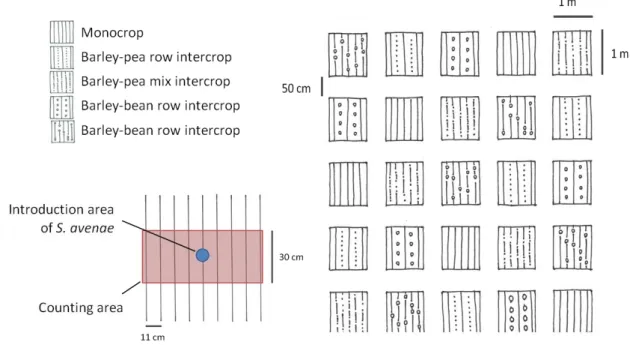
FIGURE 4:EXPERIMENTAL DESIGN OF THE PLOTS IN THE FIELD, WITH ON THE BTTOM LEFT A ZOOM OF ONE PLOT TO SEE AREA OF APHID INTRODUCTION AND COUNTING METHOD. ... 29
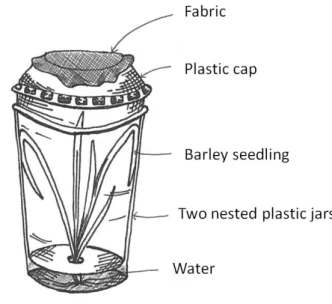
FIGURE 5:REPRESENTATION OF A PLASTIC BOX WHERE THE APHID COLONIES WERE KEPT BEFORE INTRODUCTION OF THE APHIDS IN THE EXPERIMENTS. ... 30
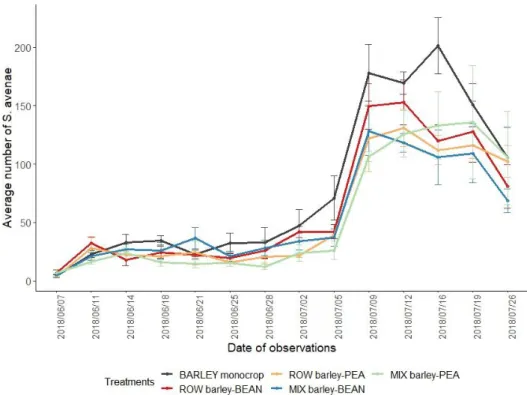
FIGURE 6:EVOLUTION IN TIME OF THE NUMBER OF S. AVENAE COUNTED IN THE FIELD PER TREATMENTS. ... 32
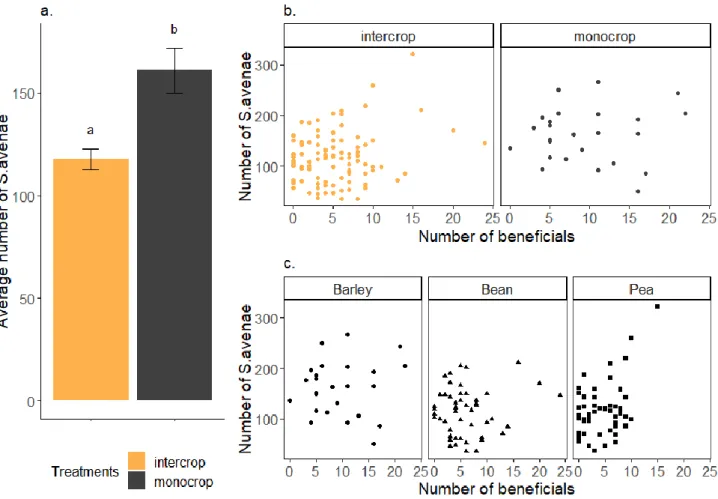
FIGURE 7:REPRESENTATION OF THE NUMBER OF S. AVENAE, A. BETWEEN THE DIFFERENT TREATMENTS, B. BETWEEN THE DIFFERENT PLANT SPECIES INTERCROPPED WITH BARLEY, AND C. IN RELATION WITH BENEFICIAL INSECTS NUMBER (WHEN PRESENT IN THE PLOTS) AND DEPENDING ON THE ARRANGEMENTS (NONE IN THE MONOCROP, ROW OR MIX IN THE INTERCROP). ... 34
FIGURE 8:REPRESENTATION OF THE STATISTICAL ANALYSIS. A. AVERAGE NUMBER OF S. AVENAE BETWEEN THE DIFFERENT TREATMENTS, B. NUMBER OF APHIDS IN RELATION WITH THE NUMBER OF BENEFICIAL BETWEEN THE DIFFERENT TREATMENTS, C. NUMBER OF APHIDS IN RELATION WITH THE NUMBER OF BENEFICIAL BETWEEN THE PLANT INTERCROPPED. ... 35
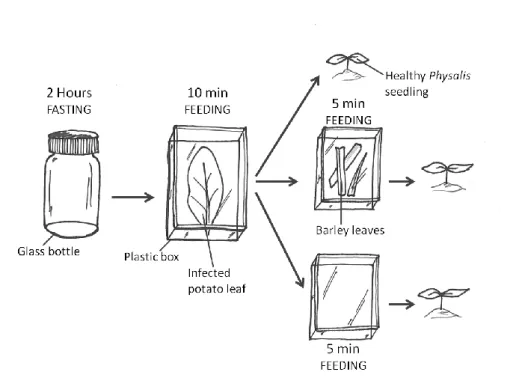
FIGURE 9:EXPERIMENTAL DESIGN OF EXPERIMENT 1.TIMES REFER TO THE PERIOD FOR WHICH APHIDS STAYED IN THE COMPARTMENT. ... 41
FIGURE 10:DESIGN OF THE NETS USED TO KEEP THE APHID IN THE POT... 41
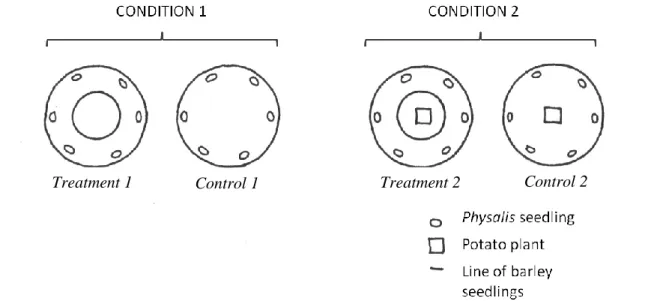
FIGURE 11:EXPERIMENTAL DESIGN OF THE POTS FOR CONDITIONS 1 AND 2 ... 44
FIGURE 12:POT DESIGN DURING THE EXPERIMENT. ... 44
FIGURE 13:PICTURE SHOWING IN A. THE DIFFERENCES BETWEEN A HEALTHY PHYSALIS (ON THE LEFT) AND A PVY INFECTED ONE (ON THE RIGHT).IN B. IS A ZOOM OF AN INFECTED PHYSALIS.BOTH PICTURES ARE CONTRAST AND LIGHT MODIFIED TO INCREASE THE VISIBILITY OF THE SYMPTOMS. ... 45
FIGURE 14:RATE OF INFECTED PHYSALIS (I.E. NUMBER OF PHYSALIS PRESENTING PVY SYMPTOMS / TOTAL NUMBER OF PHYSALIS PER REPLICATE) IN EACH TREATMENT. ... 47
FIGURE 15:AVERAGE NUMBER OF M. PERSICAE PRESENT IN THE POTS. A. AND C. REPRESENT THE INCREASE OF THE POPULATION BETWEEN THE THREE COUNTS (WITH OR WITHOUT A POTATO PLANT IN THE POT RESPECTIVELY). B. AND D. REPRESENT THE NUMBER OF APHIDS THAT REACHED THE PHYSALIS (WITH OR WITHOUT A POTATO PLANT IN THE POT RESPECTIVELY).THE LETTERS INDICATE THE INFLUENCE OF THE TREATMENT IN THE MODEL, WHEN LETTERS ARE IDENTICAL THE TREATMENTS HAD NO INFLUENCE ON THE NUMBER OF APHID THAT REACHED THE PHYSALIS. ... 48
FIGURE 16:PREVALENCE OF PVY IN THE PHYSALIS PLANTS. A. REFERS TO THE RESULTS WHEN NO POTATO WAS PRESENT IN THE POT AND B. REFERS TO THE RESULTS WHEN A POTATO PLANT WAS IN THE POT.LETTERS ON THE GRAPHS REFER TO THE DIFFERENCES BETWEEN THE MODALITIES.WHEN LETTERS ARE THE SAME, THERE IS NO STATISTICAL DIFFERENCES. ... 49
13
Introduction
Pest insects are known to cause a lot of damage to crop production (Ben Issa et al. 2016). The yield losses caused by herbivore pests are estimated to be 15% of the worldwide crop production (Maxmen 2013). Indeed, herbivores can reduce plant performances. When feeding on the flowers, they affect the whole fruit and seed production of the plant; when feeding on the leaves they alter growth, reproduction and vigour of the plants (Crawley 1989). Among herbivores, aphids are particularly damaging to the crops. One of the reasons can be their wide host plant range.
Aphids are the most important insect pest in Britain (Tatchell 1989; Ben Issa et al. 2016). They put the crops at risks because they are directly feeding on the plants (Savaris et al. 2013), thus affecting the yield or the quality (Tatchell 1989). They also damage the crops indirectly with plant virus transmission being a threat for farmers.
Insecticides are the most efficient method for controlling aphids (Tatchell 1989). However, resistance to some of the products (Farkas 2015; Ben Issa et al. 2016) and critics from the society pressurise for more sustainable pest management practices. As a result, interest in a heterogeneous agricultural environment for pest control has increased.
Moreover, cropping systems have evolved in most countries toward homogeneity and high input requirements (Matson et al. 1997; Anil et al. 1998; Tilman et al. 2002). However, it is known that plant diversity increases ecosystem services, among them is control of infestation from pests. Thus research has increased on diversity within agricultural environments (Anil et
al. 1998). In some crops, it has been found that increasing genetic diversity can significantly
lower yield losses due to pathogens (Matson et al. 1997) or to herbivores (Letourneau et al. 2011). Different strategies are used: planting hedges, agroforestry, stripes of flowers and mixtures are some of the examples.
Introducing plant heterogeneity to agricultural fields is carried out at different scales and might be used to control aphids. Some evidences show an influence of the landscape arrangement on the aphid abundance. The distance of 1,500m around a field has been determined as the most influential on the aphid populations (Carrière et al. 2014). At the field scale, diversity of plant species has an influence on aphid diversity depending on the creation of habitats. The density of aphid increases when plant diversity increases the number of habitats in the field. Whereas the reverse is observed in the case of a reduction of the habitat number (Bosem Baillod et al. 2017). In general, diversity in the field reduces the abundance of herbivores, and less damage is observed (Risch 1983; Letourneau et al. 2011; Dassou & Tixier 2016).
14 Plant diversity in the field can also act as a physical barrier to the aphids. Crop diversity may occur in time; it is referred to as crop rotation. Few studies looked at the effect of rotation on pest infestation. But it is likely that reducing the frequency of one crop in one field reduces infestations from its pests (the Colorado potato beetle being one example; Umaerus, 1992). In a system that increases plant diversity within one field, diverse plant characteristics might increase the difficulty for aphids to land on the crop. Another possibility is that the diversity camouflages the crop and the aphids have difficulty in finding the crop (Hooks & Fereres 2006).
Techniques such as “trap-crop” or “banker-plant” use knowledge about pest behaviour to protect crops. These plants (not always used as crops) are grown on the borders of the field of the crop that has to be protected. The trap-crop is a more attractive species in comparison to the crop (Hooks & Fereres 2006; Ben Issa et al. 2016). Whereas the banker plant is any plant that can disturb aphid behaviour and thus reduce damage in the crop, or attract natural enemies of the aphids (Frank 2010).
The results from studies using these methods to increase the diversity in the field are inconsistent. Admittedly, diversity brings arthropods (Dassou & Tixier 2016) and natural enemies of pests (Letourneau et al. 2011), but borders of a field are found to be less frequented by pests compared to its centre (Bosem Baillod et al. 2017).
Another way to bring plant diversity into a field is by associating different crops. Such systems are called intercrops, and are a way to cultivate two or more crop species in the same field and at the same time (Newton et al. 2009; Brooker et al. 2015).
The goal of this report was to review the knowledge that may help to understand the use of intercrops as pest and virus control and then design experiments to test this. Different cereal-legume intercrops and their impact on cereal aphids were investigated. Then the virus transmission from a potato aphid in a potato-barley intercrop was studied.
15
Background
What is intercropping?
One of the possible methods that can increase plant diversity within one field is to mix different crops. In the mixtures, the crop used can be of the same species, which is referred to as variety mixtures; otherwise the crops are from different plant species, which refers as species mixtures or intercropping. Intercropping is defined as the cultivation of two or more crop species at the same time within a field (Brooker et al. 2015).
The intercrops can be managed differently by altering crop species, time of sowing, sowing ratios or machinery used. Three major intercropping systems can be identifying (Ofori & Stern 1987; Brooker et al. 2015), they are represented Figure 1:
Strip / row intercropping where the crops are grown at the same time in rows,
Mixed intercropping where the crop species are grown at the same time with random sowing,
Relay intercropping where one crop is sown before the other.
Figure 1: Representation of the different intercrops style: relay, mixed and strip or row intercropping
(Brooker et al. 2015).
One of the most studied systems is intercrop between cereals and legumes. This interest is explained by the benefits from nitrogen fixation from the legume (Anil et al. 1998) and its
16 potential economic advantages (Vlachostergios et al. 2015). Indeed, this mixture is interesting for forage production as it has a better yield than the legume sole crop, and a higher crude protein content than the cereal sole crop (Lithourgidis et al. 2007; Vlachostergios et al. 2015). Little by little species mixtures are added to some agricultural systems or rotation. Especially in small scale farms running poly-culture and poly-livestock businesses, as intercrops can be grown for forage (Anil et al. 1998; Walker et al. 2009).
Why use intercropping?
Agronomic perspective: yield, nutrient and resources, benefits for the following crops.
When two (or more) crops are growing together, competition for the resources might occur. As defined by Ofori and Stern (1987), competition between two plants growing together in the same field is over the search for the same resource, when its amount is below the combined need of the crops. Because species are different, intercrops are predicted to use different niches (Newton et al. 2009). This means that the needs and uptakes of the growth factors between the crops are slightly different.
In this regard, the choice of the crop species (Fujita et al. 1992; Lithourgidis et al. 2007; Hauggaard-Nielsen et al. 2008), the arrangement (e.g. random vs row mixtures, row spacing (Fujita et al. 1992)), the ratio of each species (Lithourgidis et al. 2007; Vlachostergios et al. 2015) and the sowing density (Ofori & Stern 1987) are important parameters to take into account, and may change the agronomy of the intercrop.
Yield and production advantages
Intercrops have shown agronomic potential when compared to pure stand crops; although results from intercrop production vary between studies (Fujita et al. 1992; Jahansooz et al. 2007; Newton et al. 2009; Yu et al. 2016). The Land-Equivalent Ratio (LER) is used to calculate and evaluate the efficiency of intercrops. It is the land area of sole crop that is needed to produce the same yield as the intercrop (Yu et al. 2016). It is shown that in average LER of cereal-legume intercrops is 1.17±0.24, which indicates a better land use efficiency compared to the sole crops (Yu et al. 2016). Furthermore, the overall yield in intercrops is found to be more stable over years (Raseduzzaman & Jensen 2017). Such improvements can be explained by a better use of resources (Yu et al. 2016).
Light and water resources
In cereal-legume intercrop competition for light or water can occur. It is known that the light interception of one crop varies with its architecture (Ofori & Stern 1987). Cereals have long and narrow leaves compare to legumes that have short, wide ones. Thus in terms of light reception, each crop plant has a specific strategy. However, when one of the crops becomes taller than the other one, it produces shadow which results in competition for light. It has been observed in maize-bean intercrops the shadow from maize induced a reduced temperature in the intercrop (Castro et al. 1991).
17 For water uptake, intercrops are said to be more efficient (Jahansooz et al. 2007; Brooker et al. 2015). The water uptake depends on the characteristic of the plants; one can be more competitive than the other (Jahansooz et al. 2007). In the search of different plant characteristics, cereal-legume intercrops are interesting as their rooting system differ and as a result the water uptake is increased when compared to sole crop (Layek et al. 2018).
Soil properties
Intercrops can improve water use efficiency in comparison to a sole crop because of their impact on soil physical properties. Within these systems the soil organic matter is increased (Layek et al. 2018). This may directly improve the structure of the soil, as well as water retention and air circulation. Moreover, by adding a plant species, the biology of the soil might be different to the one found under a sole crop, with possible higher diversity. In addition the chemical properties of the soil are modified by intercrops with nutrients being a good example. Nutrient uptake is different between cereals and legumes as legumes have the ability to fix atmospheric nitrogen (N). This is done in a symbiotic relationship with a bacterium, from the species Rhizobium, present in the plant roots. The symbiosis bacteria are located in specialised cells called nodules. As they access atmospheric N, legumes rely less on the soil N than cereals do (Justes et al. 2014) and the two crops are using different niches for N. As a result, cereal-legume intercrops have better N use efficiency (Ofori & Stern 1987; Fujita et al. 1992; Hauggaard-Nielsen et al. 2008). For instance, a 32% increase in N use has been determined in a wheat-pea intercrop (Bedoussac & Justes 2011). One explanation may be the N transfer from the legume to the soil (Fujita et al. 1992; Xiao et al. 2004; Hauggaard-Nielsen & Jensen 2005; Justes et al. 2014). Through root exudates or leaf decomposition on the soil, legumes release N that is available to the cereal (Fujita et al. 1992; Justes et al. 2014). This transfer of N between the crops is referred to as facilitation.
Effect on the following year’s crop
Intercrops are shown to be beneficial to the following crop (Fujita et al. 1992; Walker et al. 2009), depending on the cereal-legume mixture (species and ratio).
It is considered as an advantage for the farmers because whole intercrop system has a better resource use efficiency compared to a single stand crop. Thus intercropping cereals and legumes could maintain good production and reduce the amount of input necessary.
Ecological perspective: biodiversity
As the environment quality is getting more consideration by the society, agriculture is closely monitored. The risks from chemical inputs are controlled, which leads to the prohibition of harmful products (either for the environment or for human health). Among the parameters taken into account for environment quality measurement, is biodiversity. To some extend the biodiversity has reduced in the current agricultural systems (Matson et al. 1997; Tilman et al. 2002; Letourneau et al. 2011). Suppressing certain species in an ecosystem can disturb the natural balance of ecological regulation, thus an increase of diversity may favour ecosystem
18 services. Using higher plant diversity in the fields may promote higher shelters and food supplies for organisms (beneficial ones being target in agriculture).
Economic perspective
As yield can be increase by intercrops, the economic benefit from this system is direct. Furthermore, higher protein content in cereals are observed when intercropped with legume (Lithourgidis et al. 2011; Bedoussac & Justes 2011; Vlachostergios et al. 2015), it increases the grain quality and so the marketable opportunities for it. Then, because facilitation may occur within the system, intercrops between cereals and legumes can be used in low input systems (Bedoussac & Justes 2011). Despite the lower yield of the intercrop in comparison to the sole crop, the overall economy of intercrops might be advantageous for farmers (Fujita et
al. 1992). For instance, red pea-cereal intercrops have shown a monetary advantage index
compared to the sole crop (Vlachostergios et al. 2015).
Aphids
DescriptionAphids are Hemipterans from the Aphidoidea superfamily. In terms of morphology (Figure 3) aphids comprise: head (with a pair of antennae, eyes, and rostrum), thorax (with three pairs of legs and sometimes wings) and an abdomen (usually with a pair of cornicles and a cauda). Their morphology varies between their different life stages and according to their living conditions. Indeed, aphids undergo four nymphal stages and an adult one. Moreover, apterous aphids are produced when the conditions are good; whereas winged individuals are produced when the conditions worsen (Kennedy & Stroyan 1959; Dixon 1985).
Life cycle
Aphids produce both parthenogenetic and sexual individuals depending on climate and growth stage (Dixon 1985). There are many different species in the Aphididae family; they may have different life cycles. The most common one is explained Figure 2 below (monoecic holocyclic cycle).
19
Figure 2: Representation of aphid life cycle
The sexual individuals lay eggs during autumn or winter (Dixon 1985; Fraval 1998a; Turpeau
et al. 2011, 2018d). At this stage temperatures are important for the future development of the
aphids. Indeed, a cold period to enter into diapause is necessary for their later growth (Dixon 1985) and to determine their flying behaviour (Turpeau et al. 2011).
The eggs hatch at the end of winter around host plant budburst (Dixon 1985; Turpeau et al. 2011, 2018d). The individuals produced are females, either apterous or alate depending on the environmental conditions (Turpeau et al. 2011, 2018d). Using viviparous parthenogenesis, these females produce live offspring that will become apterous females (Fraval 1998a). That is the start of a new colony.
Once settles on its host plant the aphid population grows and the clonal individuals are produced through parthenogenesis, especially during spring and summer. Environmental conditions determine whether apterous or alate aphids develop. Plant physiology (such as senescence) or aphid’s population density (“group effect”) induce the production of alates (Dixon 1985).
Early summer is characterised as the flying period for aphids. They spread, and look for new hosts to colonise (Turpeau et al. 2011, 2018d). When days shorten and temperatures reduces sexual individuals are generated, then the winter egg is produced.
The life cycle differs depending on the aphid species. For example S. avenae (the grain aphid) has a monoecic holocyclic cycle, which refers to a life cycle reproduced on the same plant
20 species throughout the year. Whereas, R. padi (bird cherry oat aphid) and M. dirhodum (rose grain aphid) have a dioecic holocyclic cycle, which refers to a life cycle that occurs on two different host species. The winter egg is laid on one plant species, then after a few generations alate individuals are produced and leave the first plant species to another one. New generations develop and before winter alate individuals are produced and fly again to the winter host plant species (Fraval 1998a; Turpeau et al. 2018d).
Feeding habits
Aphids are herbivorous (Figure 3), they are pricker-sucker insects and feed on their host plant (Kennedy & Stroyan 1959; Dixon 1985). They insert their rostrum in the plant cell to reach the phloem and extract nutrients they need from the sap with their stylet (Kennedy & Stroyan 1959; Turpeau et al. 2018d). Young leaves produced in spring are generally preferred by the aphids because of the amino acid content of these parts (Kennedy & Stroyan 1959; Dixon 1985). Thus young plants are more susceptible to aphid attack compared to more mature ones (Carrière et
al. 2014).
Damage on crops caused by aphids
When aphids are on a plant they can cause different types of damage:
Direct damage
Aphids weaken the whole plant by feeding directly on parts of the plant. When it comes to agriculture, food production can be threatened; as yields can be reduced. The extent of this damage depends on the number of aphids and the time they are feeding on the plant (Tatchell 1989; Turpeau et al. 2018e). In cereals, direct damage can occur during the growth period and be up to 1% decrease in grain weight/plant (for 100 aphids feeding in one day) (Savaris et al. 2013). Damage by aphids also resulted in a 2.5t/ha decrease in the final grain yield (Turpeau
et al. 2011). Aphids release saliva when feeding on plant material which may cause a reaction
from the plant and ultimately alter its development (Turpeau et al. 2018e).
Indirect damage
Indirect effects are also recorded. Aphids extract the nitrogenous matter from the sap, in return they excrete the carbohydrates they don’t use, so called the honeydew emissions (Kennedy & Stroyan 1959; Turpeau et al. 2018e). The honeydew is ejected onto the plant itself producing sticky surfaces, especially when the number of aphid is high. It can cause indirect damages to the plant because it alters the photosynthesis efficiency, especially by reducing light interception (Rabbinge et al. 1981). Furthermore, honeydew can be the substrate for fungus development, such as black mould (Turpeau et al. 2018e), which enhances damage to the crop. In addition, aphids are virus vectors. They can carry and transfer virus from one plant to the other. The damage following a virus transmission by aphids is often more severe than damage caused by direct feeding. For instance, inone experiment 6% of the damage observed on cereals could be explained by direct feeding while 25% was explained by virus transmission (Valenzuela & Hoffmann 2015). The type of virus aphids transmitted and the efficiency of the transmission is dependent on aphid behaviour (such as the duration of the probing period or the effect of fasting: Day and Irzykiewicz, 1954).
21
Aphids in the food web
In the food web, aphids are predated or parasitized by other animals and insects. Indeed, herbivores are part of a community with three trophic levels. The herbivores are feeding on a plant and natural enemies (predators, parasitoids or parasites) are feeding on the herbivores (Price et al. 1980). Among natural enemies of aphids there are different types. Some are generalists and while aphids are part of their diet, they also rely on other food resources for their survival. Others are specialists, in this case aphids are their only food resources; they are aphidiphagous. There are two levels of speciality as either the natural enemy can eat different aphid species or it only feed on one aphid species.
Some of the major natural enemies of aphids are presented below.
Predators.
One well known aphid predator is Coccinella septempunctata (Coleoptera, Cocconellidae). C.
septempunctata undergoes three development stages: egg, larva and pupa (Beverley 2010).
One individual can lay about 200 to 500 eggs in its life time. The time duration of larval and pupal stage is highly dependent on their prey type (Hagen & van den Bosch 1968; Özder & Sağlam 2003; Beverley 2010).
Larvae (Figure 3) and adults individuals feed on aphids, other arthropods and pollen (Beverley 2010). The aphid species they feed on is not specific but it influences their development, fecundity and mortality (Özder & Sağlam 2003; Beverley 2010). Generally larvae feed from the body fluids of the aphids, whereas the adults eat the whole insect (Beverley 2010).
Among cereal aphids, it has been found that S. avenae is a good prey for C. septempunctata. Indeed it has a short developmental period and a low fecundity when feeding on this species.
R. padi was found to be a poor prey (Özder & Sağlam 2003).
The most important aphid predators are larvae from the Syrphidae (Diptera) family (Hagen & van den Bosch 1968). Three developmental stages (egg, lava and pupa) are necessary for the syrphids to become adult (UC-IPM 2014). Syrphid eggs are laid close to aphids and in abundant populations (Hagen & van den Bosch 1968; Turpeau et al. 2018a). Between 500 and 1000 eggs are laid by one syrphid female (Turpeau et al. 2018a). The larvae (Figure 3) are aphidiphagous for some species (Turpeau et al. 2018a). They thus feed on aphids but their specificity for one particular aphid species varies. They can eat between 400 and 800 aphids during their development. The duration of the larval stage depends on the environment conditions. The larvae suck the body fluid of the aphids (Turpeau et al. 2018a). The adults feed on nectar, pollen and honeydew (Hagen & van den Bosch 1968; Turpeau et al. 2018a).
Other arthropod species, for example Chrysopidae (Neuroptera) and Hemerobiidae (Neuroptera), also are predators of aphids (Hagen & van den Bosch 1968; Turpeau et al. 2018b). Generally both the larvae and the adult feed on them, however larvae is much voracious than adults. For instance, the larvae can feed on 200 to 500 aphids during their development (Hagen & van den Bosch 1968; Turpeau et al. 2018b).
Parasitoids.
Parasitoids kill their host as they develop within them (Figure 3), the host being the food supply of the larvae (Turpeau et al. 2018c). Most of the parasitoids of aphids are Hymenopteran from
22 either Aphelinidae family or Aphidiinae sub-family (Hagen & van den Bosch 1968; Turpeau
et al. 2018c). The parasitoids wasps are solitary endoparasites of aphids (Hagen & van den
Bosch 1968; Turpeau et al. 2018c). They are highly sensitive to temperature which can impact on their fecundity, development time and longevity (Hagen & van den Bosch 1968).
Individuals from the Aphidiinae sub-family have a narrow range of aphid specificity (Hagen & van den Bosch 1968; Turpeau et al. 2018c). They are attracted by their host’s odour, especially honeydew (Hagen & van den Bosch 1968), and recognise them after antennae contact (Hagen & van den Bosch 1968). They insert their ovipositor bringing forward their abdomen between the legs (Turpeau et al. 2018c). The number of eggs deposited depends highly on the species, the temperatures and the environmental conditions (Hagen & van den Bosch 1968). Only one egg per aphid is deposited and all aphid stages can be parasited. When the larvae develops in the aphid’s abdomen the aphid is being transformed to a mummy (inflated aphid covered by silk) (Hagen & van den Bosch 1968; Turpeau et al. 2018c). The emergent wasps are mainly females, and are able to oviposit just after they emerge. Adult wasps feed on honeydew or don’t feed (Hagen & van den Bosch 1968).
In the Aphelinidae family a few species attack aphids. Not all the species palpate the aphid with its antennae, but when an aphid is chosen, the wasp turn its body to insert its ovipositor in the insect (Hagen & van den Bosch 1968; Turpeau et al. 2018c). The larvae stages are preferred for the oviposition and one egg is generally deposited (Hagen & van den Bosch 1968). The aphid mummy become black while the larvae develops. The emergent females have few eggs, but the ovogenesis is continuous in these individuals. Adults feed on aphid’s body fluids mainly (Hagen & van den Bosch 1968; Turpeau et al. 2018c).
The action of natural enemies in the field can be of great interest for farmer to control pests. Some of the natural enemies presented here are used for biological control (i.e. use of natural mechanisms and interactions to control pests, especially through the introduction of macro-organisms, micro-macro-organisms, chemical mediators or natural substances), and are commercially available for farmers. They have been particularly successful in enclosed environments such as greenhouses.
23
Figure 3: Representation of an aphid (morphology) and its relations in the food web (predators and parasitoids above, plant below). Pictures of the predators and parasitoids were taken in the field of Woodland (SRUC-Aberdeen campus).
How can aphids find their host?
Aphids have to find their host to grow and build colonies. Depending on the species the new individuals change host during spring. In other situations migratory aphids leave their plant to find a new host. Both types, alate and apterous, are able to disperse on relatively long distances, one flying and the other one walking (Ben-Ari et al. 2015). However, when the living conditions are getting more difficult, alate aphids develop and spread in the ecosystem. Alate aphids are better individual for spread as they use wind currents to fly, thus can reach more distant locations (Schröder et al. 2017). During this dispersion process the aphids are looking for a new host plant.
The aphid host finding behaviour can be divided into distinct steps (Powell et al. 2006; Döring 2014):
The plant finding process, either walking or flying, the aphids need to find their host plant to survive. Sensory stimuli are used (Powell et al. 2006; Schröder et al. 2017). For aphids it has been shown that colour has an attractive effect, especially yellow (Powell et al. 2006; Döring 2014). Further studies found that not only the colour will influence the landing of an aphid but also the contrast between the plant and its background (Hooks & Fereres 2006; Döring & Röhrig 2016). The greater the contrast, the greater the chance of landing.
24 The landing (for flying individuals): it is a decision (Döring 2014) that the aphid makes when the different stimuli attract it to one plant. The main attractant for the aphids to alight on a plant is the plant volatiles (Powell et al. 2006). Indeed, aphids seem to be able to recognise either single or mixture compound(s) from their host plants, however they are repelled by volatiles emitted from non-host plants (Schröder et al. 2017). The probing: the aphid inserts briefly its stylet into the parenchyma cells of the plant.
As host finding is a matter of chance (Döring 2014), aphids need to probe the plant they landed on, to determine whether it is their host (Powell et al. 2006; Hooks & Fereres 2006). The first probe occurs after a general acceptance of the plant surface characteristics. It would be a brief probe that just goes to the epidermis (Pirone & Perry 2002; Powell et al. 2006). If the sap is recognised, longer probes will occur for better discrimination. The probing is repeated as long as a host plant is found, but also depending on the settlement strategy of the aphids (Döring 2014; Schröder et al. 2017). The phloem acceptance. Finally when the sap is fully recognised, aphids settle for sap
ingestion (Powell et al. 2006).
Pest control effect of intercrops?
Aphids are sensitive to odours and colours to find their host plants (Powell et al. 2006; Döring 2014; Schröder et al. 2017). It is therefore likely that higher diversity in an environment increase the difficulty for aphids to find their hosts. This phenomenon has been observed at different scales.
Furthermore, either decrease or increase of pest numbers have been observed in intercrops compared to pure stands. Some examples showed that at the maximum growth of the colony, lower density of aphids were found in the intercrop (Lopes et al. 2015; Lai et al. 2017). In other cases, intercrop showed an increased number of aphids (Helenius 1989). The result appears to depend on the type of intercrop studied. The proportions of each plant species, the arrangement, and the row space may change the overall influence of the intercrop to control the pest (Letourneau et al. 2011).
There are different theories to explain these results. They involve either pest or natural enemy behaviour.
On the one hand is the “natural enemy” hypothesis, first described by Root (1973). It states that the natural enemies of herbivores will be more effective when there is diversity in the environment (Helenius 1989). Indeed, these beneficial insects will be able to find a greater diversity in food supply, such as more herbivore species with various occurrence times, but also more nectar or pollen. Diversity will also bring more habitats, because of different plant architecture (Trenbath 1993). Various habitats and diversity of food type may attract other insects, some of them being predators or parasitoids of the pests. Thus the possible controlling effect from an intercrop may come from a higher number of natural enemies that regulate the aphid populations. This system would appear to favour the generalist aphid predators where adults have a wider diet, including plant products.
25 On the other hand is the “resource concentration” hypothesis. It was also suggested by Root (1973), where he described the hypothesis as a “trapping effect” on herbivores. Herbivores and insects in general, tend to be attracted by area where their host is in high number (concentrated). Thus, herbivores are expected to be more effective on a pure stand where their host plant is in great quantity (Helenius 1989). However, more diverse environment, such as intercrops, will confuse the insects in their search of hosts (Lopes et al. 2015). It can be related to lesser number of the host, or visual / olfactory disturbances (Trenbath 1993; Hooks & Fereres 2006). In this case aphids are less likely to land on intercrops (compared to a pure stand field).
Finally, intercrops have also been studied with regard to viruses. The use of intercrop to the reduce transmission spread from aphids has been debated. The theory behind it is the “virus
sink hypothesis” (Irwin et al. 2000). It is related to non-persistently transmitted virus. When
aphids are looking for their host plant they probes on the plant they land on. It is expected that after few probes on non-host plant the aphids will lose the virus and reduce their infectivity (Irwin et al. 2000; Hooks & Fereres 2006). Plus, the presence of another species in the field may increase the difficulty for the aphids to find their host (Irwin et al. 2000). Thus it is expected that the intercrop will disrupt the efficiency of virus transmission.
26
Presentation of the work
In cereals various aphid species can visit the crops, but there are three main species commonly found in the field in Scotland. They are Metopolophium dirhodum, Sitobion avenae and
Rhopalosiphum padi (sasa and ephytia). They damage cereal crops by feeding on the crop, and
by spreading Barley Yellow Dwarf Virus (BYDV). Another threat is the transmission of the Potato Virus Y (PVY) to potato crops, as these three species are vectors of this potato virus (SASA 2018a). It is important to control the aphid population, and especially their dispersion to potato field because the PVY is the most harmful virus in potatoes (Valkonen 2007). Despite the fact that these aphids are not hosted by potato, they can transmit the virus while landing on a potato plant (Valkonen 2007).
Furthermore, potato plants can be used as hosts by six main aphid species. The most numerous in Scotland is Macrosiphum euphorbiae, however Myzus persicae is the most important in most of the European countries (SASA 2018b). Myzus persicae is of particular interest because it a good virus vector particularly for PVY (SASA 2018c).
The aim of the study was to determine whether intercrop systems could act as an aphid control in terms of development of their population and virus transmission. Different mechanisms by which intercrops can help to control these pests were tested, and divided in two chapters. In the first chapter the development and dispersion of the cereal aphids in a cereal legume intercrop are considered. The objectives were:
1. To determine whether the presence of a non-host plant in the main crop could act as a physical barrier to the aphid dispersal.
2. To evaluate the efficiency to control cereal aphids of different intercrops based on crop species and arrangement.
3. To assess the role of the natural enemies in intercrop compared to pure stand of barley. The second chapter is about non-persistent virus transmission in intercrops. The intercrop system used was barley-potato, and the non-persistent virus studied was PVY. The main objective was to determine whether the introduction of a non-host plant can affect virus transmission of PVY.
27
Chapter 1 : Reduction of aphid
number by intercrop systems
Introduction
S. avenae is one of the cereal aphids. It is found in high numbers in Scotland (SASA 2018a)
and develops mainly on spring cereals (as well as M. dirhodum and R. padi the other cereal aphids). Early season they attack the leaves and when the ears appear they migrate to develop on them. They can reduce the number or quality of the grain when their population is numerous. Intercrops are studied for the numerous benefits they are expected to provide to crops. However, their ability to control pests is questioned. Indeed, by increasing the number of plant species the number of arthropods is expected to increase as well (Helenius 1989; Xie et al. 2012; Liu et al. 2017). However it is difficult to predict whether it will increase pest insects (Root 1973; Helenius 1989) or beneficial insects (Root 1973; Trenbath 1993; Xie et al. 2012; Liu et al. 2017).
Theories, such as the “natural enemy” and the “resource concentration” hypotheses, help to understand the possible mechanisms that occur in intercrops. However results from different studies vary, and support either both or neither hypotheses. In some cases a higher number of aphids was found in pure crop plots, compare to the intercrops (Trenbath 1993; Lopes et al. 2015, 2016; Lai et al. 2017). These support the “resource concentration” hypothesis. Other cases found that the intercrop increase the number of alate aphids, compared to the monocrop (Helenius 1989, 1991).
Differences found on the effects of intercrops on aphid populations can be explain by space and time parameters. Indeed, the arrangement of the intercrops provides different aphid phenology. Randomly mixed intercrops seem to have a better controlling effect (i.e. reducing the number of aphids) compare to row intercropping (Lopes et al. 2015). The proportion of each crop has also an impact on the aphid population. For example in a wheat-maize intercrop, the less wheat in the ratio the higher the number of cereal aphids were found (Liu et al. 2017). The crop species and the sowing density used may also affect the efficiency of intercrops to act as a pest control (Singh et al. 2017).
Furthermore, variations in time have been observed. The number of aphids between an intercrop and a sole crop varies depending on the growth stage of the aphid population. The aphid colonisation seems to be delayed in the pure stand, with higher number in the intercrop
28 at that stage. Later the pattern of colony growth is reversed and higher numbers of aphids are found in the pure stand compared to the intercrop (Liu et al. 2017).
The aim of the current study was to determine whether intercropping has a controlling effect on the aphid population. The following hypotheses were tested:
i) An intercrop between cereal and legume would reduce the number of cereal aphids.
ii) The arrangement of the intercrop changes the spread of aphids, with mixed intercropping providing more efficient control.
iii) The legume species used changes the dispersion of the cereal aphids, with more dispersion when barley is intercropped with peas compared to beans, as the peas may act as a bridge between the barley plants.
iv) Natural enemies might be more abundant in the intercrops.
Materials and Methods
:
Site.
All the experiment were conducted at the Scotland’s Rural College (SRUC) Aberdeen campus (Craibstone Estate, Aberdeen, AB21 9Y1). The field experiment was located next to the research building, in the “Woodland” area. The Woodland soil is a sandy loam, and partly sheltered by trees.
Treatments.
The aim of this field experiment was to determine the effect of intercropping on the development of aphid colonies. Thus, five different designs were used and arranged in a latin-square (see Figure 4); they comprised different arrangements (row or mix) and plant species (bean or pea) in the intercrop systems with barley.
Plant species Arrangements Treatments
Barley A pure stand of barley.
Two row-intercrops: o Barley-bean. o Barley-pea. Two mixed-intercrop: o Barley-bean. o Barley-pea. None Row Mix Monocrop Intercrop Pea Bean
29 No pure stands of bean or pea had been sown because only the development of cereal aphids toward barley was recorded. The cereal aphids do not colonise legumes. The different species intercropped were used to compare the influence of their structures on the spread of aphids. The different arrangements were established to evaluate their influence on aphid dispersion.
Figure 4: Experimental design of the plots in the field, with on the bttom left a zoom of one plot to see area of aphid introduction and counting method.
Plant material.
On the 1st of May 2018 all the seeds were hand sown in the Woodland field. The barley seeds
used had been grown organically and were Westminster variety. The bean seeds were also grown organically of the Fanfare variety and the pea seeds were fungicide treated, from the 04 variety. The barley was sown about 2-3 cm deep in the ground at the rate of 200 kg/ha. Bean and pea were sown deeper, about 5-7cm. The intercrops (replacement type) used 60% barley and 40% legumes. Bean sowing rate was 50 seed/m2 and pea sowing rate was 100 seed/m2.
The plot area for this experiment was 1m x 1m, and the space between the rows was 11-12 cm, which is equivalent to 9 rows in each plot.
In the row intercrop the middle row was always sown with barley, from that the legumes rows alternated outward. This led to 5 rows of barley and 4 rows of one legume (either bean or pea depending on the plot). In the mixed intercrop the barley and legume were randomly sown, which led to mixture of barley and one legume (either bean or pea depending on the plot) in the same row.
Aphid colonies.
The cereal aphid, Sitobion avenae, was used in this experiment. 30 individual per plots were added the 6th June, to insure its presence in the field. They were provided by the James Hutton Institute (courtesy of Dr Gaynor Malloch). They were kept in double compartment plastic pots (see Figure 5) until the day of release in the field. In these plastic boxes, aphids were located in the biggest compartment, and were fed with barley leaves, in order to keep the colonies
30 growing. The barley had access to the second compartment which was filled with water to maintain the leaves.
Figure 5: Representation of a plastic box where the aphid colonies were kept before introduction of the aphids in the experiments.
Counting.
S. avenae were counted twice a week and then once a week for the three last counting. A
distinction between adults, alate aphids or nymphs was made while counting the aphids. The differences were observed and based on the presence of wings (alate aphids) or not and based on the size of the individuals (< 1 mm for nymphs and > 2 mm for adults). In addition, beneficial insects were recorded. Visual observation of mummies and larvae indicated that the natural enemies were parasitoid wasps, ladybirds and syrphids (hoverflies). Their number were recorded, the term “beneficial” is used to describe them.
A yellow trap (Ringot Nickerson model) was put in the middle of the field. The yellow trap was filled with 800ml water containing one drop of detergent. It was implemented for one week, and then the insects were collected and put in 70% alcohol solution before classification by insect orders. The yellow trap was used three times during the experiment.
Statistical analysis.
The number of S. avenae counted on barley plants was the primary variable examined in the analysis (data of S. avenae on the legumes was not used as only a few aphids were counted on these plant species).
A first general analyse was made to determine the influence of treatments and date of counting. The number of aphids showed a Poisson distribution. The use of a generalised linear model was appropriate (family: Poisson, link: logit).
The data was then separated into two different periods: the “development of the aphid colonies” (development) and the “peak of the colonies” (peak). The 9th July was the date when higher
31 Number of aphids was recorded at different date; to take into account this repeated measurements in time, the plots were used as a random factor. This includes the variation that exists naturally between the plots in the model. Intercrops parameters and natural enemies were analysed. The model used is shown below:
𝑁𝑢𝑚𝑏𝑒𝑟 𝑜𝑓 𝑆. 𝑎𝑣𝑒𝑛𝑎𝑒 ~ 𝑇𝑟𝑒𝑎𝑡𝑚𝑒𝑛𝑡𝑠 ∗ 𝐴𝑟𝑟𝑎𝑛𝑔𝑒𝑚𝑒𝑛𝑡 ∗ 𝑃𝑙𝑎𝑛𝑡𝑠 ∗ 𝑁𝑢𝑚𝑏𝑒𝑟 𝑜𝑓 𝑏𝑒𝑛𝑒𝑓𝑖𝑐𝑖𝑎𝑙 + (1 | 𝑃𝑙𝑜𝑡𝑠)
Treatment is either monocrop or intercrops. Arrangement states for none, row or mix. Plants refers to either barley, bean or pea.
The main difference between the analyses of the two time period (i.e. development or peak of the colonies) was the distribution of the number of aphids. It followed a Poisson distribution during the development of the colonies (use of a generalised mixed linear model) whereas it was normal at the peak of the colonies (use of a linear mixed model).
The model was extended using the “lme4” package from the statistical software R version 3.3 .2 (2016-10-31) by using the function “glmer” for generalised mixed linear model, and “lmer ” for mixed linear model. The difference between the parameters of the models was tested by an analysis of the variance method: ANOVA (type III).
Results
Observations from the yellow trap.
In the experiments an initial infestation was inoculated into the plots. This was done at a time prior to natural colonisation and ensured uniformity of infestation and replication. However the open field also experienced external landing of aphids which was detected by the yellow water trap. 3, 9 and 77 aphids were monitored by yellow traps, 12th June, 2nd July and 18th July respectively. By the third sampling, the highest number of aphids was recorded. The species of aphids in the trap were not identified, but it is likely they were from tree colonising species as the field was surrounded by trees and not agricultural land.
Evolution of the S. avenae population.
No delay in the expansion of the colonies was observed between the different treatments, Figure 6. The development of the colonies occurred in June until flowering of the barley (appox. 5th July) when the growth peak was observed. Evolution of the location of aphids is presented in the appendix. The colonies maintained higher number of individuals until the beginning of August (approx.. 2nd August).
The statistical analysis on the total number of aphids showed that the treatment, the date of counting and their interaction had a significant influence (p value = 7.26*10-4, <<0.05 and <<0.05 respectively). For a better understanding of the results, the following analysis were separated between the period in which aphid colonies developed or peaked.
32
Figure 6: Evolution in time of the number of S. avenae counted in the field per treatments. Parameters influencing the number of aphids:
Results of the statistical analysis are presented in Table 1.
Table 1 : Result of the statistical analysis done on the number of S. avenae counted in the field. The numbers in bold refer to significant parameters in the model.
P_value Parameters Development of the colonies Peak of the colonies Treatment 0.00099 0.0076 Plant 0.018 0.33 Arrangement 0.15 0.14 Number of beneficial 0.28 0.0025 Plant : Arrangement 0.20 0.54
Treatment : Number of beneficial 0.51 0.017
Plant : Number of beneficial 0.40 0.019
Arrangement : Number of beneficial 0.040 0.033