HAL Id: dumas-01262241
https://dumas.ccsd.cnrs.fr/dumas-01262241
Submitted on 26 Jan 2016HAL is a multi-disciplinary open access
archive for the deposit and dissemination of sci-entific research documents, whether they are pub-lished or not. The documents may come from teaching and research institutions in France or abroad, or from public or private research centers.
L’archive ouverte pluridisciplinaire HAL, est destinée au dépôt et à la diffusion de documents scientifiques de niveau recherche, publiés ou non, émanant des établissements d’enseignement et de recherche français ou étrangers, des laboratoires publics ou privés.
Informal rural credit schemes and their impact on rural
livelihoods in Kabarole district, Uganda: a network
approach
Andrew Ellias State
To cite this version:
Andrew Ellias State. Informal rural credit schemes and their impact on rural livelihoods in Kabarole district, Uganda: a network approach. Humanities and Social Sciences. 2000. �dumas-01262241�
INFORMAL RURAL CREDIT SCHEMES AND THEIR
IMPACT ON RURAL LIVELIHOODS IN KABAROLE
DISTRICT, UGANDA: A NETWOPK APPROACH
ERA
25 Oi,C). IFRAR
3
ANDREW ELLIAS STATE
DEPARTMENT OF SOCIOLOGY
MAKERERE UNIVERSITY
A RESEARCH THESIS SUBMITTED AS PARTIAL FULFILLMENT
FOR THE AWARD OF THE MASTER OF ARTS (SOCIOLOGY)
DEGREE OF MAKERERE UNIVERSITY
DECLARATION
I hereby declare that this thesis is my original work and has not been submitted for a degree in any other University
Sign . .ate ... I...
This thesis has been submitted for examination with authority as a University Supervisor.
Signed... Date
31
DEDICATION
pwqpq
ACKNOWLEDGEMENTS
This study has come to what it is because of the many social network relations among different actors. My special heartfelt thanks goes to my wife, companion and friend, AMOOTI; who has had to bear the inconvenience of being denied the husbands comfort that I may have provided but because of this thesis! I hope I have done what your desires were.
I acknowledge the great contributions my academic teachers and supervisors have done as to make this thesis a success. First, Dr. Edward K. Kirumira, Senior Lecturer and Head, Department of Sociology for his endurance and humour in the endless consultations I have had to make, sometimes without an appointment. His timely intellectual, moral and colleagual encouragement gave me the impetus to complete this thesis. I owe a lot to him especially in the theoretical thinking that is embedded in this work. Second, Associate Professor Rwabukwali B. Charles, my second supervisor, was an inspiring supervisor especially in good writing skills and academic guidance. His insistence on having research data speak for itself in the presentation made this thesis look the way it is. To them I say "MWEBALE MUNO" (THANK YOU VERY MUCH).
I am grateful to the Department of Sociology and Makerere University for giving me the scholarship to study. This has given me the necessary tools and environment to grow intellectually in Sociology. My thanks also go to Dr. Andrew Mickleburgh, MA course coordinator, Department of Sociology for the encouragement he usually gave to the MA class. My thanks go to the Government of Uganda and the School of Postgraduate Studies and Research (SPGS) for giving the research grant that enabled me to conduct the research. Special thanks go to Mrs. Twinomukunzi Roy who supported my grant application even after it lying in limbo for many years. Thanks go to Mr. Mbaaga Frank and the late Mr. Asowa who read and approved my first research proposal in 1995.
To Mr. Jagwe-Wadda of Makerere University, I am grateful for the encouragement you have given me. I feared the times when I had to take your Laptop Computer for this work even when you had work to do with it. Without your laptop, this work would have been a long distant dream. I acknowledge Prof. Harvey McMurry, a Fuibright Scholar, on his influence on the use of theories in research, for the theory in this thesis was his original idea. The following colleagues were very useful in my study: Mr. Arojjo-Obbo, S and Mr. Waiswa Dauda especially their encouragement to go on when the going got tough. The following people have contributed differently to the success of this thesis. Namusoke Lilian, Asiimwe John Bosco and all the MA students (1997/98), Gamukama Pat Adyeri, Twesige Titus, Tinkasimiire Peter and Kunihira Charles. I am also grateful to all the research respondents in rural Kabarole district. You were quick to respond to the questions asked. Also the different authors whose ideas I have used to perfect my own thinking. To the all of them, I hope I have not misrepresented your ideas. I am wholly responsible for the views expressed in this thesis.
ABSTRACT
The major aim of the study was to analyze how social network relations can be used to understand the contributions of !RCS to a better quality of life in Kabarole district, Uganda. The assumption of the study is that credit can be a catalyst to a better life in the rural areas by enabling farmers and rural artisans to purchase inputs, hire labour, and acquire basic necessities. Secondly, that a vast majority of the rural poor in most developing countries have limited access to credit services in order to improve their livelihoods. In most times, they have had to resort to the informally constituted credit schemes through a social network relation that act as a buffer in the absence of the formal credit sector. Hence, the network analysis in this study is used to contextualise the development, formation, operation and impact of informal rural credit schemes (IRCS) on rural livelihoods.
The study design was a cross sectional survey on the IRCS activities in rural areas. The conceptual concern of this study is network analysis. The model of analysis proposed assumes that social network relations in form of IRCS flourish where there are people who have similar interests, are close knit friends, neighbours, or village mates, with somewhat same resource base.
The major findings of the study indicate that socio-cultural contexts of the people greatly influence the nature and form of social network relations created. Membership to informal rural credit schemes is based on age, sex, and marital status and socio economic statuses in the community. It is also' possible, then, that people will make new friends from informal credit schemes as to further their social network ties. In most times, the groups and/or associations formed have been used as a social insurance against problems that are likely to arise. The findings also indicate that the people to improve the well being in the rural areas have used IRCS. The improvements include a good diet, health care; construction of iron sheet roofed houses as well as buying household items in the homesteads.
The most salient conclusion is that informal rural credit schemes can be tapped for poverty alleviation programmes. These can be of immerse contribution where people have united basing on the social network relations that are based on contractual obligations in their endevour to fight poverty. Most times, IRCS network relations are demand driven rather than supply driven.
TABLE OF CONTENTS Declaration . Dedication...ii Acknowledgement...iii Abstract...iv Table of Contents ...v
Listof Tables ...vii
Listof Figures ...viii
List of Case Studies ... ix
Acronyms and definitions ...x
CHAPTER ONE: INTRODUCTION 11 Background to the Problem 1.2 Statement of the Problem ... 4
1.2.1 Research Questions ... 5
1.3 Objective of the Study ... 6
1.3.1 Major Objective ... 6
1.3.2 Specific Objectives ... 6
1.4 Significance of the Study ... 7
1.5 Theoretical Framework ... 7
1.6 The Thesis Layout and Character ... 12
CHAPTER TWth LiTERATURE REVIEW 2.1 IRCS and Rural Development ...14
2.2 The Formation and Operational Patterns of 1RCS ...18
2.3 The Formal-Informal Linkages and LRCS ...20
2.4 IRCS Contribution to Rural Livelihood Status ...22
CHAPTER THREE: METHODOLOGY 3.1 The Study Design ...25
3 .2 Area of Study ...25
3.3. Sample Selection and Sampling Unit ...26
3.4 Data Collection ...27
3.4.1 The Social Survey ...28
3.4.2 Focus Group Discussions and PRA Sessions ...28
3.4.3 Key Information Interviews ...30
3.4.4 Documentary Review ...31
CHAPTER FOUR: BACKGROUND CHARACTERISTICS OF THE STUDY POPULATION
4.1 Socio-economic Background of the Study Population ...32
4.1.1 The Age and Sex of the respondents ...32
4.1.2 Marital Status of the respondents ...33
4.1.3 Source of Income of the respondents ...33
4.1.4 Education of the respondents ...34
CHAPTER FIVE: THE DEVELOPMENT AND OPERATIONAL PATTERNS OF INFORMAL CREDIT NETWORK RELATIONS IN KABAROLE DSTRICT 5.1 Reasons for the formation of IRCS ... 38
5.2 Income-Expenditure Pattern and Network Relations ... 39
5.3 Membership to IRCS ... 41
5.4 Nature of Group and Individuals Network ... 45
5.4.1 Kinds of Networks developed ... 45
5.4.2 Need orientation ... 48
5.4.3 Cases Studies on Development of IRCS ... 51
5.5 Organizational Mechanism of IRCS ... 55
5.6 The Inclusion - Extension Criteria ... 59
5.7 Checks and Balance in IRCS ... 63
CHAPTER SIX: CONTRIBUTIONS OF IRCS TO INDIVIDUAL HOUSEHOLD AND COMMUNITY LIVELIHOODS 6.1 Individual Household Livelihoods ...66
6.2 Community Livelihoods ...72
6.2.1. Social Capital ...72
6.2.2. Satisfaction with IIRCS ...76
6.3 1TRCS and Women's Empowerment Process ...78
6.4 Resource Allocation and Use ...82
6.5 The Formal Informal Linkages and JRCS in Kabarole District 84 CHAPTER SEVEN: DISCUSSION, CONCLUSIONS AND RECOMMENDATIONS 7.1 Social Network and Informal Rural Credit Schemes ... 88
7.2 Formation and Operational Dynamism of IRCS ... 89
7.3 Groups and Individual Social Networks ... 93
7.4 Contribution of IRCS in Rural Livelihood Improvement ... 96
7.5 IRCS and Women Empowerment ... 98
7.6 The formal - Informal Sector Linkage ... 99
7.7 Conclusions ... 102
REFERENCES . 106 APPENDICES
Appendix A: Household Questionnaire
Appendix B: Focus Group/Key Informant Discussion Guide Appendix C: PRA Tasks
LIST OF TABLES
Table 1: Age Distribution by Sex of the Respondent 32
Table 2: Marital Status by Membership of Credit Scheme 33
Table 3: Source of Income by Sex of Respondents 34
Table 4: Ability to read and Education Attainment 35
Table 5: Ability to read and Education Attainment of Spouse 36
Table 6: Respondents' Education Spouse 37
Table 7: Expenditure Pattern of the Respondents 41
Table 8: Membership by Sex of Household Head 42
Table 9: Membership by Marital Status 43
Table 10: People who are Eligible to Join Credit Schemes 44
Table 11: IRCS Ranking by the Respondents 47
Table 12: Where Respondents go for Assistance 49
Table 13: Reasons Why Respondents Joined I1RCS 51
Table 14: Who started the Informal Credit Scheme in the Area 54 Table 15: Membership and Whether one can become a Member 60 Table 16: Kind of persons who cannot become members 62 Table 17: Respondents attitude about the Credit Schemes by Expectations 68
Table 18: New information learnt from IRCS 69
Table 19: Expected Services and whether Expectations were met or not 70 Table 20: Known New People through JIRCS by sex of the Respondents 73 Table 21: IRCS Impact on the General Community Livelihood 74 Table 22: Embracing all members and satisfaction with IRCS 76 Table 23: Benefits of being a member of the credit schemes 77
Table 24 Women own income and women membership 79
Table 25: Use of IRCS contributions by Gender 82
Table 26: Membership to Formal Organizations by
LIST OF FIGURES
LIST OF CASE STUDIES Case Study I: The Role of the Bakiga migrants in the formation
Of ERCS in Kabarole District ...52
Case Study 2: The Credit Schemes in Kisengya, Kigarale
Parish, Kabarole District ...53
Case Study 3: The Experience of Jane - a Single mother in the
Credit Scheme in Kabarole District ...72
Case Study 4: Mwenge Rural Training and Development
ACRONYMS AND DEFINITIONS Acronyms used IRCS - MRTADO - UNDP - RSA - ROSCA - NRSA - NROSCA -
Informal Rural Credit Scheme(s)
Mwenge Rural Training and Development Organization United Nations Development Programme
Rotating Savings Associations
Rotating Savings and Credit Associations Non-Rotating Savings Associations
Non-Rotating savings and Credit Associations
Definitions of Key Terms
Informal Rural Credit Scheme(s) in this thesis are taken to be informal organizations formed by people who know each other as friends, neighbours and colleagues and whom have and share common problems and/or situations. They are not limited to cash credit transactions but engage in other activities such as health provision, farming groups as well as saving and credit groups.
CHAPTER ONE
INTRODUCTION
1.1 Background to the Problem.
The majority of the populations in the Third World countries live in rural areas with subsistence farming as their main source of livelihood. Most of these populations live in abject poverty. In Uganda, about 55 percent of the population live below the poverty line (Mugenzi,
1999). The situation of poverty levels in most of the developing countries is so appalling that it has required, over the past decades, different approaches to counter the trend. The approaches have been in form of rural development programmes in order to improve the rural livelihoods of the rural dwellers. In most of the post independence period, a considerable thinking has been devoted to developing rural areas by placing substantial emphasis on promoting the social-cultural and economic improvement of livelihoods of the rural people. One such approach to rural development has been the campaign to provide accessible credit to the rural farmers. However, very often, establishing financial institutions in the rural communities can be very difficult and an expensive venture for governments, institutions and other organizations. Therefore the vast majority of the rural population in these countries has very limited access to credit and other financial services that can enable them have improved livelihoods.
Some of the micro-credit institutions have managed to achieve good outreach, but financial sustainability has still remained a distant goal to achieve. Many of the cooperatives and credit unions have only attracted the low-income urban salaiy earners and have not been able to take root in rural areas (Mugenzi, 1999; Jazayen, 1998). Given the high costs associated with the provision of locally accessible financial services to remote rural communities, a liberalised formal financial sector is unlikely to engage in such activities on its own.
Thus, securing credit remains a formidable obstacle for many of the rural poor people. This is because of the high transaction costs of the rural banking for the formal institution due to information gaps and knowledge about rural customers as well as the high supervision costs. The orthodox banking methods with emphasis on formal employment and security is not in most cases applicable to rural environments. The banks will therefore concentrate largely in urban areas and deal principally with high net-worth customers who can provide the necessary formal guarantees. In this case, lending to small rural producers in Africa has been limited by low profit margins, little collateral, corruption, high interest rates and risks associated with businesses vulnerable to natures whims (Senghore, 1994).
In a research report on credit constraints that poor rural households face in nine Asian and African countries (Bangladesh, Cameroon, China, Egypt, Ghana, Madagascar, Malawi, Nepal, and Pakistan), it was reported that the shortcomings of the banking principles were based on collateral lending. This was coupled with an organizational set up without any incentives to do business with the poor. They excessively depended on government finding and had unrestricted political patronage that severely disadvantaged their performance. The provision of saving services was largely neglected because the importance of providing deposit services to the poor was not appreciated. It was then easy for the socially powerful and the wealthy to preempt most of the benefits of the subsidized distribution of credit (Zeller and Sharma, 1998).
Thus, in most cases, the people who are poorly facilitated in credit terms in the rural areas have continued to look for alternative ways to alleviate their disadvantaged positions in the financial services sector. They have formed informal networks like informal credit schemes to improve their already disadvantaged positions.
In a bid to accelerate the rate of rural development of the under developed economies, the dual existence of the two financial sectors (Formal and Informal) needs to be examined, analysed
and encouraged. The role of the informal rural credit scheme in strengthening community ties in society, and/or providing small loans to improve rural livelihoods is an important aspect of rural development.
In view of the unpredictable nature of the formal banking system with many gaps and shortcomings, a new local credit system in the rural areas has been developed to help fill the missing links in the credit provision for rural development. This is the informal rural credit scheme (IRCS). The IRCS approach to rural development involves mobilising the local savings in the rural areas in form of small groups and organisations. Most successful credit organisations tend to comprise members who know each other well and can apply peer pressure to ensure loan repayments (Munyakho, 1994). These close knit relations greatly help the rural farmers access credit through a network relationship that is used for the mobilisation of resources in form of informal rural credit schemes to improve their livelihood. Without such networks, obtaining credit for rural development becomes a problem.
A network is "any group of individuals and/or organizations who, on a voluntary basis, exchange information or goods or implement joint activities and who get organized for that purpose in such a way that individual autonomy remains intact." (Alders et al., 1993). The most salient characteristics of networks are that members take part and carry out joint activities that cannot easily be performed alone and members' individual autonomy remains intact. Mother assumption is that essential exchange of resources between actors and groups usually creates a value in the link per Se. The individual's strength in this case depends on the nature of links held with other associates, credit groups, and competitors (Cateora, 1993).
The nature of Informal Rural Credit Schemes ([RCS) is also dependent on the settings in which they are developed. In the patron and client type of relationships, for instance, there is a strong element of interpersonal obligation in terms of personal loyalty -or reciprocity,
attachment, inequality and differences in power between patrons and clients (Eisenstadt and Roninger, 1984; Forsgren, 1989). The most important area in the interaction between IRCS formation and the improved rural livelihood is the trust and solidarity that exist in the relationship formed.
In Kenya, for example, development in the rural sector resulted at least in improved perceptions of rural development subsumed under the broad concept of local level development. This broadly implied that socio-economic development could be induced and managed locally, in which strong local organisations are a crucial requirement (Alila, 1995). The coming together into a linkage for development purposes, promotes the improvement of livelihoods in terms of increased incomes from informal credit schemes that are informally constituted. Credit and savings facilities can help poor rural households manage and often augment their otherwise meager resources and acquire adequate food and other basic necessities for their families. These include informal rural credit schemes.
The small farmer in a developing country like Uganda, where about 90 percent of the people earn their living from agriculture, must now be our focus (UNDP, 1997). Not surprisingly, the small thrmers in these countries always pay high rates for the loans from formal banking institutions. The option oftentimes to the rural poor is to resort to informal rural credit schemes in a network relationship where repayment is bolstered by the sense of belonging to a local institution which may act as an alternative to the formal credit schemes for the improvement of rural livelihood. The well managed savings facilities provide incentives for households to build up funds for investment or future consumption. The need for rural credit is evident and reflected in the number of informal rural credit schemes that exist to enable people have access to credit. Membership to IRCS ranges from three to ten individuals.
1.2 Statement of the Problem
Over the past years, rural credit has emerged as a powerful policy instrument to deal with the problems of rural development in Third World countries. The formal credit institutions that exist have not managed to fully penetrate the rural areas as to cause significant rural livelihood improvement. Their emphasis on formal employment, collateral, and insistence on bureaucratic details have hampered them. Most important of all, they have concentrated largely on people with high net-worth incomes who can provide the necessary guarantees. Secondly, people in Asia, Africa and Latin America, who constitute the majority of the developing countries, live and seek their livelihood in rural areas where the majority of the world's poorest of the poor are among them (Padmanabhan, 1988). Over the years, not only do we not see any perceptible improvement in their living conditions, but often times they have slipped back. Thus, any intermediary between this circle of poverty and livelihood improvement cannot be let to waste. The informal rural credit scheme is one of such intermediary.
However, despite the importance of IRCS in the overall development of the livelihoods of the rural people, gaps still exist on how these IRCS are developed, organised and operated. The problem is that credit facilities available to the rural farmers are informally mobilised. This entails people collaborating in a network relation as to cause the mobiisation of credit for rural livelihood improvement. Yet we have little knowledge how these informal rural credit schemes (IRCS) are organised and operated. Accordingly, one way forward in understanding the operational patterns of these informalised rural credit schemes is to use the network theory and/or analysis'. In this regard, a test of the formation, function and credibility of Informal
'The key aspect of the network theory/analysis is that it tends to move away from the study of social groups and social categories toward the study of ties among and between actors that are not "sufficiently bounded and densely
knit to be termed groups" (Wellinan, 1983:169). The network ties can be strong or weak ties. The strong ties are lmks between people and their close friends while weak ties are links between people and mere acquaintances
(Granovetter, 1973; 1983). In this regard, social network theory and/or analysis is meant to test the level .ãf social
ties which exists among people in rural areas that makes them come together to form IRCS. This analysis helps in
determining how IRCS are formed and how they impact on rural livelihoods in Kabarole district. 5
Rural Credit Schemes in improving rural livelihood is critical. There is, therefore, a need to document IRCS in terms of their operational patterns and then develop conceptual frameworks that would enable a clear understanding of IRCS. It is in this regard that a network analysis is proposed to evaluate the IRCS contribution to the improvement of the rural livelihoods.
1.2.1 Research Questions
The main research questions addressed in this study are:
I) What kind of networking exists among different actors and groups that exist in the credit schemes in particular and in the rural areas in general?
How do the network relations develop?
How do the Informal Rural Credit Schemes operate?
Are there any mechanisms of regulating the scheme that act as checks and balance? What are the gender dynamics within the system of informal rural credit schemes in terms of resource allocation and use?
What net contribution by this scheme is beneficial to the members and societal aspect at large?.
1.3 Objectives of the Study 1.3.1 Major Objective
The major objective of the study is to analyse the impact of rural informal credit schemes on rural livelihoods using the network approach.
1.3.2 Specific Objectives
1. To examine group formation dynamics and operational patterns of informal rural credit schemes in Kabarole district.
2. To identi1y whether there are gender differences in the network relations that are involved in the informal rural credit schemes.
To assess the contribution of informal rural credit schemes to individual household and community livelihood in rural areas.
To re-examine the linkages between formal and informal credit sectors.
1.4 Significance of the Study
The purpose of this study is to better understand the development of informal rural credit schemes and their impact on the development process in Kabarole, Uganda. This study is informed by the social network theory, which posits that ties among and between actors are based on common interests, group norms, as well as the resource bases in a community. Thus, in applying the social network theory to rural credit mobilisation, one may not be concerned on how members are categorised on the basis of what they have contributed but rather on the similarities with other members in the network relation.
The main argument of the study was that a look at the operational mechanisms of the networks in the informal rural credit schemes is necessary in order to contextualise how the social networks are formed, negotiated and contested in the rural communities and their impact on the rural livelihood.
The results of this study, therefore, provide usefhl contributions to the understanding of the dynamics and network relations that comprise of rural informal credit systems. It tries to explain why people come together to form IRCS that may have very little impact to livelihood status if it looked from an outsider point of view. It is this role that when people come together to mobilise look for. In most times, the failure by the formal sector to assert itself on the rural people that the informal rural credit find its place. The data, therefore, will guide the policy makers and implementers at the national and district levels, especially, in light of the on-
going poverty alleviation programmes. The findings will also act as basis for further research in the area of informal rural credit and poverty alleviation.
1.5 Theoretical Framework
The study is conceived under the social network approach. Using this approach, informal rural credit schemes are studied by analysing the patterns of ties linking their members. Network analysts search for regular network patterns beneath the often-complex surface of social systems, and actors and their behaviours are seen as constrained by structures in the community. Thus, the focus is not on voluntarism but on structural constraints and prospects (Weilman, 1983:156-157). One crucial aspect of the network analysis is that it tends to move away from the study of social groups and social categories towards the analysis of ties among and between actors that are not sufficiently bounded and densely knit to be termed groups (Weilman, 1983:169).
In the field of informal rural credit schemes, network, as a theory has not been subjected to serious analysis or formulation. However, network approach has been given extensive usage in industrial systems of high-income economies (Hakansson, 1987,1989; Hakansson and Snehota, 1995). Thus, when viewed from an industrial network perspective, the exchange linkages condition the relationships with certain parties. Hence, individuals could form networks based on the activity links, actor bonds and the resource base.
Although the networking approach may involve strong and weak ties depending on the nature of the bonds formed, the network theory rests on a number of set principles (Ritzer, 1992; Zerihun, 1996). To Ritzer (1992), the basic guiding principles of the network theory are six elements. The first is that ties among actors usually have common interest in both content and intensity. In this regard, actors supply each other with the equal credit contribution, which are used for different purposes. As the individuals are all included in many different types of
networks. In most cases, members will have the freedom to choose to belong to some of the networks than others.
Secondly, the ties among individuals have to be analysed within the context of the larger social environmental setting. The various societal ties in a form of credit schemes that are formed affect individual ties and the development they cause in an area.
Thirdly, the structuring of social ties leads to various kinds of networks. For instance, if there is a tie between R and S and S and T, there is likely to be a tie between R and T. It is most likely that there would be a tie between B., S and T. Likewise, there are likely to be limits on how many links can exist and how intense they can be. The outcome is likely to be the development of network clusters with distinct boundaries in form of Credit clubs and/or associations that can be vety vital in the development process in rural areas.
Fourth, the existence of clusters formed leads to the cross-linkages between clusters as well as between individuals. A network could exist between individual borrowers as well as with the association/club. This may imply that the development process is a result of different players and groups within society.
Filth, that there are unequal ties among elements in a system, with the result that scarce resources are differentially distributed to cause an impact on rural livelihood in a network form. For example, resources in society are accessed differently depending on whether is a male or female with the latter being treated unfairly.
Finally, the unequal distribution of scarce resources may lead to both collaboration and competition. In this case, groups combine together to acquire the scarce resources collectively whereas others compete and conflict over them. This gives network theory a dynamic quality:
with the structure of the system changing with shifting patterns of coalition and conflict thus having an impact on the entire rural development process i.e. people often contest and negotiate membership and participation in networks. This is also discussed by Rosenthal et al., (1985). In other words, people are not always passive in these processes.
In applying the social network approach to informal rural credit mobilization, one is interested, not in how credit members are categorized according to how much they have contributed. But rather, in the similarities with other partners in the system and how network relations can be transformed into outright strategies for improving rural livelihoods. Thus, the basis for informal relationships is the contextual social obligations to help kinsmen, neighbours, trustworthiness, social solidarity, family ties, friendship networks, and credit worthiness in the community.
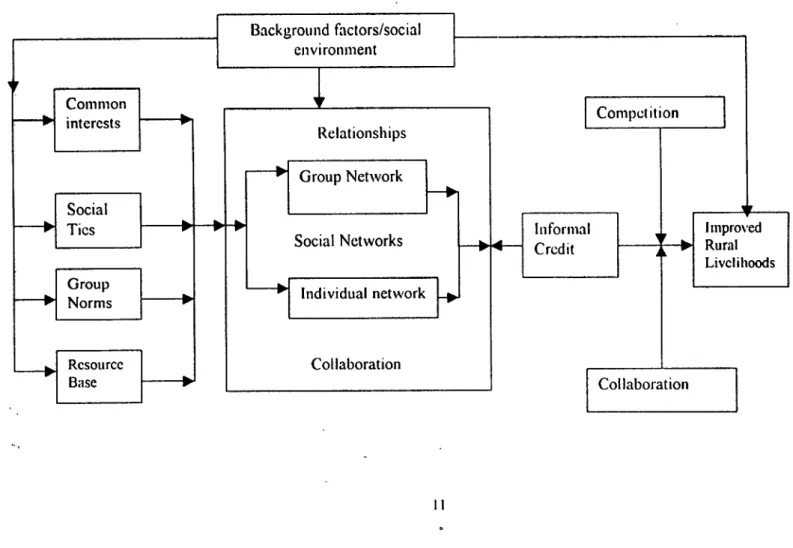
Informal rural credit schemes can be viewed from a network perspective and Figure 1 illustrates the interaction process between background/social environment factors, individual and group networking and informal rural credit schemes with the associated outcomes of improved rural livelihoods. Thus, issues of common interests, social ties, group norms, the resource base and/or the informal credit are in most cases likely to have an impact on the type of network relations so formed. Figure 1 shows how possible it is for social networks to be formed because of the social-environmental interaction as well as formation of informal credit schemes can lead to the formation of social networks. Secondly, it is also possible to have collaboration and competition between and among informal credit schemes formed. Thirdly, all different interaction above is most likely to lead to the improvement of rural livelihoods.
FIGURE 1. The Network Analysis/Conceptual framework
Background factors/social environment
Common Compel it ion
interests
i I
Relationships Group Network Social7
Rtural ivchhoods Group Individual network Norms Resource Collaboration I Base TCollaboration1.6 The Thesis Layout and Character
The Thesis is arranged in eight chapters. Chapter one presents the background to the problem, statement of the problem and the objectives of the study. It also gives the theoretical underpinnings on which the Thesis is based on. Chapter two is the review of the related literature on the study areas. The literature review is based on the themes and objectives of the study. These are the formation and operational mechanisms, contribution to the improvement of rural livelihoods of the IRCS as well as the linkage between the formal and informal financial sectors and the empowerment process of the venerable groups in the community.
The third chapter is the presentation of the discussion on the methods used in the study. It includes the research design, a description of the area of study, sample selection and sampling procedures, data collection and management and analysis. The fourth chapter discusses the background features of the study population in the three rural villages (Kisengya, Kihumbya and Katunguru) where the research was carried out. The chapter aims at bringing out the relationship between socio-economic factors such as the age, sex and marital status, education attainment as well as the expenditure patterns of the respondents. It also presents the nature of informal rural credit schemes that are henceforth formed. The presentation here is mainly hinged on the assumption that the nature of the socio-economic characteristics of the population will, in many instances, be a ground for the formation of the social network relations in form if IRCS.
Chapter five presents a discussion on the formation and operational mechanism of the informal credit schemes. The hypothesis being proposed in this chapter is that socio-economic characteristics/social environmental factors determine the development of the network relationships, which subsequently leads to the formation of rural credit schemes. The development of credit network relations in rural areas depends on several factors. They may - include issues of gender, marital status, source of income as well as expenditure patterns, and
exposure to new friends in the scheme as a form of social capital and/or insurance. Such factors greatly impact on other relations as the results indicate in the proceeding sections. The operational patterns of informal rural credit schemes (IRCS) are, in this chapter, presented under three main categories. These include the reasons for the formation of [RCS, organisational mechanism of IRCS, and the checks and balances in the IRCS. Chapter six is the presentation of an assessment of the contributions of informal rural credit schemes to individual households and the general community livelihoods in Kabarole District.
Chapter seven presents the application of the social network analysis in understanding the informal rural credit schemes in Kabarole district. In the rural setting, network analysis is used in an attempt to understand the ways in which urban dwellers are hiked to one another and to show how these shape the tenure of their experience. It also presents the conclusions and recommendations of the study on the network approach to informal rural credit schemes done in Kabarole district, Uganda. It includes the most salient findings of the study and attempts to show the major conclusions regarding the understanding of the IRCS using a network analysis.
CHAPTER TWO
LITERATURE REVIEW
2.1 IRCS and Rural Development
Since the early 1980s, there have been several economic reforms that have been pursued in Africa. The major objectives of such reforms have been mainly focussed on the attainment of higher growth rates after the rearrangement of the domestic prices in relation to the foreign economies. This was done after removing all the policy induced obstacles or distortions to the expansion of the outputs. What is stimulating to note about the reforms and their effects is the growth in the low-income African countries than in the middle-income developing countries (World Bank, 1992). The major reasons given are the increasing proportion of the burden of the adjustment that fell mainly upon the public investments (Mosley and Weeks, 1993). In this case, private investments have not grown substantially in many countries which has led to the inadequate domestic resource mobilisation following the economic reforms as many countries became dependants than ever before. It is predicated that African countries will decline ftirther making the domestic resource mobilisation even more unavoidable (Global Coalition for Africa -GCA, 1993).
It is argued that the mobilisañon of savings and conversion into investments through efficient financial intermidiaiy is becoming increasingly important to the policy makers in the Third World countries. Unfortunately, acceptable conditions for enhanced and successful financial intermidiation have not resulted into anything. The liberalisation of the financial sectors has not, in many respects, led to improved rural livelihoods. Savings mobilisation and lending by the formal financial sector continue to decline to date.
The relatively low significance of the rural savings in a number of these economics is attributed to the lack of confidence in the stability of the financial sectors of many countries following
years of interference by governments in the operations of such sectors (GCA, 1993). Also the poor infrastructure for the formal savings mobilisation has to a big extent been responsible. The loss of hope cannot be relieved by the reforms that focus only on the provision of the financial incentives. What potential savers need is the guarantee that their savings are safe otherwise they will look elsewhere. There is considerable evidence that shows that in looking elsewhere, the informal rural credit schemes are used. In fact, it is suspected that the informal segments of the financial markets in many African countries are bigger than the formal sectors (Chipeta and Mkandawire, 1991; Aryeetey and Hyuha, 1991). Therefore, it is unlikely that any important increases in savings mobilisation can occur after the reforms if factors that attract potential savers in the IRCS activities are not considered in the reform undertaking.
The informal credit and savings sector is the spontaneous sector comprising mutual and proprietary units such as the Rotating Savings and Credit Associations (ROSCA). These are defined as associations formed upon a core of participants who agree to make regular contributions to a find which is given, in whole or in part, to each contributor in rotation (Ardener, 1964:201). In simple terms, several persons join together to raise money and contribute to a common find on a regular basis. At each time of contribution a different member receives all the money collected. They are sometimes known as indigenous bankers who historically predate formal finance (Chandavarkar, 1992, 1985). These ROSCA are textbook examples of clubs which, surprisingly, have been so completely by passed by the economic theory of clubs. The other constituent of informal finance is reactive since it crops up primarily as a reaction to deficiencies and controls over formal finance and typically assumes the form of urban curb market, private finance companies and other fringe entities (Buchanan, 1965; SandIer and Tschirhart, 1980).
2Aiyeétey (1995:) describes informal inance as the participation in all commercial saving and lending activity
taking place outside of formal or established financial institutions.
3Wai (1957) also describes the sector as the unorganised money market 15
It is should be noted that informal lenders have prior adequate information about the borrower capacity and willingness to repay loans. Relatives and friends, in particular, can better enforce repayment because of the potential threats to the borrower's reputation within the family circles in the event of defaulting. Reputation is also considered to be an important fctor in enforcing tenancy contracts, because loss of reputation due to discovery of opportunistic behaviour will reduce future contractual opportunities (Otsuka, et al., 1989). This type of interaction works well in what is called network relations.
In Nepal, the farm size and irrigation are major determinants of borrowing from formal institutions whereas family size is the most decisive factor in borrowing from informal sources (Yadav et al., 1992) Yadav, et al (1992) fuirther argues that formal sector borrowing per hectare of cultivated area initially increases and then decreases with farm size. This analysis indicates that while very small farmers tend to be excluded from the formal financial market because of a lack of collateral, very large farmers choose to borrow less from that source because of lower production efficiency4 . This argument strengthens the idea that looking at informal rural credit scheme needs to be revisited by looking at the mechanisms under which they operate, encouraging improvement in rural livelihoods and subsequently rural development.
The total proportion of the number of informal loans, or of households borrowing from the informal sector, is higher in most cases than what statistics indicate. For instance, Ghate (1992) says that the share of rural informal credit accounts for about one third to tt'o-thirds of total rural credit in Bangladesh and China; two fifths in India, Sri-Lanka and Thailand and two-thirds to three quarters in Malaysia, Nepal, Pakistan and the Philippines.
4Designation or security given as a pledge for the fulfillment of an obligation i.e. property, stocks, bonds or anything
Economists have long recognized such diversity in the rural financial credits and the uniqueness of the different categories of credit contacts (Bottomley, 1963; Long, 1 968a; 1968b). It is only of recent that an analysis of the informal credit has been done. But even when informal credits are included in the analysis, they are often aggregated with formal credit (Iqbal, 1983), or the various types of informal credits are not distinguished in statistical analysis (Binswanger et. al., 1985). This procedure implicitly assumes that various credit contracts particularly in the informal sector, are perfect substitutes. This deficiency and lack of a clear vision as regards mechanisms of informal rural credit schemes must be looked into, if any meaningful analysis of the scheme is to be done.
Although the interest rates for loans from relatives and friends are low, they should not be literally interpreted as comparable to formal loans because reciprocity or mutual help is often involved in this transaction and implicit interest payments are not uncommon, for instance, in the form of free labour services. To be more advantageous to the rural community, an analysis of the cobweb network relations/processes in such associations is important. Perhaps more important is that does the rationing mechanism does not require a collateral. This is likely to increase lenders' expected return because the collateral reduces incentives or temptations to default that shifts the expected loss from the lenders to the borrowers (Binswanger et al. 1985; Federetal. 1988).
In practice, however, it is difficult for moneylenders in the informal sector to obtain legal sanctions even in the case of defaulting. Yadav, et al (1992) says that a collateral-free loan is most common in the case of relatives and friends. These observations suggest that poor farmers are excluded from the formal sector and are forced to rely on informal rural credit sector borrowing, which sometimes does not require a collateral but social capital in form of social networks.
The existing literature on the informal rural credit scheme (finance) and its importance is, paradoxically, more recognized now by intergovernmental organizations, such as the World Bank, (The World Bank, 1989:112 - 121), Asian Development Bank, (The Asian Development Bank, 1990:187 - 211) than the domestic authorities in countries where they are found. The development of a coherent policy toward informal rural credit sector, which is currently a disorganised ensemble of neglect and outright prejudice, would probably offer better options to livelihood improvement.
2.2 The Formation and Operational Patterns of IRCS
It is not possible to exactly say where informal rural credit schemes originated. But the existence in Cameroon of informal credit organizations that included savings and credit ftinctions (using money) could have appeared at least as early as 1940 (Meyer, 1940). Meyer describes a type of a saving club, Ngwa, which existed in Bali, Southern Cameroon, and the Susu collection in Ghana. The name of the credit schemes differs from place to place (Guilbot, 1956; Little, 1962, 1965; Bascom, 1952; Nadel, 1942, Aryeetey, 1995).
A detailed description of the rotating credit associations in West Africa are discussed by many authors (Ardener, 1952; Isong, 1958; Okonjo, 1977; Delancey, 1978; lily, 1973; Okorie and Miller, 1978, Aiyeetey, 1995). All these discuss the formation, operation and uses of such institution in West Africa. Delancey (1977) acknowledges that the informal credit schemes are widely used in Cameroon and their existence there for many years have been an important factor in the recent and very rapid growth of the credit union movement, in light of the foregoing, therefore, it may be legitimate to document the contributions and the network processes of informal rural credit schemes. This process can give us a thorough evaluation for determining the extent of their roles to the household economy and their contribution to improved rural livelihoods in Uganda.
It is on this note that the time may have come to acknowledge that the informal credit schemes can offer money to small borrowers in greater amounts at lower costs than banks. They can also allow them to do so openly, subject perhaps to the setting up of suitable mechanisms to monitor on lending rates like they did in Sri Lanka (Fernando, 1986). This points to the fact that the informal sector cannot wither away as the traditional view of financial dualism assumes, or it may have to continue playing an important complementary role or perhaps even growing in absolute size. Fernando (1986) presents the case of the Cheetu system in Sri Lanka. It one form of informal credit system that has succeeded because of different reasons. The most outstanding feature of the Cheetu system and the major reasons for its success is the aspect of the local control and responsibility in the allocation of Cheetu money. These are schemes that are composed of self selected peer groups who shape their own organisation and make their own rules with a great deal of flexibility in their operational mechanisms. Hence, its adaptability to a variety of purposes makes it a darling of every member of the rural community.
The most important factor for the success of the Cheetu scheme in the rural community is its confinement to a small group of people known to each other at very close friendship levels. The members trust each other's financial dealings, saving capacity, credit worthiness, and a good moral standing in the rural community are causal measure for the selection of members. In the same way, one's length of stay in the village, the kith and kin groups to which one belongs and the company one keeps are among the salient points a person is judged on in the selection process. This, in a way, points to the use of and reliance on the social network relations to become a member of the savings schemes.
The discussion on the operational patterns of the IRCS need not forget to analyse how the cases of default are treated. The paramount precedence in the operations of the IRCS commitment, and the subsequent absence of the defaulters, is the guiding principle in the rural
schemes. The members fear the disgrace and humiliation that can fall on them. Wainana (1990) argues that the stigma, which might follow, acts as a deterrent to most of the potential de1ulters. Another usefi.il point note is the consequences on the defaulter if trustworthiness leads to the exclusion from frirther participation in the [RCS, especially where they are firmly embedded in the local social and economic structure. In most cases a defaulter threatens the system of IRCS which can damage the credibility of the entire group (see for example, Ardener, 1964, Niger-Thomas, 1995, and Summerfield, 1995). In this case, members sometimes set rules for people to provide a substantial guarantor.
2.3 The Formal-informal Linkages and LRCS
Currently, the idea being advocated is to encourage the dual existence of the two sectors: Formal and Informal for a common cause, which has not yet been seriously addressed. Ghate (1992), observes that the nature of interaction between the fojmal and informal financial sectors in developing countries is a subject with important policy implications. It has implications for the ftiture existence of the informal credit sector as the formal sector expands in the long term. Secondly, the pattern of interaction between the two sectors has implication for the prospects of success of the rural livelihOod improvement programme. Thus, the informal sector offers a stronger competition so as to induce it to improve its terms, and promoting linkages with it. It then takes advantage of the IRCS lower transactions costs in reaching smaller and poorer borrowers. Thirdly, the existence of the informal sector have implications for the efficacy of monetaly and credit policy in achieving stabilization objectives. Finally, the interaction between the formal and informal financial sectors has implications for the effects of financial liberalization through removing restrictions on the deposit rate of interest (Ghate, 1992).
Cole and Park (1983) consent that the dualism between the two sectors reflects the underlying production structure and distribution of wealth of an economy. In economies characterized by
large primary and small industrial and commercial sectors, the majority of borrowers consist of frmers, small industrialists and small retailers and wholesalers, who require short-term loans, and in relatively small amounts. The needs of such borrowers are met by relatively atomistic financial markets and by traditional financial institutions.
At this point, it is important to show why some borrowers and/or their credit needs belong to the informal sectors. It is generally agreed that the informal sector activities possess no collateral. In this case the informal sector may be in position to lend without collateral on the basis of first hand information on the borrower, the strength of Community ties, and the level of networking that exists. Secondly, it is suitable for small or short duration loan, for which the transactions cost may be so high as to place it beyond the profitable reach of the formal sector. Thirdly, credit controls may prevent the formal sector from making loans for a variety of purposes, including consumption loans, so that the borrower has no alternative but to approach the informal sector.
In this case, as the informal sector increases, the demand for informal credit increases for the complementary purpose of having working capital. Thus, both by virtue of specializing in one end of either sector, and by financing the credit needs of complementary purposes in the middle segment of the continuum, informal finance is complementary to formal finance. Hence a policy has to be generated as to how best the two sectors can harmoniously compliment each other. Alam (1989) and Larson (1988) found that most of the rural informal loans originated from the formal banks and was lent by informal lenders.
A great deal of informal credit trade is sourced from the formal sector. This takes advantage of the fact that marketing intermediaries higher up in the distribution chain have superior access to the banks (Nayar, 1973; and Angel, De Goede and Sevilla, 1978; Boumari, 1979; Ghatè, 1992), so do credit unions, savings groups and moneylenders. Adams, Graham and
Von Pischke (1984) however, talk of cheap credits given by banks to undermine informal credit rural schemes
There are different degrees of the linkages between the formal and the informal sectors. In this case, these links exists as either strong or weak ties. These linkages are observed in the savings mobilization and in the credit sectors. What is not so clear is how significant they are for the improvement of rural livelihoods. Oftentimes the linkage could be in form of the complimentary or competition in the credit sector (see for example, Aryeetey, 1995, Chipeta and Mkandawire, 1992). What is important now is to assess whether there is any significant relationship between the sectors as to cause improvement in the rural livelihoods.
2.4 IRCS Contribution to Rural Livelihood Status
This leads to the discission on the improvement of rural livelihoods basing on the household. The idea of a fixed unit called a "Household" can be defined differently. Galbraith (1973) argues that it is a consequence of only a short step to defining the head of household as a financial supporter of the household and the productive member of it supported by a vague fmily labour. Some insights into the widespread use and the multiple variations of this institution can be found in Africa. Over the years, a large number of studies have indicated the existence of indigenous African savings and credit institutions at the household and community levels (Ardener, 1964; Ardener and Bouman, 1995). Too, there has been evidence of widely held attitudes supporting use of such institutions.
The most important point here is that local rather than bureaucratic knowledge is crucial. What come into play are the traditional social obligations to help kinsmen, neighbours, and friends whenever there are problems. Since there are no rigged rules to follow, members can adjust their positions to cater for an emergence. The speed with which [RCS can react to the emergence cannot be leveled with the impersonal formal banking sector because you do not
need collateral to acquire a loan even though a substantial guarantor is required. The habit of not requiring collateral should in this case be seen in context of the operations of the [RCS. In most of the IRCS, members are friends, neighbours, regular customers, relatives and business colleagues. Likewise, there is a feeling of necessity to give assistance where a person is trusted, and in the end establishing a relationship. Such a relation can progress in to social network among the entire community.
The most common benefits from informal credit are: ability to have working business, solving emergence problems, pay school fees, buying household items, strengthening social ties in the community, and buying food. The fact that people are able to meet their emergence problems, purchase food and household items, and enlarge their social network makes them have a rural life that extends beyond their purely business concerns. It is a life that involves the relations with individuals and groups within the rural community (Alila, 1995).
The [RCS are in most cases seen as having moral and social dimensions. It this social element that is highly valued by others who join the credit schemes. The socialization process may also be enhanced in the IRCS. Members may get considerable economic returns apart from getting the rotational contributions. They may also get to know the information on a wide range of topics such as market opportunities, and arrange business deals. In all these situations, friendship networks are prerequisite for the improvement of the rural livelihoods.
The empowerment of the women is part of the contribution of the IRCS in rural livelihood improvement. The major point to celebrate the empowerment process among the rural women folk is their ability to make decisions of their own regarding credit schemes. This is because women become decision-makers while spending savings made Out of the IRCS (see, Wainana, 1990, Niger-Thomas, 1995).
In sum, this chapter presents a review of the literature that has been documented on the [RCS. They have been presented under sub-headings such as the place of [RCS in rural development, the formation and operation, the formal-informal linkages and their impact on rural livelihoods. What is clear, thougii is that the IRCS have a very big role that they play in improving the rural livelihood status.
CHAPTER THREE
METHODOLOGY
3.1 The Study Design
The research design was essentially a cross-sectional aimed at exploring the formation, and impact of informal rural credit schemes in Kabarole district. The design involved conducting interviews using questionnaires, Key informant interviews and Focus Group Discussions. The target study populations were people who are members of [RCS, aged between 18-70 years who included both males and females. This categorisation was very useflul in comparing the participation level by gender. Membership to informal rural credit schemes was a priority. In all, 200 respondents participated in the study.
3.2 Area of Study
The area of study was Kabarole district. The geography, historical and language factors influenced the choice of Kabarole as a study area. First, Kabarole district is in a rural area, which suits well with the study, which addresses the informal credit schemes in the rural areas. On top of this, I am born in Kabarole and speak the local dialect (Rutoro) fluently. Second, Kabarole district is characterised by different aspects of rural credit. There was the famous rural farmer's scheme under Uganda Commercial Bank that was meant for rural farmers5.
Thirdly, its ethnic set up suits the research in terms of the different socio-economic and cultural factors. For example, the district is a composed of many ethnic groups like the Batooro, Banyoro, Bakiga, Banyarwanda, Bakonjo, and Banyankole. All these I thought would help in testing the nature of social networks formed. It would help differentiating the kind of [RCS formed between different ethnic groups.
The UCB niral farmers credit scheme was a government of Uganda credit scheme which, was meant : for rural farmers. But it was the politicians and businessmen who ended up benefiting from the credit scheme. What is interesting is that the debtors did pay back the loans until the government established debt collection bureau.
3.3 Sample Selection and Sampling Unit
A multi-stage cluster sampling procedure was used to select the sample for the study in the district. The primary sampling unit (PSU) was the counties in the district. One sub-county was randomly selected from the district and the secondary sampling unit (SSU) were the three parishes selected from the sub-county. The tertiary sampling unit (TSU) was the three sub-parishes (LCs) 6 altogether randomly selected from the three parishes that would have been selected in the district. The total number of sub-parishes selected was three. The basis of random selection is to determine the size and magnitude of rural informal credit scheme and the general characteristics of the population. The following parishes and sub parishes were selected from Nyantungo Sub-county respectively: Kigarale, Nyaibanda and Kibira parishes and Kisengya, Kihumbya and Katunguru sub parishes. In each sub parish, 30 respondents were interviewed using the questionnaire.
The sampling frames in each sub-parish were obtained from the chairpersons of LCI within the areas selected. The sampling frame included a list of all the members of the sampled village where the study was to be conducted. A sampling frame was composed and using simple random sampling, 30 respondents were selected from each parish in the district. A total sample of 90 households was thus selected for the study. This constitutes 45% of the total study population. Structured interviews were conducted at the household level7 . These interviews were based on decision making, use and the contributions of IRCS at the improvement of livelihoods of the community, the role of women in the scheme, the current local organizational and institutional framework under the various village groups that compose the informal credit schemes.
6 LC I represents local council committee at the village level. As a policy of the present regime (NRM), each village
/zone has a committee (LCI) equivalent to a village which combine to form LCII for the parish (Muruka) and the
chairperson is equivalent to the village or parish. -
7lnterviews were conducted in the sampled homes. In most cases the head of the home or his/her spouse would be interviewed. In the event that none of the above are at home, a child of 18 years would be interviewed. If all were
In terms of actual fieldwork experiences, the data collection exercise went on well as earlier on planned. However, there were shortcomings regarding the methodology and the actual execution of the study. First, there was the problem of obtaining the lists (updated) of the village residents in the areas visited. The local officials thought that there was no need for them to have updated lists because they knew most of the people who are in the villages. This meant that there was a time lag between the preparation of the lists of the residents and the actual research survey. Secondly, the period when the research was carried Out (February - April) was a time for harvesting as well as preparing the gardens for the coming planting season. In most cases, respondents were found in their gardens. This led to a time lag between one respondent to another. Third, by using simple random sampling, the 30 respondents were found to be in different locations rather than in a cluster. This proved to be a very difficult venture crossing the whole village for respondents. Fourth, there were a lot of suspicions among respondents because of the rebel remnants in the district. Getting proper introductory letters that were obtained from the LCHI, LCII, and LCI chairpersons in the areas visited and Makerere University, however, solved this. Finally, transport was a big problem in the area. This is because of the long distance from the centre to the rural areas where the research was conducted. However, the problem was overcome by the use of the motor cycle transport common in the area.8
3.4 Data Collection
The data collection procedure was carried out in phases such as the sample survey, Focus Group Discussions (FGDs) and PRA sessions, and key informants, and the documentary review of the earlier works done on [RCS and network development. The use of several methods was to make sure that the data collected is triangulated. This helped in cross checking the various sources of information. The data collection exercise began with the initial
absent, then the household would be replaced. But there were no such cases encountered in the whole study. 27
contacts with local leaders. These included the LC HI chairperson, Nyantungo sub-county who gave an introductory note to the researcher to proceed to the selected areas.
3.4.1 The Social Survey
The social survey was conducted using a household-based questionnaire. In most cases, respondents were found at home or in the nearby gardens since it was a planting season. In case of failure to trace the respondent, the household could easily be replaced. The major components of the household questionnaire were the respondents' identification, demographic characteristics, organization, operation and gender relations of IRCS as well as the contributions to rural livelihood (see appendix A).
3.4.2 Focus Group Discussions and PRA Sessions
In each of the three sub-parishes selected, twenty participants, in two groups of ten for both wamen and men were constituted into the focus group discussions (FGD) 9 and Participatory Rural Appraisal (PRA) groups' ° . This was done for comparison purposes. A rapid appraisal of the areas determined who should be selected to participate in the study given their knowledge on the operations of informal rural credit schemes through a participatory methods approach. It involved having an inventory of all the households whose members belonged to an informal organization. This constituted 40 percent of the study population (80 participants in 4 sessions). These formed part of the FOD information (see Appendix B).
The commonest means of transport in the area is motor cycles known as 'Boda Boda'.
Focus Group Discussions (FGD) is a data collection technique that involves a discussion of about 7-12 people about a topic(s) of research. Normally the discussion takes place in an environment where there is little interference from outside. The sitting anangement is in a semi-circle with a moderator and a recorder. A moderator conducts the discussion according to the pre-set questions in the discussion guide.
'° Chanibers (1992) describes the participatory rural appraisal methods of research (commonly abbreviated as PRA) as a family of approaches and methods that enable the local people to share, enhance and analyse their knowledge of life and conditions. They are part of the intercultural didactic approach and took full account of the socio-cultural framework of the rural way of life. In this case, the information is shared and owned by local people. The mode of investigation, sharing and analysis is open-ended and often visual, by groups, and through comparisons.
The discussions were aimed at generating village wide information regarding how [RCS are formed, the inclusion-exclusion criteria, and the contributions towards improving rural livelihood. The following tasks were part of the PRA activities undertaken in the FGDs: Seasonal Calendars, Well-being ranking and Gender Analysis (see Appendix Q. In this case, participants were asked to draw seasonal differences in activities engaged in, how they define the village wealth and gender differences in the activities done.
Seasonal Calendars
This was basically done to explore seasonal constraints and opportunities by showing changes month by month throughout the year. Participants in the FGD were asked to draw patterns of organization, publicity techniques, labour activities, travel distances for meetings to organize the credit schemes, credit availability, effects illnesses and market days, which season does IRCS activities take place? These were noted to have important implications for the informal credits formation and/or contribution (see Appendix C)
Well-being Ranking"
This task was performed to understand how households in the chosen villages cope with their day to day realities as a result of household income and expenditure patterns. The following aspects were asked of the FGD participants: Average size of the households, main sources of income, patterns of expenditure and access to other sources of income generating activities in the area. These were vital in determining how much on average do members of IRCS contribute. It was useftil also in assessing the nature of networks formed, which are based on informal credit. The information collected led into discussions on rural livelihood improvement, provided a sample frame to cross check the relative well being of respondents. By using such a method, biases against the poor and 'vulnerable were avoided because the
Mikkelsen (1995) contends that well-being ranking is meant to target the poorest of the poor. She argues that well-being ranking is a comparison of wealth, usually some concept of well-being, and does not require discussion of absolute income and other assets. Normally, it leads to the understanding of the local criteria of wealth and well-being and changes in the wealth
researcher was able to determine the key local indicators of welfare and well-being in the community(see Appendix Q.
(iii) Gender12 Analysis
This activity was done to study the differences in gender roles and their impact on community livelihood as well as participation in informal credit schemes. FGD participants were asked about their gender role profiles, access and control over IIRCS resources and how impacts on peoples livelihoods in the villages. It was also used to document the current gender status and relations in the local communities regarding the operations of the informal rural credit systems.
This analysis helped in determining whether IRCS have led to the empowerment of women in these areas(see Appendix Q.
3.4.3 Key Informants interviews
In addition to the household survey, the individuals with knowledge on the communities were visited and interviewed. These included groups of individuals with knowledge on the operations of IRCS and groups dealing with informal credit schemes in the area (for instance Mwenge Rural Training and Development Organisation - MRTADO which acts as a micro finance organisation). These are "custodians" or secretaries of IRCS and members of the village bank. These constituted 15 percent of the study population (30 Key Informants). These were divided into ten each sub parish. A snowball research technique, where one key informant introduced the researcher to the next key informant, was used. In all, the key informants were asked about the past and current socio-cultural, political and economic organisation of the informal rural credit schemes and how they impacts upon rural livelihoods.
Some of the key informant experiences given are presented as quotations and case studies in the data.
12 Contrary to "Sex" tiich describes the biological differences, "Gender" describes the social differences between