HAL Id: hal-00783079
https://hal.archives-ouvertes.fr/hal-00783079
Submitted on 31 Jan 2013
HAL is a multi-disciplinary open access
archive for the deposit and dissemination of
sci-entific research documents, whether they are
pub-lished or not. The documents may come from
teaching and research institutions in France or
abroad, or from public or private research centers.
L’archive ouverte pluridisciplinaire HAL, est
destinée au dépôt et à la diffusion de documents
scientifiques de niveau recherche, publiés ou non,
émanant des établissements d’enseignement et de
recherche français ou étrangers, des laboratoires
publics ou privés.
Experiments and design of an inference fuzzy system
Farida Benmakrouha, Christiane Hespel, Edouard Monnier, Daniele Quichaud
To cite this version:
Farida Benmakrouha, Christiane Hespel, Edouard Monnier, Daniele Quichaud. Experiments and
design of an inference fuzzy system. FCTA- International Conference on Fuzzy Computation Theory
and Applications, Oct 2012, Spain. pp 420 - 423. �hal-00783079�
Experiments and design of an inference fuzzy system
F. Benmakrouha
1, C. Hespel
1E. Monnier
1and D. Quichaud
11Computer Sciences INSA RENNES, FRANCE
{benma, hespel, monnier, quichaud}@insa-rennes.fr
Keywords: fuzzy system; diabetes; datum plane covering.
Abstract: The aim of this paper is to propose a criterion to estimate the design, from experimental data, of a fuzzy inference system, when data are sparse.
This lack of data is important and may improve the generalisation ability of fuzzy systems (0). Several methods have been proposed to obtain automatic fuzzy rules from sparse training data.
In (0), the authors first construct fuzzy rules from collect data. Then, they use kernel regressions for generate training data.
Another technique used when classical inference methods produce sparse fuzzy rules is a diffusion procedure based on interpolation to initialize incomplete rules (0), (0), (0).
Our method has the advantage of occuring before initialization step and therefore avoiding unfired rules which make difficult to produce an accurate output. .
INTRODUCTION
The lack of data is important and is pointed out by M Lutaud-Brunet in (0). Sugeno and Yasukawa underline in (0) how difficult it is to build a fuzzy model when data are scarce and membership func-tions don’t sweep over all the universe of discourse. This may improve the generalisation ability of fuzzy systems (0).
Several methods have been proposed to obtain automatic fuzzy rules from sparse training data. In (0), the authors first construct fuzzy rules from collect data. Then, they use kernel regressions for generate training data.
Another technique used when classical inference methods produce sparse fuzzy rules is a diffusion procedure based on interpolation to initialize incom-plete rules (0), (0),(0).
The objective of this paper is to measure the impact of datum plane covering on the outcome of a fuzzy inference system. Most of optimization methods make the assumption that datum plane is sufficiently covered. If this assumption no longer holds, we will see that these methods cannot work, since it implies that, before optimization, the fuzzy system gives acceptable results. In (0), we analysed the relationship between learning set Ω and labels of fuzzy inference system. In this paper, we take into account a data density repartition, by the measure of
number of available data on intervals of each input variable domain.
All these tecniques take place during optimisation step when our method is used before initialization step. This in turn allows one to isolate unfired rules and to proceed, if necessary, to a partial remodelling of the FIS before training and optimization.
1
The Tagaki-Sugeno Model
The model under consideration in this section is a Tagaki-Sugeno model, which corresponds to dis-cretized linear models of order 1, combined with non-linear functions.
y(t) =
r
∑
i=1
hi(z(t))(ai1.y(t − idecal) + bi1.u(t − idecal))
y(t) is the output,
ris the number of linear models,
z(t) a vector which depends lineary or not on the state,
hi(z(t)) >= 0 , i = 1, · · · , r nonlinear functions
verifying the convex sum property.
idecal is the time lag between input and its effect, which is specially interesting in our application.
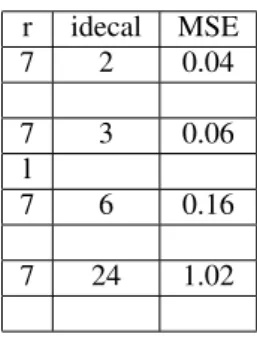
We have measures about every five minutes and we admit that the effect of insulin (considered in our application)is fast and noticeable ten (idecal=2) minutes later, up to half an hour(idecal = 6).
The determination of unknown parameters ai
1and ai2 is done by the algorithm of recursive least square.
2
Application to the
insulin/glycaemia behavior of
diabetics
2.1
The available data
The correlated data ”‘insulin infusion deliv-ery/glycaemia”’ has been provided by the team of Pr. Pinget, CHU of Strasbourg. They concern the same person and the same insulin.The insulin infu-sion has been done by an intra-peritoneal route and the glycaemia has been checked by a subcutaneous sensor. Measures of glycaemia have been made every five minutes during 7 days, which corresponds to 1700 measures.
A bolus is a dose of insulin infused manually, in ad-dition to the basic dose, since postprandial glycemia cannot be regulated satisfactorily. The insulin file contains crude data about basic insulin doses as well as boluses. So, a pretraitement of the insulin file has been necessary to produce a file of insulin delivery for the same person every five minutes.
2.2
Experiments and Validation of the
model
The learning set is composed of the first mea-sures(280 points) that corresponds to insulin infusion and blood glucose concentration of a patient during a day. We take 7 (r= 7)linear models, considering that each model is valid about three and half hours. The mean square error(MSE)is calculated on the totality of the measures(1700 points).
We make experiments by changing the parameter
idecalof the model, time lag between an input and its effect.
The test of our modeling method shows that we can predict the glycaemia over a long period (7 days), by considering glycaemia and insulin delivery 15-minute (resp 30-15-minute) before with an error of about 6%(resp 16%), which is a good result compared with current results. However, we see that results obtained are not so good in the last case, when we consider
r idecal MSE 7 2 0.04 7 3 0.06 l 7 6 0.16 7 24 1.02
Table 1: First Table .
slow effect insulin (with 2-hours delay). In this case, our model has to be refined, by increasing its order.
3
Datum Plane Covering
We propose a measure used to pre-validate a fuzzy model. We suppose that there exists a learning set Ω = {(xj,dj)}, where xj is an input vector and dj,
the corresponding output. We also assume that the desired function f is defined in
V= [a1,b1] × [a2,b2] × ... × [ap,bp]
Usually, to validate a fuzzy inference system, the mean square error (MSE) is calculated on a test set. If the MSE exceeds a threshold, then training is done, using a gradient method. This consists in modifying
Cj at each presentation of examples from the error
(y(xj) − dj).
Unfortunately, in case of model invalidation, we cannot determine never learned rules that cause the gap between the model and the real system. More-over, if there is an insufficient covering of datum plane, training and finer splitting of input space are inefficient and useless. With the criterion proposed below, we estimate the datum plane coverage and we are able to isolate inactivated rules. Then, partial remodeling of the fuzzy inference system is possible. The study is investigating the relationship between a quantitative variable X , number of available data for each input, and a qualitative variable Y , labels of membership functions.
When designing a fuzzy system, we attribute to each input I r modalities (or labels) noted
y1,· · · yl,· · · yr. We note XIthe variable for the input I
of average ¯xIand variance σ2XI. We note ΩI the
cor-responding learning set . Each label yl of I defines
a subset ΩIl of ΩI : we obtain a partition of ΩIin m classes. We note nIl = card(ΩI
l) and nI= card(ΩI).
We have nI = Σm
l=1nIl. Then, if we consider the
re-striction de XIto ΩI
the average (noted ¯xIl)and the variance (noted σ2XI l of XIon this subset: ¯ xIl =∑ω∈ΩIlX(ω) nIl σ2 XlI= ∑ω∈ΩI l(X(ω) − ¯x I l)2 nIl
We have an index of connection between the datum plane coverage (for an input I) and the learning set defined by : sI= s σ2 E σ2 X I where σ2 XI= σ2E+ σ2R and σ2E=∑ r l=1nIl∗ ( ¯xIl− ¯xI)2 nI and σ2 R= ∑rl=1nIl∗ σ2 XI l nI and ¯ xI=∑ r l=1(nIl∗ ¯xIl) nI
This index of connection consists in detecting rela-tionships between number of data of the learning set ΩI and r
Ilabels. This index is low if the features of
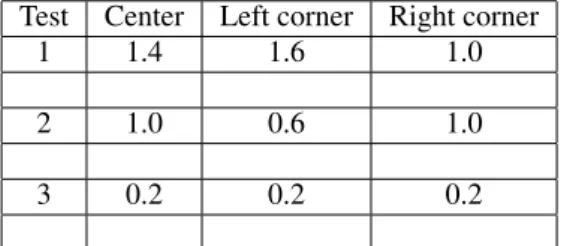
these labels are not so different (Test 1). When this index is high, it points to that there is a bad repartition of membership functions (Test 3). This gives an in-formation about the repartition of data of learning set ΩIbetween membership functions.
3.1
Experiments
We have made 3 tests for the first input (with two tri-angular membership functions) using our application. We give in these array the features of these functions. We obtain for the first test a low index(0.035), the sec-ond a medium index (0.28) and for the last test a high index (0.84). In the third test, the first membership function is useless and the corresponding rules are in-actived. So, we can suppress them without affecting results. We have made a 4th test where three (out of four) membership functions and the associated rules were unnecessary.
Test Center Left corner Right corner 1 1.4 1.6 1.0 2 1.0 0.6 1.0 3 0.2 0.2 0.2
Table 2: First membership function.
Test Center Left corner Right corner 1 2.6 1.0 0.9 2 2.6 1.0 0.9 3 3.0 2.8 0.5
Table 3: Second membership function.
3.2
graphic representation
We represent sets of data by Box & Whiskers Plots to underline the relation between number of data and labels of membership functions. The first figure (resp figure 2 and figure 3) corresponds to Test1 (resp Test 2 and Test 3). 0,00 5,00 10,00 15,00 20,00 25,00 30,00 35,00 40,00 Groupe A Groupe B Q1 Min Moust.Inf Mediane Moust.sup Max Q3 Figure 1
4
Conclusion
We have proposed a measure for detecting useless rules and thus pre-validating a fuzzy inference sys-tem. When the model is not pre-validated, we have not to carry out next steps, particularly optimization step.
0,00 5,00 10,00 15,00 20,00 25,00 30,00 35,00 40,00 Groupe A Groupe B Q1 Min Moust.Inf Mediane Moust.sup Max Q3 Figure 2 0,00 5,00 10,00 15,00 20,00 25,00 30,00 35,00 40,00 45,00 50,00 Groupe A Groupe B Q1 Min Moust.Inf Mediane Moust.sup Max Q3 Figure 3
We have shown that this criterion gives useful information about datum plane coverage.
REFERENCES
Benmakrouha F. Parameter identification in a fuzzy
system with insufficient data.Sixth IEEE Inter-national Conference on Fuzzy Systems, 1:537 542, July 1997.
F Benmakrouha, C Hespel, E Monnier, An algorithm
for rule selection on fuzzy rule-based system ap-plied to the treatment of diabetics and detection fraud in electronic payment, FUZZ-IEEE 2010 Barcelona Spain
P.Y Glorennec, Algorithmes d’apprentissage pour
syst`emes d’inf´erence floueParis France Herm`es, 1999.
Sugeno M.,Yasukawa T. ”A Fuzzy-Logic-Based
Ap-proch to Qualitative Modeling”, IEEE Trans. on Fuzzy Systems , Vol. 1, no1, February 1993. Lutaud M. Identification et Contrˆole de processus
par r´eseaux Neuro-Flous.Th`ese de Doctorat de l’Universit´e d’Evry Val d’Essonne
Baranyi, P. Kczy A general and specialised solid
cut-ting method for fuzzy rule interpolation. in J. BUSEFAL, URA-CNRS, Vol 66, France, 1996, pp 13-22.
A.M. Albisser, B.S. Leibel, T.G. Ewart, et al., An
arti-ficial endocrine pancreas, Diabetes, 23 (1974), pp. 389-396.
J.L. Selam, P. Micossi, F.L. Dunn et al., Clinical trial
of programmable implantable insulin pump for type I diabetes, Diabetes Care, 15 (1992) pp. 877-885.
G. Bleckert, U.G. Oppel, and E. Salzsieder, Mixed
graphical models for simultaneous model iden-tification and control applied to glucose-insulin metabolism ,Comput.Methods Prog.Biomed. 56(1998), no. 2, 141-155.
B. Candas and J. Radziuk, An adaptive plasma
glucose controller based on a nonlinear in-sulin/glucose model, IEEE Trans. Biomed. Eng. 41 (1994), no. 2, 116–123.
Cruz Vega Israel, Wen Yu Multiple fuzzy neural
net-works modeling with sparse data, Neurocomput-ing 73 (2010) pp 2446-2453B
Isao Ishibuchi, Takashi Yamamoto Performance
Eval-uation of Fuzzy Partitions with Different Fuzzifi-cation Grades, FUZZ-IEEE’02. Proceedings of the 2002 IEEE International Conference Fuzzy Systems, 2002.
R.S. Parker, F.J. Doyle III, and N.A. Peppas, A
model-based algorithm for blood glucose control in Type I diabetic patients, IEEE Trans. Biomed. Eng. 46 (1999), no. 2, 148–157.
Z. Trajanoski and P. Wach, Fuzzy filter for state
es-timation of a gluco-regulatory system, Comput. Methods Progr. Biomed. 50 (1996), no. 3, 265– 273.
T. Johansen Fuzzy model based control: stabil-ity,robustness, and performance issues, IEEE Trans.Fuzzy Syst. 2(3)(1994) 221-234
H. Wang, K. Tanaka, M.Griffin, An approach to fuzzy
control of nonlinear systems: stability and de-sign issues, IEEE Trans.Fuzzy Syst. 4(1)(1996) 14-23.
S. Cao, N. Rees, G. Feng, Analysis and design
for a class of complex control systems., Part I: Fuzzy modelling and identification, Automatica 33(6)(1997) 1017-1028.
J.Gutierrez, F. Fernandez, S. Guadarrama, E. Trillas ,
“A step towards conceptually improving tagaki-sugeno’s approximation”, IPMU’2002 , III:pp 1789-1794, July 2002.
A. Juditsky, H. Hjalmarsson, A. Benveniste, B. De-lyon, L. Ljung, J. Sjberg,and Q. Zhang,
Non-linear black-box models in system identification: mathematical foundations, Automatica J. IFAC 31 (1995), no. 12, 1725–1750.
J. Sjberg, Q. Zhang, L. Ljung, A. Benveniste, B. De-lyon, P.-Y. Glorennec, H. Hjalmarsson, and A. Juditsky, Nonlinear black-box modeling
in-systems identification: a unified overview, Au-tomatica J. IFAC 31 (1995), no. 12, 1691–1724.