In press, Consciousness and Cognition
Predicting the phenomenology of episodic future thoughts
Arnaud D’Argembeaua and Martial Van der Lindena,b
a Department of Psychology, University of Liège, Belgium
b Department of Psychology, University of Geneva, Switzerland
Corresponding author:
Arnaud D’Argembeau, Department of Psychology – Cognition & Behavior, University of Liège, Boulevard du Rectorat 3 (B33), 4000 Liège, Belgium. Email: [email protected]
Abstract
Recent findings suggest that multiple event properties contribute to shape the phenomenology of episodic future thoughts, but the specific role of each property is not yet fully understood. This study shows that different phenomenological features are predicted by distinct event properties. The vividness of an episodic future thought largely depends on the familiarity of its constitutive elements (i.e., the envisioned location, persons and objects), while the visual perspective adopted is instead related to the temporal distance of the imagined event. Cognitive feelings such as the sense of pre-experiencing the future depend on sensory-perceptual qualities, and are further modulated by the personal importance attributed to the event. These findings suggest that the essence of episodic future thought—the sensation of mentally visiting one’s personal future—lies, in part, in the relevance of imagined events with respect to personal goals.
Keywords: episodic future thinking; episodic memory; autobiographical memory; phenomenology; consciousness; mental time travel; goals.
1. Introduction
One of the remarkable features of the human mind is that it allows us to transcend our immediate circumstances to envision possible futures. This ability—often termed episodic
future thinking—is central to many aspects of human cognition and behavior, from planning
and decision making, to self-control and the sense of identity (Atance & O'Neill, 2001; Boyer, 2008; Damasio, 1999; Schacter, Addis, & Buckner, 2008; Suddendorf & Corballis, 2007; Szpunar, 2010; Tulving, 2005). A hallmark characteristic of episodic future thinking is the subjective feeling of “pre-experiencing” the future; we can imagine what it would be like to be in a particular future situation, for example, by picturing the setting, characters and action in our mind’s eye (D'Argembeau & Van der Linden, 2004). These phenomenological qualities are important because they likely determine one’s beliefs about what might lie ahead, and in turn influence one’s decisions and behavior (Libby, Shaeffer, Eibach, & Slemmer, 2007).
What shapes the sense of pre-experiencing and other phenomenological features of episodic future thoughts is not yet fully understood. Recent studies suggest that multiple properties of envisioned events (e.g., temporal distance, affective valence, location
familiarity) play some role (Berntsen & Bohn, 2010; D'Argembeau & Van der Linden, 2004; de Vito, Gamboz, & Brandimonte, in press; Szpunar & McDermott, 2008). However,
different event properties often co-vary with each other and it is therefore essential to
determine the specific contribution of each property to better understand what modulates the phenomenology of episodic future thoughts. For example, recent findings suggest that temporal distance is associated with a decrease in vividness not because of time per se, but because people tend to place near future episodes in more familiar locations, which are represented more clearly than less familiar locations (Arnold, McDermott, & Szpunar, 2011). Although these findings point to the importance of location familiarity in mediating the
vividness of episodic future thoughts, a comprehensive investigation of the possible
contribution of other event properties remains to be performed. Furthermore, it is unknown whether phenomenological features other than vividness are also mediated by the familiarity of envisioned settings.
Two types of phenomenological features should be distinguished in episodic future thoughts: perceptual qualities and cognitive feelings. We here refer to sensory-perceptual qualities as the phenomenological properties of mental images. As with memories for past events, episodic future thoughts are constructed by assembling a set of details stored in episodic memory, such as details about particular locations, persons, and objects (Schacter & Addis, 2007; Suddendorf & Corballis, 2007). These details may be represented as
simulations in modality-specific systems (Barsalou, 2008; Rubin, 2006) and give rise to mental images, mainly (though not exclusively) visual images (for a discussion of the central role of visual imagery in autobiographical memory, see Brewer, 1996). These images are subjectively perceived as more or less vivid (D'Argembeau & Van der Linden, 2006) and can be viewed from different perspectives—one can see an event through one’s own field of view or as an external observer (Nigro & Neisser, 1983; Rice & Rubin, 2009).
Besides sensory-perceptual qualities (e.g., vividness and visual perspective), episodic future thoughts are accompanied by particular states of consciousness (Tulving, 1985) or “cognitive feelings” (Conway, 2009). Of central importance is the subjective sense of being brought forward in time to pre-experience an event—a specific state of consciousness that Tulving termed “autonoetic consciousness” (Tulving, 1985, 2005). Another cognitive feeling relates to the belief that the imagined event will actually happen in the future, which of course can have quite powerful effects on behavior (Conway, 2009). Finally, there is evidence that imagined future events can subjectively feel more or less distant, sometimes independently of objective (clock and calendar) time (Ross & Wilson, 2002).
The purpose of this study was to investigate the specific contribution of various event properties to these different aspects of the phenomenology of episodic future thoughts. To do so, we assessed the degree to which naturally occurring variations in sensory-perceptual qualities and cognitive feelings are predicted by different event properties that have been linked to the phenomenology of future thoughts in previous studies (Arnold et al., 2011; Berntsen & Bohn, 2010; D'Argembeau & Van der Linden, 2004; de Vito et al., in press; Szpunar & McDermott, 2008). In line with recent findings (Arnold et al., 2011), we expected that the vividness of an episodic future thought would be mainly related to the familiarity of its constitutive elements (i.e., the imagined setting, persons, and objects), and we were particularly interested in assessing the degree to which other event properties (e.g., temporal distance, personal significance) contributed to vividness once this factor had been taken into account.
An important goal of this study was then to examine what variables predicted the cognitive feelings associated with episodic future thoughts (i.e., autonoetic consciousness, belief, and subjective distance). Cognitive feelings can be broadly conceived as meta-cognitive judgments that are based on sensory-perceptual qualities (Rubin, Schrauf, &
Greenberg, 2003), and we thus expected that cognitive feelings would vary with the vividness of episodic future thoughts. Yet, it is unlikely that states such as autonoetic consciousness depend solely on sensory-perceptual qualities. Indeed, people can vividly imagine fictitious experiences without necessarily having the sensation that they are pre-experiencing the future (de Vito et al., in press; Hassabis, Kumaran, Vann, & Maguire, 2007). Perhaps what
distinguishes episodic future thoughts from mental representations of such fictitious
experiences is the relevance of the imagined events with regard to personal goals―episodic future thoughts may be primarily driven by personal goals, their main function being to incarnate goals into specific future scenarios (D'Argembeau & Mathy, 2011; D'Argembeau,
Stawarczyk, et al., 2010). Cognitive feelings such as the subjective sense of pre-experiencing the future might thus be shaped, in part, by the relevance of the envisioned events with respect to personal goals. In this study, we tested this hypothesis by examining whether cognitive feelings are modulated by the personal importance attributed to imagined events, after the effect of sensory-perceptual qualities had been taken into account.
2. Methods
2.1. Participants
Seventy-two students (36 women and 36 men) from the University of Liège and the
University of Geneva volunteered to take part in the study (mean age = 21.8 years, SD = 2.4).
2.2. Materials and procedure
Participants received a booklet instructing them to imagine a series of specific events that they might experience in the future. The cover page explained in detail that each future thought should refer to a specific event (i.e., an event that happens in a specific place, at a specific time, and that last a few minutes or hours but not more than a day) and some examples were provided to illustrate what would or would not be considered as a specific event. The
instructions also mentioned that participants were free to imagine events from any life domain and from any time period, provided that these events might reasonably happen in the future.
The following pages asked participants to imagine five specific future events in response to cue words. The cues referred to familiar persons and broad categories of experiences (i.e., family, work, friend, party, and trip) that could potentially be associated
with a variety of specific future events. Each cue word was presented on a separate page and participants had to imagine a future event in response to each cue (i.e., an event that the cue made them think of). The instructions emphasized again that the imagined event should be specific. When participants had a specific event in mind, they first wrote a brief description of the event. They were not asked to describe the event in detail and were told that if they feel uncomfortable about revealing the content of the event, they could describe it in very general terms. This was done in order to avoid that participants refrain from imagining some future events because they know that they would have to describe these events in detail and would feel uncomfortable to do so.1
After having described the event, participants were instructed to take one or two minutes to imagine this event in as much detail as possible. Then, while keeping the imagined event in mind, they assessed the phenomenological characteristics of their future thought, using a series of 7-point rating scales that were adapted from previous work (Johnson, Foley, Suengas, & Raye, 1988; Rubin et al., 2003) for use in research on episodic future thinking (D'Argembeau & Van der Linden, 2004, 2006; Szpunar & McDermott, 2008). Some rating scales assessed the sensory-perceptual qualities of the future thought: overall vividness (1 = vague, 7 = extremely vivid), amount of visual details (1 = not at all, 7 = a lot), amount of other sensory details (1 = not at all, 7 = a lot), clarity of imagined location (1 = not at all clear, 7 = extremely clear), and clarity of imagined persons and objects (1 = not at all clear, 7 = extremely clear). The visual perspective that participants adopted when imagining the event was also assessed, using a continuous scale (1 = own eyes, 7 = observer) (Rice & Rubin, 2009). 1 Because the instructions did not require participants to describe the imagined events in detail, the event descriptions could not be used to check event specificity and, therefore, we do not have objective data to confirm that the imagined events were indeed specific. However, given the emphasis that we put on event specificity in the instructions and the examples we provided to illustrate what would or would not be considered as a specific event, we feel quite confident that the future thoughts reported by the participants referred to specific events.
Other items assessed cognitive feelings associated with imagining the future event. Participants rated their feeling of pre-experiencing the event (1 = not at all, 7 = totally) and sense of mentally traveling to the time when the event would happen (1 = not at all, 7 = totally). Another scale assessed the feeling of subjective distance to the event (Ross & Wilson, 2002): it was explained that an imagined future event can feel more or less close in time (as if it was going to happen very soon or in a long time), independently of the date one thinks this event will happen, and participants rated how close the event felt (1 = feels very close, 7 = feels very far away). The belief that the imagined event will actually materialize in the future was assessed by asking participants to estimate the probability that the event will happen (1 = extremely low, 7 = extremely high). Participants also rated their feeling of having changed/of being a different person in the imagined event (1 = not at all, 7 = totally). This question was included because previous research has shown that the phenomenological characteristics of future thoughts can be influenced by perceived self-change (Libby & Eibach, 2002). Ratings of self-change were not included in the analyses, however, because they were highly skewed to the right (68% of the events were rated as involving no or very little self-change, that is, a rating of 1 or 2) and a Box-Cox transformation could not normalize the data.
Other questions and scales assessed various event properties known to influence the phenomenology of future thoughts or hypothesized to do so (Arnold et al., 2011; Berntsen & Bohn, 2010; D'Argembeau & Van der Linden, 2004). The temporal distance of the imagined event was assessed by asking participants to report when in the future this event would take place (in how many days, months and years; their answers were transformed in days for data analyses). The familiarity of the constitutive elements of the future thought was also rated: the familiarity of the imagined location (1 = unfamiliar, 7 = extremely familiar), and the
familiarity of the imagined persons and objects (1 = unfamiliar, 7 = extremely familiar). Other items assessed the importance of the event with regard to personal goals and values (1 = not at
all important, 7 = very important) and its affective valence (-3 = very negative, 0 = neutral, +3 = very positive); ratings of affective valence were not included in the analyses, however, because they were highly skewed to the left (63% of the events received a rating of 2 or 3) and the data could not be normalized. Finally, participants rated the extent to which they had previously thought about the imagined event (1 = never, 7 = very often).
3. Results
In total, 360 future events were reported from the 72 participants. Due to their hierarchical structure (i.e., the sampled events were nested within participants), data were analyzed using multilevel modeling (Goldstein, 2011), with events as level 1 units and participants as level 2 units (for examples of the application of multilevel modeling to autobiographical memory and future thinking data, see e.g. D’Argembeau, Renaud, & Van der Linden, 2011; Wright, 1998). As a general rule, we first looked at the bivariate associations between phenomenological features and the various event properties of interest in this study. Then, when multiple event properties were related to phenomenology, the independent contribution of each variable was assessed. All analyses were performed using MLwiN (Rasbash, Charlton, Browne, Healy, & Cameron, 2009).
3.1. Predicting sensory-perceptual qualities
The five items that assessed the sensory-perceptual qualities of future thoughts (i.e., overall vividness, amount of visual details, amount of other sensory details, clarity of imagined location, and clarity of imagined persons and objects) were highly correlated between each other (the mean correlation at the within-participants level was .50). Therefore, we decided to
average these items to form a vividness index; we estimated the internal consistency of this index using the matrix of correlations between items at the within-participants level (see Hox, 2010), which showed a good internal reliability (alpha = .82).
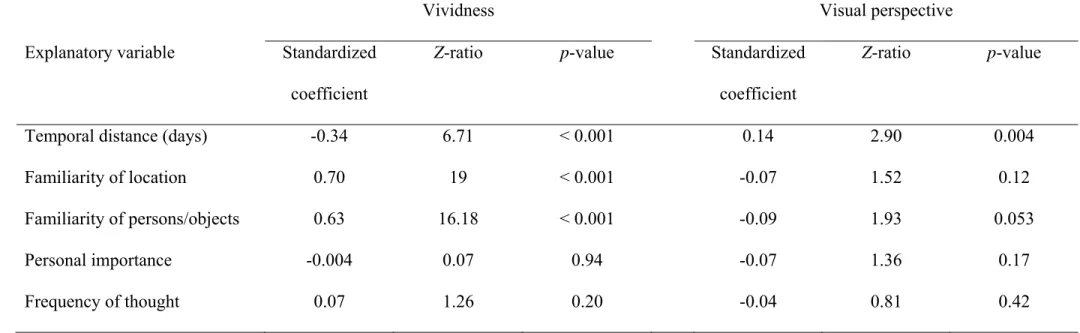
We then examined what properties of the imagined events predicted the vividness of episodic future thoughts. The overall mean for the vividness index was 4.45. The estimate of the between-participants variance was 0.198 (SE = 0.095) and the estimate of the within-participants variance was 1.728 (SE = 0.144); thus, 90% of the total variance was due to within-participants differences (i.e., variation among events). To investigate the relations between the vividness of episodic future thoughts and the different event properties of interest in this study, we fitted, for each dimension, a random intercept multilevel model that included this property as predictor variable and vividness as outcome variable. This was analogous to running a bivariate correlation but with multilevel data. The results are shown in Table 1. These analyses showed that vividness was negatively related to temporal distance (as estimated by the number of days from the present)2 and was positively related to location familiarity and familiarity of persons/objects. Personal importance and frequency of thought were not significantly related to vividness. For personal importance, a likelihood ratio (LR) test indicated that a random slope model fitted the data significantly better than the simpler random intercept model (LR = 7.59, 2 d.f., p = 0.02), meaning that the relationship between vividness and importance varied significantly across participants; the average relation
between the two variables across participants was not significant (standardized coefficient = -0.01, Z = 0.10, p = 0.92). For all other variables, a random slope model did not fit the data significantly better, meaning that the relations between vividness and these variables were similar across participants.
2
Note that this variable was highly right-skewed and thus was log-transformed (natural logarithm) for modeling purposes.
Next, we investigated the independent contribution of the different event properties that showed a significant bivariate association with vividness. The bivariate analyses indicated that the two variables that were most strongly related to vividness were the
familiarity of the imagined location and familiarity of imagined persons/objects. Both location familiarity and familiarity of persons/objects were significant predictors of vividness when they were entered simultaneously in a random intercept model (location familiarity:
standardized coefficient = 0.50, Z = 12.90, p < 0.001; familiarity of persons/objects:
standardized coefficient = 0.36, Z = 9.28, p < 0.001); together, these two variables accounted for 61% of the within-participants variance in vividness. Adding temporal distance to the model did not result in a significantly better fit (LR = 1.12, 1 d.f., p = 0.29; standardized coefficient = -0.04). Thus, although temporal distance did predict vividness, its effect appeared to be mediated by the familiarity of the imagined location and persons/objects.3
Next, we examined what event properties predicted the visual perspective participants adopted when imagining the future events (i.e., first-person versus third-person). The overall mean for the measure of visual perspective was 3.05. The estimate of the between-participants variance was 1.356 (SE = 0.307) and the estimate of the within-participants variance was 2.347 (SE = 0.196); thus, 63% of the total variance was due to within-participants differences (i.e., variation among events). Table 1 shows the bivariate relations (estimated by fitting a random intercept multilevel model) between visual perspective and each event property of interest in this study. The only significant predictor of visual perspective was temporal distance, showing that participants adopted a third-person (i.e., observer) perspective to a greater extent when imagining more distant future events. This effect was quite small,
3 Because the vividness index included two items assessing the clarity of the imagined location and clarity of imagined persons/objects, one could wonder whether this might explain why the familiarity of location and familiarity of persons/objects were significant predictors of vividness. To investigate this possibility, we re‐run the analyses with the clarity of location and clarity of persons/objects scales being removed from the vividness index. This yielded exactly the same pattern of results, indicating that the effects reported above are not simply driven by the inclusion of the clarity of location and clarity of persons/objects scales in the vividness index.
however, accounting for 3% of the within-participants variance in visual perspective. Previous studies suggest that visual perspective is related to vividness (for review, see Rice, 2010) and we indeed found that the degree to which the imagined events were visualized using a third-person perspective was inversely related to vividness (standardized coefficient = -0.12, Z = 2.59, p = 0.01); importantly, however, the effect of temporal distance remained significant after controlling for vividness (standardized coefficient = 0.11, Z = 2.13, p = 0.03). For all variables, a random slope model did not fit the data significantly better, meaning that the relations between visual perspective and these variables were similar across participants.
3.2. Predicting autonoetic consciousness
Our next goal was to investigate what variables predicted autonoetic consciousness—the feeling of being brought forward in time to pre-experience imagined future events. The two scales assessing the feeling of pre-experiencing the event and the sense of mentally traveling through time were strongly correlated with each other (the correlation between the two items at the within-participants level was .62) and were therefore averaged to form an index of autonoetic consciousness. The overall mean for this index was 3.80. The estimate of the between-participants variance was 0.750 (SE = 0.172) and the estimate of the within-participants variance was 1.376 (SE = 0.115); thus, 65% of the total variance was due to within-participants differences (i.e., variation among events).
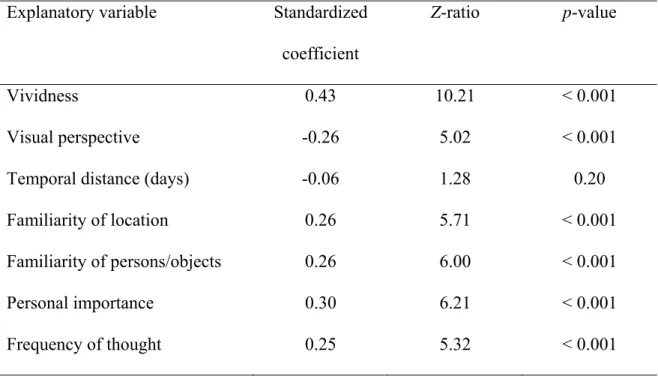
As can be seen from Table 2, autonoetic consciousness was significantly related to the sensory-perceptual qualities of episodic future thoughts and also to multiple event properties, such as the familiarity of constitutive elements, personal importance, and frequency of thought. We then examined the independent contribution of these variables to the prediction of autonoetic consciousness. We introduced vividness and visual perspective first in the
model (because autonoetic consciousness is theoretically conceptualized as a meta-cognitive judgment based on sensory-perceptual qualities), and then investigated whether some event properties were significant predictors of autonoetic consciousness after sensory-perceptual qualities had been taken into account. The simultaneous introduction of vividness and visual perspective into a random intercept model indicated that they independently contributed to autonoetic consciousness; ratings of autonoetic consciousness increased with increasing vividness (standardized coefficient = 0.41, Z = 9.88, p < 0.001) and decreased when
participants adopted an observer perspective (standardized coefficient = -0.20, Z = 4.24, p < 0.001). These two variables accounted for 29% of the within-participants variance in
autonoetic consciousness. Adding location familiarity and familiarity of persons/objects to the model did not result in a significantly better fit (LR = 1.84, 2 d.f., p = 0.40). On the other hand, adding personal importance after vividness and visual perspective had already been included in the model resulted in a significantly better fit (LR = 52.63, 2 d.f., p < 0.001), showing that autonoetic consciousness increased when the imagined future events were more related to personal goals (standardized coefficient = 0.30, Z = 5.86, p < 0.001).4 Adding temporal distance and frequency of thought to the model did not result in a significantly better fit (LR = 4.50, 2 d.f., p = 0.11). Overall, then, the best and most parsimonious model was to use vividness, visual perspective, and personal importance to predict autonoetic
consciousness. This model accounted for 42% of the within-participants variance in autonoetic consciousness.
3.3. Predicting feelings of subjective distance
4 For this variable, a random slope model fitted the data better than the simpler random intercept model, indicating that the relation between autonoetic consciousness and personal importance varied significantly across participants. We thus allowed the slope for the relationship between autonoetic consciousness and personal importance to vary randomly across participants.
Next, we investigated what variables predict the feeling of subjective distance to an imagined future event (i.e., the sense that the event is more or less close in time). The overall mean for the feeling of subjective distance was 3.53. The estimate of the between-participants variance was 0.267 (SE = 0.129) and the estimate of the within-participants variance was 2.343 (SE = 0.195); thus, 90% of the total variance was due to within-participants differences (i.e., variation among events).
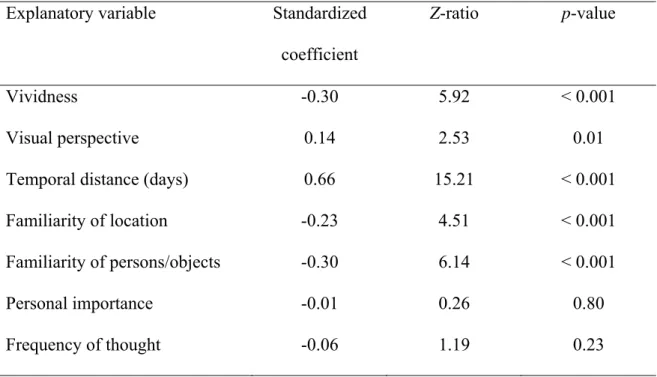
As can be seen from Table 3, the subjective sense of distance was significantly related to the sensory-perceptual qualities of episodic future thoughts, the objective temporal distance of the imagined events (i.e., the estimated number of days from the present), and the
familiarity of their constitutive elements. To investigate the independent contribution of these variables, we first introduced objective temporal distance in the model (which, unsurprisingly, was positively related to the feeling of subjective distance) and then examined whether other variables were significant predictors of subjective distance after the effect of objective distance had been taken into account. Vividness made a small but significant contribution to the prediction of the subjective sense of distance after objective distance had been included in the model (standardized coefficient = -0.12, Z =2.70, p = 0.007), showing that events that were imagined more vividly felt closer in time, independently of the estimated moment when the event will happen. On the other hand, the effects of visual perspective, familiarity of location, and familiarity of persons/objects were not significant after objective distance had been taken into account.
As shown in Table 3, the bivariate associations between subjective distance and personal importance and frequency of thought were not significant. Nevertheless, we decided to investigate further the possible effects of personal importance and frequency of thought because both variables were positively related to objective distance (personal importance: standardized coefficient = 0.26, Z = 5.16, p < 0.001; frequency of thought: standardized
coefficient = 0.16, Z = 3.12, p = 0.002), which was the strongest predictor of subjective distance. When adjusting for the effect of objective distance, we found that personal
importance made a significant contribution to subjective distance (standardized coefficient = -0.18, Z = 4, p < 0.001). This shows that, once the objective distance of the imagined events had been taken into account, events that were more related to personal goals felt closer in time. In a similar vein, we found that frequency of thought was significantly related to
subjective distance after the effect of objective distance had been controlled for; events which participants had thought about more often felt closer in time (standardized coefficient = -0.16,
Z = 3.71, p < 0.001). Adding personal importance and frequency of thought to a model that
already included vividness and objective distance resulted in a significantly better fit (LR = 16.73, 2 d.f., p < 0.001); however, only the coefficient for personal importance reached significance in this case (personal importance: standardized coefficient = -0.12, Z = 2.23, p = 0.03; frequency of thought: standardized coefficient = -0.08, Z =1.64, p = 0.10). Thus, the best and most parsimonious model for predicting the feeling of subjective distance to an imagined future event was to use objective distance, vividness, and personal importance. This model accounted for 48% of the within-participants variance in the sense of subjective distance.
3.4. Predicting perceived probability
Finally, we explored what phenomenological features and event properties predict the belief that the imagined event will actually happen in the future. The overall mean for the measure of perceived probability was 5.68. The estimate of the between-participants variance was 0.062 (SE = 0.071) and the estimate of the within-participants variance was 1.660 (SE = 0.139); thus, 96% of the total variance was due to within-participants differences (i.e., variation among events).
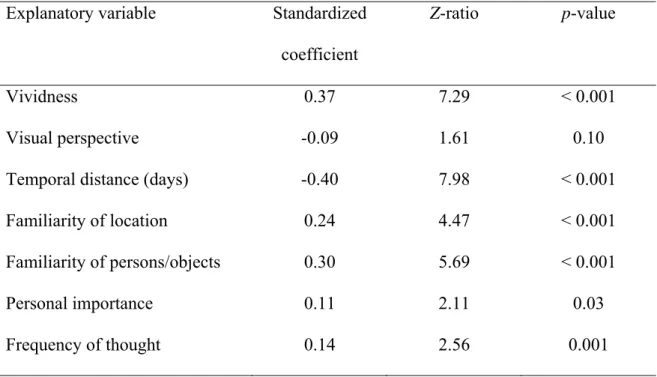
The bivariate analyses (see Table 4) indicated that perceived probability was associated with the vividness of the future thoughts and with multiple event properties (temporal distance, familiarity of imagined elements, personal importance, and frequency of thought). We then investigated the independent contribution of these variables. Previous research has shown that imagining a future event increases the subjective likelihood that the event will occur and this effect appears to be mediated by the ease with which the imagination process takes place (for review, see Koehler, 1991). Considering these findings, we first investigated whether the vividness of the imagined event and the frequency with which participants had previously envisioned this event made independent contribution to its subjective likelihood. When entering vividness and frequency of thought simultaneously in a random intercept model, we found that both variables were significant predictors of perceived probability (vividness: standardized coefficient = 0.37, Z = 7.32, p < 0.001; frequency of thought: standardized coefficient = 0.12, Z = 2.25, p = 0.02).
We then explored whether other event properties contributed to perceived probability after the effects of vividness and frequency of thought had been taken into account. Adding objective temporal distance to the model resulted in a significantly better fit (LR = 42.30, 1 d.f., p < 0.001; standardized coefficient = -0.35); the effects of vividness and frequency of thought both remained significant. The only other variable that made a significant
contribution to perceived probability after vividness, frequency of thought, and temporal distance had been included in the model was personal importance (LR = 17.11, 2 d.f., p < 0.001), showing that future events that were more strongly related to personal goals were perceived as more probable (standardized coefficient = 0.15, Z = 2.14, p = 0.03).5 After personal importance had been included in the model, the effects of vividness and temporal
5
A random slope model fitted the data better than the simpler random intercept model for this variable, so we allowed the slope for the relationship between perceived probability and personal importance to vary
distance remained significant, while the effect of frequency of thought was no longer significant (standardized coefficient = 0.09, Z = 1.53, p = .12). Overall, then, the best and most parsimonious model for predicting the belief that the imagined events will actually happen in the future was to use vividness, temporal distance, and personal importance. This model accounted for 32% of the within-participants variance in perceived probability.
4. Discussion
The present findings show that different aspects of the phenomenology of episodic future thoughts are predicted by (partly) distinct event properties. The vividness of episodic future thoughts depended largely on the familiarity of the constitutive elements of the imagined events, whereas the visual perspective adopted was unrelated to this factor and was, instead, predicted by the temporal distance of the events. The cognitive feelings that accompany episodic future thoughts depended in part on sensory-perceptual qualities (i.e., vividness and visual perspective), and were further modulated by the personal importance attributed to the envisioned events.
The two strongest predictors of the vividness of episodic future thoughts were the familiarity of the imagined location and familiarity of imagined persons and objects. Although temporal distance was related to vividness, this association was no longer significant when the familiarity of envisioned elements was taken into account. These results are consistent with recent findings showing that the influence of temporal distance on the vividness of episodic future thoughts is largely mediated by location familiarity (Arnold et al., 2011), and the present study further demonstrates that the familiarity of elements other than location (i.e., persons and objects) also plays a significant and independent role in shaping vividness. On the other hand, another important sensory-perceptual feature of episodic future thoughts—visual
perspective—was unrelated to the familiarity of envisioned elements, but depended instead on the estimated temporal distance of the events. This finding is in keeping with previous
observations that people tend to adopt a third-person (i.e., observer) perspective to a greater extent when representing more distant events, both in the past (Nigro & Neisser, 1983; Rice & Rubin, 2009) and in the future (D'Argembeau & Van der Linden, 2004). Of interest, the present results further showed that the effect of temporal distance did not simply result from a decrease in vividness with increasing distance. It should be noted, however, that the effect of temporal distance was quite small and could be due to factors other than time per se, for example a tendency to reflect more on the broader meaning of distant events (Libby & Eibach, 2011).
An important contribution of this study is to shed some light on the determinants of the cognitive feelings that accompany episodic future thinking (Conway, 2009; Tulving, 2005). In this regard, we found that cognitive feelings depended, in part, on the sensory-perceptual qualities of future thoughts. More specifically, the feeling of pre-experiencing an imagined event, its subjective closeness, and the belief that this event will happen in the future were all increased with the vividness of the future thought. In addition, the feeling of pre-experiencing was further increased when participants imagined the event from their own visual perspective. These results support the idea that cognitive feelings are meta-cognitive judgments that are based on the activity of sensory-perceptual systems (Rubin et al., 2003). Of particular interest, however, cognitive feelings did not depend solely on sensory-perceptual qualities; they were further modulated by the personal importance attributed to the envisioned events. When participants imagined future events that were more connected to their personal goals and values, they felt that they were pre-experiencing the situations to a greater extent and the events felt closer in time. Furthermore, the belief that the imagined events will actually materialize in the future also increased with the personal relevance of the
events. The essence of episodic future thinking—the subjective sense of pre-experiencing the future—might thus lie not only in the construction of a detailed representation of a complex event (Hassabis & Maguire, 2007), but also in the value attributed to this event with respect to one’s personal goals (D'Argembeau & Mathy, 2011; D'Argembeau, Stawarczyk, et al., 2010); a key difference between episodic future thoughts and the imagination of other fictitious experiences is that the former are more meaningfully related to personal goals, which might contribute to giving rise to the sensation of pre-experiencing one’s future. This subjective sense and other cognitive feelings may in turn play a significant role in goal pursuit, for example by increasing motivation and effort to attain imagined future states and by prompting the mental simulation of the steps needed to achieve these states (Karniol & Ross, 1996; Taylor, Pham, Rivkin, & Armor, 1998).
It is also noteworthy that for feelings of pre-experiencing and perceived probability, allowing the slope of personal importance to vary randomly across participants provided a better fit to the data. This result suggests that there are significant individual differences in the extent to which the personal importance of imagined events impact the cognitive feelings associated with episodic future thoughts. Interestingly, recent findings have shown that cognitive feelings such as the sense of pre-experiencing future events are modulated by individual differences in self-consciousness (more specifically, the tendency to think about oneself and to focus attention on one’s inner experience; D'Argembeau, Ortoleva, Jumentier, & Van der Linden, 2010). Although this remains to be investigated in detail, it is conceivable that the degree to which cognitive feelings are influenced by the personal relevance of
imagined events also depends, in part, on the level of self-consciousness of the individual. In short, this study shows that different aspects of the phenomenology of episodic future thoughts are shaped by distinct properties of imagined events. Sensory-perceptual qualities seem mainly grounded in the familiarity of the different elements constituting the
imagined scene, such as the envisioned location, persons and objects. Sensory-perceptual qualities in turn contribute to the sense of pre-experiencing the imagined event, to its subjective closeness, and to the belief that this event will actually materialize in the future. Importantly, these cognitive feelings are further modulated by the personal importance attributed to the envisioned events. The essence of episodic future thought—the sensation of mentally visiting one’s personal future—might thus lie, in part, in the relevance of imagined events with respect to personal goals.
Acknowledgements: The authors thank Aurélie Felice, Michalina Maj, and Silvia Menegale
for their help in data collection. Arnaud D’Argembeau is supported by the Fund for Scientific Research (FRS-FNRS), Belgium.
References
Arnold, K. M., McDermott, K. B., & Szpunar, K. K. (2011). Imagining the near and far future: The role of location familiarity. Memory & Cognition, 39, 954-967. Atance, C. M., & O'Neill, D. K. (2001). Episodic future thinking. Trends in Cognitive
Sciences, 5, 533-539.
Barsalou, L. W. (2008). Grounded cognition. Annual Review Psychology, 59, 617-645. Berntsen, D., & Bohn, A. (2010). Remembering and forecasting: The relation between
autobiographical memory and episodic future thinking. Memory & Cognition, 38, 265-278.
Boyer, P. (2008). Evolutionary economics of mental time travel? Trends in Cognitive
Sciences, 12, 219-224.
Brewer, W. F. (1996). What is recollective memory? In D. C. Rubin (Ed.), Remembering our
past: Studies in autobiographical memory (pp. 19-66). Cambridge, MA: Cambridge
University Press.
Conway, M. A. (2009). Autobiographical memory and consciousness. In W. P. Banks (Ed.),
Encyclopedia of consciousness (Vol. 1, pp. 77-82). Oxford: Academic Press.
D'Argembeau, A., & Mathy, A. (2011). Tracking the construction of episodic future thoughts.
Journal of Experimental Psychology: General, 140, 258-271.
D'Argembeau, A., Ortoleva, C., Jumentier, S., & Van der Linden, M. (2010). Component processes underlying future thinking. Memory & Cognition, 38, 809-819.
D’Argembeau, A., Renaud, O., & Van der Linden, M. (2011). Frequency, characteristics, and functions of future-oriented thoughts in daily life. Applied Cognitive Psychology, 25, 96-103.
D'Argembeau, A., Stawarczyk, D., Majerus, S., Collette, F., Van der Linden, M., Feyers, D., Maquet, P., & Salmon, E. (2010). The neural basis of personal goal processing when envisioning future events. Journal of Cognitive Neuroscience, 22, 1701-1713.
D'Argembeau, A., & Van der Linden, M. (2004). Phenomenal characteristics associated with projecting oneself back into the past and forward into the future: influence of valence and temporal distance. Consciousness and Cognition, 13, 844-858.
D'Argembeau, A., & Van der Linden, M. (2006). Individual differences in the
phenomenology of mental time travel: The effect of vivid visual imagery and emotion regulation strategies. Consciousness and Cognition, 15, 342-350.
Damasio, A. R. (1999). The feeling of what happens: Body and emotion in the making of
consciousness. New York: Harcourt Brace.
de Vito, S., Gamboz, N., & Brandimonte, M. A. (in press). What differentiates episodic future thinking from complex scene imagery. Consciousness and Cognition.
Goldstein, H. (2011). Multilevel statistical models (4th Ed.). Chichester, UK: Wiley.
Hassabis, D., Kumaran, D., Vann, S. D., & Maguire, E. A. (2007). Patients with hippocampal amnesia cannot imagine new experiences. Proceedings of the National Academy of
Sciences of the United States of America, 104, 1726-1731.
Hassabis, D., & Maguire, E. A. (2007). Deconstructing episodic memory with construction.
Trends in Cognitive Sciences, 11, 299-306.
Hox, J. J. (2010). Multilevel analysis: Techniques and applications (2nd
Ed.). New York:
Routledge.
Johnson, M. K., Foley, M. A., Suengas, A. G., & Raye, C. L. (1988). Phenomenal characteristics of memories for perceived and imagined autobiographical events.
Karniol, R., & Ross, M. (1996). The motivational impact of temporal focus: Thinking about the future and the past. Annual Review of Psychology, 47, 593-620.
Koehler, D. J. (1991). Explanation, imagination, and confidence in judgment. Psychological
Bulletin, 110, 499-519.
Libby, L. K., & Eibach, R. P. (2002). Looking back in time: self-concept change affects visual perspective in autobiographical memory. Journal of Personality and Social
Psychology, 82, 167-179.
Libby, L. K., & Eibach, R. P. (2011). Self-enhancement or self-coherence? Why people shift visual perspective in mental images of the personal past and future. Personality and
Social Psychology Bulletin, 37, 714-726.
Libby, L. K., Shaeffer, E. M., Eibach, R. P., & Slemmer, J. A. (2007). Picture yourself at the polls - Visual perspective in mental imagery affects self-perception and behavior.
Psychological Science, 18, 199-203.
Nigro, G., & Neisser, U. (1983). Point of view in personal memories. Cognitive Psychology,
15, 467-482.
Rasbash, J., Charlton, C., Browne, W. J., Healy, M., & Cameron, B. (2009). MLwiN Version 2.1. Centre for Multilevel Modelling, University of Bristol.
Rice, H. J. (2010). Seeing where we're at: A review of visual perspective and memory retrievel. In J. H. Mace (Ed.), The act of remembering: Toward an understanding of
how we recall the past (pp. 228-258). Chichester, UK: Wiley-Blackwell.
Rice, H. J., & Rubin, D. C. (2009). I can see it both ways: first- and third-person visual perspectives at retrieval. Consciousness and Cognition, 18, 877-890.
Ross, M., & Wilson, A. E. (2002). It feels like yesterday: Self-esteem, valence of personal past experiences, and judgments of subjective distance. Journal of Personality and
Rubin, D. C. (2006). The basic-systems model of episodic memory. Perspectives on
Psychological Science, 1, 277-311.
Rubin, D. C., Schrauf, R. W., & Greenberg, D. L. (2003). Belief and recollection of autobiographical memories. Memory & Cognition, 31, 887-901.
Schacter, D. L., & Addis, D. R. (2007). The cognitive neuroscience of constructive memory: remembering the past and imagining the future. Philosophical Transactions of the
Royal Society of London B: Biological Sciences, 362, 773-786.
Schacter, D. L., Addis, D. R., & Buckner, R. L. (2008). Episodic Simulation of Future Events: Concepts, Data, and Applications. Annals of the New York Academy of Sciences, 1124, 39-60.
Suddendorf, T., & Corballis, M. C. (2007). The evolution of foresight: What is mental time travel and is it unique to humans? Behavioral and Brain Sciences, 30, 299-351. Szpunar, K. K. (2010). Episodic future thought: An emerging concept. Perspectives on
Psychological Science, 5, 142-162.
Szpunar, K. K., & McDermott, K. B. (2008). Episodic future thought and its relation to remembering: Evidence from ratings of subjective experience. Consciousness and
Cognition, 17, 330-334.
Taylor, S. E., Pham, L. B., Rivkin, I. D., & Armor, D. A. (1998). Harnessing the imagination. Mental simulation, self-regulation, and coping. American Psychologist, 53, 429-439. Tulving, E. (1985). Memory and consciousness. Canadian Psychologist, 26, 1-12.
Tulving, E. (2005). Episodic memory and autonoesis: Uniquely human? In H. S. Terrace & J. Metcalfe (Eds.), The missing link in cognition: Origins of self-reflective consciousness (pp. 3-56). Oxford: Oxford University Press.
Wright, D. B. (1998). Modelling clustered data in autobiographical memory research: The multilevel approach. Applied Cognitive Psychology, 12, 339-357.
Table 1. Bivariate associations between the sensory-perceptual qualities of episodic future thoughts (vividness and visual perspective) and event properties
Vividness Visual perspective
Explanatory variable Standardized
coefficient
Z-ratio p-value Standardized
coefficient
Z-ratio p-value
Temporal distance (days) -0.34 6.71 < 0.001 0.14 2.90 0.004
Familiarity of location 0.70 19 < 0.001 -0.07 1.52 0.12
Familiarity of persons/objects 0.63 16.18 < 0.001 -0.09 1.93 0.053
Personal importance -0.004 0.07 0.94 -0.07 1.36 0.17
Table 2. Bivariate associations between autonoetic consciousness and other variables
Explanatory variable Standardized
coefficient
Z-ratio p-value
Vividness 0.43 10.21 < 0.001
Visual perspective -0.26 5.02 < 0.001
Temporal distance (days) -0.06 1.28 0.20
Familiarity of location 0.26 5.71 < 0.001
Familiarity of persons/objects 0.26 6.00 < 0.001
Personal importance 0.30 6.21 < 0.001
Frequency of thought 0.25 5.32 < 0.001
Table 3. Bivariate associations between subjective distance and other variables
Explanatory variable Standardized
coefficient
Z-ratio p-value
Vividness -0.30 5.92 < 0.001
Visual perspective 0.14 2.53 0.01
Temporal distance (days) 0.66 15.21 < 0.001
Familiarity of location -0.23 4.51 < 0.001 Familiarity of persons/objects -0.30 6.14 < 0.001 Personal importance -0.01 0.26 0.80 Frequency of thought -0.06 1.19 0.23
Table 4. Bivariate associations between perceived probability and other variables
Explanatory variable Standardized
coefficient
Z-ratio p-value
Vividness 0.37 7.29 < 0.001
Visual perspective -0.09 1.61 0.10
Temporal distance (days) -0.40 7.98 < 0.001
Familiarity of location 0.24 4.47 < 0.001
Familiarity of persons/objects 0.30 5.69 < 0.001
Personal importance 0.11 2.11 0.03